bonnet VOLKSWAGEN TIGUAN 2017 Owner´s Manual
[x] Cancel search | Manufacturer: VOLKSWAGEN, Model Year: 2017, Model line: TIGUAN, Model: VOLKSWAGEN TIGUAN 2017Pages: 341, PDF Size: 9.14 MB
Page 252 of 341
Wiper blades
Service position
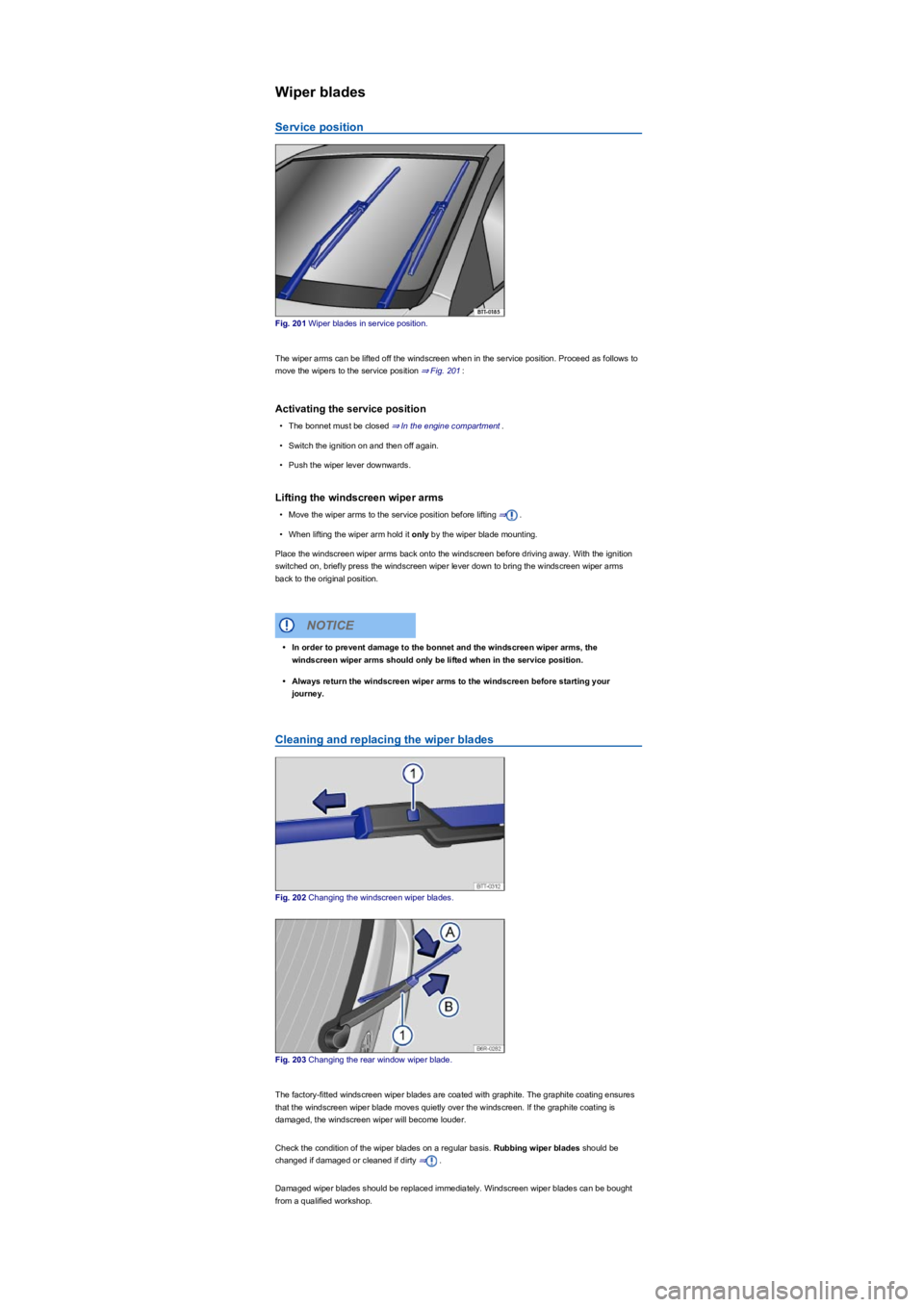
Fig. 201 Wiper blades in service position.
The wiper arms can be lifted off the windscreen when in the service position. Proceed as follows to
move the wipers to the service position ⇒ Fig. 201:
Activating the service position
•The bonnet must be closed ⇒ In the engine compartment.
•Switch the ignition on and then off again.
•Push the wiper lever downwards.
Lifting the windscreen wiper arms
•Move the wiper arms to the service position before lifting ⇒.
•When lifting the wiper arm hold it only by the wiper blade mounting.
Place the windscreen wiper arms back onto the windscreen before driving away. With the ignition
switched on, briefly press the windscreen wiper lever down to bring the windscreen wiper arms
back to the original position.
Cleaning and replacing the wiper blades
Fig. 202 Changing the windscreen wiper blades.
Fig. 203 Changing the rear window wiper blade.
The factory-fitted windscreen wiper blades are coated with graphite. The graphite coating ensures
that the windscreen wiper blade moves quietly over the windscreen. If the graphite coating is
damaged, the windscreen wiper will become louder.
Check the condition of the wiper blades on a regular basis. Rubbing wiper blades should be
changed if damaged or cleaned if dirty ⇒.
Damaged wiper blades should be replaced immediately. Windscreen wiper blades can be bought
from a qualified workshop.
•In order to prevent damage to the bonnet and the windscreen wiper arms, the
windscreen wiper arms should only be lifted when in the service position.
•Always return the windscreen wiper arms to the windscreen before starting your
journey.
NOTICE
Page 255 of 341
Check to see if a fuse has blown Changing fuses.
Follow the instructions to change the affected bulb . Always use identical bulbs with the
same designation. The designation is inscribed on the bulb, either on the glass part or on
the base.
Do not touch the glass part of the bulb with unprotected fingers. The heat of the bulb would
cause the fingerprint to evaporate and condense on the reflector. This will impair the
brightness of the headlight.
After changing the bulb, check to ensure that the bulb is working properly. If the bulb is not
working properly, the bulb may not have been inserted properly or may have failed again,
or the connector may have been inserted incorrectly.
Any time you change a bulb in the front of the vehicle, the headlight settings should be
checked by a qualified workshop.
Changing bulbs in the headlights (halogen bulbs)
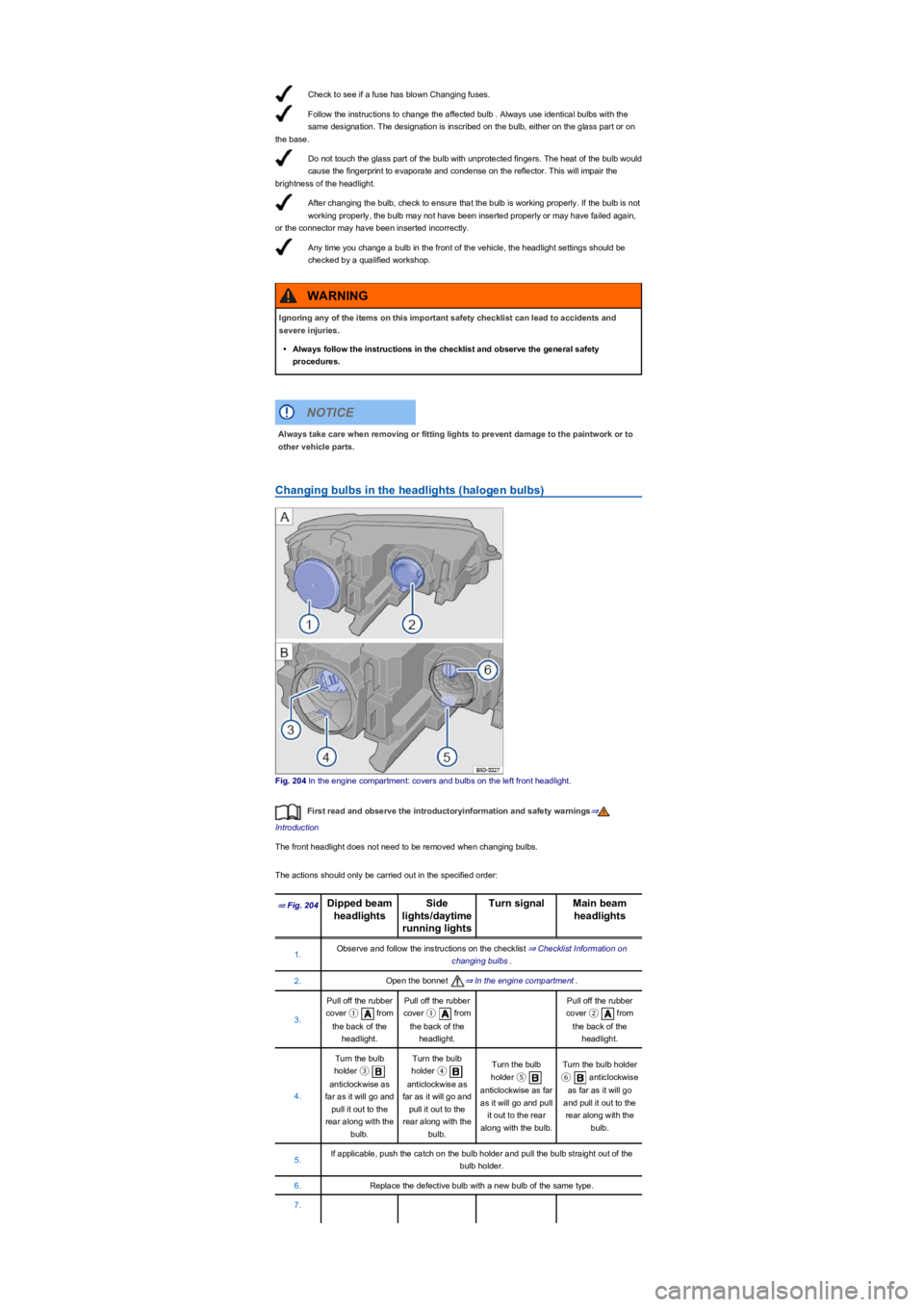
Fig. 204 In the engine compartment: covers and bulbs on the left front headlight.
First read and observe the introductoryinformation and safety warnings⇒
Introduction
The front headlight does not need to be removed when changing bulbs.
The actions should only be carried out in the specified order:
⇒ Fig. 204Dipped beam
headlights
Side
lights/daytime
running lights
Turn signalMain beam
headlights
1.Observe and follow the instructions on the checklist ⇒ Checklist Information on
changing bulbs.
2.Open the bonnet ⇒ In the engine compartment.
3.
Pull off the rubber
cover ① from
the back of the
headlight.
Pull off the rubber
cover ① from
the back of the
headlight.
Pull off the rubber
cover ② from
the back of the
headlight.
4.
Turn the bulb
holder ③
anticlockwise as
far as it will go and
pull it out to the
rear along with the
bulb.
Turn the bulb
holder ④
anticlockwise as
far as it will go and
pull it out to the
rear along with the
bulb.
Turn the bulb
holder ⑤
anticlockwise as far
as it will go and pull
it out to the rear
along with the bulb.
Turn the bulb holder
⑥ anticlockwise
as far as it will go
and pull it out to the
rear along with the
bulb.
5.If applicable, push the catch on the bulb holder and pull the bulb straight out of the
bulb holder.
6.Replace the defective bulb with a new bulb of the same type.
7.
Ignoring any of the items on this important safety checklist can lead to accidents and
severe injuries.
•Always follow the instructions in the checklist and observe the general safety
procedures.
WARNING
Always take care when removing or fitting lights to prevent damage to the paintwork or to
other vehicle parts.
NOTICE
Page 256 of 341
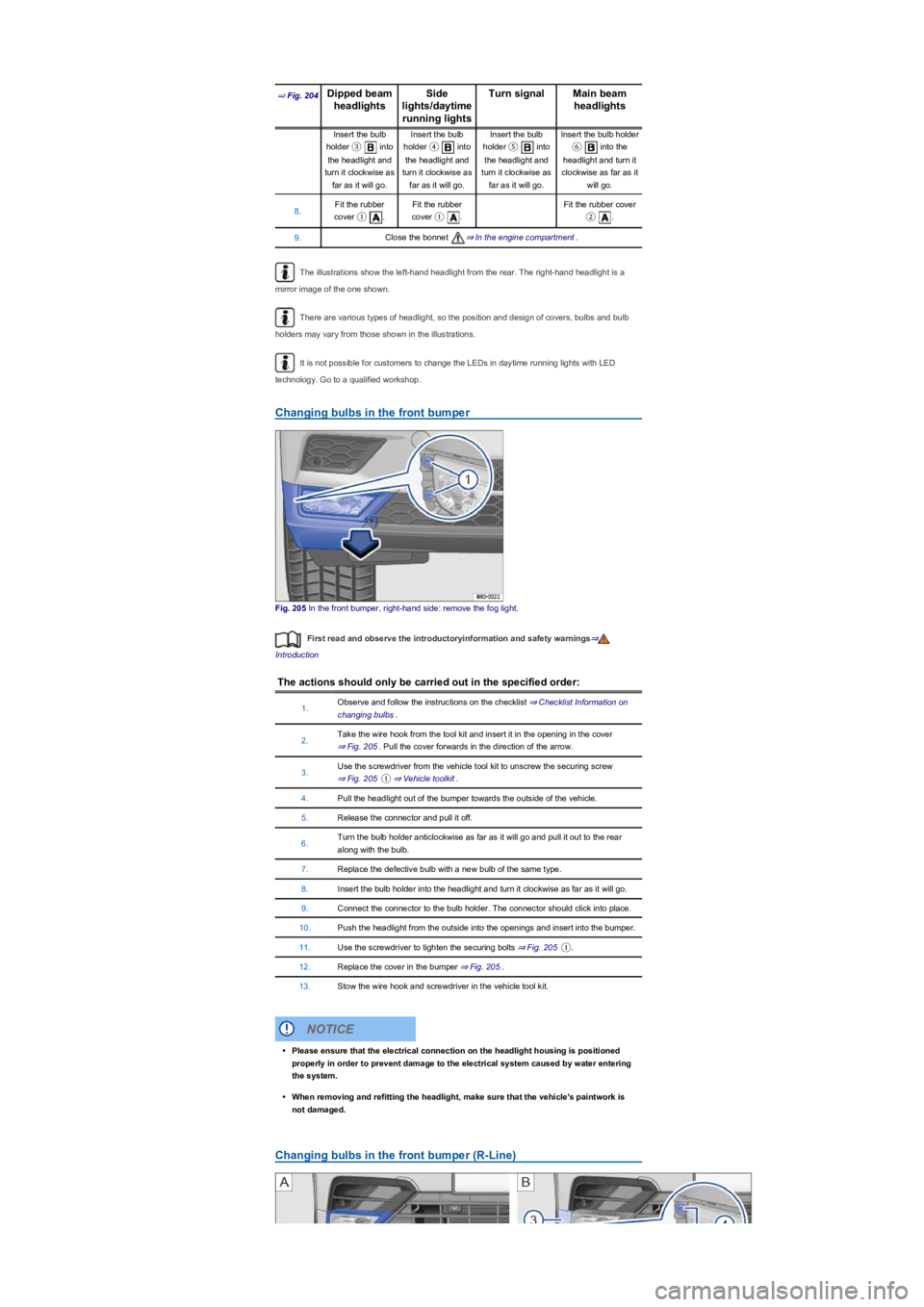
⇒ Fig. 204Dipped beam
headlights
Side
lights/daytime
running lights
Turn signalMain beam
headlights
Insert the bulb
holder ③ into
the headlight and
turn it clockwise as
far as it will go.
Insert the bulb
holder ④ into
the headlight and
turn it clockwise as
far as it will go.
Insert the bulb
holder ⑤ into
the headlight and
turn it clockwise as
far as it will go.
Insert the bulb holder
⑥ into the
headlight and turn it
clockwise as far as it
will go.
8.Fit the rubber
cover ①.
Fit the rubber
cover ①.
Fit the rubber cover
②.
9.Close the bonnet ⇒ In the engine compartment.
The illustrations show the left-hand headlight from the rear. The right-hand headlight is a
mirror image of the one shown.
There are various types of headlight, so the position and design of covers, bulbs and bulb
holders may vary from those shown in the illustrations.
It is not possible for customers to change the LEDs in daytime running lights with LED
technology. Go to a qualified workshop.
Changing bulbs in the front bumper
Fig. 205 In the front bumper, right-hand side: remove the fog light.
First read and observe the introductoryinformation and safety warnings⇒
Introduction
The actions should only be carried out in the specified order:
1.Observe and follow the instructions on the checklist ⇒ Checklist Information on
changing bulbs.
2.Take the wire hook from the tool kit and insert it in the opening in the cover
⇒ Fig. 205. Pull the cover forwards in the direction of the arrow.
3.Use the screwdriver from the vehicle tool kit to unscrew the securing screw
⇒ Fig. 205①⇒ Vehicle toolkit.
4.Pull the headlight out of the bumper towards the outside of the vehicle.
5.Release the connector and pull it off.
6.Turn the bulb holder anticlockwise as far as it will go and pull it out to the rear
along with the bulb.
7.Replace the defective bulb with a new bulb of the same type.
8.Insert the bulb holder into the headlight and turn it clockwise as far as it will go.
9.Connect the connector to the bulb holder. The connector should click into place.
10.Push the headlight from the outside into the openings and insert into the bumper.
11.Use the screwdriver to tighten the securing bolts ⇒ Fig. 205①.
12.Replace the cover in the bumper ⇒ Fig. 205.
13.Stow the wire hook and screwdriver in the vehicle tool kit.
Changing bulbs in the front bumper (R-Line)
•Please ensure that the electrical connection on the headlight housing is positioned
properly in order to prevent damage to the electrical system caused by water entering
the system.
•When removing and refitting the headlight, make sure that the vehicle's paintwork is
not damaged.
NOTICE
Page 260 of 341
•Push the retaining lugs ⇒ Fig. 208① upwards in the direction of the arrow whilst opening the
stowage compartment until the fuse carrier can be accessed.
•To install, press the stowage compartment into the mounts on the dash panel until it audibly
clicks into place on both sides and then close the compartment.
Right-hand drive: opening the fuse box in the dash panel
•Open the stowage compartment on the front passenger side and remove the contents if
necessary ⇒ Fig. 209.
•Slide the braking element ⇒ Fig. 209① downwards into the opening in the holder and pull it
out sideways.
•Push catches ⇒ Fig. 209② upwards in the direction of the arrow whilst opening the stowage
compartment further.
•To install: bring storage compartment into position. Insert the brake element in the holder
opening and push upwards until it audibly engages. Carefully push the stowage compartment
forwards beyond the resistance of the catches ⇒ Fig. 209②.
Fuses in the engine compartment
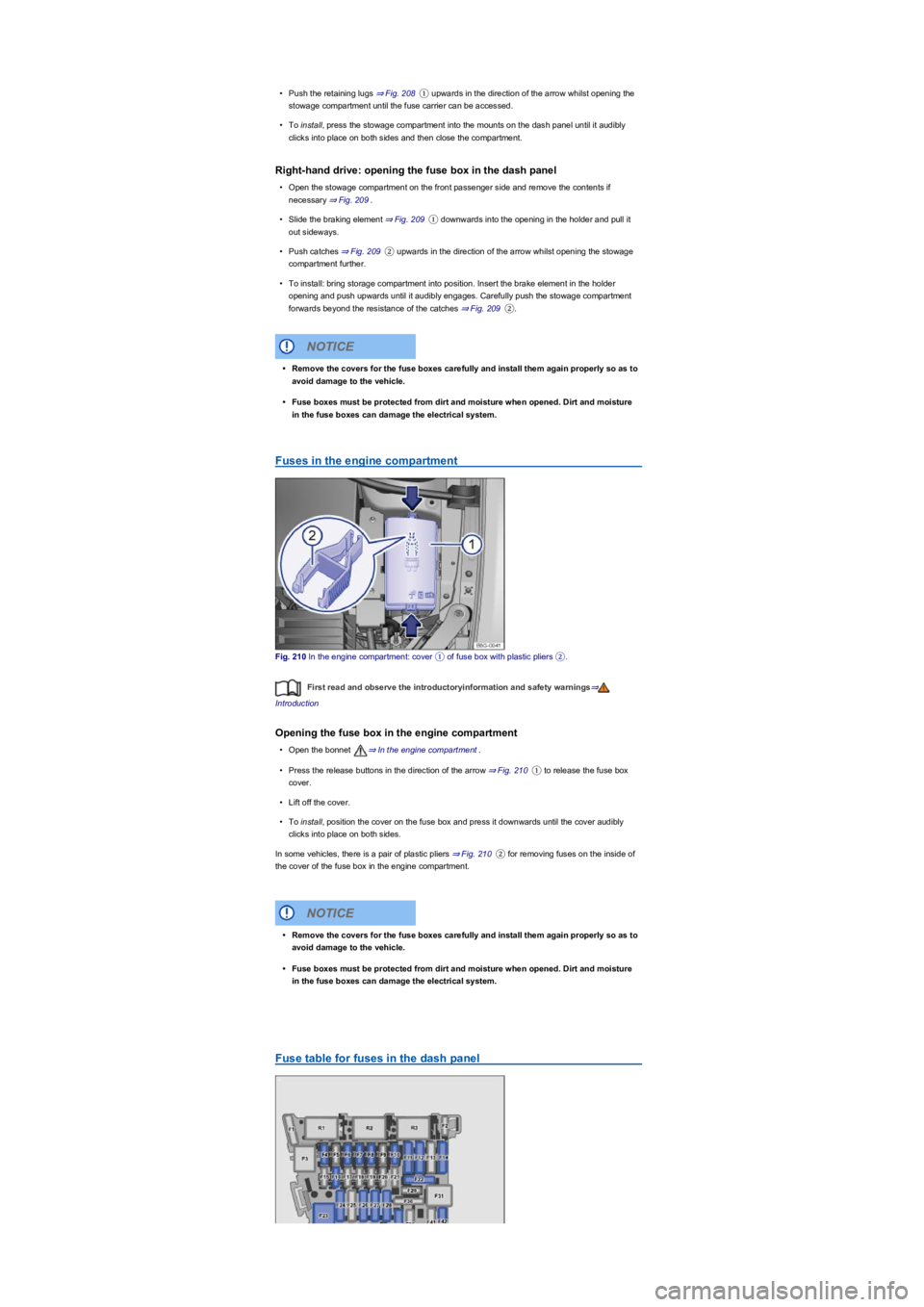
Fig. 210 In the engine compartment: cover ① of fuse box with plastic pliers ②.
First read and observe the introductoryinformation and safety warnings⇒
Introduction
Opening the fuse box in the engine compartment
•Open the bonnet ⇒ In the engine compartment.
•Press the release buttons in the direction of the arrow ⇒ Fig. 210① to release the fuse box
cover.
•Lift off the cover.
•To install, position the cover on the fuse box and press it downwards until the cover audibly
clicks into place on both sides.
In some vehicles, there is a pair of plastic pliers ⇒ Fig. 210② for removing fuses on the inside of
the cover of the fuse box in the engine compartment.
Fuse table for fuses in the dash panel
•Remove the covers for the fuse boxes carefully and install them again properly so as to
avoid damage to the vehicle.
•Fuse boxes must be protected from dirt and moisture when opened. Dirt and moisture
in the fuse boxes can damage the electrical system.
NOTICE
•Remove the covers for the fuse boxes carefully and install them again properly so as to
avoid damage to the vehicle.
•Fuse boxes must be protected from dirt and moisture when opened. Dirt and moisture
in the fuse boxes can damage the electrical system.
NOTICE
Page 272 of 341
Safety notes for working in the engine compartment
Always park the vehicle on a level and stable surface before carrying out any work in the engine
compartment.
The engine compartment of a motor vehicle is a hazardous area. You should only carry out work on
the engine, and in the engine compartment, if you know exactly how to perform the required tasks,
are aware of the general safety procedures and have access to the correct equipment, service
fluids and suitable tools. Failing to carry out work correctly can cause serious injuries ⇒. The
work should be carried out by a qualified workshop if you are uncertain. Volkswagen recommends
using a Volkswagen dealership for this purpose.
Unintentional vehicle movements during service work can cause serious injury.
•Never work underneath a vehicle if it is not secured against rolling away. If you are
working underneath the vehicle while the wheels are on the ground, the vehicle must
be on a level, the wheels chocked, and the vehicle key removed from the ignition lock
as required.
•If you have to work underneath the vehicle, use suitable stands to provide extra
support for the vehicle. The vehicle jack is not sufficient for this task and can fail,
which can lead to serious injuries.
•The start/stop system must have been deactivated.
WARNING
The engine compartment of any motor vehicle is a dangerous area. Serious injuries can be
sustained here.
•The utmost care and attention must be paid when carrying out any work and you must
follow the general safety rules. Never take any risks.
•Never do any work on the engine or in the engine compartment unless you know
exactly how to carry it out. If you are uncertain of what to do, the work should be
carried out by a qualified workshop. Serious injuries can result from work that has not
been carried out properly.
•Never open the bonnet if you see steam or coolant escaping from the engine
compartment. Hot steam or hot coolant can cause serious burns. Always wait until you
can no longer see or hear steam or coolant coming from the engine compartment.
•Always allow the engine to cool down before opening the bonnet.
•Hot parts of the engine or exhaust system can burn the skin.
•Observe the following points before opening the bonnet once the engine has cooled
down:
- Switch on the electronic parking brake and move the selector lever to position P
or move the gear lever to the neutral position.
- Switch off the ignition and remove the vehicle key from the ignition lock.
- Always keep children away from the engine compartment and never leave the
vehicle unattended.
•The cooling system is under pressure when the engine is hot. Never open the cap of
the coolant expansion tank when the engine is hot. Coolant may spray out and cause
serious burns and other injuries.
- Slowly and carefully turn the cap on the coolant expansion tank anticlockwise
while exerting gentle downward pressure on the cap.
- Always protect the face, hands and arms from hot coolant or steam with a large,
thick cloth.
•When refilling, do not spill any service fluids on engine components or on the exhaust
system. The spilt service fluids can start a fire.
WARNING
High voltages in the electrical system can cause electric shocks, burns, serious injuries
and death!
•Never short circuit the electric system. The 12-volt battery could explode.
•Please note the following guidelines to help reduce the risk of an electric shock and
serious injuries while the engine is running or being started:
- Never touch the electrical wiring of the ignition system.
- Never touch the electrical wiring and connections of gas discharge bulbs.
WARNING
Page 274 of 341
Allow the engine to cool sufficiently.
Children and other people should be kept well away from the engine compartment.
Ensure that the vehicle cannot roll away unexpectedly.
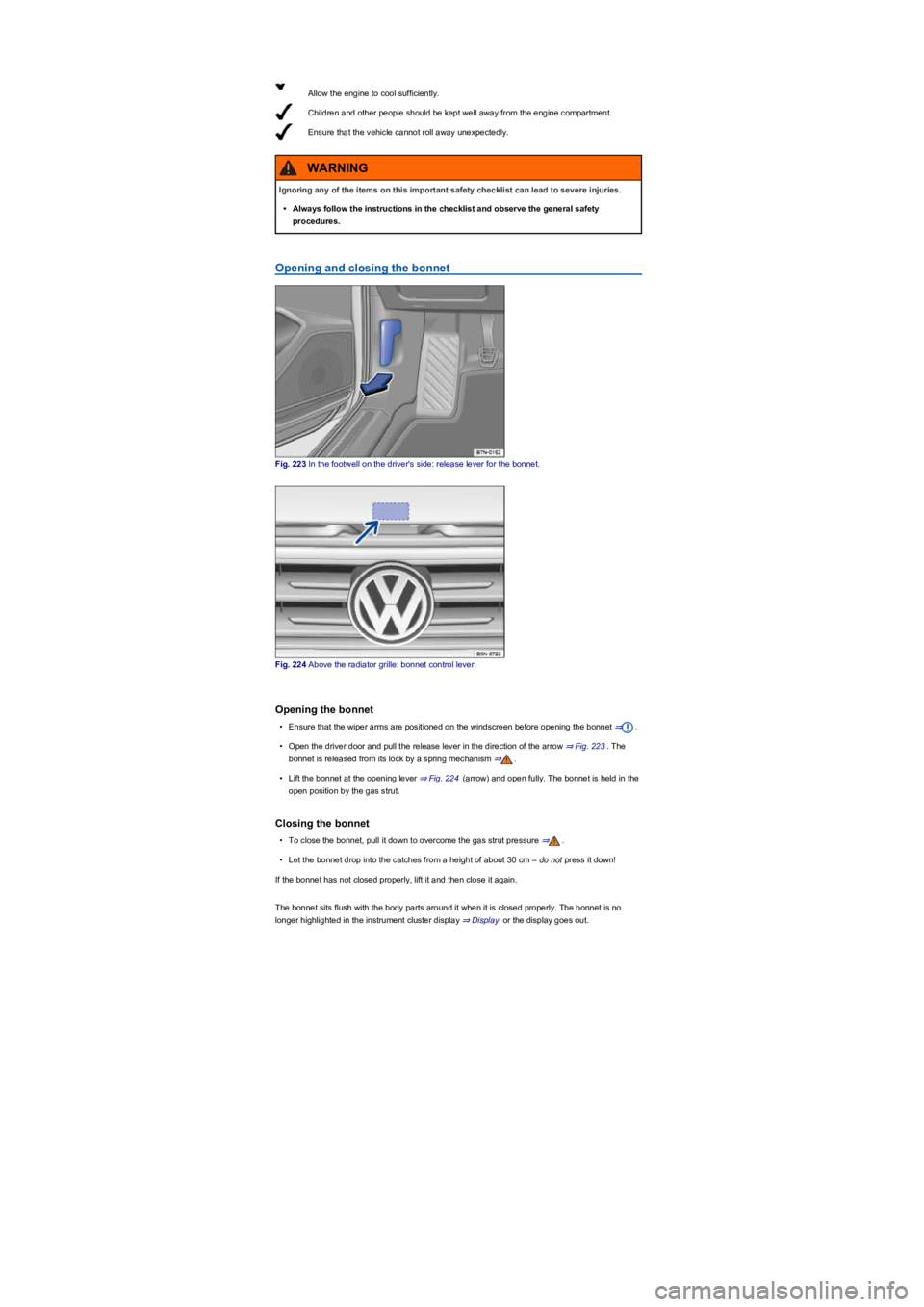
Opening and closing the bonnet
Fig. 223 In the footwell on the driver's side: release lever for the bonnet.
Fig. 224 Above the radiator grille: bonnet control lever.
Opening the bonnet
•Ensure that the wiper arms are positioned on the windscreen before opening the bonnet ⇒.
•Open the driver door and pull the release lever in the direction of the arrow ⇒ Fig. 223. The
bonnet is released from its lock by a spring mechanism ⇒.
•Lift the bonnet at the opening lever ⇒ Fig. 224 (arrow) and open fully. The bonnet is held in the
open position by the gas strut.
Closing the bonnet
•To close the bonnet, pull it down to overcome the gas strut pressure ⇒.
•Let the bonnet drop into the catches from a height of about 30 cm – do not press it down!
If the bonnet has not closed properly, lift it and then close it again.
The bonnet sits flush with the body parts around it when it is closed properly. The bonnet is no
longer highlighted in the instrument cluster display ⇒ Display or the display goes out.
Ignoring any of the items on this important safety checklist can lead to severe injuries.
•Always follow the instructions in the checklist and observe the general safety
procedures.
WARNING
Page 275 of 341
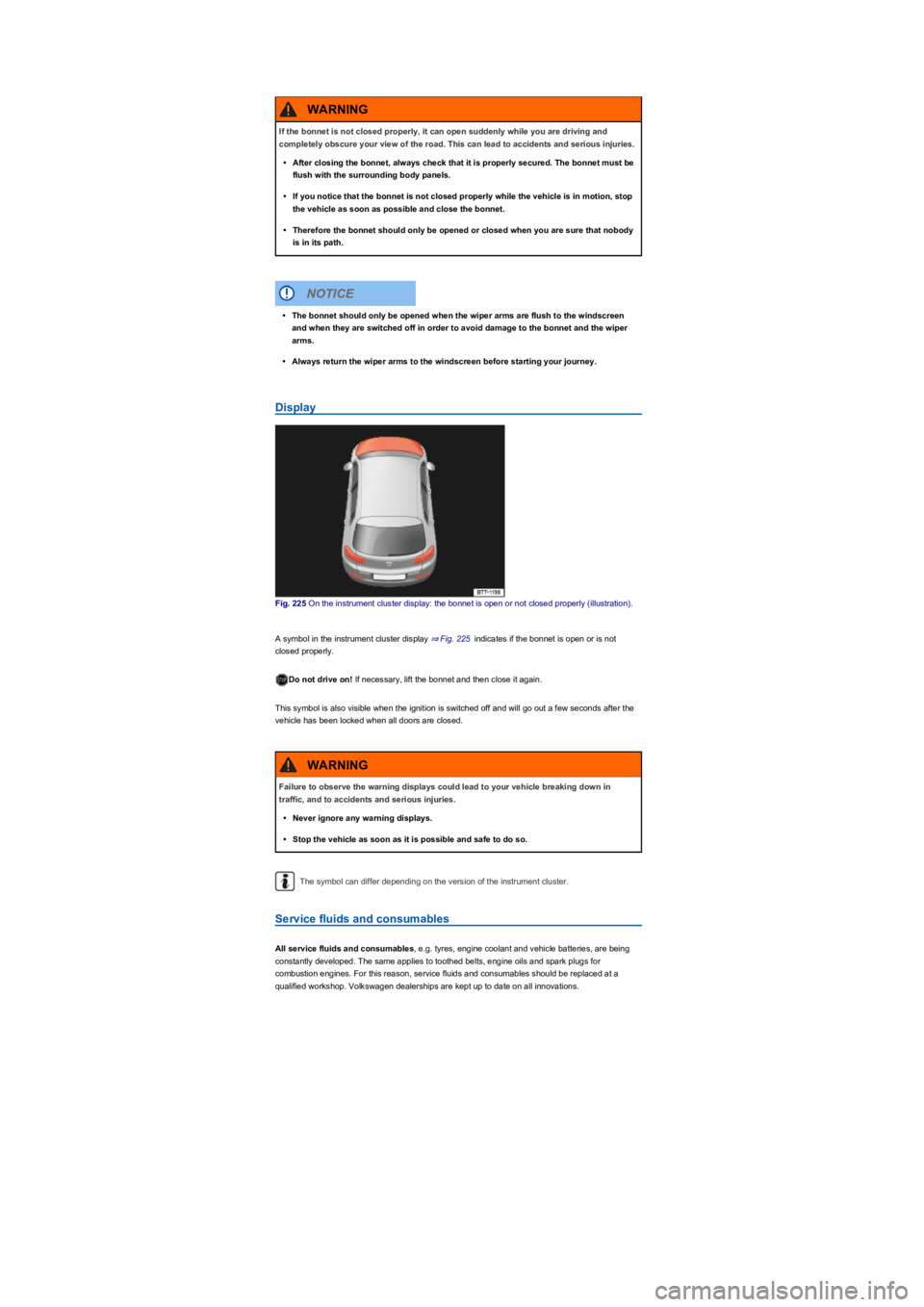
Display
Fig. 225 On the instrument cluster display: the bonnet is open or not closed properly (illustration).
A symbol in the instrument cluster display ⇒ Fig. 225 indicates if the bonnet is open or is not
closed properly.
Do not drive on! If necessary, lift the bonnet and then close it again.
This symbol is also visible when the ignition is switched off and will go out a few seconds after the
vehicle has been locked when all doors are closed.
The symbol can differ depending on the version of the instrument cluster.
Service fluids and consumables
All service fluids and consumables, e.g. tyres, engine coolant and vehicle batteries, are being
constantly developed. The same applies to toothed belts, engine oils and spark plugs for
combustion engines. For this reason, service fluids and consumables should be replaced at a
qualified workshop. Volkswagen dealerships are kept up to date on all innovations.
If the bonnet is not closed properly, it can open suddenly while you are driving and
completely obscure your view of the road. This can lead to accidents and serious injuries.
•After closing the bonnet, always check that it is properly secured. The bonnet must be
flush with the surrounding body panels.
•If you notice that the bonnet is not closed properly while the vehicle is in motion, stop
the vehicle as soon as possible and close the bonnet.
•Therefore the bonnet should only be opened or closed when you are sure that nobody
is in its path.
WARNING
•The bonnet should only be opened when the wiper arms are flush to the windscreen
and when they are switched off in order to avoid damage to the bonnet and the wiper
arms.
•Always return the wiper arms to the windscreen before starting your journey.
NOTICE
Failure to observe the warning displays could lead to your vehicle breaking down in
traffic, and to accidents and serious injuries.
•Never ignore any warning displays.
•Stop the vehicle as soon as it is possible and safe to do so.
WARNING
Page 276 of 341
Leaking service fluids can pollute the environment. Spilt service fluids must be collected in
suitable containers and disposed of properly and with respect for the environment.
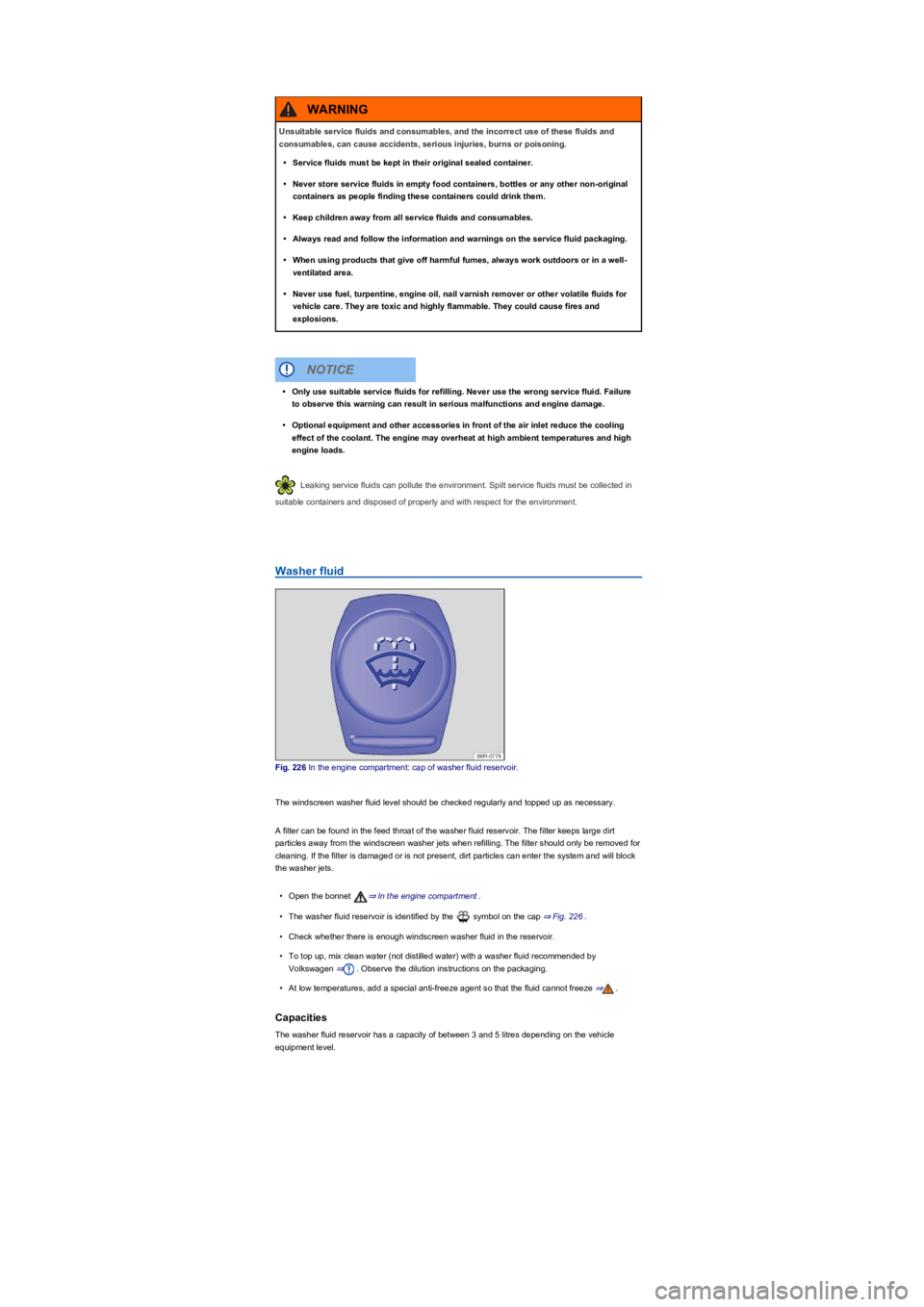
Washer fluid
Fig. 226 In the engine compartment: cap of washer fluid reservoir.
The windscreen washer fluid level should be checked regularly and topped up as necessary.
A filter can be found in the feed throat of the washer fluid reservoir. The filter keeps large dirt
particles away from the windscreen washer jets when refilling. The filter should only be removed for
cleaning. If the filter is damaged or is not present, dirt particles can enter the system and will block
the washer jets.
•Open the bonnet ⇒ In the engine compartment.
•The washer fluid reservoir is identified by the symbol on the cap ⇒ Fig. 226.
•Check whether there is enough windscreen washer fluid in the reservoir.
•To top up, mix clean water (not distilled water) with a washer fluid recommended by
Volkswagen ⇒. Observe the dilution instructions on the packaging.
•At low temperatures, add a special anti-freeze agent so that the fluid cannot freeze ⇒.
Capacities
The washer fluid reservoir has a capacity of between 3 and 5 litres depending on the vehicle
equipment level.
Unsuitable service fluids and consumables, and the incorrect use of these fluids and
consumables, can cause accidents, serious injuries, burns or poisoning.
•Service fluids must be kept in their original sealed container.
•Never store service fluids in empty food containers, bottles or any other non-original
containers as people finding these containers could drink them.
•Keep children away from all service fluids and consumables.
•Always read and follow the information and warnings on the service fluid packaging.
•When using products that give off harmful fumes, always work outdoors or in a well-
ventilated area.
•Never use fuel, turpentine, engine oil, nail varnish remover or other volatile fluids for
vehicle care. They are toxic and highly flammable. They could cause fires and
explosions.
WARNING
•Only use suitable service fluids for refilling. Never use the wrong service fluid. Failure
to observe this warning can result in serious malfunctions and engine damage.
•Optional equipment and other accessories in front of the air inlet reduce the cooling
effect of the coolant. The engine may overheat at high ambient temperatures and high
engine loads.
NOTICE
Page 280 of 341
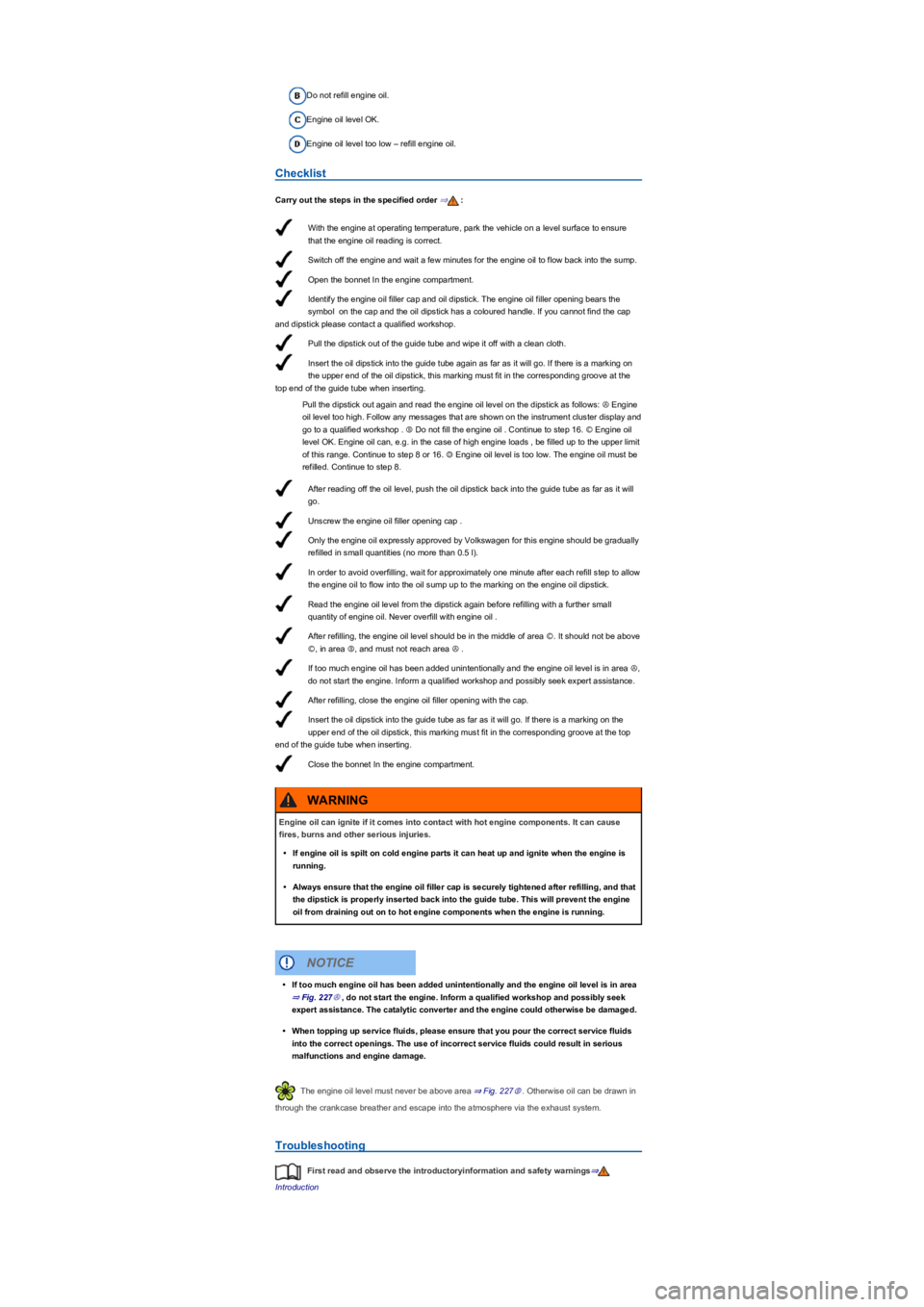
With the engine at operating temperature, park the vehicle on a level surface to ensure
that the engine oil reading is correct.
Switch off the engine and wait a few minutes for the engine oil to flow back into the sump.
Open the bonnet In the engine compartment.
Identify the engine oil filler cap and oil dipstick. The engine oil filler opening bears the
symbol on the cap and the oil dipstick has a coloured handle. If you cannot find the cap
and dipstick please contact a qualified workshop.
Pull the dipstick out of the guide tube and wipe it off with a clean cloth.
Insert the oil dipstick into the guide tube again as far as it will go. If there is a marking on
the upper end of the oil dipstick, this marking must fit in the corresponding groove at the
top end of the guide tube when inserting.
After reading off the oil level, push the oil dipstick back into the guide tube as far as it will
go.
Unscrew the engine oil filler opening cap .
Only the engine oil expressly approved by Volkswagen for this engine should be gradually
refilled in small quantities (no more than 0.5 l).
In order to avoid overfilling, wait for approximately one minute after each refill step to allow
the engine oil to flow into the oil sump up to the marking on the engine oil dipstick.
Read the engine oil level from the dipstick again before refilling with a further small
quantity of engine oil. Never overfill with engine oil .
After refilling, the engine oil level should be in the middle of area Ⓒ. It should not be above
Ⓒ, in area Ⓑ, and must not reach area Ⓐ .
If too much engine oil has been added unintentionally and the engine oil level is in area Ⓐ,
do not start the engine. Inform a qualified workshop and possibly seek expert assistance.
After refilling, close the engine oil filler opening with the cap.
Insert the oil dipstick into the guide tube as far as it will go. If there is a marking on the
upper end of the oil dipstick, this marking must fit in the corresponding groove at the top
end of the guide tube when inserting.
Close the bonnet In the engine compartment.
Do not refill engine oil.
Engine oil level OK.
Engine oil level too low – refill engine oil.
Checklist
Carry out the steps in the specified order ⇒:
Pull the dipstick out again and read the engine oil level on the dipstick as follows: Ⓐ Engine
oil level too high. Follow any messages that are shown on the instrument cluster display and
go to a qualified workshop . Ⓑ Do not fill the engine oil . Continue to step 16. Ⓒ Engine oil
level OK. Engine oil can, e.g. in the case of high engine loads , be filled up to the upper limit
of this range. Continue to step 8 or 16. Ⓓ Engine oil level is too low. The engine oil must be
refilled. Continue to step 8.
The engine oil level must never be above area ⇒ Fig. 227Ⓑ. Otherwise oil can be drawn in
through the crankcase breather and escape into the atmosphere via the exhaust system.
Troubleshooting
First read and observe the introductoryinformation and safety warnings⇒
Introduction
Engine oil can ignite if it comes into contact with hot engine components. It can cause
fires, burns and other serious injuries.
•If engine oil is spilt on cold engine parts it can heat up and ignite when the engine is
running.
•Always ensure that the engine oil filler cap is securely tightened after refilling, and that
the dipstick is properly inserted back into the guide tube. This will prevent the engine
oil from draining out on to hot engine components when the engine is running.
WARNING
•If too much engine oil has been added unintentionally and the engine oil level is in area
⇒ Fig. 227Ⓐ, do not start the engine. Inform a qualified workshop and possibly seek
expert assistance. The catalytic converter and the engine could otherwise be damaged.
•When topping up service fluids, please ensure that you pour the correct service fluids
into the correct openings. The use of incorrect service fluids could result in serious
malfunctions and engine damage.
NOTICE
Page 282 of 341
Coolant and coolant additives can pollute the environment. Spilt service fluids must be
collected then disposed of properly and in an environmentally responsible way.
Checking the coolant level and refilling coolant
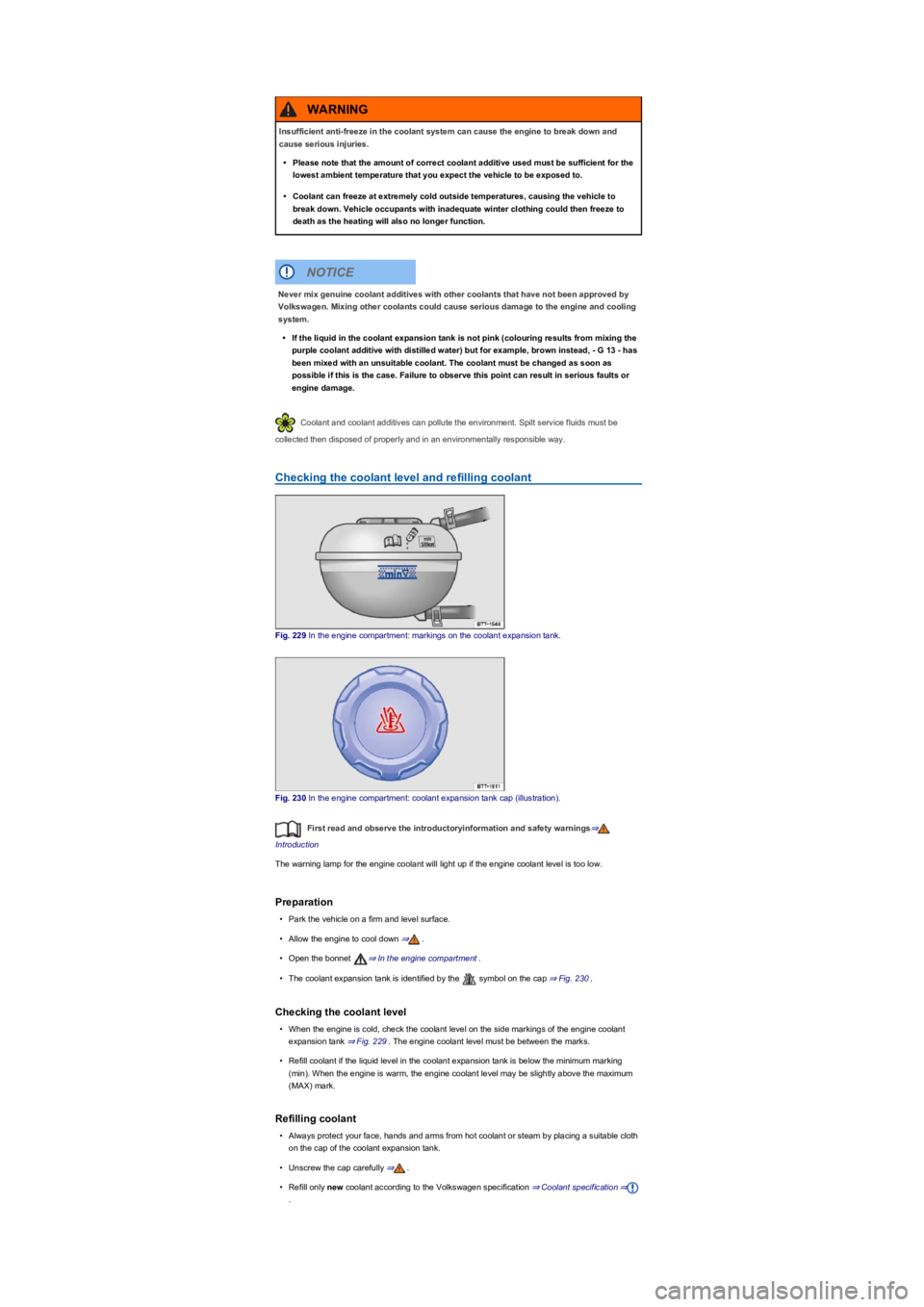
Fig. 229 In the engine compartment: markings on the coolant expansion tank.
Fig. 230 In the engine compartment: coolant expansion tank cap (illustration).
First read and observe the introductoryinformation and safety warnings⇒
Introduction
The warning lamp for the engine coolant will light up if the engine coolant level is too low.
Preparation
•Park the vehicle on a firm and level surface.
•Allow the engine to cool down ⇒.
•Open the bonnet ⇒ In the engine compartment.
•The coolant expansion tank is identified by the symbol on the cap ⇒ Fig. 230.
Checking the coolant level
•When the engine is cold, check the coolant level on the side markings of the engine coolant
expansion tank ⇒ Fig. 229. The engine coolant level must be between the marks.
•Refill coolant if the liquid level in the coolant expansion tank is below the minimum marking
(min). When the engine is warm, the engine coolant level may be slightly above the maximum
(MAX) mark.
Refilling coolant
•Always protect your face, hands and arms from hot coolant or steam by placing a suitable cloth
on the cap of the coolant expansion tank.
•Unscrew the cap carefully ⇒.
•Refill only new coolant according to the Volkswagen specification ⇒ Coolant specification⇒
.
Insufficient anti-freeze in the coolant system can cause the engine to break down and
cause serious injuries.
•Please note that the amount of correct coolant additive used must be sufficient for the
lowest ambient temperature that you expect the vehicle to be exposed to.
•Coolant can freeze at extremely cold outside temperatures, causing the vehicle to
break down. Vehicle occupants with inadequate winter clothing could then freeze to
death as the heating will also no longer function.
WARNING
Never mix genuine coolant additives with other coolants that have not been approved by
Volkswagen. Mixing other coolants could cause serious damage to the engine and cooling
system.
•If the liquid in the coolant expansion tank is not pink (colouring results from mixing the
purple coolant additive with distilled water) but for example, brown instead, - G 13 - has
been mixed with an unsuitable coolant. The coolant must be changed as soon as
possible if this is the case. Failure to observe this point can result in serious faults or
engine damage.
NOTICE