fuel consumption VOLKSWAGEN TIGUAN 2017 Owner´s Manual
[x] Cancel search | Manufacturer: VOLKSWAGEN, Model Year: 2017, Model line: TIGUAN, Model: VOLKSWAGEN TIGUAN 2017Pages: 341, PDF Size: 9.14 MB
Page 153 of 341
Steering
Information on steering
The steering should be locked every time you leave the vehicle to make it more difficult for the
vehicle to be stolen.
Steering
The power steering is not hydraulic. It is an electromechanical system. The advantage of this
steering system is that no hydraulic hoses, hydraulic oil, pumps, filter or other parts are required.
The electromechanical system reduces fuel consumption. A hydraulic system requires constant oil
pressure in the system, whereas an electromechanical steering system only needs an energy
supply while steering.
In vehicles with driving profile selection, the selected driving profile can affect the behaviour of the
power steering ⇒ Driving profile selection and 4MOTION Active Control.
Electronic steering column lock in vehicles with starter button
The steering column will be locked if the driver door is opened and the ignition is switched off. For
this, the vehicle should be stationary and, if necessary, the gear selector lever should be in position
P.
If the ignition is not switched off until after the driver door is opened, the electronic steering column
will only be locked when the vehicle is locked using the vehicle key or the sensor in the door
handle.
Mechanical steering column lock (steering lock) in vehicles with an
ignition lock
The steering column is locked if the vehicle key is removed from the ignition lock when the vehicle
is stationary. Turn the steering wheel slightly until the steering lock clicks into place.
Insert the vehicle key into the ignition lock to unlock the steering lock. Turn the steering wheel
slightly to take the load off the steering lock mechanism. Hold the steering wheel in this position and
turn the ignition on.
Electromechanical steering
The power steering provided by the electromechanical steering system automatically adjusts to the
vehicle speed, steering wheel torque and steering wheel angle. The electromechanical steering
only functions when the engine is running.
You will need considerably more strength than normal to steer the vehicle if the power steering is
reduced or has failed completely.
Counter steering assistance
Counter steering assistance provides the driver with power steering in critical driving situations.
Additional steering power helps the driver when counter steering ⇒.
The intelligent Hill Descent Control technology cannot overcome the laws of physics, and
functions only within the limits of the system. Never allow the extra convenience afforded
by pull-away assist systems to tempt you into taking any risks when driving.
•Unintentional vehicle movements can cause serious injury.
•The Hill Descent Control cannot replace the full concentration of the driver.
•Always adapt your speed and driving style to suit visibility, weather, road and traffic
conditions.
•A Hill Descent Control System may not be able to always hold the vehicle on uphill
gradients or brake it sufficiently on all slopes going downhill (e.g. if the ground is
slippery or icy).
WARNING
Always be prepared to brake the vehicle. Accidents and injuries could occur if this is not
ensured.
•The Hill Descent Control system is only a support function and may not be able to
brake the vehicle sufficiently in all situations when driving downhill.
•The vehicle may accelerate despite the Hill Descent Control system.
WARNING
Page 161 of 341
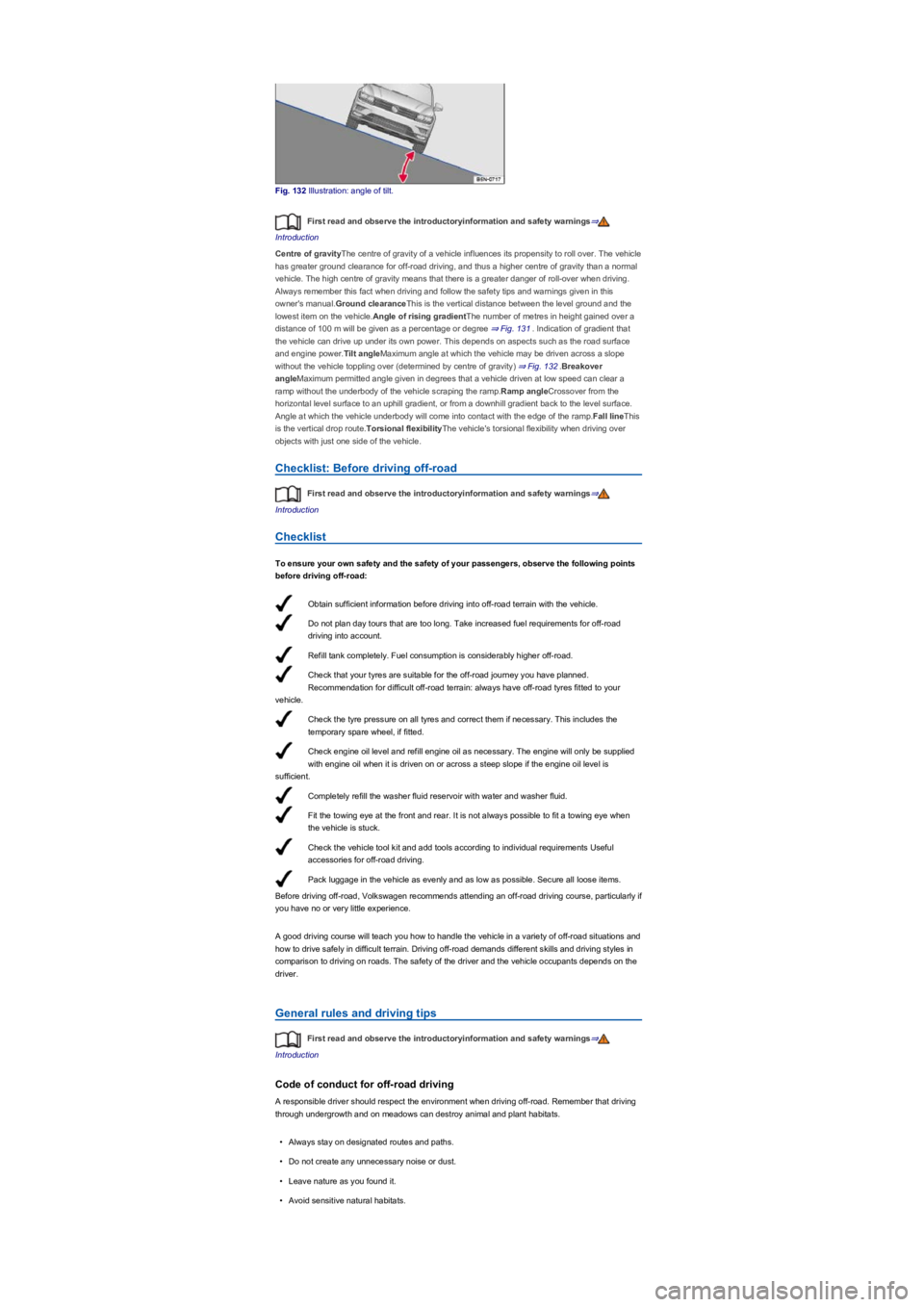
Obtain sufficient information before driving into off-road terrain with the vehicle.
Do not plan day tours that are too long. Take increased fuel requirements for off-road
driving into account.
Refill tank completely. Fuel consumption is considerably higher off-road.
Check that your tyres are suitable for the off-road journey you have planned.
Recommendation for difficult off-road terrain: always have off-road tyres fitted to your
vehicle.
Check the tyre pressure on all tyres and correct them if necessary. This includes the
temporary spare wheel, if fitted.
Check engine oil level and refill engine oil as necessary. The engine will only be supplied
with engine oil when it is driven on or across a steep slope if the engine oil level is
sufficient.
Completely refill the washer fluid reservoir with water and washer fluid.
Fit the towing eye at the front and rear. It is not always possible to fit a towing eye when
the vehicle is stuck.
Check the vehicle tool kit and add tools according to individual requirements Useful
accessories for off-road driving.
Pack luggage in the vehicle as evenly and as low as possible. Secure all loose items.
Fig. 132 Illustration: angle of tilt.
First read and observe the introductoryinformation and safety warnings⇒
Introduction
Centre of gravityThe centre of gravity of a vehicle influences its propensity to roll over. The vehicle
has greater ground clearance for off-road driving, and thus a higher centre of gravity than a normal
vehicle. The high centre of gravity means that there is a greater danger of roll-over when driving.
Always remember this fact when driving and follow the safety tips and warnings given in this
owner's manual.Ground clearanceThis is the vertical distance between the level ground and the
lowest item on the vehicle.Angle of rising gradientThe number of metres in height gained over a
distance of 100 m will be given as a percentage or degree ⇒ Fig. 131. Indication of gradient that
the vehicle can drive up under its own power. This depends on aspects such as the road surface
and engine power.Tilt angleMaximum angle at which the vehicle may be driven across a slope
without the vehicle toppling over (determined by centre of gravity) ⇒ Fig. 132.Breakover
angleMaximum permitted angle given in degrees that a vehicle driven at low speed can clear a
ramp without the underbody of the vehicle scraping the ramp.Ramp angleCrossover from the
horizontal level surface to an uphill gradient, or from a downhill gradient back to the level surface.
Angle at which the vehicle underbody will come into contact with the edge of the ramp.Fall lineThis
is the vertical drop route.Torsional flexibilityThe vehicle's torsional flexibility when driving over
objects with just one side of the vehicle.
Checklist: Before driving off-road
First read and observe the introductoryinformation and safety warnings⇒
Introduction
Checklist
To ensure your own safety and the safety of your passengers, observe the following points
before driving off-road:
Before driving off-road, Volkswagen recommends attending an off-road driving course, particularly if
you have no or very little experience.
A good driving course will teach you how to handle the vehicle in a variety of off-road situations and
how to drive safely in difficult terrain. Driving off-road demands different skills and driving styles in
comparison to driving on roads. The safety of the driver and the vehicle occupants depends on the
driver.
General rules and driving tips
First read and observe the introductoryinformation and safety warnings⇒
Introduction
Code of conduct for off-road driving
A responsible driver should respect the environment when driving off-road. Remember that driving
through undergrowth and on meadows can destroy animal and plant habitats.
•Always stay on designated routes and paths.
•Do not create any unnecessary noise or dust.
•Leave nature as you found it.
•Avoid sensitive natural habitats.
Page 233 of 341
Make sure you are aware of the weight of the roof carrier system and the load to be transported.
Weigh the load if necessary.
However, you will not be able to carry the maximum roof load if you are using a roof carrier with a
lower weight rating. In this case, do not exceed the maximum weight limit for the load carrier
system which is specified in the manufacturer's installation instructions.
Distributing the load
Distribute the load evenly and secure it correctly ⇒.
Notes on use
First read and observe the introductoryinformation and safety warnings⇒
Introduction
Remove the roof carrier in the following situations
•When the roof carrier is no longer being used.
•Before entering a car wash.
•When the vehicle height exceeds the required clearance height, e.g. in a garage.
Driving with a fitted roof carrier will increase air resistance and thus increase fuel
consumption.
Trailer towing
Introduction
This chapter contains information on the followingsubjects:
⇒ Technical requirements
⇒ Electrically adjustable ball coupling
⇒ Fitting a bicycle carrier on the swivelling ball head
⇒ Notes on towing a trailer
⇒ Loading the trailer
⇒ Trailer towing
⇒ Trailer stabilisation
⇒ Retrofitting a towing bracket
⇒ Troubleshooting
The vehicle can be used to tow a trailer if it has the required technical equipment for this. The
additional trailer load will affect the amount of wear, fuel consumption and performance of the
vehicle and, in certain circumstances, could shorten the service intervals.
Accidents and vehicle damage can occur if the maximum permitted roof load is exceeded.
•Never exceed the quoted roof load, the maximum permissible axle loads, and the
permissible gross vehicle weight for the vehicle.
•Do not exceed the weight rating of the roof carrier, even if the maximum roof load has
not been reached.
WARNING
Loose and incorrectly secured loads can fall off the roof carrier and cause accidents and
injuries.
•Always use suitable and undamaged securing straps.
WARNING
When opening the boot lid take care not to let it hit the roof load.
NOTICE
•Always remove the roof carrier before driving through an automatic car wash.
•The height of the vehicle is changed by the installation of a carrier system and the load
secured to it. Check and compare the height of the vehicle with clearance heights, e.g.
for underpasses and garage doors.
•The roof carrier and its load must not obstruct you from opening and closing the tilting
and sliding panoramic sunroof and the boot lid. The roof aerial must also remain
unaffected.
NOTICE
Page 243 of 341
Safety instructions for handling fuel
Fuels can pollute the environment. Any spilt service fluids must be cleaned up and disposed
of properly.
The tank flap cannot be opened manually. Seek expert assistance.
Fuel types and refuelling
Introduction
This chapter contains information on the followingsubjects:
⇒ Petrol
⇒ Diesel
⇒ Refuelling
⇒ Misfuelling prevention device
The tank flap is located at the rear right-hand side of the vehicle ⇒ Side view.
Different engines require different fuels. The factory-fitted sticker on the inside of the tank flap
indicates the required fuel type for your vehicle.
Information on indicator and warning lamps can be found in the troubleshooting section at the end
of the chapter ⇒ Troubleshooting.
Petrol
First read and observe the introductoryinformation and safety warnings⇒
Introduction
Vehicles with a petrol engine must be run on unleaded petrol. Fuels with a maximum ethanol
content of 10% (E10) can be used for refuelling ⇒.
The petrol grades differ with respect to the octane number. The vehicle may be filled with petrol that
has a higher octane number than the engine requires. However, this does not provide any
advantage in terms of fuel consumption or engine output.
The fuel quality affects the running properties, performance and service life of the engine. You
should therefore use fuel that already contains suitable service additives if possible ⇒.
Information on the fuel standards can be found in the chapter on fuel standards ⇒ Fuel standards.
Incorrect handling of fuel can cause explosions, fire, serious burns and other injuries.
•Switch off the auxiliary heater⇒ Auxiliary heater and ventilation, the engine, the
ignition, your mobile phone and other wireless equipment while refuelling.
•Do not get into the vehicle to avoid electrostatic discharge.
•Make sure that the tank cap is closed properly and no fuel can escape.
•Comply with any relevant safety information and legislation concerning the handling of
fuels.
WARNING
Fuel may run out of the fuel canister. This could cause fire and injuries.
•Do not carry fuel canisters in the vehicle.
CAUTION
Incorrect refuelling can lead to damage to the vehicle.
•Only use fuels that have been approved for the vehicle.
•Do not use fuels containing metals and only use approved additives.
•Spilt fuel should be removed from all vehicle components immediately.
NOTICE
Page 249 of 341
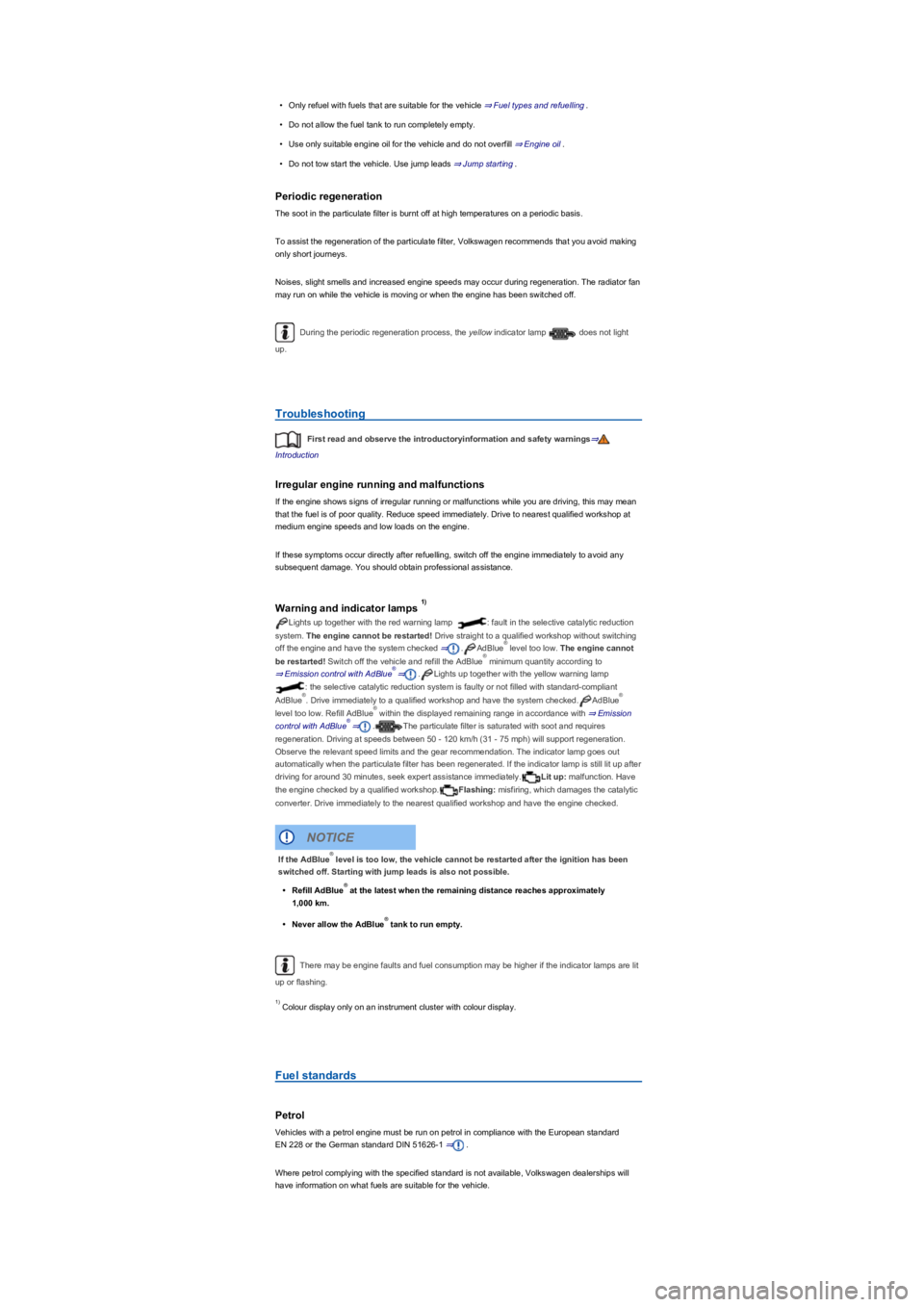
•Only refuel with fuels that are suitable for the vehicle ⇒ Fuel types and refuelling.
•Do not allow the fuel tank to run completely empty.
•Use only suitable engine oil for the vehicle and do not overfill ⇒ Engine oil.
•Do not tow start the vehicle. Use jump leads ⇒ Jump starting.
Periodic regeneration
The soot in the particulate filter is burnt off at high temperatures on a periodic basis.
To assist the regeneration of the particulate filter, Volkswagen recommends that you avoid making
only short journeys.
Noises, slight smells and increased engine speeds may occur during regeneration. The radiator fan
may run on while the vehicle is moving or when the engine has been switched off.
During the periodic regeneration process, the yellow indicator lamp does not light
up.
Troubleshooting
First read and observe the introductoryinformation and safety warnings⇒
Introduction
Irregular engine running and malfunctions
If the engine shows signs of irregular running or malfunctions while you are driving, this may mean
that the fuel is of poor quality. Reduce speed immediately. Drive to nearest qualified workshop at
medium engine speeds and low loads on the engine.
If these symptoms occur directly after refuelling, switch off the engine immediately to avoid any
subsequent damage. You should obtain professional assistance.
Warning and indicator lamps
Lights up together with the red warning lamp : fault in the selective catalytic reduction
system. The engine cannot be restarted! Drive straight to a qualified workshop without switching
off the engine and have the system checked ⇒.AdBlue level too low. The engine cannot
be restarted! Switch off the vehicle and refill the AdBlue minimum quantity according to
⇒ Emission control with AdBlue⇒.Lights up together with the yellow warning lamp
: the selective catalytic reduction system is faulty or not filled with standard-compliant
AdBlue. Drive immediately to a qualified workshop and have the system checked.AdBlue
level too low. Refill AdBlue within the displayed remaining range in accordance with ⇒ Emission
control with AdBlue⇒.The particulate filter is saturated with soot and requires
regeneration. Driving at speeds between 50 - 120 km/h (31 - 75 mph) will support regeneration.
Observe the relevant speed limits and the gear recommendation. The indicator lamp goes out
automatically when the particulate filter has been regenerated. If the indicator lamp is still lit up after
driving for around 30 minutes, seek expert assistance immediately.Lit up: malfunction. Have
the engine checked by a qualified workshop.Flashing: misfiring, which damages the catalytic
converter. Drive immediately to the nearest qualified workshop and have the engine checked.
There may be engine faults and fuel consumption may be higher if the indicator lamps are lit
up or flashing.
Colour display only on an instrument cluster with colour display.
Fuel standards
Petrol
Vehicles with a petrol engine must be run on petrol in compliance with the European standard
EN 228 or the German standard DIN 51626-1 ⇒.
Where petrol complying with the specified standard is not available, Volkswagen dealerships will
have information on what fuels are suitable for the vehicle.
1)
®
®
®
®®
®
®
If the AdBlue level is too low, the vehicle cannot be restarted after the ignition has been
switched off. Starting with jump leads is also not possible.
•Refill AdBlue at the latest when the remaining distance reaches approximately
1,000 km.
•Never allow the AdBlue tank to run empty.
NOTICE
®
®
®
1)
Page 277 of 341
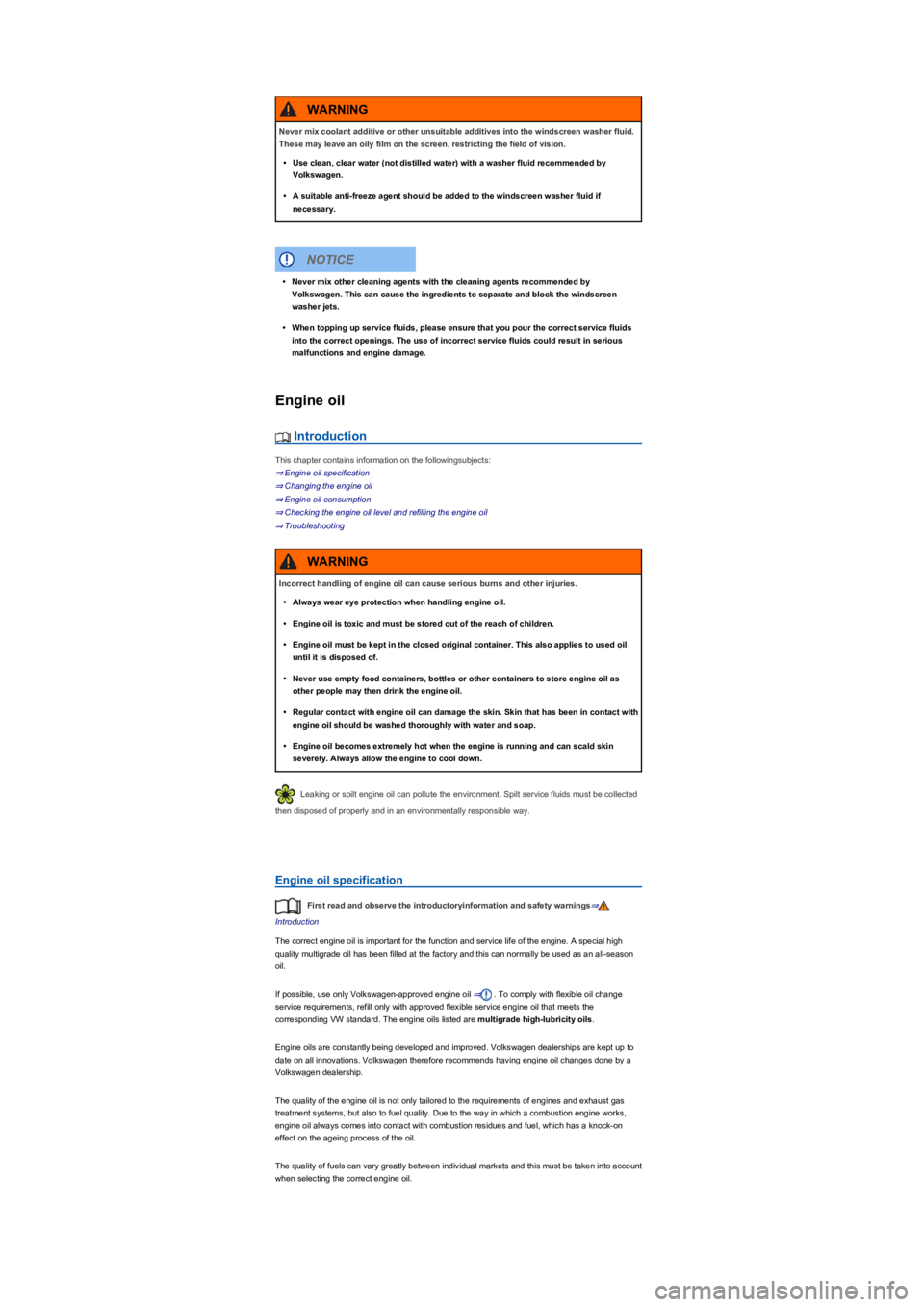
Engine oil
Introduction
This chapter contains information on the followingsubjects:
⇒ Engine oil specification
⇒ Changing the engine oil
⇒ Engine oil consumption
⇒ Checking the engine oil level and refilling the engine oil
⇒ Troubleshooting
Leaking or spilt engine oil can pollute the environment. Spilt service fluids must be collected
then disposed of properly and in an environmentally responsible way.
Engine oil specification
First read and observe the introductoryinformation and safety warnings⇒
Introduction
The correct engine oil is important for the function and service life of the engine. A special high
quality multigrade oil has been filled at the factory and this can normally be used as an all-season
oil.
If possible, use only Volkswagen-approved engine oil ⇒. To comply with flexible oil change
service requirements, refill only with approved flexible service engine oil that meets the
corresponding VW standard. The engine oils listed are multigrade high-lubricity oils.
Engine oils are constantly being developed and improved. Volkswagen dealerships are kept up to
date on all innovations. Volkswagen therefore recommends having engine oil changes done by a
Volkswagen dealership.
The quality of the engine oil is not only tailored to the requirements of engines and exhaust gas
treatment systems, but also to fuel quality. Due to the way in which a combustion engine works,
engine oil always comes into contact with combustion residues and fuel, which has a knock-on
effect on the ageing process of the oil.
The quality of fuels can vary greatly between individual markets and this must be taken into account
when selecting the correct engine oil.
Never mix coolant additive or other unsuitable additives into the windscreen washer fluid.
These may leave an oily film on the screen, restricting the field of vision.
•Use clean, clear water (not distilled water) with a washer fluid recommended by
Volkswagen.
•A suitable anti-freeze agent should be added to the windscreen washer fluid if
necessary.
WARNING
•Never mix other cleaning agents with the cleaning agents recommended by
Volkswagen. This can cause the ingredients to separate and block the windscreen
washer jets.
•When topping up service fluids, please ensure that you pour the correct service fluids
into the correct openings. The use of incorrect service fluids could result in serious
malfunctions and engine damage.
NOTICE
Incorrect handling of engine oil can cause serious burns and other injuries.
•Always wear eye protection when handling engine oil.
•Engine oil is toxic and must be stored out of the reach of children.
•Engine oil must be kept in the closed original container. This also applies to used oil
until it is disposed of.
•Never use empty food containers, bottles or other containers to store engine oil as
other people may then drink the engine oil.
•Regular contact with engine oil can damage the skin. Skin that has been in contact with
engine oil should be washed thoroughly with water and soap.
•Engine oil becomes extremely hot when the engine is running and can scald skin
severely. Always allow the engine to cool down.
WARNING
Page 279 of 341
Before changing the engine oil, first find out where old oil can be disposed of properly near
you.
Used oil must be disposed of in accordance with regulations governing the protection of the
environment. Never dispose of old oil in locations such as gardens, woods, sewerage systems, on
streets and roads, or in rivers and waterways.
Engine oil consumption
First read and observe the introductoryinformation and safety warnings⇒
Introduction
Engine oil consumption can vary from engine to engine and can change during the working life of
an engine.
The vehicle may consume up to 1.0 litre of engine oil per 2,000 km, depending on how you drive
and the conditions in which the car is used. In new vehicles, consumption is likely to be higher for
the first 5,000 km. The engine oil level must therefore be checked at regular intervals, preferably
when refuelling and before long journeys.
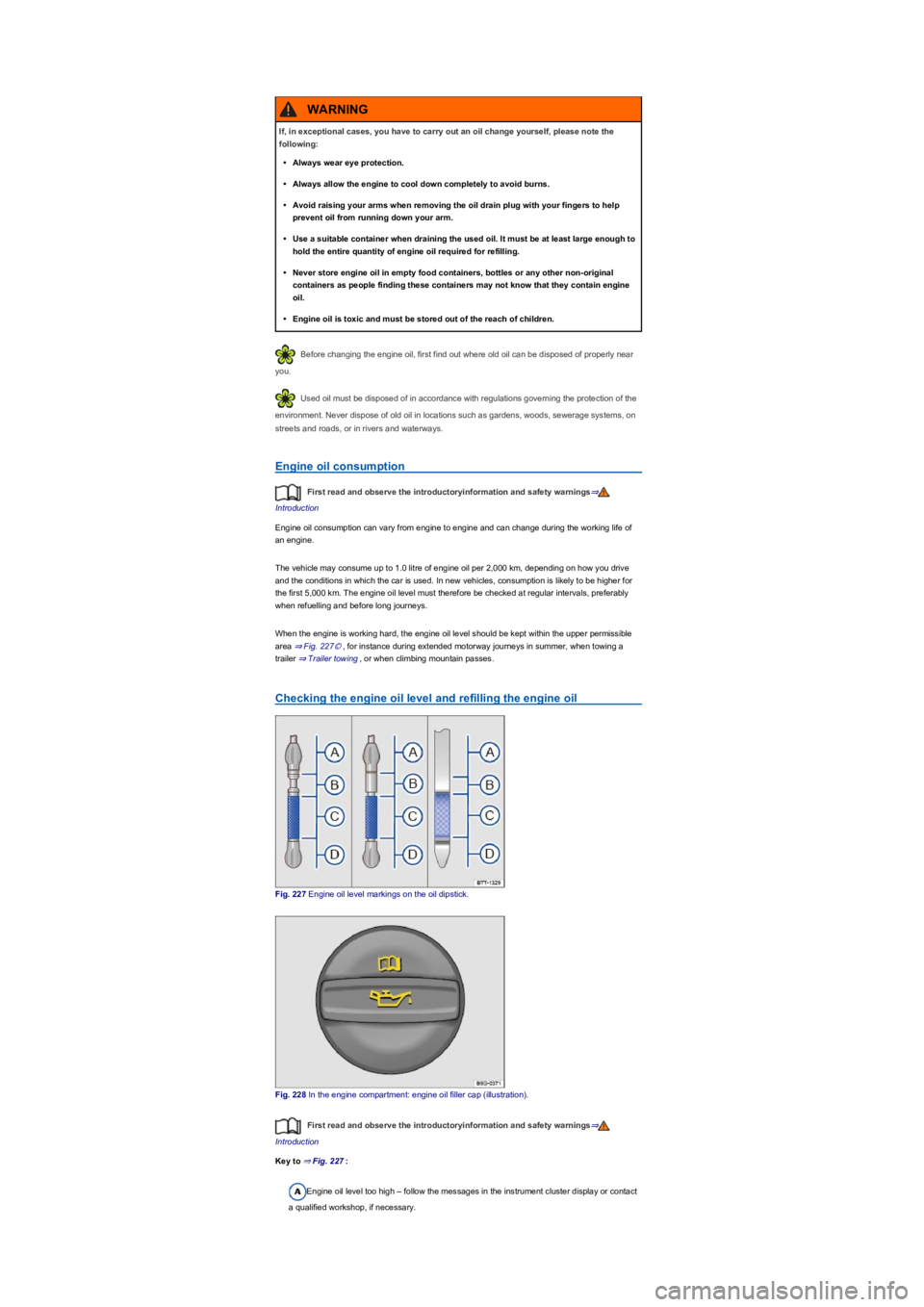
When the engine is working hard, the engine oil level should be kept within the upper permissible
area ⇒ Fig. 227Ⓒ, for instance during extended motorway journeys in summer, when towing a
trailer ⇒ Trailer towing, or when climbing mountain passes.
Checking the engine oil level and refilling the engine oil
Fig. 227 Engine oil level markings on the oil dipstick.
Fig. 228 In the engine compartment: engine oil filler cap (illustration).
First read and observe the introductoryinformation and safety warnings⇒
Introduction
Key to ⇒ Fig. 227:
Engine oil level too high – follow the messages in the instrument cluster display or contact
a qualified workshop, if necessary.
If, in exceptional cases, you have to carry out an oil change yourself, please note the
following:
•Always wear eye protection.
•Always allow the engine to cool down completely to avoid burns.
•Avoid raising your arms when removing the oil drain plug with your fingers to help
prevent oil from running down your arm.
•Use a suitable container when draining the used oil. It must be at least large enough to
hold the entire quantity of engine oil required for refilling.
•Never store engine oil in empty food containers, bottles or any other non-original
containers as people finding these containers may not know that they contain engine
oil.
•Engine oil is toxic and must be stored out of the reach of children.
WARNING
Page 290 of 341
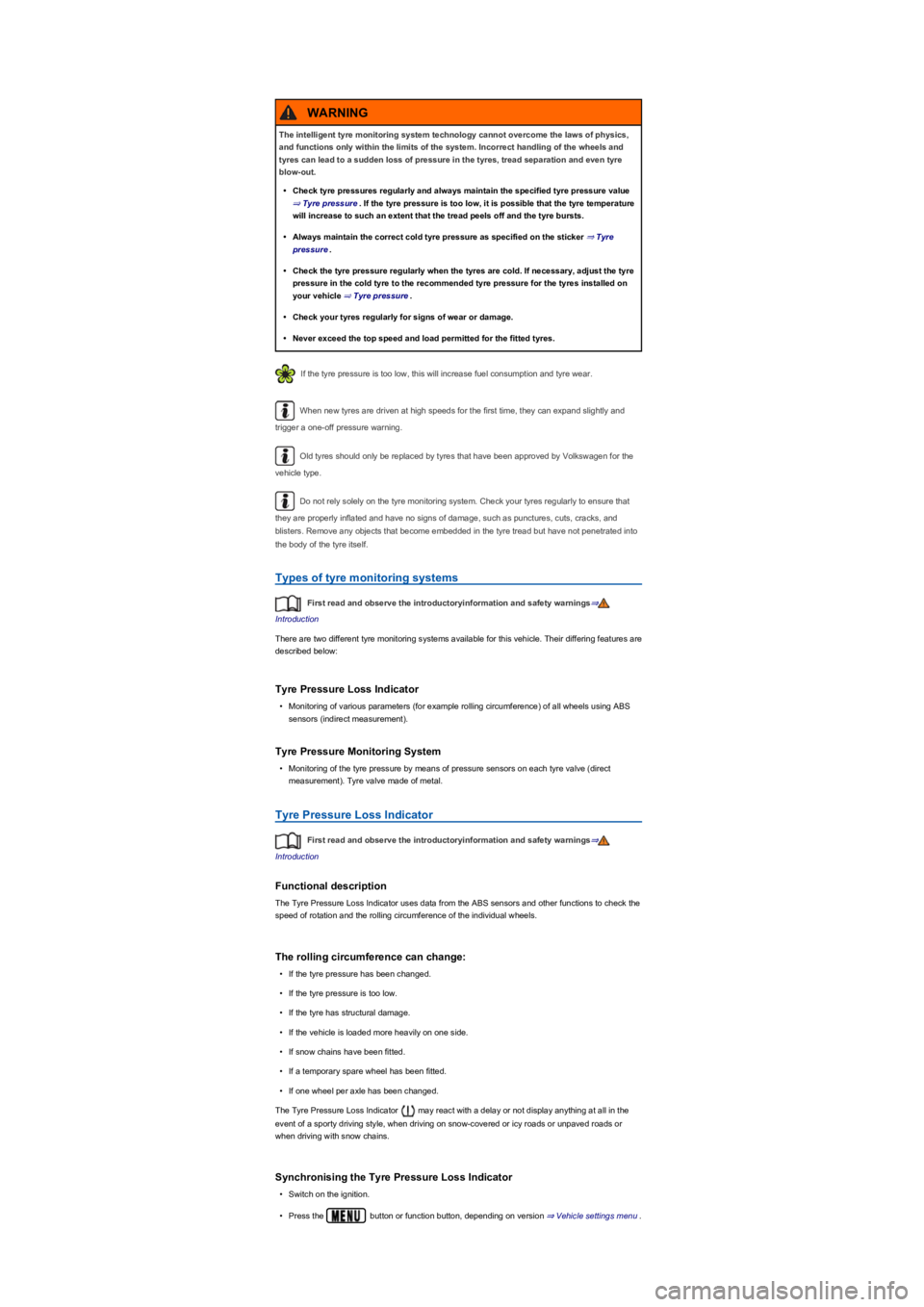
If the tyre pressure is too low, this will increase fuel consumption and tyre wear.
When new tyres are driven at high speeds for the first time, they can expand slightly and
trigger a one-off pressure warning.
Old tyres should only be replaced by tyres that have been approved by Volkswagen for the
vehicle type.
Do not rely solely on the tyre monitoring system. Check your tyres regularly to ensure that
they are properly inflated and have no signs of damage, such as punctures, cuts, cracks, and
blisters. Remove any objects that become embedded in the tyre tread but have not penetrated into
the body of the tyre itself.
Types of tyre monitoring systems
First read and observe the introductoryinformation and safety warnings⇒
Introduction
There are two different tyre monitoring systems available for this vehicle. Their differing features are
described below:
Tyre Pressure Loss Indicator
•Monitoring of various parameters (for example rolling circumference) of all wheels using ABS
sensors (indirect measurement).
Tyre Pressure Monitoring System
•Monitoring of the tyre pressure by means of pressure sensors on each tyre valve (direct
measurement). Tyre valve made of metal.
Tyre Pressure Loss Indicator
First read and observe the introductoryinformation and safety warnings⇒
Introduction
Functional description
The Tyre Pressure Loss Indicator uses data from the ABS sensors and other functions to check the
speed of rotation and the rolling circumference of the individual wheels.
The rolling circumference can change:
•If the tyre pressure has been changed.
•If the tyre pressure is too low.
•If the tyre has structural damage.
•If the vehicle is loaded more heavily on one side.
•If snow chains have been fitted.
•If a temporary spare wheel has been fitted.
•If one wheel per axle has been changed.
The Tyre Pressure Loss Indicator may react with a delay or not display anything at all in the
event of a sporty driving style, when driving on snow-covered or icy roads or unpaved roads or
when driving with snow chains.
Synchronising the Tyre Pressure Loss Indicator
•Switch on the ignition.
•Press the button or function button, depending on version ⇒ Vehicle settings menu.
The intelligent tyre monitoring system technology cannot overcome the laws of physics,
and functions only within the limits of the system. Incorrect handling of the wheels and
tyres can lead to a sudden loss of pressure in the tyres, tread separation and even tyre
blow-out.
•Check tyre pressures regularly and always maintain the specified tyre pressure value
⇒ Tyre pressure. If the tyre pressure is too low, it is possible that the tyre temperature
will increase to such an extent that the tread peels off and the tyre bursts.
•Always maintain the correct cold tyre pressure as specified on the sticker ⇒ Tyre
pressure.
•Check the tyre pressure regularly when the tyres are cold. If necessary, adjust the tyre
pressure in the cold tyre to the recommended tyre pressure for the tyres installed on
your vehicle ⇒ Tyre pressure.
•Check your tyres regularly for signs of wear or damage.
•Never exceed the top speed and load permitted for the fitted tyres.
WARNING
Page 298 of 341
Tyre pressure
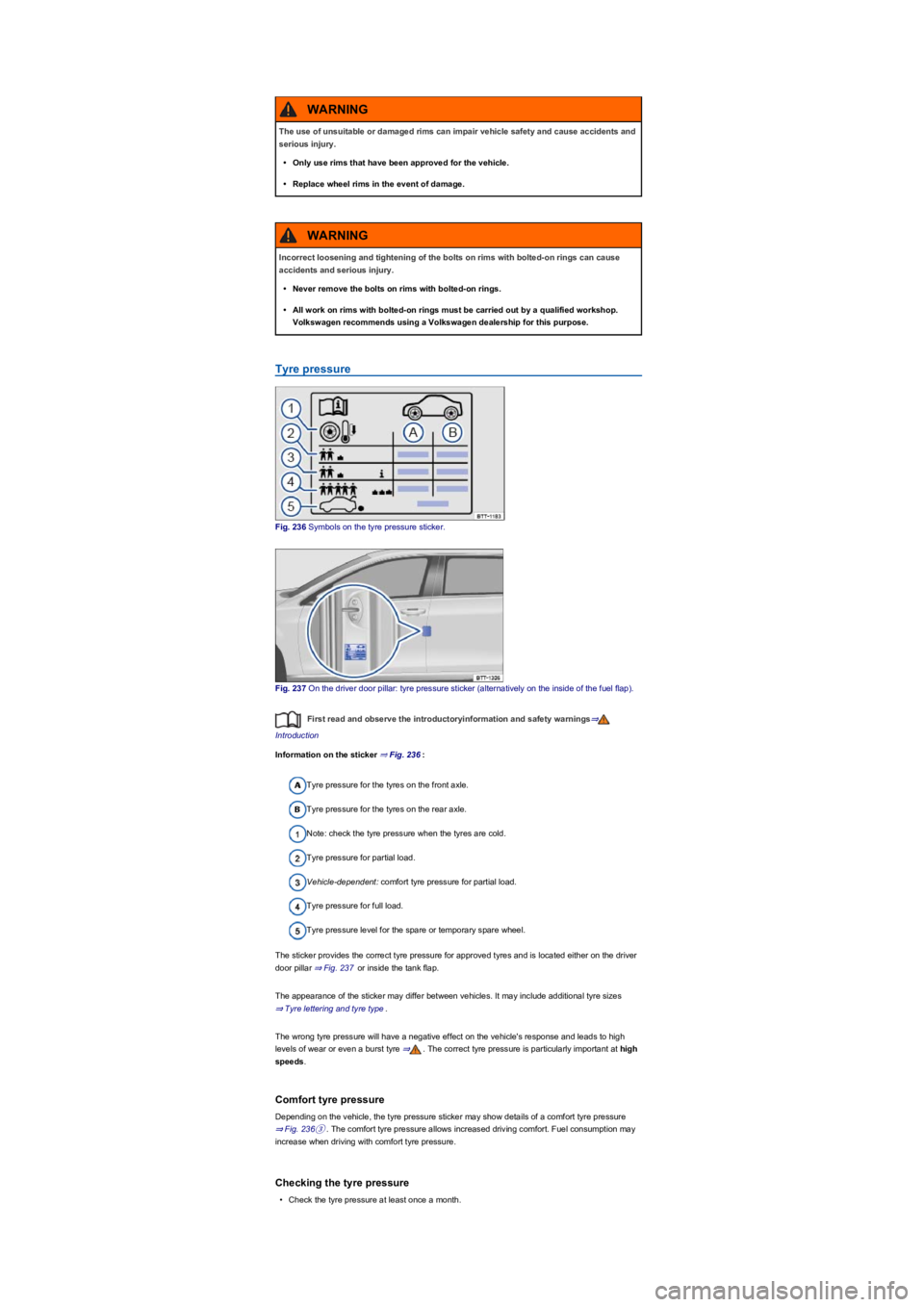
Fig. 236 Symbols on the tyre pressure sticker.
Fig. 237 On the driver door pillar: tyre pressure sticker (alternatively on the inside of the fuel flap).
First read and observe the introductoryinformation and safety warnings⇒
Introduction
Information on the sticker ⇒ Fig. 236:
Tyre pressure for the tyres on the front axle.
Tyre pressure for the tyres on the rear axle.
Note: check the tyre pressure when the tyres are cold.
Tyre pressure for partial load.
Vehicle-dependent: comfort tyre pressure for partial load.
Tyre pressure for full load.
Tyre pressure level for the spare or temporary spare wheel.
The sticker provides the correct tyre pressure for approved tyres and is located either on the driver
door pillar ⇒ Fig. 237 or inside the tank flap.
The appearance of the sticker may differ between vehicles. It may include additional tyre sizes
⇒ Tyre lettering and tyre type.
The wrong tyre pressure will have a negative effect on the vehicle's response and leads to high
levels of wear or even a burst tyre ⇒. The correct tyre pressure is particularly important at high
speeds.
Comfort tyre pressure
Depending on the vehicle, the tyre pressure sticker may show details of a comfort tyre pressure
⇒ Fig. 236③. The comfort tyre pressure allows increased driving comfort. Fuel consumption may
increase when driving with comfort tyre pressure.
Checking the tyre pressure
•Check the tyre pressure at least once a month.
The use of unsuitable or damaged rims can impair vehicle safety and cause accidents and
serious injury.
•Only use rims that have been approved for the vehicle.
•Replace wheel rims in the event of damage.
WARNING
Incorrect loosening and tightening of the bolts on rims with bolted-on rings can cause
accidents and serious injury.
•Never remove the bolts on rims with bolted-on rings.
•All work on rims with bolted-on rings must be carried out by a qualified workshop.
Volkswagen recommends using a Volkswagen dealership for this purpose.
WARNING
Page 299 of 341
•Always check the tyre pressure when the tyres are cold. The specified tyre pressure applies to
cold tyres. Tyre pressure is always higher in warm tyres than it is in cold tyres. For this reason,
never reduce the pressure in warm tyres to adjust the tyre pressure.
•Always adjust the tyre pressure to the load level ⇒ Fig. 236④.
•After adjusting the tyre pressures, always screw the caps onto the valves and observe the
information on the tyre monitoring system ⇒ Tyre monitoring systems.
•Always use the tyre pressure specified on the sticker. Never exceed the maximum tyre pressure
which is given on the sidewall of the tyre
Underinflated tyres will result in increased fuel consumption.
Tread depth and wear indicators
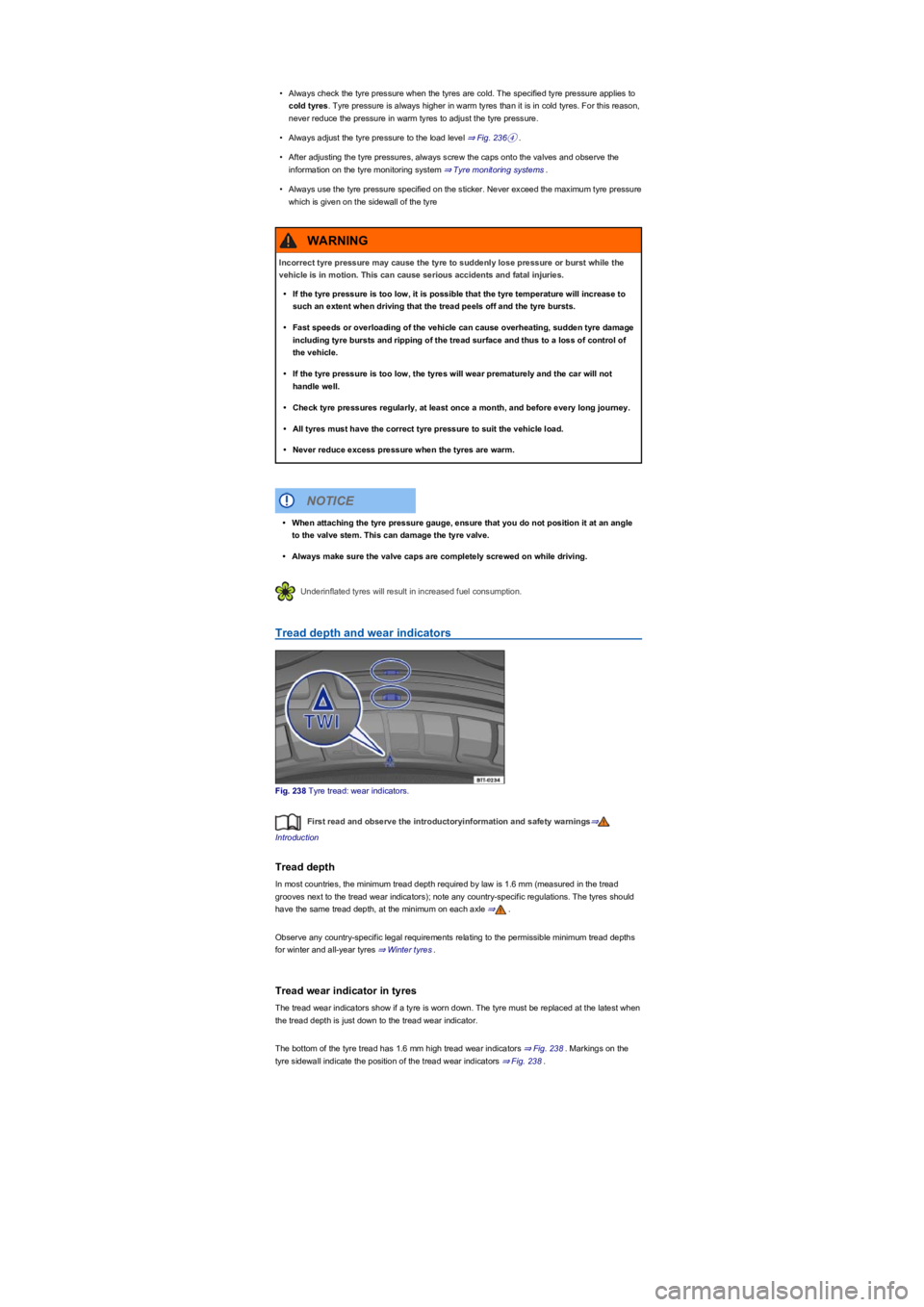
Fig. 238 Tyre tread: wear indicators.
First read and observe the introductoryinformation and safety warnings⇒
Introduction
Tread depth
In most countries, the minimum tread depth required by law is 1.6 mm (measured in the tread
grooves next to the tread wear indicators); note any country-specific regulations. The tyres should
have the same tread depth, at the minimum on each axle ⇒.
Observe any country-specific legal requirements relating to the permissible minimum tread depths
for winter and all-year tyres ⇒ Winter tyres.
Tread wear indicator in tyres
The tread wear indicators show if a tyre is worn down. The tyre must be replaced at the latest when
the tread depth is just down to the tread wear indicator.
The bottom of the tyre tread has 1.6 mm high tread wear indicators ⇒ Fig. 238. Markings on the
tyre sidewall indicate the position of the tread wear indicators ⇒ Fig. 238.
Incorrect tyre pressure may cause the tyre to suddenly lose pressure or burst while the
vehicle is in motion. This can cause serious accidents and fatal injuries.
•If the tyre pressure is too low, it is possible that the tyre temperature will increase to
such an extent when driving that the tread peels off and the tyre bursts.
•Fast speeds or overloading of the vehicle can cause overheating, sudden tyre damage
including tyre bursts and ripping of the tread surface and thus to a loss of control of
the vehicle.
•If the tyre pressure is too low, the tyres will wear prematurely and the car will not
handle well.
•Check tyre pressures regularly, at least once a month, and before every long journey.
•All tyres must have the correct tyre pressure to suit the vehicle load.
•Never reduce excess pressure when the tyres are warm.
WARNING
•When attaching the tyre pressure gauge, ensure that you do not position it at an angle
to the valve stem. This can damage the tyre valve.
•Always make sure the valve caps are completely screwed on while driving.
NOTICE