service interval VOLKSWAGEN TIGUAN 2017 Owner´s Manual
[x] Cancel search | Manufacturer: VOLKSWAGEN, Model Year: 2017, Model line: TIGUAN, Model: VOLKSWAGEN TIGUAN 2017Pages: 341, PDF Size: 9.14 MB
Page 278 of 341
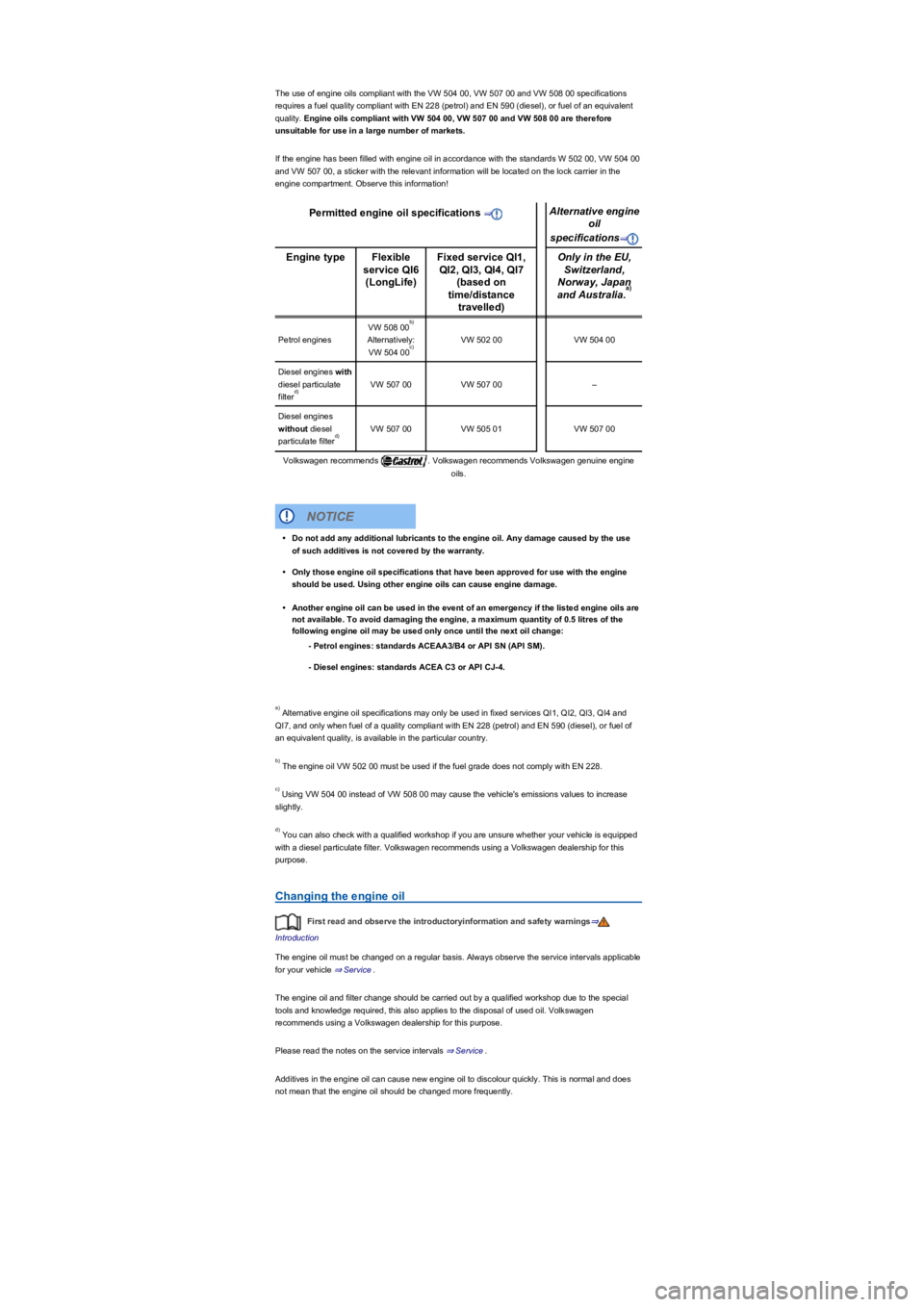
The use of engine oils compliant with the VW 504 00, VW 507 00 and VW 508 00 specifications
requires a fuel quality compliant with EN 228 (petrol) and EN 590 (diesel), or fuel of an equivalent
quality. Engine oils compliant with VW 504 00, VW 507 00 and VW 508 00 are therefore
unsuitable for use in a large number of markets.
If the engine has been filled with engine oil in accordance with the standards W 502 00, VW 504 00
and VW 507 00, a sticker with the relevant information will be located on the lock carrier in the
engine compartment. Observe this information!
Permitted engine oil specifications ⇒Alternative engine
oil
specifications⇒
Engine typeFlexible
service QI6
(LongLife)
Fixed service QI1,
QI2, QI3, QI4, QI7
(based on
time/distance
travelled)
Only in the EU,
Switzerland,
Norway, Japan
and Australia.
Petrol engines
VW 508 00
Alternatively:
VW 504 00
VW 502 00VW 504 00
Diesel engines with
diesel particulate
filter
VW 507 00VW 507 00–
Diesel engines
without diesel
particulate filter
VW 507 00VW 505 01VW 507 00
Volkswagen recommends . Volkswagen recommends Volkswagen genuine engine
oils.
Alternative engine oil specifications may only be used in fixed services QI1, QI2, QI3, QI4 and
QI7, and only when fuel of a quality compliant with EN 228 (petrol) and EN 590 (diesel), or fuel of
an equivalent quality, is available in the particular country.
The engine oil VW 502 00 must be used if the fuel grade does not comply with EN 228.
Using VW 504 00 instead of VW 508 00 may cause the vehicle's emissions values to increase
slightly.
You can also check with a qualified workshop if you are unsure whether your vehicle is equipped
with a diesel particulate filter. Volkswagen recommends using a Volkswagen dealership for this
purpose.
Changing the engine oil
First read and observe the introductoryinformation and safety warnings⇒
Introduction
The engine oil must be changed on a regular basis. Always observe the service intervals applicable
for your vehicle ⇒ Service.
The engine oil and filter change should be carried out by a qualified workshop due to the special
tools and knowledge required, this also applies to the disposal of used oil. Volkswagen
recommends using a Volkswagen dealership for this purpose.
Please read the notes on the service intervals ⇒ Service.
Additives in the engine oil can cause new engine oil to discolour quickly. This is normal and does
not mean that the engine oil should be changed more frequently.
a)
b)
c)
d)
d)
•Do not add any additional lubricants to the engine oil. Any damage caused by the use
of such additives is not covered by the warranty.
•Only those engine oil specifications that have been approved for use with the engine
should be used. Using other engine oils can cause engine damage.
•Another engine oil can be used in the event of an emergency if the listed engine oils are
not available. To avoid damaging the engine, a maximum quantity of 0.5 litres of the
following engine oil may be used only once until the next oil change:
- Petrol engines: standards ACEAA3/B4 or API SN (API SM).
- Diesel engines: standards ACEA C3 or API CJ-4.
NOTICE
a)
b)
c)
d)
Page 288 of 341
•Switch off all electrical consumers and the ignition.
•Unlock the vehicle before disconnecting the battery in order to avoid triggering the anti-theft
alarm.
•First disconnect the negative cable and then the positive cable ⇒.
Connecting the 12-volt vehicle battery
•Switch off all electrical consumers and the ignition before reconnecting the 12-volt vehicle
battery.
•First reconnect the positive cable and then the negative cable ⇒.
Various indicator lamps may light up after the 12-volt vehicle battery has been connected and the
ignition is switched on. They will go out if you drive a short distance at a speed of approximately
15 – 20 km/h (10 – 12 mph). If the indicator lamps remain lit up, the vehicle should be checked by a
qualified workshop.
If the 12-volt vehicle battery was disconnected for an extended period, the system may not able to
calculate or correctly display the time when the next service is due ⇒ Instrument cluster. Observe
the maximum permissible service intervals ⇒ Service.
Vehicles with Keyless Access:⇒ Central locking system: if the ignition cannot be switched on after
connecting the 12-volt vehicle battery, lock and unlock the vehicle from the outside. Then try to start
the ignition again. Please contact an expert if the ignition cannot be switched on.
Automatic switch-off for electrical consumers
The intelligent vehicle electrical system management automatically implements a range of
measures to prevent the 12-volt battery from discharging under high loads:
•The idling speed is increased so that the alternator provides more electricity.
•The performance of large electrical consumers may be reduced or they may be switched off
completely.
•The power supply to the 12-volt socket and the cigarette lighter is interrupted temporarily while
the engine is being started.
The vehicle electrical system management function cannot always prevent the 12-volt vehicle
battery from discharging. For example when the ignition is switched on for an extended period with
the engine off, or when the side or parking lights are on when the vehicle is parked for an extended
period.
Battery switch-off in an accident in which the airbag is triggered
In vehicles with 12-volt vehicle battery in the luggage compartment, the electrical connection to the
12-volt vehicle battery is disconnected pyrotechnically in the event of an accident in which the
airbags are triggered. This prevents short-circuiting.
What can cause the 12-volt vehicle battery to discharge?
•Long periods at a standstill in which the engine is not running, especially if the ignition is
switched on.
•The use of electrical consumers when the engine is switched off.
•When the auxiliary heater is being used ⇒ Auxiliary heater and ventilation.
Page 315 of 341
The vehicle data sticker confirms when the vehicle was first registered or delivered, when the
delivery inspection was carried out, and thus the date from which your vehicle is covered by our
warranty.
Saving the service operations performed (digital service schedule)
Each service record is stored by your Volkswagen dealership and qualified workshop in a central
system. This transparent documentation of the service history allows the service operations
performed to be reproduced at any time. Each time you have your vehicle serviced, Volkswagen
recommends asking for a printed service record, which contains all service work stored in the
system.
With every service, the printout of the previous service record is replaced by a current printout.
The digital service schedule is not available in some markets. In this case, your Volkswagen
dealership will inform you about the documentation process for service work.
Service work
The following information is documented in the digital service schedule by your Volkswagen
dealership or qualified workshop:
•When which service was carried out.
•Whether any repairs are recommended, such as replacement of the brake pads in the near
future.
•Whether you had any special requests before or during the maintenance work (your service
advisor will note these on the order).
•Which components or service fluids were changed.
•When your next service is scheduled for.
The LongLife mobility guarantee is valid until the next inspection is due. Documentation takes place
at every due inspection.
The type and scope of service work may differ from vehicle to vehicle. Information on specific work
for your vehicle can be requested from a qualified workshop.
Regular servicing of your vehicle not only maintains its value, it also ensures that your
vehicle remains roadworthy and in working order. You should therefore have your vehicle serviced
according to the Volkswagen guidelines.
Fixed service or flexible service
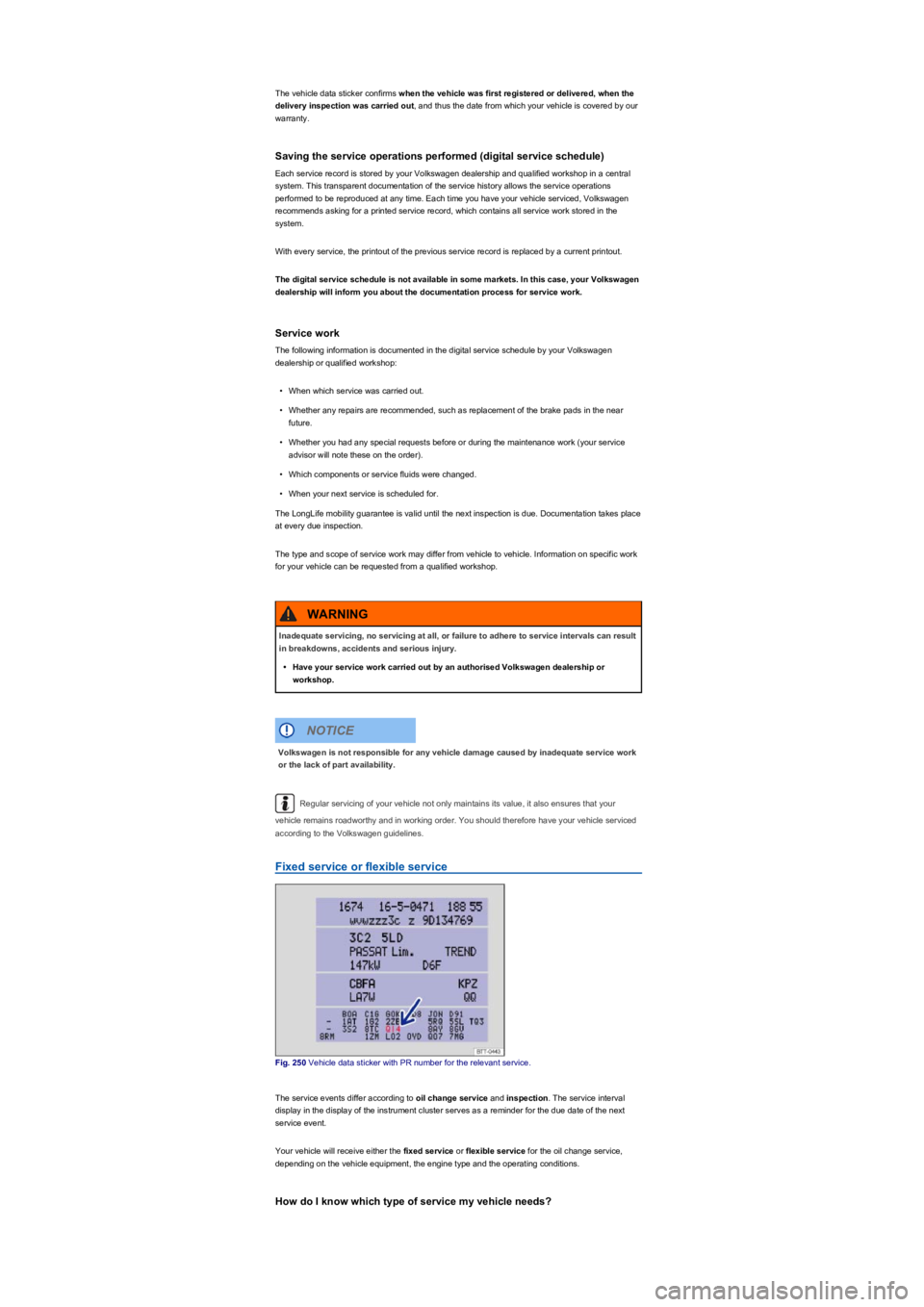
Fig. 250 Vehicle data sticker with PR number for the relevant service.
The service events differ according to oil change service and inspection. The service interval
display in the display of the instrument cluster serves as a reminder for the due date of the next
service event.
Your vehicle will receive either the fixed service or flexible service for the oil change service,
depending on the vehicle equipment, the engine type and the operating conditions.
How do I know which type of service my vehicle needs?
Inadequate servicing, no servicing at all, or failure to adhere to service intervals can result
in breakdowns, accidents and serious injury.
•Have your service work carried out by an authorised Volkswagen dealership or
workshop.
WARNING
Volkswagen is not responsible for any vehicle damage caused by inadequate service work
or the lack of part availability.
NOTICE
Page 316 of 341
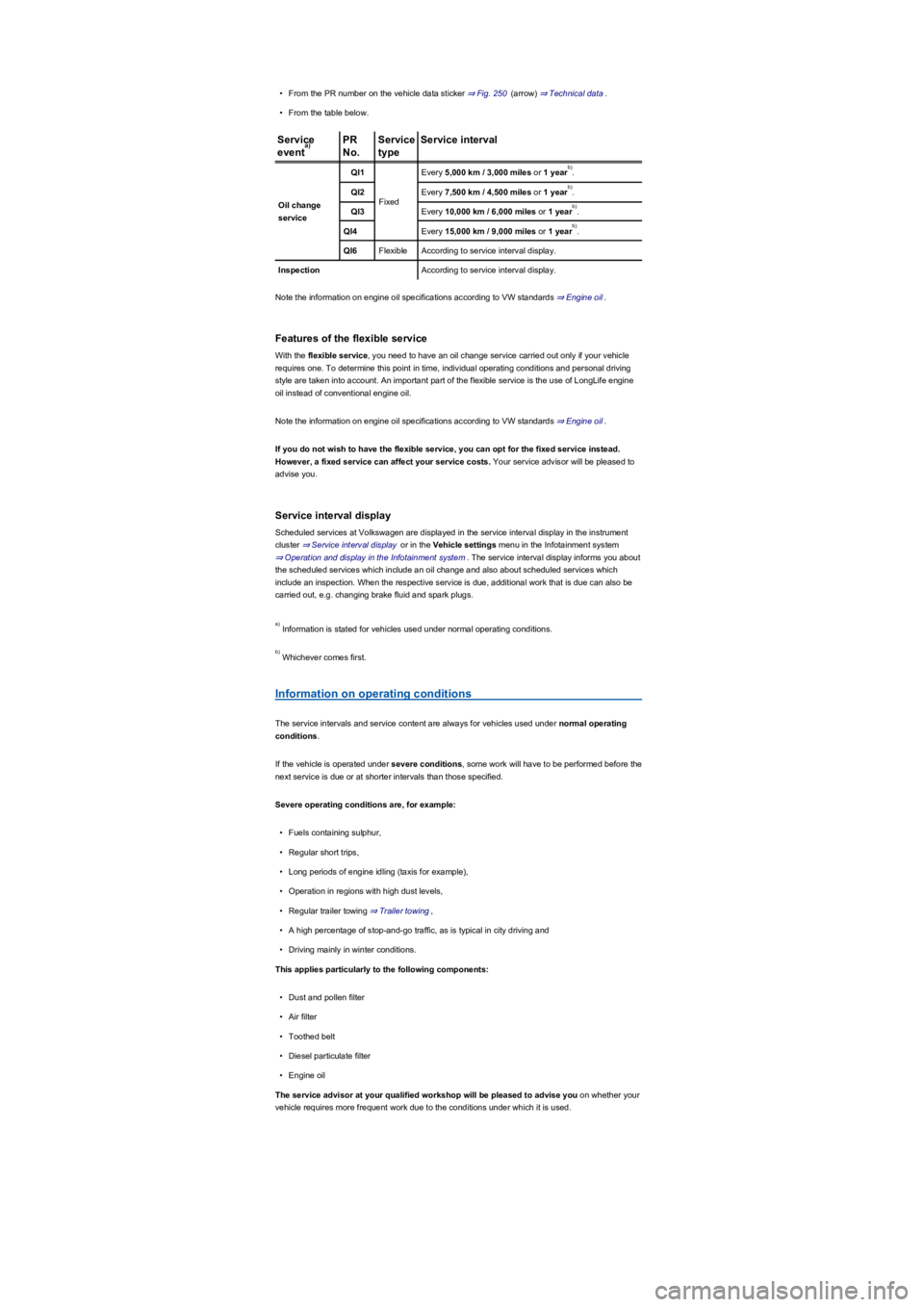
•From the PR number on the vehicle data sticker ⇒ Fig. 250 (arrow) ⇒ Technical data.
•From the table below.
Service
event
PR
No.
Service
type
Service interval
Oil change
service
QI1
Fixed
Every 5,000 km / 3,000 miles or 1 year.
QI2Every 7,500 km / 4,500 miles or 1 year.
QI3Every 10,000 km / 6,000 miles or 1 year.
QI4Every 15,000 km / 9,000 miles or 1 year.
QI6FlexibleAccording to service interval display.
InspectionAccording to service interval display.
Note the information on engine oil specifications according to VW standards ⇒ Engine oil.
Features of the flexible service
With the flexible service, you need to have an oil change service carried out only if your vehicle
requires one. To determine this point in time, individual operating conditions and personal driving
style are taken into account. An important part of the flexible service is the use of LongLife engine
oil instead of conventional engine oil.
Note the information on engine oil specifications according to VW standards ⇒ Engine oil.
If you do not wish to have the flexible service, you can opt for the fixed service instead.
However, a fixed service can affect your service costs. Your service advisor will be pleased to
advise you.
Service interval display
Scheduled services at Volkswagen are displayed in the service interval display in the instrument
cluster ⇒ Service interval display or in the Vehicle settings menu in the Infotainment system
⇒ Operation and display in the Infotainment system. The service interval display informs you about
the scheduled services which include an oil change and also about scheduled services which
include an inspection. When the respective service is due, additional work that is due can also be
carried out, e.g. changing brake fluid and spark plugs.
Information is stated for vehicles used under normal operating conditions.
Whichever comes first.
Information on operating conditions
The service intervals and service content are always for vehicles used under normal operating
conditions.
If the vehicle is operated under severe conditions, some work will have to be performed before the
next service is due or at shorter intervals than those specified.
Severe operating conditions are, for example:
•Fuels containing sulphur,
•Regular short trips,
•Long periods of engine idling (taxis for example),
•Operation in regions with high dust levels,
•Regular trailer towing ⇒ Trailer towing,
•A high percentage of stop-and-go traffic, as is typical in city driving and
•Driving mainly in winter conditions.
This applies particularly to the following components:
•Dust and pollen filter
•Air filter
•Toothed belt
•Diesel particulate filter
•Engine oil
The service advisor at your qualified workshop will be pleased to advise you on whether your
vehicle requires more frequent work due to the conditions under which it is used.
a)
b)
b)
b)
b)
a)
b)
Page 317 of 341
Scope of service
The scope of service includes all maintenance work that is necessary in order to keep your vehicle
roadworthy (depending on the operating conditions and vehicle equipment, e.g. engine, gearbox or
service fluids). The maintenance work is divided into inspection work and servicing work. You can
find out what work is required in detail for your vehicle:
•From your Volkswagen dealership.
•From your qualified workshop.
•In the electronic repair and workshop information system erWin at https://erwin.volkswagen.de.
Inspection work
Electrics
•12-volt vehicle battery: check and replace if necessary.
•Lighting: check.
•High-voltage components: check.
•Horn: check.
•Headlight setting: check.
•Service interval display: reset.
Engine/gearbox
•Exhaust system: check.
•Gearbox and final drive: check.
•Gas system: check.
•Poly V-belt: check.
•Cooling system: check.
•Engine and components in engine compartment: check.
•Engine oil level: check.
Running gear
•Swivel joints/track rods: check.
•Tyres: check.
•Brake system: check.
•Brake pads/discs: check.
•Brake fluid level: check.
•Boots: check.
•Coupling rod and stabiliser bearings: check.
•Pneumatic suspension: check.
•Breakdown set: check.
•Tyre pressure on all wheels: check.
•Power steering: check.
•Shock absorbers/coil springs: check.
Body
•Roof systems: check.
•Windscreen: check.
•Body: check for corrosion.
•Wiper blades: check.
•Window wiper and washer system: check.
•Door arresters: lubricate.
•Underbody: check.
Inadequate servicing, no servicing at all, or failure to adhere to service intervals can result
in breakdowns, accidents or serious injury.
•Have your service work carried out by an authorised Volkswagen dealership or
workshop.
WARNING
Volkswagen is not responsible for any vehicle damage caused by inadequate service work
or the lack of part availability.
NOTICE