weight VOLKSWAGEN TIGUAN 2017 Owner´s Manual
[x] Cancel search | Manufacturer: VOLKSWAGEN, Model Year: 2017, Model line: TIGUAN, Model: VOLKSWAGEN TIGUAN 2017Pages: 341, PDF Size: 9.14 MB
Page 60 of 341
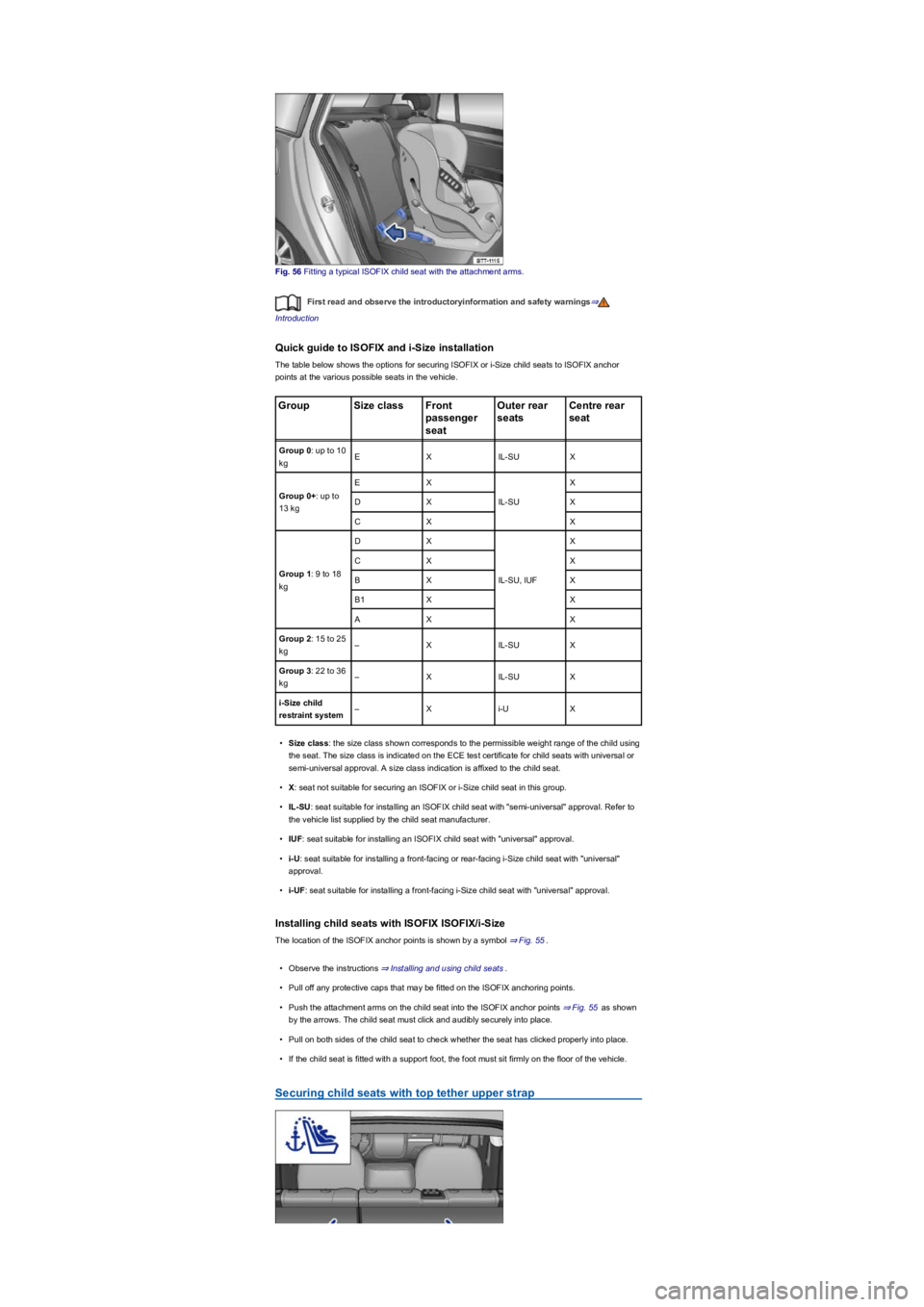
Fig. 56 Fitting a typical ISOFIX child seat with the attachment arms.
First read and observe the introductoryinformation and safety warnings⇒
Introduction
Quick guide to ISOFIX and i-Size installation
The table below shows the options for securing ISOFIX or i-Size child seats to ISOFIX anchor
points at the various possible seats in the vehicle.
GroupSize classFront
passenger
seat
Outer rear
seats
Centre rear
seat
Group 0: up to 10
kgEXIL-SUX
Group 0+: up to
13 kg
EX
IL-SU
X
DXX
CXX
Group 1: 9 to 18
kg
DX
IL-SU, IUF
X
CXX
BXX
B1XX
AXX
Group 2: 15 to 25
kg–XIL-SUX
Group 3: 22 to 36
kg–XIL-SUX
i-Size child
restraint system–Xi-UX
•Size class: the size class shown corresponds to the permissible weight range of the child using
the seat. The size class is indicated on the ECE test certificate for child seats with universal or
semi-universal approval. A size class indication is affixed to the child seat.
•X: seat not suitable for securing an ISOFIX or i-Size child seat in this group.
•IL-SU: seat suitable for installing an ISOFIX child seat with "semi-universal" approval. Refer to
the vehicle list supplied by the child seat manufacturer.
•IUF: seat suitable for installing an ISOFIX child seat with "universal" approval.
•i-U: seat suitable for installing a front-facing or rear-facing i-Size child seat with "universal"
approval.
•i-UF: seat suitable for installing a front-facing i-Size child seat with "universal" approval.
Installing child seats with ISOFIX ISOFIX/i-Size
The location of the ISOFIX anchor points is shown by a symbol ⇒ Fig. 55.
•Observe the instructions ⇒ Installing and using child seats.
•Pull off any protective caps that may be fitted on the ISOFIX anchoring points.
•Push the attachment arms on the child seat into the ISOFIX anchor points ⇒ Fig. 55 as shown
by the arrows. The child seat must click and audibly securely into place.
•Pull on both sides of the child seat to check whether the seat has clicked properly into place.
•If the child seat is fitted with a support foot, the foot must sit firmly on the floor of the vehicle.
Securing child seats with top tether upper strap
Page 61 of 341
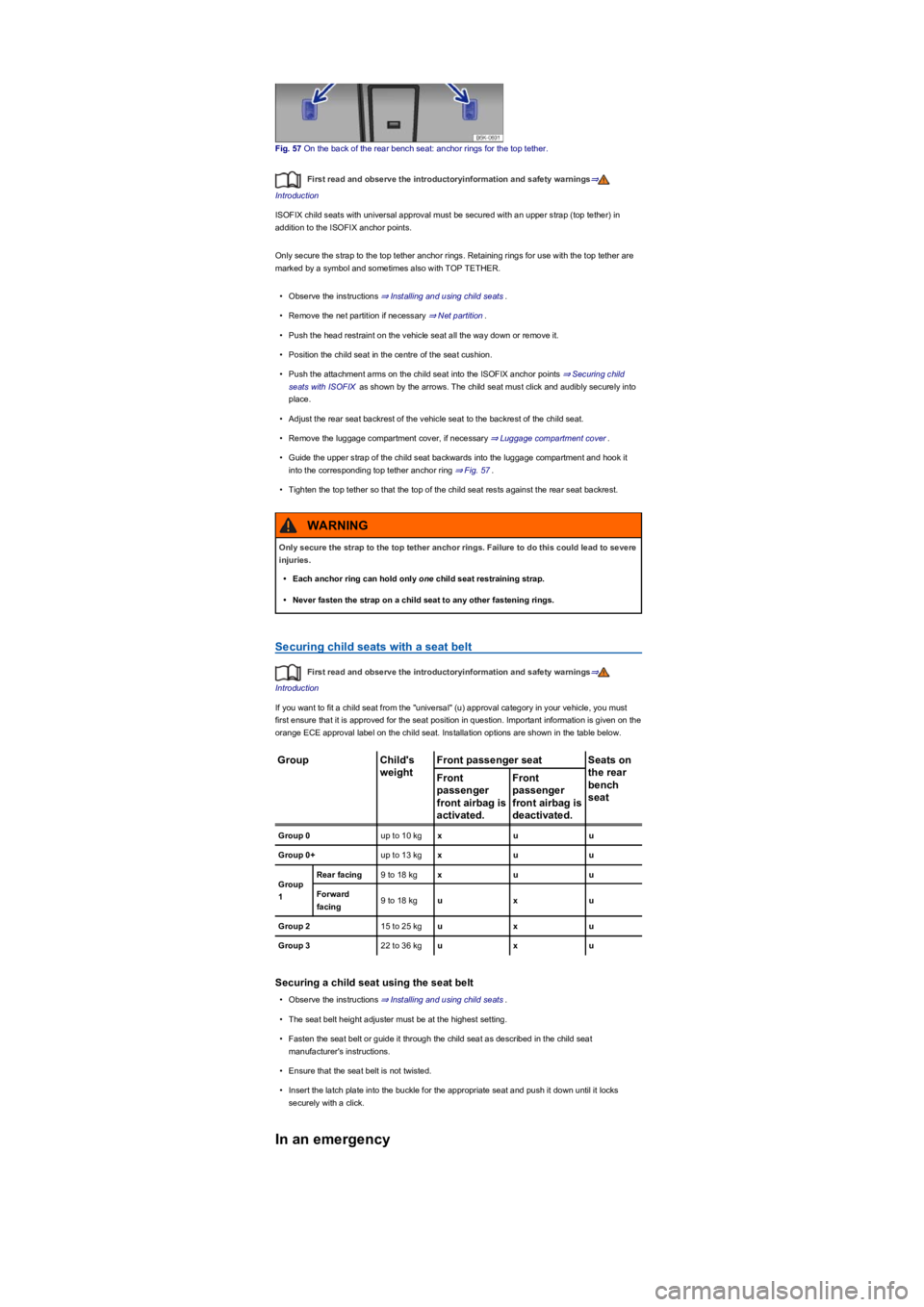
Fig. 57 On the back of the rear bench seat: anchor rings for the top tether.
First read and observe the introductoryinformation and safety warnings⇒
Introduction
ISOFIX child seats with universal approval must be secured with an upper strap (top tether) in
addition to the ISOFIX anchor points.
Only secure the strap to the top tether anchor rings. Retaining rings for use with the top tether are
marked by a symbol and sometimes also with TOP TETHER.
•Observe the instructions ⇒ Installing and using child seats.
•Remove the net partition if necessary ⇒ Net partition.
•Push the head restraint on the vehicle seat all the way down or remove it.
•Position the child seat in the centre of the seat cushion.
•Push the attachment arms on the child seat into the ISOFIX anchor points ⇒ Securing child
seats with ISOFIX as shown by the arrows. The child seat must click and audibly securely into
place.
•Adjust the rear seat backrest of the vehicle seat to the backrest of the child seat.
•Remove the luggage compartment cover, if necessary ⇒ Luggage compartment cover.
•Guide the upper strap of the child seat backwards into the luggage compartment and hook it
into the corresponding top tether anchor ring ⇒ Fig. 57.
•Tighten the top tether so that the top of the child seat rests against the rear seat backrest.
Securing child seats with a seat belt
First read and observe the introductoryinformation and safety warnings⇒
Introduction
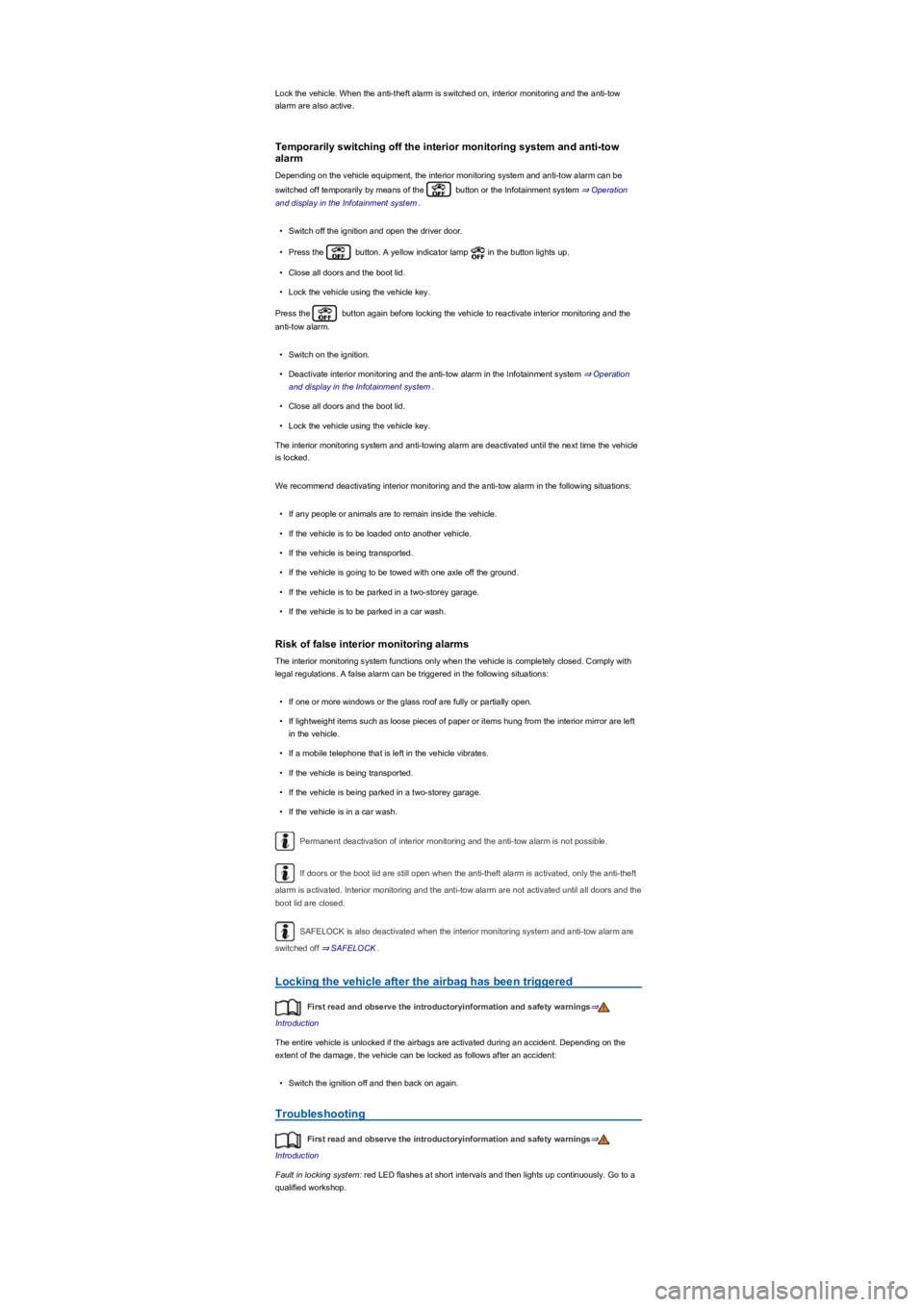
If you want to fit a child seat from the "universal" (u) approval category in your vehicle, you must
first ensure that it is approved for the seat position in question. Important information is given on the
orange ECE approval label on the child seat. Installation options are shown in the table below.
GroupChild's
weight
Front passenger seatSeats on
the rear
bench
seat
Front
passenger
front airbag is
activated.
Front
passenger
front airbag is
deactivated.
Group 0up to 10 kgxuu
Group 0+up to 13 kgxuu
Group
1
Rear facing9 to 18 kgxuu
Forward
facing9 to 18 kguxu
Group 215 to 25 kguxu
Group 322 to 36 kguxu
Securing a child seat using the seat belt
•Observe the instructions ⇒ Installing and using child seats.
•The seat belt height adjuster must be at the highest setting.
•Fasten the seat belt or guide it through the child seat as described in the child seat
manufacturer's instructions.
•Ensure that the seat belt is not twisted.
•Insert the latch plate into the buckle for the appropriate seat and push it down until it locks
securely with a click.
In an emergency
Only secure the strap to the top tether anchor rings. Failure to do this could lead to severe
injuries.
•Each anchor ring can hold only one child seat restraining strap.
•Never fasten the strap on a child seat to any other fastening rings.
WARNING
Page 75 of 341
Lock the vehicle. When the anti-theft alarm is switched on, interior monitoring and the anti-tow
alarm are also active.
Temporarily switching off the interior monitoring system and anti-tow
alarm
Depending on the vehicle equipment, the interior monitoring system and anti-tow alarm can be
switched off temporarily by means of the button or the Infotainment system ⇒ Operation
and display in the Infotainment system.
•Switch off the ignition and open the driver door.
•Press the button. A yellow indicator lamp in the button lights up.
•Close all doors and the boot lid.
•Lock the vehicle using the vehicle key.
Press the button again before locking the vehicle to reactivate interior monitoring and the
anti-tow alarm.
•Switch on the ignition.
•Deactivate interior monitoring and the anti-tow alarm in the Infotainment system ⇒ Operation
and display in the Infotainment system.
•Close all doors and the boot lid.
•Lock the vehicle using the vehicle key.
The interior monitoring system and anti-towing alarm are deactivated until the next time the vehicle
is locked.
We recommend deactivating interior monitoring and the anti-tow alarm in the following situations:
•If any people or animals are to remain inside the vehicle.
•If the vehicle is to be loaded onto another vehicle.
•If the vehicle is being transported.
•If the vehicle is going to be towed with one axle off the ground.
•If the vehicle is to be parked in a two-storey garage.
•If the vehicle is to be parked in a car wash.
Risk of false interior monitoring alarms
The interior monitoring system functions only when the vehicle is completely closed. Comply with
legal regulations. A false alarm can be triggered in the following situations:
•If one or more windows or the glass roof are fully or partially open.
•If lightweight items such as loose pieces of paper or items hung from the interior mirror are left
in the vehicle.
•If a mobile telephone that is left in the vehicle vibrates.
•If the vehicle is being transported.
•If the vehicle is being parked in a two-storey garage.
•If the vehicle is in a car wash.
Permanent deactivation of interior monitoring and the anti-tow alarm is not possible.
If doors or the boot lid are still open when the anti-theft alarm is activated, only the anti-theft
alarm is activated. Interior monitoring and the anti-tow alarm are not activated until all doors and the
boot lid are closed.
SAFELOCK is also deactivated when the interior monitoring system and anti-tow alarm are
switched off ⇒ SAFELOCK.
Locking the vehicle after the airbag has been triggered
First read and observe the introductoryinformation and safety warnings⇒
Introduction
The entire vehicle is unlocked if the airbags are activated during an accident. Depending on the
extent of the damage, the vehicle can be locked as follows after an accident:
•Switch the ignition off and then back on again.
Troubleshooting
First read and observe the introductoryinformation and safety warnings⇒
Introduction
Fault in locking system: red LED flashes at short intervals and then lights up continuously. Go to a
qualified workshop.
Page 79 of 341
The front passenger door and the rear doors can be locked manually. This does not activate the
anti-theft alarm.
•Open the door.
•Remove the rubber seal from the end face of the door.
•Insert the key bit into the slot and turn.
•Secure the rubber seal again.
•Ensure that the door is locked.
•The vehicle should be checked by a qualified workshop as soon as possible.
The manually locked door is unlocked again when the vehicle is unlocked or the door is opened
from the inside.
The doors can be unlocked and opened from the inside by pulling the door release handle.
Boot lid
Introduction
This chapter contains information on the followingsubjects:
⇒ Opening and closing the boot lid
⇒ Electrically opening and closing the boot lid
⇒ Boot lid with movement sensor ()
⇒ Automatically closing the boot lid ()
⇒ Unlocking the boot lid manually
⇒ Troubleshooting
The boot lid is unlocked and locked together with the doors.
On vehicles with the keyless locking and starting system Keyless Access, the boot lid is unlocked
automatically when it is opened ⇒ Locking and unlocking the vehicle with keyless access.
Incorrect and unsupervised unlocking, opening or closing of the boot lid can cause
accidents and serious injuries.
•The boot lid should only be opened or closed when you are sure that nobody is in its
path.
•Always check that the boot lid is properly closed after closing it. The closed boot lid
must be flush with the surrounding body panels.
•Always keep the boot lid closed while the vehicle is in motion.
•Never open the boot lid when loads, e.g. bicycles, are attached to it. The boot lid may
close under its own weight due to the additional load. Support the boot lid as
necessary or remove the load before opening.
•Close and lock the boot lid and all vehicle doors when the vehicle is not in use. Ensure
that no one remains in the vehicle.
•Never leave children playing unattended in or around the vehicle, especially when the
boot lid is open. Children could climb into the luggage compartment and shut the boot
lid, thereby trapping themselves inside. Temperatures inside a locked vehicle may
reach extremes of heat or cold, according to season. This can cause serious injuries
and illness or fatalities, especially to small children.
WARNING
Serious injuries could occur if the boot lid is unlocked or opened incorrectly or without
due care and attention.
•The boot lid may not always be detected as being unlocked if there is a carrier and
items attached to it. The boot lid may open suddenly while the vehicle is in motion if it
is unlocked.
WARNING
If there is a large amount of snow or a heavy load on the boot lid, the boot lid may lower
by itself and cause serious injuries due to the additional weight.
•Never open the boot lid if it is covered by a large amount of snow or a load is attached
to it, e.g. a rack or luggage carrier.
•Remove the snow or luggage before opening the boot lid.
WARNING
Page 90 of 341
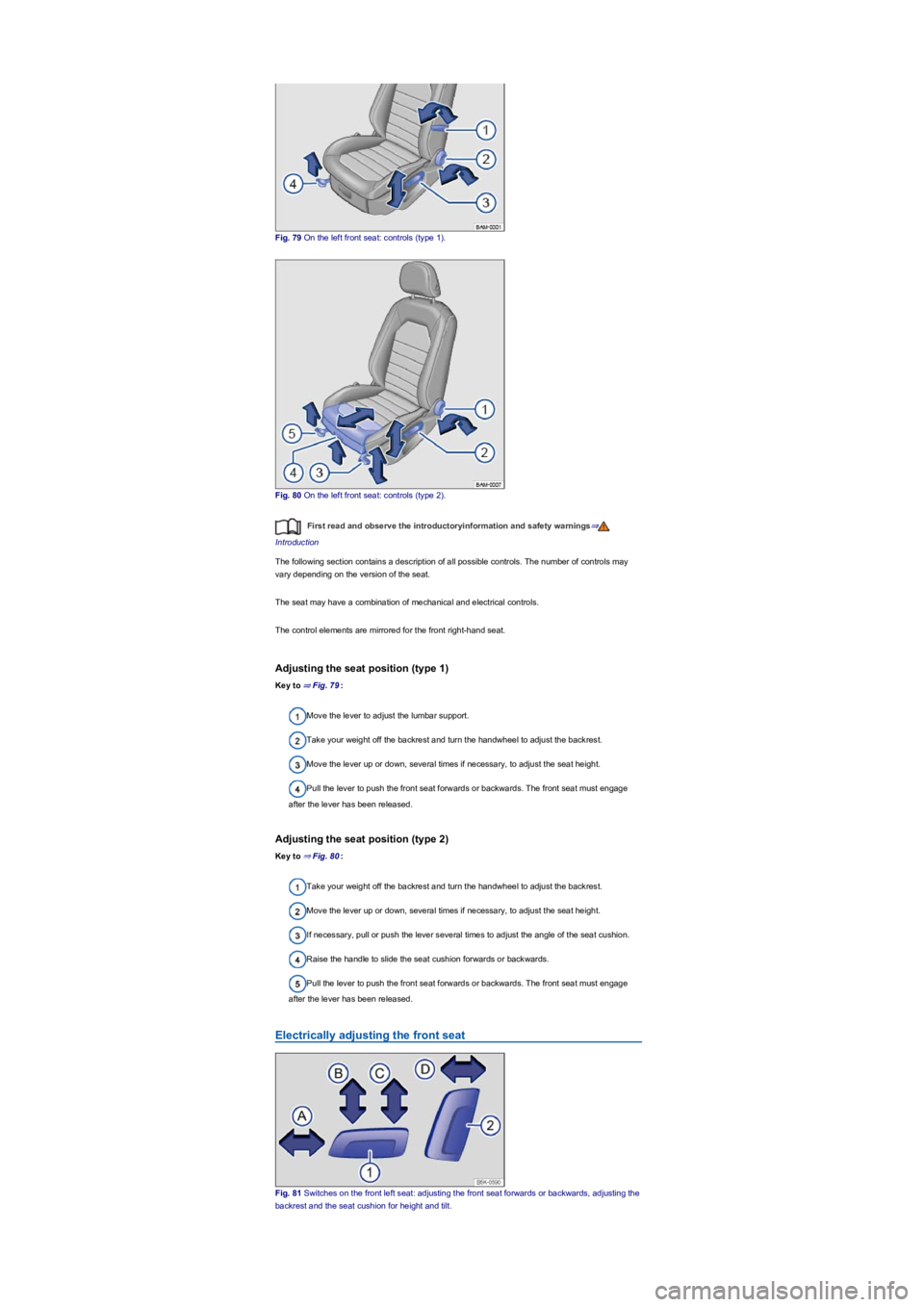
Fig. 79 On the left front seat: controls (type 1).
Fig. 80 On the left front seat: controls (type 2).
First read and observe the introductoryinformation and safety warnings⇒
Introduction
The following section contains a description of all possible controls. The number of controls may
vary depending on the version of the seat.
The seat may have a combination of mechanical and electrical controls.
The control elements are mirrored for the front right-hand seat.
Adjusting the seat position (type 1)
Key to ⇒ Fig. 79:
Move the lever to adjust the lumbar support.
Take your weight off the backrest and turn the handwheel to adjust the backrest.
Move the lever up or down, several times if necessary, to adjust the seat height.
Pull the lever to push the front seat forwards or backwards. The front seat must engage
after the lever has been released.
Adjusting the seat position (type 2)
Key to ⇒ Fig. 80:
Take your weight off the backrest and turn the handwheel to adjust the backrest.
Move the lever up or down, several times if necessary, to adjust the seat height.
If necessary, pull or push the lever several times to adjust the angle of the seat cushion.
Raise the handle to slide the seat cushion forwards or backwards.
Pull the lever to push the front seat forwards or backwards. The front seat must engage
after the lever has been released.
Electrically adjusting the front seat
Fig. 81 Switches on the front left seat: adjusting the front seat forwards or backwards, adjusting the
backrest and the seat cushion for height and tilt.
Page 130 of 341
m/k/a995MK Vehicles with manual gearbox: change from first to second gear immediately
after setting off. Change to higher gears rapidly.
m/k/a995MK Vehicles with DSG dual clutch gearbox: accelerate slowly and avoid using the
kickdown function.
Gear-change indicator ⇒ Gear-change indicator.
Eco driving profile ⇒ Driving profile selection and 4MOTION Active Control.
Avoid full throttle
Never fully use the maximum speed of the vehicle. Driving at excessive speeds, e.g. above 130
km/h on the motorway, will increase air resistance and thus the amount of force needed to move
the vehicle.
Reduce idling
Drive off immediately with low revs. If you are stopped for a long period, do not allow the engine to
idle but switch it off, e.g. when in a traffic jam or at a railway crossing.
In vehicles with an activated start/stop system, the engine will switch off automatically when the
vehicle is stopping and when the vehicle is stationary ⇒ Start/stop system .
Refuel with moderation
A full fuel tank increases the weight of the vehicle. A fuel tank that is half to three quarters full is
sufficient for urban journeys in particular.
Avoid short journeys
A cold engine has a very high fuel consumption. The optimum operating temperature is reached
only after driving a few miles. The fuel consumption is above average at very low ambient
temperatures, e.g. in winter ⇒ Fig. 116. Plan journeys economically and combine short distances.
Carry out regular maintenance
Regular maintenance is an essential prerequisite for economical driving and increases the service
life of the vehicle.
Observe the correct tyre pressures
An inadequate tyre pressure does not just mean greater wear, but also increases the rolling
resistance of the tyres and thus the fuel consumption. Use optimised rolling resistance tyres.
Adjust the tyre pressure according to the vehicle load. Observe the information on the tyre pressure
sticker ⇒ Useful information about wheels and tyres
Tyre Pressure Loss Indicator or Tyre Pressure Monitoring System ⇒ Tyre monitoring systems.
Use low viscosity engine oil
Fully synthetic engine oils with a low viscosity decrease frictional resistance in the engine and
spread better and more quickly, especially for cold starts.
Do not drive with unnecessary loads in the vehicle
You can reduce fuel consumption by clearing out the luggage compartment before setting off, for
example by removing empty drink crates or unused child seats.
In order to keep the drag coefficient of the vehicle as low as possible, remove attachments and
add-on parts such as ski, bicycle or roof carriers after use.
Save electrical energy
The alternator is driven by the engine and generates power for convenience consumers such as the
air conditioning system, window heating and ventilation. Saving electrical energy is easy, e.g.:
•At high ambient temperatures, ventilate the car before starting a journey and drive a short
distance with open window. Only then switch on the air conditioning system.
•Switch off convenience systems as soon as they have served their purpose.
Adapt your speed and distance from the vehicles ahead to suit visibility, weather, road
and traffic conditions.
WARNING
Page 145 of 341
DSG dual clutch gearbox
Function of the DSG dual clutch gearbox
Description
The vehicle is equipped with a DSG dual clutch gearbox.
The DSG dual clutch gearbox is a gearbox which uses dual-clutch technology to change gear
automatically. It uses a dual clutch and two gear train halves to enable very fast gear changes with
no loss of torque. The DSG dual clutch gearbox thus combines the performance and economy of a
manual gearbox with the comfort and convenience of a conventional automatic transmission.
Function
When driving, engine power is transferred to the drive axle via the gearbox. In order to change
gears, the power transmission between the engine and the gearbox has to be interrupted. This is
what the clutch is for.
With the DSG dual clutch system with its two gear train halves, the engine power is always
connected to one gear train half when driving. Before a gear change, the next higher or lower gear
is already preselected in the load-free second gear train half. The clutch on the non-driven gear is
closed and the other is opened at the same time. This is what makes very fast gear changes
possible.
Thanks to its design, the DSG dual clutch gearbox is more efficient than an automatic gearbox.
Whereas in an automatic gearbox the torque converter is constantly in use, in the DSG dual clutch
system the clutch can be opened at idling speed, thus saving fuel. Thanks to its efficiency, low
weight and intelligent control system, the DSG dual clutch system usually enables fuel
consumption equal to or lower than a manual gearbox.
However, just like the manual gearbox, the clutch in the DSG dual clutch gearbox is subject to
wear. Regular maintenance is necessary depending on the type of dual clutch gearbox DSG;
further information ⇒ Scope of service. In the event of a fault in one gear train half, the DSG dual
clutch gearbox also allows one gear train half to be deactivated and the journey to be continued
using the other gear train half ⇒ Troubleshooting. If this happens, have the system checked as
soon as possible by a qualified workshop.
DSG dual clutch gearbox: selecting a gear
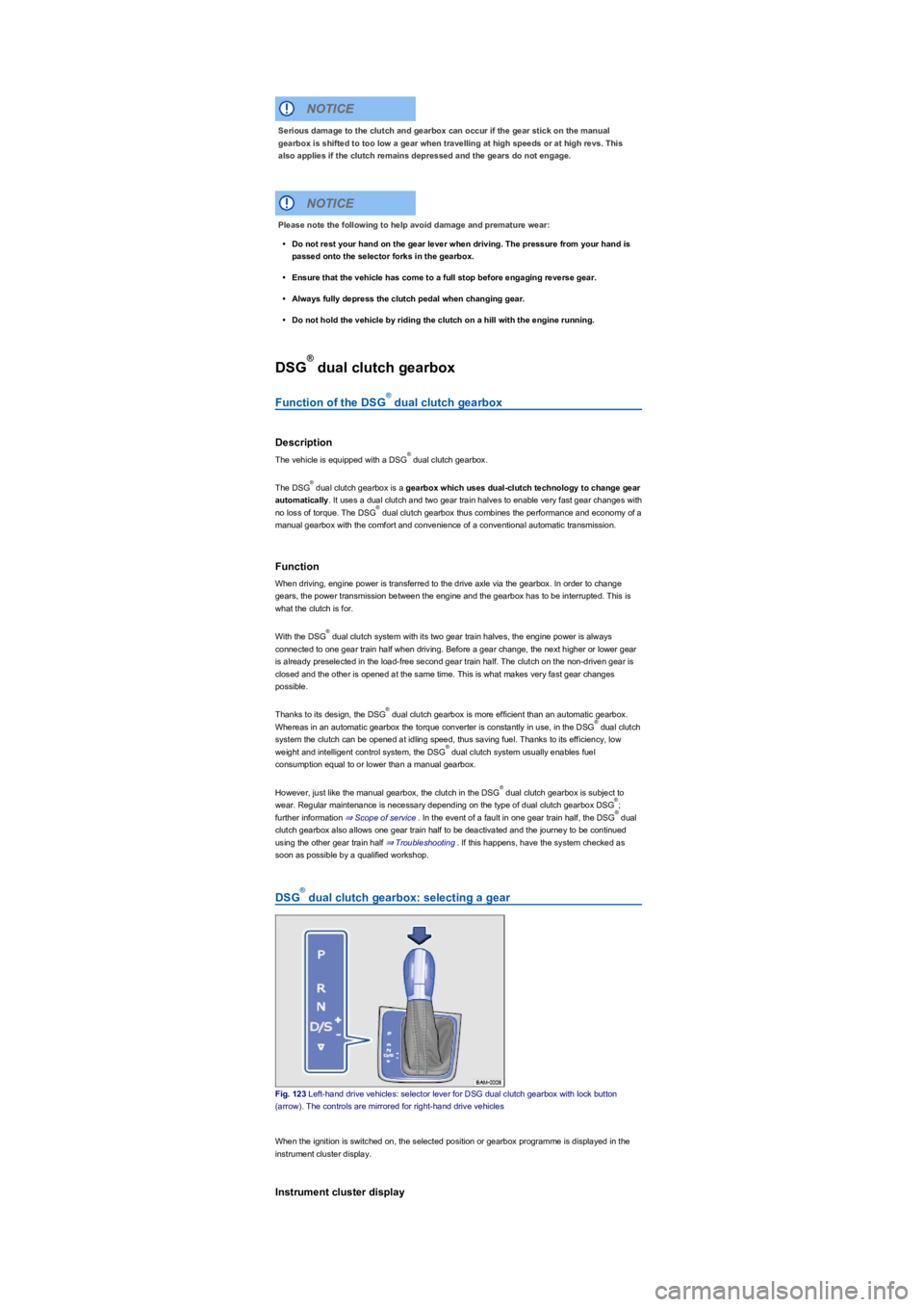
Fig. 123 Left-hand drive vehicles: selector lever for DSG dual clutch gearbox with lock button
(arrow). The controls are mirrored for right-hand drive vehicles
When the ignition is switched on, the selected position or gearbox programme is displayed in the
instrument cluster display.
Instrument cluster display
Serious damage to the clutch and gearbox can occur if the gear stick on the manual
gearbox is shifted to too low a gear when travelling at high speeds or at high revs. This
also applies if the clutch remains depressed and the gears do not engage.
NOTICE
Please note the following to help avoid damage and premature wear:
•Do not rest your hand on the gear lever when driving. The pressure from your hand is
passed onto the selector forks in the gearbox.
•Ensure that the vehicle has come to a full stop before engaging reverse gear.
•Always fully depress the clutch pedal when changing gear.
•Do not hold the vehicle by riding the clutch on a hill with the engine running.
NOTICE
®
®
®
®
®
®
®
®
®
®
®
®
®
Page 166 of 341
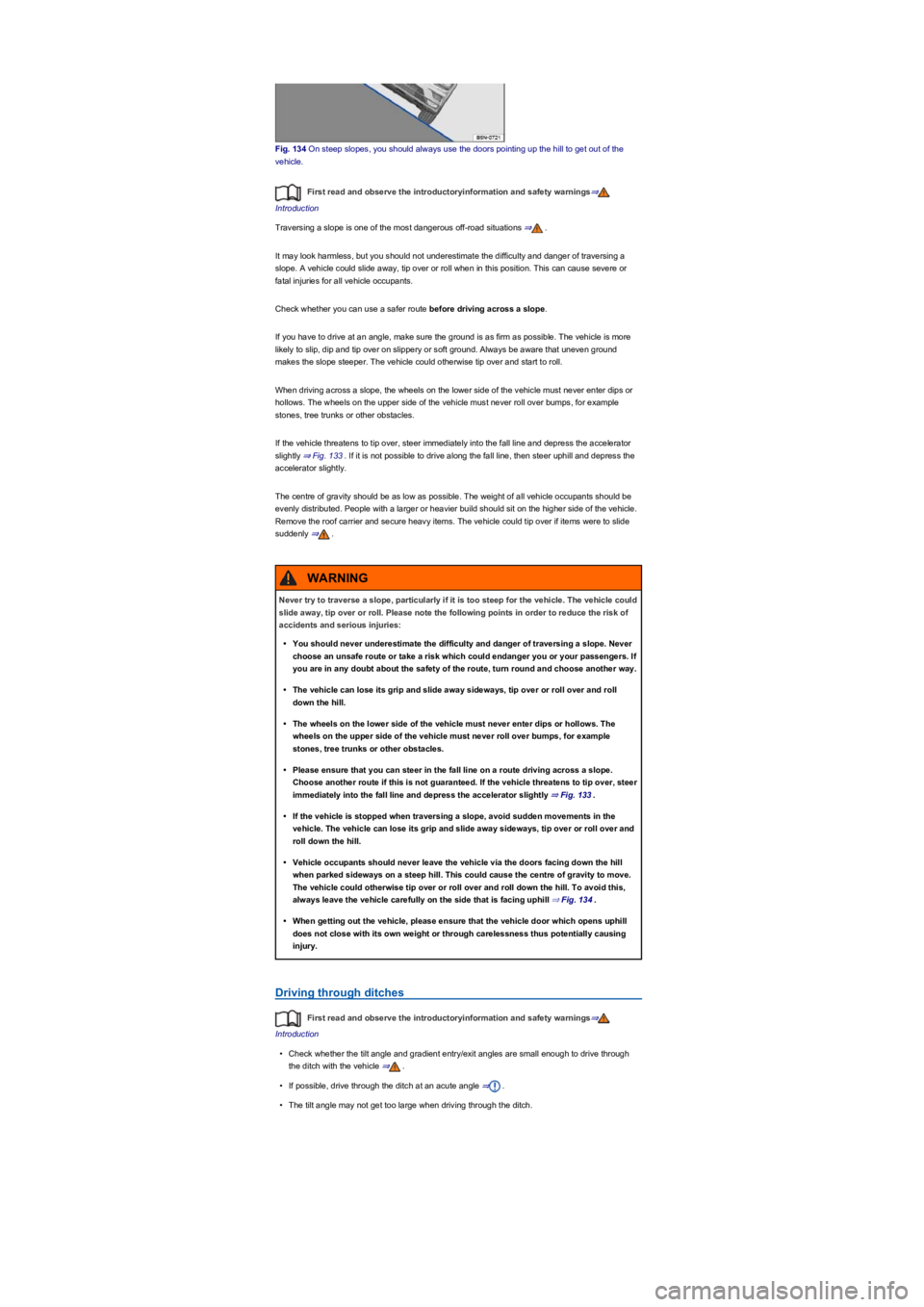
Fig. 134 On steep slopes, you should always use the doors pointing up the hill to get out of the
vehicle.
First read and observe the introductoryinformation and safety warnings⇒
Introduction
Traversing a slope is one of the most dangerous off-road situations ⇒.
It may look harmless, but you should not underestimate the difficulty and danger of traversing a
slope. A vehicle could slide away, tip over or roll when in this position. This can cause severe or
fatal injuries for all vehicle occupants.
Check whether you can use a safer route before driving across a slope.
If you have to drive at an angle, make sure the ground is as firm as possible. The vehicle is more
likely to slip, dip and tip over on slippery or soft ground. Always be aware that uneven ground
makes the slope steeper. The vehicle could otherwise tip over and start to roll.
When driving across a slope, the wheels on the lower side of the vehicle must never enter dips or
hollows. The wheels on the upper side of the vehicle must never roll over bumps, for example
stones, tree trunks or other obstacles.
If the vehicle threatens to tip over, steer immediately into the fall line and depress the accelerator
slightly ⇒ Fig. 133. If it is not possible to drive along the fall line, then steer uphill and depress the
accelerator slightly.
The centre of gravity should be as low as possible. The weight of all vehicle occupants should be
evenly distributed. People with a larger or heavier build should sit on the higher side of the vehicle.
Remove the roof carrier and secure heavy items. The vehicle could tip over if items were to slide
suddenly ⇒.
Driving through ditches
First read and observe the introductoryinformation and safety warnings⇒
Introduction
•Check whether the tilt angle and gradient entry/exit angles are small enough to drive through
the ditch with the vehicle ⇒.
•If possible, drive through the ditch at an acute angle ⇒.
•The tilt angle may not get too large when driving through the ditch.
Never try to traverse a slope, particularly if it is too steep for the vehicle. The vehicle could
slide away, tip over or roll. Please note the following points in order to reduce the risk of
accidents and serious injuries:
•You should never underestimate the difficulty and danger of traversing a slope. Never
choose an unsafe route or take a risk which could endanger you or your passengers. If
you are in any doubt about the safety of the route, turn round and choose another way.
•The vehicle can lose its grip and slide away sideways, tip over or roll over and roll
down the hill.
•The wheels on the lower side of the vehicle must never enter dips or hollows. The
wheels on the upper side of the vehicle must never roll over bumps, for example
stones, tree trunks or other obstacles.
•Please ensure that you can steer in the fall line on a route driving across a slope.
Choose another route if this is not guaranteed. If the vehicle threatens to tip over, steer
immediately into the fall line and depress the accelerator slightly ⇒ Fig. 133.
•If the vehicle is stopped when traversing a slope, avoid sudden movements in the
vehicle. The vehicle can lose its grip and slide away sideways, tip over or roll over and
roll down the hill.
•Vehicle occupants should never leave the vehicle via the doors facing down the hill
when parked sideways on a steep hill. This could cause the centre of gravity to move.
The vehicle could otherwise tip over or roll over and roll down the hill. To avoid this,
always leave the vehicle carefully on the side that is facing uphill ⇒ Fig. 134.
•When getting out the vehicle, please ensure that the vehicle door which opens uphill
does not close with its own weight or through carelessness thus potentially causing
injury.
WARNING
Page 168 of 341
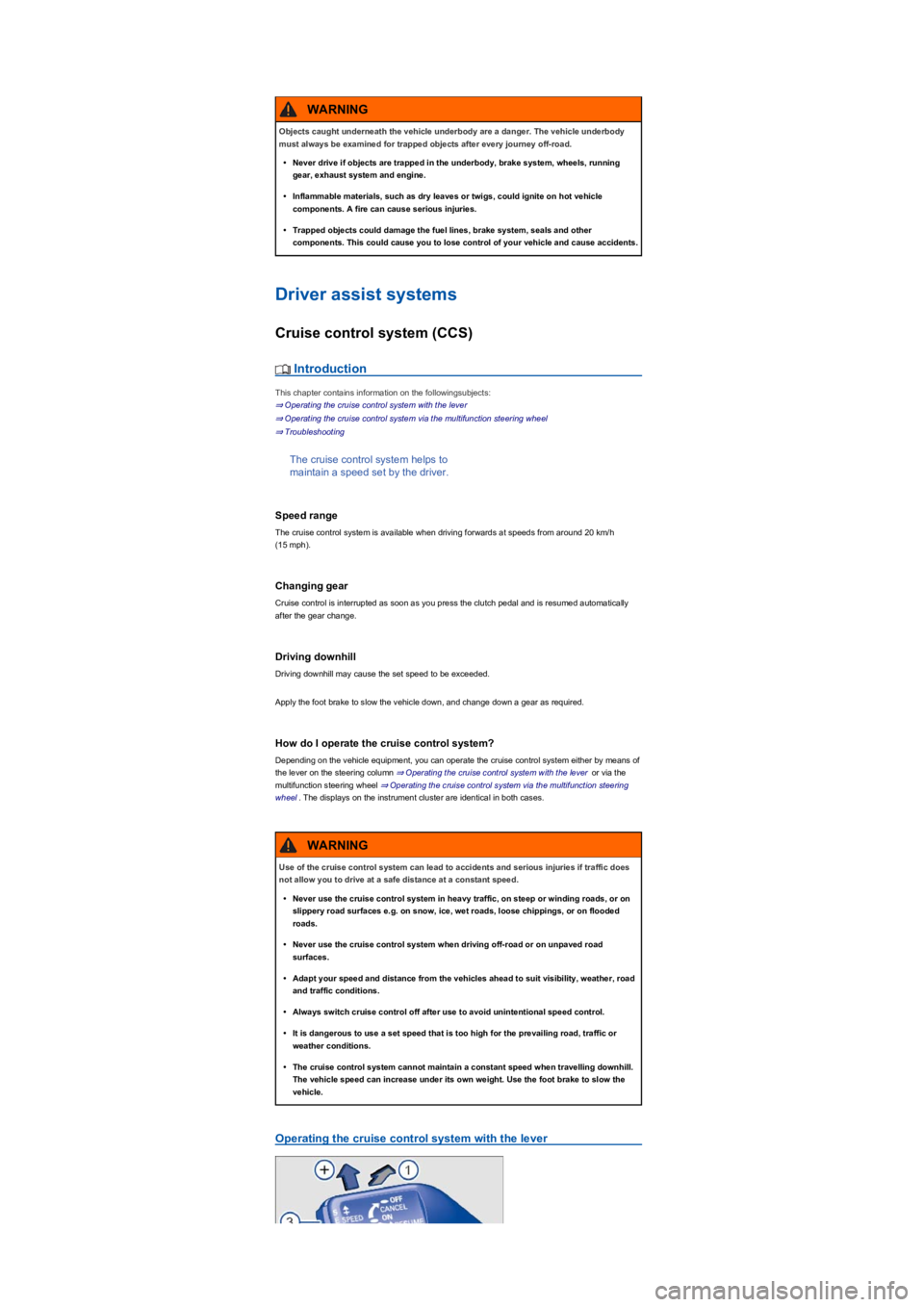
Driver assist systems
Cruise control system (CCS)
Introduction
This chapter contains information on the followingsubjects:
⇒ Operating the cruise control system with the lever
⇒ Operating the cruise control system via the multifunction steering wheel
⇒ Troubleshooting
The cruise control system helps to
maintain a speed set by the driver.
Speed range
The cruise control system is available when driving forwards at speeds from around 20 km/h
(15 mph).
Changing gear
Cruise control is interrupted as soon as you press the clutch pedal and is resumed automatically
after the gear change.
Driving downhill
Driving downhill may cause the set speed to be exceeded.
Apply the foot brake to slow the vehicle down, and change down a gear as required.
How do I operate the cruise control system?
Depending on the vehicle equipment, you can operate the cruise control system either by means of
the lever on the steering column ⇒ Operating the cruise control system with the lever or via the
multifunction steering wheel ⇒ Operating the cruise control system via the multifunction steering
wheel. The displays on the instrument cluster are identical in both cases.
Operating the cruise control system with the lever
Objects caught underneath the vehicle underbody are a danger. The vehicle underbody
must always be examined for trapped objects after every journey off-road.
•Never drive if objects are trapped in the underbody, brake system, wheels, running
gear, exhaust system and engine.
•Inflammable materials, such as dry leaves or twigs, could ignite on hot vehicle
components. A fire can cause serious injuries.
•Trapped objects could damage the fuel lines, brake system, seals and other
components. This could cause you to lose control of your vehicle and cause accidents.
WARNING
Use of the cruise control system can lead to accidents and serious injuries if traffic does
not allow you to drive at a safe distance at a constant speed.
•Never use the cruise control system in heavy traffic, on steep or winding roads, or on
slippery road surfaces e.g. on snow, ice, wet roads, loose chippings, or on flooded
roads.
•Never use the cruise control system when driving off-road or on unpaved road
surfaces.
•Adapt your speed and distance from the vehicles ahead to suit visibility, weather, road
and traffic conditions.
•Always switch cruise control off after use to avoid unintentional speed control.
•It is dangerous to use a set speed that is too high for the prevailing road, traffic or
weather conditions.
•The cruise control system cannot maintain a constant speed when travelling downhill.
The vehicle speed can increase under its own weight. Use the foot brake to slow the
vehicle.
WARNING
Page 171 of 341
Troubleshooting
First read and observe the introductoryinformation and safety warnings⇒
Introduction
Regulation is automatically interrupted.
•You have depressed the brake pedal.
•The selector lever of the DSG dual clutch gearbox is not in the selector lever position D.
•The vehicle has exceeded the stored speed for an extended period.
•If regulation related to driving dynamics is taking place, e.g. by TCS and ESC.
•Malfunction. Switch off the cruise control system and have it checked by a qualified workshop.
Volkswagen recommends using a Volkswagen dealership for this purpose.
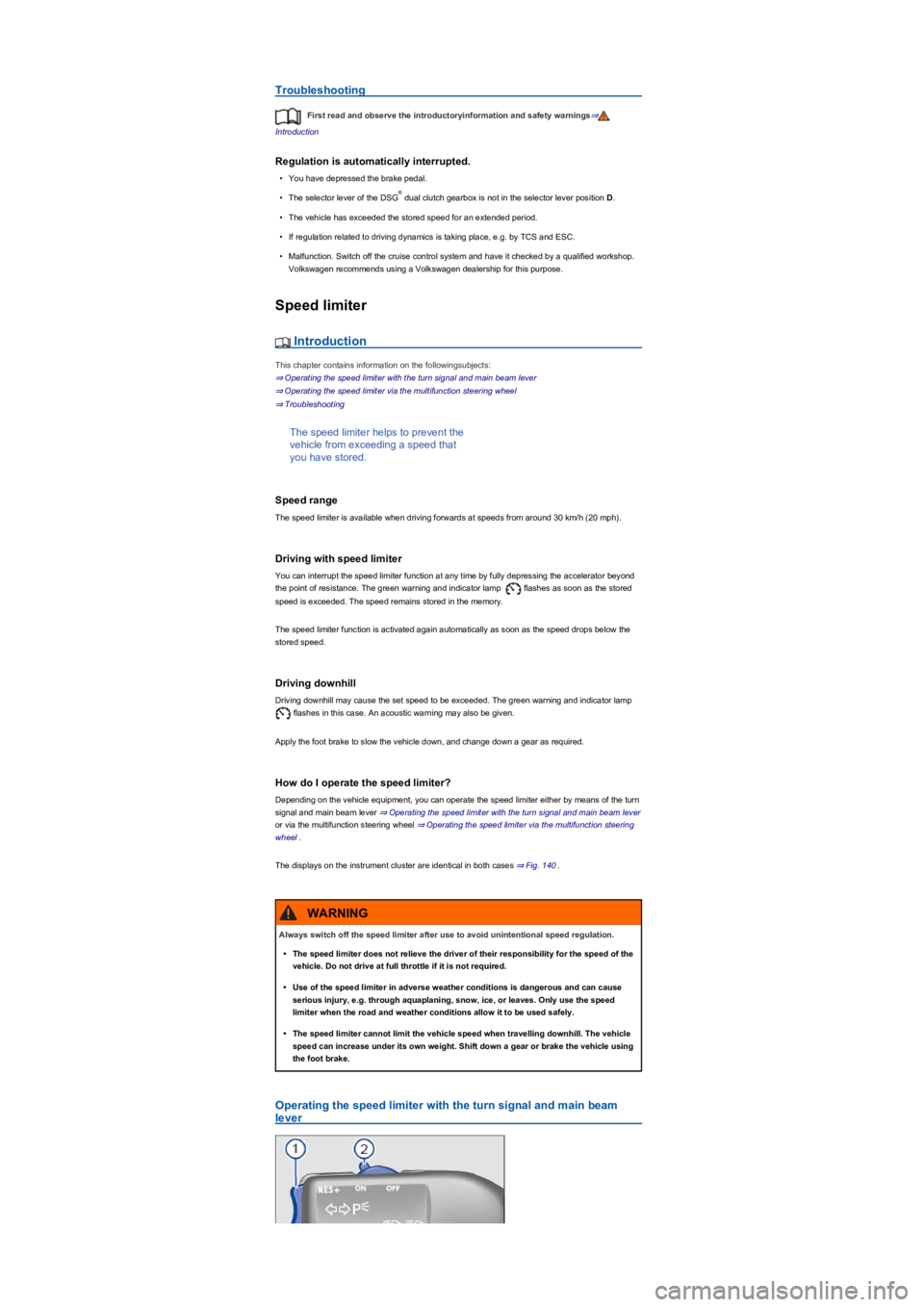
Speed limiter
Introduction
This chapter contains information on the followingsubjects:
⇒ Operating the speed limiter with the turn signal and main beam lever
⇒ Operating the speed limiter via the multifunction steering wheel
⇒ Troubleshooting
The speed limiter helps to prevent the
vehicle from exceeding a speed that
you have stored.
Speed range
The speed limiter is available when driving forwards at speeds from around 30 km/h (20 mph).
Driving with speed limiter
You can interrupt the speed limiter function at any time by fully depressing the accelerator beyond
the point of resistance. The green warning and indicator lamp flashes as soon as the stored
speed is exceeded. The speed remains stored in the memory.
The speed limiter function is activated again automatically as soon as the speed drops below the
stored speed.
Driving downhill
Driving downhill may cause the set speed to be exceeded. The green warning and indicator lamp
flashes in this case. An acoustic warning may also be given.
Apply the foot brake to slow the vehicle down, and change down a gear as required.
How do I operate the speed limiter?
Depending on the vehicle equipment, you can operate the speed limiter either by means of the turn
signal and main beam lever ⇒ Operating the speed limiter with the turn signal and main beam lever
or via the multifunction steering wheel ⇒ Operating the speed limiter via the multifunction steering
wheel.
The displays on the instrument cluster are identical in both cases ⇒ Fig. 140.
Operating the speed limiter with the turn signal and main beam
lever
®
Always switch off the speed limiter after use to avoid unintentional speed regulation.
•The speed limiter does not relieve the driver of their responsibility for the speed of the
vehicle. Do not drive at full throttle if it is not required.
•Use of the speed limiter in adverse weather conditions is dangerous and can cause
serious injury, e.g. through aquaplaning, snow, ice, or leaves. Only use the speed
limiter when the road and weather conditions allow it to be used safely.
•The speed limiter cannot limit the vehicle speed when travelling downhill. The vehicle
speed can increase under its own weight. Shift down a gear or brake the vehicle using
the foot brake.
WARNING