weight VOLKSWAGEN TIGUAN 2017 Owner´s Manual
[x] Cancel search | Manufacturer: VOLKSWAGEN, Model Year: 2017, Model line: TIGUAN, Model: VOLKSWAGEN TIGUAN 2017Pages: 341, PDF Size: 9.14 MB
Page 191 of 341
Electronic parking brake
Operating the electronic parking brake
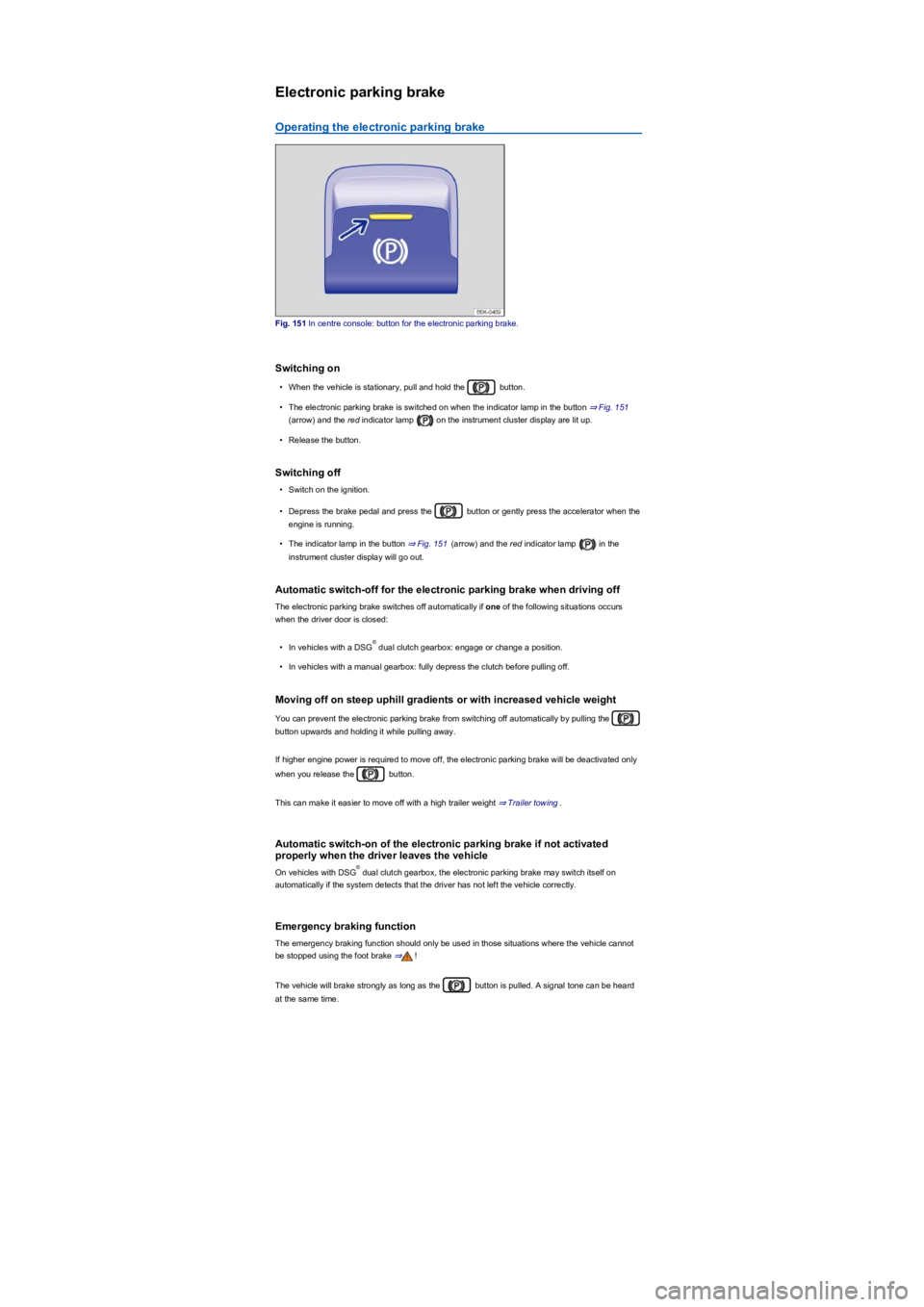
Fig. 151 In centre console: button for the electronic parking brake.
Switching on
•When the vehicle is stationary, pull and hold the button.
•The electronic parking brake is switched on when the indicator lamp in the button ⇒ Fig. 151
(arrow) and the red indicator lamp on the instrument cluster display are lit up.
•Release the button.
Switching off
•Switch on the ignition.
•Depress the brake pedal and press the button or gently press the accelerator when the
engine is running.
•The indicator lamp in the button ⇒ Fig. 151 (arrow) and the red indicator lamp in the
instrument cluster display will go out.
Automatic switch-off for the electronic parking brake when driving off
The electronic parking brake switches off automatically if one of the following situations occurs
when the driver door is closed:
•In vehicles with a DSG dual clutch gearbox: engage or change a position.
•In vehicles with a manual gearbox: fully depress the clutch before pulling off.
Moving off on steep uphill gradients or with increased vehicle weight
You can prevent the electronic parking brake from switching off automatically by pulling the
button upwards and holding it while pulling away.
If higher engine power is required to move off, the electronic parking brake will be deactivated only
when you release the button.
This can make it easier to move off with a high trailer weight ⇒ Trailer towing.
Automatic switch-on of the electronic parking brake if not activated
properly when the driver leaves the vehicle
On vehicles with DSG dual clutch gearbox, the electronic parking brake may switch itself on
automatically if the system detects that the driver has not left the vehicle correctly.
Emergency braking function
The emergency braking function should only be used in those situations where the vehicle cannot
be stopped using the foot brake ⇒!
The vehicle will brake strongly as long as the button is pulled. A signal tone can be heard
at the same time.
®
®
Page 216 of 341
Fig. 172 Drawer under the front seat.
First read and observe the introductoryinformation and safety warnings⇒
Introduction
To open: press the button in the drawer grip and open the drawer.
To close: push the drawer under the front seat until it clicks into place.
Coat and bag hooks
First read and observe the introductoryinformation and safety warnings⇒
Introduction
Coat hooks are located in the centre door pillar and on the rear roof grab handles.
Bag hooks are located in the luggage compartment ⇒ Luggage compartment equipment.
Drink holder
Introduction
This chapter contains information on the followingsubjects:
⇒ Drink holders in the front centre console
⇒ Drink holder in the rear centre armrest
Bottle holder
There are bottle holders in the stowage compartments of the driver and front passenger doors.
There are also drink holders in the folding tables on the front seats ⇒ Folding table.
If the drawer is left open it can hinder the correct operation of the pedals. This can result
in accidents and severe injuries.
•Always keep the drawer closed while the vehicle is in motion. Otherwise the drawer or
other items could fall into the driver footwell and obstruct the pedals.
WARNING
The drawer is designed for a maximum load of 1.5kg.
NOTICE
Hanging up items of clothing can restrict the driver's field of vision and cause accidents
and serious injuries.
•Always hang items of clothing in such a way that they do not restrict the driver's field
of vision.
•The built-in coat hooks should only be used for lightweight clothing. Never leave any
heavy, hard or sharp objects in the pockets.
WARNING
Each coat hook may be loaded with a maximum of 2.5 kg.
NOTICE
Page 224 of 341
Volkswagen Car-Net services can be subject to regional restrictions. Availability also depends on
the mobile network coverage in each country.
Exchanging your system
If the factory-fitted Infotainment system or control unit is damaged or must be exchanged in a
vehicle with Volkswagen Car-Net services installed, go to a qualified workshop. This may require
registering or activating again.
Registration for user account on Car-Net portal
If you wish to use the Volkswagen Car-Net e-Remote, Guide & Inform or Security & Service
services in a Car-Net-compatible vehicle, you must create a user account at
www.volkswagen.com/car-net and activate Volkswagen Car-Net.
Service description
The portfolios for the e-Remote, Guide & Inform and Security & Service services are all explained in
a separate service description. This service descriptions and additional important information about
all services and Car-Net-capable vehicles are available online at www.volkswagen.com/car-net and
on the Car-Net portal once a user account has been set up.
All service descriptions are updated at irregular intervals and are available on the Car-Net portal.
Always use the latest edition of the relevant service description.
Volkswagen Car-Net services is a system based on a mobile network. If a fault arises
despite the fact that all requirements have been fulfilled, please try using the services again at a
later time.
The use of Volkswagen Car-Net and the necessary mobile network connection may be
subject to a fee. Due to the potentially high volume of data in use, Volkswagen recommends using
a mobile phone tariff which includes a data flat rate. For more information contact your mobile
telephone provider.
Data transfer via the factory-fitted SIM card reader (if possible).
Apps
First read and observe the introductoryinformation and safety warnings⇒
Introduction
•The Volkswagen Car-Net app that executes Volkswagen Car-Net services in the vehicle and
that can provide information.
•Volkswagen App-Connect allows content from Volkswagen apps and third party apps on mobile
devices to be shown on the Infotainment system screen.
There may be problems with compatibility with third party apps.
Applications, their use and the necessary mobile network connection may be subject to charges.
A wide range of applications may be available and they can be vehicle-specific and country-specific
⇒. Content, range and provider of applications can vary. Some applications also depend on
availability of services offered by third parties.
We are unable to guarantee that the available apps can be run on all mobile devices and all
operating systems.
Applications offered by Volkswagen can be changed, set, deactivated, reactivated and expanded
without prior notice.
Transporting
Stowing luggage and loads
Cargo and luggage can be transported in the vehicle, on a trailer ⇒ Technical requirements and on
the roof ⇒ Roof carrier. Always observe the legal regulations.
Stowing luggage safely in the vehicle
•Always distribute any loads in the vehicle as evenly as possible.
•Always stow luggage and heavy objects in the luggage compartment ⇒.
•Place heavy objects as far forward in the luggage compartment as possible.
•Observe gross axle weight ratings and the gross vehicle weight rating ⇒ Information on
technical data.
•Secure luggage in the luggage compartment to the fastening rings using suitable fixing and
securing straps ⇒ Luggage compartment equipment.
•Also stow small objects safely.
1)
Page 232 of 341
If the vehicle is not approved for use with a roof carrier, do not use or retrofit a roof carrier.
Securing a roof carrier
First read and observe the introductoryinformation and safety warnings⇒
Introduction
Special roof carriers must be used to transport luggage, bicycles, skis, surfboards or boats safely ⇒
. Suitable accessories are available from your Volkswagen dealership.
Attaching roof bars and load carrier system (vehicles with roof railings)
Mount roof bars to the roof railing according to the installation instructions provided.
Once you have fitted the base carrier bars, you can then secure the respective carrier system on
them.
Loading the roof carrier
First read and observe the introductoryinformation and safety warnings⇒
Introduction
Maximum permissible roof load
The maximum permitted roof load is 75 kg.
The roof load limit refers to the combined weight of the roof carrier and the load carried on the roof
⇒.
When transporting heavy or bulky items on the roof carrier, the vehicle handling will
change due to the shift in the centre of gravity and increased susceptibility to crosswinds.
•Always secure loads properly using suitable and undamaged securing straps.
•Cargo that is large, heavy, bulky, long or flat will have a negative effect on the vehicle
aerodynamics, centre of gravity and overall handling.
•Avoid abrupt and sudden driving and braking manoeuvres.
•Always adapt your speed and driving style to suit visibility, weather, road and traffic
conditions.
WARNING
A roof carrier that has not been approved for the vehicle or a roof carrier that is fitted to a
vehicle that is not approved for use with a roof carrier may cause accidents or injuries.
•Use only roof carriers that have been approved by Volkswagen for your vehicle type.
•Never use a roof carrier on a vehicle that has not been approved for use with a roof
carrier.
•A roof carrier that is fitted nevertheless may become loose whilst the vehicle is in
motion and fall from the vehicle roof.
WARNING
Securing a roof carrier of any kind to a vehicle that is not approved for use with a roof
carrier may lead to severe damage to the vehicle.
NOTICE
Incorrectly attaching and using the roof bars and load carrier could cause the whole roof
carrier system to fall off the roof. This could cause accidents and injuries.
•Only use roof bars and load carrier systems when they are undamaged and fitted
correctly.
•Always fit roof bars and load carriers correctly. Always observe the installation
instructions provided by the manufacturer.
•Attach the roof bars only at the specified mounting points.
•Special roof carriers for items such as bicycles, skis, surfboards, etc. should always be
properly installed. Always observe the installation instructions provided by the
manufacturer.
•Check that the roof carrier is secured before starting your journey and tighten as
necessary after driving a short distance. During a long trip, check all bolts and
fasteners at each stop.
•Do not carry out any changes or repairs to the roof bars or the load carrier system.
WARNING
Page 233 of 341
Make sure you are aware of the weight of the roof carrier system and the load to be transported.
Weigh the load if necessary.
However, you will not be able to carry the maximum roof load if you are using a roof carrier with a
lower weight rating. In this case, do not exceed the maximum weight limit for the load carrier
system which is specified in the manufacturer's installation instructions.
Distributing the load
Distribute the load evenly and secure it correctly ⇒.
Notes on use
First read and observe the introductoryinformation and safety warnings⇒
Introduction
Remove the roof carrier in the following situations
•When the roof carrier is no longer being used.
•Before entering a car wash.
•When the vehicle height exceeds the required clearance height, e.g. in a garage.
Driving with a fitted roof carrier will increase air resistance and thus increase fuel
consumption.
Trailer towing
Introduction
This chapter contains information on the followingsubjects:
⇒ Technical requirements
⇒ Electrically adjustable ball coupling
⇒ Fitting a bicycle carrier on the swivelling ball head
⇒ Notes on towing a trailer
⇒ Loading the trailer
⇒ Trailer towing
⇒ Trailer stabilisation
⇒ Retrofitting a towing bracket
⇒ Troubleshooting
The vehicle can be used to tow a trailer if it has the required technical equipment for this. The
additional trailer load will affect the amount of wear, fuel consumption and performance of the
vehicle and, in certain circumstances, could shorten the service intervals.
Accidents and vehicle damage can occur if the maximum permitted roof load is exceeded.
•Never exceed the quoted roof load, the maximum permissible axle loads, and the
permissible gross vehicle weight for the vehicle.
•Do not exceed the weight rating of the roof carrier, even if the maximum roof load has
not been reached.
WARNING
Loose and incorrectly secured loads can fall off the roof carrier and cause accidents and
injuries.
•Always use suitable and undamaged securing straps.
WARNING
When opening the boot lid take care not to let it hit the roof load.
NOTICE
•Always remove the roof carrier before driving through an automatic car wash.
•The height of the vehicle is changed by the installation of a carrier system and the load
secured to it. Check and compare the height of the vehicle with clearance heights, e.g.
for underpasses and garage doors.
•The roof carrier and its load must not obstruct you from opening and closing the tilting
and sliding panoramic sunroof and the boot lid. The roof aerial must also remain
unaffected.
NOTICE
Page 234 of 341
Driving with a trailer not only places an extra load on the vehicle, but also requires increased
concentration on the part of the driver.
Vehicles with start/stop system
If the connected trailer is not recognised, or when using towing brackets that were not retrofitted by
Volkswagen, the start/stop system must be deactivated manually using the button in the
centre console before starting to tow a trailer, and must remain switched off for as long as the trailer
is being towed ⇒.
Always switch off the anti-theft alarm before a trailer is hitched or unhitched or a bicycle
carrier is loaded or unloaded ⇒ Central and manual locking. The tilt sensor could otherwise trigger
an alarm unintentionally.
With a new engine, do not tow a trailer during the first 1,000 km ⇒ Running in the engine.
Some retro-fitted towing brackets may cover the aperture for fitting the towing eye. If so, the
towing eye cannot be used for towing or tow-starting other vehicles. For this reason, the retro-fitted
towing bracket ball head should be stored in the vehicle at all times.
It is dangerous to transport people in a trailer and it may also be illegal.
DANGER
Improper use of the towing bracket can lead to a loss of vehicle control, accidents and
serious injuries.
•Only use the towing bracket if it is fitted properly and is not damaged.
•Do not carry out any alterations or repairs to the towing bracket.
•Wherever possible, swivel in or remove the ball head when a trailer is not being used in
order to reduce the risk of injury in rear-end collisions, and the risk of injury to
pedestrians and cyclists when the vehicle is parked.
•Never install a weight-distributing or load-balancing towing bracket to the vehicle. The
vehicle is not constructed for these kinds of towing brackets. The towing bracket can
fail, causing the trailer to tear loose from the vehicle.
WARNING
Towing a trailer and transporting heavy or bulky items can change the vehicle handling,
increase the braking distance and lead to accidents.
•Always secure loads properly using suitable and undamaged securing straps.
•Always adapt your speed and driving style to suit visibility, weather, road and traffic
conditions. Reduce your speed, particularly when going downhill.
•Trailers with a high centre of gravity are more likely to tip over than trailers with a low
centre of gravity.
•Always drive carefully and think ahead. Accelerate carefully and gently. Avoid abrupt
and sudden driving and braking manoeuvres.
•Take special care when overtaking. Reduce your speed immediately if the trailer shows
even the slightest sign of snaking.
•Never drive faster than 80 km/h (50 mph) when towing a trailer; also 100 km/h (60 mph)
in exceptional cases. This also applies to countries where higher speeds are permitted.
Keep to country-specific speed limits which may be lower for vehicles with trailers than
for vehicles without trailers.
•Never try to stop a trailer from snaking by increasing your speed.
•Never install a weight-distributing or load-balancing towing bracket on the vehicle.
WARNING
The start/stop system must always be switched off manually when towing a trailer using
towing brackets that have not been retrofitted by Volkswagen. Otherwise faults can occur
in the brake system, possibly resulting in accidents and serious injuries.
WARNING
Observe the instructions and information relating to vehicles with N1 approval
⇒ Information about vehicles with N1 approval (light commercial vehicle).
NOTICE
Page 239 of 341
If there is a fault in the vehicle or trailer electrical systems or in the anti-theft alarm or if there
is a fault in the anti-theft alarm, have the vehicle checked by a qualified workshop.
If the engine is not running and electrical equipment is switched on in the trailer via the trailer
socket, the 12-volt vehicle battery will discharge.
If the 12-volt vehicle battery charge level is low, the electrical connection to the trailer will be
interrupted automatically.
Loading the trailer
First read and observe the introductoryinformation and safety warnings⇒
Introduction
Trailer weight and drawbar load
The trailer weight is the weight that the vehicle can pull ⇒. The drawbar load is the load that is
exerted vertically from above onto the ball head of the towing bracket ⇒ Information on technical
data.
The figures for trailer weights and draw bar weights that are given on the data plate of the towing
bracket are for certification purposes only. The correct values for your specific model, which may be
lower than these figures, are given in the vehicle registration documents. All data in the official
vehicle documents take precedence over these data.
The maximum permitted drawbar load exerted by the trailer drawbar on the ball head of the towing
bracket must not exceed 100 kg.
In the interest of driving safety, Volkswagen recommends that you always use the maximum
drawbar load. The response of the trailer on the road will be poor if the drawbar load is too small.
The drawbar load increases the weight on the rear axle and reduces the maximum load level as a
result.
Gross combination weight rating
The combination weight is made up of the actual weight of the loaded vehicle and of the loaded
trailer.
In some countries, trailers are divided into different classes. Volkswagen recommends that you
contact a qualified workshop to find out about suitable trailers.
Loading the trailer
The weight of the load should be distributed evenly. The maximum permitted drawbar load should
be utilised. Do not place the load only at the front or the rear of the trailer:
•Distribute the load in the trailer so that heavy objects are either over or as near to the axle as
possible.
•Secure all loads on the trailer properly.
Tyre pressure
Follow the trailer manufacturer's recommendations concerning the tyre pressure for the trailer tyres.
When towing a trailer, inflate the tyres on the towing vehicle with the maximum permitted tyre
pressure ⇒ Tyre pressure.
Accidents and serious injuries can occur if you exceed the vehicle's maximum permitted
gross axle weight rating, drawbar load, gross vehicle weight rating or gross combination
weight rating.
•Never exceed the specified values.
•Never let the actual weights at the front and rear axles exceed the gross axle weight
ratings. Never exceed the permissible gross vehicle weight for the vehicle with weight
at the front and rear of the vehicle.
WARNING
Loads that may slide can severely impair stability and driving safety, which can cause
accidents and severe injuries.
•Always load trailers correctly.
•Always secure loads properly using suitable and undamaged securing straps.
WARNING
Page 240 of 341
Trailer towing
First read and observe the introductoryinformation and safety warnings⇒
Introduction
Headlight adjustment
Towing a trailer can raise the front end of the vehicle enough for the dipped beam to blind other
road users. Use the headlight range control to lower the light cone as required. Vehicles with
automatic headlight range adjustment are adjusted automatically.
Things to note when driving with a trailer
•If the trailer has an overrun brake, apply the brakes gently at first and then firmly. This will
prevent the jerking that can be caused by the trailer wheels locking.
•The combination weight causes the braking distance to increase.
•Engage a lower gear prior to inclines (manual gearbox or Tiptronic mode of the automatic
gearbox) to additionally make use of engine braking. The brake system could otherwise
overheat and fail.
•The vehicle's centre of gravity and, in turn, the vehicle's handling, will change because of the
trailer load and the increased combined towing weight of the vehicle and trailer.
•The weight distribution of a loaded trailer with an unladen towing vehicle is very unfavourable.
When driving in this situation, drive particularly carefully and slowly.
Pulling off on slopes when towing a trailer
A vehicle towing a trailer is liable to roll back a short distance when moving off on a slope,
depending on the angle of the slope and the total weight of the trailer and vehicle.
When towing a trailer, pull off on slopes as follows:
•Depress and hold the brake pedal.
•Press button once to switch off the electronic parking brake ⇒ Electronic parking
brake.
•Manual gearbox: depress the clutch fully.
•Select first gear ⇒ Manual gearbox: selecting a gear or selector lever position D/S⇒ DSG dual
clutch gearbox.
•Pull on the button and hold it in this position to hold the vehicle and trailer with the
electronic parking brake.
•Release the brake pedal.
•Pull away slowly. To do this, slowly release the clutch pedal for a manual gearbox.
•Only let go of the button when the engine has sufficient power to move off.
Trailer stabilisation
First read and observe the introductoryinformation and safety warnings⇒
Introduction
The trailer stabilisation function can detect if an attached trailer is starting to lurch from side to side
and can provide countersteer.
Trailer stabilisation is a subsidiary function of the Electronic Stability Control (ESC).
®
Incorrect trailer towing can cause loss of vehicle control and serious personal injury.
•Towing a trailer and transporting heavy or bulky items can change the way the vehicle
handles and increase the braking distance.
•Always drive carefully and think ahead. Brake earlier than in normal driving.
•Always adapt your speed and driving style to suit visibility, weather, road and traffic
conditions. Reduce your speed, particularly when going downhill.
•Accelerate carefully and gently. Avoid abrupt and sudden driving and braking
manoeuvres.
•Take special care when overtaking. Reduce your speed immediately if the trailer shows
even the slightest sign of snaking.
•Never try to stop a trailer from snaking by increasing your speed.
•Keep to speed limits which may be lower for vehicles with trailers than for vehicles
without trailers.
WARNING
Page 332 of 341
Information in accordance with the EU Chemicals Regulation
REACH
In accordance with the European regulations on chemicals, known as REACH, Volkswagen would
like to inform you about the substances that may be found in your vehicle.
You can access this information online using your vehicle identification number ⇒ Technical data:
https://reachinfo.volkswagen.com
Declaration of conformity
The individual manufacturer declares herewith that the following products conform, at the time of
vehicle production, with the basic requirements and other relevant laws and regulations, including
FCC Part 15.19, FCC Part 15.21 and RSS-Gen Issue 1:
Radio-based equipment
•Electronic immobiliser.
•Vehicle key.
•Keyless Access locking and starting system.
•Adaptive Cruise Control (ACC).
•Area monitoring system (Front Assist) including City Emergency Brake.
•Lane change system (Side Assist)
•Remote control for the auxiliary heater ⇒ Auxiliary heater and ventilation.
•Trailer manoeuvring system (Trailer Assist) ⇒ Trailer Assist
Electrical equipment
•12-volt socket.
•230-volt Euro socket, 115-volt socket, 100-volt socket.
Recycling and scrapping end-of-life vehicles
Recycling end-of-life vehicles
Volkswagen has already made provision for you to recycle your vehicle in an environmentally
responsible manner. The recycling system operating in many European countries will take back
your vehicle at the end of its useful life. Once the vehicle has been recycled, a certificate of
destruction will be issued to show that the vehicle has been disposed of correctly.
End-of-life vehicles are recycled free of charge, provided that national legislation is complied with.
Further information on the recycling of end-of-life vehicles can be found at a Volkswagen
dealership.
Scrapping
The relevant safety requirements must be observed when the vehicle or components of the airbag
and the belt tensioners are scrapped. Qualified workshops are familiar with these requirements.
Information about vehicles with N1 approval (light commercial
vehicle)
Please observe the following information for vehicles used to transport goods with a maximum
permitted weight of up to 3.5 t (N1 approval in Europe):
Variants and number of seats
N1 vehicles based on a Volkswagen passenger car models are available in different versions. The
number of seats may be restricted to two or four.
Vehicles with two seats: there is no floor covering in the rear of the vehicle interior because there is
no rear bench seat ⇒.
Vehicles with four seats: the centre seat on the rear bench seat cannot be used⇒.
Safe transport of children
Like in vehicles with passenger car approval (M1), approved child restraint systems can be used on
the seats ⇒ Safe transport of children.
Towing a trailer
If the vehicle is approved for towing a trailer, observe any local regulations for driving with a trailer
and using a towing bracket.
Page 333 of 341
If the vehicle exceeds the permitted gross weight or axle load for the rear axle, a speed of 80 km/h
must not be exceeded when towing a trailer. This also applies to countries where higher speeds are
permitted. Always obey speed limits. In some areas speed limits for vehicles towing trailers are
lower than for vehicles without trailers.
Any permitted excess loads for the vehicle are entered in the vehicle documents. If no permitted
excess load is entered, the permitted driving speed limit is 100 km/h taking into account country-
specific legislation.
Technical data
Refer to the vehicle documents for the technical data.
Technical data
Information on technical data
Unless otherwise indicated or listed separately, the technical data for the basic model apply.
Optional equipment, different vehicle equipment, special vehicles and country-specific vehicle
equipment levels can result in different values. All data in the official vehicle documents take
precedence over these data.
Observe the instructions and information relating to vehicles with N1 approval ⇒ Information about
vehicles with N1 approval (light commercial vehicle).
Engine
The vehicle data sticker or the vehicle registration documents show which engine is installed in your
vehicle.
Weight
The values for the kerb weight in the following tables apply to the road-ready vehicle with driver
(75 kg), service fluids including fuel tank carrying 90% of its capacity and, if applicable, tool kit and
spare tyre ⇒. Additional equipment and retrofitted accessories increase the kerb weight stated
and reduce the maximum permitted load accordingly.
The load comprises the weights of the following:
•Vehicle occupants
•All luggage
•Roof load including the mounts or roof bars and the load carrier system
•Drawbar load when towing a trailer ⇒ Trailer towing.
Performance figures
For reasons of vehicle registration and vehicle taxation, the power output and performance of some
engines may vary in some countries from the information given in this booklet.
In certain vehicles with heavy duty suspension, the engine could be governed to provide a
maximum speed of 210 km/h.
Danger of injuries and electric shock from exposed cables.
•Have the luggage compartment completed at the latest after delivery so that the cables
in the rear area of the vehicle are covered during use of the vehicle.
WARNING
Danger of serious injury due to incorrect transport of persons.
•Never transport a person or child in the middle of the rear bench seat.
•The lack of restraint systems such as seat belt and head restraint can result in serious
or fatal injury in the event of an accident.
WARNING
Danger of serious and fatal injury.
•Do not transport people in the luggage compartment.
•Observe the safety instructions and information on the luggage compartment and
transporting items ⇒ Transporting.
WARNING