height VOLKSWAGEN TIGUAN 2017 Owner´s Manual
[x] Cancel search | Manufacturer: VOLKSWAGEN, Model Year: 2017, Model line: TIGUAN, Model: VOLKSWAGEN TIGUAN 2017Pages: 341, PDF Size: 9.14 MB
Page 226 of 341
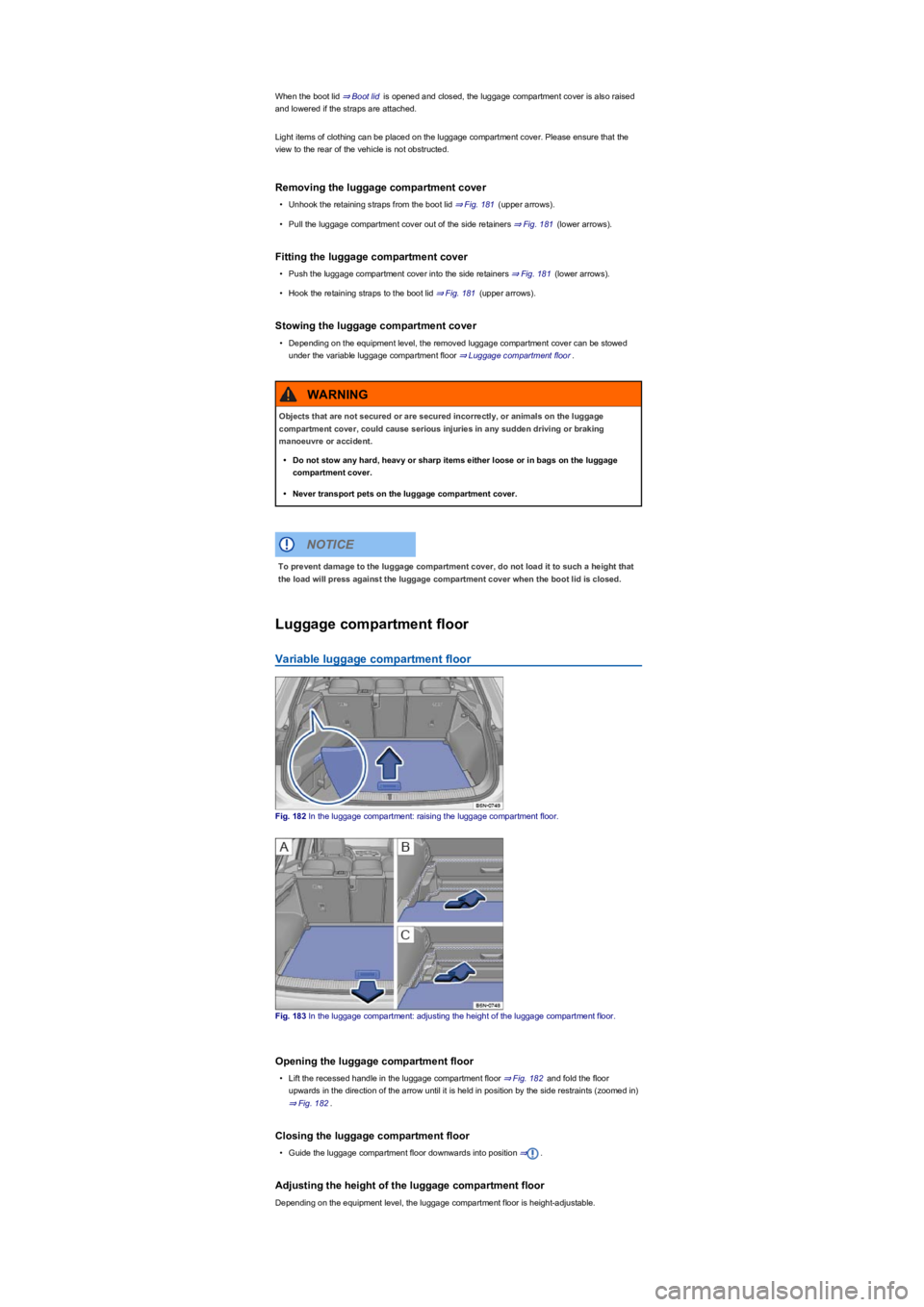
When the boot lid ⇒ Boot lid is opened and closed, the luggage compartment cover is also raised
and lowered if the straps are attached.
Light items of clothing can be placed on the luggage compartment cover. Please ensure that the
view to the rear of the vehicle is not obstructed.
Removing the luggage compartment cover
•Unhook the retaining straps from the boot lid ⇒ Fig. 181 (upper arrows).
•Pull the luggage compartment cover out of the side retainers ⇒ Fig. 181 (lower arrows).
Fitting the luggage compartment cover
•Push the luggage compartment cover into the side retainers ⇒ Fig. 181 (lower arrows).
•Hook the retaining straps to the boot lid ⇒ Fig. 181 (upper arrows).
Stowing the luggage compartment cover
•Depending on the equipment level, the removed luggage compartment cover can be stowed
under the variable luggage compartment floor ⇒ Luggage compartment floor.
Luggage compartment floor
Variable luggage compartment floor
Fig. 182 In the luggage compartment: raising the luggage compartment floor.
Fig. 183 In the luggage compartment: adjusting the height of the luggage compartment floor.
Opening the luggage compartment floor
•Lift the recessed handle in the luggage compartment floor ⇒ Fig. 182 and fold the floor
upwards in the direction of the arrow until it is held in position by the side restraints (zoomed in)
⇒ Fig. 182.
Closing the luggage compartment floor
•Guide the luggage compartment floor downwards into position ⇒.
Adjusting the height of the luggage compartment floor
Depending on the equipment level, the luggage compartment floor is height-adjustable.
Objects that are not secured or are secured incorrectly, or animals on the luggage
compartment cover, could cause serious injuries in any sudden driving or braking
manoeuvre or accident.
•Do not stow any hard, heavy or sharp items either loose or in bags on the luggage
compartment cover.
•Never transport pets on the luggage compartment cover.
WARNING
To prevent damage to the luggage compartment cover, do not load it to such a height that
the load will press against the luggage compartment cover when the boot lid is closed.
NOTICE
Page 227 of 341
•If necessary, unclip the luggage net ⇒ Luggage net and remove the securing straps.
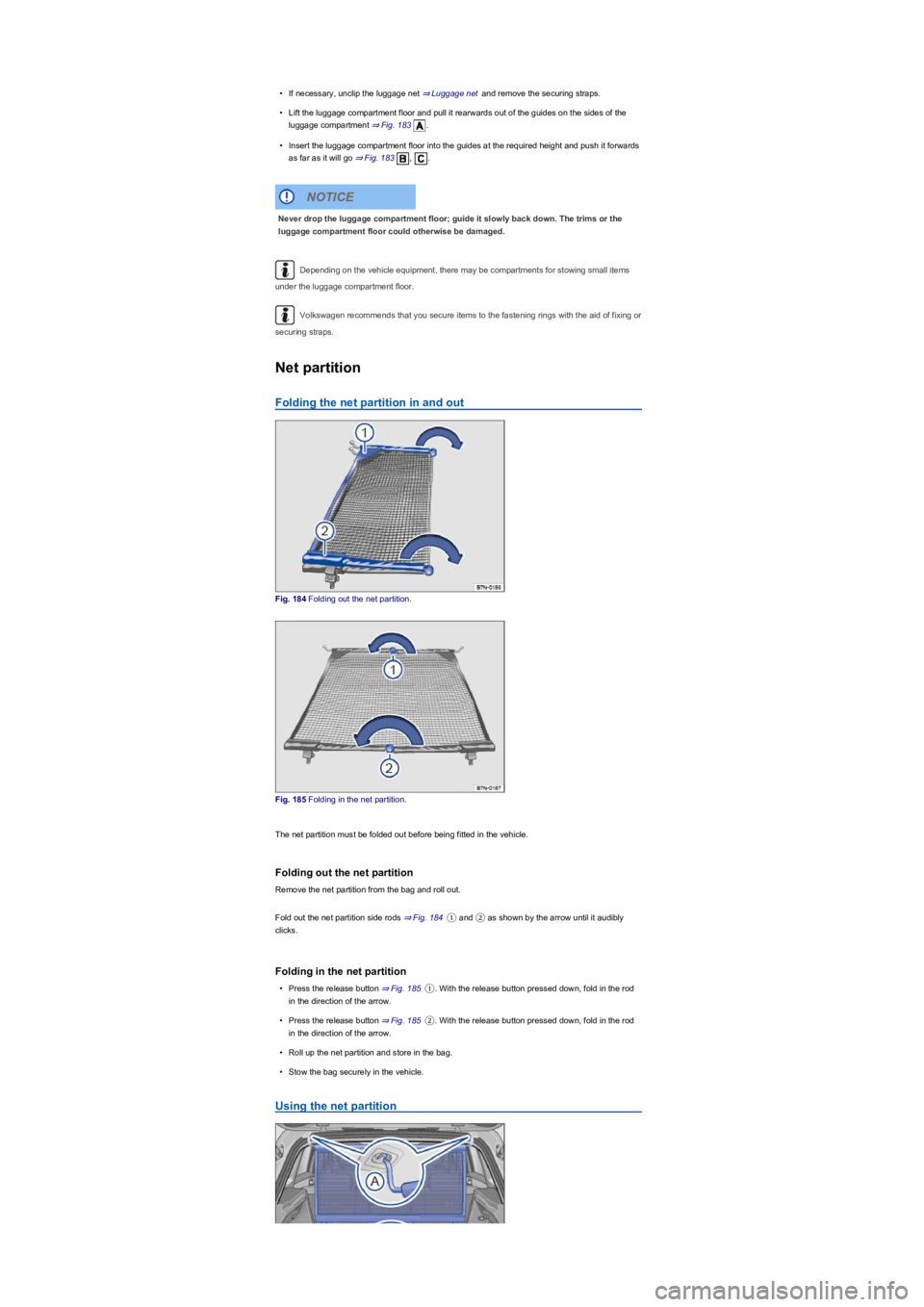
•Lift the luggage compartment floor and pull it rearwards out of the guides on the sides of the
luggage compartment ⇒ Fig. 183.
•Insert the luggage compartment floor into the guides at the required height and push it forwards
as far as it will go ⇒ Fig. 183, .
Depending on the vehicle equipment, there may be compartments for stowing small items
under the luggage compartment floor.
Volkswagen recommends that you secure items to the fastening rings with the aid of fixing or
securing straps.
Net partition
Folding the net partition in and out
Fig. 184 Folding out the net partition.
Fig. 185 Folding in the net partition.
The net partition must be folded out before being fitted in the vehicle.
Folding out the net partition
Remove the net partition from the bag and roll out.
Fold out the net partition side rods ⇒ Fig. 184① and ② as shown by the arrow until it audibly
clicks.
Folding in the net partition
•Press the release button ⇒ Fig. 185①. With the release button pressed down, fold in the rod
in the direction of the arrow.
•Press the release button ⇒ Fig. 185②. With the release button pressed down, fold in the rod
in the direction of the arrow.
•Roll up the net partition and store in the bag.
•Stow the bag securely in the vehicle.
Using the net partition
Never drop the luggage compartment floor; guide it slowly back down. The trims or the
luggage compartment floor could otherwise be damaged.
NOTICE
Page 233 of 341
Make sure you are aware of the weight of the roof carrier system and the load to be transported.
Weigh the load if necessary.
However, you will not be able to carry the maximum roof load if you are using a roof carrier with a
lower weight rating. In this case, do not exceed the maximum weight limit for the load carrier
system which is specified in the manufacturer's installation instructions.
Distributing the load
Distribute the load evenly and secure it correctly ⇒.
Notes on use
First read and observe the introductoryinformation and safety warnings⇒
Introduction
Remove the roof carrier in the following situations
•When the roof carrier is no longer being used.
•Before entering a car wash.
•When the vehicle height exceeds the required clearance height, e.g. in a garage.
Driving with a fitted roof carrier will increase air resistance and thus increase fuel
consumption.
Trailer towing
Introduction
This chapter contains information on the followingsubjects:
⇒ Technical requirements
⇒ Electrically adjustable ball coupling
⇒ Fitting a bicycle carrier on the swivelling ball head
⇒ Notes on towing a trailer
⇒ Loading the trailer
⇒ Trailer towing
⇒ Trailer stabilisation
⇒ Retrofitting a towing bracket
⇒ Troubleshooting
The vehicle can be used to tow a trailer if it has the required technical equipment for this. The
additional trailer load will affect the amount of wear, fuel consumption and performance of the
vehicle and, in certain circumstances, could shorten the service intervals.
Accidents and vehicle damage can occur if the maximum permitted roof load is exceeded.
•Never exceed the quoted roof load, the maximum permissible axle loads, and the
permissible gross vehicle weight for the vehicle.
•Do not exceed the weight rating of the roof carrier, even if the maximum roof load has
not been reached.
WARNING
Loose and incorrectly secured loads can fall off the roof carrier and cause accidents and
injuries.
•Always use suitable and undamaged securing straps.
WARNING
When opening the boot lid take care not to let it hit the roof load.
NOTICE
•Always remove the roof carrier before driving through an automatic car wash.
•The height of the vehicle is changed by the installation of a carrier system and the load
secured to it. Check and compare the height of the vehicle with clearance heights, e.g.
for underpasses and garage doors.
•The roof carrier and its load must not obstruct you from opening and closing the tilting
and sliding panoramic sunroof and the boot lid. The roof aerial must also remain
unaffected.
NOTICE
Page 274 of 341
Allow the engine to cool sufficiently.
Children and other people should be kept well away from the engine compartment.
Ensure that the vehicle cannot roll away unexpectedly.
Opening and closing the bonnet
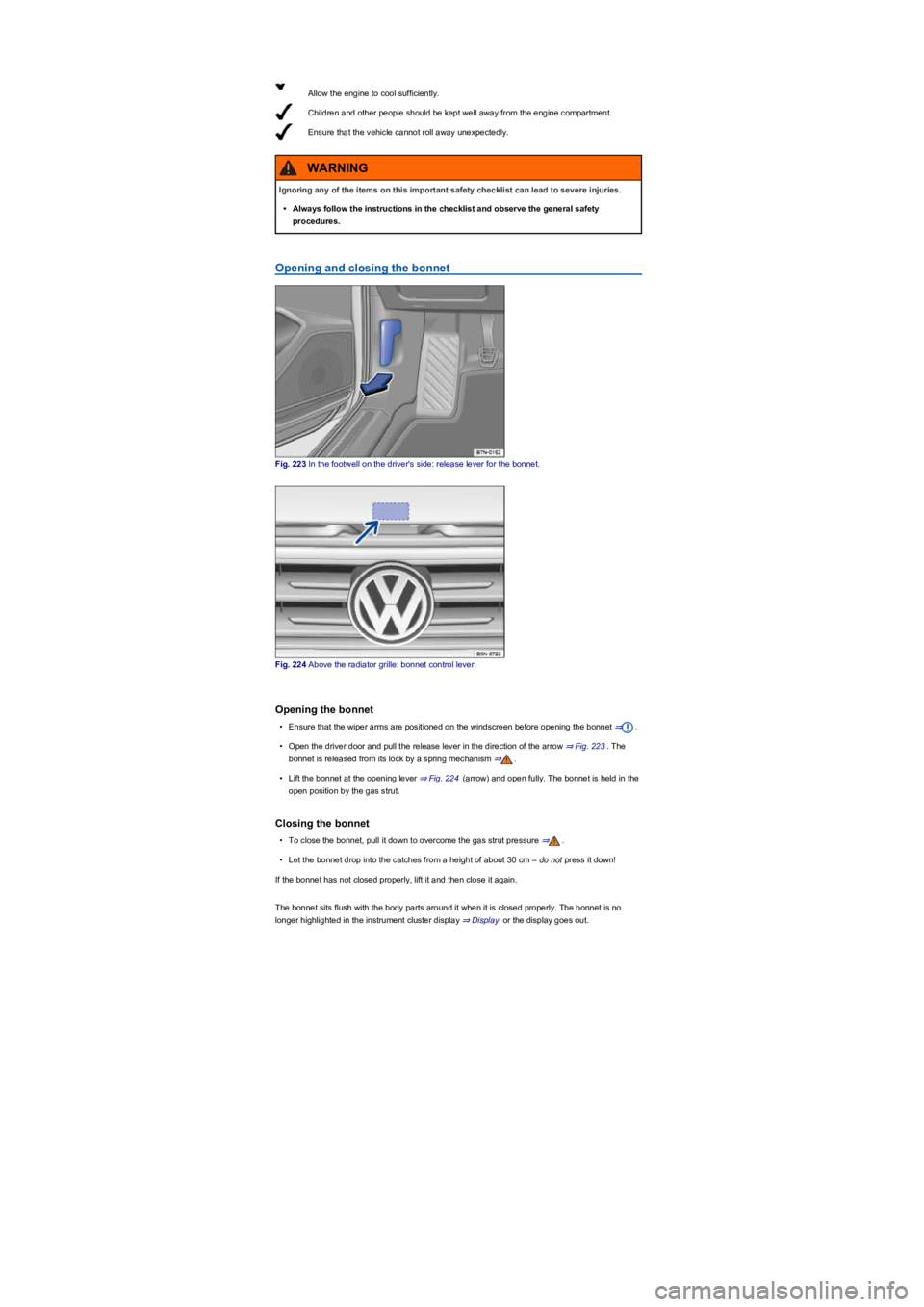
Fig. 223 In the footwell on the driver's side: release lever for the bonnet.
Fig. 224 Above the radiator grille: bonnet control lever.
Opening the bonnet
•Ensure that the wiper arms are positioned on the windscreen before opening the bonnet ⇒.
•Open the driver door and pull the release lever in the direction of the arrow ⇒ Fig. 223. The
bonnet is released from its lock by a spring mechanism ⇒.
•Lift the bonnet at the opening lever ⇒ Fig. 224 (arrow) and open fully. The bonnet is held in the
open position by the gas strut.
Closing the bonnet
•To close the bonnet, pull it down to overcome the gas strut pressure ⇒.
•Let the bonnet drop into the catches from a height of about 30 cm – do not press it down!
If the bonnet has not closed properly, lift it and then close it again.
The bonnet sits flush with the body parts around it when it is closed properly. The bonnet is no
longer highlighted in the instrument cluster display ⇒ Display or the display goes out.
Ignoring any of the items on this important safety checklist can lead to severe injuries.
•Always follow the instructions in the checklist and observe the general safety
procedures.
WARNING
Page 303 of 341
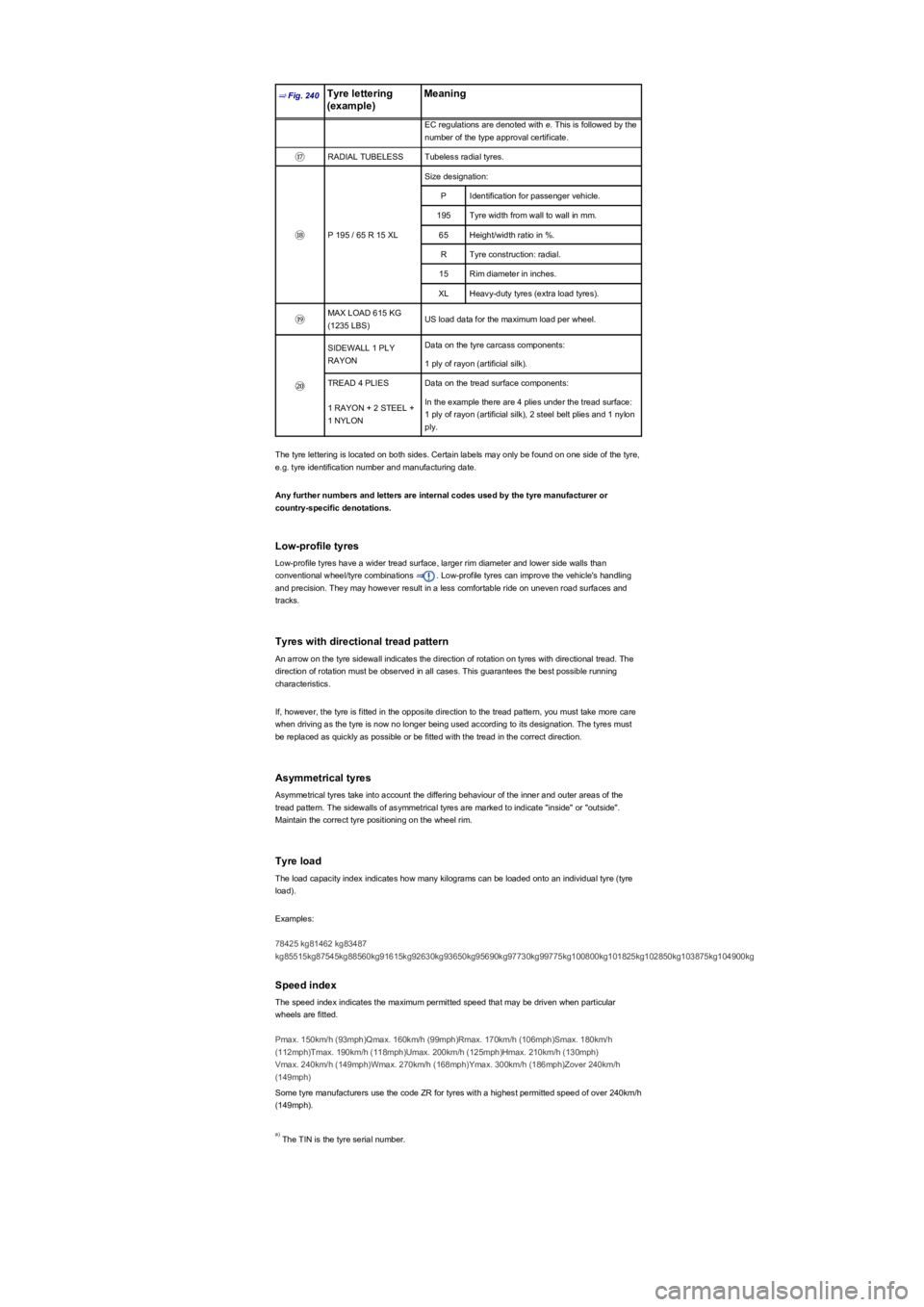
⇒ Fig. 240Tyre lettering
(example)
Meaning
EC regulations are denoted with e. This is followed by the
number of the type approval certificate.
⑰RADIAL TUBELESSTubeless radial tyres.
⑱P 195 / 65 R 15 XL
Size designation:
PIdentification for passenger vehicle.
195Tyre width from wall to wall in mm.
65Height/width ratio in %.
RTyre construction: radial.
15Rim diameter in inches.
XLHeavy-duty tyres (extra load tyres).
⑲MAX LOAD 615 KG
(1235 LBS)US load data for the maximum load per wheel.
⑳
SIDEWALL 1 PLY
RAYON
Data on the tyre carcass components:
1 ply of rayon (artificial silk).
TREAD 4 PLIESData on the tread surface components:
1 RAYON + 2 STEEL +
1 NYLON
In the example there are 4 plies under the tread surface:
1 ply of rayon (artificial silk), 2 steel belt plies and 1 nylon
ply.
The tyre lettering is located on both sides. Certain labels may only be found on one side of the tyre,
e.g. tyre identification number and manufacturing date.
Any further numbers and letters are internal codes used by the tyre manufacturer or
country-specific denotations.
Low-profile tyres
Low-profile tyres have a wider tread surface, larger rim diameter and lower side walls than
conventional wheel/tyre combinations ⇒. Low-profile tyres can improve the vehicle's handling
and precision. They may however result in a less comfortable ride on uneven road surfaces and
tracks.
Tyres with directional tread pattern
An arrow on the tyre sidewall indicates the direction of rotation on tyres with directional tread. The
direction of rotation must be observed in all cases. This guarantees the best possible running
characteristics.
If, however, the tyre is fitted in the opposite direction to the tread pattern, you must take more care
when driving as the tyre is now no longer being used according to its designation. The tyres must
be replaced as quickly as possible or be fitted with the tread in the correct direction.
Asymmetrical tyres
Asymmetrical tyres take into account the differing behaviour of the inner and outer areas of the
tread pattern. The sidewalls of asymmetrical tyres are marked to indicate "inside" or "outside".
Maintain the correct tyre positioning on the wheel rim.
Tyre load
The load capacity index indicates how many kilograms can be loaded onto an individual tyre (tyre
load).
Examples:
78425 kg81462 kg83487
kg85515kg87545kg88560kg91615kg92630kg93650kg95690kg97730kg99775kg100800kg101825kg102850kg103875kg104900kg
Speed index
The speed index indicates the maximum permitted speed that may be driven when particular
wheels are fitted.
Pmax. 150km/h (93mph)Qmax. 160km/h (99mph)Rmax. 170km/h (106mph)Smax. 180km/h
(112mph)Tmax. 190km/h (118mph)Umax. 200km/h (125mph)Hmax. 210km/h (130mph)
Vmax. 240km/h (149mph)Wmax. 270km/h (168mph)Ymax. 300km/h (186mph)Zover 240km/h
(149mph)
Some tyre manufacturers use the code ZR for tyres with a highest permitted speed of over 240km/h
(149mph).
The TIN is the tyre serial number.a)
Page 335 of 341
Engine and gearbox code, paint number, interior equipment. In the example, the engine
code is CPTA ⇒ Fig. 253.
Optional extras, PR numbers.
Type plate
The type plate ⇒ Fig. 253 can be seen on the lower part of the door pillar when the door is
open. Vehicles for certain export countries do not have a type plate.
The type plate contains the following data:
Permit
Gross vehicle weight rating
Gross combination weight rating (vehicle plus trailer ⇒ Trailer towing)
Gross axle weight rating, front
Gross axle weight rating, rear
Vehicle identification number
The vehicle identification number can be read from outside the vehicle through a viewer in the
windscreen ⇒ Fig. 254 (arrow). The viewer is located in the lower corner of the windscreen. The
vehicle identification number is also stamped on the right-hand water drainage channel. The water
drainage channel is located between the suspension turret and wing. Open the bonnet ⇒ In the
engine compartment to gain access to the vehicle identification number.
Dimensions
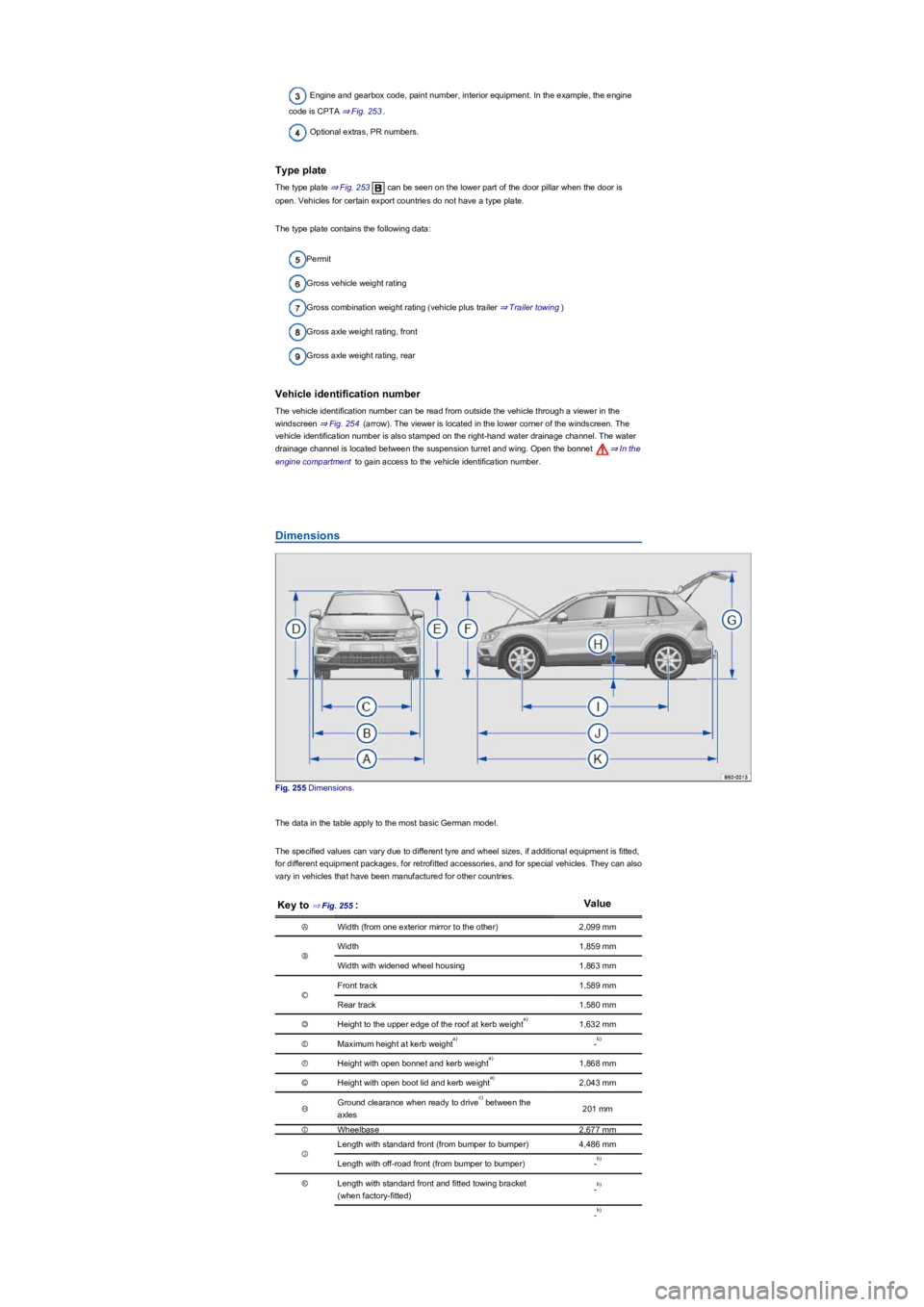
Fig. 255 Dimensions.
The data in the table apply to the most basic German model.
The specified values can vary due to different tyre and wheel sizes, if additional equipment is fitted,
for different equipment packages, for retrofitted accessories, and for special vehicles. They can also
vary in vehicles that have been manufactured for other countries.
Key to ⇒ Fig. 255:Value
ⒶWidth (from one exterior mirror to the other)2,099 mm
Ⓑ
Width1,859 mm
Width with widened wheel housing1,863 mm
Ⓒ
Front track1,589 mm
Rear track1,580 mm
ⒹHeight to the upper edge of the roof at kerb weight1,632 mm
ⒺMaximum height at kerb weight-
ⒻHeight with open bonnet and kerb weight1,868 mm
ⒼHeight with open boot lid and kerb weight2,043 mm
ⒽGround clearance when ready to drive between the
axles201 mm
ⒾWheelbase2,677 mm
Ⓙ
Length with standard front (from bumper to bumper)4,486 mm
Length with off-road front (from bumper to bumper)-
ⓀLength with standard front and fitted towing bracket
(when factory-fitted)-
-
a)
a)b)
a)
a)
c)
b)
b)
b)