seats VOLKSWAGEN TIGUAN 2017 Owner´s Manual
[x] Cancel search | Manufacturer: VOLKSWAGEN, Model Year: 2017, Model line: TIGUAN, Model: VOLKSWAGEN TIGUAN 2017Pages: 341, PDF Size: 9.14 MB
Page 88 of 341
Seats and head restraints
Front seats
Introduction
This chapter contains information on the followingsubjects:
⇒ Mechanically adjusting the front seat
⇒ Electrically adjusting the front seat
⇒ Folding the front passenger seat backrest forwards
The following section describes the options for adjusting the front seats. Always ensure that the
correct sitting position is adjusted ⇒ Sitting position.
Incorrect use of the steering column position adjustment and incorrect adjustment of the
steering wheel can cause serious or fatal injuries.
•After adjusting the steering column, always move lever ⇒ Fig. 77① up so that it
engages securely. This prevents the steering column from moving spontaneously
while the vehicle is in motion.
•Never adjust the steering wheel when the vehicle is in motion. If you determine that a
readjustment is necessary, stop the vehicle safely and adjust the steering wheel to the
correct position.
•The steering wheel must always point towards the chest and not towards the face. This
ensures that the driver front airbag provides maximum protection in the event of an
accident.
•While driving, always keep both hands on the outside of the steering wheel at the 9
o'clock and 3 o'clock positions⇒ Fig. 78. This reduces the risk of injury if the driver
front airbag is triggered.
•Never hold the steering wheel at the 12 o'clock position, or in any other manner, e.g. on
the hub of the steering wheel. If the driver front airbag is triggered, you could receive
severe injuries to the arms, hands and head.
WARNING
Page 89 of 341
Mechanically adjusting the front seat
Always adjust the front seats to their correct position before any journey and ensure that
any passenger has fastened their seat belt.
•Push the front passenger seat as far back as possible.
•Adjust the driver seat so that there is at least 25 cm between your breastbone and the
hub of the steering wheel. Adjust the driver seat by moving it forwards or backwards
so that you are able to press the pedals to the floor with your knees still slightly bent
and so that the distance from the dash panel to your knees is at least 10 cm. If your
build makes it impossible to fulfil this requirement then you must contact a qualified
workshop so they can make any necessary modifications.
•Never travel with the backrest tilted far back. The further back the backrest is tilted, the
greater the risk of injury caused by incorrect seat belt routing or an incorrect sitting
position.
•Never travel with the backrest tilted far forwards. When a front airbag is triggered it
could force the seat backrest backwards and injure vehicle occupants on the back
seats.
•Adopt and maintain the greatest possible distance from the steering wheel and dash
panel.
•You should always sit upright with your back against the seat backrest with the front
seats properly adjusted. Do not position any body part too close where the airbags are
fitted.
•The risk of serious injury is increased for passengers on the rear seat if they are not
sitting upright because the seat belts are incorrectly positioned.
WARNING
Incorrect adjustment of the seats can cause accidents and serious injuries.
•Only adjust the seats when the vehicle is stationary. The seats could change position
unexpectedly if you attempt to reposition them while the vehicle is in motion, leading
to a loss of control of the vehicle. Furthermore, an incorrect seating position is
adopted while adjusting the seat.
•Only adjust the height and tilt of the seat or move it forwards and backwards when the
area around the seat is clear.
•To be able to make adjustments to the seats, the area around them must not be
restricted by any items.
•Only adjust the height of the rear seat or move it forwards and backwards when the
area around the seat is clear.
•The areas for adjusting and locking the seats must not be soiled.
WARNING
Improper use of seat covers or protective covers may lead to the electrical seat controls
being operated accidentally and the front seats moving unexpectedly while the vehicle is
moving. You could lose control over the vehicle. This could result in serious injury and
accidents. Furthermore, this may result in damage to the electrical components in the
front seats.
•Never attach or secure seat covers or protective covers to the electrical controls.
•Do not fit seat covers or protective covers over the seats unless they have been
expressly approved for use in the vehicle.
WARNING
Cigarette lighters in the vehicle could be damaged or accidentally lit. This could lead to
serious burns and other injuries.
•Before adjusting the seats always ensure that there is no lighter on or near the
moveable parts of the seat.
•Before closing stowage areas or compartments always ensure that there is no lighter
in the way.
•Never stow lighters in stowage areas, compartments or on other surfaces in the
vehicle. High surface temperatures, especially in summer, may cause cigarette lighters
to self-ignite.
WARNING
Page 91 of 341
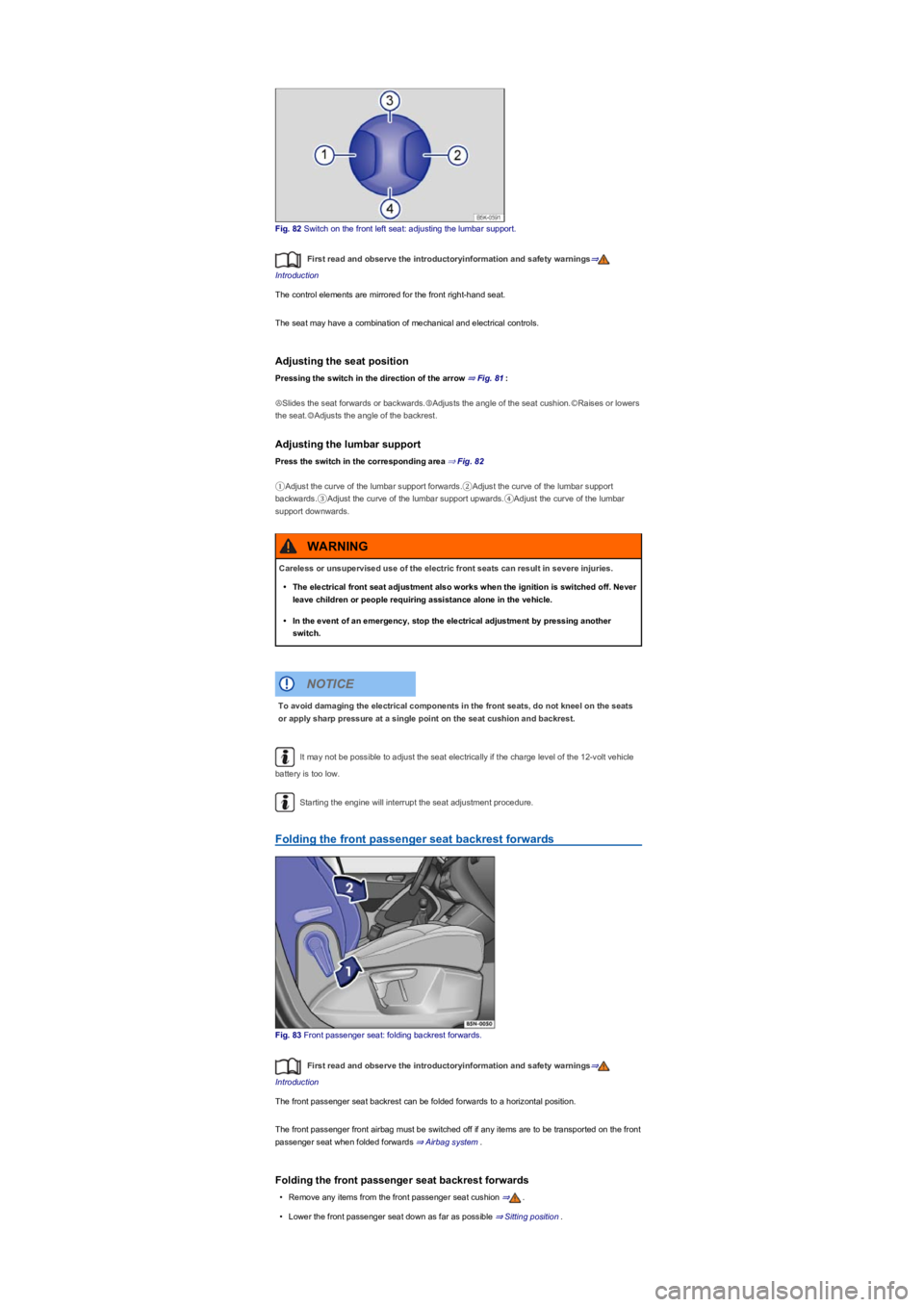
Fig. 82 Switch on the front left seat: adjusting the lumbar support.
First read and observe the introductoryinformation and safety warnings⇒
Introduction
The control elements are mirrored for the front right-hand seat.
The seat may have a combination of mechanical and electrical controls.
Adjusting the seat position
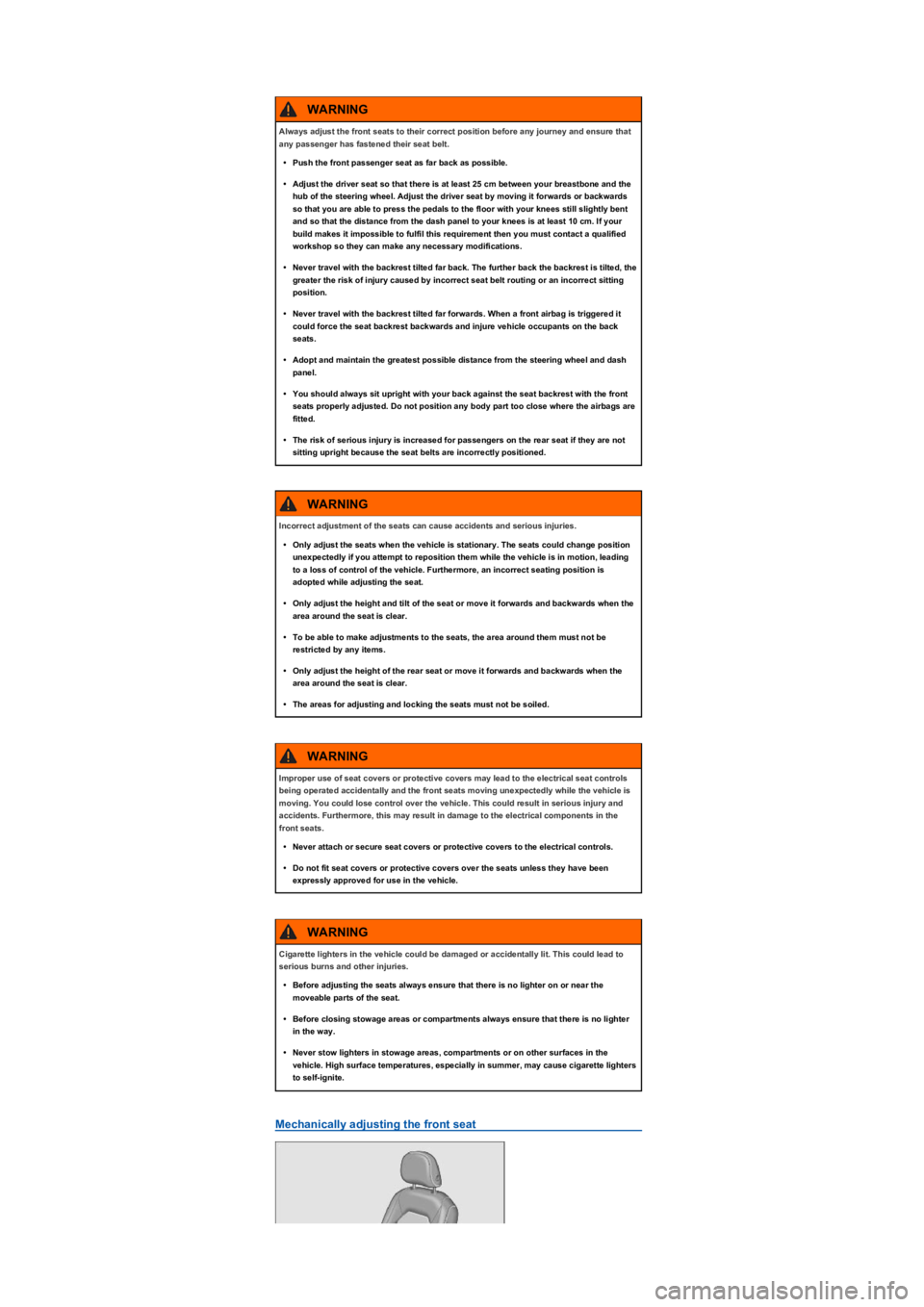
Pressing the switch in the direction of the arrow ⇒ Fig. 81:
ⒶSlides the seat forwards or backwards.ⒷAdjusts the angle of the seat cushion.ⒸRaises or lowers
the seat.ⒹAdjusts the angle of the backrest.
Adjusting the lumbar support
Press the switch in the corresponding area ⇒ Fig. 82
①Adjust the curve of the lumbar support forwards.②Adjust the curve of the lumbar support
backwards.③Adjust the curve of the lumbar support upwards.④Adjust the curve of the lumbar
support downwards.
It may not be possible to adjust the seat electrically if the charge level of the 12-volt vehicle
battery is too low.
Starting the engine will interrupt the seat adjustment procedure.
Folding the front passenger seat backrest forwards
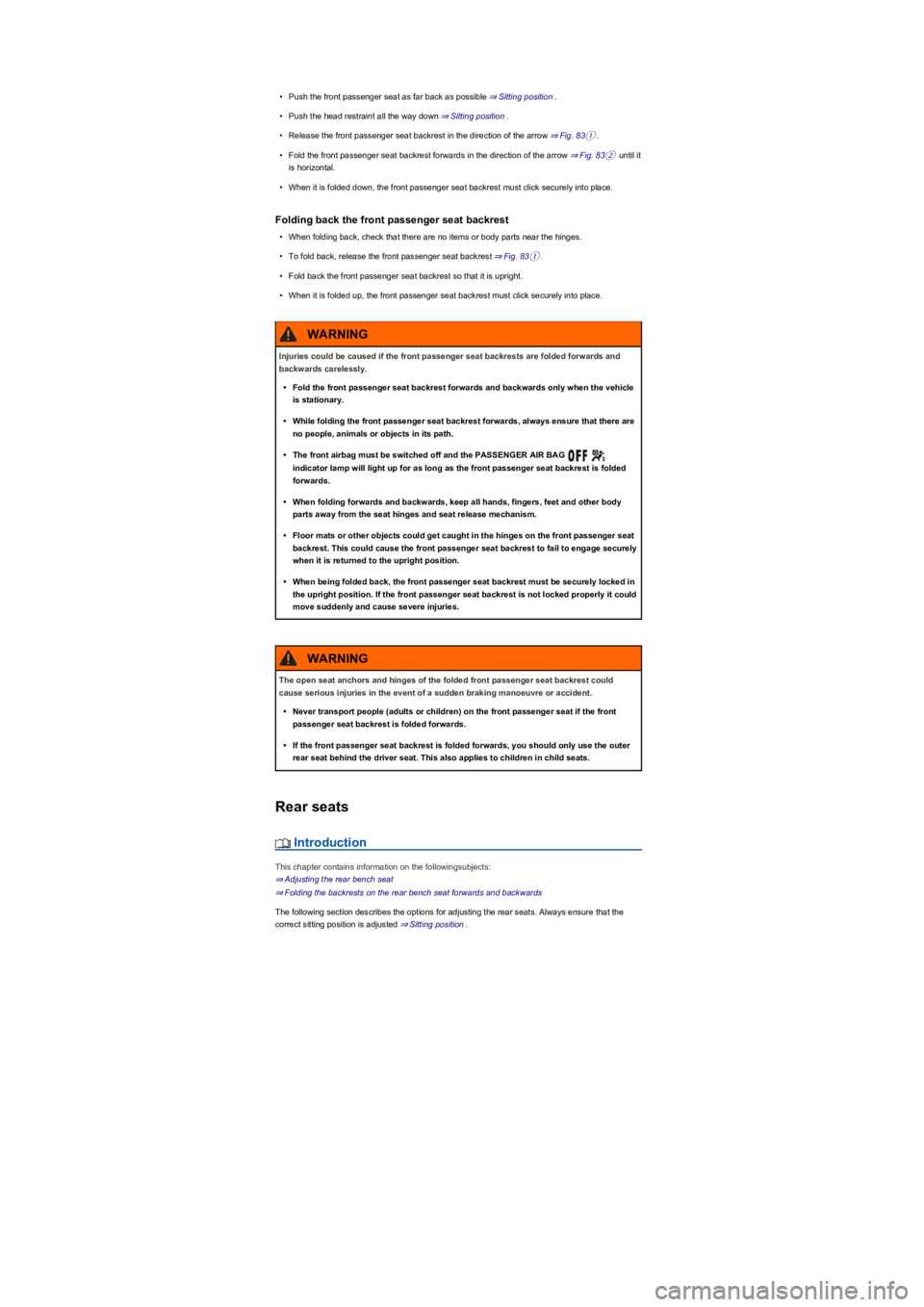
Fig. 83 Front passenger seat: folding backrest forwards.
First read and observe the introductoryinformation and safety warnings⇒
Introduction
The front passenger seat backrest can be folded forwards to a horizontal position.
The front passenger front airbag must be switched off if any items are to be transported on the front
passenger seat when folded forwards ⇒ Airbag system.
Folding the front passenger seat backrest forwards
•Remove any items from the front passenger seat cushion ⇒.
•Lower the front passenger seat down as far as possible ⇒ Sitting position.
Careless or unsupervised use of the electric front seats can result in severe injuries.
•The electrical front seat adjustment also works when the ignition is switched off. Never
leave children or people requiring assistance alone in the vehicle.
•In the event of an emergency, stop the electrical adjustment by pressing another
switch.
WARNING
To avoid damaging the electrical components in the front seats, do not kneel on the seats
or apply sharp pressure at a single point on the seat cushion and backrest.
NOTICE
Page 92 of 341
•Push the front passenger seat as far back as possible ⇒ Sitting position.
•Push the head restraint all the way down ⇒ Sitting position.
•Release the front passenger seat backrest in the direction of the arrow ⇒ Fig. 83①.
•Fold the front passenger seat backrest forwards in the direction of the arrow ⇒ Fig. 83② until it
is horizontal.
•When it is folded down, the front passenger seat backrest must click securely into place.
Folding back the front passenger seat backrest
•When folding back, check that there are no items or body parts near the hinges.
•To fold back, release the front passenger seat backrest ⇒ Fig. 83①.
•Fold back the front passenger seat backrest so that it is upright.
•When it is folded up, the front passenger seat backrest must click securely into place.
Rear seats
Introduction
This chapter contains information on the followingsubjects:
⇒ Adjusting the rear bench seat
⇒ Folding the backrests on the rear bench seat forwards and backwards
The following section describes the options for adjusting the rear seats. Always ensure that the
correct sitting position is adjusted ⇒ Sitting position.
Injuries could be caused if the front passenger seat backrests are folded forwards and
backwards carelessly.
•Fold the front passenger seat backrest forwards and backwards only when the vehicle
is stationary.
•While folding the front passenger seat backrest forwards, always ensure that there are
no people, animals or objects in its path.
•The front airbag must be switched off and the PASSENGER AIR BAG
indicator lamp will light up for as long as the front passenger seat backrest is folded
forwards.
•When folding forwards and backwards, keep all hands, fingers, feet and other body
parts away from the seat hinges and seat release mechanism.
•Floor mats or other objects could get caught in the hinges on the front passenger seat
backrest. This could cause the front passenger seat backrest to fail to engage securely
when it is returned to the upright position.
•When being folded back, the front passenger seat backrest must be securely locked in
the upright position. If the front passenger seat backrest is not locked properly it could
move suddenly and cause severe injuries.
WARNING
The open seat anchors and hinges of the folded front passenger seat backrest could
cause serious injuries in the event of a sudden braking manoeuvre or accident.
•Never transport people (adults or children) on the front passenger seat if the front
passenger seat backrest is folded forwards.
•If the front passenger seat backrest is folded forwards, you should only use the outer
rear seat behind the driver seat. This also applies to children in child seats.
WARNING
Page 93 of 341
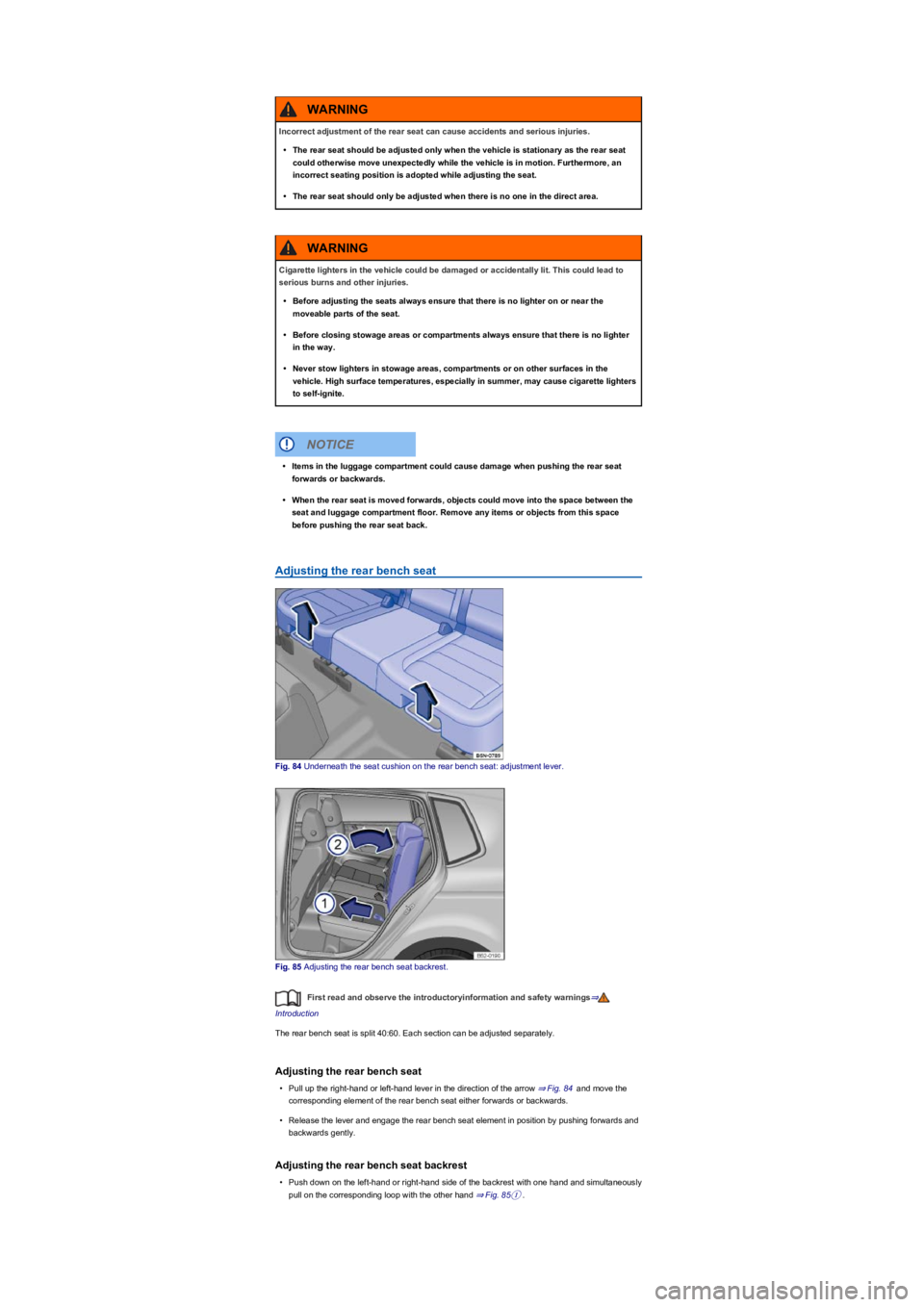
Adjusting the rear bench seat
Fig. 84 Underneath the seat cushion on the rear bench seat: adjustment lever.
Fig. 85 Adjusting the rear bench seat backrest.
First read and observe the introductoryinformation and safety warnings⇒
Introduction
The rear bench seat is split 40:60. Each section can be adjusted separately.
Adjusting the rear bench seat
•Pull up the right-hand or left-hand lever in the direction of the arrow ⇒ Fig. 84 and move the
corresponding element of the rear bench seat either forwards or backwards.
•Release the lever and engage the rear bench seat element in position by pushing forwards and
backwards gently.
Adjusting the rear bench seat backrest
•Push down on the left-hand or right-hand side of the backrest with one hand and simultaneously
pull on the corresponding loop with the other hand ⇒ Fig. 85①.
Incorrect adjustment of the rear seat can cause accidents and serious injuries.
•The rear seat should be adjusted only when the vehicle is stationary as the rear seat
could otherwise move unexpectedly while the vehicle is in motion. Furthermore, an
incorrect seating position is adopted while adjusting the seat.
•The rear seat should only be adjusted when there is no one in the direct area.
WARNING
Cigarette lighters in the vehicle could be damaged or accidentally lit. This could lead to
serious burns and other injuries.
•Before adjusting the seats always ensure that there is no lighter on or near the
moveable parts of the seat.
•Before closing stowage areas or compartments always ensure that there is no lighter
in the way.
•Never stow lighters in stowage areas, compartments or on other surfaces in the
vehicle. High surface temperatures, especially in summer, may cause cigarette lighters
to self-ignite.
WARNING
•Items in the luggage compartment could cause damage when pushing the rear seat
forwards or backwards.
•When the rear seat is moved forwards, objects could move into the space between the
seat and luggage compartment floor. Remove any items or objects from this space
before pushing the rear seat back.
NOTICE
Page 95 of 341
Head restraints
Introduction
This chapter contains information on the followingsubjects:
⇒ Adjusting the head restraints
⇒ Removing and fitting head restraints
The following section describes the options for adjusting and removing the head restraints. Always
ensure that the correct sitting position is adjusted ⇒ Sitting position.
Every seat is fitted with a head restraint. The centre head restraint at the rear is designed solely for
use with the centre rear bench seat. Therefore you should not install the head restraint in any of the
other positions.
Correct head restraint setting
Adjust the head restraint so that its upper edge is at the same height as the top of the head, but not
lower than eye level. Position the back of your head as close to the head restraint as possible.
In vehicles with head restraints that can be adjusted in the longitudinal direction, push the head
restraints on the front seats as close as possible to the back of your head.
Head restraint setting for shorter people
Push the head restraint all the way down, even if the head is then underneath the top edge of the
head restraint. There may be a small gap between the head restraint and backrest in the lowest
position.
Head restraint setting for taller people
Push the head restraint up as far as it will go.
Injuries can be caused if the rear backrests are folded forwards and backwards carelessly.
•While folding the rear backrest, always make sure that no people, animals or items are
in the path.
•Never fold the rear seat backrest forwards or backwards while the vehicle is in motion.
•Ensure that the seat belt is not trapped or damaged when folding back the rear seat
backrest.
•Always keep hands, fingers, feet or other body parts away from the seat area when
folding the rear seat backrest forwards and backwards.
•Ensure that the rear seat backrest engages securely, otherwise the seat belts for the
rear seats will not work properly. This applies to the centre seat of the rear bench seat
in particular. If a seat is occupied and the rear seat backrest has not engaged securely
into place, the seat occupant and rear seat backrest may move forwards in the event of
a sudden braking or driving manoeuvre or during accidents.
•Passengers (adults and children) must not use seats if the backrest is folded forwards
or is not clicked securely into place.
WARNING
Damage to the vehicle or to other objects could be caused if the rear bench seat backrest
is folded forwards and backwards in an uncontrolled way or without taking appropriate
care.
•Before folding the rear seat backrests forwards, always adjust the front seats so that
the rear head restraints or rear seat backrest cushions do not rub against the front
seats.
•Before folding down the rear seat backrest, always ensure that there are no objects
located in its path.
NOTICE
Page 97 of 341
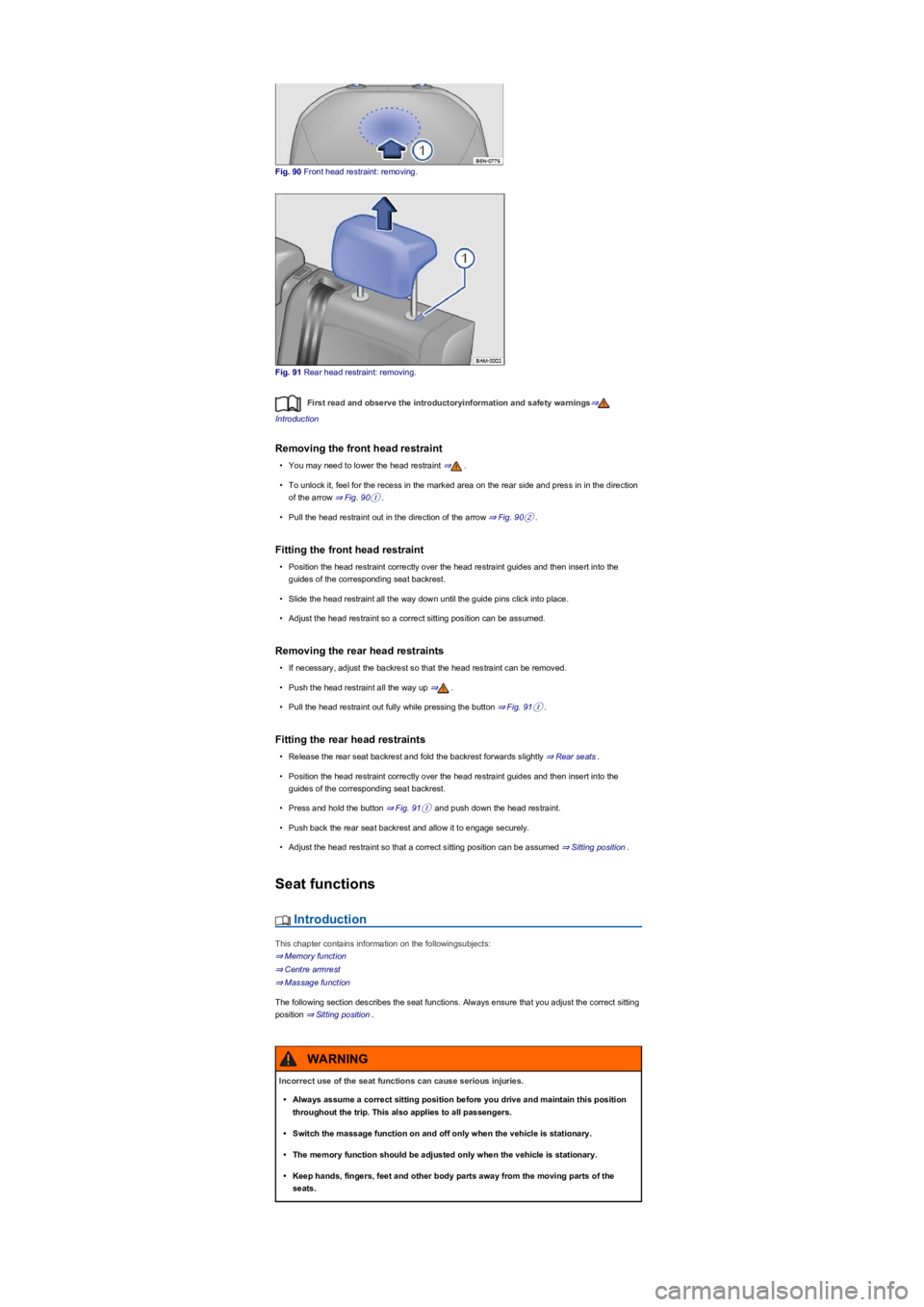
Fig. 90 Front head restraint: removing.
Fig. 91 Rear head restraint: removing.
First read and observe the introductoryinformation and safety warnings⇒
Introduction
Removing the front head restraint
•You may need to lower the head restraint ⇒.
•To unlock it, feel for the recess in the marked area on the rear side and press in in the direction
of the arrow ⇒ Fig. 90①.
•Pull the head restraint out in the direction of the arrow ⇒ Fig. 90②.
Fitting the front head restraint
•Position the head restraint correctly over the head restraint guides and then insert into the
guides of the corresponding seat backrest.
•Slide the head restraint all the way down until the guide pins click into place.
•Adjust the head restraint so a correct sitting position can be assumed.
Removing the rear head restraints
•If necessary, adjust the backrest so that the head restraint can be removed.
•Push the head restraint all the way up ⇒.
•Pull the head restraint out fully while pressing the button ⇒ Fig. 91①.
Fitting the rear head restraints
•Release the rear seat backrest and fold the backrest forwards slightly ⇒ Rear seats.
•Position the head restraint correctly over the head restraint guides and then insert into the
guides of the corresponding seat backrest.
•Press and hold the button ⇒ Fig. 91① and push down the head restraint.
•Push back the rear seat backrest and allow it to engage securely.
•Adjust the head restraint so that a correct sitting position can be assumed ⇒ Sitting position.
Seat functions
Introduction
This chapter contains information on the followingsubjects:
⇒ Memory function
⇒ Centre armrest
⇒ Massage function
The following section describes the seat functions. Always ensure that you adjust the correct sitting
position ⇒ Sitting position.
Incorrect use of the seat functions can cause serious injuries.
•Always assume a correct sitting position before you drive and maintain this position
throughout the trip. This also applies to all passengers.
•Switch the massage function on and off only when the vehicle is stationary.
•The memory function should be adjusted only when the vehicle is stationary.
•Keep hands, fingers, feet and other body parts away from the moving parts of the
seats.
WARNING
Page 106 of 341
Switching on the Coming Home function
m/k/a999MKNot in China
•Switch off the ignition.
•Operate the headlight flasher for approximately one second.
The Coming Home lighting is switched on when the driver door is opened. The switch-off delay
starts when the last vehicle door or the boot lid has been closed.
Switching on the Coming Home function
m/k/a999MKOnly in China
•Switch off the ignition.
The Coming Home lighting is switched on when the light switch is in position and the
rain/light sensor detects that it is dark.
The switch-off delay starts when the last vehicle door or the boot lid has been closed.
Switching off the Coming home function
•Automatically after the set switch-off delay has elapsed.
•OR: automatically if a vehicle door or the boot lid is still open approximately 30 seconds after
switching on.
•OR: turn light switch to position .
•OR: switch on the ignition.
Switching on the Leaving home function
•Unlock the vehicle when the light switch is in position and the rain/light sensor detects
that it is dark.
Switching off the Leaving home function
•Automatically after the switch-off delay.
•OR: lock the vehicle.
•OR: turn light switch to position .
•OR: switch on the ignition.
Some settings can be stored in the user accounts of the personalisation function and
therefore change automatically when the user account changes ⇒ Personalisation.
Headlights
Headlight range control
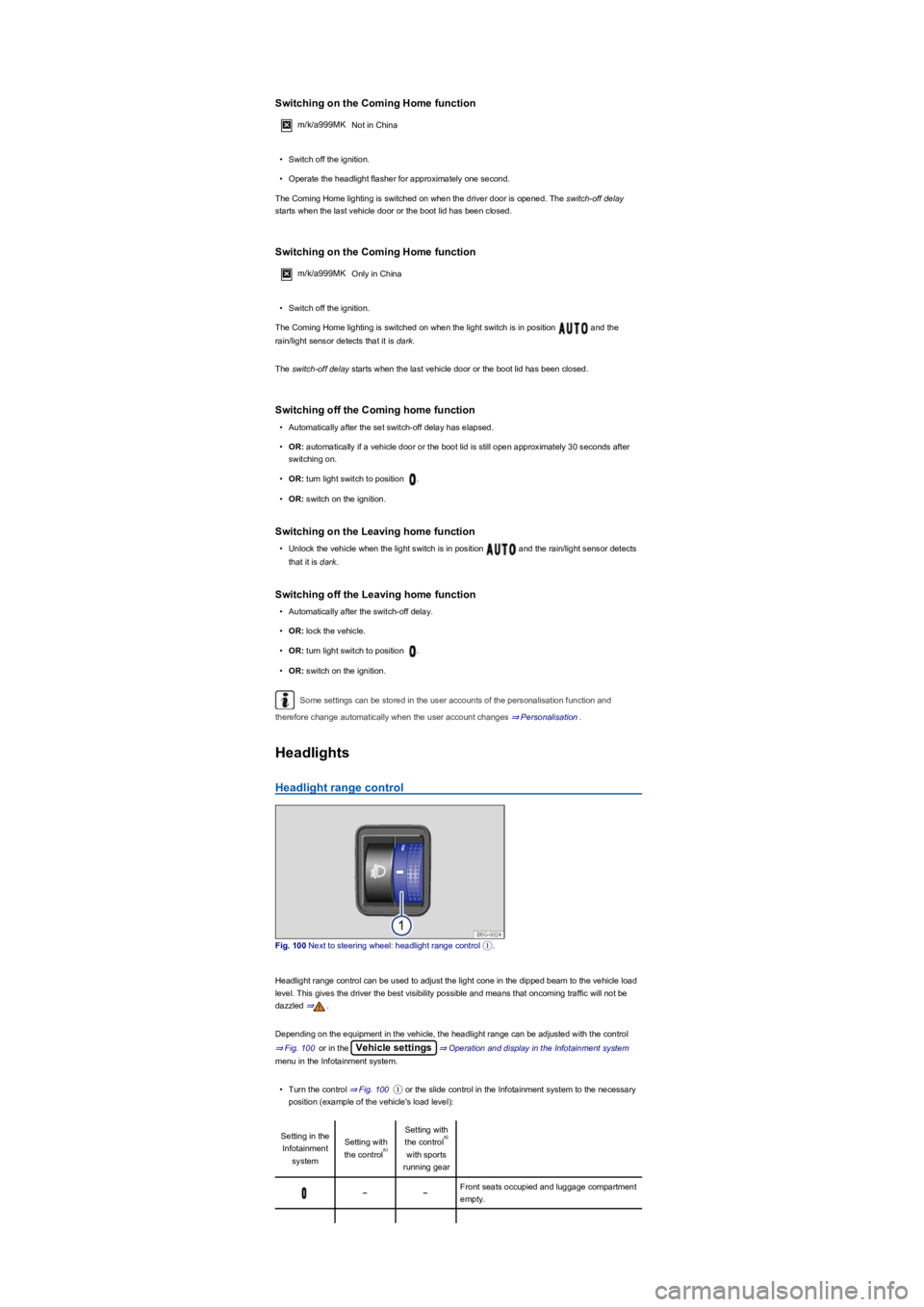
Fig. 100 Next to steering wheel: headlight range control ①.
Headlight range control can be used to adjust the light cone in the dipped beam to the vehicle load
level. This gives the driver the best visibility possible and means that oncoming traffic will not be
dazzled ⇒.
Depending on the equipment in the vehicle, the headlight range can be adjusted with the control
⇒ Fig. 100 or in the Vehicle settings⇒ Operation and display in the Infotainment system
menu in the Infotainment system.
•Turn the control ⇒ Fig. 100① or the slide control in the Infotainment system to the necessary
position (example of the vehicle's load level):
Setting in the
Infotainment
system
Setting with
the control
Setting with
the control
with sports
running gear
Front seats occupied and luggage compartment
empty.
a)
a)
Page 107 of 341
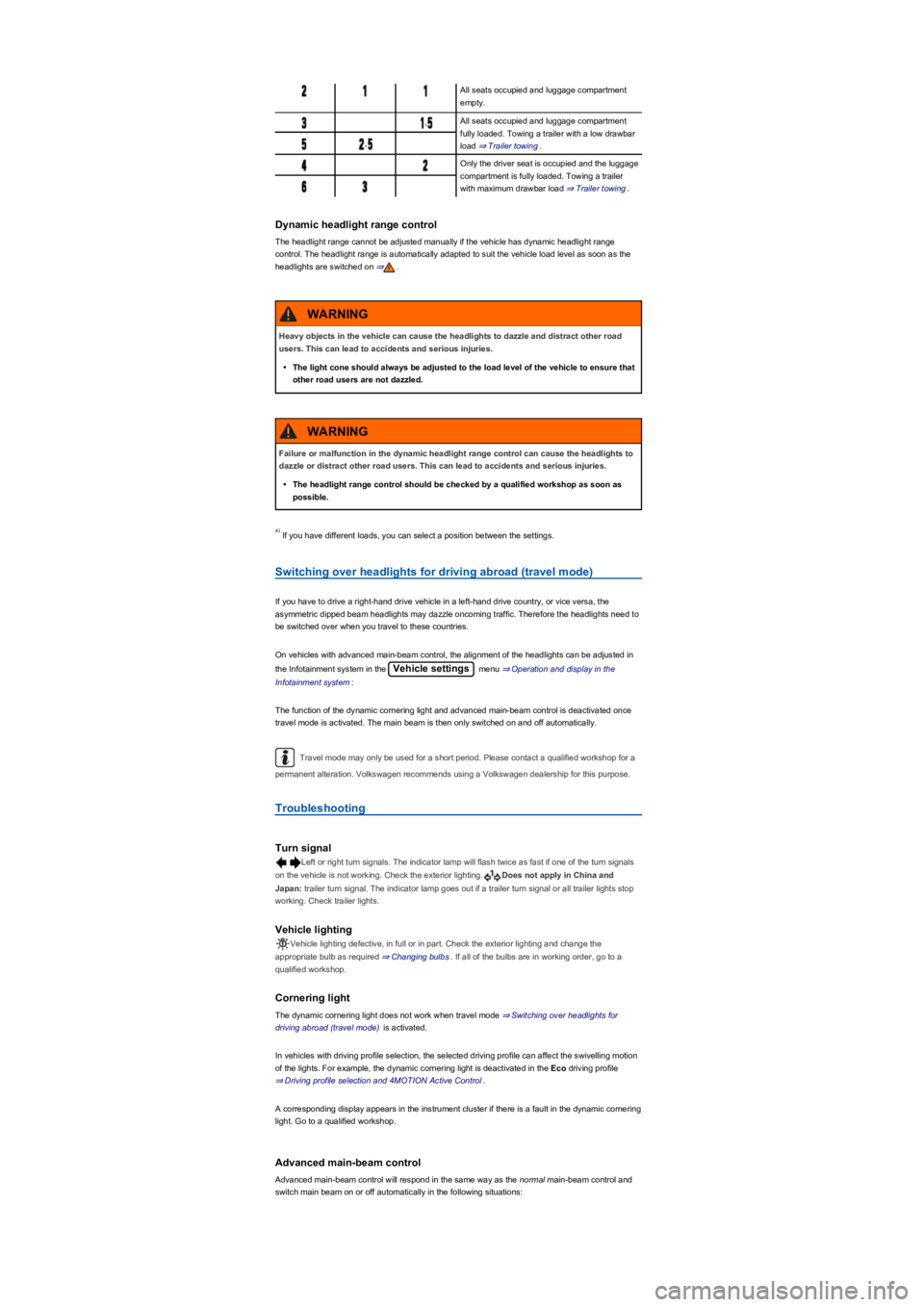
All seats occupied and luggage compartment
empty.
,All seats occupied and luggage compartment
fully loaded. Towing a trailer with a low drawbar
load ⇒ Trailer towing.,
Only the driver seat is occupied and the luggage
compartment is fully loaded. Towing a trailer
with maximum drawbar load ⇒ Trailer towing.
Dynamic headlight range control
The headlight range cannot be adjusted manually if the vehicle has dynamic headlight range
control. The headlight range is automatically adapted to suit the vehicle load level as soon as the
headlights are switched on ⇒.
If you have different loads, you can select a position between the settings.
Switching over headlights for driving abroad (travel mode)
If you have to drive a right-hand drive vehicle in a left-hand drive country, or vice versa, the
asymmetric dipped beam headlights may dazzle oncoming traffic. Therefore the headlights need to
be switched over when you travel to these countries.
On vehicles with advanced main-beam control, the alignment of the headlights can be adjusted in
the Infotainment system in the Vehicle settings menu ⇒ Operation and display in the
Infotainment system:
The function of the dynamic cornering light and advanced main-beam control is deactivated once
travel mode is activated. The main beam is then only switched on and off automatically.
Travel mode may only be used for a short period. Please contact a qualified workshop for a
permanent alteration. Volkswagen recommends using a Volkswagen dealership for this purpose.
Troubleshooting
Turn signal
Left or right turn signals. The indicator lamp will flash twice as fast if one of the turn signals
on the vehicle is not working. Check the exterior lighting.Does not apply in China and
Japan: trailer turn signal. The indicator lamp goes out if a trailer turn signal or all trailer lights stop
working. Check trailer lights.
Vehicle lighting
Vehicle lighting defective, in full or in part. Check the exterior lighting and change the
appropriate bulb as required ⇒ Changing bulbs. If all of the bulbs are in working order, go to a
qualified workshop.
Cornering light
The dynamic cornering light does not work when travel mode ⇒ Switching over headlights for
driving abroad (travel mode) is activated.
In vehicles with driving profile selection, the selected driving profile can affect the swivelling motion
of the lights. For example, the dynamic cornering light is deactivated in the Eco driving profile
⇒ Driving profile selection and 4MOTION Active Control.
A corresponding display appears in the instrument cluster if there is a fault in the dynamic cornering
light. Go to a qualified workshop.
Advanced main-beam control
Advanced main-beam control will respond in the same way as the normal main-beam control and
switch main beam on or off automatically in the following situations:
Heavy objects in the vehicle can cause the headlights to dazzle and distract other road
users. This can lead to accidents and serious injuries.
•The light cone should always be adjusted to the load level of the vehicle to ensure that
other road users are not dazzled.
WARNING
Failure or malfunction in the dynamic headlight range control can cause the headlights to
dazzle or distract other road users. This can lead to accidents and serious injuries.
•The headlight range control should be checked by a qualified workshop as soon as
possible.
WARNING
a)
Page 118 of 341
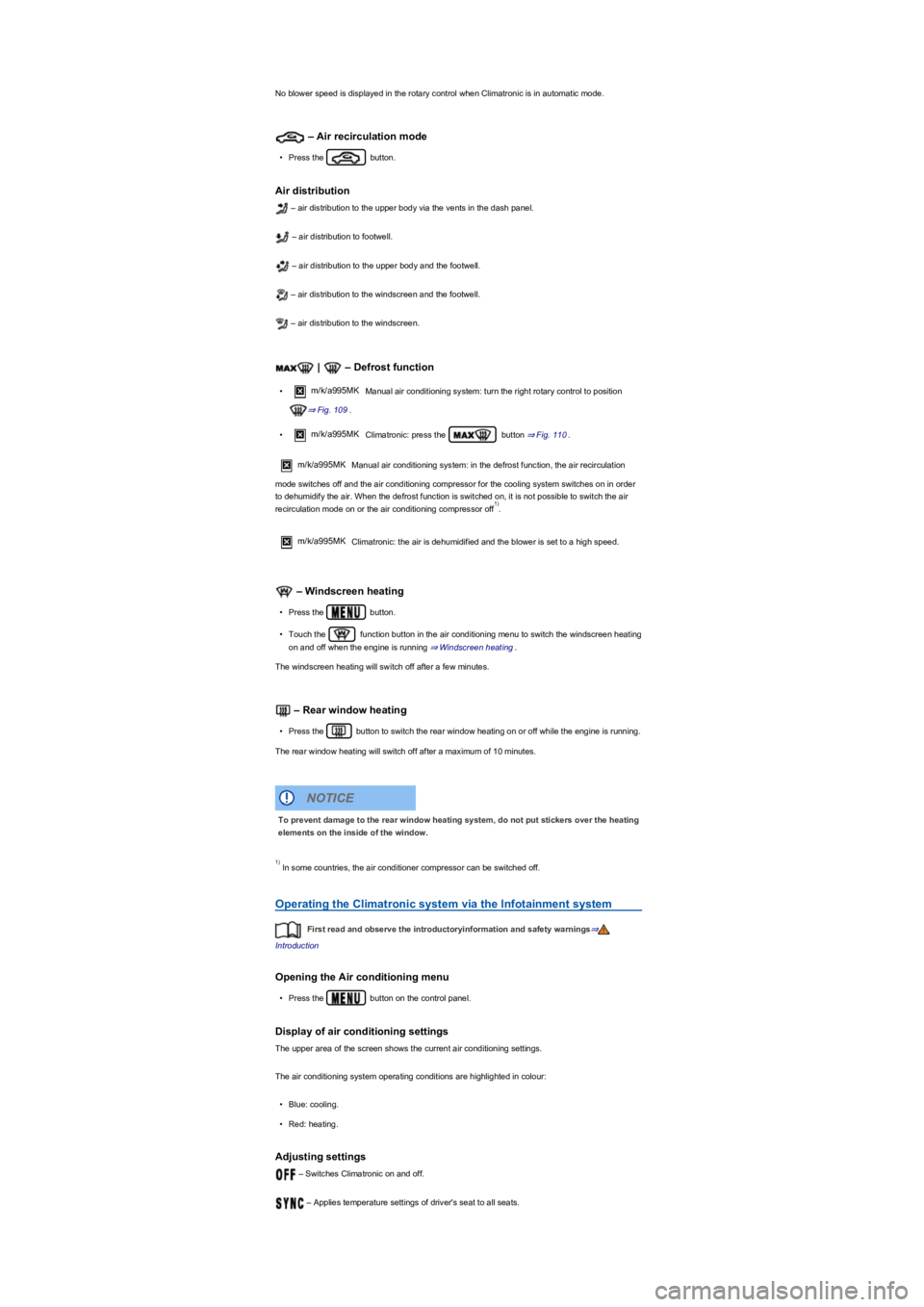
No blower speed is displayed in the rotary control when Climatronic is in automatic mode.
– Air recirculation mode
•Press the button.
Air distribution
– air distribution to the upper body via the vents in the dash panel.
– air distribution to footwell.
– air distribution to the upper body and the footwell.
– air distribution to the windscreen and the footwell.
– air distribution to the windscreen.
| – Defrost function
•m/k/a995MK Manual air conditioning system: turn the right rotary control to position
⇒ Fig. 109.
•m/k/a995MK Climatronic: press the button ⇒ Fig. 110.
m/k/a995MKManual air conditioning system: in the defrost function, the air recirculation
mode switches off and the air conditioning compressor for the cooling system switches on in order
to dehumidify the air. When the defrost function is switched on, it is not possible to switch the air
recirculation mode on or the air conditioning compressor off.
m/k/a995MK Climatronic: the air is dehumidified and the blower is set to a high speed.
– Windscreen heating
•Press the button.
•Touch the function button in the air conditioning menu to switch the windscreen heating
on and off when the engine is running ⇒ Windscreen heating.
The windscreen heating will switch off after a few minutes.
– Rear window heating
•Press the button to switch the rear window heating on or off while the engine is running.
The rear window heating will switch off after a maximum of 10 minutes.
In some countries, the air conditioner compressor can be switched off.
Operating the Climatronic system via the Infotainment system
First read and observe the introductoryinformation and safety warnings⇒
Introduction
Opening the Air conditioning menu
•Press the button on the control panel.
Display of air conditioning settings
The upper area of the screen shows the current air conditioning settings.
The air conditioning system operating conditions are highlighted in colour:
•Blue: cooling.
•Red: heating.
Adjusting settings
– Switches Climatronic on and off.
– Applies temperature settings of driver's seat to all seats.
1)
To prevent damage to the rear window heating system, do not put stickers over the heating
elements on the inside of the window.
NOTICE
1)