warning VOLKSWAGEN TIGUAN 2017 Owner´s Manual
[x] Cancel search | Manufacturer: VOLKSWAGEN, Model Year: 2017, Model line: TIGUAN, Model: VOLKSWAGEN TIGUAN 2017Pages: 341, PDF Size: 9.14 MB
Page 333 of 341
If the vehicle exceeds the permitted gross weight or axle load for the rear axle, a speed of 80 km/h
must not be exceeded when towing a trailer. This also applies to countries where higher speeds are
permitted. Always obey speed limits. In some areas speed limits for vehicles towing trailers are
lower than for vehicles without trailers.
Any permitted excess loads for the vehicle are entered in the vehicle documents. If no permitted
excess load is entered, the permitted driving speed limit is 100 km/h taking into account country-
specific legislation.
Technical data
Refer to the vehicle documents for the technical data.
Technical data
Information on technical data
Unless otherwise indicated or listed separately, the technical data for the basic model apply.
Optional equipment, different vehicle equipment, special vehicles and country-specific vehicle
equipment levels can result in different values. All data in the official vehicle documents take
precedence over these data.
Observe the instructions and information relating to vehicles with N1 approval ⇒ Information about
vehicles with N1 approval (light commercial vehicle).
Engine
The vehicle data sticker or the vehicle registration documents show which engine is installed in your
vehicle.
Weight
The values for the kerb weight in the following tables apply to the road-ready vehicle with driver
(75 kg), service fluids including fuel tank carrying 90% of its capacity and, if applicable, tool kit and
spare tyre ⇒. Additional equipment and retrofitted accessories increase the kerb weight stated
and reduce the maximum permitted load accordingly.
The load comprises the weights of the following:
•Vehicle occupants
•All luggage
•Roof load including the mounts or roof bars and the load carrier system
•Drawbar load when towing a trailer ⇒ Trailer towing.
Performance figures
For reasons of vehicle registration and vehicle taxation, the power output and performance of some
engines may vary in some countries from the information given in this booklet.
In certain vehicles with heavy duty suspension, the engine could be governed to provide a
maximum speed of 210 km/h.
Danger of injuries and electric shock from exposed cables.
•Have the luggage compartment completed at the latest after delivery so that the cables
in the rear area of the vehicle are covered during use of the vehicle.
WARNING
Danger of serious injury due to incorrect transport of persons.
•Never transport a person or child in the middle of the rear bench seat.
•The lack of restraint systems such as seat belt and head restraint can result in serious
or fatal injury in the event of an accident.
WARNING
Danger of serious and fatal injury.
•Do not transport people in the luggage compartment.
•Observe the safety instructions and information on the luggage compartment and
transporting items ⇒ Transporting.
WARNING
Page 334 of 341
When the performance figures were measured, the vehicle was not fitted with any equipment that
could reduce performance, e.g. a roof carrier or mud flaps.
Gross combination weight rating
The gross combination weight ratings listed are only applicable for altitudes up to 1,000 m above
sea level. The maximum weight of the car and trailer must be reduced by approximately 10% for
every further 1,000 m in altitude.
Explanation of tables
Gearbox abbreviations: MG = manual gearbox, DSG = dual clutch gearbox DSG. MG6 = 6-speed
manual gearbox.
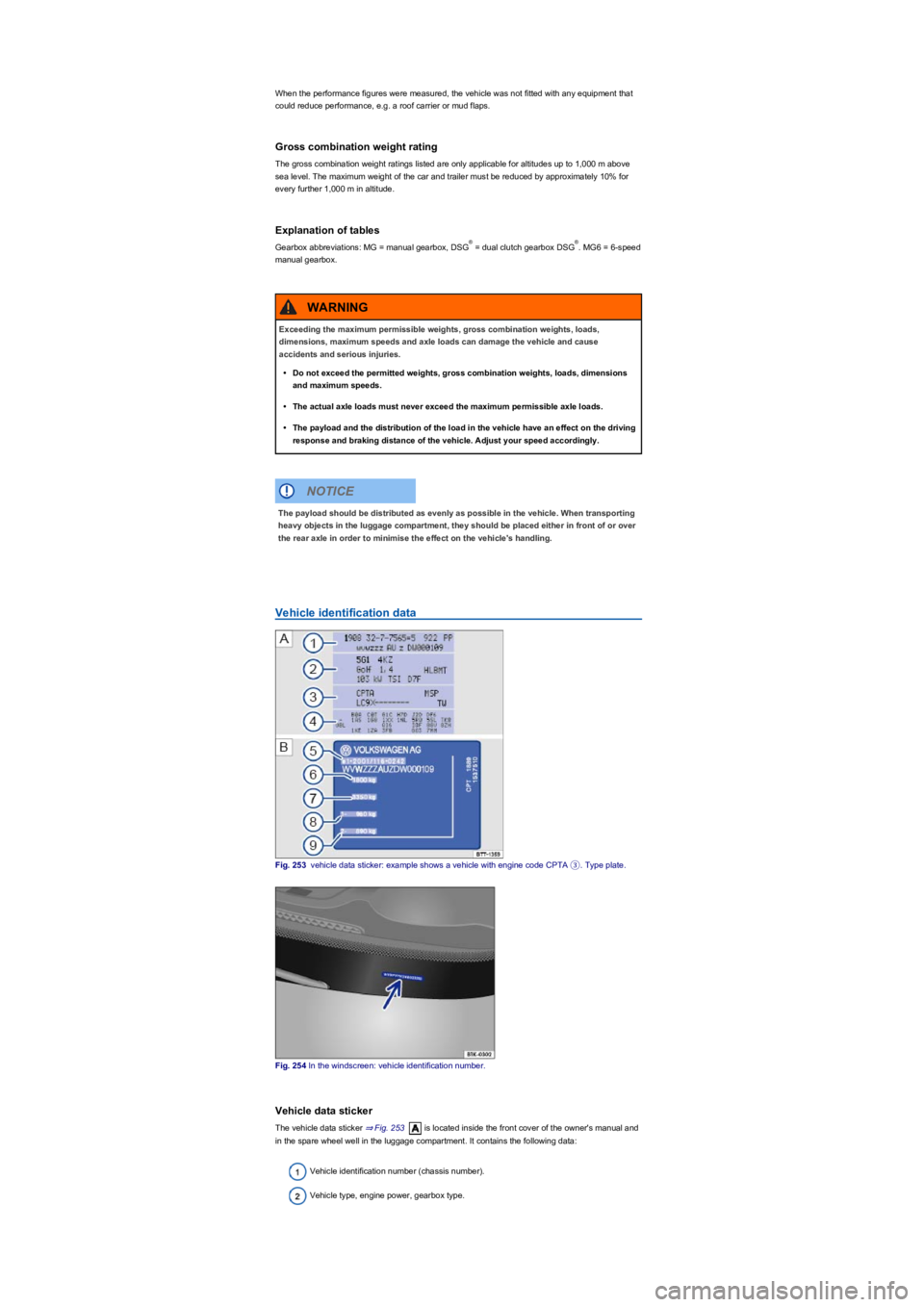
Vehicle identification data
Fig. 253 vehicle data sticker: example shows a vehicle with engine code CPTA ③. Type plate.
Fig. 254 In the windscreen: vehicle identification number.
Vehicle data sticker
The vehicle data sticker ⇒ Fig. 253 is located inside the front cover of the owner's manual and
in the spare wheel well in the luggage compartment. It contains the following data:
Vehicle identification number (chassis number).
Vehicle type, engine power, gearbox type.
®®
Exceeding the maximum permissible weights, gross combination weights, loads,
dimensions, maximum speeds and axle loads can damage the vehicle and cause
accidents and serious injuries.
•Do not exceed the permitted weights, gross combination weights, loads, dimensions
and maximum speeds.
•The actual axle loads must never exceed the maximum permissible axle loads.
•The payload and the distribution of the load in the vehicle have an effect on the driving
response and braking distance of the vehicle. Adjust your speed accordingly.
WARNING
The payload should be distributed as evenly as possible in the vehicle. When transporting
heavy objects in the luggage compartment, they should be placed either in front of or over
the rear axle in order to minimise the effect on the vehicle's handling.
NOTICE