pressure VOLKSWAGEN TIGUAN 2017 Owner´s Manual
[x] Cancel search | Manufacturer: VOLKSWAGEN, Model Year: 2017, Model line: TIGUAN, Model: VOLKSWAGEN TIGUAN 2017Pages: 341, PDF Size: 9.14 MB
Page 295 of 341
Handling wheels and tyres
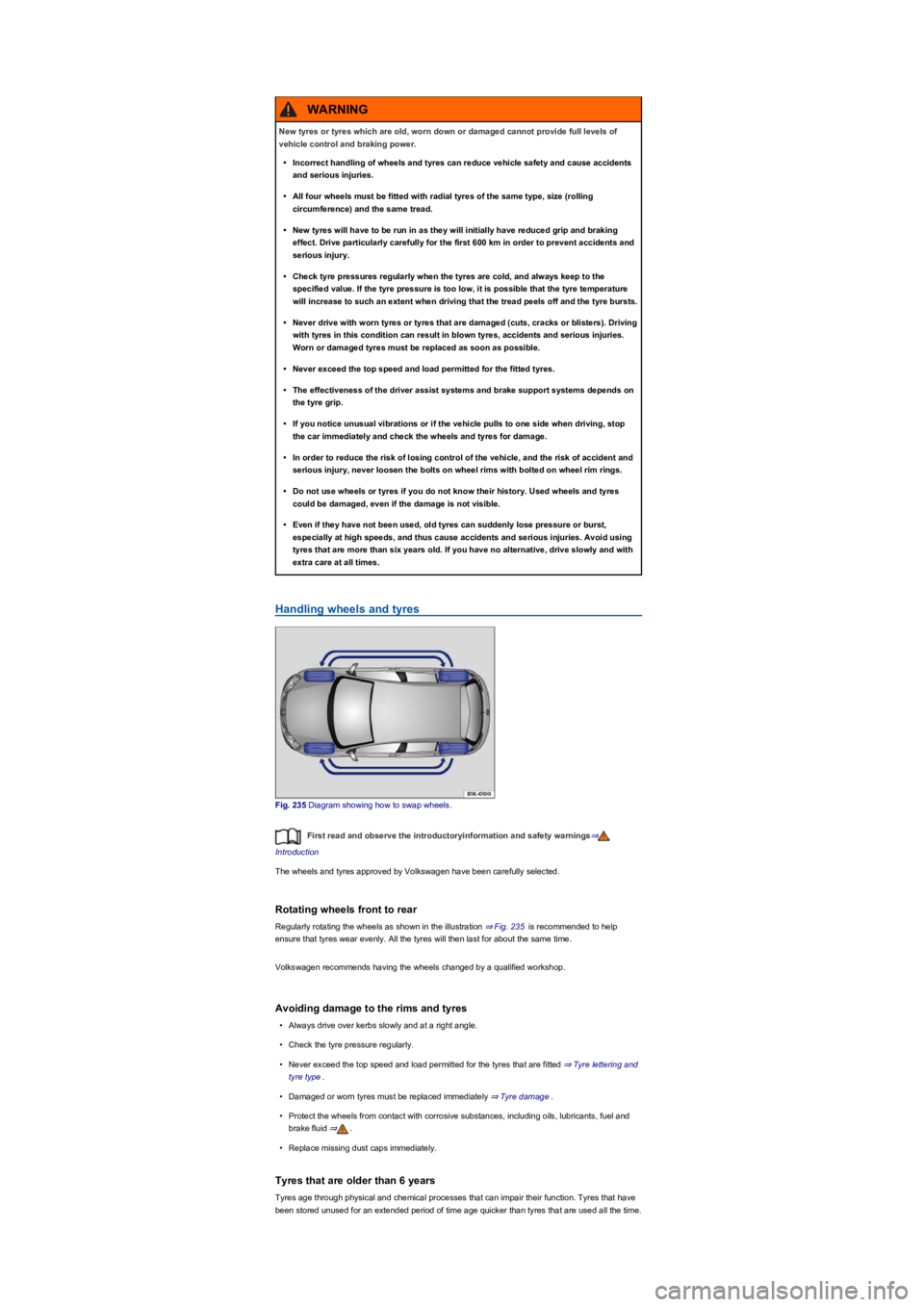
Fig. 235 Diagram showing how to swap wheels.
First read and observe the introductoryinformation and safety warnings⇒
Introduction
The wheels and tyres approved by Volkswagen have been carefully selected.
Rotating wheels front to rear
Regularly rotating the wheels as shown in the illustration ⇒ Fig. 235 is recommended to help
ensure that tyres wear evenly. All the tyres will then last for about the same time.
Volkswagen recommends having the wheels changed by a qualified workshop.
Avoiding damage to the rims and tyres
•Always drive over kerbs slowly and at a right angle.
•Check the tyre pressure regularly.
•Never exceed the top speed and load permitted for the tyres that are fitted ⇒ Tyre lettering and
tyre type.
•Damaged or worn tyres must be replaced immediately ⇒ Tyre damage.
•Protect the wheels from contact with corrosive substances, including oils, lubricants, fuel and
brake fluid ⇒.
•Replace missing dust caps immediately.
Tyres that are older than 6 years
Tyres age through physical and chemical processes that can impair their function. Tyres that have
been stored unused for an extended period of time age quicker than tyres that are used all the time.
New tyres or tyres which are old, worn down or damaged cannot provide full levels of
vehicle control and braking power.
•Incorrect handling of wheels and tyres can reduce vehicle safety and cause accidents
and serious injuries.
•All four wheels must be fitted with radial tyres of the same type, size (rolling
circumference) and the same tread.
•New tyres will have to be run in as they will initially have reduced grip and braking
effect. Drive particularly carefully for the first 600 km in order to prevent accidents and
serious injury.
•Check tyre pressures regularly when the tyres are cold, and always keep to the
specified value. If the tyre pressure is too low, it is possible that the tyre temperature
will increase to such an extent when driving that the tread peels off and the tyre bursts.
•Never drive with worn tyres or tyres that are damaged (cuts, cracks or blisters). Driving
with tyres in this condition can result in blown tyres, accidents and serious injuries.
Worn or damaged tyres must be replaced as soon as possible.
•Never exceed the top speed and load permitted for the fitted tyres.
•The effectiveness of the driver assist systems and brake support systems depends on
the tyre grip.
•If you notice unusual vibrations or if the vehicle pulls to one side when driving, stop
the car immediately and check the wheels and tyres for damage.
•In order to reduce the risk of losing control of the vehicle, and the risk of accident and
serious injury, never loosen the bolts on wheel rims with bolted on wheel rim rings.
•Do not use wheels or tyres if you do not know their history. Used wheels and tyres
could be damaged, even if the damage is not visible.
•Even if they have not been used, old tyres can suddenly lose pressure or burst,
especially at high speeds, and thus cause accidents and serious injuries. Avoid using
tyres that are more than six years old. If you have no alternative, drive slowly and with
extra care at all times.
WARNING
Page 296 of 341
Volkswagen recommends replacing tyres that are older than 6 years with new tyres. This also
applies for tyres which appear to still be in good condition and whose tread depth has not yet
reached the minimum value stipulated by legislation ⇒.
Winter and all-year tyres also largely lose their effectiveness through ageing – regardless of the
remaining tread depth ⇒ Winter tyres.
The age of each tyre can be determined using the manufacturing date ⇒ Tyre lettering and tyre
type.
Storing tyres
Always store tyres in a cool, dry and preferably dark place. Do not store tyres mounted on the rim
vertically.
Any tyres not fitted on rims should be kept in suitable sleeves to protect against dirt and should be
stored vertically (standing on the tread).
New tyres
•Drive particularly carefully for the first 600 km with new tyres as the tyres have to be run in.
Tyres that have not been run in have reduced grip ⇒ and braking effect ⇒.
•All four wheels must be fitted with tyres of the same type, size, and the same tread pattern.
Replacing tyres
•Always replace tyres at least on an axle-by-axle basis ⇒.
•Old tyres should only be replaced by tyres that have been approved by Volkswagen for the
vehicle type.
•Never use tyres with an effective size that is larger than Volkswagen-approved tyres.
Re-adapting the Tyre Pressure Loss Indicator
The Tyre Pressure Loss Indicator must be recalibrated each time one or more wheels are replaced.
This also applies for changing the wheels round, e.g. from the front to the rear ⇒ Tyre monitoring
systems.
Vehicles fitted with a Tyre Pressure Monitoring System
If you wish to replace factory-fitted wheels, make sure that the new wheels are equipped with
sensors that are compatible with the Tyre Pressure Monitoring System ⇒ Tyre Pressure Monitoring
System. The vehicle must be driven at a speed of over 25 km/h (15 mph) for an extended period so
that the new wheels can be recognised.
Volkswagen recommends that a new valve set and set of seals is used every time the sensors are
replaced or modified.
Further information on the Tyre Pressure Monitoring System ⇒ Tyre monitoring systems.
Corrosive liquids and other substances can cause visible and invisible damage to the
tyres, which can cause the tyre to burst.
•Always keep chemicals, oils, lubricants, fuel, brake fluid and other corrosive
substances away from the tyres.
WARNING
Even if they have not been used, old tyres can suddenly lose pressure or burst, especially
at high speeds, and thus cause accidents and serious injuries.
•Avoid using tyres that are more than six years old. If you have no alternative, drive
slowly and with extra care at all times.
WARNING
New tyres will have to be run in as they will initially have reduced grip and braking effect.
•Drive particularly carefully for the first 600 km in order to prevent accidents and
serious injury.
WARNING
Page 298 of 341
Tyre pressure
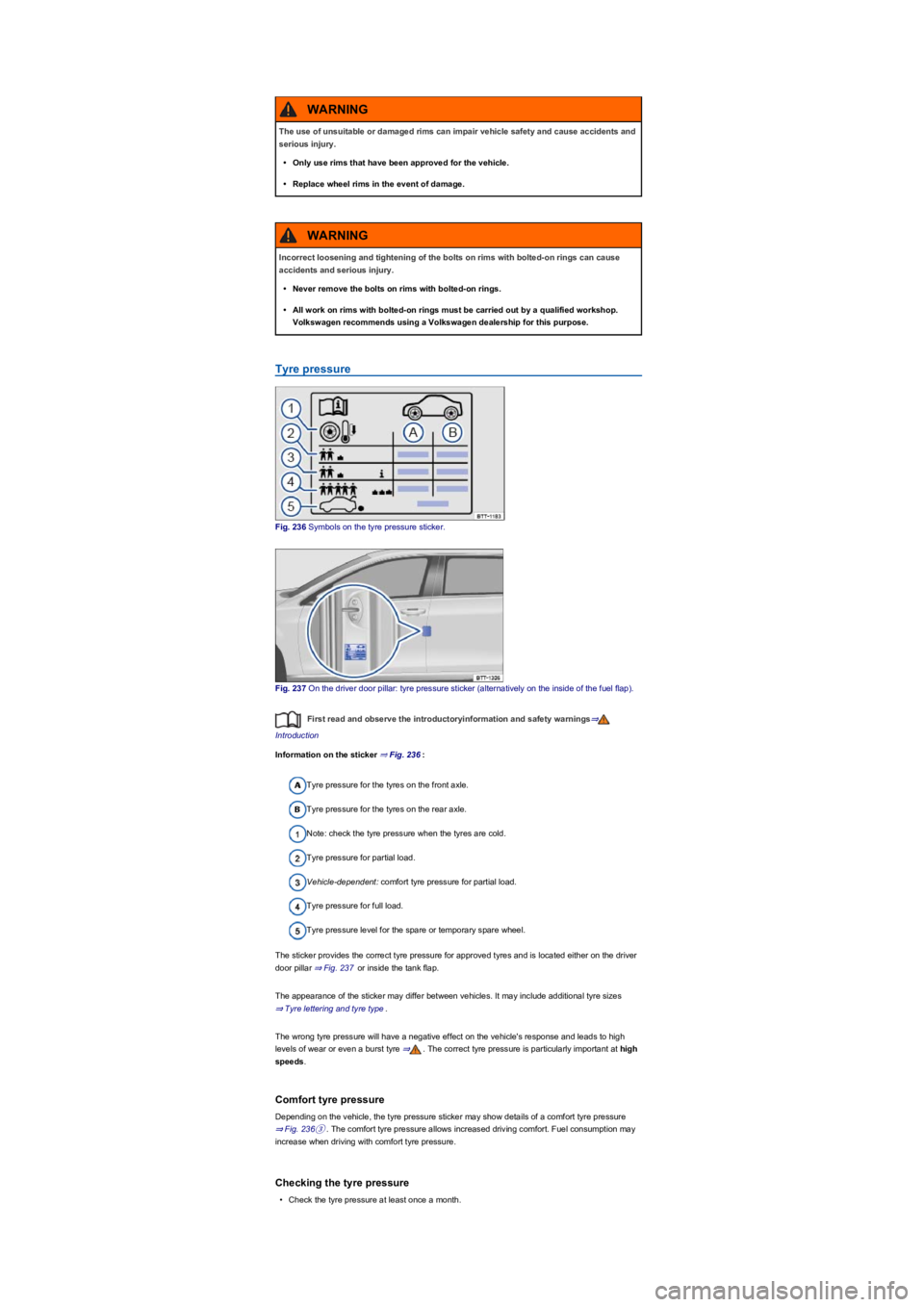
Fig. 236 Symbols on the tyre pressure sticker.
Fig. 237 On the driver door pillar: tyre pressure sticker (alternatively on the inside of the fuel flap).
First read and observe the introductoryinformation and safety warnings⇒
Introduction
Information on the sticker ⇒ Fig. 236:
Tyre pressure for the tyres on the front axle.
Tyre pressure for the tyres on the rear axle.
Note: check the tyre pressure when the tyres are cold.
Tyre pressure for partial load.
Vehicle-dependent: comfort tyre pressure for partial load.
Tyre pressure for full load.
Tyre pressure level for the spare or temporary spare wheel.
The sticker provides the correct tyre pressure for approved tyres and is located either on the driver
door pillar ⇒ Fig. 237 or inside the tank flap.
The appearance of the sticker may differ between vehicles. It may include additional tyre sizes
⇒ Tyre lettering and tyre type.
The wrong tyre pressure will have a negative effect on the vehicle's response and leads to high
levels of wear or even a burst tyre ⇒. The correct tyre pressure is particularly important at high
speeds.
Comfort tyre pressure
Depending on the vehicle, the tyre pressure sticker may show details of a comfort tyre pressure
⇒ Fig. 236③. The comfort tyre pressure allows increased driving comfort. Fuel consumption may
increase when driving with comfort tyre pressure.
Checking the tyre pressure
•Check the tyre pressure at least once a month.
The use of unsuitable or damaged rims can impair vehicle safety and cause accidents and
serious injury.
•Only use rims that have been approved for the vehicle.
•Replace wheel rims in the event of damage.
WARNING
Incorrect loosening and tightening of the bolts on rims with bolted-on rings can cause
accidents and serious injury.
•Never remove the bolts on rims with bolted-on rings.
•All work on rims with bolted-on rings must be carried out by a qualified workshop.
Volkswagen recommends using a Volkswagen dealership for this purpose.
WARNING
Page 299 of 341
•Always check the tyre pressure when the tyres are cold. The specified tyre pressure applies to
cold tyres. Tyre pressure is always higher in warm tyres than it is in cold tyres. For this reason,
never reduce the pressure in warm tyres to adjust the tyre pressure.
•Always adjust the tyre pressure to the load level ⇒ Fig. 236④.
•After adjusting the tyre pressures, always screw the caps onto the valves and observe the
information on the tyre monitoring system ⇒ Tyre monitoring systems.
•Always use the tyre pressure specified on the sticker. Never exceed the maximum tyre pressure
which is given on the sidewall of the tyre
Underinflated tyres will result in increased fuel consumption.
Tread depth and wear indicators
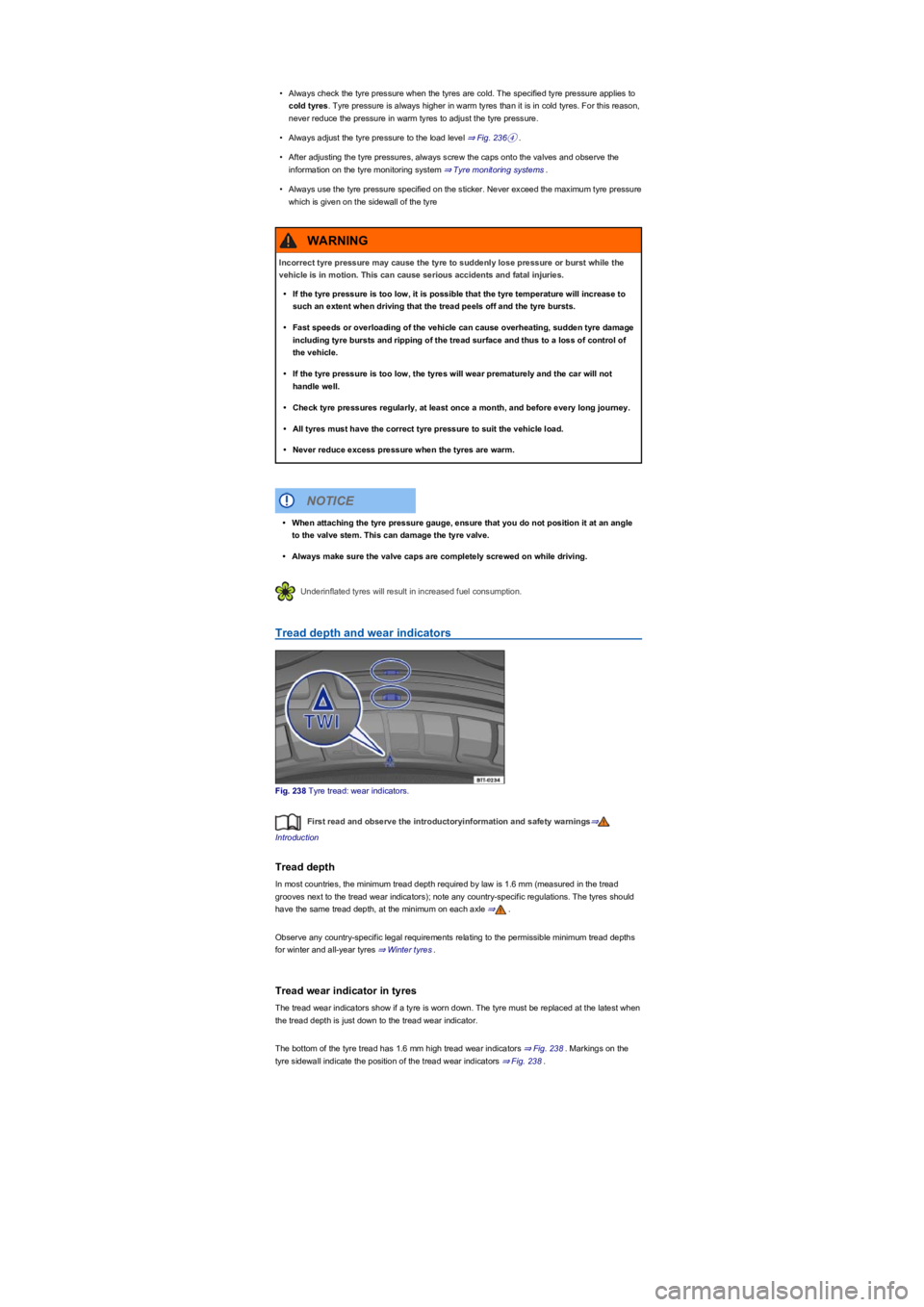
Fig. 238 Tyre tread: wear indicators.
First read and observe the introductoryinformation and safety warnings⇒
Introduction
Tread depth
In most countries, the minimum tread depth required by law is 1.6 mm (measured in the tread
grooves next to the tread wear indicators); note any country-specific regulations. The tyres should
have the same tread depth, at the minimum on each axle ⇒.
Observe any country-specific legal requirements relating to the permissible minimum tread depths
for winter and all-year tyres ⇒ Winter tyres.
Tread wear indicator in tyres
The tread wear indicators show if a tyre is worn down. The tyre must be replaced at the latest when
the tread depth is just down to the tread wear indicator.
The bottom of the tyre tread has 1.6 mm high tread wear indicators ⇒ Fig. 238. Markings on the
tyre sidewall indicate the position of the tread wear indicators ⇒ Fig. 238.
Incorrect tyre pressure may cause the tyre to suddenly lose pressure or burst while the
vehicle is in motion. This can cause serious accidents and fatal injuries.
•If the tyre pressure is too low, it is possible that the tyre temperature will increase to
such an extent when driving that the tread peels off and the tyre bursts.
•Fast speeds or overloading of the vehicle can cause overheating, sudden tyre damage
including tyre bursts and ripping of the tread surface and thus to a loss of control of
the vehicle.
•If the tyre pressure is too low, the tyres will wear prematurely and the car will not
handle well.
•Check tyre pressures regularly, at least once a month, and before every long journey.
•All tyres must have the correct tyre pressure to suit the vehicle load.
•Never reduce excess pressure when the tyres are warm.
WARNING
•When attaching the tyre pressure gauge, ensure that you do not position it at an angle
to the valve stem. This can damage the tyre valve.
•Always make sure the valve caps are completely screwed on while driving.
NOTICE
Page 300 of 341
Tyre damage
First read and observe the introductoryinformation and safety warnings⇒
Introduction
Damage to tyres and wheel rims is often hidden ⇒.
•If you suspect that a wheel is damaged, stop the vehicle as soon as it is safe to do so.
•Check the tyres and rims for damage.
•If a tyre is damaged, do not drive on. Seek expert assistance.
•If there is no visible damage, drive slowly and cautiously to the next qualified workshop in order
to have the vehicle checked.
Foreign bodies in the tyre
•Leave the foreign body in the tyre if it has entered the inner tyre. Foreign bodies that are stuck
between the tyre tread blocks can be removed.
•Replace the damaged wheel ⇒ Changing a wheel or seal the tyre with the breakdown set and
inflate it ⇒ Breakdown set. Seek professional assistance for this if necessary.
•Check and adjust the tyre pressure.
•Go to a qualified workshop. Volkswagen recommends using a Volkswagen dealership for this
purpose.
Tyre wear
Fast cornering, heavy acceleration and hard braking all increase tyre wear.
Wheel imbalance may develop when the vehicle is driven; you will notice this by nervous steering
response. Unbalanced wheels will affect the level of tyre wear. In this case the wheels should be
balanced again.
Incorrect wheel alignment causes excessive tyre wear, impairing the safety of the vehicle. The
wheel alignment should be checked by a qualified workshop if tyres show excessive wear.
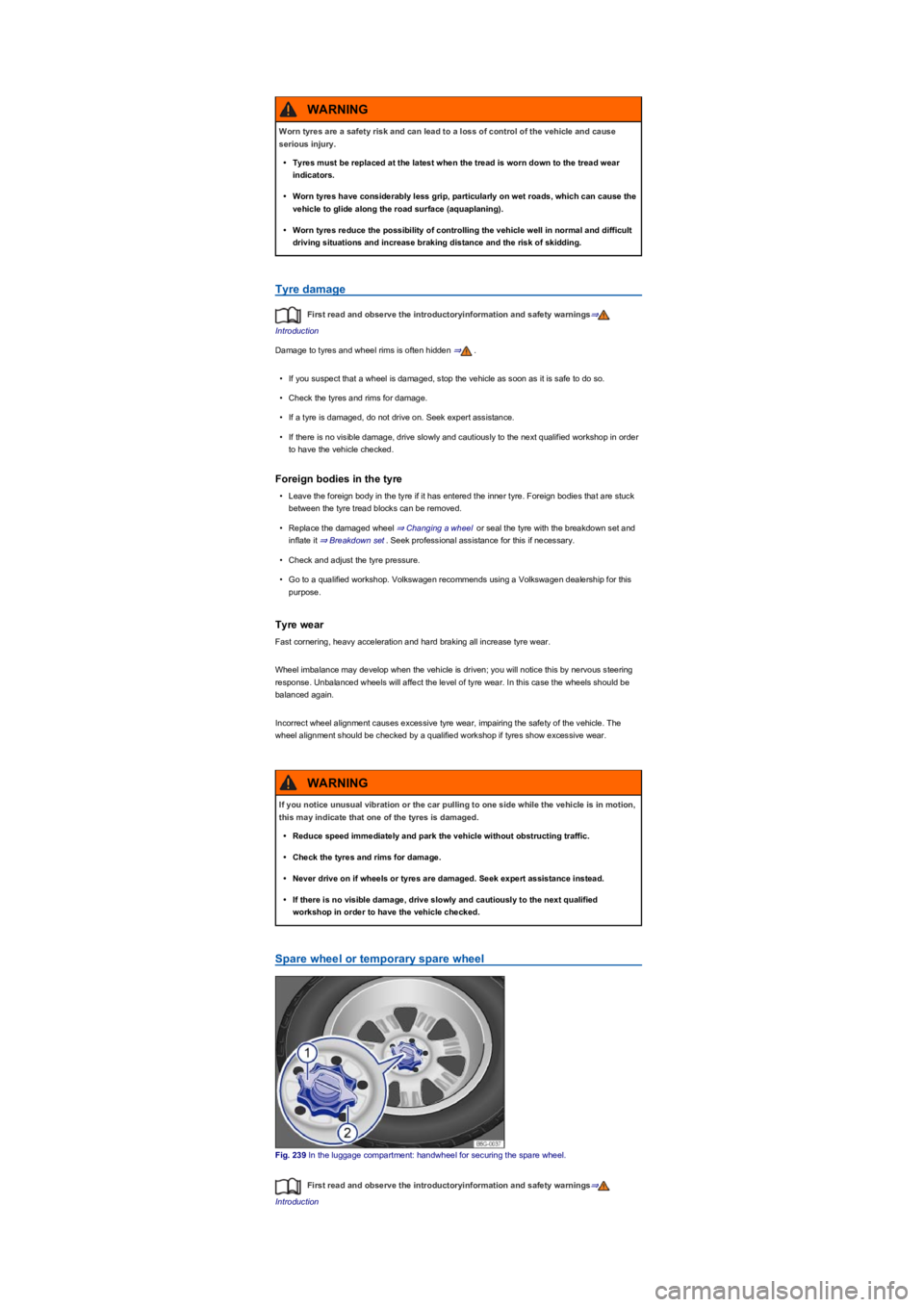
Spare wheel or temporary spare wheel
Fig. 239 In the luggage compartment: handwheel for securing the spare wheel.
First read and observe the introductoryinformation and safety warnings⇒
Introduction
Worn tyres are a safety risk and can lead to a loss of control of the vehicle and cause
serious injury.
•Tyres must be replaced at the latest when the tread is worn down to the tread wear
indicators.
•Worn tyres have considerably less grip, particularly on wet roads, which can cause the
vehicle to glide along the road surface (aquaplaning).
•Worn tyres reduce the possibility of controlling the vehicle well in normal and difficult
driving situations and increase braking distance and the risk of skidding.
WARNING
If you notice unusual vibration or the car pulling to one side while the vehicle is in motion,
this may indicate that one of the tyres is damaged.
•Reduce speed immediately and park the vehicle without obstructing traffic.
•Check the tyres and rims for damage.
•Never drive on if wheels or tyres are damaged. Seek expert assistance instead.
•If there is no visible damage, drive slowly and cautiously to the next qualified
workshop in order to have the vehicle checked.
WARNING
Page 301 of 341
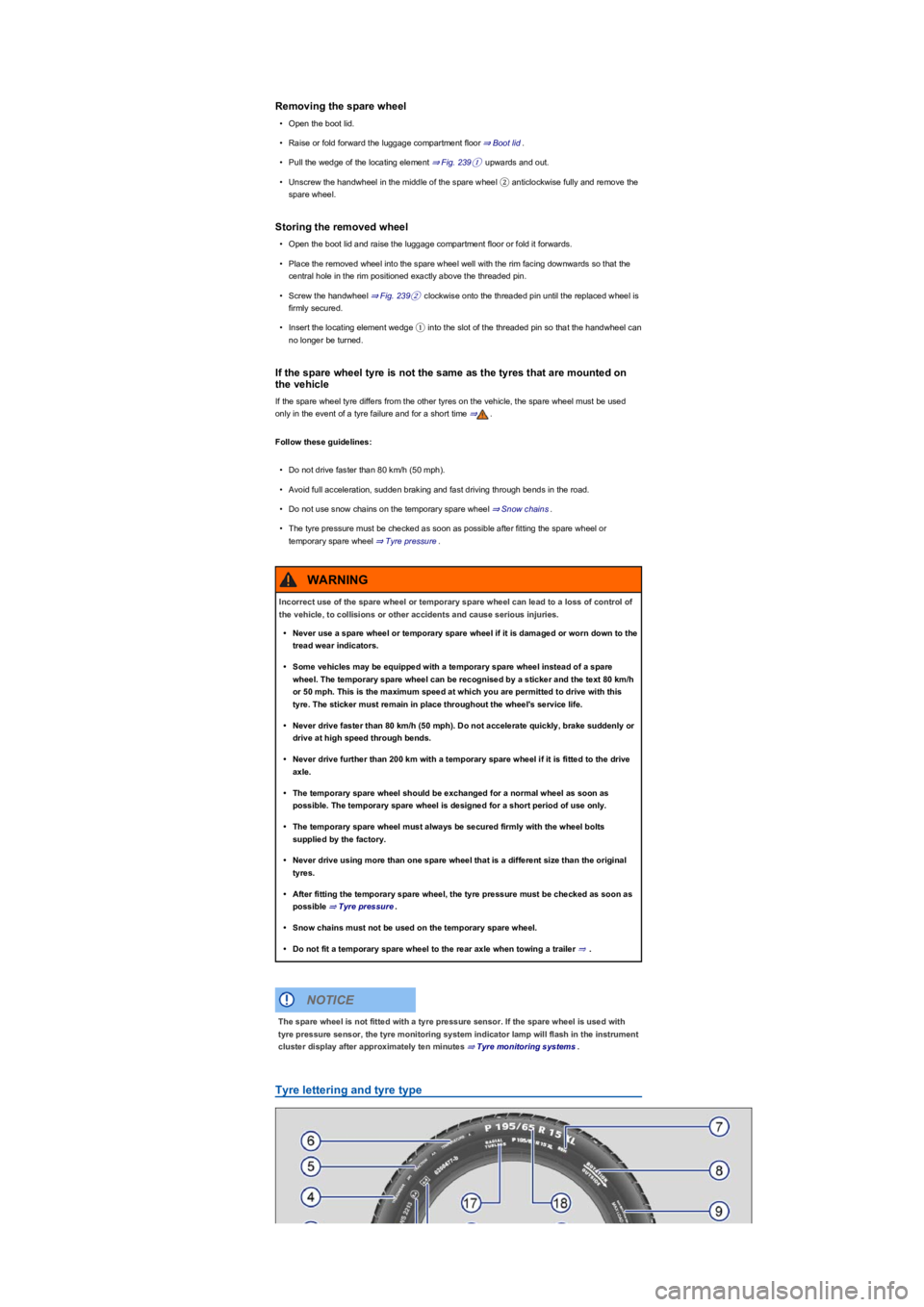
Removing the spare wheel
•Open the boot lid.
•Raise or fold forward the luggage compartment floor ⇒ Boot lid.
•Pull the wedge of the locating element ⇒ Fig. 239① upwards and out.
•Unscrew the handwheel in the middle of the spare wheel ② anticlockwise fully and remove the
spare wheel.
Storing the removed wheel
•Open the boot lid and raise the luggage compartment floor or fold it forwards.
•Place the removed wheel into the spare wheel well with the rim facing downwards so that the
central hole in the rim positioned exactly above the threaded pin.
•Screw the handwheel ⇒ Fig. 239② clockwise onto the threaded pin until the replaced wheel is
firmly secured.
•Insert the locating element wedge ① into the slot of the threaded pin so that the handwheel can
no longer be turned.
If the spare wheel tyre is not the same as the tyres that are mounted on
the vehicle
If the spare wheel tyre differs from the other tyres on the vehicle, the spare wheel must be used
only in the event of a tyre failure and for a short time ⇒.
Follow these guidelines:
•Do not drive faster than 80 km/h (50 mph).
•Avoid full acceleration, sudden braking and fast driving through bends in the road.
•Do not use snow chains on the temporary spare wheel ⇒ Snow chains.
•The tyre pressure must be checked as soon as possible after fitting the spare wheel or
temporary spare wheel ⇒ Tyre pressure.
Tyre lettering and tyre type
Incorrect use of the spare wheel or temporary spare wheel can lead to a loss of control of
the vehicle, to collisions or other accidents and cause serious injuries.
•Never use a spare wheel or temporary spare wheel if it is damaged or worn down to the
tread wear indicators.
•Some vehicles may be equipped with a temporary spare wheel instead of a spare
wheel. The temporary spare wheel can be recognised by a sticker and the text 80 km/h
or 50 mph. This is the maximum speed at which you are permitted to drive with this
tyre. The sticker must remain in place throughout the wheel's service life.
•Never drive faster than 80 km/h (50 mph). Do not accelerate quickly, brake suddenly or
drive at high speed through bends.
•Never drive further than 200 km with a temporary spare wheel if it is fitted to the drive
axle.
•The temporary spare wheel should be exchanged for a normal wheel as soon as
possible. The temporary spare wheel is designed for a short period of use only.
•The temporary spare wheel must always be secured firmly with the wheel bolts
supplied by the factory.
•Never drive using more than one spare wheel that is a different size than the original
tyres.
•After fitting the temporary spare wheel, the tyre pressure must be checked as soon as
possible ⇒ Tyre pressure.
•Snow chains must not be used on the temporary spare wheel.
•Do not fit a temporary spare wheel to the rear axle when towing a trailer ⇒.
WARNING
The spare wheel is not fitted with a tyre pressure sensor. If the spare wheel is used with
tyre pressure sensor, the tyre monitoring system indicator lamp will flash in the instrument
cluster display after approximately ten minutes ⇒ Tyre monitoring systems.
NOTICE
Page 302 of 341
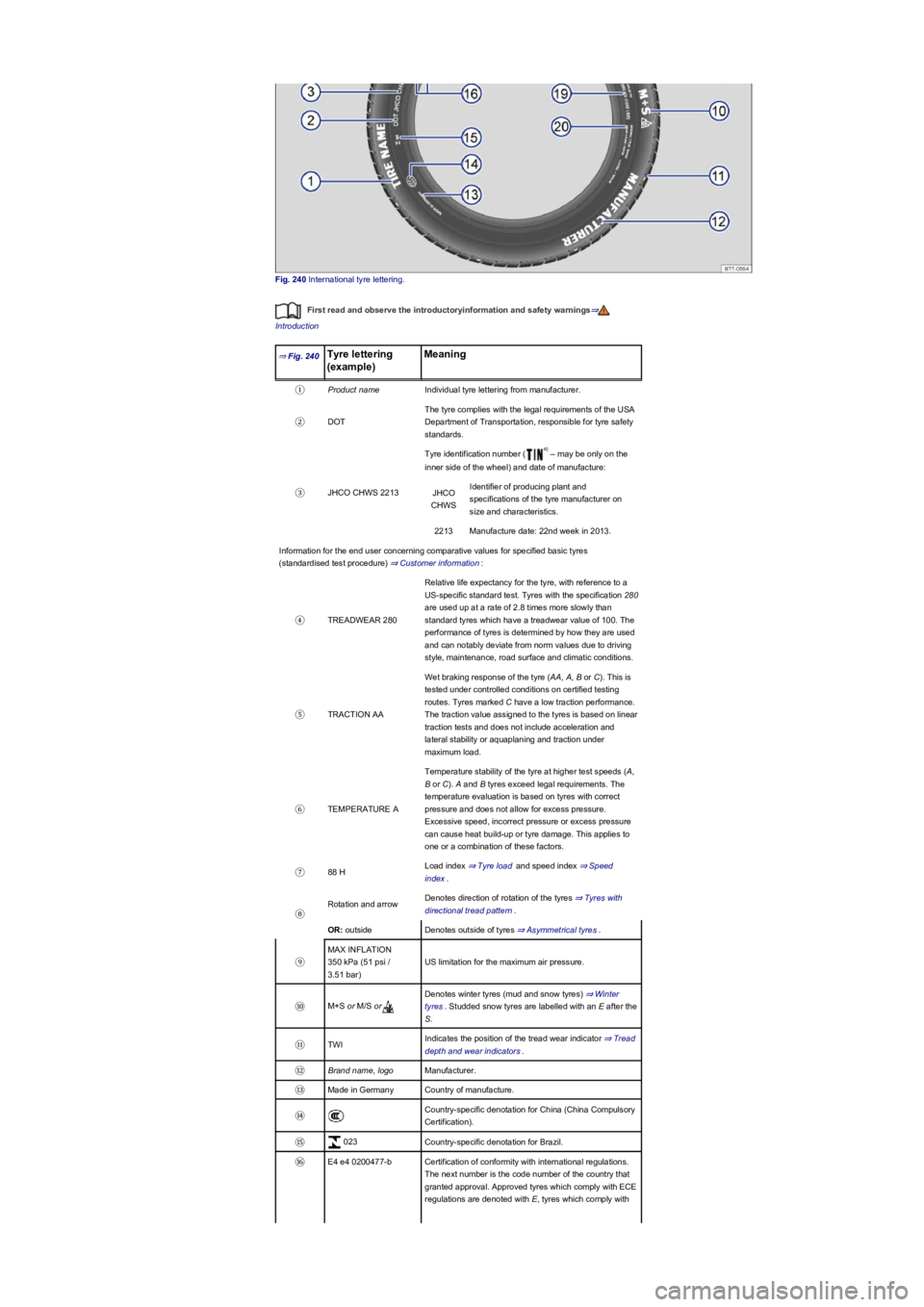
Fig. 240 International tyre lettering.
First read and observe the introductoryinformation and safety warnings⇒
Introduction
⇒ Fig. 240Tyre lettering
(example)
Meaning
①Product nameIndividual tyre lettering from manufacturer.
②DOT
The tyre complies with the legal requirements of the USA
Department of Transportation, responsible for tyre safety
standards.
③JHCO CHWS 2213
Tyre identification number ( – may be only on the
inner side of the wheel) and date of manufacture:
JHCO
CHWS
Identifier of producing plant and
specifications of the tyre manufacturer on
size and characteristics.
2213Manufacture date: 22nd week in 2013.
Information for the end user concerning comparative values for specified basic tyres
(standardised test procedure) ⇒ Customer information:
④TREADWEAR 280
Relative life expectancy for the tyre, with reference to a
US-specific standard test. Tyres with the specification 280
are used up at a rate of 2.8 times more slowly than
standard tyres which have a treadwear value of 100. The
performance of tyres is determined by how they are used
and can notably deviate from norm values due to driving
style, maintenance, road surface and climatic conditions.
⑤TRACTION AA
Wet braking response of the tyre (AA, A, B or C). This is
tested under controlled conditions on certified testing
routes. Tyres marked C have a low traction performance.
The traction value assigned to the tyres is based on linear
traction tests and does not include acceleration and
lateral stability or aquaplaning and traction under
maximum load.
⑥TEMPERATURE A
Temperature stability of the tyre at higher test speeds (A,
B or C). A and B tyres exceed legal requirements. The
temperature evaluation is based on tyres with correct
pressure and does not allow for excess pressure.
Excessive speed, incorrect pressure or excess pressure
can cause heat build-up or tyre damage. This applies to
one or a combination of these factors.
⑦88 HLoad index ⇒ Tyre load and speed index ⇒ Speed
index.
⑧
Rotation and arrowDenotes direction of rotation of the tyres ⇒ Tyres with
directional tread pattern.
OR: outsideDenotes outside of tyres ⇒ Asymmetrical tyres.
⑨
MAX INFLATION
350 kPa (51 psi /
3.51 bar)
US limitation for the maximum air pressure.
⑩M+S or M/S or
Denotes winter tyres (mud and snow tyres) ⇒ Winter
tyres. Studded snow tyres are labelled with an E after the
S.
⑪TWIIndicates the position of the tread wear indicator ⇒ Tread
depth and wear indicators.
⑫Brand name, logoManufacturer.
⑬Made in GermanyCountry of manufacture.
⑭Country-specific denotation for China (China Compulsory
Certification).
⑮ 023Country-specific denotation for Brazil.
⑯E4 e4 0200477-bCertification of conformity with international regulations.
The next number is the code number of the country that
granted approval. Approved tyres which comply with ECE
regulations are denoted with E, tyres which comply with
a)
Page 304 of 341
Maximum load and speed range for tyres
First read and observe the introductoryinformation and safety warnings⇒
Introduction
Vehicles in the EU and the so-called EU user states are issued an EC Certificate of Conformity.
This details the size, diameter and speed range of all tyres approved by Volkswagen for the
relevant vehicle type.
The type plate shows whether there is an EC certificate of conformity for this particular vehicle. The
type plate can be seen on the lower part of the door pillar when the door is open ⇒ Technical data.
•If the type plate has a row marked Permit then the vehicle does have an EC certificate of
conformity.
•If there is no type plate, or no row marked Permit the vehicle does not have an EC certificate of
conformity.
Winter tyres
First read and observe the introductoryinformation and safety warnings⇒
Introduction
Winter or all-year tyres improve the handling and brake response in winter conditions. Volkswagen
recommends that winter tyres be fitted to the vehicle at temperatures below +7°C (+45°F) or in
winter road conditions.
Winter tyres and all-year tyres lose a large degree of their effectiveness for winter conditions when
the tread is worn down to a depth of 4 mm.
The following applies when using winter tyres:
•Observe any country-specific legal requirements.
•Use winter tyres on all four wheels at the same time.
•Only use in winter road conditions.
•Only use the sizes of tyre that have been approved for the vehicle.
•Winter tyres must have the same belt type, size and the same tread pattern.
•Observe the maximum speed permitted by the speed index ⇒.
Speed limitation
Winter tyres have a speed limit depending on the speed index ⇒ Tyre lettering and tyre type.
Speed warning settings can be made and adjusted in the Infotainment system using the
button and the and Tyres function buttons ⇒ Operation and display in the
Infotainment system.
If you use V-rated tyres, the speed limits and required tyre pressure will be determined by the
engine size. You must ask a Volkswagen dealership about the maximum permitted speed and
required tyre pressure.
Four-wheel drive (4MOTION)
Thanks to its four-wheel drive, the vehicle will have plenty of traction in winter conditions, even with
the standard tyres. Nevertheless, Volkswagen still recommends that winter tyres or all-year tyres
should be fitted on all 4 wheels in winter, mainly because this will give a better braking response.
Observe information on snow chains⇒ Snow chains.
Summer tyres should be fitted in good time at the end of the winter. The vehicle handling is
better if summer tyres are fitted at temperatures above +7°C (+45°F). They are quieter, do not wear
so quickly and reduce fuel consumption.
In vehicles with a Tyre Pressure Loss Indicator, the system has to re-synchronise after
wheels are changed ⇒ Tyre monitoring systems.
Volkswagen dealerships can provide details on permissible winter tyre sizes.
The improved winter driving characteristics afforded by the winter tyres should not
encourage you to take any risks.
•Adapt your speed and driving style to suit visibility, weather, road and traffic
conditions.
•Never exceed the top speed and load permitted for the winter tyres that are fitted.
WARNING
Page 305 of 341
Snow chains
First read and observe the introductoryinformation and safety warnings⇒
Introduction
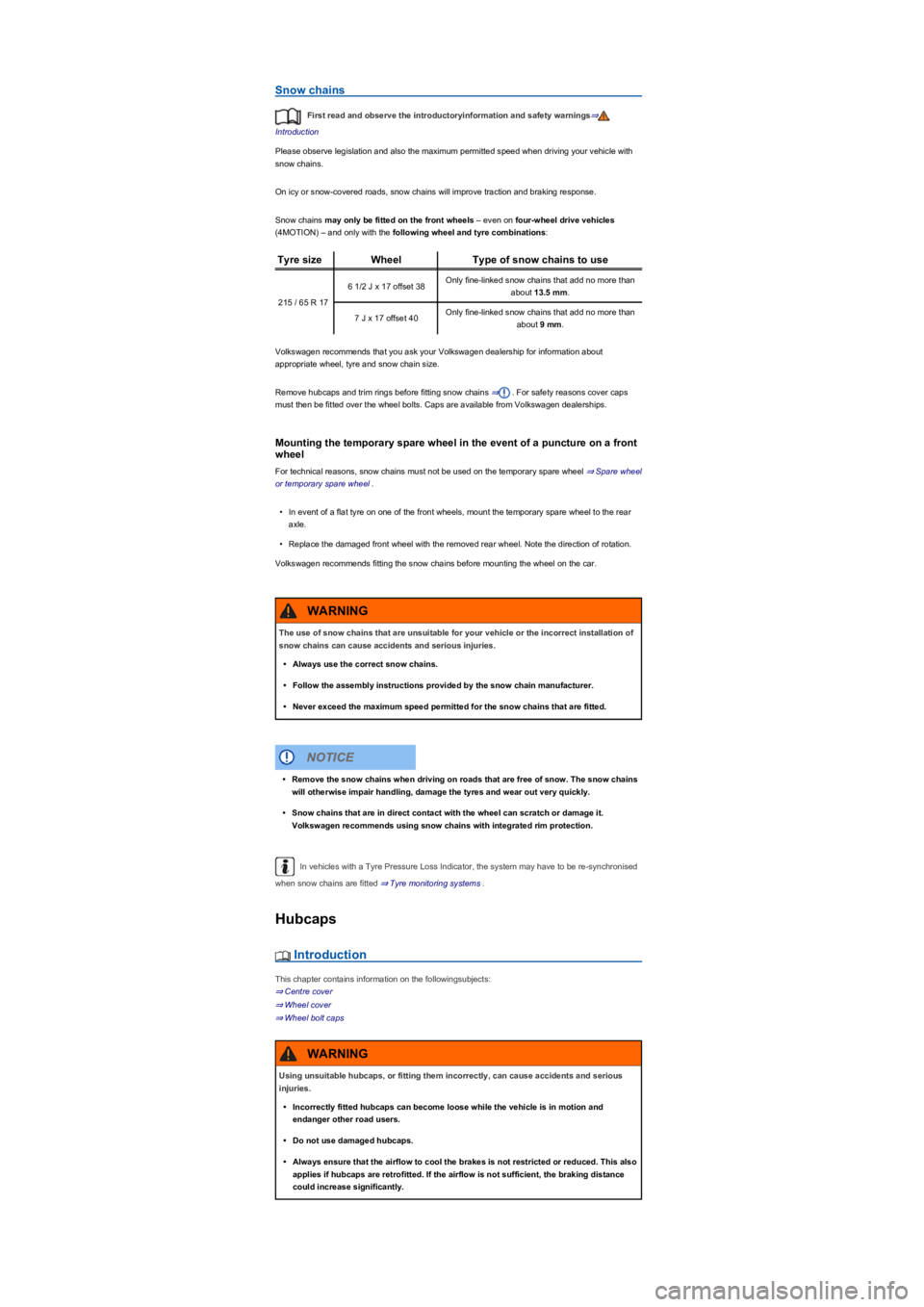
Please observe legislation and also the maximum permitted speed when driving your vehicle with
snow chains.
On icy or snow-covered roads, snow chains will improve traction and braking response.
Snow chains may only be fitted on the front wheels – even on four-wheel drive vehicles
(4MOTION) – and only with the following wheel and tyre combinations:
Tyre sizeWheelType of snow chains to use
215 / 65 R 17
6 1/2 J x 17 offset 38Only fine-linked snow chains that add no more than
about 13.5 mm.
7 J x 17 offset 40Only fine-linked snow chains that add no more than
about 9 mm.
Volkswagen recommends that you ask your Volkswagen dealership for information about
appropriate wheel, tyre and snow chain size.
Remove hubcaps and trim rings before fitting snow chains ⇒. For safety reasons cover caps
must then be fitted over the wheel bolts. Caps are available from Volkswagen dealerships.
Mounting the temporary spare wheel in the event of a puncture on a front
wheel
For technical reasons, snow chains must not be used on the temporary spare wheel ⇒ Spare wheel
or temporary spare wheel.
•In event of a flat tyre on one of the front wheels, mount the temporary spare wheel to the rear
axle.
•Replace the damaged front wheel with the removed rear wheel. Note the direction of rotation.
Volkswagen recommends fitting the snow chains before mounting the wheel on the car.
In vehicles with a Tyre Pressure Loss Indicator, the system may have to be re-synchronised
when snow chains are fitted ⇒ Tyre monitoring systems.
Hubcaps
Introduction
This chapter contains information on the followingsubjects:
⇒ Centre cover
⇒ Wheel cover
⇒ Wheel bolt caps
The use of snow chains that are unsuitable for your vehicle or the incorrect installation of
snow chains can cause accidents and serious injuries.
•Always use the correct snow chains.
•Follow the assembly instructions provided by the snow chain manufacturer.
•Never exceed the maximum speed permitted for the snow chains that are fitted.
WARNING
•Remove the snow chains when driving on roads that are free of snow. The snow chains
will otherwise impair handling, damage the tyres and wear out very quickly.
•Snow chains that are in direct contact with the wheel can scratch or damage it.
Volkswagen recommends using snow chains with integrated rim protection.
NOTICE
Using unsuitable hubcaps, or fitting them incorrectly, can cause accidents and serious
injuries.
•Incorrectly fitted hubcaps can become loose while the vehicle is in motion and
endanger other road users.
•Do not use damaged hubcaps.
•Always ensure that the airflow to cool the brakes is not restricted or reduced. This also
applies if hubcaps are retrofitted. If the airflow is not sufficient, the braking distance
could increase significantly.
WARNING
Page 307 of 341
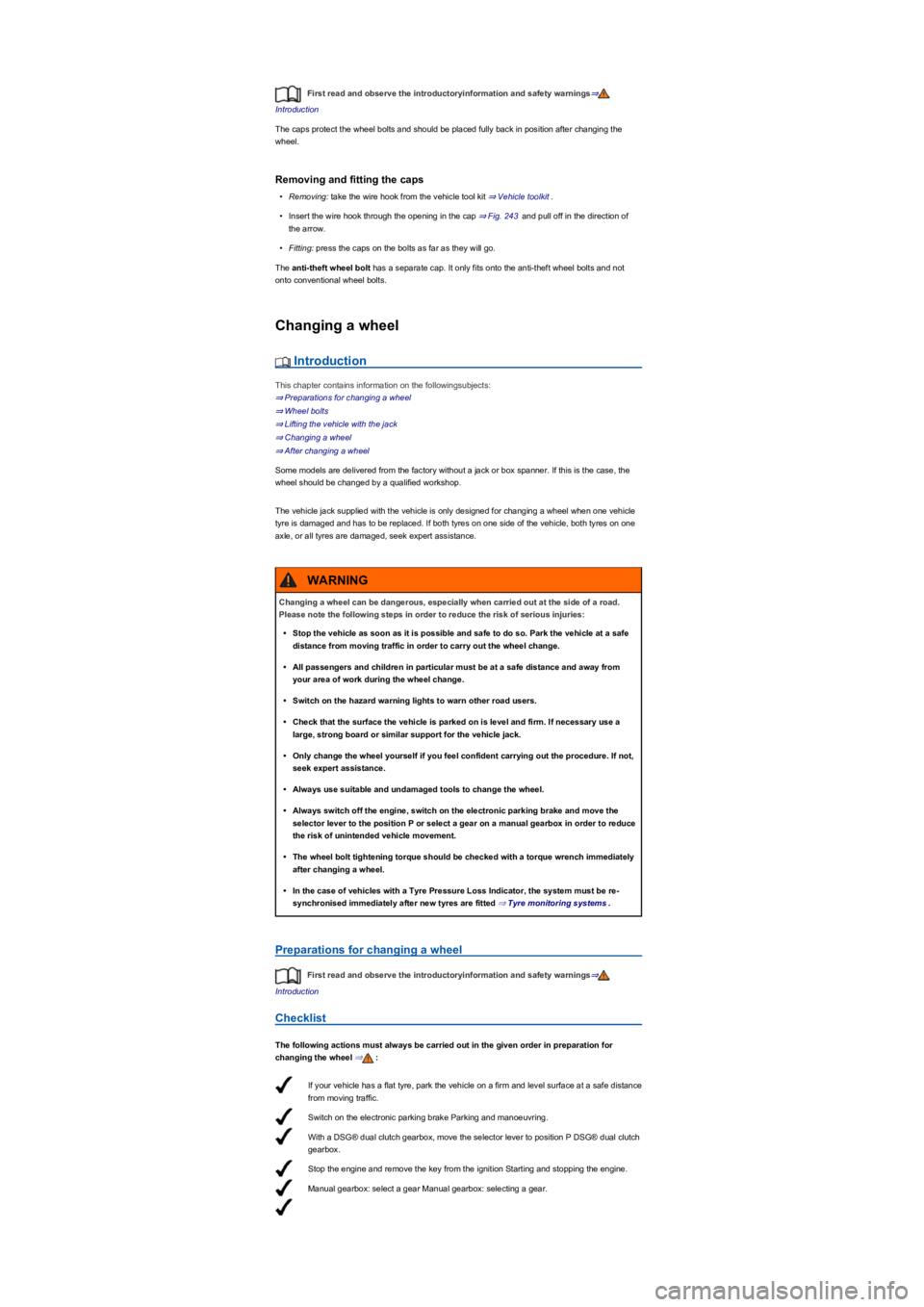
If your vehicle has a flat tyre, park the vehicle on a firm and level surface at a safe distance
from moving traffic.
Switch on the electronic parking brake Parking and manoeuvring.
With a DSG® dual clutch gearbox, move the selector lever to position P DSG® dual clutch
gearbox.
Stop the engine and remove the key from the ignition Starting and stopping the engine.
Manual gearbox: select a gear Manual gearbox: selecting a gear.
First read and observe the introductoryinformation and safety warnings⇒
Introduction
The caps protect the wheel bolts and should be placed fully back in position after changing the
wheel.
Removing and fitting the caps
•Removing: take the wire hook from the vehicle tool kit ⇒ Vehicle toolkit.
•Insert the wire hook through the opening in the cap ⇒ Fig. 243 and pull off in the direction of
the arrow.
•Fitting: press the caps on the bolts as far as they will go.
The anti-theft wheel bolt has a separate cap. It only fits onto the anti-theft wheel bolts and not
onto conventional wheel bolts.
Changing a wheel
Introduction
This chapter contains information on the followingsubjects:
⇒ Preparations for changing a wheel
⇒ Wheel bolts
⇒ Lifting the vehicle with the jack
⇒ Changing a wheel
⇒ After changing a wheel
Some models are delivered from the factory without a jack or box spanner. If this is the case, the
wheel should be changed by a qualified workshop.
The vehicle jack supplied with the vehicle is only designed for changing a wheel when one vehicle
tyre is damaged and has to be replaced. If both tyres on one side of the vehicle, both tyres on one
axle, or all tyres are damaged, seek expert assistance.
Preparations for changing a wheel
First read and observe the introductoryinformation and safety warnings⇒
Introduction
Checklist
The following actions must always be carried out in the given order in preparation for
changing the wheel ⇒:
Changing a wheel can be dangerous, especially when carried out at the side of a road.
Please note the following steps in order to reduce the risk of serious injuries:
•Stop the vehicle as soon as it is possible and safe to do so. Park the vehicle at a safe
distance from moving traffic in order to carry out the wheel change.
•All passengers and children in particular must be at a safe distance and away from
your area of work during the wheel change.
•Switch on the hazard warning lights to warn other road users.
•Check that the surface the vehicle is parked on is level and firm. If necessary use a
large, strong board or similar support for the vehicle jack.
•Only change the wheel yourself if you feel confident carrying out the procedure. If not,
seek expert assistance.
•Always use suitable and undamaged tools to change the wheel.
•Always switch off the engine, switch on the electronic parking brake and move the
selector lever to the position P or select a gear on a manual gearbox in order to reduce
the risk of unintended vehicle movement.
•The wheel bolt tightening torque should be checked with a torque wrench immediately
after changing a wheel.
•In the case of vehicles with a Tyre Pressure Loss Indicator, the system must be re-
synchronised immediately after new tyres are fitted ⇒ Tyre monitoring systems.
WARNING