pressure VOLKSWAGEN TIGUAN 2017 Owner´s Manual
[x] Cancel search | Manufacturer: VOLKSWAGEN, Model Year: 2017, Model line: TIGUAN, Model: VOLKSWAGEN TIGUAN 2017Pages: 341, PDF Size: 9.14 MB
Page 311 of 341
After changing a wheel
First read and observe the introductoryinformation and safety warnings⇒
Introduction
•Clean the tools from the vehicle tool kit and place them back in the foam rubber holder in the
luggage compartment ⇒ Vehicle toolkit.
•Stow the changed wheel securely in the luggage compartment.
•Have the tightening torque of the wheel bolts checked immediately ⇒ Tightening torque for the
wheel bolts.
•The damaged wheel should be replaced as soon as possible.
In vehicles with a Tyre Pressure Loss Indicator, the system has to re-synchronise after
wheels are changed ⇒ Tyre monitoring systems.
Breakdown set
Introduction
This chapter contains information on the followingsubjects:
⇒ Contents of the breakdown set
⇒ Preparation
⇒ Sealing and inflating tyres
⇒ Test after driving for 10 minutes
The breakdown set can be used to temporarily and reliably seal any tyre damage caused by foreign
bodies or punctures (up to approx. 4 mm in diameter). Do not remove foreign objects (e.g.
screws or nails) from the tyre!
Once the sealant has been added to the tyre, the tyre pressure must be checked and adjusted
again after approximately ten minutes of driving.
Seek expert assistance if more than one of the vehicle's tyres is damaged. The breakdown set is
designed to fill only one tyre.
Use the breakdown set only when the vehicle has been safely parked and if you are familiar with
the work and safety precautions needed. Seek expert assistance if this is not the case.
The tyre sealant must not be used:
•If the rim is damaged.
•If the outside temperature is below -20°C (-4°F).
•If there are cuts or punctures in the tyre that are larger than 4 mm.
•If the vehicle was driven with very low tyre pressure or a flat tyre.
•If the use-by date on the tyre filler bottle has expired.
•In conjunction with AirStop tyres. You can tell if your vehicle is equipped with AirStop tyres if
there is the word Seal on the outside of the tyres.
Incorrect torque or incorrect use of wheel bolts can lead to a loss of control of the vehicle,
cause accidents and serious injuries.
•Always keep all wheel bolts and threads in the wheel hubs clean and free from oil and
grease. The wheel bolts must be easy to turn and be tightened to the specified torque.
•The hexagonal socket in the screwdriver handle should only be used for turning wheel
bolts, not use for loosening or tightening them.
WARNING
®®
Page 312 of 341
Dispose of used or out-of-date sealant in accordance with legal requirements.
You can get a new tyre filler bottle from a Volkswagen dealership.
Observe the separate instructions from the manufacturer of the breakdown set.
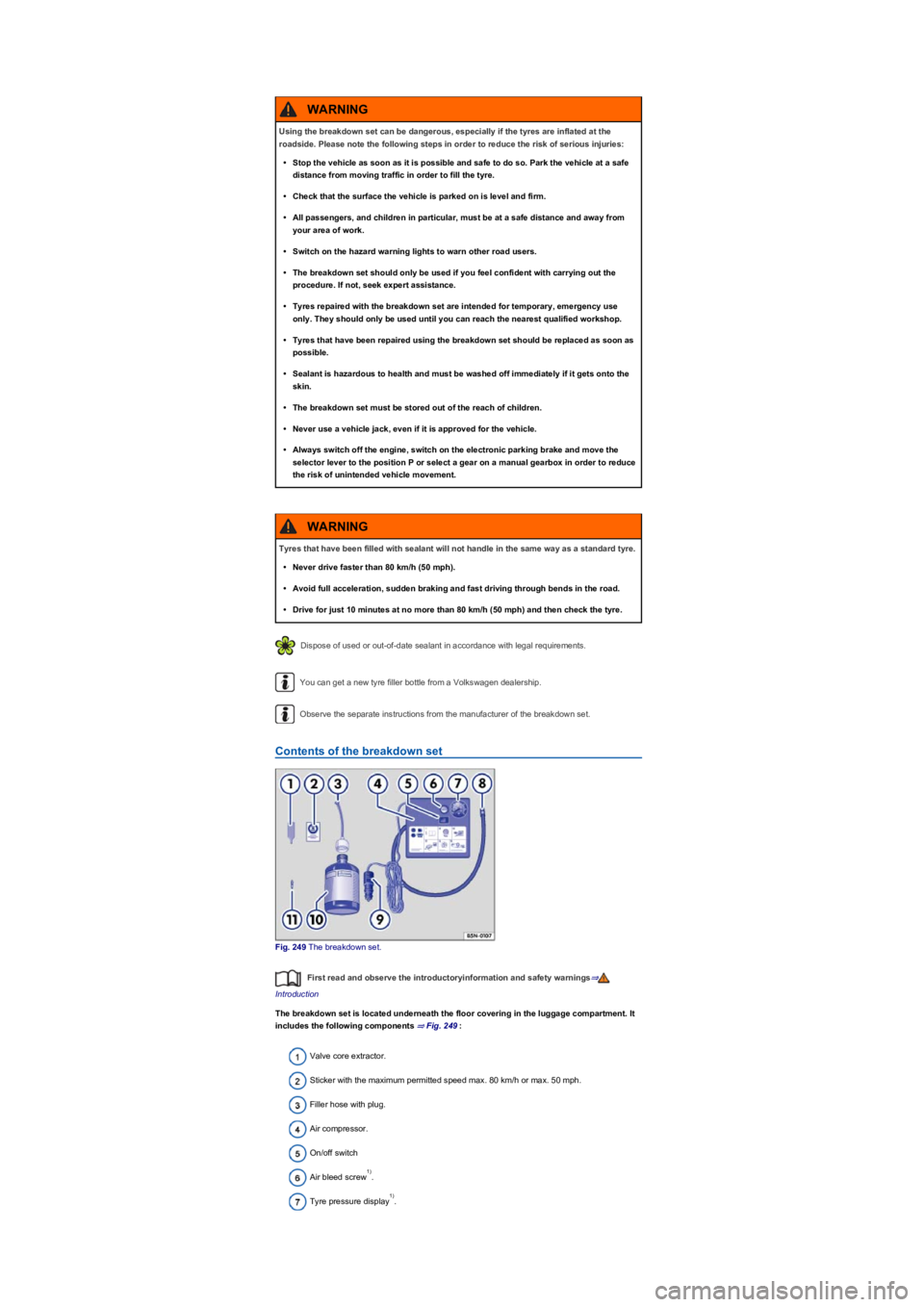
Contents of the breakdown set
Fig. 249 The breakdown set.
First read and observe the introductoryinformation and safety warnings⇒
Introduction
The breakdown set is located underneath the floor covering in the luggage compartment. It
includes the following components ⇒ Fig. 249:
Valve core extractor.
Sticker with the maximum permitted speed max. 80 km/h or max. 50 mph.
Filler hose with plug.
Air compressor.
On/off switch
Air bleed screw.
Tyre pressure display.
Using the breakdown set can be dangerous, especially if the tyres are inflated at the
roadside. Please note the following steps in order to reduce the risk of serious injuries:
•Stop the vehicle as soon as it is possible and safe to do so. Park the vehicle at a safe
distance from moving traffic in order to fill the tyre.
•Check that the surface the vehicle is parked on is level and firm.
•All passengers, and children in particular, must be at a safe distance and away from
your area of work.
•Switch on the hazard warning lights to warn other road users.
•The breakdown set should only be used if you feel confident with carrying out the
procedure. If not, seek expert assistance.
•Tyres repaired with the breakdown set are intended for temporary, emergency use
only. They should only be used until you can reach the nearest qualified workshop.
•Tyres that have been repaired using the breakdown set should be replaced as soon as
possible.
•Sealant is hazardous to health and must be washed off immediately if it gets onto the
skin.
•The breakdown set must be stored out of the reach of children.
•Never use a vehicle jack, even if it is approved for the vehicle.
•Always switch off the engine, switch on the electronic parking brake and move the
selector lever to the position P or select a gear on a manual gearbox in order to reduce
the risk of unintended vehicle movement.
WARNING
Tyres that have been filled with sealant will not handle in the same way as a standard tyre.
•Never drive faster than 80 km/h (50 mph).
•Avoid full acceleration, sudden braking and fast driving through bends in the road.
•Drive for just 10 minutes at no more than 80 km/h (50 mph) and then check the tyre.
WARNING
1)
1)
Page 314 of 341
•Insert the 12-volt plug ⇒ Fig. 249⑨ into one of the vehicle's 12-volt sockets ⇒ Electrical
sockets.
•Use the on/off switch ⇒ Fig. 249⑤ to switch on the air compressor.
•Run the air compressor until the tyre pressure has reached 2.0 – 2.5 bar (29 – 36 psi /
200 – 250 kPa) ⇒. The maximum running time is eight minutes⇒.
•Switch off the air compressor.
•If a pressure level of 2.0 – 2.5 bar (29 – 36 psi / 200 – 250 kPa) cannot be achieved, unscrew
the tyre filler hose from the tyre valve.
•Drive (or reverse) the vehicle approximately ten metres so that the sealing compound is more
evenly distributed in the tyre.
•Screw the tyre filler hose for the air compressor firmly back onto the tyre valve and inflate the
tyre again.
•If the required pressure still cannot be reached, the tyre is too badly damaged. The tyre cannot
be sealed with the breakdown set. Do not drive on. Seek expert assistance ⇒.
•Disconnect the air compressor and unscrew the tyre filler hose from the tyre valve.
•Drive the vehicle no faster than 80 km/h (50 mph) if a tyre pressure of 2.0 – 2.5 bar (29 – 36 psi
/ 200 – 250 kPa) has been reached.
•Check the tyre pressure after driving for ten minutes⇒ Test after driving for 10 minutes.
Test after driving for 10 minutes
First read and observe the introductoryinformation and safety warnings⇒
Introduction
Reconnect the tyre filler hose ⇒ Fig. 249⑧ and read off the tyre pressure on the tyre pressure
display ⑦.
1.3 bar (19 psi / 130 kPa) and lower:
•Do not drive on! The tyre cannot be sealed adequately with the breakdown set.
•Seek expert assistance ⇒.
1.4 bar (20 psi / 140 kPa) and higher:
•Adjust the tyre pressure back to the correct value ⇒ Useful information about wheels and tyres.
•Resume your journey to the nearest qualified workshop. Do not exceed a maximum speed of
80 km/h (50 mph).
•The damaged tyre should be replaced at the qualified workshop.
Maintenance
Service
Service work and digital service schedule
The vehicle data attached to the inside cover of this owner's manual help ensure that you can
have the correct Volkswagen Genuine Parts installed in your vehicle whenever required. The data
also determine which type of service applies to your vehicle.
The tyre filler hose and the air compressor can get hot during inflation.
•Protect your hands and skin from the hot components.
•Do not place the hot tyre filler hose or the hot air compressor on any inflammable
materials.
•Allow the device to cool down fully before stowing.
•If the tyre will not inflate to at least 2.0 bar (29 psi / 200 kPa), the tyre is too damaged.
The sealant is unable to seal the tyre. Do not drive on. Seek expert assistance.
WARNING
Switch the air compressor off after a maximum of 8 minutes to avoid overheating. Let the
air compressor cool down for a few minutes before switching it back on.
NOTICE
Driving with an unsealed tyre is dangerous as it can cause accidents and serious injuries.
•Do not carry on driving if the tyre pressure is 1.3 bar (19 psi / 130 kPa) or lower.
•Seek expert assistance.
WARNING
®
Page 317 of 341
Scope of service
The scope of service includes all maintenance work that is necessary in order to keep your vehicle
roadworthy (depending on the operating conditions and vehicle equipment, e.g. engine, gearbox or
service fluids). The maintenance work is divided into inspection work and servicing work. You can
find out what work is required in detail for your vehicle:
•From your Volkswagen dealership.
•From your qualified workshop.
•In the electronic repair and workshop information system erWin at https://erwin.volkswagen.de.
Inspection work
Electrics
•12-volt vehicle battery: check and replace if necessary.
•Lighting: check.
•High-voltage components: check.
•Horn: check.
•Headlight setting: check.
•Service interval display: reset.
Engine/gearbox
•Exhaust system: check.
•Gearbox and final drive: check.
•Gas system: check.
•Poly V-belt: check.
•Cooling system: check.
•Engine and components in engine compartment: check.
•Engine oil level: check.
Running gear
•Swivel joints/track rods: check.
•Tyres: check.
•Brake system: check.
•Brake pads/discs: check.
•Brake fluid level: check.
•Boots: check.
•Coupling rod and stabiliser bearings: check.
•Pneumatic suspension: check.
•Breakdown set: check.
•Tyre pressure on all wheels: check.
•Power steering: check.
•Shock absorbers/coil springs: check.
Body
•Roof systems: check.
•Windscreen: check.
•Body: check for corrosion.
•Wiper blades: check.
•Window wiper and washer system: check.
•Door arresters: lubricate.
•Underbody: check.
Inadequate servicing, no servicing at all, or failure to adhere to service intervals can result
in breakdowns, accidents or serious injury.
•Have your service work carried out by an authorised Volkswagen dealership or
workshop.
WARNING
Volkswagen is not responsible for any vehicle damage caused by inadequate service work
or the lack of part availability.
NOTICE
Page 319 of 341
Suitable accessories are available from your Volkswagen dealership. Follow the usage
instructions on the packaging.
Washing the vehicle
Also wash the underside of the vehicle on a regular basis to remove road salt or seawater residue.
Automatic car washes
Always observe all the car wash operator's specifications, in particular if your vehicle features add-
on parts ⇒.
•Preferably use car washes without brushes.
•Preclean the vehicle by rinsing with water.
•The steering column must not lock when driving through automatic car washes ⇒ Steering.
•Always switch off the Auto Hold function ⇒ Electronic parking brake, the wipers ⇒ Wipers and
the rain/light sensor before entering the car wash.
•Fold in the exterior mirrors.
•If your vehicle has decorative and protective films, do not select a wash program with hot wax.
High-pressure cleaners
Observe the manufacturer's information for the high-pressure cleaner. Never use rotating nozzles
⇒.
•Only use water with a maximum temperature of +60°C (+140°F).
•Do not clean windows that are iced over or covered in snow with a high-pressure cleaner.
•Move the jet of water uniformly so that the nozzle is at least 50 cm away from the side windows
and other vehicle components.
•Do not point the water jet at the same location for too long. Instead, leave stubborn dirt to soak.
•If possible, do not direct the water jet at seals, e.g. side windows, decorative trim, tyres, rubber
hoses, insulation materials or any other sensitive components, e.g. door locks.
•Sensors, camera lenses, and decorative and protective films should be sprayed directly only for
brief periods of time.
Washing the car by hand
Washing the car by hand is always the more gentle way to clean it. However, there are also some
things to note for this ⇒.
•Before washing the vehicle, soak the dirt with plenty of water and then rinse it off thoroughly.
•Clean the vehicle with a soft sponge, a wash mitt or a brush applying only light pressure. Start
with the roof and work from the top to the bottom.
•Rinse the sponge, wash mitt or brush thoroughly at regular short intervals.
•Clean the wheels, sill panels etc. last. Use a second sponge for this.
Use a shampoo for very stubborn dirt only.
Car care products can be toxic and hazardous. Unsuitable care products and incorrect use
of care products can cause accidents, serious injuries, burns or poisoning.
•Care products must be kept in the original, sealed container only.
•Read the manufacturer's instructions.
•Never use empty food cans, bottles or other containers for storing care products.
•Keep children away from care products.
•The products can give off harmful fumes during use. They should therefore only be
used outside or in well-ventilated spaces.
•Never use fuel, turpentine, engine oil, nail varnish remover or other volatile fluids to
wash, clean or care for your vehicle. These substances are toxic and highly
inflammable.
WARNING
Stains, dirt and other deposits containing aggressive and solvent-based ingredients attack
the material and may cause irreparable damage, even if only left for a short time.
•Stains, dirt and other deposits should always be removed as quickly as possible and
not allowed to dry in.
•Have stubborn stains removed by a qualified workshop.
NOTICE
1)
Page 321 of 341
Use the Volkswagen Genuine de-icing agent (- 000 096 322 -) to remove ice.
Wiper blades:⇒ Wiper blades.
Paintwork: always treat surfaces carefully in order to prevent damage to the paint coat. Use a
clean, soft cloth and a mild soap solution or cleaning clay to remove any light dirt immediately, e.g.
deposits, insect residue, or cosmetics.
Repair minor paint damage with a touch-up pen. Refer to the vehicle data sticker for the paint code
⇒ Technical data. Consult a qualified workshop in the event of damage to surfaces with matt paint.
•Overflowing fuel or service fluids: clean immediately.
•Flash rust deposits: moisten deposits with a soap solution. Then remove any deposits with
cleaning clay.
•Corrosion: have removed by a qualified workshop.
•Water no longer forms beads on clean paint: preserve paintwork at least twice a year using
Volkswagen Genuine hard wax (- 000 096 317 -).
•No gloss in spite of preservation/paint unattractive: treat the vehicle with suitable polish after
cleaning to remove dirt and dust.
Plenum chamber, engine compartment: remove leaves and other loose objects with a vacuum
cleaner or by hand ⇒ Fig. 251⇒. Cleaning of the engine compartment should always be
performed by a qualified workshop ⇒.
Water that has entered the plenum chamber via a manual process (e.g. from a high-pressure
cleaner) can cause considerable damage to the vehicle.
Sensors, camera lenses: clean the area in front of the sensors or camera with a soft cloth and
solvent-free cleaning agent. Observe the installation locations ⇒ Vehicle overviews.
•Switch on the ignition.
•Move the selector lever to position R.
•Clean the camera lens.
Clean sensitive surfaces on the rain/light sensor and the camera window on the windscreen in the
same way as windows and glass surfaces (depending on vehicle equipment).
Remove snow with a brush. Do not use warm or hot water.
Use the Volkswagen Genuine de-icing agent (- 000 096 322 -) to remove ice.
Decorative films, protective films: remove soiling in the same way as for paint. Always use
Volkswagen Genuine plastic cleaner (- 000 096 314 -) for matt decorative films.
Treat the vehicle with liquid hard wax every three months after washing and removing dust. Only
use clean, soft microfibre clothes to apply it. Do not use hot wax, also not in car washes!
•Stubborn dirt: remove carefully using white spirits, and then rinse using warm water.
Trim parts, trim strips, exhaust pipes made of chrome, aluminium or stainless steel: clean
only in a dust-free environment using a clean, soft cloth and a mild soap solution.
Chrome parts can be protected using Volkswagen Genuine hard wax (- 000 096 317 -).
Anodised surfaces: do not use chrome cleaning products.
Headlights, tail light clusters: use a soft sponge soaked with a mild soap solution. Do not use
any cleaning agents that contain alcohol or solvents.
•Stubborn dirt: remove with Volkswagen Genuine chrome and aluminium care product (-
000 096 319 D -).
Wheels: remove dirt and gritting salt deposits with plenty of water.
Alloy wheels: treat dirty aluminium wheels with Volkswagen Genuine wheel cleaner (- 000 096 304
-). Volkswagen recommends treating the wheel rims with Volkswagen Genuine hard wax (-
000 096 317 -) every three months.
•Damage protective paint coating: repair immediately with a touch-up pen. Go to a qualified
workshop if necessary.
•Brake dust: use Volkswagen Genuine wheel rim cleaner (- 000 096 304 -).
Door lock cylinders: Volkswagen recommends using Volkswagen Genuine de-icing agent (-
000 096 322 -) for de-icing. Do not use door lock de-icers containing substances that dissolve
grease.
1)
1)
1)
Page 323 of 341
Displays: use a Volkswagen Genuine cleaning cloth (- 000 096 166 A -) with a little water, a
suitable glass cleaner or LCD cleaner. Do not clean displays with a dry cloth.
Rubber seals: clean with a soft, lint-free cloth and plenty of water. Treat with Volkswagen Genuine
rubber care agent (- 000 096 310 -) on a regular basis.
Seat belts: carefully pull the seat belt right out and leave it out ⇒. Remove large particles of dirt
with a soft brush. Clean the seat belt with a mild soap solution. Leave the belt fabric to dry
completely and then allow it to roll up.
Wooden trims: clean with a soft cloth and some mild soap solution.
Cleaning upholstery fabrics
If clothing that is not sufficiently colour-fast, e.g. denim, leaves stains on the seat cushion, this does
not a defect in the cover fabric. The seat padding may contain components for the airbag system
and electrical connections. Seat padding that is damaged, incorrectly cleaned or treated, or that
becomes wet, may cause damage to the vehicle electrical system or trigger a fault in the airbag
system ⇒.
Depending on the equipment, seat cushions with seat heating feature electrical components and
connectors that may be damaged in the event of incorrect cleaning or treatment ⇒. This can
also result in damage to other parts of the vehicle electrics.
•Do not use high-pressure cleaners, steam cleaners or coolant spray.
•Do not switch on the seat heating to dry the seats.
•Do not use washing paste or fine detergent solutions.
•Avoid getting the seat wet.
•In the event of uncertainty, contact a Volkswagen dealership.
Mild soap solution: a maximum of two tablespoons of neutral soap diluted in one litre of water.
Accessories, modifications, repairs and renewal of
parts
Accessories and parts
Volkswagen recommends that you seek advice from a Volkswagen dealership before purchasing
accessories, replacement parts or service fluids, for example if the vehicle is to be retrofitted with
accessories or if parts have to be renewed. Volkswagen dealerships can recommend accessories,
parts and service fluids suitable for your requirements. They can also answer any questions you
might have regarding official regulations.
Volkswagen recommends you use only approved Volkswagen accessories and Volkswagen
Genuine Parts. These parts and accessories have been specially tested by Volkswagen for
suitability, reliability and safety. And Volkswagen dealerships are qualified to install them correctly.
Although the market is constantly scrutinised, Volkswagen cannot assume responsibility for the
reliability, safety and suitability of products Volkswagen has not approved. Volkswagen can
therefore assume no responsibility for these parts, even if they have been approved by an official
testing agency or are covered by an official approval certificate.
Any retro-fitted equipment which has a direct effect on the control of the vehicle must be
approved by Volkswagen for use in your vehicle and bear the e mark (the European Union's
1)
Failure to clean the parts properly can cause damage to the seat belts, the fastenings and
the belt retractor.
•Never use chemical cleaning agents on the seat belts or their components. The seat
belts must also not come into contact with corrosive fluids, solvents or sharp objects.
•Dry the cleaned seat belt fully before allowing it to retract.
•Avoid allowing foreign bodies or liquids to enter the slot for the seat belt buckle.
•Never try to repair, modify or remove the seat belts yourself.
WARNING
Incorrect cleaning and care may cause vehicle damage.
•Sharp objects, such as zips, rivets on clothing or belts may damage surfaces. Open
Velcro fasteners can also cause damage.
•Do not use a steam cleaner, brushes or hard sponges etc. for cleaning under any
circumstances.
•To avoid damage, stubborn stains should be removed by a specialist cleaning
company.
NOTICE
1)
®
Page 328 of 341
Data storage and services
Your vehicle is fitted with electronic control units. Some of these are required to make sure your
vehicle remains safe while others provide support while driving (driver assist systems).
Furthermore, your vehicle is equipped with convenience and Infotainment functions, which are also
made possible using electronic control units.
Electronic control units contain data memories that can store information regarding the vehicle
status, component load levels, maintenance requirements, technical events and faults on a
temporary or permanent basis. This information generally documents the status of a component, a
module, a system or the environment, e.g.:
•Operating states of system components, e.g. filling levels, tyre pressure, battery status.
•Status messages from the vehicle or its individual components, e.g. wheel revolutions or speed,
deceleration, lateral acceleration, display of fastened seat belts.
•Faults or malfunctions in important system components, e.g. lights, brakes.
•Information on events which damaged the vehicle.
•System reactions to specific driving situations, triggering of an airbag, intervention the stability
control systems.
•Ambient conditions, e.g. temperature, rain.
As well as performing the actual control unit functions, these data are also used to detect and
rectify faults and help Volkswagen to improve vehicle functions. The majority of these data are
temporary are processed only within the vehicle itself. Only a very small amount of data is stored in
the event memories or possibly on the vehicle key.
Reading out the vehicle's event memory
There is a diagnostic interface in the vehicle interior for reading out the event memories (on-board
diagnostic system) ⇒.
If you have service work performed on your vehicle, the technical data can be read out of the
vehicle together with the vehicle identification number by service employees, e.g. workshops, or
third parties such as breakdown services. Service work includes, for example, repairs,
maintenance, warranty work or quality assurance measures. The service workshop or third party
collects, processes and uses the data. The data document the vehicle's technical status, help in
troubleshooting and in improving quality and may be sent to Volkswagen in some cases.
Furthermore, the manufacturer is subject to legal product safety requirements. To make sure it
complies with these requirements, the manufacturer requires technical data from the vehicles.
Event memories in the vehicle can be reset by a service workshop as part of repair or service work.
The event memory should only be read and reset by a qualified workshop. Additional information on
the stored data is available from qualified workshops.
After a fault has been rectified, the information in the memory pertaining to the fault is deleted.
Other memory content is overwritten on an ongoing basis.
Event data recorder
This vehicle is equipped with an event data recorder. The main task of an event data recorder is to
record data in particular accident scenarios or accident-like situations, e.g. in the event of airbags
being triggered or a collision with an obstacle on the road. These data help in analysis of how a
vehicle system behaved in these situations. The event data recorder records data relating to driving
dynamics and the restraint system for a short period of 10 s or less. This information includes, for
example:
•how various systems in your vehicle have functioned.
•whether the seat belts of the driver and front passenger were fastened.
•the extent to which the driver pressed the brake or accelerator pedal.
•how fast the vehicle was travelling.
These data help to obtain a better understanding of the circumstances in the situations where
accidents and injuries have occurred.
Data from driver assist systems are also recorded. In addition to information about whether the
systems were switched on or off, available only to a restricted extent or inactive, it is also possible
to determine whether these functions steered, accelerated or braked the vehicle in the above-
described situations. Depending on the vehicle equipment, these systems include the following:
•Adaptive Cruise Control (ACC).
•Lane keeping system (Lane Assist).
•Park Assist.
•Park Distance Control.
•Emergency braking functions (Front Assist).
The data of the event data recorder are recorded only if a particular accident-like situation occurs.
No recordings occur under normal driving conditions. Audio or video data from the vehicle interior
or vehicle surroundings are not stored. Personal data such as name, gender age or accident
location are also not recorded at any time. However, third parties such as law enforcement
agencies can use corresponding means to link the content of the event data recorder with other
sources of data and thus establish a reference to persons as part of an accident investigation.
Page 340 of 341
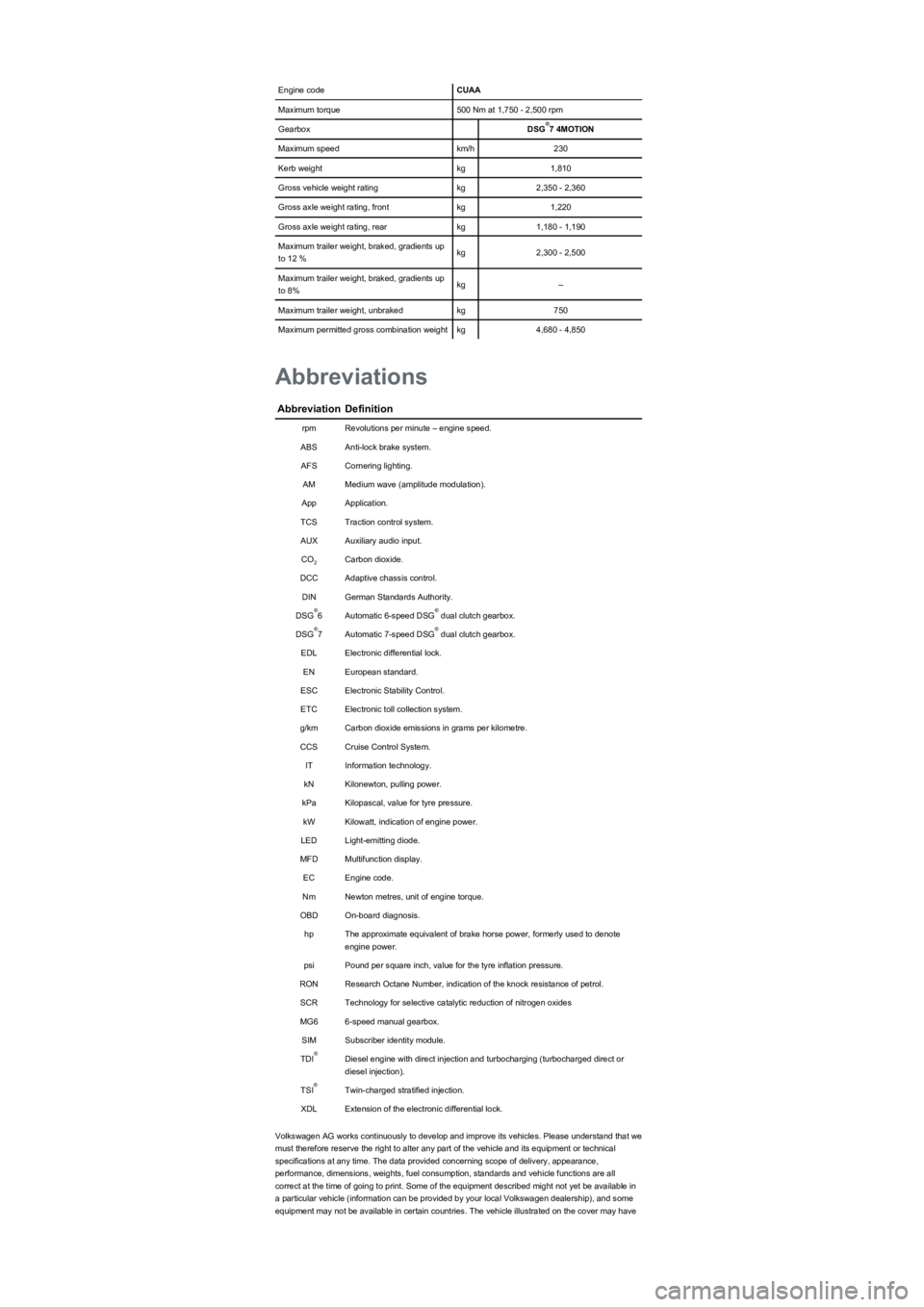
Engine codeCUAA
Maximum torque500 Nm at 1,750 - 2,500 rpm
GearboxDSG7 4MOTION
Maximum speedkm/h230
Kerb weightkg1,810
Gross vehicle weight ratingkg2,350 - 2,360
Gross axle weight rating, frontkg1,220
Gross axle weight rating, rearkg1,180 - 1,190
Maximum trailer weight, braked, gradients up
to 12 %kg2,300 - 2,500
Maximum trailer weight, braked, gradients up
to 8%kg–
Maximum trailer weight, unbrakedkg750
Maximum permitted gross combination weightkg4,680 - 4,850
AbbreviationDefinition
rpmRevolutions per minute – engine speed.
ABSAnti-lock brake system.
AFSCornering lighting.
AMMedium wave (amplitude modulation).
AppApplication.
TCSTraction control system.
AUXAuxiliary audio input.
COCarbon dioxide.
DCCAdaptive chassis control.
DINGerman Standards Authority.
DSG6Automatic 6-speed DSG dual clutch gearbox.
DSG7Automatic 7-speed DSG dual clutch gearbox.
EDLElectronic differential lock.
ENEuropean standard.
ESCElectronic Stability Control.
ETCElectronic toll collection system.
g/kmCarbon dioxide emissions in grams per kilometre.
CCSCruise Control System.
ITInformation technology.
kNKilonewton, pulling power.
kPaKilopascal, value for tyre pressure.
kWKilowatt, indication of engine power.
LEDLight-emitting diode.
MFDMultifunction display.
ECEngine code.
NmNewton metres, unit of engine torque.
OBDOn-board diagnosis.
hpThe approximate equivalent of brake horse power, formerly used to denote
engine power.
psiPound per square inch, value for the tyre inflation pressure.
RONResearch Octane Number, indication of the knock resistance of petrol.
SCRTechnology for selective catalytic reduction of nitrogen oxides
MG66-speed manual gearbox.
SIMSubscriber identity module.
TDIDiesel engine with direct injection and turbocharging (turbocharged direct or
diesel injection).
TSITwin-charged stratified injection.
XDLExtension of the electronic differential lock.
Volkswagen AG works continuously to develop and improve its vehicles. Please understand that we
must therefore reserve the right to alter any part of the vehicle and its equipment or technical
specifications at any time. The data provided concerning scope of delivery, appearance,
performance, dimensions, weights, fuel consumption, standards and vehicle functions are all
correct at the time of going to print. Some of the equipment described might not yet be available in
a particular vehicle (information can be provided by your local Volkswagen dealership), and some
equipment may not be available in certain countries. The vehicle illustrated on the cover may have
®
Abbreviations
2
®®
®®
®
®