Control VOLKSWAGEN TIGUAN 2017 Owner´s Manual
[x] Cancel search | Manufacturer: VOLKSWAGEN, Model Year: 2017, Model line: TIGUAN, Model: VOLKSWAGEN TIGUAN 2017Pages: 341, PDF Size: 9.14 MB
Page 137 of 341
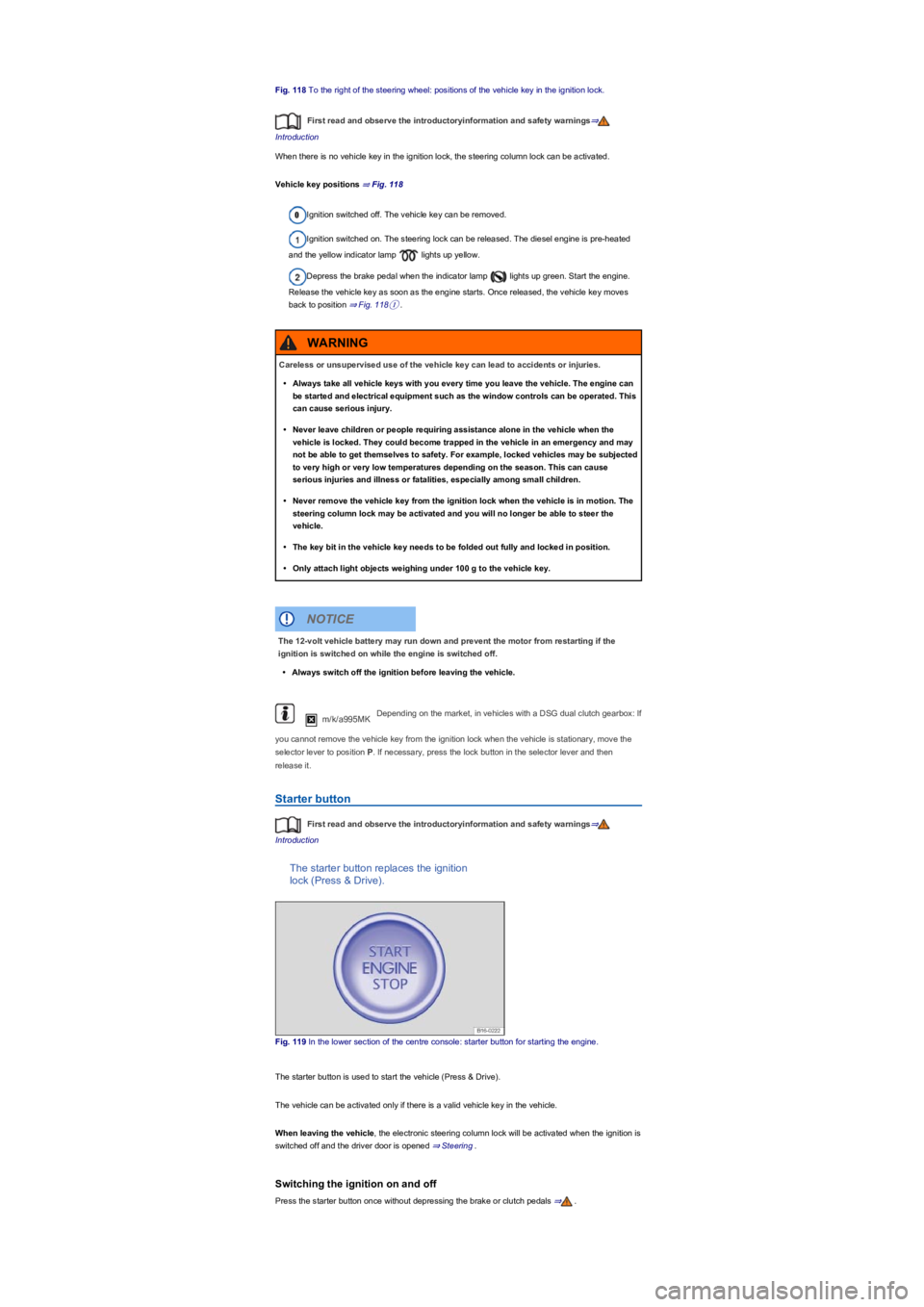
Fig. 118 To the right of the steering wheel: positions of the vehicle key in the ignition lock.
First read and observe the introductoryinformation and safety warnings⇒
Introduction
When there is no vehicle key in the ignition lock, the steering column lock can be activated.
Vehicle key positions ⇒ Fig. 118
Ignition switched off. The vehicle key can be removed.
Ignition switched on. The steering lock can be released. The diesel engine is pre-heated
and the yellow indicator lamp lights up yellow.
Depress the brake pedal when the indicator lamp lights up green. Start the engine.
Release the vehicle key as soon as the engine starts. Once released, the vehicle key moves
back to position ⇒ Fig. 118①.
m/k/a995MKDepending on the market, in vehicles with a DSG dual clutch gearbox: If
you cannot remove the vehicle key from the ignition lock when the vehicle is stationary, move the
selector lever to position P. If necessary, press the lock button in the selector lever and then
release it.
Starter button
First read and observe the introductoryinformation and safety warnings⇒
Introduction
The starter button replaces the ignition
lock (Press & Drive).
Fig. 119 In the lower section of the centre console: starter button for starting the engine.
The starter button is used to start the vehicle (Press & Drive).
The vehicle can be activated only if there is a valid vehicle key in the vehicle.
When leaving the vehicle, the electronic steering column lock will be activated when the ignition is
switched off and the driver door is opened ⇒ Steering.
Switching the ignition on and off
Press the starter button once without depressing the brake or clutch pedals ⇒.
Careless or unsupervised use of the vehicle key can lead to accidents or injuries.
•Always take all vehicle keys with you every time you leave the vehicle. The engine can
be started and electrical equipment such as the window controls can be operated. This
can cause serious injury.
•Never leave children or people requiring assistance alone in the vehicle when the
vehicle is locked. They could become trapped in the vehicle in an emergency and may
not be able to get themselves to safety. For example, locked vehicles may be subjected
to very high or very low temperatures depending on the season. This can cause
serious injuries and illness or fatalities, especially among small children.
•Never remove the vehicle key from the ignition lock when the vehicle is in motion. The
steering column lock may be activated and you will no longer be able to steer the
vehicle.
•The key bit in the vehicle key needs to be folded out fully and locked in position.
•Only attach light objects weighing under 100 g to the vehicle key.
WARNING
The 12-volt vehicle battery may run down and prevent the motor from restarting if the
ignition is switched on while the engine is switched off.
•Always switch off the ignition before leaving the vehicle.
NOTICE
Page 140 of 341
•m/k/a995MKVehicles with a starter button: Press the starter button briefly ⇒ Fig. 119. If
the engine cannot be switched off, carry out the emergency switch-off procedure ⇒ Emergency
deactivation.
•Observe the instructions in the instrument cluster ⇒ Instrument cluster.
Warning before leaving the vehicle
In order to indicate an active ignition when leaving the vehicle, an acoustic warning signal sounds
when opening the driver door and corresponding warning messages appear on the display of the
instrument cluster. The ignition also switches off automatically after a certain period in order to
prevent unintentional discharge of the 12-volt vehicle battery.
m/k/a995MK Vehicles with DSG dual clutch gearbox: if the selector lever is not in position P,
an acoustic warning signal will sound when the driver door is opened and the warning
message Please move selector lever to position P. will be shown on the instrument cluster
display. In this way, a warning is given that the vehicle could potentially roll away. The electronic
parking brake is also activated.
After the engine is switched off, the radiator fan in the engine compartment may run on for
some minutes, even if the ignition is switched off or the vehicle key has been removed. The radiator
fan will switch itself off automatically.
Electronic immobiliser
First read and observe the introductoryinformation and safety warnings⇒
Introduction
The immobiliser helps to prevent the engine from being started and driven with an unauthorised
vehicle key.
There is a chip in the key. This is used to automatically deactivate the immobiliser when a valid
vehicle key is inserted into the ignition lock.
The electronic immobiliser is automatically activated when the vehicle key is removed from the
ignition lock. In vehicles with keyless locking and starting system Keyless Access, the vehicle key
must be outside the vehicle ⇒ Central and manual locking.
The engine can only be started using a genuine Volkswagen vehicle key with the correct code.
Coded vehicle keys are available from a Volkswagen dealership ⇒ Vehicle key set.
The vehicle cannot be operated properly if you do not have a genuine Volkswagen key.
Troubleshooting
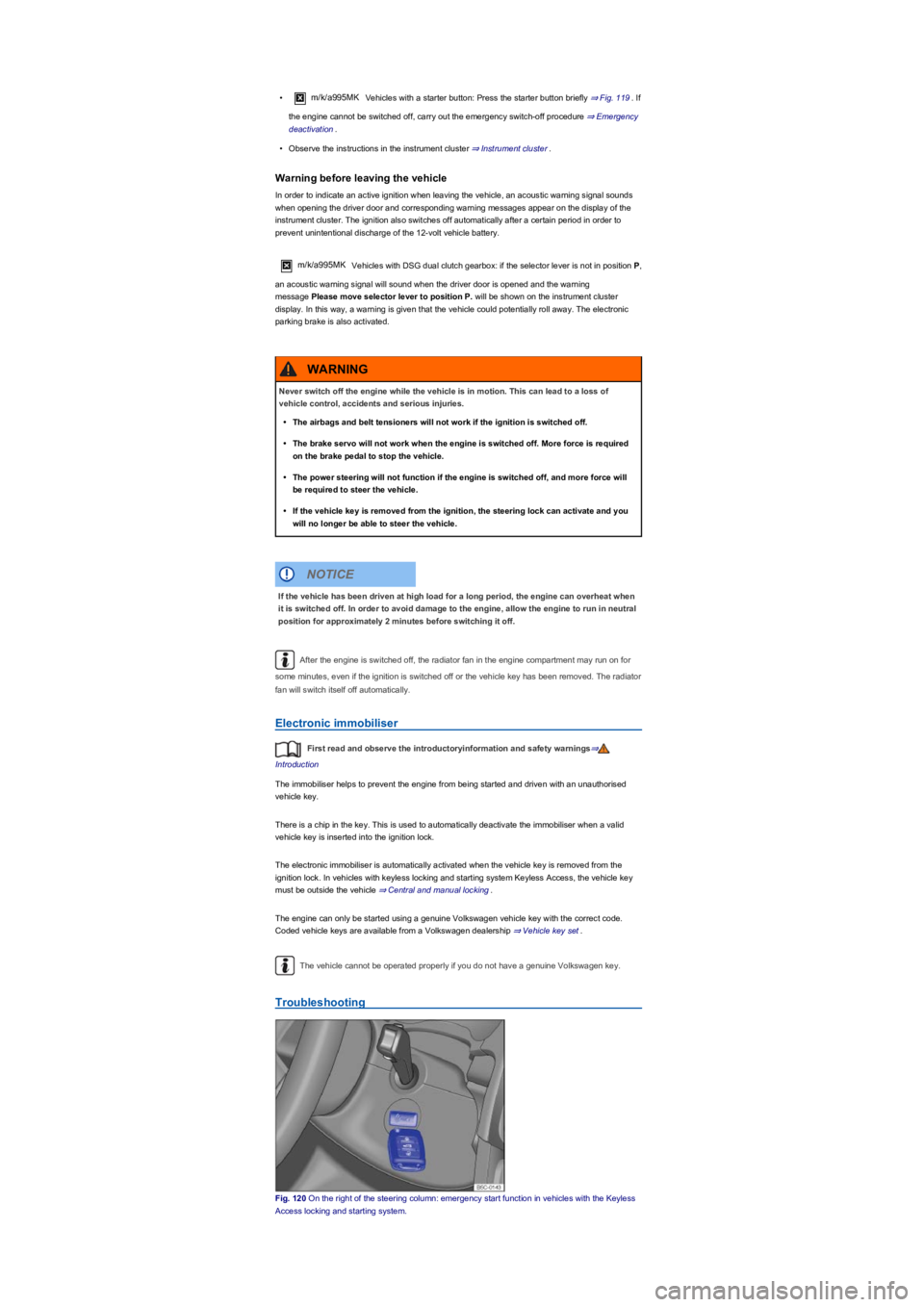
Fig. 120 On the right of the steering column: emergency start function in vehicles with the Keyless
Access locking and starting system.
Never switch off the engine while the vehicle is in motion. This can lead to a loss of
vehicle control, accidents and serious injuries.
•The airbags and belt tensioners will not work if the ignition is switched off.
•The brake servo will not work when the engine is switched off. More force is required
on the brake pedal to stop the vehicle.
•The power steering will not function if the engine is switched off, and more force will
be required to steer the vehicle.
•If the vehicle key is removed from the ignition, the steering lock can activate and you
will no longer be able to steer the vehicle.
WARNING
If the vehicle has been driven at high load for a long period, the engine can overheat when
it is switched off. In order to avoid damage to the engine, allow the engine to run in neutral
position for approximately 2 minutes before switching it off.
NOTICE
Page 141 of 341
First read and observe the introductoryinformation and safety warnings⇒
Introduction
Warning and indicator lamps in the instrument cluster
Warning and indicator lamps light up
Fault in engine management system. The engine should be checked by a qualified workshop
as soon as possible.Risk of engine overheating. The engine speed will be automatically
restricted. The engine speed is shown on the instrument cluster display. The engine speed control
is lifted when the engine is no longer in a critical temperature range and the foot is taken off the
accelerator. and Engine speed limitation is initiated due to a fault in the engine
management system. Make sure that you do not exceed the displayed engine speed. The engine
should be checked by a qualified workshop as soon as possible.Exhaust system fault. Have
the engine checked by a qualified workshop.Particulate filter has become saturated with
soot. Drive in fourth gear (manual gearbox) or in selector lever position D (DSG dual clutch
gearbox) at a speed of at least 70 km/h (44 mph) for approximately 15 minutes. Observe the valid
speed limits. Go to the nearest qualified workshop if the indicator lamp still does not go out.
m/k/a997MKVehicles with diesel engine
Indicator lamps flash.
Fault in engine management system. The engine should be checked by a qualified workshop
as soon as possible.Engine management system has detected misfiring, which damages the
catalytic converter. Reduce speed immediately and drive carefully to the nearest qualified
workshop. Have the engine checked.
Unauthorised vehicle keys
If a non-authorised vehicle key has been inserted in the ignition lock it can be removed as follows:
•m/k/a995MKVehicles with a DSG dual clutch gearbox: press the lock button in the
selector lever and release. Pull the vehicle key out of the ignition lock.
•m/k/a995MKVehicles with a manual gearbox: remove the vehicle key from the ignition
lock.
Emergency start function
Use the emergency start function if no valid vehicle key is detected in the vehicle interior. A
corresponding display will appear in the instrument cluster. This could be the case, for example, if
the button cell in the vehicle key is weak or discharged:
•Depress and hold the brake pedal.
•Hold the vehicle key to the right of the steering column trim directly after pressing the starter
button ⇒ Fig. 120.
•The ignition is switched on automatically, and in some cases the engine is started.
Emergency deactivation
If the engine cannot be switched off by pressing the starter button briefly, an emergency switch-off
procedure is required:
•Press the starter button twice within a few seconds or press and hold once.
•The engine switches off automatically ⇒.
Immobiliser malfunction
A message will be displayed in the instrument cluster if an unauthorised vehicle key is used or there
is a fault in the system. The engine cannot be started. Use an authorised vehicle key or seek expert
assistance.
Start/stop system
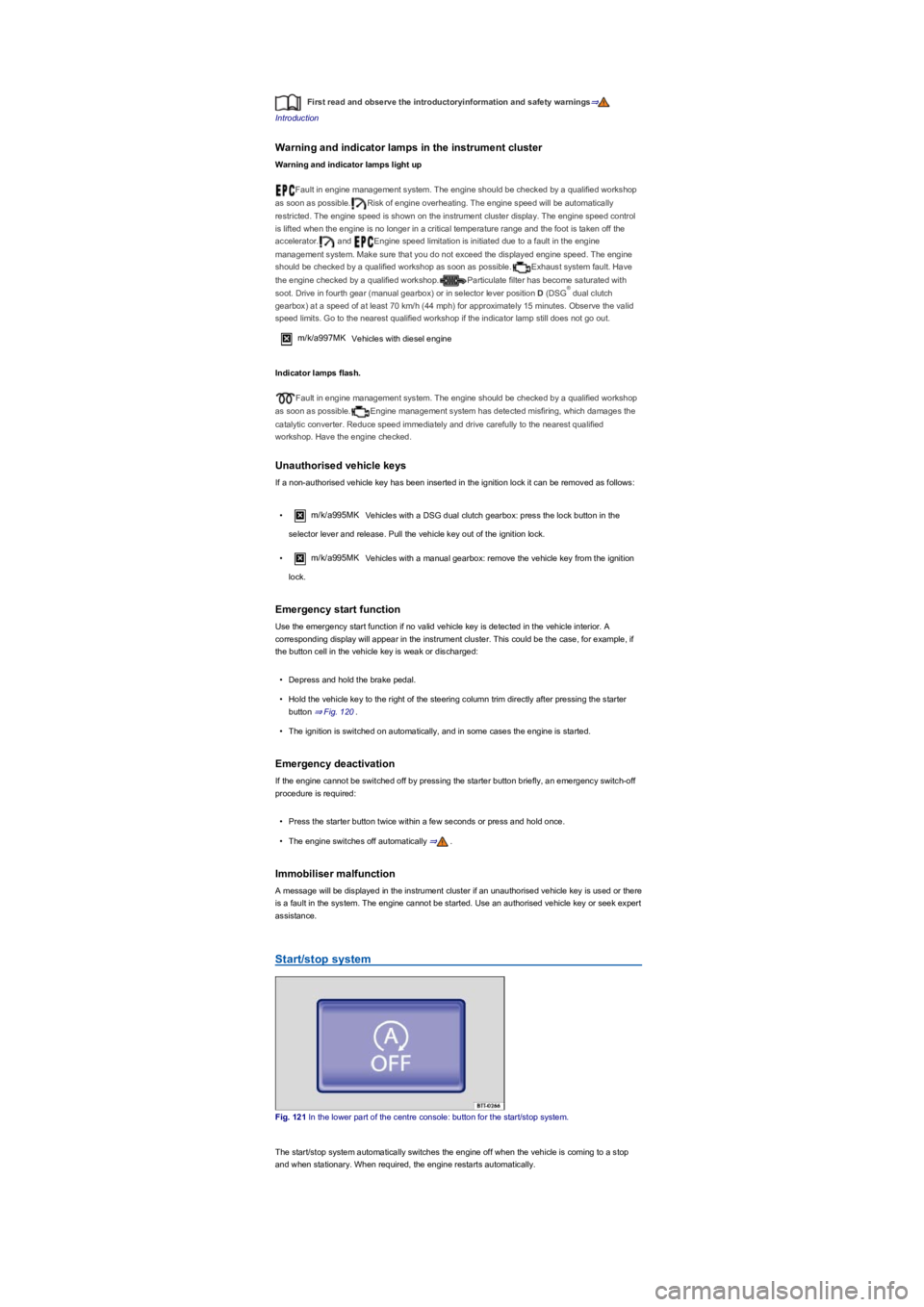
Fig. 121 In the lower part of the centre console: button for the start/stop system.
The start/stop system automatically switches the engine off when the vehicle is coming to a stop
and when stationary. When required, the engine restarts automatically.
®
Page 143 of 341
Conditions that require a manual engine start
The engine must be started manually under the following conditions:
•If the driver door is opened.
•If the bonnet is opened.
Activating and deactivating the start/stop system manually
•Press the button in the centre console ⇒ Fig. 121 to deactivate the system. If the
start/stop system has been deactivated, the indicator lamp in the button lights up.
•Press the button in the centre console again ⇒ Fig. 121 to reactivate the system.
The instrument cluster shows the status of the start/stop system every time the button is
pressed.
If the start/stop system has switched the engine off, it will start again as soon as the system has
been deactivated manually with the button.
Always deactivate the start/stop system manually when driving through water.
Start/stop mode when Adaptive Cruise Control (ACC) is active
The engine will be switched off after the Adaptive Cruise Control (ACC) has brought the vehicle to a
standstill via an active braking intervention ⇒ Adaptive Cruise Control (ACC).
m/k/a995MKVehicles with DSG dual clutch gearbox: when the Adaptive Cruise Control
(ACC) is active, the DSG dual clutch gearbox can shift into coasting mode and the engine can be
switched off with the engine-off coasting function.
In the following instances, the engine will restart when the Adaptive Cruise Control (ACC) is active:
•If the accelerator is depressed.
•When the Adaptive Cruise Control (ACC) has resumed speed and automatic distance control.
•If the vehicle ahead has moved on.
•If the Adaptive Cruise Control (ACC) is deactivated and the vehicle driving in front moved away.
Troubleshooting
The engine stop function may be deactivated if the temperature is above around 38°C (100°F).
In some cases, it may be necessary to restart the engine manually. Follow any
corresponding messages on the instrument cluster display.
The start/stop function is activated automatically if the Eco driving profile is selected on
vehicles with driving profile selection ⇒ Driving profile selection and 4MOTION Active Control.
Always deactivate the start/stop system manually when driving through water.
Manual gearbox: selecting a gear
®
Never switch off the engine or the ignition while the vehicle is in motion. This can lead to a
loss of vehicle control, accidents and serious injuries.
•The airbags and belt tensioners will not work if the ignition is switched off.
•The brake servo will not work when the engine is switched off. That is why more
pressure on the brake pedal is needed to brake the vehicle when the engine is
switched off.
•The power steering will not work when the engine is not running. More power is
needed to steer the vehicle when the engine is switched off.
•When the ignition is switched off, the steering lock may activate and you will no longer
be able to steer the vehicle.
•The start/stop system must be deactivated if work is to be carried out in the engine
compartment.
WARNING
If the start/stop system is used in very high outside temperatures over a long period, the
12-volt vehicle battery can be damaged.
NOTICE
Page 144 of 341
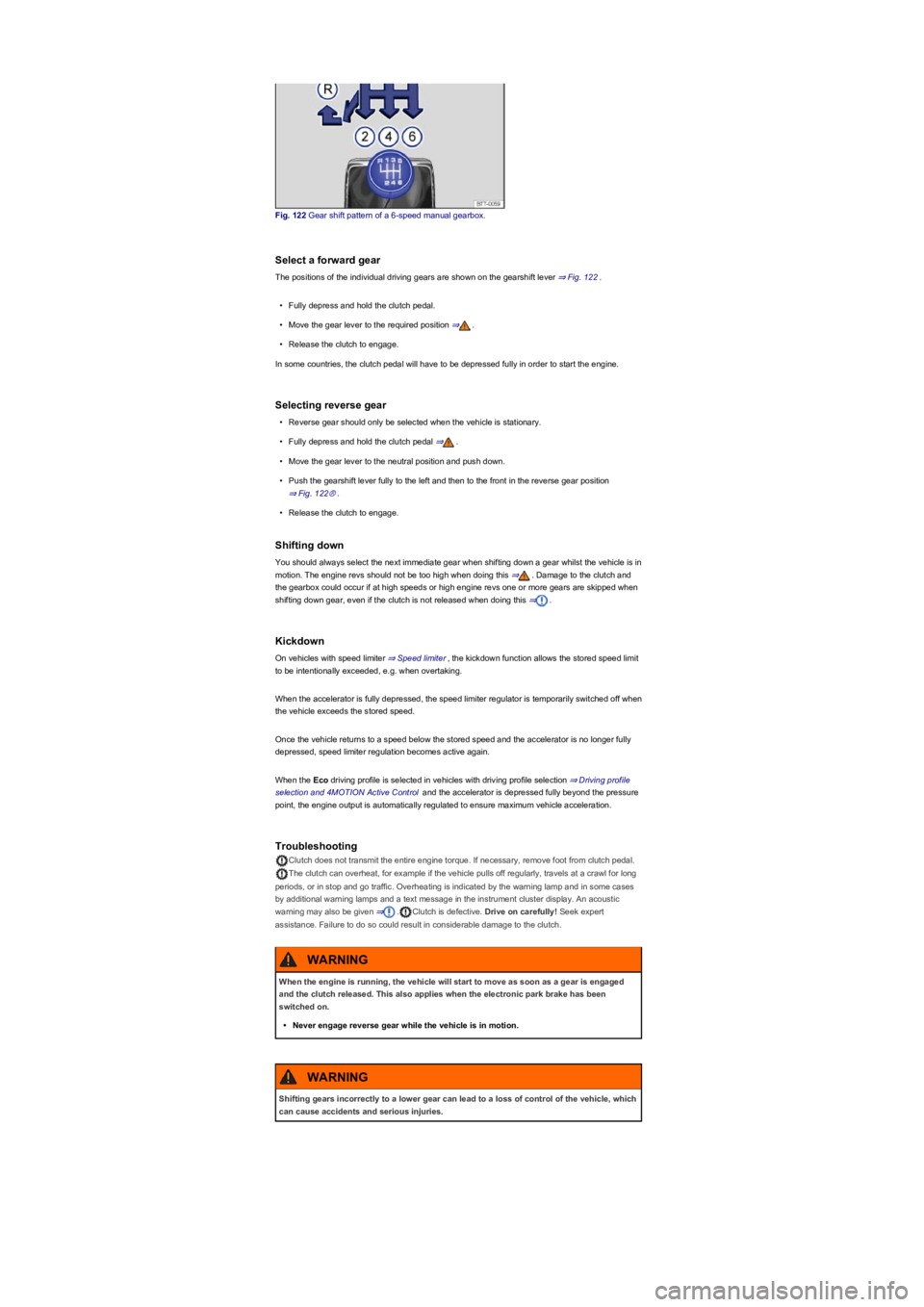
Fig. 122 Gear shift pattern of a 6-speed manual gearbox.
Select a forward gear
The positions of the individual driving gears are shown on the gearshift lever ⇒ Fig. 122.
•Fully depress and hold the clutch pedal.
•Move the gear lever to the required position ⇒.
•Release the clutch to engage.
In some countries, the clutch pedal will have to be depressed fully in order to start the engine.
Selecting reverse gear
•Reverse gear should only be selected when the vehicle is stationary.
•Fully depress and hold the clutch pedal ⇒.
•Move the gear lever to the neutral position and push down.
•Push the gearshift lever fully to the left and then to the front in the reverse gear position
⇒ Fig. 122Ⓡ.
•Release the clutch to engage.
Shifting down
You should always select the next immediate gear when shifting down a gear whilst the vehicle is in
motion. The engine revs should not be too high when doing this ⇒. Damage to the clutch and
the gearbox could occur if at high speeds or high engine revs one or more gears are skipped when
shifting down gear, even if the clutch is not released when doing this ⇒.
Kickdown
On vehicles with speed limiter ⇒ Speed limiter, the kickdown function allows the stored speed limit
to be intentionally exceeded, e.g. when overtaking.
When the accelerator is fully depressed, the speed limiter regulator is temporarily switched off when
the vehicle exceeds the stored speed.
Once the vehicle returns to a speed below the stored speed and the accelerator is no longer fully
depressed, speed limiter regulation becomes active again.
When the Eco driving profile is selected in vehicles with driving profile selection ⇒ Driving profile
selection and 4MOTION Active Control and the accelerator is depressed fully beyond the pressure
point, the engine output is automatically regulated to ensure maximum vehicle acceleration.
Troubleshooting
Clutch does not transmit the entire engine torque. If necessary, remove foot from clutch pedal.
The clutch can overheat, for example if the vehicle pulls off regularly, travels at a crawl for long
periods, or in stop and go traffic. Overheating is indicated by the warning lamp and in some cases
by additional warning lamps and a text message in the instrument cluster display. An acoustic
warning may also be given ⇒.Clutch is defective. Drive on carefully! Seek expert
assistance. Failure to do so could result in considerable damage to the clutch.
When the engine is running, the vehicle will start to move as soon as a gear is engaged
and the clutch released. This also applies when the electronic park brake has been
switched on.
•Never engage reverse gear while the vehicle is in motion.
WARNING
Shifting gears incorrectly to a lower gear can lead to a loss of control of the vehicle, which
can cause accidents and serious injuries.
WARNING
Page 145 of 341
DSG dual clutch gearbox
Function of the DSG dual clutch gearbox
Description
The vehicle is equipped with a DSG dual clutch gearbox.
The DSG dual clutch gearbox is a gearbox which uses dual-clutch technology to change gear
automatically. It uses a dual clutch and two gear train halves to enable very fast gear changes with
no loss of torque. The DSG dual clutch gearbox thus combines the performance and economy of a
manual gearbox with the comfort and convenience of a conventional automatic transmission.
Function
When driving, engine power is transferred to the drive axle via the gearbox. In order to change
gears, the power transmission between the engine and the gearbox has to be interrupted. This is
what the clutch is for.
With the DSG dual clutch system with its two gear train halves, the engine power is always
connected to one gear train half when driving. Before a gear change, the next higher or lower gear
is already preselected in the load-free second gear train half. The clutch on the non-driven gear is
closed and the other is opened at the same time. This is what makes very fast gear changes
possible.
Thanks to its design, the DSG dual clutch gearbox is more efficient than an automatic gearbox.
Whereas in an automatic gearbox the torque converter is constantly in use, in the DSG dual clutch
system the clutch can be opened at idling speed, thus saving fuel. Thanks to its efficiency, low
weight and intelligent control system, the DSG dual clutch system usually enables fuel
consumption equal to or lower than a manual gearbox.
However, just like the manual gearbox, the clutch in the DSG dual clutch gearbox is subject to
wear. Regular maintenance is necessary depending on the type of dual clutch gearbox DSG;
further information ⇒ Scope of service. In the event of a fault in one gear train half, the DSG dual
clutch gearbox also allows one gear train half to be deactivated and the journey to be continued
using the other gear train half ⇒ Troubleshooting. If this happens, have the system checked as
soon as possible by a qualified workshop.
DSG dual clutch gearbox: selecting a gear
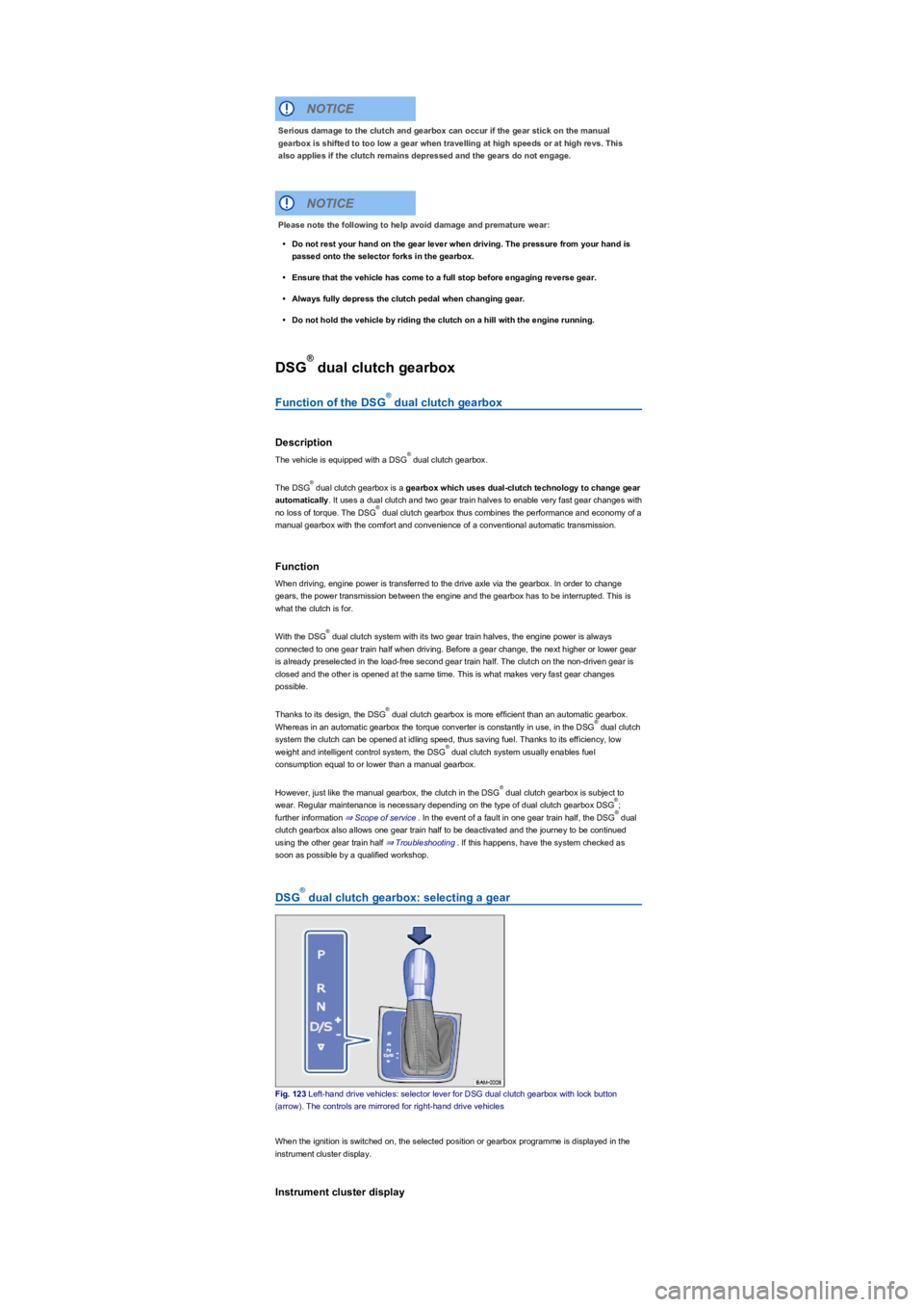
Fig. 123 Left-hand drive vehicles: selector lever for DSG dual clutch gearbox with lock button
(arrow). The controls are mirrored for right-hand drive vehicles
When the ignition is switched on, the selected position or gearbox programme is displayed in the
instrument cluster display.
Instrument cluster display
Serious damage to the clutch and gearbox can occur if the gear stick on the manual
gearbox is shifted to too low a gear when travelling at high speeds or at high revs. This
also applies if the clutch remains depressed and the gears do not engage.
NOTICE
Please note the following to help avoid damage and premature wear:
•Do not rest your hand on the gear lever when driving. The pressure from your hand is
passed onto the selector forks in the gearbox.
•Ensure that the vehicle has come to a full stop before engaging reverse gear.
•Always fully depress the clutch pedal when changing gear.
•Do not hold the vehicle by riding the clutch on a hill with the engine running.
NOTICE
®
®
®
®
®
®
®
®
®
®
®
®
®
Page 146 of 341
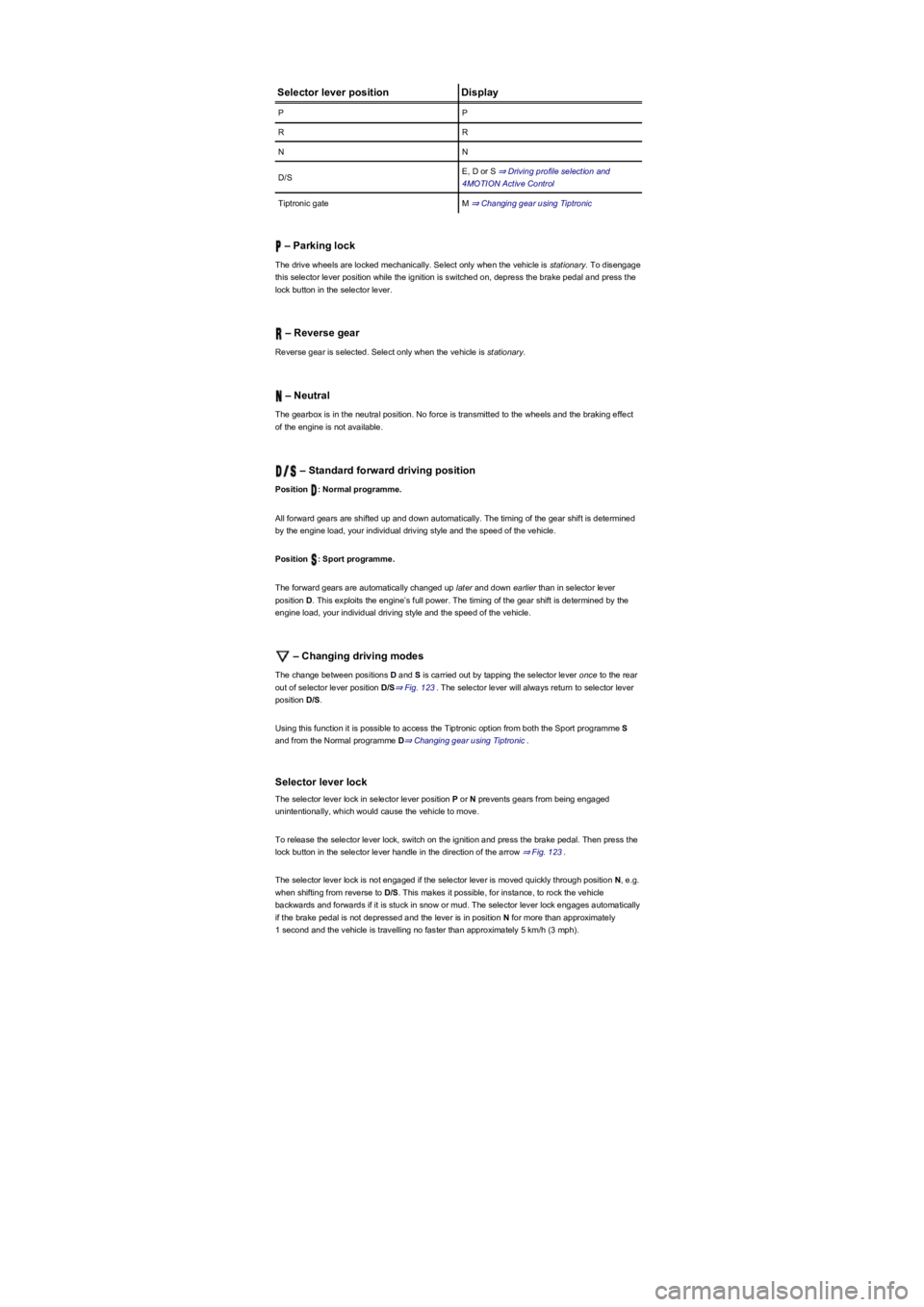
Selector lever positionDisplay
PP
RR
NN
D/SE, D or S ⇒ Driving profile selection and
4MOTION Active Control
Tiptronic gateM ⇒ Changing gear using Tiptronic
– Parking lock
The drive wheels are locked mechanically. Select only when the vehicle is stationary. To disengage
this selector lever position while the ignition is switched on, depress the brake pedal and press the
lock button in the selector lever.
– Reverse gear
Reverse gear is selected. Select only when the vehicle is stationary.
– Neutral
The gearbox is in the neutral position. No force is transmitted to the wheels and the braking effect
of the engine is not available.
– Standard forward driving position
Position : Normal programme.
All forward gears are shifted up and down automatically. The timing of the gear shift is determined
by the engine load, your individual driving style and the speed of the vehicle.
Position : Sport programme.
The forward gears are automatically changed up later and down earlier than in selector lever
position D. This exploits the engine’s full power. The timing of the gear shift is determined by the
engine load, your individual driving style and the speed of the vehicle.
– Changing driving modes
The change between positions D and S is carried out by tapping the selector lever once to the rear
out of selector lever position D/S⇒ Fig. 123. The selector lever will always return to selector lever
position D/S.
Using this function it is possible to access the Tiptronic option from both the Sport programme S
and from the Normal programme D⇒ Changing gear using Tiptronic.
Selector lever lock
The selector lever lock in selector lever position P or N prevents gears from being engaged
unintentionally, which would cause the vehicle to move.
To release the selector lever lock, switch on the ignition and press the brake pedal. Then press the
lock button in the selector lever handle in the direction of the arrow ⇒ Fig. 123.
The selector lever lock is not engaged if the selector lever is moved quickly through position N, e.g.
when shifting from reverse to D/S. This makes it possible, for instance, to rock the vehicle
backwards and forwards if it is stuck in snow or mud. The selector lever lock engages automatically
if the brake pedal is not depressed and the lever is in position N for more than approximately
1 second and the vehicle is travelling no faster than approximately 5 km/h (3 mph).
Page 147 of 341
If the selector lever is moved accidentally to N when driving, take your foot off the
accelerator. Wait for the engine revs in the neutral position before selecting a position again.
Changing gear using Tiptronic
Tiptronic allows the gears to be shifted
up and down manually with a DSG
dual clutch gearbox.
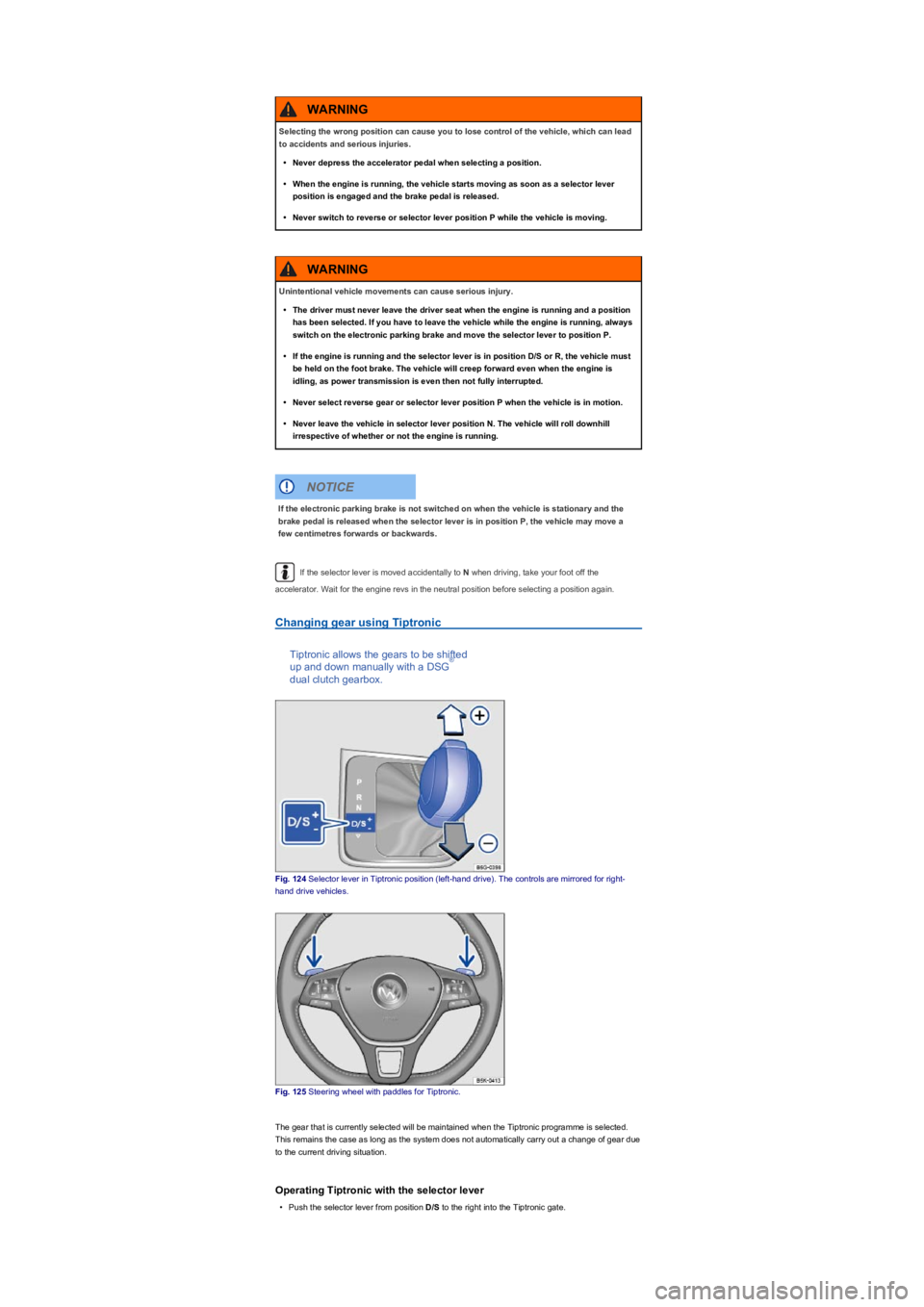
Fig. 124 Selector lever in Tiptronic position (left-hand drive). The controls are mirrored for right-
hand drive vehicles.
Fig. 125 Steering wheel with paddles for Tiptronic.
The gear that is currently selected will be maintained when the Tiptronic programme is selected.
This remains the case as long as the system does not automatically carry out a change of gear due
to the current driving situation.
Operating Tiptronic with the selector lever
•Push the selector lever from position D/S to the right into the Tiptronic gate.
Selecting the wrong position can cause you to lose control of the vehicle, which can lead
to accidents and serious injuries.
•Never depress the accelerator pedal when selecting a position.
•When the engine is running, the vehicle starts moving as soon as a selector lever
position is engaged and the brake pedal is released.
•Never switch to reverse or selector lever position P while the vehicle is moving.
WARNING
Unintentional vehicle movements can cause serious injury.
•The driver must never leave the driver seat when the engine is running and a position
has been selected. If you have to leave the vehicle while the engine is running, always
switch on the electronic parking brake and move the selector lever to position P.
•If the engine is running and the selector lever is in position D/S or R, the vehicle must
be held on the foot brake. The vehicle will creep forward even when the engine is
idling, as power transmission is even then not fully interrupted.
•Never select reverse gear or selector lever position P when the vehicle is in motion.
•Never leave the vehicle in selector lever position N. The vehicle will roll downhill
irrespective of whether or not the engine is running.
WARNING
If the electronic parking brake is not switched on when the vehicle is stationary and the
brake pedal is released when the selector lever is in position P, the vehicle may move a
few centimetres forwards or backwards.
NOTICE
®
Page 148 of 341
•Gently push the selector lever forwards ⊕ or back ㊀ to shift gear up or down ⇒ Fig. 124.
When moving the selector lever in the Tiptronic gate, do not press the lock button on the selector
lever.
Operating Tiptronic with the paddles
•Pull the right paddle ⇒ Fig. 125 towards the steering wheel to change up a gear.
•Pull the left paddle towards the steering wheel to change down a gear.
•To leave Tiptronic mode, pull the right paddle towards the steering wheel for approximately one
second.
Tiptronic is automatically deactivated if the selector paddles are not operated for some time and the
selector lever is not in the Tiptronic gate.
Driving with DSG dual clutch gearbox
The gearbox changes the forward gears up and down automatically.
Driving down hills
The steeper the gradient, the lower the gear you will need. Lower gears increase the braking effect
of the engine. Never allow the vehicle to roll down mountains or hills in the neutral position N.
•Reduce your speed.
•Push the selector lever from position D/S to the right into the Tiptronic gate ⇒ Changing gear
using Tiptronic.
•Gently push the selector lever to the rear to change down gear.
•OR: shift down using the paddles on the steering wheel ⇒ Changing gear using Tiptronic.
Stopping and pulling away on an uphill gradient
The steeper the uphill gradient, the lower the gear you will need.
If you wish to stop the vehicle or pull away when driving uphill you should use the Auto Hold
function ⇒ Electronic parking brake.
When you stop the vehicle on an incline and the vehicle remains in gear, the vehicle must always
be prevented from rolling by depressing the brake pedal or by applying the electronic parking brake.
The brake pedal or the electronic parking brake should not be released until you pull away ⇒.
Coasting with DSG dual clutch gearbox
In coasting mode, the momentum of the vehicle can be used to save fuel in conjunction with a
foresighted driving style. With the engine-off coasting function, the engine is not just disengaged,
but is also switched off. The engine no longer brakes the vehicle – the vehicle can roll for a longer
distance. The function is available only in the selector lever position D/S and at speeds of
approximately 30 – 130 km/h (18 mph – 80 mph).
An automatic engine start may take place in order to ensure reliable engine restarting and to
guarantee the power supply of the vehicle electrical system.
Triggering coasting
•Select the Eco driving profile from the driving profile selection menu ⇒ Driving profile selection
and 4MOTION Active Control.
•Remove your foot from accelerator pedal. The engine is disengaged and runs in coasting mode.
The vehicle rolls without the braking effect of the engine. The engine is automatically switched
off on vehicles with engine-off coasting function.
Cancelling coasting mode
•Depress the brake pedal briefly.
•OR: depress the accelerator or brake pedal briefly.
•OR: pull a paddle towards the steering wheel.
•OR: press the selector lever to the Tiptronic position.
Kickdown
The kick down function enables maximum acceleration in the selector lever position D/S or in the
Tiptronic position.
•When accelerating, the gearbox automatically shifts up to the next gear shortly before
the maximum permitted engine speed is reached.
•When shifting down a gear manually, the gearbox will not change gear until the engine
can no longer be overrevved.
NOTICE
®
®
Page 149 of 341
If the accelerator pedal is depressed fully, the gearbox will automatically shift to a lower gear,
depending on the speed and engine revs. This will make use of the full vehicle acceleration.
The gearbox does not shift up to the next gear until the engine reaches the maximum engine speed
for the gear.
When the Eco driving profile is selected in vehicles with driving profile selection ⇒ Driving profile
selection and 4MOTION Active Control and the accelerator is depressed fully beyond the pressure
point, the engine output is automatically regulated to ensure maximum vehicle acceleration.
Launch Control Programme
The Launch Control programme gives the vehicle maximum acceleration from a standing start in
vehicles with a DSG dual clutch gearbox.
•Switch off TCS ⇒ Brake support systems.
•Depress and hold the brake pedal with your left foot.
•In selector lever position D/S, select position S. Alternatively, select the Tiptronic position or in
vehicles with driving profile selection select the Sport driving profile ⇒ Driving profile selection
and 4MOTION Active Control.
•With your right foot, depress the accelerator until the engines speed reaches approximately
3,200 rpm.
•Take your left foot off the brake ⇒. The vehicle will start with maximum acceleration.
•Switch the TCS back on after acceleration.
Troubleshooting
®
Rapid acceleration can cause loss of traction and skidding, particularly on slippery roads.
This can cause you to lose control of the vehicle, which can lead to accidents and serious
injuries.
•Always adjust your driving style in accordance with the flow of traffic.
•Only use kickdown or fast acceleration if visibility, weather, road and traffic conditions
permit, and other road users are not put at risk due to the acceleration and the driving
style.
•Please note that the driven wheels could start to spin and the vehicle could skid if the
traction control system (TCS) is switched off, especially if the road is slippery.
•Switch the traction control system (TCS) back on after acceleration.
•Only use the launch control programme, if the road and traffic conditions allow for it.
•You should never endanger other road users through the acceleration of your vehicle
or through your driving style.
WARNING
Never ride the brake pedal. Do not overuse the brake pedal. Constant braking will cause
the brakes to overheat. This can considerably reduce the brake effect, increase the
braking distance and, in certain circumstances, cause the brake system to fail completely.
WARNING
•If you stop the vehicle on an incline, do not attempt to stop it from rolling back by
depressing the accelerator while a position is still selected. The dual clutch gearbox
DSG could overheat and be damaged.
•Never allow the vehicle to roll in position N, particularly if the ignition is switched off.
The DSG dual clutch gearbox will not be lubricated and could be damaged.
•m/k/a995MK Vehicles with Launch Control Programme: accelerating with the
Launch Control programme places heavy strain on all vehicle components. This can
lead to higher rates of wear.
NOTICE
®
®
•Never let the brakes rub by applying light pressure to the brake when it is not
necessary to brake. This will increase levels of wear.
•Before driving down a long, steep gradient, reduce your speed and select a suitable
recuperation level. This will make use of the electric drive braking effect and relieve the
load on the brakes. The brakes could otherwise overheat and possibly fail. The brakes
should only be used to slow or stop the vehicle.
NOTICE