Fuel VOLKSWAGEN TIGUAN 2017 Owner´s Manual
[x] Cancel search | Manufacturer: VOLKSWAGEN, Model Year: 2017, Model line: TIGUAN, Model: VOLKSWAGEN TIGUAN 2017Pages: 341, PDF Size: 9.14 MB
Page 319 of 341
Suitable accessories are available from your Volkswagen dealership. Follow the usage
instructions on the packaging.
Washing the vehicle
Also wash the underside of the vehicle on a regular basis to remove road salt or seawater residue.
Automatic car washes
Always observe all the car wash operator's specifications, in particular if your vehicle features add-
on parts ⇒.
•Preferably use car washes without brushes.
•Preclean the vehicle by rinsing with water.
•The steering column must not lock when driving through automatic car washes ⇒ Steering.
•Always switch off the Auto Hold function ⇒ Electronic parking brake, the wipers ⇒ Wipers and
the rain/light sensor before entering the car wash.
•Fold in the exterior mirrors.
•If your vehicle has decorative and protective films, do not select a wash program with hot wax.
High-pressure cleaners
Observe the manufacturer's information for the high-pressure cleaner. Never use rotating nozzles
⇒.
•Only use water with a maximum temperature of +60°C (+140°F).
•Do not clean windows that are iced over or covered in snow with a high-pressure cleaner.
•Move the jet of water uniformly so that the nozzle is at least 50 cm away from the side windows
and other vehicle components.
•Do not point the water jet at the same location for too long. Instead, leave stubborn dirt to soak.
•If possible, do not direct the water jet at seals, e.g. side windows, decorative trim, tyres, rubber
hoses, insulation materials or any other sensitive components, e.g. door locks.
•Sensors, camera lenses, and decorative and protective films should be sprayed directly only for
brief periods of time.
Washing the car by hand
Washing the car by hand is always the more gentle way to clean it. However, there are also some
things to note for this ⇒.
•Before washing the vehicle, soak the dirt with plenty of water and then rinse it off thoroughly.
•Clean the vehicle with a soft sponge, a wash mitt or a brush applying only light pressure. Start
with the roof and work from the top to the bottom.
•Rinse the sponge, wash mitt or brush thoroughly at regular short intervals.
•Clean the wheels, sill panels etc. last. Use a second sponge for this.
Use a shampoo for very stubborn dirt only.
Car care products can be toxic and hazardous. Unsuitable care products and incorrect use
of care products can cause accidents, serious injuries, burns or poisoning.
•Care products must be kept in the original, sealed container only.
•Read the manufacturer's instructions.
•Never use empty food cans, bottles or other containers for storing care products.
•Keep children away from care products.
•The products can give off harmful fumes during use. They should therefore only be
used outside or in well-ventilated spaces.
•Never use fuel, turpentine, engine oil, nail varnish remover or other volatile fluids to
wash, clean or care for your vehicle. These substances are toxic and highly
inflammable.
WARNING
Stains, dirt and other deposits containing aggressive and solvent-based ingredients attack
the material and may cause irreparable damage, even if only left for a short time.
•Stains, dirt and other deposits should always be removed as quickly as possible and
not allowed to dry in.
•Have stubborn stains removed by a qualified workshop.
NOTICE
1)
Page 320 of 341
Waxing
Waxing protects the paintwork. At the latest when water no longer clearly forms small drops and
runs off the paintwork when the vehicle is clean, you should re-wax the vehicle with a good wax
solution.
Even if a preservative wax is applied regularly in the automatic car wash, Volkswagen recommends
protecting the vehicle paintwork at least twice a year using Volkswagen Genuine hard wax (-
000 096 317 -).
Polishing
Polishing is only necessary if the paint has lost its shine, and the gloss cannot be brought back by
applying wax.
Wash the vehicle only in specially provided wash bays This prevents waste water
contaminated with oil, grease or fuel from entering the sewerage system.
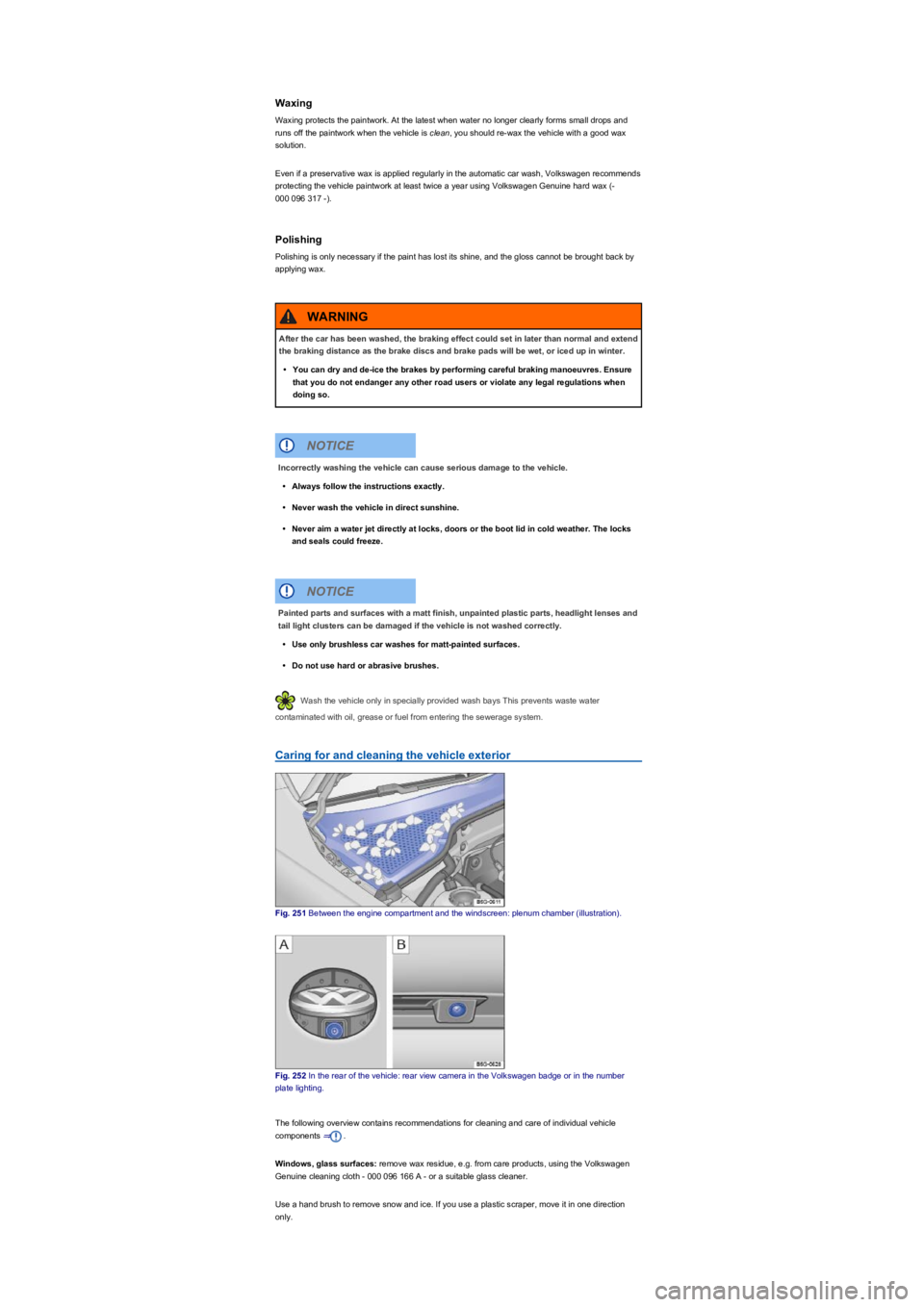
Caring for and cleaning the vehicle exterior
Fig. 251 Between the engine compartment and the windscreen: plenum chamber (illustration).
Fig. 252 In the rear of the vehicle: rear view camera in the Volkswagen badge or in the number
plate lighting.
The following overview contains recommendations for cleaning and care of individual vehicle
components ⇒.
Windows, glass surfaces: remove wax residue, e.g. from care products, using the Volkswagen
Genuine cleaning cloth - 000 096 166 A - or a suitable glass cleaner.
Use a hand brush to remove snow and ice. If you use a plastic scraper, move it in one direction
only.
After the car has been washed, the braking effect could set in later than normal and extend
the braking distance as the brake discs and brake pads will be wet, or iced up in winter.
•You can dry and de-ice the brakes by performing careful braking manoeuvres. Ensure
that you do not endanger any other road users or violate any legal regulations when
doing so.
WARNING
Incorrectly washing the vehicle can cause serious damage to the vehicle.
•Always follow the instructions exactly.
•Never wash the vehicle in direct sunshine.
•Never aim a water jet directly at locks, doors or the boot lid in cold weather. The locks
and seals could freeze.
NOTICE
Painted parts and surfaces with a matt finish, unpainted plastic parts, headlight lenses and
tail light clusters can be damaged if the vehicle is not washed correctly.
•Use only brushless car washes for matt-painted surfaces.
•Do not use hard or abrasive brushes.
NOTICE
Page 321 of 341
Use the Volkswagen Genuine de-icing agent (- 000 096 322 -) to remove ice.
Wiper blades:⇒ Wiper blades.
Paintwork: always treat surfaces carefully in order to prevent damage to the paint coat. Use a
clean, soft cloth and a mild soap solution or cleaning clay to remove any light dirt immediately, e.g.
deposits, insect residue, or cosmetics.
Repair minor paint damage with a touch-up pen. Refer to the vehicle data sticker for the paint code
⇒ Technical data. Consult a qualified workshop in the event of damage to surfaces with matt paint.
•Overflowing fuel or service fluids: clean immediately.
•Flash rust deposits: moisten deposits with a soap solution. Then remove any deposits with
cleaning clay.
•Corrosion: have removed by a qualified workshop.
•Water no longer forms beads on clean paint: preserve paintwork at least twice a year using
Volkswagen Genuine hard wax (- 000 096 317 -).
•No gloss in spite of preservation/paint unattractive: treat the vehicle with suitable polish after
cleaning to remove dirt and dust.
Plenum chamber, engine compartment: remove leaves and other loose objects with a vacuum
cleaner or by hand ⇒ Fig. 251⇒. Cleaning of the engine compartment should always be
performed by a qualified workshop ⇒.
Water that has entered the plenum chamber via a manual process (e.g. from a high-pressure
cleaner) can cause considerable damage to the vehicle.
Sensors, camera lenses: clean the area in front of the sensors or camera with a soft cloth and
solvent-free cleaning agent. Observe the installation locations ⇒ Vehicle overviews.
•Switch on the ignition.
•Move the selector lever to position R.
•Clean the camera lens.
Clean sensitive surfaces on the rain/light sensor and the camera window on the windscreen in the
same way as windows and glass surfaces (depending on vehicle equipment).
Remove snow with a brush. Do not use warm or hot water.
Use the Volkswagen Genuine de-icing agent (- 000 096 322 -) to remove ice.
Decorative films, protective films: remove soiling in the same way as for paint. Always use
Volkswagen Genuine plastic cleaner (- 000 096 314 -) for matt decorative films.
Treat the vehicle with liquid hard wax every three months after washing and removing dust. Only
use clean, soft microfibre clothes to apply it. Do not use hot wax, also not in car washes!
•Stubborn dirt: remove carefully using white spirits, and then rinse using warm water.
Trim parts, trim strips, exhaust pipes made of chrome, aluminium or stainless steel: clean
only in a dust-free environment using a clean, soft cloth and a mild soap solution.
Chrome parts can be protected using Volkswagen Genuine hard wax (- 000 096 317 -).
Anodised surfaces: do not use chrome cleaning products.
Headlights, tail light clusters: use a soft sponge soaked with a mild soap solution. Do not use
any cleaning agents that contain alcohol or solvents.
•Stubborn dirt: remove with Volkswagen Genuine chrome and aluminium care product (-
000 096 319 D -).
Wheels: remove dirt and gritting salt deposits with plenty of water.
Alloy wheels: treat dirty aluminium wheels with Volkswagen Genuine wheel cleaner (- 000 096 304
-). Volkswagen recommends treating the wheel rims with Volkswagen Genuine hard wax (-
000 096 317 -) every three months.
•Damage protective paint coating: repair immediately with a touch-up pen. Go to a qualified
workshop if necessary.
•Brake dust: use Volkswagen Genuine wheel rim cleaner (- 000 096 304 -).
Door lock cylinders: Volkswagen recommends using Volkswagen Genuine de-icing agent (-
000 096 322 -) for de-icing. Do not use door lock de-icers containing substances that dissolve
grease.
1)
1)
1)
Page 333 of 341
If the vehicle exceeds the permitted gross weight or axle load for the rear axle, a speed of 80 km/h
must not be exceeded when towing a trailer. This also applies to countries where higher speeds are
permitted. Always obey speed limits. In some areas speed limits for vehicles towing trailers are
lower than for vehicles without trailers.
Any permitted excess loads for the vehicle are entered in the vehicle documents. If no permitted
excess load is entered, the permitted driving speed limit is 100 km/h taking into account country-
specific legislation.
Technical data
Refer to the vehicle documents for the technical data.
Technical data
Information on technical data
Unless otherwise indicated or listed separately, the technical data for the basic model apply.
Optional equipment, different vehicle equipment, special vehicles and country-specific vehicle
equipment levels can result in different values. All data in the official vehicle documents take
precedence over these data.
Observe the instructions and information relating to vehicles with N1 approval ⇒ Information about
vehicles with N1 approval (light commercial vehicle).
Engine
The vehicle data sticker or the vehicle registration documents show which engine is installed in your
vehicle.
Weight
The values for the kerb weight in the following tables apply to the road-ready vehicle with driver
(75 kg), service fluids including fuel tank carrying 90% of its capacity and, if applicable, tool kit and
spare tyre ⇒. Additional equipment and retrofitted accessories increase the kerb weight stated
and reduce the maximum permitted load accordingly.
The load comprises the weights of the following:
•Vehicle occupants
•All luggage
•Roof load including the mounts or roof bars and the load carrier system
•Drawbar load when towing a trailer ⇒ Trailer towing.
Performance figures
For reasons of vehicle registration and vehicle taxation, the power output and performance of some
engines may vary in some countries from the information given in this booklet.
In certain vehicles with heavy duty suspension, the engine could be governed to provide a
maximum speed of 210 km/h.
Danger of injuries and electric shock from exposed cables.
•Have the luggage compartment completed at the latest after delivery so that the cables
in the rear area of the vehicle are covered during use of the vehicle.
WARNING
Danger of serious injury due to incorrect transport of persons.
•Never transport a person or child in the middle of the rear bench seat.
•The lack of restraint systems such as seat belt and head restraint can result in serious
or fatal injury in the event of an accident.
WARNING
Danger of serious and fatal injury.
•Do not transport people in the luggage compartment.
•Observe the safety instructions and information on the luggage compartment and
transporting items ⇒ Transporting.
WARNING
Page 336 of 341
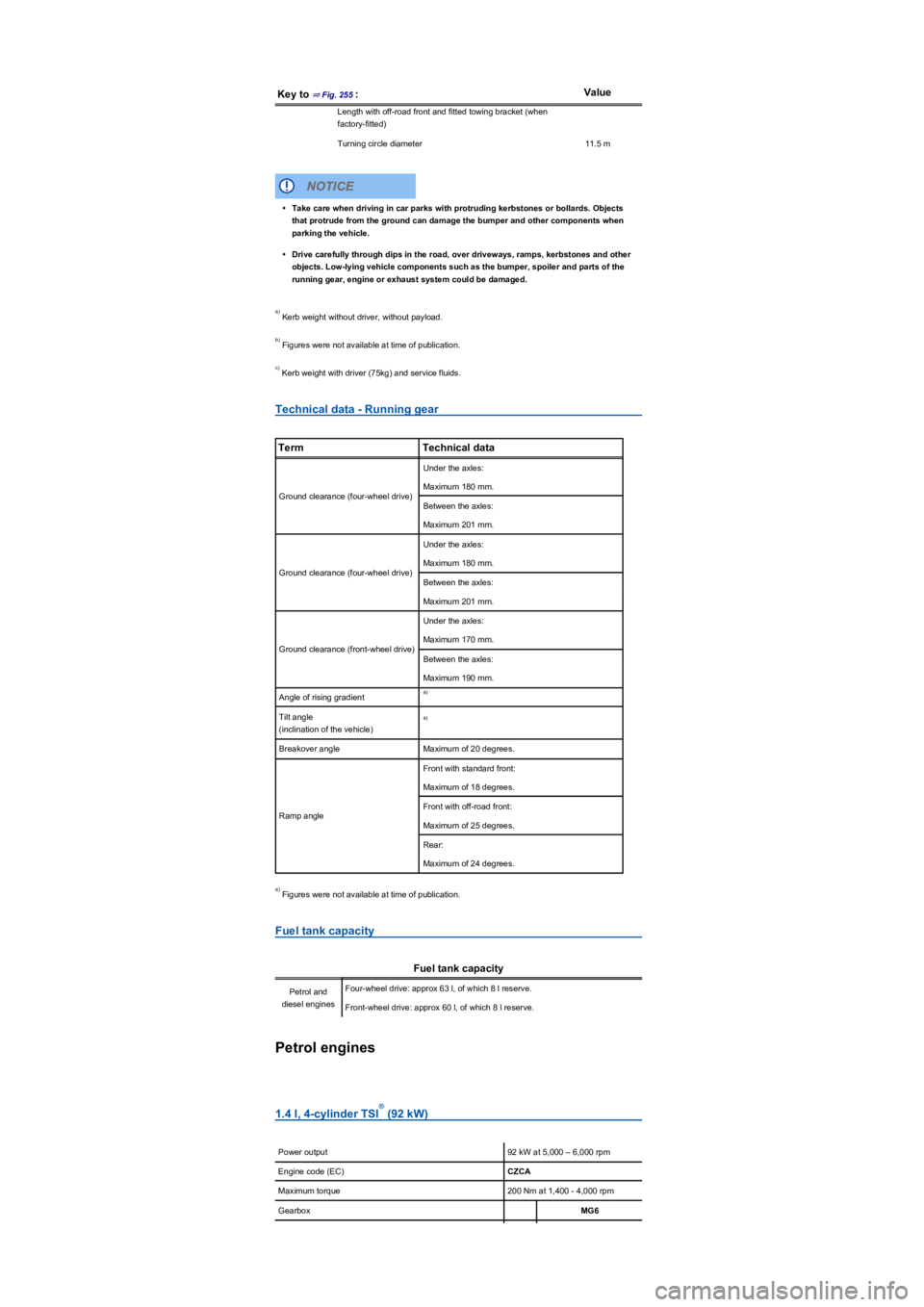
Key to ⇒ Fig. 255:Value
Length with off-road front and fitted towing bracket (when
factory-fitted)
Turning circle diameter11.5 m
Kerb weight without driver, without payload.
Figures were not available at time of publication.
Kerb weight with driver (75kg) and service fluids.
Technical data - Running gear
TermTechnical data
Ground clearance (four-wheel drive)
Under the axles:
Maximum 180 mm.
Between the axles:
Maximum 201 mm.
Ground clearance (four-wheel drive)
Under the axles:
Maximum 180 mm.
Between the axles:
Maximum 201 mm.
Ground clearance (front-wheel drive)
Under the axles:
Maximum 170 mm.
Between the axles:
Maximum 190 mm.
Angle of rising gradient
Tilt angle
(inclination of the vehicle)
Breakover angleMaximum of 20 degrees.
Ramp angle
Front with standard front:
Maximum of 18 degrees.
Front with off-road front:
Maximum of 25 degrees.
Rear:
Maximum of 24 degrees.
Figures were not available at time of publication.
Fuel tank capacity
Fuel tank capacity
Petrol and
diesel engines
Four-wheel drive: approx 63 l, of which 8 l reserve.
Front-wheel drive: approx 60 l, of which 8 l reserve.
Petrol engines
1.4 l, 4-cylinder TSI (92 kW)
Power output92 kW at 5,000 – 6,000 rpm
Engine code (EC)CZCA
Maximum torque200 Nm at 1,400 - 4,000 rpm
GearboxMG6
•Take care when driving in car parks with protruding kerbstones or bollards. Objects
that protrude from the ground can damage the bumper and other components when
parking the vehicle.
•Drive carefully through dips in the road, over driveways, ramps, kerbstones and other
objects. Low-lying vehicle components such as the bumper, spoiler and parts of the
running gear, engine or exhaust system could be damaged.
NOTICE
a)
b)
c)
a)
a)
a)
®
Page 340 of 341
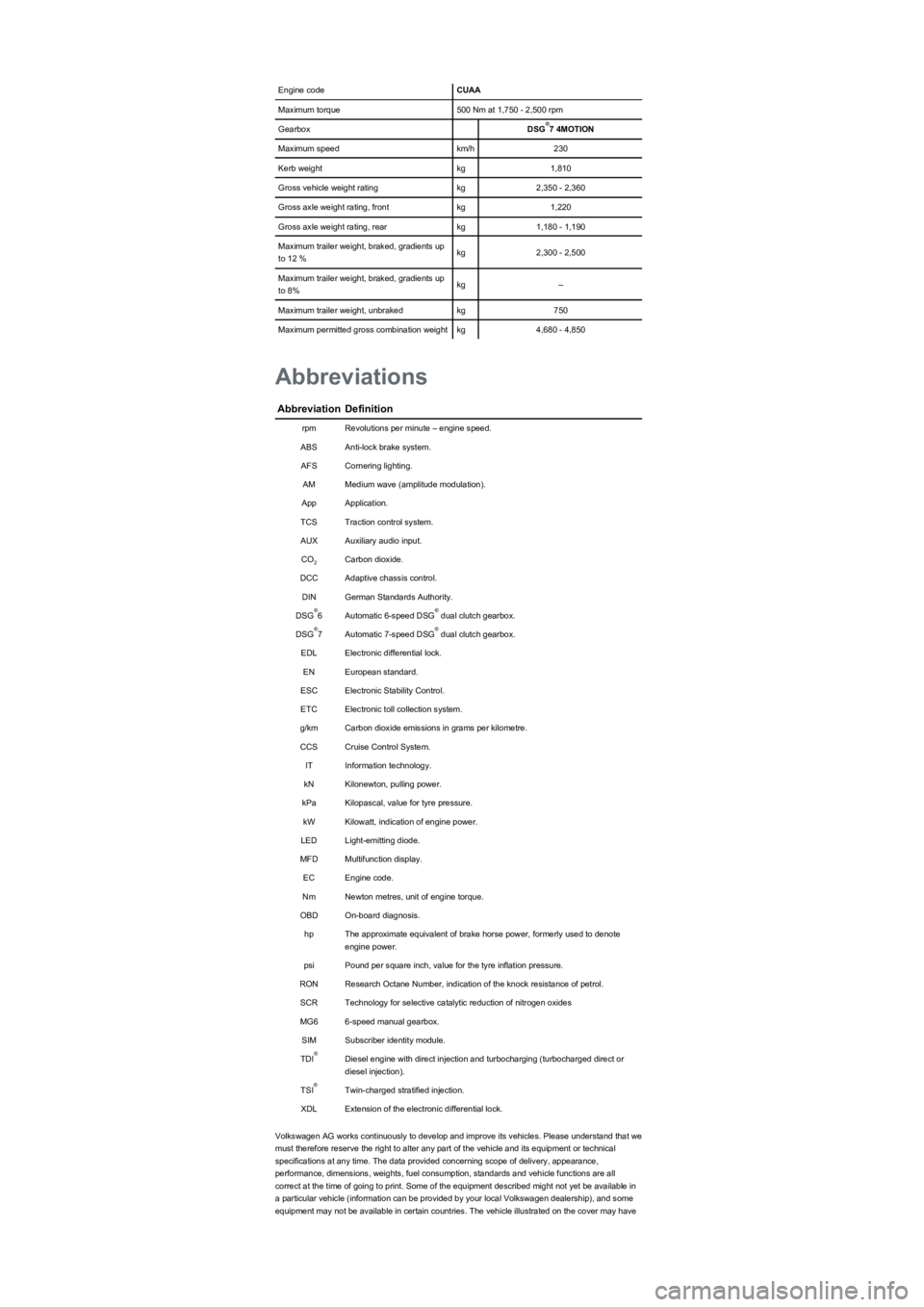
Engine codeCUAA
Maximum torque500 Nm at 1,750 - 2,500 rpm
GearboxDSG7 4MOTION
Maximum speedkm/h230
Kerb weightkg1,810
Gross vehicle weight ratingkg2,350 - 2,360
Gross axle weight rating, frontkg1,220
Gross axle weight rating, rearkg1,180 - 1,190
Maximum trailer weight, braked, gradients up
to 12 %kg2,300 - 2,500
Maximum trailer weight, braked, gradients up
to 8%kg–
Maximum trailer weight, unbrakedkg750
Maximum permitted gross combination weightkg4,680 - 4,850
AbbreviationDefinition
rpmRevolutions per minute – engine speed.
ABSAnti-lock brake system.
AFSCornering lighting.
AMMedium wave (amplitude modulation).
AppApplication.
TCSTraction control system.
AUXAuxiliary audio input.
COCarbon dioxide.
DCCAdaptive chassis control.
DINGerman Standards Authority.
DSG6Automatic 6-speed DSG dual clutch gearbox.
DSG7Automatic 7-speed DSG dual clutch gearbox.
EDLElectronic differential lock.
ENEuropean standard.
ESCElectronic Stability Control.
ETCElectronic toll collection system.
g/kmCarbon dioxide emissions in grams per kilometre.
CCSCruise Control System.
ITInformation technology.
kNKilonewton, pulling power.
kPaKilopascal, value for tyre pressure.
kWKilowatt, indication of engine power.
LEDLight-emitting diode.
MFDMultifunction display.
ECEngine code.
NmNewton metres, unit of engine torque.
OBDOn-board diagnosis.
hpThe approximate equivalent of brake horse power, formerly used to denote
engine power.
psiPound per square inch, value for the tyre inflation pressure.
RONResearch Octane Number, indication of the knock resistance of petrol.
SCRTechnology for selective catalytic reduction of nitrogen oxides
MG66-speed manual gearbox.
SIMSubscriber identity module.
TDIDiesel engine with direct injection and turbocharging (turbocharged direct or
diesel injection).
TSITwin-charged stratified injection.
XDLExtension of the electronic differential lock.
Volkswagen AG works continuously to develop and improve its vehicles. Please understand that we
must therefore reserve the right to alter any part of the vehicle and its equipment or technical
specifications at any time. The data provided concerning scope of delivery, appearance,
performance, dimensions, weights, fuel consumption, standards and vehicle functions are all
correct at the time of going to print. Some of the equipment described might not yet be available in
a particular vehicle (information can be provided by your local Volkswagen dealership), and some
equipment may not be available in certain countries. The vehicle illustrated on the cover may have
®
Abbreviations
2
®®
®®
®
®