navigation system VOLKSWAGEN TIGUAN 2017 Owner´s Manual
[x] Cancel search | Manufacturer: VOLKSWAGEN, Model Year: 2017, Model line: TIGUAN, Model: VOLKSWAGEN TIGUAN 2017Pages: 341, PDF Size: 9.14 MB
Page 7 of 341
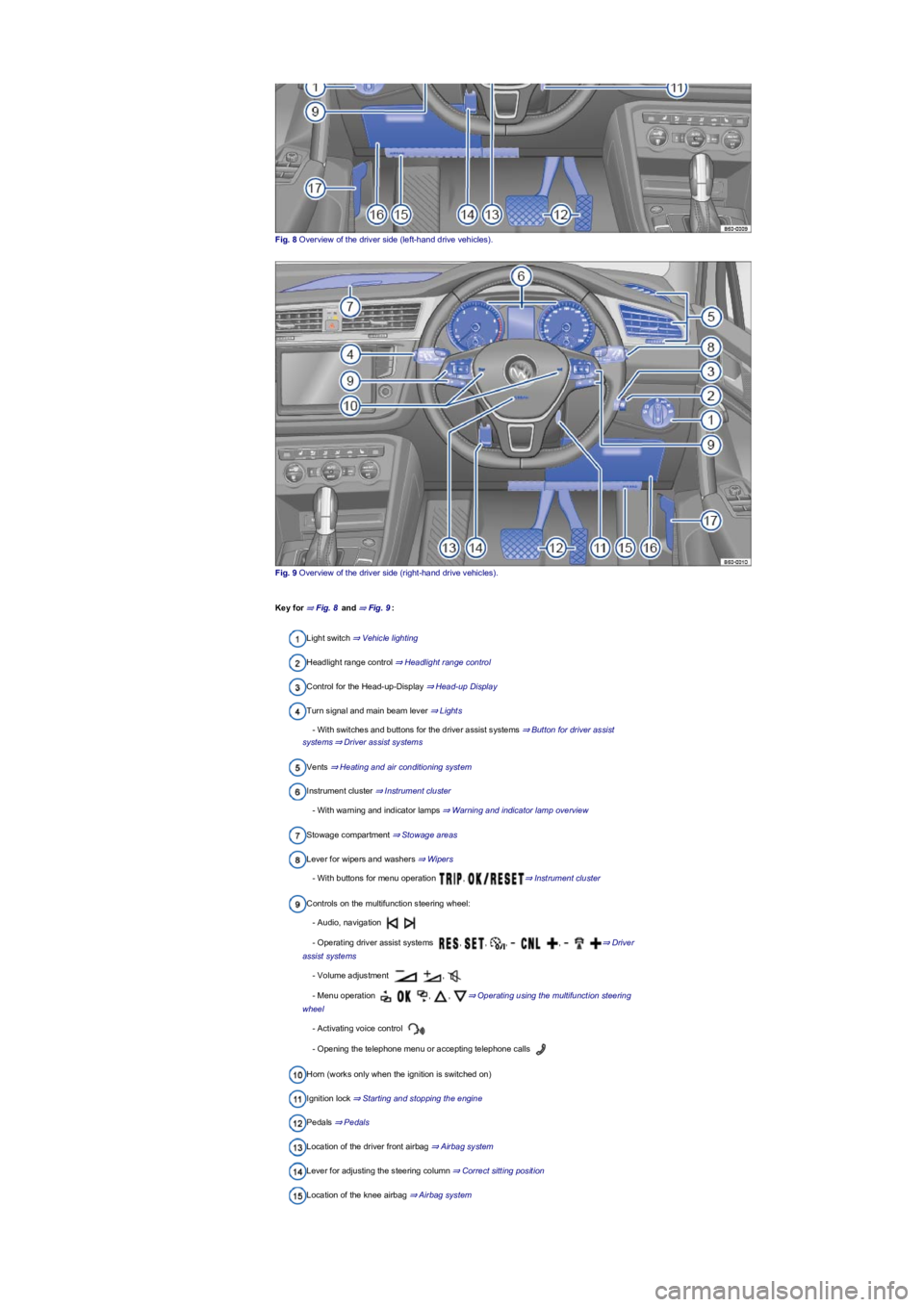
Fig. 8 Overview of the driver side (left-hand drive vehicles).
Fig. 9 Overview of the driver side (right-hand drive vehicles).
Key for ⇒ Fig. 8 and ⇒ Fig. 9:
Light switch ⇒ Vehicle lighting
Headlight range control ⇒ Headlight range control
Control for the Head-up-Display ⇒ Head-up Display
Turn signal and main beam lever ⇒ Lights
- With switches and buttons for the driver assist systems ⇒ Button for driver assist
systems⇒ Driver assist systems
Vents ⇒ Heating and air conditioning system
Instrument cluster ⇒ Instrument cluster
- With warning and indicator lamps ⇒ Warning and indicator lamp overview
Stowage compartment ⇒ Stowage areas
Lever for wipers and washers ⇒ Wipers
- With buttons for menu operation , ⇒ Instrument cluster
Controls on the multifunction steering wheel:
- Audio, navigation
- Operating driver assist systems , , , , ⇒ Driver
assist systems
- Volume adjustment ,
- Menu operation , , ⇒ Operating using the multifunction steering
wheel
- Activating voice control
- Opening the telephone menu or accepting telephone calls
Horn (works only when the ignition is switched on)
Ignition lock ⇒ Starting and stopping the engine
Pedals ⇒ Pedals
Location of the driver front airbag ⇒ Airbag system
Lever for adjusting the steering column ⇒ Correct sitting position
Location of the knee airbag ⇒ Airbag system
Page 14 of 341
Fuel gauge⇒ Fuel gauge.
Coolant temperature display ⇒ Coolant temperature display.
Current gear / selector lever position⇒ Manual gearbox: selecting a gear or ⇒ DSG
dual clutch gearbox.
Information profiles
To select a specific information profile, go to the Views menu option in the display of the instrument
cluster ⇒ Instrument cluster menus. The Active Info Display shows additional information in the
centre of the dials ⇒ Fig. 15② depending on the information profile you have selected. The
following information profiles are available:
•Classic. No additional information shown.
•Consumption and range. Current consumption is shown graphically and average consumption
is shown digitally in the rev counter. The remaining range is shown digitally in the speedometer.
•Efficiency. Average consumption is shown digitally and current consumption is shown
graphically in the rev counter. In the speedometer, the symbol is shown if the current
driving style is fuel-efficient, and a graphic display helps the driver save fuel.
•Navigation. If route guidance is active: the remaining distance to the set destination and an
estimated time of arrival are shown in the rev counter, and arrows to aid navigation are shown
in the speedometer. If route guidance is inactive: the current altitude is shown in the rev
counter, and a compass is shown in the speedometer.
•Driver assistance. Graphic representation of various driver assist systems, or digital display of
the driving time in the rev counter. The speedometer meanwhile shows arrow navigation or a
compass.
•Off-road. Digital display of the steering angle and compass display in the speedometer. With
active Hill Descent Control: graphic display of the Hill Descent Control with speed display in the
speedometer.
Navigation map in the Active Info Display
With some vehicle equipment levels, the Active Info Display is able to display a detailed map. To
display this map, select the Navigation menu item in the instrument cluster ⇒ Instrument cluster
menus.
The map can be shown in either of two sizes. If the larger version is selected, the Active Info
Display dials will be smaller. To select the preferred map size:
•Press the button on the multifunction steering wheel ⇒ Instrument cluster menus to
switch between map sizes as required.
•OR: press the or arrow button on the multifunction steering wheel to select the
required map size. A frame appears around the selected option.
•Confirm the selection by pressing the button on the multifunction steering wheel.
Depending on the equipment level, navigation is shown on two displays or only one. The navigation
map be displayed on the Active Info Display and Infotainment system or only on the Infotainment
system display. In the latter case, only navigation arrows are shown on the Active Info Display.
Changing up a gear early will help to save fuel and reduce engine noise.
Head-up Display
First read and observe the introductoryinformation and safety warnings⇒
Introduction
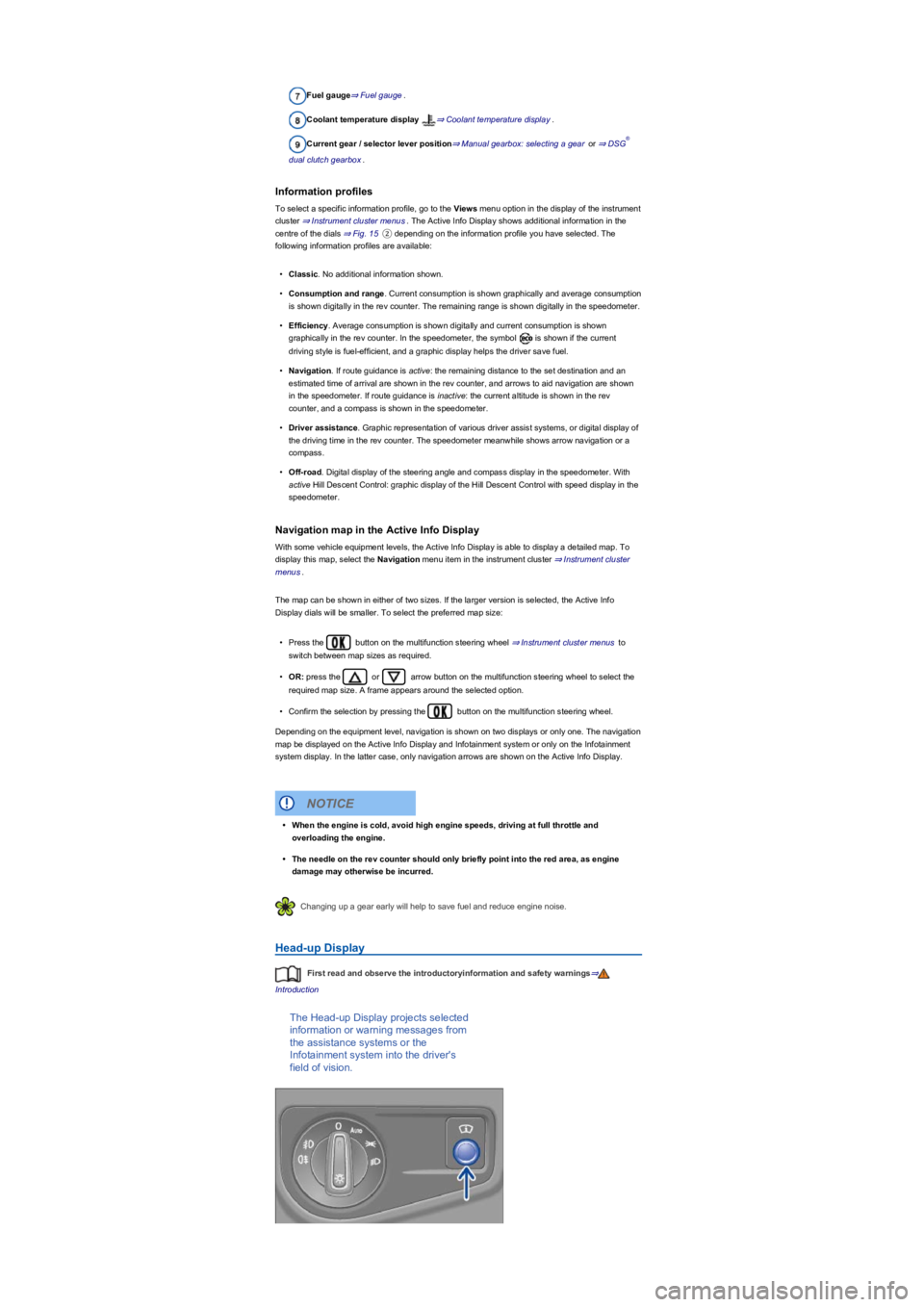
The Head-up Display projects selected
information or warning messages from
the assistance systems or the
Infotainment system into the driver's
field of vision.
®
•When the engine is cold, avoid high engine speeds, driving at full throttle and
overloading the engine.
•The needle on the rev counter should only briefly point into the red area, as engine
damage may otherwise be incurred.
NOTICE
Page 16 of 341
•Time ⇒ Time.
•Radio and navigation information ⇒BookletInfotainment system,.
•Telephone information ⇒BookletInfotainment system,.
•Outside temperature
•Compass display
•Selector lever positions
•Gear-change indicator ⇒ Gear-change indicator.
•Driving data display (multifunction display) and menus for various settings ⇒ Instrument cluster
menus.
•Service interval display ⇒ Service interval display.
•Speed warning function ⇒ Instrument cluster menus.
•Speed warning for winter tyres.
•Start/stop system status display ⇒ Start/stop system .
•Status display for Active Cylinder Management (ACT) ⇒ Driving economically.
•Economical mode .
•Engine code (EC)
•Personalisation: welcome and user selection.
•Road signs detected by the Dynamic Road Sign Display system ⇒ Dynamic Road Sign Display
(Sign Assist).
Open doors, bonnet and boot lid
The instrument cluster display indicates if any doors, the bonnet or boot lid are open once the
vehicle has been unlocked, and while the vehicle is in motion. In some cases, a signal tone is also
given. Different instrument cluster designs will have different displays.
Selector lever positions (DSG dual clutch gearbox)
The gear selected is displayed on the side of the selector lever and on the display in the instrument
cluster. The instrument cluster display may show which gear has been selected if the selector lever
is in D/S position or in Tiptronic mode ⇒ DSG dual clutch gearbox.
Outside temperature display
If the outside temperature falls below approximately +4°C (+39°F), the temperature display also
shows a snowflake symbol . This symbol remains lit up until the outside temperature rises
above +6°C (+43°F) ⇒.
Heat radiated from the engine may cause the temperature display to show a slightly higher value
than the actual outside temperature if the vehicle is stationary, the auxiliary heater ⇒ Auxiliary
heater and ventilation is switched on or the vehicle is travelling at a very low vehicle speed.
The measuring range lies between -45°C (-49°F) and +76°C (+169°F).
Gear-change indicator
When driving in Tiptronic mode, the instrument cluster display may recommend a gear to save fuel
⇒ Gear-change indicator.
Mileage displays
The odometer registers the total distance travelled by the car.
The trip recorder (trip) shows the distance travelled since the trip recorder was last reset.
•To reset the trip recorder to 0, briefly press the button in the instrument cluster
⇒ Analogue instrument cluster or ⇒ Digital instrument cluster (Active Info Display).
Speed warning for winter tyres
A display in the instrument cluster indicates when the set maximum speed has been exceeded
⇒ Instrument cluster menus.
You can adjust the settings for the speed warning in the Infotainment system ⇒ Vehicle settings
menu.
Compass display
If the ignition is switched on, depending on the equipment level, the instrument cluster display
shows the current direction of travel in the form of an abbreviation, e.g. NW for north west.
The graphic compass display is also shown when the Infotainment system is switched on and route
guidance is not active.
®
®
®
Page 17 of 341
Economical mode
While driving, the instrument cluster will show whether the vehicle is in a fuel-efficient mode ,
e.g. due to active cylinder management (ACT) ⇒ Driving economically or coasting of the
automatic gearbox ⇒ DSG dual clutch gearbox.
Engine code
Press and hold the button in the instrument cluster (for approximately 15 seconds) to show
the vehicle's engine code (EC) in the display. The ignition must be switched on but the engine must
not be running ⇒ Analogue instrument cluster or ⇒ Digital instrument cluster (Active Info Display).
Trailer drawbar load display
If the vehicle drives with a trailer attached (depends on equipment and not available in all markets),
the drawbar load and the trailer weight can be shown in the instrument cluster display.
Different instrument clusters are available, which means that the versions and displays may
vary. In displays without warning or information texts, faults are indicated exclusively by indicator
lamps.
Some displays in the instrument cluster may be overridden by sudden alerts, e.g. incoming
telephone calls.
Depending on the vehicle equipment level, some settings and displays may also appear in
the Infotainment system.
If several warning reports are detected, the symbols will appear for several seconds, one
after another. The symbols will continue to appear until the faults are rectified.
If warning messages about malfunctions are displayed when the ignition is switched on, it
may not be possible to adjust some settings as described, or the information display may appear
differently. If this is the case, take the vehicle to a qualified workshop to have the malfunction
rectified.
Instrument cluster menus
First read and observe the introductoryinformation and safety warnings⇒
Introduction
The range of content and layout of the menus and displays depend on the vehicle electronics and
the level of vehicle equipment.
Qualified workshops can programme and modify other functions depending on the vehicle
equipment level. Volkswagen recommends using a Volkswagen dealership for this purpose.
Some menu options can only be opened when the vehicle is stationary.
◾Driving data⇒ Driving data display (multifunction display)
◾Assist systems
◾Lane Assist on/off ⇒ Lane keeping system (Lane Assist)
◾Front Assist on/off ⇒ Area monitoring system (Front Assist)
◾Pedestrian Monitoring on/off ⇒ Pedestrian Monitoring
◾Lane change system on/off ⇒ Lane change system (Side Assist) incl. Rear Traffic Alert
◾Rear Traffic Alert on/off ⇒ Lane change system (Side Assist) incl. Rear Traffic Alert
◾ACC (display only) ⇒ Adaptive Cruise Control (ACC)
◾Views⇒ Instrument cluster
◾Navigation⇒BookletInfotainment system,
◾Audio⇒BookletInfotainment system,
◾Telephone⇒BookletInfotainment system,
◾Vehicle status⇒ Warning and information messages
◾Lap timer⇒ Lap timer
◾Personalisation (user selection)⇒ Personalisation
®
®
Streets and bridges can be iced over at outside temperatures above freezing point.
•The snowflake symbol indicates that there is a risk of black ice.
•There may be black ice on the roads even when outside temperatures are above +4 °C
(+39 °F), even when no snowflake symbol is displayed.
•You should never rely solely on the outside temperature display!
WARNING
1)
Page 22 of 341
using the button or function button and the Vehicle, and
Driver assistance function buttons ⇒ Vehicle settings menu.
In trailer mode, the speed warning function display can be adjusted to the type of trailer or to legal
requirements. The settings can be adjusted in increments of 10 km/h (5 mph) within a range
between 60 km/h (40 mph) and 130 km/h (80 mph). If a higher speed is set than is permitted for
driving with a trailer in the country in which you are currently travelling, Dynamic Road Sign Display
automatically issues a warning at the usual speed limit, e.g. at 80 km/h (50 mph) in Germany.
If the speed warning for the trailer is deactivated, Dynamic Road Sign Display issues warnings as if
the vehicle was being driven without a trailer.
Functional limitations
Dynamic Road Sign Display is subject to system-related limitations. The following conditions can
restrict the function of Dynamic Road Sign Display, or prevent it from working altogether:
•Poor visibility, e.g. snow, rain, fog or heavy spray.
•Dazzling, e.g. from oncoming traffic or sunlight.
•High speeds.
•Covered or dirty camera.
•Traffic signs located outside of the camera's field of view.
•Partially or fully hidden traffic signs, e.g. by trees, snow, dirt or other vehicles.
•Non-standard traffic signs.
•Damaged or bent traffic signs.
•Variable traffic signs on gantries (changeable traffic sign display using LEDs or other light
sources).
•Out-of-date map material in the Infotainment system.
•Vehicles with traffic sign stickers, e.g. speed restrictions on trucks.
Some settings can be saved in the user accounts of the personalisation function and can
therefore change automatically when the user account is changed ⇒ Personalisation.
Time
First read and observe the introductoryinformation and safety warnings⇒
Introduction
•To set the time (on all vehicle clocks), press and hold the button in the instrument
cluster while the doors are closed until the word Time appears in the instrument cluster display
⇒ Analogue instrument cluster or ⇒ Digital instrument cluster (Active Info Display).
•Release the button. The time is shown in the instrument cluster display and the hour
setting is marked.
•Then press the button repeatedly until the required hour is displayed. Press and hold
the button to scroll through quickly.
The intelligent Dynamic Road Sign Display technology cannot overcome the laws of
physics, and functions only within the limits of the system. Do not let the extra
convenience afforded by Dynamic Road Sign Display tempt you into taking any risks when
driving, as this can cause accidents. The system is not a substitute for the full
concentration of the driver.
•Always adapt your speed and driving style to suit visibility, weather, road and traffic
conditions.
•Poor visibility, darkness, snow, rain and fog can cause road signs to be not displayed
or be incorrectly displayed by the system.
•If the camera's field of view is dirty, covered or damaged, the function of the Dynamic
Road Sign Display system may be impaired.
WARNING
Driving recommendations and traffic symbols displayed by the Dynamic Road Sign
Display system may differ from the current traffic situation.
•Not all road signs can be recognised by the system and displayed correctly.
•Road signs and traffic regulations have priority over the recommendations and
displays provided by the Dynamic Road Sign Display system.
WARNING
Availability of the Dynamic Road Sign Display system is restricted in
waypoint navigation mode (waypoint navigation) of the Infotainment system.
NOTICE
Page 28 of 341
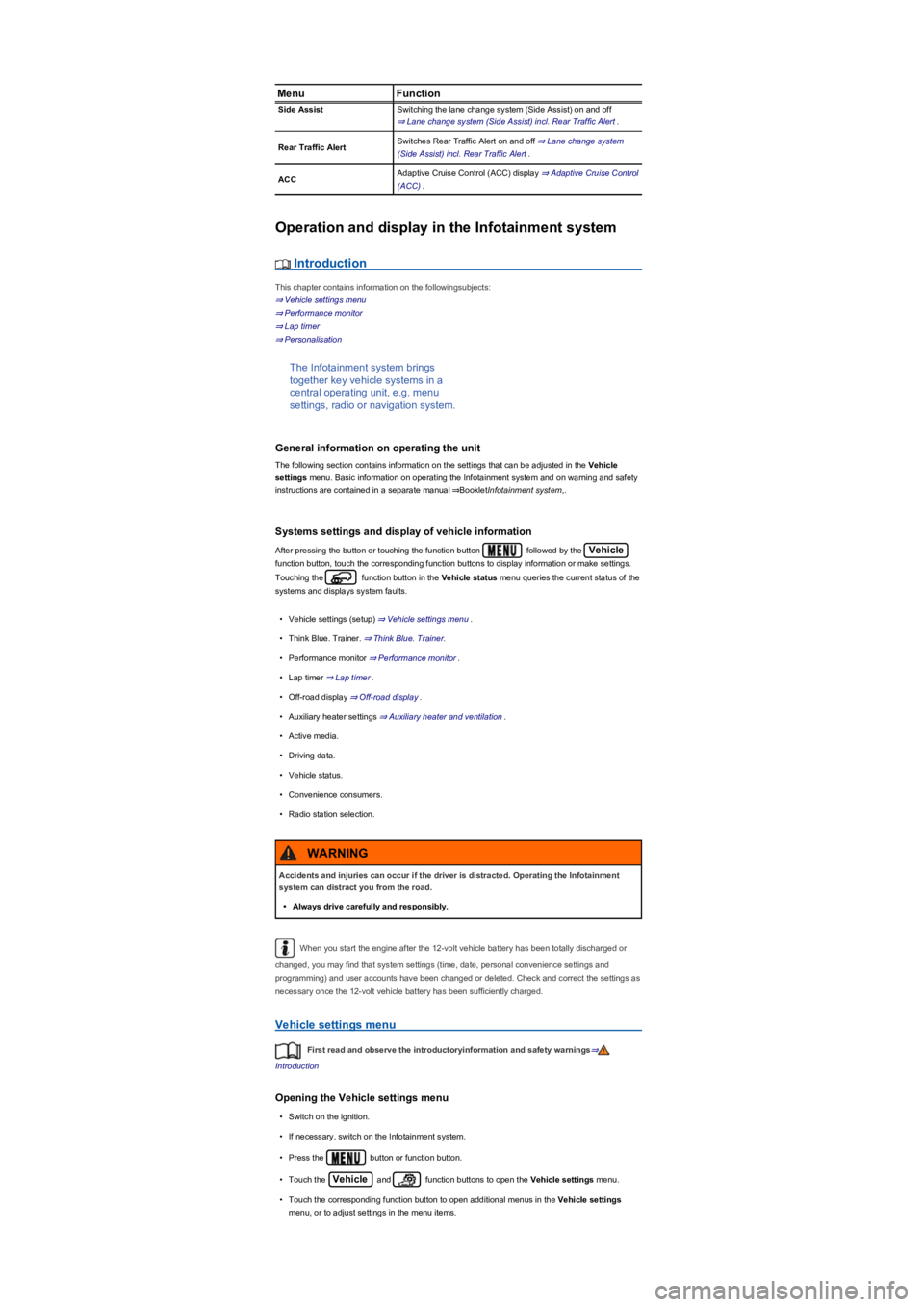
MenuFunction
Side AssistSwitching the lane change system (Side Assist) on and off
⇒ Lane change system (Side Assist) incl. Rear Traffic Alert.
Rear Traffic AlertSwitches Rear Traffic Alert on and off ⇒ Lane change system
(Side Assist) incl. Rear Traffic Alert.
ACCAdaptive Cruise Control (ACC) display ⇒ Adaptive Cruise Control
(ACC).
Operation and display in the Infotainment system
Introduction
This chapter contains information on the followingsubjects:
⇒ Vehicle settings menu
⇒ Performance monitor
⇒ Lap timer
⇒ Personalisation
The Infotainment system brings
together key vehicle systems in a
central operating unit, e.g. menu
settings, radio or navigation system.
General information on operating the unit
The following section contains information on the settings that can be adjusted in the Vehicle
settings menu. Basic information on operating the Infotainment system and on warning and safety
instructions are contained in a separate manual ⇒BookletInfotainment system,.
Systems settings and display of vehicle information
After pressing the button or touching the function button followed by the Vehicle
function button, touch the corresponding function buttons to display information or make settings.
Touching the function button in the Vehicle status menu queries the current status of the
systems and displays system faults.
•Vehicle settings (setup) ⇒ Vehicle settings menu.
•Think Blue. Trainer. ⇒ Think Blue. Trainer.
•Performance monitor ⇒ Performance monitor.
•Lap timer ⇒ Lap timer.
•Off-road display ⇒ Off-road display.
•Auxiliary heater settings ⇒ Auxiliary heater and ventilation.
•Active media.
•Driving data.
•Vehicle status.
•Convenience consumers.
•Radio station selection.
When you start the engine after the 12-volt vehicle battery has been totally discharged or
changed, you may find that system settings (time, date, personal convenience settings and
programming) and user accounts have been changed or deleted. Check and correct the settings as
necessary once the 12-volt vehicle battery has been sufficiently charged.
Vehicle settings menu
First read and observe the introductoryinformation and safety warnings⇒
Introduction
Opening the Vehicle settings menu
•Switch on the ignition.
•If necessary, switch on the Infotainment system.
•Press the button or function button.
•Touch the Vehicle and function buttons to open the Vehicle settings menu.
•Touch the corresponding function button to open additional menus in the Vehicle settings
menu, or to adjust settings in the menu items.
Accidents and injuries can occur if the driver is distracted. Operating the Infotainment
system can distract you from the road.
•Always drive carefully and responsibly.
WARNING
Page 36 of 341
If fuel in the adequate quality available Fuel and emission control?
Are the correct service fluids that comply with Volkswagen specifications available in the
destination country Service fluids and consumables?
Will the navigation function in the factory-fitted Infotainment system and the navigation
data available work in the destination country?
Are special tyres necessary for travelling in the destination country?
Is a fire extinguisher prescribed in your destination country?
Which requirements must be observed regarding reflective vests?
Windscreen washer fluid level Wipers.
Engine oil level Engine oil.
Engine coolant level Engine coolant.
Brake fluid level Brake fluid.
Tyre pressure Wheels and tyres.
Checklist
Therefore, do not do any work in the engine compartment unless you know exactly how to
carry out the jobs, are aware of the general safety procedures and have the correct
equipment, service fluids and suitable tools to hand ⇒ In the engine compartment! In any
other case all work must be carried out by a qualified workshop. Make sure that the
following are checked regularly:
Vehicle lighting Lights required for the vehicle to be roadworthy:
- Turn signals
- Side lights, dipped beam headlights and main beam headlights
- Tail light cluster
- Brake lights
- Rear fog light
- Number plate light.
Servicing the vehicle is not only about vehicle maintenance – it also ensures that your
vehicle remains roadworthy and in perfect working order. You should therefore have your vehicle
serviced according to Volkswagen guidelines. Some work may have to be carried out before the
due date of the next service if the vehicle is subjected to severe operating conditions. Severe
operating conditions are, for example, regular stop and go driving or driving in areas with high
levels of dust. Further information can be obtained from your Volkswagen dealership or a qualified
workshop.
Sitting position
Introduction
This chapter contains information on the followingsubjects:
⇒ Dangers of assuming an incorrect sitting position
⇒ Correct sitting position
Driving under the influence of alcohol, drugs, medication or narcotics can cause serious
accidents and fatal injuries.
•Alcohol, drugs, medication and narcotics can severely impair perception, reaction
times and driving safety. This could cause you to lose control of the vehicle.
WARNING
Always observe current traffic regulations and speed limits, and think ahead when driving.
Correct interpretation of a driving situation can make the difference between reaching
your destination safely and having an accident with serious injuries.
WARNING
Volkswagen is not responsible for any vehicle damage caused by low-quality fuel,
inadequate servicing work or lack of Genuine Parts.
NOTICE
Observe the instructions and information relating to vehicles with N1 approval
⇒ Information about vehicles with N1 approval (light commercial vehicle).
NOTICE
Page 51 of 341
•If the vehicle rolls over.
•If the speed in a collision is lower than the reference value specified in the control unit.
Front airbags
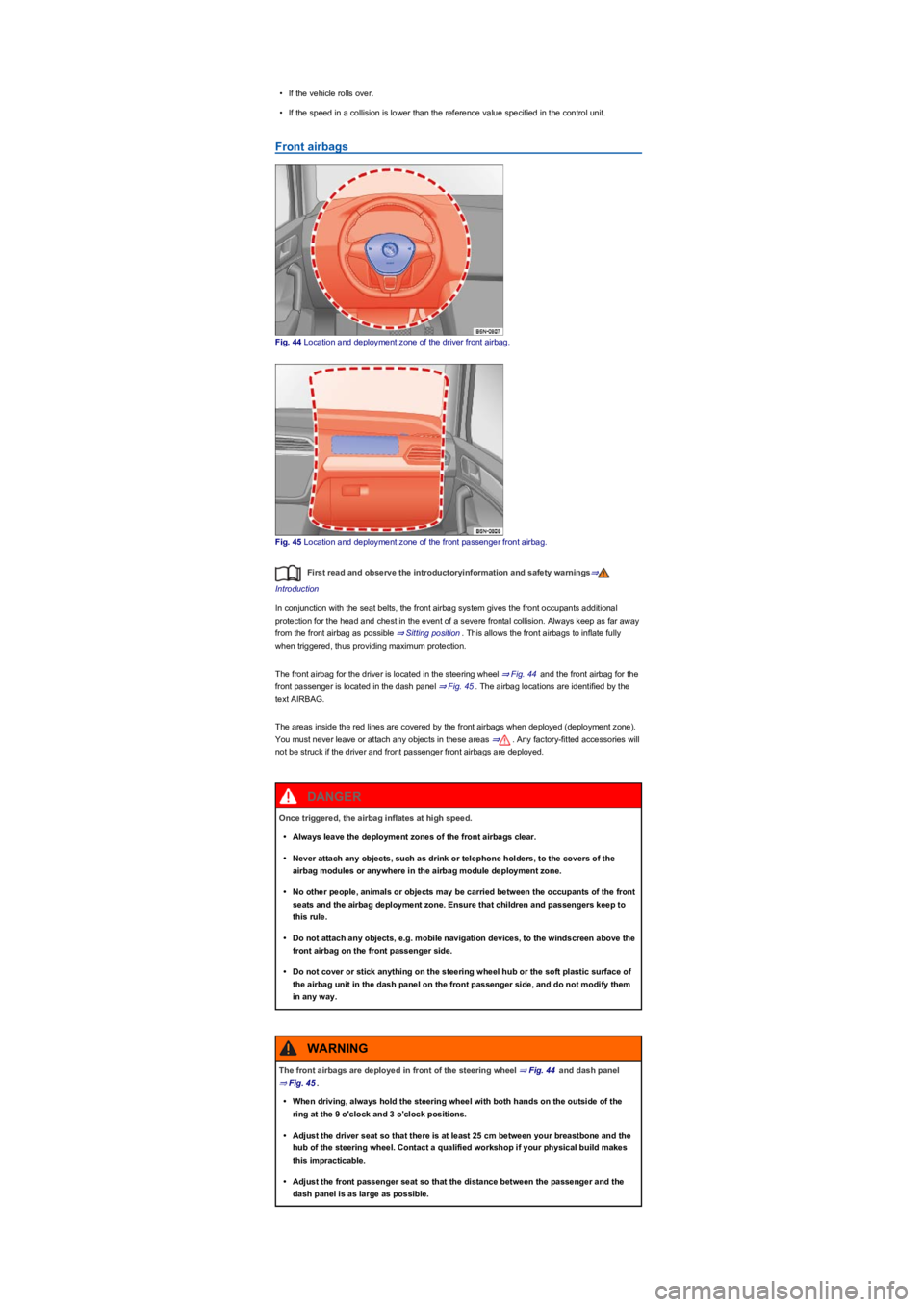
Fig. 44 Location and deployment zone of the driver front airbag.
Fig. 45 Location and deployment zone of the front passenger front airbag.
First read and observe the introductoryinformation and safety warnings⇒
Introduction
In conjunction with the seat belts, the front airbag system gives the front occupants additional
protection for the head and chest in the event of a severe frontal collision. Always keep as far away
from the front airbag as possible ⇒ Sitting position. This allows the front airbags to inflate fully
when triggered, thus providing maximum protection.
The front airbag for the driver is located in the steering wheel ⇒ Fig. 44 and the front airbag for the
front passenger is located in the dash panel ⇒ Fig. 45. The airbag locations are identified by the
text AIRBAG.
The areas inside the red lines are covered by the front airbags when deployed (deployment zone).
You must never leave or attach any objects in these areas ⇒. Any factory-fitted accessories will
not be struck if the driver and front passenger front airbags are deployed.
Once triggered, the airbag inflates at high speed.
•Always leave the deployment zones of the front airbags clear.
•Never attach any objects, such as drink or telephone holders, to the covers of the
airbag modules or anywhere in the airbag module deployment zone.
•No other people, animals or objects may be carried between the occupants of the front
seats and the airbag deployment zone. Ensure that children and passengers keep to
this rule.
•Do not attach any objects, e.g. mobile navigation devices, to the windscreen above the
front airbag on the front passenger side.
•Do not cover or stick anything on the steering wheel hub or the soft plastic surface of
the airbag unit in the dash panel on the front passenger side, and do not modify them
in any way.
DANGER
The front airbags are deployed in front of the steering wheel ⇒ Fig. 44 and dash panel
⇒ Fig. 45.
•When driving, always hold the steering wheel with both hands on the outside of the
ring at the 9 o'clock and 3 o'clock positions.
•Adjust the driver seat so that there is at least 25 cm between your breastbone and the
hub of the steering wheel. Contact a qualified workshop if your physical build makes
this impracticable.
•Adjust the front passenger seat so that the distance between the passenger and the
dash panel is as large as possible.
WARNING
Page 104 of 341
In vehicles with a corresponding equipment level, main-beam control can be activated and
deactivated in the Infotainment system in the Vehicle settings menu ⇒ Operation and
display in the Infotainment system:
Switching on main beam control
•Switch on the ignition and turn the light switch to position .
•Tap the turn signal and main beam lever forwards out of the basic position.
When the main-beam control is switched on, the indicator lamp is shown on the instrument
cluster display.
Switching off main beam control
•Pull back the turn signal and main beam lever.
•OR: turn the light switch to a position that is not .
•OR: switch off the ignition.
•OR: push the turn signal and main beam lever forwards to switch on the manual main beam.
Advanced main-beam control (Dynamic Light Assist)
Advanced main-beam control provides maximum illumination for the road and the surrounding area.
At the same time, it prevents vehicles in front or oncoming vehicles from being dazzled. The system
uses a camera to detect other road users and their distance from your vehicle and covers part of
the headlights appropriately. If the system can no longer prevent other road users from being
dazzled, the main beams are switched off automatically.
System limits
The main beam must be switched off manually under the following conditions because it is not
switched off in time or not switched off at all by the main beam control:
•In poorly lit streets where there are highly-reflective signs.
•Other road users with insufficient lighting facilities, such as pedestrians, cyclists.
•In tight bends, brows of hills or depressions in the land or half-hidden oncoming traffic.
•With oncoming traffic on streets with a central barrier where the driver can see clearly over the
central barrier e.g. truck drivers.
•In fog, snow or heavy rain.
•In dusty or sandy areas.
•Damage to the windscreen in the camera's vision field.
•If the viewing field of the camera is misted up, dirty, covered by a sticker, snow or ice.
•If the camera is broken or the power supply is interrupted.
Light-emitting objects in the camera's field of operation, e.g. mobile navigation devices, could
impair the functions of the main-beam control system (Light Assist).
Parking light
Switching the parking lights on and off
Do not let the extra convenience afforded by main beam control tempt you into taking any
risks when driving – this can cause accidents. The system is not a substitute for the full
concentration of the driver.
•Always check the lights yourself and adjust them to the prevailing conditions for lights,
vision and road traffic.
•The main beam control may not be able to recognise all driving situations correctly and
may not work properly in certain situations.
•If the camera's field of view is dirty, covered or damaged, the function of the main
beam control may be impaired. This also applies if changes are made to the vehicle's
lighting system, for example if additional headlights are fitted.
WARNING
Please observe the following points in order to avoid impairing the proper function of the
system:
•Regularly clean the camera's field of view, and keep it free from snow and ice.
•Do not cover the camera's field of view.
•Regularly check the area of the windscreen that is in the camera's field of view for
damage.
NOTICE
Page 142 of 341
Switching on start/stop
The function is automatically activated every time the ignition is switched on. The instrument cluster
display will show information about the current status.
Vehicles with DSG dual clutch gearbox may be equipped with a start/stop system with engine-off
coasting function. The engine-off coasting function is deactivated and activated together with the
start/stop system.
Further information regarding start/stop mode is available in the Infotainment system ⇒ Operation
and display in the Infotainment system. This information also applies to coasting.
Indicator lamps
If the indicator lamp is lit, the start/stop system is available and automatic engine stop is active.
If the indicator lamp is lit, the start/stop system is not available or the start/stop system has
started the engine automatically. Check whether all technical requirements have been fulfilled. If
not, ensure that all technical requirements are met ⇒ Important preconditions for automatic engine
switch-off.
The display on the instrument cluster may show the status of the start/stop system.
In addition, start/stop information on the current status of the start/stop system can be displayed as
required in Infotainment systems with a navigation function. Touch the i in the start/stop
information to obtain further information on the status.
Vehicles with a manual gearbox
•Disengage the gear and release the clutch pedal when the vehicle is coming to a stop, or when
it is stationary. The engine is stopped.
•Depress the clutch pedal to restart the engine.
Vehicles with DSG dual clutch gearbox
•To stop, press and hold the brake pedal. The engine switches off shortly before the vehicle
reaches a complete standstill or when the vehicle is stationary.
•Take your foot off the brake pedal, or depress the accelerator, to restart the engine.
Important preconditions for automatic engine switch-off
•The driver is wearing their seat belt.
•The driver door is closed.
•The bonnet is closed.
•A minimum engine temperature has been reached.
•m/k/a995MKVehicles with Climatronic: the temperature of the vehicle interior is within
the preset temperature range, and the humidity level is not too high.
•The defrost function of the air conditioning system is not switched on.
•The charge level of the 12-volt vehicle battery is sufficient.
•The temperature of the 12-volt vehicle battery is not too low or too high.
•The vehicle is not on a steep incline.
•The windscreen heating is not switched on.
•m/k/a995MKVehicles with DSG dual clutch gearbox: the steering wheel is not turned
too sharply.
•Reverse gear is not engaged.
•The Park Assist system is not active.
•The Off-road or Off-road Individual driving profile is activated.
When the conditions for automatic engine switch-off are only fulfilled when the vehicle is stationary,
the engine can also switch off subsequently, e.g. by switching off the defrost function.
Conditions for an automatic restart
The engine can start automatically under the following conditions:
•If the temperature inside the vehicle substantially increases or decreases.
•If the vehicle rolls on.
•If the electric voltage of the 12-volt vehicle battery drops.
•If the steering wheel is moved.
As a general rule, the engine always starts again automatically when required by the detected
situation and the vehicle.
®
®