coolant VOLKSWAGEN TRANSPORTER 1990 T4 / 4.G User Guide
[x] Cancel search | Manufacturer: VOLKSWAGEN, Model Year: 1990, Model line: TRANSPORTER, Model: VOLKSWAGEN TRANSPORTER 1990 T4 / 4.GPages: 165, PDF Size: 24.87 MB
Page 100 of 165

Downloaded from www.Manualslib.com manuals search engine
AINTENANCE
VEHICLE CARE
Ibur
vehicle has been designed to help «eep maintenance requirements to a mini--jm. However, a certain amount of regu
lar maintenance is still necessary to as s-re your vehicle's safety, economy and re- ability.
Maintenance
Service is
required
every
12
months
or
every
15,000
miles
(24,000
kilometers),
whichever occurs
first.
I addition, it is necessary to perform an oil
nange
6 months after each Maintenance
Service,
or after each 7,500 miles (12,000
•: (ometers) whichever occurs
first.
"he
first
oil change must be performed 6 ~ionths after the delivery of the vehicle or
after 7,500 miles (12,000 kilometers).
Under
difficult
operating
conditions, for
example
at extreme low outside tempera
tures or in very dusty regions, etc., some
service
work should be performed bet
ween the intervals specified.
This
applies particularly to: • oil changes, and
• cleaning or replacing the air
filter.
The
maintenance work should be per formed by Volkswagen dealers because
they have the expertise, the workshop facilities and the special tools required. It is important
that
this work is per
formed according to the manufacturer's instructions.
Proof
of servicing in accordance
with
the
maintenance schedule may be a condition
for upholding a possible warranty claim
made
within the warranty period.
Safety
and
environmental
concerns
place
very strict limits on the nature of re
pairs
and adjustment on engine and trans
mission
parts which an owner can per
form.
Tampering
with
safety-related
parts
can
endanger
you as
well
as
other
motorists.
Always
observe environmental regula tions when disposing of old engine oil,
used
brake fluid,
dirty
engine coolant,
spent batteries or worn out tires.
95
www.westfaliaT3.info - a useful website for owners and enthusiasts of VW Westfalia T25 / T3 Campervans
Page 109 of 165

Downloaded from www.Manualslib.com manuals search engine
VEHICLE
CARE
COOLING
SYSTEM
The cooling system
is
sealed and gener ally requires little attention.
The cooling system has been filled at the factory with
a
permanent coolant which
does not need to be changed. The coolant
consists
of a
mixture
of
water
and the
manufacturer's coolant additive
G 11 —
antifreeze
on
glycol basis with anticorro-
sion additives (40% for USA
models;
50%
for Canadian models).
This
mixture
assures
the
necessary frost protection
and protects
the
entire cooling system
against corrosion and
scaling,
and raises
the boiling point of the coolant.
Do
not
reduce
the
concentration
of the
coolant
in the
summer
by
adding plain
water.
The coolant additive proportion
must
be at least
40%
but not more than
60%,
to
maintain the antifreeze protection
and the cooling efficiency. For year round driving, antifreeze is added
at the factory for temperatures down to:
-13°
F/-25°C(USA)
-40°
F/-40°
C
(Canada)
Only
use
quality phosphate-free
anti
freeze containing ethylene glycol. Such antifreeze
is
available at
your
Volkswagen
dealer.
WARNING Antifreeze is poisonous. Always store antifreeze in its original container and
well
out of the reach of children. If you drain
the
coolant,
it must
be
caught
and
safely stored. Drained coolant should normally not be reused. Always des-
pose
of used coolant observing all en
vironmental regulations.
Coolant losses
Coolant losses may indicate
a
leak in
the
cooling
system.
In
this
case,
the
cooling
system should
be
inspected immediately by
your
Volkswagen dealer.
It is not
suffi
cient merely to add coolant.
In a
sealed system, losses can only occur
if
the
boiling point
of the
coolant
is ex
ceeded as
a
result of overheating.
Overheating can occur
if:
•
the
flow
of air to the
radiator
is
obstructed
by
leaves, dust, insects
or by
additional
lights installed
in
front
of the
radiator grille;
•
the boiling point of the coolant has been
reduced
due to an
incorrect mixture
of
coolant and water;
•
the
radiator fan
is not
working
- see
"Radiator
fan",
or;
•
the vehicle is being driven up
a
long
hill
j
in
a
low gear with engine speed
very
high
and
at
very
high ambient temperature
-
see
"Radiator fan".
If
the cause for the overheating cannot
be
determined
and
corrected, contact
your
Volkswagen dealer immediately, other-
I
wise serious engine damage could result.
104
Always
heed
WARNING on page
97.
www.westfaliaT3.info - a useful website for owners and enthusiasts of VW Westfalia T25 / T3 Campervans
Page 110 of 165
Downloaded from www.Manualslib.com manuals search engine
VEHICLE CARE
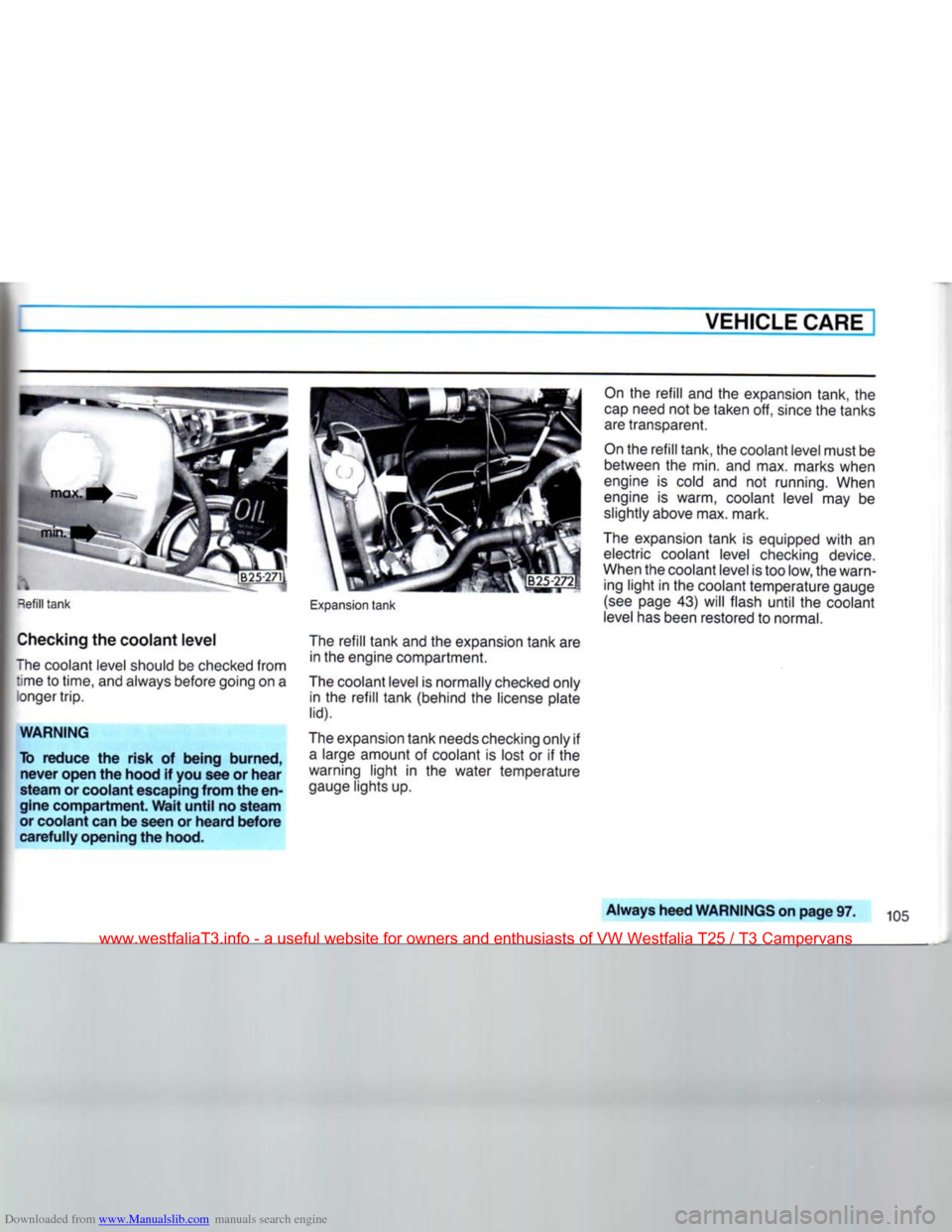
Refill
tank
Checking
the coolant level
The coolant level should
be
checked from time
to
time, and always before going on
a
longer
trip.
WARNING
To
reduce the risk of being burned, never open the hood if you see or hear
steam or coolant
escaping
from the en
gine compartment.
Wait
until
no steam
or
coolant can be seen or heard before
carefully opening the
hood.
Expansion
tank
The refill tank and
the
expansion tank are in
the
engine compartment.
The coolant level
is
normally checked only in
the
refill tank (behind
the
license plate
lid).
The expansion tank needs checking only
if
a
large amount
of
coolant
is
lost
or if the
warning
light
in the
water temperature gauge lights up.
On
the
refill
and the
expansion tank,
the
cap
need
not
be taken
off,
since the tanks
are transparent.
On
the refill tank, the coolant level must
be
between
the
min.
and
max. marks when
engine
is
cold
and not
running. When
engine
is
warm, coolant level
may be
slightly above max. mark.
The expansion tank
is
equipped
with
an
electric coolant level checking device.
When the coolant level is too low, the warn ing
light
in the
coolant temperature gauge
(see
page
43)
will flash
until
the
coolant
level has been restored
to
normal.
Always heed WARNINGS on page 97.
105
www.westfaliaT3.info - a useful website for owners and enthusiasts of VW Westfalia T25 / T3 Campervans
Page 111 of 165
Downloaded from www.Manualslib.com manuals search engine
VEHICLE CARE
Adding
coolant
Turn
off the
engine
and allow it to cool
down.
WARNING
Reduce the
risk
of scalding
from
hot
coolant
by
following
these
steps.
• If the cap
from
the expansion
tank
must
be
removed
wait
until
the
engine
has cooled down. The cooling system
is
under
pressure.
•
Protect
face, hands and
arms
by
covering the cap
with
a
large,
thick
rag
to
protect
against
escaping
fluid
and steam.
•
Carefully
and
slowly
turn
cap one
turn
to
allow
excess pressure to es cape
before
completely
removing
cap.
Top
up coolant in refill tank. Only when
cooling
system was drained or a lot of
cool
ant needs to be added, also
fill
expansion
tank.
To
maintain the anti-corrosion properties of the coolant, the antifreeze concentra
tion should not be reduced, even during
the warm
season.
Increasing
the
antifreeze
in the
coolant
to
more
than
60% is not
only
unecono mical, it is also
detrimental
to
engine
cooling.
Only
use quality phosphate-free anti
freeze
containing ethylene glycol. Such antifreeze is available at your Volkswagen
dealer.
Antifreeze,
other
than
specified by Volks
wagen,
may cause corrosion of the cool ing system,
leading
to
engine
over
heating
and
damage.
Only
for topping-up coolant, a small amount of antifreeze containing ethylene
glycol
and phosphates may be
used,
if rec
ommended antifreeze is not available.
• After adding coolant, run the engine at
idle speed for a few seconds.
• Wait for the radiator fan to switch on
and
off again.
• Check coolant level. Add more coolant
if necessary.
Do
not overfill the system.
Excess
coolant will be forced out through
the pressure relief valve in the reservoir
when the engine becomes hot.
Screw cap on
again
tightly.
Radiator
fan
The
electric radiator fan (located in
fror:
r the car behind grille) is controlled by !':
moswitches
from the coolant and enc
TE
compartment temperature.
After
turning
off the
engine,
the
radiate
fan can
continue
to run (up to 10 r>
nutes).
It may also suddenly
start
to rx
again
even
with
the
ignition
switched
c*
Notes
• If the radiator fan does not come c
when the coolant temperature is very high
check
the fuse and replace it if necessar, - see page 129.
• The speed of the radiator fan does nc
depend
on the engine
speed,
therefore
cooling
effect cannot be increased b.
downshifting. As long as the engine runs smoothly and driving an uphill road does
not considerably reduce
speed,
there is n:
need
to downshift.
Always
heed
WARNINGS
on
page
97.
www.westfaliaT3.info - a useful website for owners and enthusiasts of VW Westfalia T25 / T3 Campervans
Page 112 of 165
Downloaded from www.Manualslib.com manuals search engine
V-BELT
winter operation
I the beginning of the winter season, have the coolant checked for anti-freeze
ecncentration. If you have to add, only use
Hality
phosphate-free anti-freeze con-
ra. ning ethylene glycol which is available
5".
your Volkswagen dealer.
Tie ratio between water and anti-freeze
r-pends
on the anticipated outside temp-
r'atures. Tension checking
Correct V-belt tension is important for over
all vehicle performance.
Tensioning and replacing of vehicle V- belts should be performed by your
Volkswagen dealer or a qualified work shop.
See page 147 for V-belt designation.
WARNING
To prevent personal injury stay well clear of the V-belt when the engine is
running.
Before checking V-belt
ten
sion turn the engine off and let it cool
down.
Hot components can burn skin
on contact.
Always heed WARNINGS on page 97. 107
www.westfaliaT3.info - a useful website for owners and enthusiasts of VW Westfalia T25 / T3 Campervans
Page 117 of 165

Downloaded from www.Manualslib.com manuals search engine
VEHICLE CARE
WINDSHIELD / REAR WINDOW WASHER CONTAINER*
The filler cap is iocated at the left side of the driver's footwell.
Vehicles with rear window wiper and washer have an additional container on
the right in the luggage compartment.
The capacities of the containers are: Windshield washer
container 4.3 qt/4.2 liters Rear window washer
container 1.1 qt/1.0 liters
Filling the containers
To fill the container, unsnap cover and un screw the filler cap. After filling the
con
tainer, screw the cap on tightly and close
cover. Since clear water is usually not adequate
for cleaning the glass, add a cleaning
solu
tion to the water.
Use winterized washer solvent during the
cold season. It helps to keep your
windshield and rear window clean and pre
vents the fluid from freezing in the winter.
Do not use engine coolant antifreeze or
any other solution that can damage the
vehicle paint.
Follow the directions on the can for the
correct amount to be used.
After filling the container press the cap onto the filler neck. Adjusting washer jets
When vehicle is stationary, the wate- should hit the windshield as illustrated.
The washer jet for the rear window shoulc be adjusted so that the fluid hits the glass
in the center of the wiped area.
The jets can be adjusted with a needle.
The jets for the headlight washer system' can only be adjusted with a special
tool.
If necessary contact your Volkswagen
deal
er.
112 * where applicable
www.westfaliaT3.info - a useful website for owners and enthusiasts of VW Westfalia T25 / T3 Campervans
Page 155 of 165

Downloaded from www.Manualslib.com manuals search engine
TECHNICAL DATA
WEIGHTS
The vehicle capacity weight (max. load), the
Gross
Vehicle Weight Rating
(GVWR),
and
the
Gross
Axle Weight Ratings
(GAWR)
for
front
and rear, are listed on the
Safety
Compliance Sticker on the
left
door-
jamb.
The gross vehicle weight rating includes the weight
of the
basic
vehicle plus
full
fuel tank,
oil and
coolant, plus max. load which combines passenger (150 pounds/
68 kg per designated seating position) and luggage weight. Luggage weight
is not
increased
by the use of a
roof rack,
unless
passenger capacity
is
reduced
accordingly.
The gross axle weight rating
is the
maxi mum load
that
can be applied
at
each axle
of the vehicle.
Syncro
When driving off-road,
the
Gross
Vehicle
Weight
(GVWR)
must
be
reduced
by 440
lbs (200 kg).
WARNING
•
The actual
gross
axle
weight
rating
at the
front
and rear axles should not
exceed the permissible weights, and
their
combination must not exceed the
Gross
Vehicle Weight Rating.
•
Exceeding permissible
weight
ratings can result in vehicle damage,
accidents and personal injury.
Note
The vehicle capacity weight figures apply when
the
load
is
distributed evenly
in the
vehicle (passengers
and
luggage). When
transporting
a
heavy load
in the
luggage
compartment,
the
load should be carried
as
near
to
the rear axle as possible so
that
the
vehicle's
handling
is not
impaired.
On no
account should
you
exceed
the
maximum
permissible axle loads
or the
maximum
gross
vehicle weight. Always remember
that
the vehicle's handing
will
be
affected by
the
extra
load,
and
adjust your speed accordingly.
Roof
weights
The maximum permissible roof weight
on
the station wagon
and
kombi
is 220 lb,
100
kg. The
roof luggage rack
on the
campmobile
with
pop-up roof allows only 110 lb/50 kg.
For
more details see page 68.
Maximum permissible
trailer
weights
Braked
trailer 900 kg (2,000 lb.) Unbraked trailer 600 kg (1,3201b.)
Tongue load 75 kg
(
1651b.)
Do not exceed the
weight
limitations of
your
trailer
hitch.
150
www.westfaliaT3.info - a useful website for owners and enthusiasts of VW Westfalia T25 / T3 Campervans
Page 161 of 165

Downloaded from www.Manualslib.com manuals search engine
GAS
STATION
INFORMATION
1 -
Jack
and tools, see page 123.
2
- Windshield washer container, capacity 4.3 qt/4.2 liters.
3
-
Fuse
box, see page 128.
4 - Brake
fluid
reservoir, see page 108.
5
- Spare wheel, see page 124.
6 - Battery, see page 109.
7 -
Fuel
filler neck (rear wheel drive), capacity 16 gal/60 liters.
8 -
Rear
window washer container, capacity 1.1 qt/1.0 liters.
9 -
Fuel
filler neck (syncro), capacity 18.5 gal/70 liters.
10 - Air cleaner, see page 103.
11 - Power steering
fluid
reservoir, see page 103.
12 - Engine oil dipstick/oil filler neck, see page 99.
13
- Coolant
refill
tank, see page 105.
14 - ATF dipstick, see page 102.
157
www.westfaliaT3.info - a useful website for owners and enthusiasts of VW Westfalia T25 / T3 Campervans
Page 162 of 165

Downloaded from www.Manualslib.com manuals search engine
ALPHABETICAL
INDEX
page
Accessories
122
Air
cleaner 103
Air
Conditioner 54 All-wheel-drive 75
Alternator warning
light
44
Ashtrays
64
Assist
handles and coat hooks ... 67
Automatic safety belts 14
Automatic Transmission 35
Automatic Transmission Fluid .... 102 Auxiliary Heater 57, 60
Battery 109
Battery charging 110
Brake
fluid reservoir 108
Brake
warning
light
43
Brakes
29
Break-in
period 69
Bulb
chart 130
Bulb
replacing 130
Buzzer
7,35
Capacities
147
Catalytic
converter 144
Central
locking system 8
Cigarette lighter 63
Child
safety 15
Chime
7,35
Cleaning
products 89
Climate
controls 51
Clock
41 page
Coolant
temperature gauge .... 41
Cooling
system 104
Consumer
information 152
Corrosion
protection 94
Cruise
control 49
Curtains
27
Cup
holder 66
Dashboard
4
Data
146
Defogging/defrosting 52 Differential lock 33
Dimensions
148
Do-it-yourself service 123
Doors
9
Economically
driving 72
Electric
windows 12
Emergency
equipment 70
Emergency
flasher 46
Emergency
starting 136
Emergency
towing 138
Emission
Control System 144
Engine
code letter 151
Engine
compartment lid 97
Engine
cooling 41,104
Engine
exhaust 144
Engine
number 151
Engine
oil changing 100
pace
Engine
oil checking 9?
Engine
oil grades 9E
Expansion
tank 105
Fan
41, 10c
Folding
table 65
Foreign
country driving 120 Front seats 20
Fuel
economy 72
Fuel
gauge 42
Fuel
injection 142
Fuel
supply 86
Fuel
tank 85
Fuses
12E
Gas
Station
Information
156
Gasoline
additives 86
Gearshift lever 32
Glove
compartment 64
Headlight dimmer and flasher .... 48 Headlights 13C
Headlight adjustment 134
Headlight switch 46
Head
restraints 19 HeatingA/entilation 51
High beam 45,48
Horn 4
Identification label and number ... 151
Ignition/steering lock 38
Indicator lights 43
www.westfaliaT3.info - a useful website for owners and enthusiasts of VW Westfalia T25 / T3 Campervans