key VOLKSWAGEN TRANSPORTER 1990 T4 / 4.G Owners Manual
[x] Cancel search | Manufacturer: VOLKSWAGEN, Model Year: 1990, Model line: TRANSPORTER, Model: VOLKSWAGEN TRANSPORTER 1990 T4 / 4.GPages: 165, PDF Size: 24.87 MB
Page 4 of 165
Downloaded from www.Manualslib.com manuals search engine
1
INSTRUMENT PANEL
Illustration instruments and controls
Warning and indicator light symbols
CONTROLS AND EQUIPMENT
Keys,
central locking system .... 7, 8
Doors 9
Rear lid 11
Windows, mirrors 12, 13 Safety belts, head restraints . . . .14,19
Seats 20 Luggage compartment, pedals . 28,29
Brakes, Transmission 29, 32 Differential lock 33
Automatic-transmission 35 Steering lock/ignition/starter switch . 38
Starting procedures 39 Instrument cluster 40
Warning/indicator lights 43 Switches 46 Emergency flasher 46
Light switch, turn signals .... 46,48
Cruise control 49
Windshield wipers 50 Ventilation/Heating 51
Air conditioning 54
Heater 57
Sliding roof 62
Roof-rack 68 VEHICLE OPERATION
Break-in period - and afterwards . . 69
Operate your vehicle safety 70
Operate your vehicle economically
and minimize pollution 72
Trailer towing 73 Driving with the all-wheel drive ... 75
VEHICLE CARE
Fuel tank, fuel supply 85,86
Vehicle care (exterior/interior) . . 90, 93 Maintenance, inspection intervals . . 95 Engine compartment lid,
engine compartment 97 Lubricants, engine oil 98,99
Engine oil filter 101
Transmission oil 102
Power steering 103
Cooling system 104 Brake fluid 108
Battery 109
Windshield washers/wipers . . . 112,113
Tires/wheels 114 Difficult operating conditions .... 120
Winter driving 121
Accessories 122
DO-IT-YOURSELF SERVICE
Jack and tools 123 Spare wheel 124
Changing a wheel 125 Fuses, bulbs 128, 130 Adjusting headlights
134
Installing,
replacing the radio . . . . 135
Emergency starting 136
Emergency towing 138
Lifting vehicle . . 140
TECHNICAL DESCRIPTION
Engine, transmission 142
Steering,
suspension, brakes,
body, chassis 143 Emission-control-system 144
TECHNICAL DATA
Engine, spark plugs .
V-belts capacities . . Dimensions
Weights
Vehicle identification 146
147
148
150 151
CONSUMER INFORMATION
Service manuals 152
GAS STATION INFORMATION
Location of servicing points 156
ALPHABETICAL INDEX 158
www.westfaliaT3.info - a useful website for owners and enthusiasts of VW Westfalia T25 / T3 Campervans
Page 8 of 165
Downloaded from www.Manualslib.com manuals search engine
CONTROLS AND
EQUIPMENT
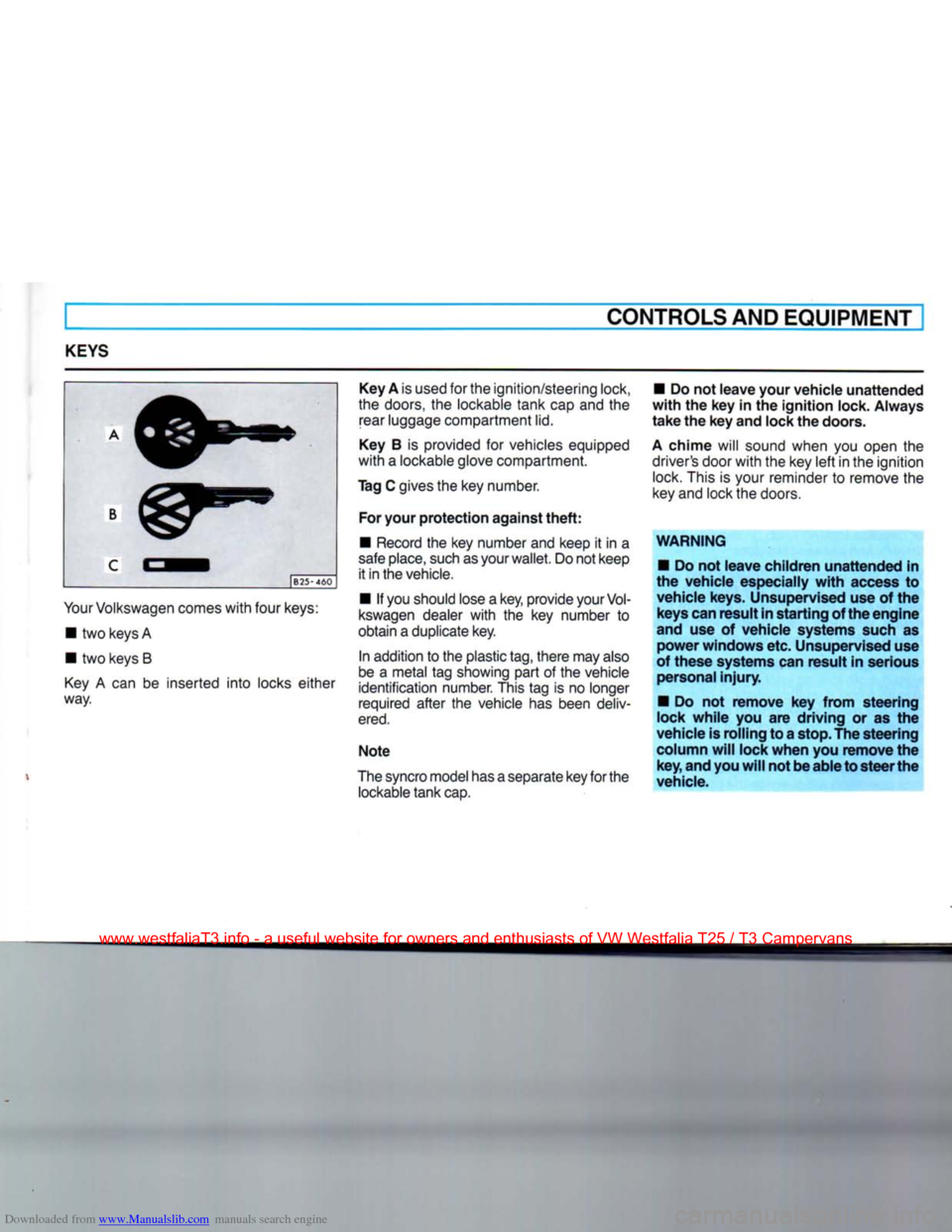
Key A is used for the ignition/steering lock, • Do not
leave
your
vehicle
unattended
the doors, the lockable tank cap and the
with
the key in the
ignition
lock.
Always
rear luggage compartment lid.
take
the key and lock the doors.
KEYS
B25-460
Your
Volkswagen comes
with
four keys: • two keys A
• two keys B
Key
A can be inserted
into
locks either
way. Key B is provided for vehicles equipped
with
a lockable glove compartment.
Tag C gives the key number.
For
your
protection
against
theft:
• Record the key number and keep it in a
safe
place, such as your wallet. Do not keep it in the vehicle.
• If you should lose a key, provide your
Vol
kswagen dealer
with
the key number to
obtain a duplicate key.
In addition to the plastic tag, there may also
be a metal tag snowing part of the vehicle
identification number. This tag is no longer
required after the vehicle has been deliv
ered.
Note
The syncro model has a separate key for the lockable tank cap.
A
chime
will sound when you open the
driver's door
with
the key
left
in the ignition lock. This is your reminder to remove the
key and lock the doors.
WARNING
• Do not
leave
children
unattended
in
the
vehicle
especially
with
access to
vehicle
keys. Unsupervised use of the
keys
can
result
in
starting
of the
engine
and use of
vehicle
systems such as
power
windows
etc. Unsupervised use
of
these
systems can
result
in serious
personal
injury.
• Do not
remove
key
from
steering
lock
while
you are
driving
or as the
vehicle
is
rolling
to a stop. The
steering
column
will
lock
when
you
remove
the key, and you
will
not be
able
to
steer
the
vehicle.
www.westfaliaT3.info - a useful website for owners and enthusiasts of VW Westfalia T25 / T3 Campervans
Page 9 of 165

Downloaded from www.Manualslib.com manuals search engine
CONTROLS AND EQUIPMENT
CENTRAL
LOCKING SYSTEM*
The
central locking system locks or un
locks
doors and rear lid simultaneously. It
is
actuated from the driver's and
passen
ger's
door.
• To lock and unlock from the outside,
turn
key in lock of driver's and passenger's
door.
• To lock and unlock from the inside, raise
or depress locking knob on window sill of
driver's and passenger's door.
When
you unlock the
driver's
and pas senger's door
with
the key
from
the
out
side or
raise
the locking knobs
from
the inside,
wait
until
both
locking knobs are
raised
before
you open one of the doors.
When
the central locking system is ac tuated, both locking knobs on window sills
should
move simultaneously. If one knob
does
not move when locking doors, open
that
particular door and close it properly.
Sliding
door and rear lid can be locked and
unlocked
individually
with
the key; manual lock operation will override the power lock
system.
WARNING
• Locking doors
from
the inside can
help
prevent
inadvertent
door opening
during
an
accident
and
generally
while
the
vehicle
is in
motion.
Locked doors can also
prevent
unwanted
entry
from
the outside.
Locked doors can,
however,
also
delay
assistance to
vehicle
occupants and rescue
from
the
outside
in the
event
of
an
accident
or
other
emergency.
• Do not
leave
children
inside the
vehicle
without
supervision. If locking
knob
in
driver's
and passenger's door is depressed,
both
doors
will
be locked
automatically.
In an
emergency
it
would
be impossible to open the doors
from
outside
without
the key.
Rear
lid • With the key slot in horizontal position
(a), the lid can be locked and unlocked by
the central locking system.
• With key slot in vertical position (b), the
rear lid remains locked when actuating the
central locking system. If the rear lid is closed
with
lock slot in ver
tical position, the luggage compartment
can
only be opened
with
the master key:
• Insert key in lock slot.
• Turn key all the way to the
right
(c) and
hold in this position.
•
Press
lock cylinder in and raise lid.
• Remove key.
'where applicable
www.westfaliaT3.info - a useful website for owners and enthusiasts of VW Westfalia T25 / T3 Campervans
Page 10 of 165

Downloaded from www.Manualslib.com manuals search engine
CONTROLS AND
EQUIPMENT
DOORS
Front
doors
To
lock, unlock and open doors from the outside
• Lock and unlock the
front
doors by
turning the key to the
right
or
left.
• Open the doors by squeezing the trig
ger in the outer door handle.
• The passenger's door can be locked
without
a key. First depress the locking knob, then close the door.
• The driver's door can only be locked
from the outside
with
the key. This precau
tion
was taken to prevent locking the driver's door while the key is still inside the
vehicle.
To
lock, unlock and open doors from the
inside
• To lock doors depress the locking knob.
WARNING
Locking doors
from
the
inside
can
help
prevent
inadvertent
door
opening
dur
ing an
accident
and
generally
while
the
vehicle
is in
motion.
Locked doors can
also
prevent
unwanted
entry
from
the
outside.
Locked doors can,
however,
also
delay
assistance to
vehicle
occupants and rescue
from
the
outside
in the
event
of
an
accident
or
other
emergency.
• To unlock doors raise the locking knob.
•
To
open doors pull the inside door handle
after raising the locking knob.
www.westfaliaT3.info - a useful website for owners and enthusiasts of VW Westfalia T25 / T3 Campervans
Page 11 of 165

Downloaded from www.Manualslib.com manuals search engine
CONTROLS AND
EQUIPMENT
Sliding door
Always
drive
with
a
fully
latched
sliding door.
To
open
from
the
outside
• Unlock the door
with
the key.
• Then press the handle down and slide
the door to the rear. The door is held in the
fully open position by a catch.
WARNING
Make
sure
the
catch
is
fully
engaged.
Otherwise,
the door could slide
for
ward
by
itself
and cause
injury
to en
tering
or
exiting
passengers. To close and lock
from
the
outside
•
Press
the handle down to release the
catch.
Slide the door forward
until
it is
closed.
You can
only
lock and
unlock
the sliding door
from
the
outside
with
the key.
To
open
from
the
inside
• Move the small sliding knob up and pull
the handle back. To close and lock
from
the
inside
• Pull the handle forward to release the
catch,
close the door and move the small
sliding knob down.
In the VANAGON Kombi and VANAGON
Delivery
Van
Cargo
area
Make
sure the cargo compartment floor
area
is loaded correctly, to permit un
obstructed operation of the sliding door.
Do
not transport people in the cargo area.
www.westfaliaT3.info - a useful website for owners and enthusiasts of VW Westfalia T25 / T3 Campervans
Page 12 of 165
![VOLKSWAGEN TRANSPORTER 1990 T4 / 4.G Owners Manual Downloaded from www.Manualslib.com manuals search engine
CONTROLS
AND
EQUIPMENT]
REAR LID
10
unlock the rear lid, use
the
key
A.
•
Insert
key
into vertical lock slot position
and
t](/img/18/7415/w960_7415-11.png "VOLKSWAGEN TRANSPORTER 1990 T4 / 4.G Owners Manual Downloaded from www.Manualslib.com manuals search engine
CONTROLS
AND
EQUIPMENT]
REAR LID
10
unlock the rear lid, use
the
key
A.
•
Insert
key
into vertical lock slot position
and
t")
Downloaded from www.Manualslib.com manuals search engine
CONTROLS
AND
EQUIPMENT]
REAR LID
10
unlock the rear lid, use
the
key
A.
•
Insert
key
into vertical lock slot position
and
turn
to
left.
•
Press lock cylinder
in
and lift lid.
The open hatchback will stay
in
position
at
any desired height.
•
To
close, swing
lid
down.
•
Lock with
key.
Be
careful when loading
or
removing
large objects. Sharp edged articles
may damage the defogger wires in
the
rear window.
For safety reasons keep
the
rear
lid
locked
at
all
times. WARNING
To help
prevent
poisonous exhaust
gas from being drawn into the vehicle,
always keep the rear lid closed while
driving.
Do
not
transport objects larger than
those fitting safely into
the
luggage
area.
www.westfaliaT3.info - a useful website for owners and enthusiasts of VW Westfalia T25 / T3 Campervans
Page 13 of 165

Downloaded from www.Manualslib.com manuals search engine
CONTROLS
AND EQUIPMENT
WINDOWS
Vent windows*
•
To
open,
press
button in latch and turn
the
latch.
•
To
close,
press
vent window
against
seal
and turn latch until button
engages.
Sliding
windows*
To
open,
press
locking
knob down and
slide
window
open.
Door
windows
Lower
and
raise
the windows with the
win
ders
in the
door
panels.
WARNING
Do
not put anything on or near the
windows
that
may
interfere
with
the driver's vision.
~s's
aco'icable
Power windows*
The
window control
switches
are
located
in
the
door
panels.
The right window can
also
be
operated
from the driver's
door
by
a
separate
switch.
The
power
windows work only with the ig
nition
on.
a
- driver's
door
b
- right
door
WARNING
Do
not leave children unattended in the
vehicle especially
with
access
to vehi
cle
keys. Unsupervised use of the keys
can
result in starting of the engine and
use
of vehicle systems such as power
windows, etc. Unsupervised use of
these systems can result in serious per
sonal
injury.
www.westfaliaT3.info - a useful website for owners and enthusiasts of VW Westfalia T25 / T3 Campervans
Page 15 of 165

Downloaded from www.Manualslib.com manuals search engine
CONTROLS
AND
EQUIPMENT
SAFETY
BELTS
WARNING Safety belts have been shown to be the
single most effective means available
for reducing the
potential
for serious in
jury
and death in automobile
acci
dents.
Therefore
for
your
own protec
tion as well as that of
your
passengers always properly wear safety
belts
when
the vehicle is in
motion.
Also, pregnant
women,
injured or physically impaired persons should use safety belts.
In order to provide the maximum level
of protection safety belts must be pro perly positioned on the
body.
Impro
perly positioned safety belts
can
cause
serious personal
injury
in
case
of
an
ac
cident.
Therefore
read and always ob serve all of the following instructions
and warnings pertaining to the use of
the safety belts installed in
your
vehi
cle.
•
The shoulder belt should be
positioned midway
over
the shoulder
never
across the neck. See illustration
on page
17.
•
Always make certain that the safety
belt tongue is inserted into the safety
belt buckle associated with the corres
ponding seat. Attaching the safety belt to the buckle for another seat could re
duce safety belt effectiveness and
cause
injury.
•
Do not wear shoulder part of belt
under
your
arm
or otherwise out of po
sition.
This
would increase the risk of
serious
injury
in case of
an
accident.
•
Do not use comfort clips or devices
which create slack in the shoulder belt portion and can increase the risk of in
jury
in an accident.
However
such clips may be required in the proper use of
some
child restraint systems.
•
Never
strap in more than one per
son,
including
small
children, with
each
belt. It is especially dangerous to
place
a safety belt
over
a child sitting
on
your
lap.
•
The lap belt must be
worn
low and
tight across the pelvis. Make sure any
slack
is wound on the retractor.
•
Belts should not be
worn
twisted.
•
Do not wear belts
over
rigid or
breakable
objects in or on
your
clothing,
such as eye glasses, pens,
keys,
etc. as these may cause
injury.
•
Several layers of
heavy
clothing
may
interfere with proper positioning of
belts
and reduce the
over
all effective
ness
of the system.
•
Keep belt buckles free of any
obstruction that may
prevent
secure
locking.
•
Make sure the belts of the unoc
cupied seats are in their stowed posi
tions.
•
Belts that have been subjected to
excessive stretch forces in
an
accident must be replaced.
•
Belts must not rub against sharp
objects.
•
Do not allow safety belts to become
damaged
by becoming caught in door
or seat hardware.
•
Inspect
your
belts periodically. If
belts
show damage to webbing, bind
ings,
buckles or retractors,
they
must
be replaced.
•
If belts do not work properly, see
your
Volkswagen dealer.
www.westfaliaT3.info - a useful website for owners and enthusiasts of VW Westfalia T25 / T3 Campervans
Page 38 of 165
Downloaded from www.Manualslib.com manuals search engine
CONTROLS
AND
EQUIPMENT
•
Never shift into Reverse (R) or Park
(P) when the vehicle is in motion.
•
Do not remove the key from the ig
nition steering lock until you have
parked the vehicle, because removal
of the key
will
lock the steering wheel.
•
If the selector lever is unintention
ally moved into Neutral (N)
while
driv
ing,
take
your foot off the accelerator pedal and
wait
until the engine speed
has
dropped to idling before selecting
a driving position.
Maneuvering
•'/hen
alternating between forward and
-averse
- for
instance,
while
maneuvering
ne
vehicle
into a tight parking
space
-
:nly
shift when the
vehicle
has
come
to a
full stop and the
engine
is running at idle
soeed.
Stuck
in snow, mud or sand
When
alternating between forward and
reverse
in an effort to free the
vehicle,
depress
the
accelerator
pedal
slightly
while
the
transmission
is in
gear,
and
release
the
accelerator
pedal
while
shifting.
Do not
race
the
engine
and
avoid
spinning
the
wheels.
Do not repeat
"rocking"
back and
forth
with
wheels
spinning
at high engine speed and heavy
throttle,
as serious damage may
be caused to the automatic transmis
sion
and other critical parts.
Kickdown
device
The
kickdown
device
gives
maximum
acceleration
when the
accelerator
pedal
is
pressed
down
past
the full throttle
posi
tion.
Depending
on
road
speed
and
engine
speed,
either the upshift is
delayed
(forced
throttle) or the box
changes
down
into
the next lower
gear.
WARNING
Be
careful when using the kickdown on
slippery
roads. Rapid acceleration may
cause
skidding.
Stopping
•
When
stopping briefly, at a traffic light
for
example,
it is not
necessary
to
move
the
selector
lever
to
Neutral.
Simply
apply
the
brakes.
To start
again
release
brake
and
accelerate.
•
The driving
positions
must
never
be
used
for holding the
vehicle
at rest
uphill.
Always
use your foot
brakes
when
stopped
on
inclines.
WARNING
•
Never get out of the driver's seat
when the engine is running and the
selector
lever is not securely locked in
the P position.
•
If you must leave the vehicle move
the selector lever securely into the P
position
and apply parking brake
firmly.
Towing
To
tow the
vehicle
see instructions
"Emergency
towing" on
page
138.
www.westfaliaT3.info - a useful website for owners and enthusiasts of VW Westfalia T25 / T3 Campervans
Page 39 of 165
Downloaded from www.Manualslib.com manuals search engine
CONTROLS AND EQUIPMENT
STEERING LOCK/IGNITION/STARTER
SWITCH
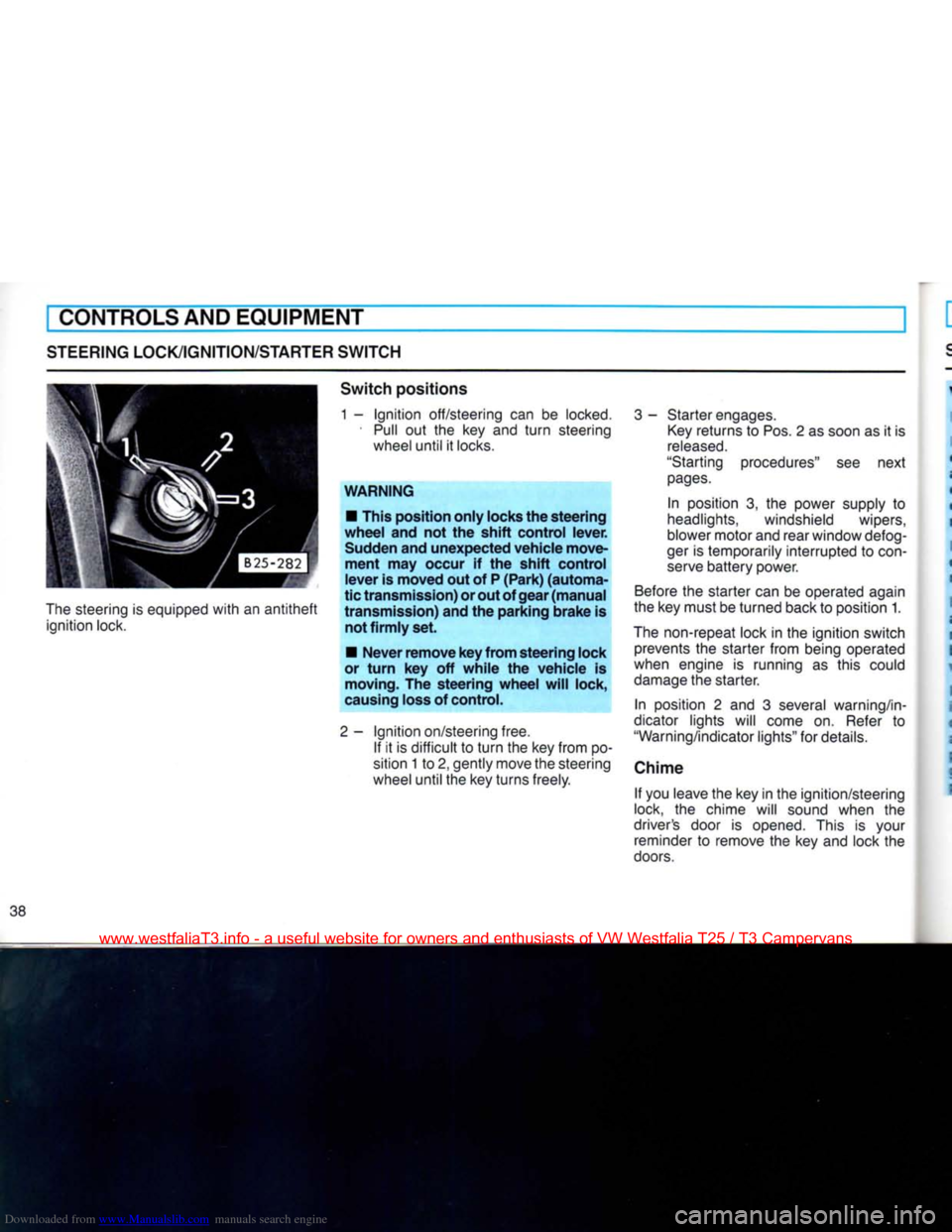
The
steering is equipped
with
an
antitheft
ignition lock.
Switch
positions
1 -
Ignition
off/steering can be
locked.
•
Pull
out the key and
turn
steering wheel until it
locks.
WARNING
• This position
only
locks the
steering
wheel
and not the
shift
control
lever.
Sudden and
unexpected
vehicle
move
ment
may occur if the
shift
control
lever
is
moved
out of P
(Park)
(automa
tic
transmission)
or out of
gear
(manual
transmission)
and the
parking
brake
is not
firmly
set.
•
Never
remove
key
from
steering
lock
or
turn
key off
while
the
vehicle
is moving. The
steering
wheel
will
lock,
causing loss of control.
2-
Ignition
on/steering free. If it is difficult to
turn
the key from po
sition 1 to 2, gently move the steering
wheel until the key turns freely.
3
- Starter engages.
Key
returns to Pos. 2 as soon as it is
released.
"Starting procedures" see next
pages.
In position 3, the power supply to
headlights, windshield wipers,
blower motor and rear window defog-
ger
is temporarily interrupted to
con
serve
battery power.
Before
the starter can be operated again
the key must be turned back to position 1.
The
non-repeat lock in the ignition switch prevents the starter from being operated
when engine is running as this could
damage
the starter.
In position 2 and 3 several warning/in
dicator lights will come on.
Refer
to
"Warning/indicator lights" for details.
Chime If you leave the key in the ignition/steering
lock, the chime will sound when the
driver's door is opened. This is your reminder to remove the key and lock the
doors.
www.westfaliaT3.info - a useful website for owners and enthusiasts of VW Westfalia T25 / T3 Campervans