check engine VOLKSWAGEN TRANSPORTER 1990 T4 / 4.G Owner's Manual
[x] Cancel search | Manufacturer: VOLKSWAGEN, Model Year: 1990, Model line: TRANSPORTER, Model: VOLKSWAGEN TRANSPORTER 1990 T4 / 4.GPages: 165, PDF Size: 24.87 MB
Page 74 of 165
Downloaded from www.Manualslib.com manuals search engine
iLER TOWING
VEHICLE OPERATION
phLT .'jlkswagen was primarily designed
pr : assenger transportation. If you plan to
m*
B.
trailer you should be mindful that
MLT
:ar will be performing a service it was
•cr "tended for. The additional load will
Wee durability and economy of per-
m~ ance. • :. :ow a trailer, your Volkswagen may
mc. -9 more frequent maintenance due to
ft* extra
load.
Gc not tow a trailer during the break-in kriod of your vehicle.
Keep an eye on your coolant tempera-
fere gauge. If coolant temperature warn- rc light comes on pull off the road to a sa's place to allow engine to cool down.
Maximum trailer weight
A vailer for your vehicle is limited to a
typi-
ca class I trailer. The maximum gross
Bier weight and the tongue load must not
eoeed the specifications listed in the
[fechnical Information/Data section of this
ranual.
Do not exceed the gross vehicle weight
•rhich is the weight of the driver, passen ger, luggage, trailer hitch and tongue
weight of the loaded trailer. Trailer hitch
Use a weight-carrying hitch conforming to
the gross trailer weight. The hitch must be suitable for your vehicle and trailer and
securely bolted to the body. Always check
with the trailer hitch manufacturer to make
sure that you are using the correct hitch. Do not use a bumper hitch.
The hitch must be installed in a way not to interfere with the impact-absorbing
bumper system. No modifications should
be made to the vehicle exhaust and brake
systems. From time to time check that all hitch mounting bolts remain securely fas
tened.
If not towing a trailer for a long period of
time,
remove the trailer hitch. This pre
vents the hitch from causing damage should your vehicle be struck from behind.
When removing the trailer hitch, seal all bolt holes to prevent water and exhaust
fumes from entering the vehicle.
Trailer brakes If your trailer is equipped with a braking
system,
check to be sure that it conforms
to all regulations.
The trailer brake system must not be di rectly connected to the vehicle's brake sys
tem.
Tire pressure
When towing a trailer, inflate the tires of
your vehicle to the cold tire pressure listed on the label on the left front door jamb. In
flate trailer tires to trailer and tire manufac
turer's specifications.
Safety chains
Always use safety chains between your car and trailer.
Trailer lights
Trailer lights must meet all regulations. Do not connect the trailer light system directly
to the light system of your vehicle. Be sure
to check with your Volkswagen dealer for
correct wiring, switches and relays.
Before you tow a trailer
Correct and even load distribution. All ob
jects inside the trailer should be held securely in place to guard against shifting, be it forward, backward or sideways.
Never allow a passenger in a moving
trailer.
www.westfaliaT3.info - a useful website for owners and enthusiasts of VW Westfalia T25 / T3 Campervans
Page 75 of 165
Downloaded from www.Manualslib.com manuals search engine
VEHICLE OPERATION
For
best roadability adjust your load to the
maximum allowed tongue load. To be sure
measure
tongue load of loaded trailer on
bathroom
scales.
Check
that
both sides of your trailer can be
seen
from the driver's seat. If necessary in
stall extended rear-view mirrors.
Check
proper working of vehicle and
trailer lights.
Check
cold
tire
pressure of both vehicle
and
trailer.
Be
sure trailer safety chains are properly
connected
from trailer to the hitch on the
vehicle.
Leave enough slack in the chains
to permit turning corners.
Trailer
towing
tips
Your
vehicle handles differently when tow ing a trailer because of the additional
weight. Safety, performance and economy
will greatly depend on how carefully you
load
your trailer and operate your "rig."
Before
you actually tow your trailer, prac
tice turning, stopping and reversing in an
area
away from
traffic
until
you learn the
feel of your vehicle and trailer
unit.
Reversing
is
difficult
and requires practice.
Steering
while reversing is generally oppo
site of
that
when backing your vehicle with
out a trailer.
Observe
speed limits. In some areas
speeds
for vehicles towing trailers are lower than for regular vehicles.
Maintain a greater distance between your
vehicle
and the one in
front.
You will need more room to stop.
When
passing remember
that
you cannot
accelerate
as fast as you normally would
because
of the added load. Make sure you
have
enough room to
pass.
After passing
allow plenty of room for your trailer before
changing
lanes again.
Avoid
jerky starts or sudden acceleration.
Slow
down in crosswinds and on rougi"
roads.
Be especially carefull when
pas
sing
other vehicles and trucks.
When
parking always block the wheels o: both vehicle and trailer. Do not park
with
a
trailer on a slope. If it cannot be avoided dc
so
only after the following:
• Apply brakes.
• Have someone place wheel blocks
under both vehicle and trailer wheels.
• With wheel blocks in place slowly re
lease
brakes
until
wheel blocks absorb the
load.
• Apply parking brake.
•
Place
transmission in
"P"
for automatic
or in
first
or reverse gear for manual trans
mission.
74
www.westfaliaT3.info - a useful website for owners and enthusiasts of VW Westfalia T25 / T3 Campervans
Page 79 of 165
Downloaded from www.Manualslib.com manuals search engine
VEHICLE OPERATION
Advantages off the all-wheel drive
The Vanagon/Transporter Syncro
all-
wheel drive system
has the
following
ad
vantages over
a
two-wheel drive vehicle:
Driving Power
Driving Power
is
greatly increased
by the
continual all-wheel drive especially
on
snow
and
slippery surfaces, when starting
off from
a
standstill,
and
when driving
on
rough roads.
Within reason, your Vanagon/Transporter Syncro
can go
places where other
vehi
cles
may
likely
get
stuck.
It is
easier
to
stop
on slippery hills
and get
going again.
Moving Force
As
the
driving force applied
to the
road goes
to
four wheels instead
of two, the
amount
of
slip
is
considerably reduced.
This improves
the
traction between tire and road surface
and
thereby,
the
drive-
ability
on
slippery road surfaces. On vehicles with two-wheel drive,
the
driv
ing wheels
can
spin
on
slippery surfaces
if
too much acceleration
is
applied. This
greatly reduces tire grip
and can
result
in
loss
of
vehicle control.
By distributing
the
driving forces
to
four
in
stead
of two
wheels,
the
wheels
of the
Va nagon/Transporter Syncro
are
less likely
to spin under
the
same conditions.
Snow tires
With
the
all-wheel drive system
the
Vana gon/Transporter Syncro
is
good
for
winter
driving even with standard tires. However,
we recommend
the use of all
season tires
or radial snow tires (M
+
S) with
or
without
studs*,
on all
wheels,
for
better driving,
cornering
and
braking,
in
winter weather.
Details under "Snow tires"
on
page
118
also apply.
Snow chains
Snow chains can improve both road traction
and braking when driving
in
severe winter
weather. Therefore,
use
snow chains
on
your all-wheel drive vehicle when required. For additional information,
see
page
119.
Operation
In contrast
to
conventional all-wheel drive
systems that require transmissions
to be
manually engaged when needed,
the Va
nagon/Transporter Syncro all-wheel drive
system
is
always engaged. Only
the
amount
of
power being transmitted
to the
front
and
rear wheels changes automati cally
as the
road surface demands.
The
Syncro driver
is
therefore able
to
fully
con
centrate
on the
road and traffic conditions.
The differential lock*
for the
rear axle must only
be
used when
the
vehicle
is
stuck
or
in immediate danger
of
becoming stuck. For further information
on the
differential
lock,
see
page
33.
78 "Check with your local Motor Vehicle Bureau
for
possible restrictions.
'where applicable
www.westfaliaT3.info - a useful website for owners and enthusiasts of VW Westfalia T25 / T3 Campervans
Page 88 of 165
Downloaded from www.Manualslib.com manuals search engine VEHICLE OPERATION
iVater
•
Exercise
extreme caution when driving
T'ough water. Driving
into
unfamiliar
a:er
can be dangerous. Always check
~e
depth before attempting to make a
possing.
7,'ading depth - see page 149).
Vi nen it is necessary to drive through deep ater, shift
into
low gear and maintain a
ready
and slow
speed.
Engage differen-
:=] lock* (see page 33).
Be
very careful about stopping broadside
r a stream of running water as the tre-
-endous
force of the water against the
flat
; de of the vehicle could cause it be swept :ownstream
with
the current. With even only a few inches of water run
ning,
do not stop if you are on an unpaved
surface.
Moving water may wash the
foot
ing out from under your tires and make it
impossible
for you to get moving again.
When
reaching dry ground, your wet
brakes
may have very
little
braking power.
Help
dry your brakes out by riding your
brakes
for a short distance to avoid losing
control and personal
injury.
www.westfaliaT3.info - a useful website for owners and enthusiasts of VW Westfalia T25 / T3 Campervans
Page 89 of 165
Downloaded from www.Manualslib.com manuals search engine
VEHICLE OPERATION
After driving over
difficult
terrain,
espe
cially through water or mud, the following
is
important:
• Disengage the differential lock*.
• After long drives through deep mud, the
brakes must be checked and cleaned if
they are
dirty.
This will prevent damage to
the brakes and premature wear.
• After driving through deep water, take
out oil dipstick and check to see whether
there are drops of water on the dipstick or if the oil level has risen. In
that
case,
the oil
must be changed immediately.
• If during an off-road drive the vehicle
has
become stuck (dug its way
into
the
ground) or the underside was stuck by
rocks
or similar, check undercarriage,
brake lines and oil pan for damage. • The engine compartment and vehicle
underbody must be cleaned if they are
very
dirty
so
that
the function of all mova ble and electrical/electronic parts is main
tained.
•
Clean
heavy soil from wheels and tires,
check
tires for damage or foreign objects in treads.
•
Clean
turn
signals, lights and license
plate.
• Dry brake system by driving a short dis
tance
with
brake pedal slightly depressed.
This
will help regaining normal braking ac
tion
and help prevent the possibility of the
vehicle pulling to one side while braking.
Performance
testing
If the
Vanagon/Transporter
Syncro re
quires
testing
on a
dynamometer
(en
gine
output
analysis and
brake
test)
the
transaxle
drive
shaft
must
be discon nected.
The
differential
lock
must
not be en gaged.
84 "where applicable
www.westfaliaT3.info - a useful website for owners and enthusiasts of VW Westfalia T25 / T3 Campervans
Page 101 of 165
Downloaded from www.Manualslib.com manuals search engine
VEHICLE CARE
Important
Consideration
for you and your car:
A
thorough and detailed preventive maintenance schedule has been de
veloped
for your vehicle, which if followed
should
help assure you of years of reliable
and
dependable use. We strongly urge
you to give your dealer the opportunity to perform all scheduled maintenance and
necessary
repairs. He has the facilities,
original parts and trained specialists to
keep
your car running properly.
The
increasing use of electronics, sophisti
cated
fuel injection and emission control
systems
together
with
the generally in
creasing
technical complexity of today's automobiles has steadily reduced the
scope
of maintenance and repairs which
can
be carried out by vehicle owners.
Maintenance,
adjustments and repairs
usually
require special tools, testing de
vices
and other equipment by specially
trained workshop personnel in order to as
sure
proper performance, reliability and
safety of the vehicle and its many
sys
tems.
Improper maintenance, adjust ments and repairs can impair the opera
tion and reliability of your car and even
void your vehicle warranty. Above all oper ational safety can be adversely affected
creating unnecessary risks for vehicle oc
cupants and others.
This
section describes a limited number of
procedures
which can be performed upon
your vehicle
with
ordinary tools, should the
need
arise and trained personnel be un
available.
Before performing any of these
procedures,
always thoroughly read all of
the applicable
text
and carefully follow the instructions given. Always rigorously ob
serve
the
WARNINGS
provided.
WARNING
Serious personal
injury
may occur as a
result
of
improperly
performed
main
tenance,
adjustments
or
repairs.
• The
engine
compartment
of any
motor
vehicle
is a
potentially
hazard
ous
area.
• Do not
attempt
any of the
mainten
ance, checks or
repairs
described on
the
following
pages if you are not
fully
familiar
with
these
or
other
procedures
with
respect
to the vehicle, or are un
certain
as to how to proceed.
Have
the necessary
work
done
by your Volks
wagen
dealer
or any
other
properly
equipped
and
qualified
workshop.
•
Always support
your
vehicle
with
safety
stands if it is necessary to
work
underneath
the vehicle. The
jack
supplied
with
the
vehicle
is not
adequate
for
this
purpose. • If you
must
work
underneath
the . =-
hide
without
safety
stands but
with
t--t
wheels
on the ground,
always
ma-: sure the
vehicle
is on
level
ground, tr:
the
wheels
are
always
securely bloc ed and
that
the
engine
cannot
•
started.
Always
remove
the
ignitio-
key.
•
Always
be
extremely
careful
whe-
working
on the vehicle.
Always
folic commonly accepted
safety
practice*
and
general
common sense.
Never
ris• personal
injury.
Note
Incomplete or improper servicing ri
cause
problems in the operation of the r-
hicle
and may reduce or eliminate y;.
warranty coverage. If in doubt about a-
servicing,
have it done by your
Volks/
E-
gen
dealer or any other properly equips
and
qualified workshop.
www.westfaliaT3.info - a useful website for owners and enthusiasts of VW Westfalia T25 / T3 Campervans
Page 102 of 165
Downloaded from www.Manualslib.com manuals search engine
VEHICLE
CARE
ENGINE
COMPARTMENT LID
mu
have access to the engine compart-
•Mit
lid from inside the luggage compart- -ent.
"lb
open the
lid,
roll the floor covering out of
~9
way and
turn
both lock handles to the
Tb close the lid, reverse the above proce- ;jre.
ENGINE
COMPARTMENT
Always exercise extreme caution when
working on the engine. WARNING
•
Before you check anything in the en
gine compartment, stop the engine,
fully set the parking brake and remove
the ignition key.
•
Do not work on
your
car if you are
tired or ill, under emotional stress or under influence of drugs, medication
or alcohol.
•
Always let the engine cool down. Hot
components will burn skin on contact.
•
Do not spill engine oil, ATF, brake
fluid,
antifreeze and washer solvent on hot engine components, especially not
on the exhaust system.
These
fluids
are
flammable.
•
Always disconnect the battery
ground strap if you must work on the
fuel
system or the electrical system.
Never
smoke or work near heaters or
other fire hazards if you must work
around
fuel.
Always keep an approved
fire extinguisher immediately
avail
able.
Be
especially careful if engine is run
ning:
•
If work must be done with the engine
running, always fully set the parking
brake,
and make sure the shift lever is
in Neutral (Manual transmission) or
Park
(Automatic transmission).
•
Always be alert and extremely
cau
tious around the engine at
all
times par
ticularly when the engine is running.
•
Always exercise extreme caution to
prevent
neckties,
jewelry,
long hair or
loose clothing from getting caught in
the fan blades, the V-belts, or any other
moving
engine parts.
•
To avoid electrical shock and per
sonal
injury
never
touch ignition ca
bles
or components of the high voltage
electronic ignition system while the en
gine is running or even when starter is
cranked.
97
www.westfaliaT3.info - a useful website for owners and enthusiasts of VW Westfalia T25 / T3 Campervans
Page 104 of 165
Downloaded from www.Manualslib.com manuals search engine
VEHICLE CARE
ENGINE OIL
Engine oil consumption t 3 normal for your engine to consume oil.
T-Q
rate of oil consumption depends on
re quality and viscosity of
oil,
the speed at
Mich
the engine is operated, the climate,
read
conditions as well as the amount of : ution and oxidation of the lubricant.
Because
of these variables, no standard
•e:e
of oil consumption can be esta-
:
shed,
but drivers should expect an in
creased
oil consumption at high speeds
s.nd when the engine is new.
• The
engine
in your
vehicle
depends
on oil to
lubricate
and cool all of its
mov
ing
parts.
Therefore
the
engine
oil
should be checked
regularly
and
kept
at
the
required
level.
•
Make
it a
habit
to
have
the
engine
oil
level
checked
with
every
fuel
filling.
• Lack of
sufficient
engine
oil may
lead
to
severe
engine
damage.
• The oil pressure
warning
light
is not
an oil
level
indicator.
Always
heed
WARNINGS
on
page
97.
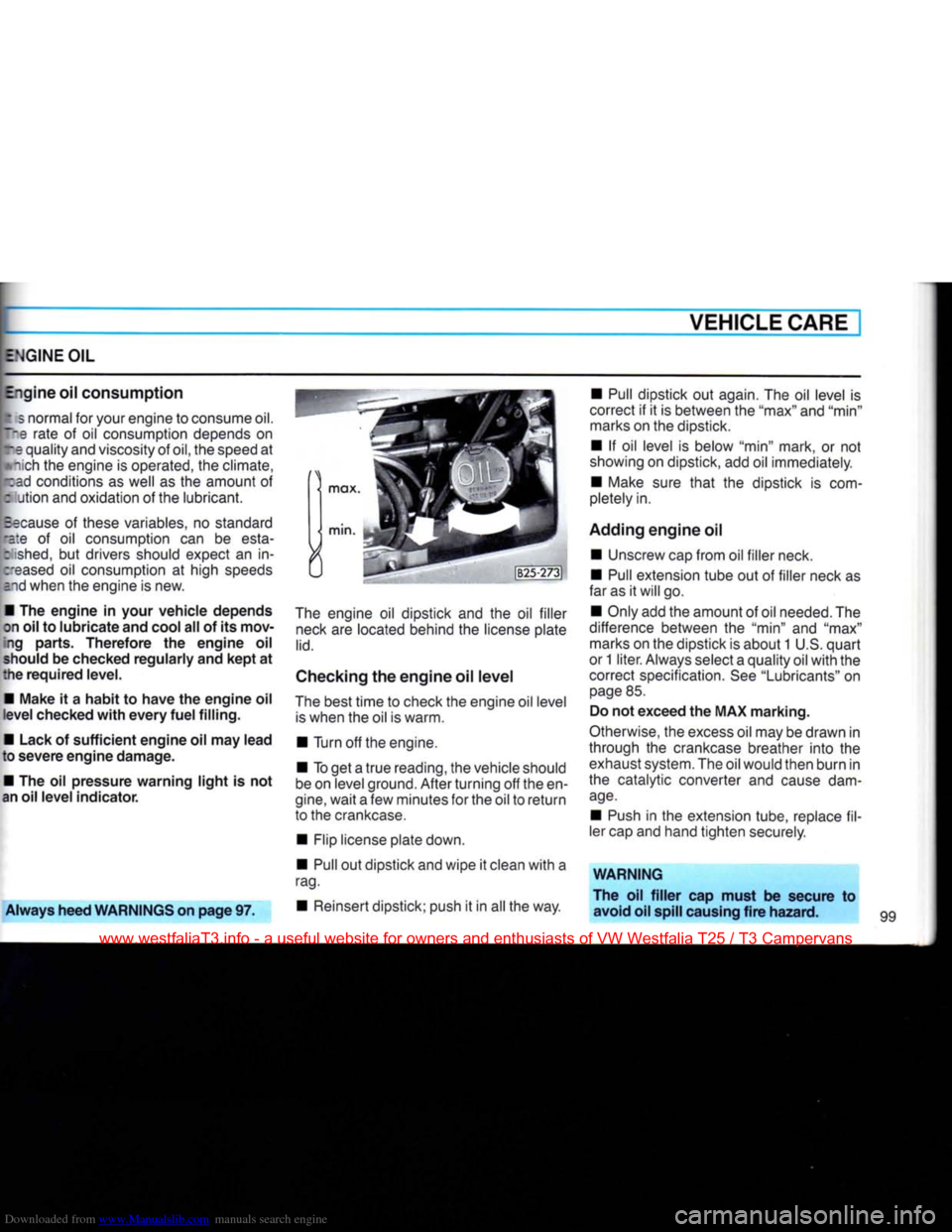
The
engine oil dipstick and the oil filler
neck
are located behind the license plate
lid.
Checking the
engine
oil
level
The
best time to check the engine oil level
is
when the oil is warm.
• Turn off the engine.
• To get a true reading, the vehicle should
be
on level ground. After turning off the en
gine,
wait a few minutes for the oil to return
to the crankcase.
• Flip license plate down.
• Pull out dipstick and wipe it clean
with
a
rag.
• Reinsert dipstick; push it in all the way. • Pull dipstick out again. The oil level is
correct if it is between the "max" and "min" marks on the dipstick.
• If oil level is below "min" mark, or not
showing on dipstick, add oil immediately.
• Make sure
that
the dipstick is com
pletely in.
Adding
engine
oil • Unscrew cap from oil filler neck.
• Pull extension tube out of filler neck as
far as it will go.
• Only add the amount of oil needed. The
difference between the "min" and "max" marks on the dipstick is about
1
U.S. quart
or
1
liter. Always select a quality oil
with
the
correct specification. See "Lubricants" on
page
85.
Do not exceed the MAX
marking.
Otherwise,
the excess oil may be drawn in
through the crankcase breather into the exhaust system. The oil would then burn in
the catalytic converter and cause dam
age.
•
Push
in the extension tube, replace fil
ler cap and hand tighten securely.
WARNING
The oil
filler
cap
must
be secure to avoid oil spill causing
fire
hazard.
www.westfaliaT3.info - a useful website for owners and enthusiasts of VW Westfalia T25 / T3 Campervans
Page 105 of 165
Downloaded from www.Manualslib.com manuals search engine
VEHICLE CARE
Changing the
engine
oil
Have
your engine oil changed regularly,
but at least twice a year (see Maintenance
booklet).
This
is very important because the lubri cating properties of oil diminish gradually
during normal operation of the vehicle.
If you drive mostly short distances, or if
you operate the vehicle in dusty
areas,
or under predominantly stop-and-go traffic
conditions, or when temperatures remain below freezing for extended periods, the
engine oil should be changed more fre
quently.
Due
to the detergent additives in the oil,
the fresh oil will look dark after the engine
has
been running for a short time. This is
normal and there is no reason to change
the oil more often than recommended by
the manufacturer.
Always
heed
WARNINGS
on
page
96
100 and97-
WARNING
•
Drain
the oil
into
a
container
that
is
designed for
this
purpose, one
that
is
large
enough to hold at
least
the oil
filling
of your
engine.
•
Wear
eye
protection.
• To
reduce
the
risk
of burns
from
hot
engine
oil let the
engine
cool
down
to
the touch.
•
When
removing
the oil
drain
plug
with
your fingers,
keep
as far
away
as possible.
Always
keep
your
forearm
parallel
to the ground to
help
prevent
hot oil
from
running
down
your arm.
• Engine oil is poisonous. Keep it
well
out of the
reach
of children. Con
tinuous
contact
with
used
engine
oil is
harmful
to your skin.
Always
protect
your skin by
washing
thoroughly
with
soap and
water.
•
Always
dispose of used
engine
oil
properly.
Do not
dump
it on
garden
soil,
wooded
areas,
into
open
streams
or
down
sewage
drains.
• Recycle used
engine
oil by
taking
it to
a used
engine
oil collection
facility
in
your
area,
or
contact
a service
station.
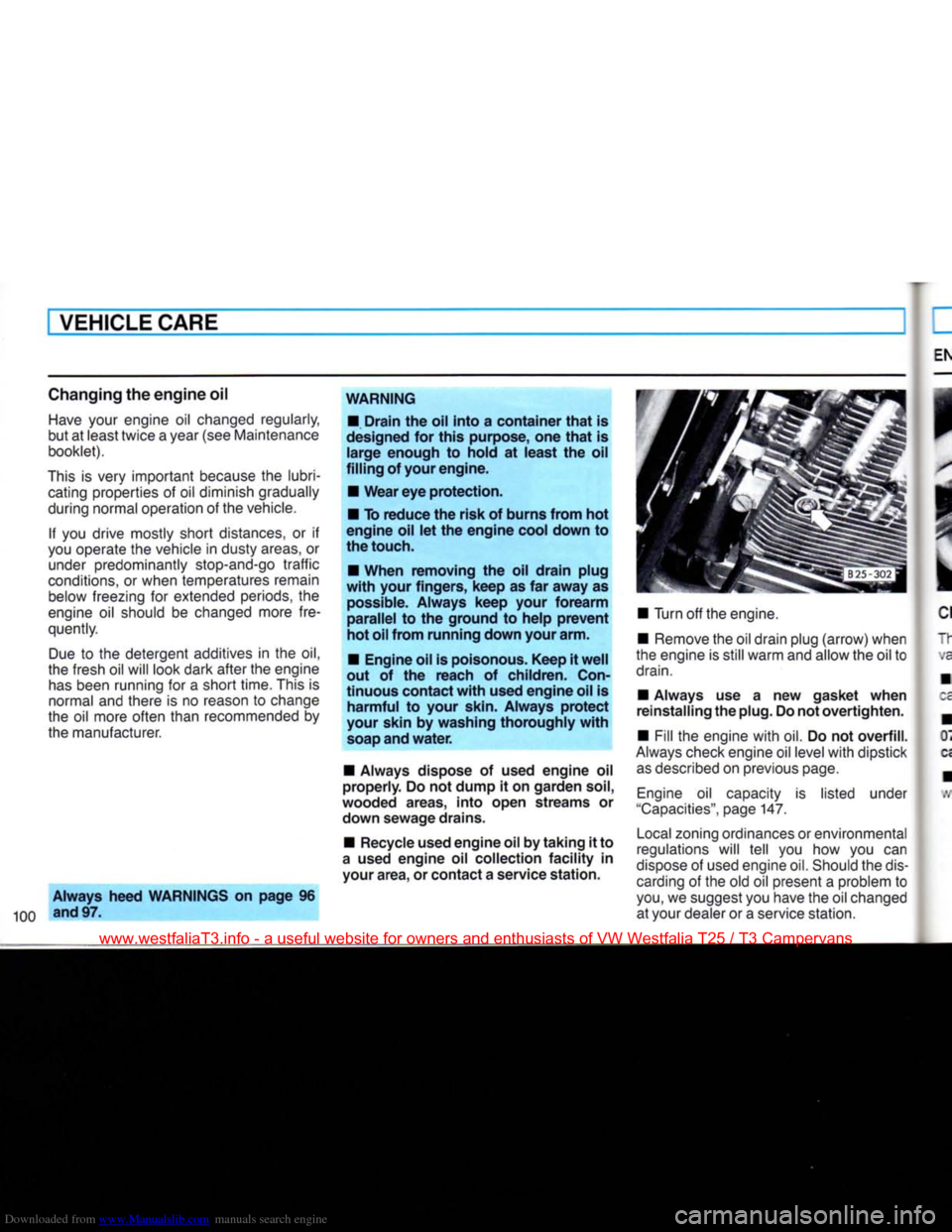
• Turn off the engine.
• Remove the oil drain plug (arrow) when
the engine is still warm and allow the oil to
drain.
•
Always
use a new
gasket
when
reinstalling
the plug. Do not
overtighten.
•
Fill
the engine
with
oil. Do not
overfill.
Always
check engine oil level
with
dipstick
as
described on previous page.
Engine
oil capacity is listed under
"Capacities",
page 147.
Local
zoning ordinances or environmental
regulations will tell you how you can
dispose
of used engine oil. Should the dis carding of the old oil present a problem to
you,
we suggest you have the oil changed
at your dealer or a service station.
www.westfaliaT3.info - a useful website for owners and enthusiasts of VW Westfalia T25 / T3 Campervans
Page 106 of 165
Downloaded from www.Manualslib.com manuals search engine
VEHICLE CARE
ENGINE OIL FILTER
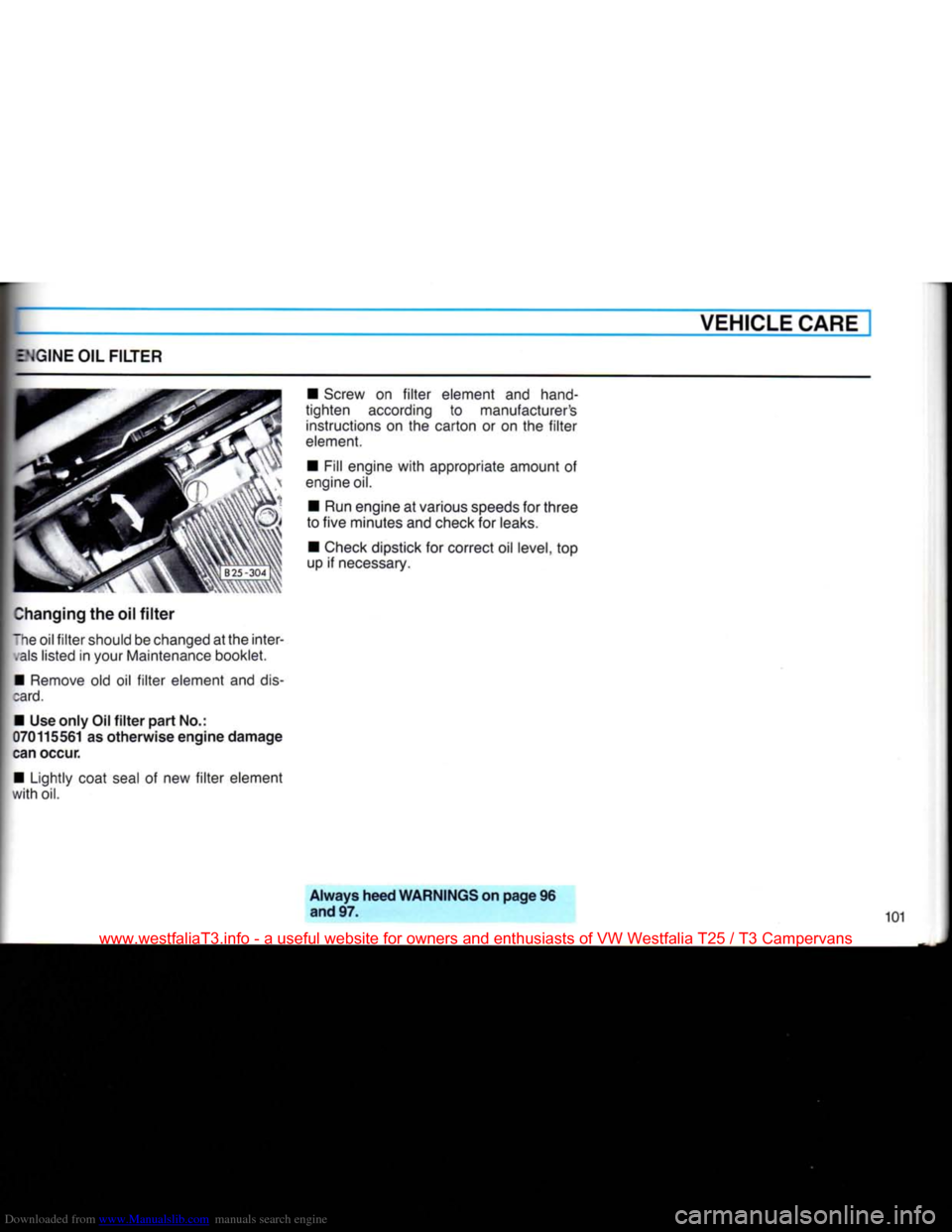
: he oil
filter
should be changed at the inter-
,als
listed in your Maintenance booklet.
• Remove old oil
filter
element and dis
card.
• Use
only
Oil
filter
part
No.:
070115561
as
otherwise
engine
damage
can occur.
• Lightly coat seal of new
filter
element
with
oil. • Screw on
filter
element and hand-
tighten according to manufacturer's instructions on the carton or on the
filter
element.
• Fill engine
with
appropriate amount of
engine oil.
• Run engine at various speeds for three
to five minutes and check for leaks.
• Check dipstick for correct oil level, top
up if necessary.
Always
heed
WARNINGS
on
page
96 and 97. 101
www.westfaliaT3.info - a useful website for owners and enthusiasts of VW Westfalia T25 / T3 Campervans