check engine VOLKSWAGEN TRANSPORTER 1990 T4 / 4.G Owner's Guide
[x] Cancel search | Manufacturer: VOLKSWAGEN, Model Year: 1990, Model line: TRANSPORTER, Model: VOLKSWAGEN TRANSPORTER 1990 T4 / 4.GPages: 165, PDF Size: 24.87 MB
Page 107 of 165
Downloaded from www.Manualslib.com manuals search engine
VEHICLE CARE
AUTOMATIC TRANSMISSION FLUID / MANUAL TRANSMISSION OIL
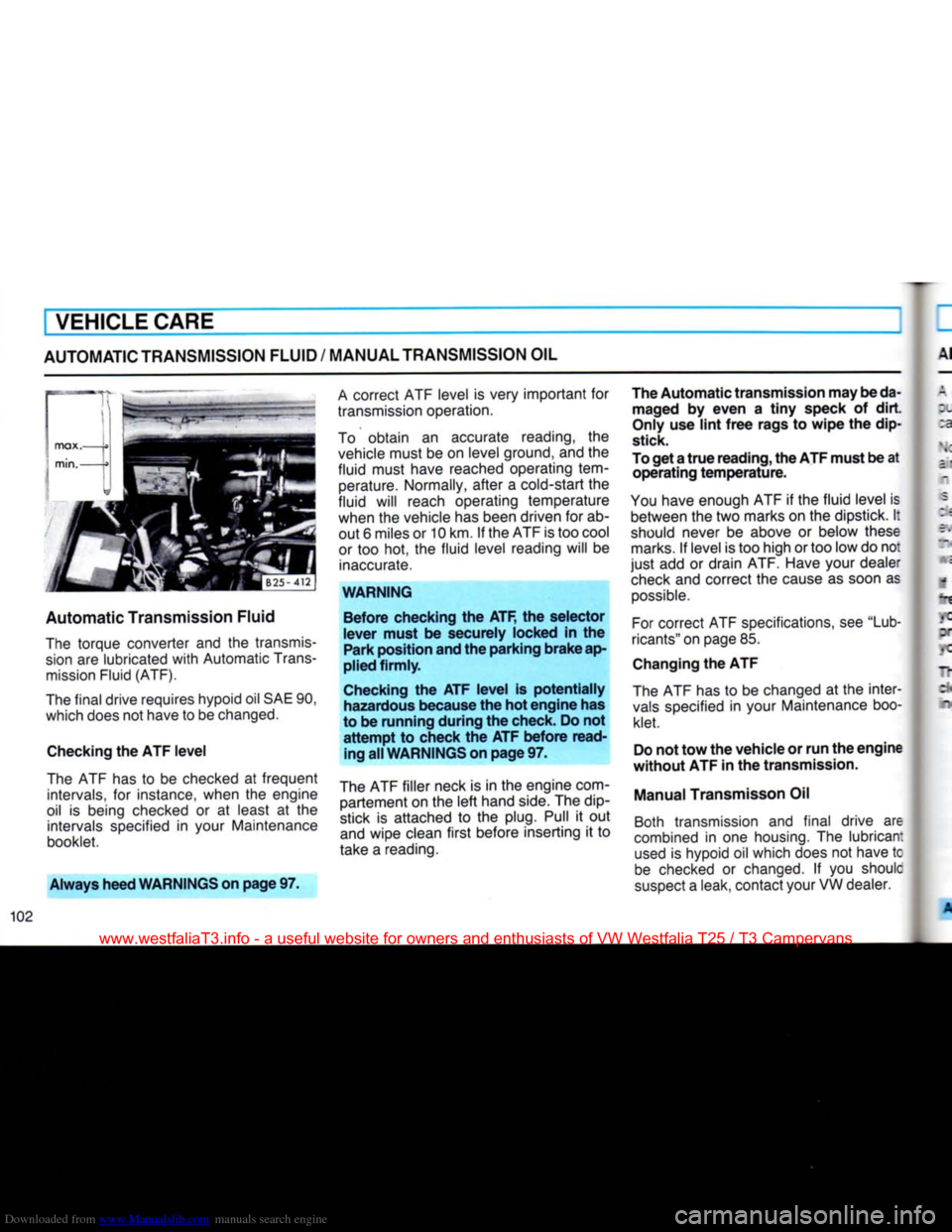
Automatic Transmission Fluid
The torque converter and the transmis
sion are lubricated with Automatic Trans mission Fluid (ATF).
The final drive requires hypoid oil SAE 90,
which does not have to be changed.
Checking the ATF level
The ATF has to be checked at frequent intervals, for instance, when the engine
oil is being checked or at least at the intervals specified in your Maintenance
booklet.
Always heed WARNINGS on page 97. A correct ATF level is very important for
transmission operation.
To obtain an accurate reading, the
vehicle must be on level ground, and the
fluid must have reached operating
tem
perature. Normally, after a cold-start the
fluid will reach operating temperature when the vehicle has been driven for ab
out 6 miles or 10 km. If the ATF is too cool
or too hot, the fluid level reading will be inaccurate.
WARNING Before checking the ATF, the selector
lever must be securely locked in the Park position and the parking brake ap
plied firmly.
Checking the ATF level is potentially hazardous because the hot engine has
to be running during the check. Do not
attempt to check the ATF before read ing all WARNINGS on page 97.
The ATF filler neck is in the engine com- partement on the left hand side. The dip
stick is attached to the
plug.
Pull it out
and wipe clean first before inserting it to
take a reading. The Automatic transmission may be da
maged by even a tiny speck of dirt.
Only use lint free rags to wipe the dip
stick.
To get a true reading, the ATF must be at operating temperature.
You have enough ATF if the fluid level is between the two marks on the dipstick. I:
should never be above or below these marks. If level is too high or too low do not
just add or drain ATF. Have your dealer check and correct the cause as soon as possible.
For correct ATF specifications, see "Lub
ricants" on page 85.
Changing the ATF
The ATF has to be changed at the inter vals specified in your Maintenance booklet.
Do not tow the vehicle or run the engine
without ATF in the transmission.
Manual Transmisson Oil Both transmission and final drive are
combined in one housing. The lubrican: used is hypoid oil which does not have tc
be checked or changed. If you shoulc
suspect a leak, contact your VW dealer.
www.westfaliaT3.info - a useful website for owners and enthusiasts of VW Westfalia T25 / T3 Campervans
Page 108 of 165
Downloaded from www.Manualslib.com manuals search engine
VEHICLE
CARE
I
AIR CLEANER
A
dirty
filter
element reduces engine
out
put and increases fuel consumption and
can
cause premature engine wear.
Normally, it is not required to service the
air cleaner more often than recommended in the Maintenance booklet. If the vehicle
is
driven on very dusty roads, the air
cleaner
must be serviced more frequently,
even
daily. We recommend
that
you have
the air cleaner serviced by your
Volks
wagen dealer or a qualified workshop.
If
your
air
filter
must
be
changed more
frequently,
we
recommend
that
you have
your
Volkswagen dealer show
you the
procedure
before
you
attempt
doing
it
yourself.
The
paper
filter
element must never
be
cleaned
or
soaked
with
gasoline, clean
ing
solvents or oil. POWER STEERING*
The
fluid
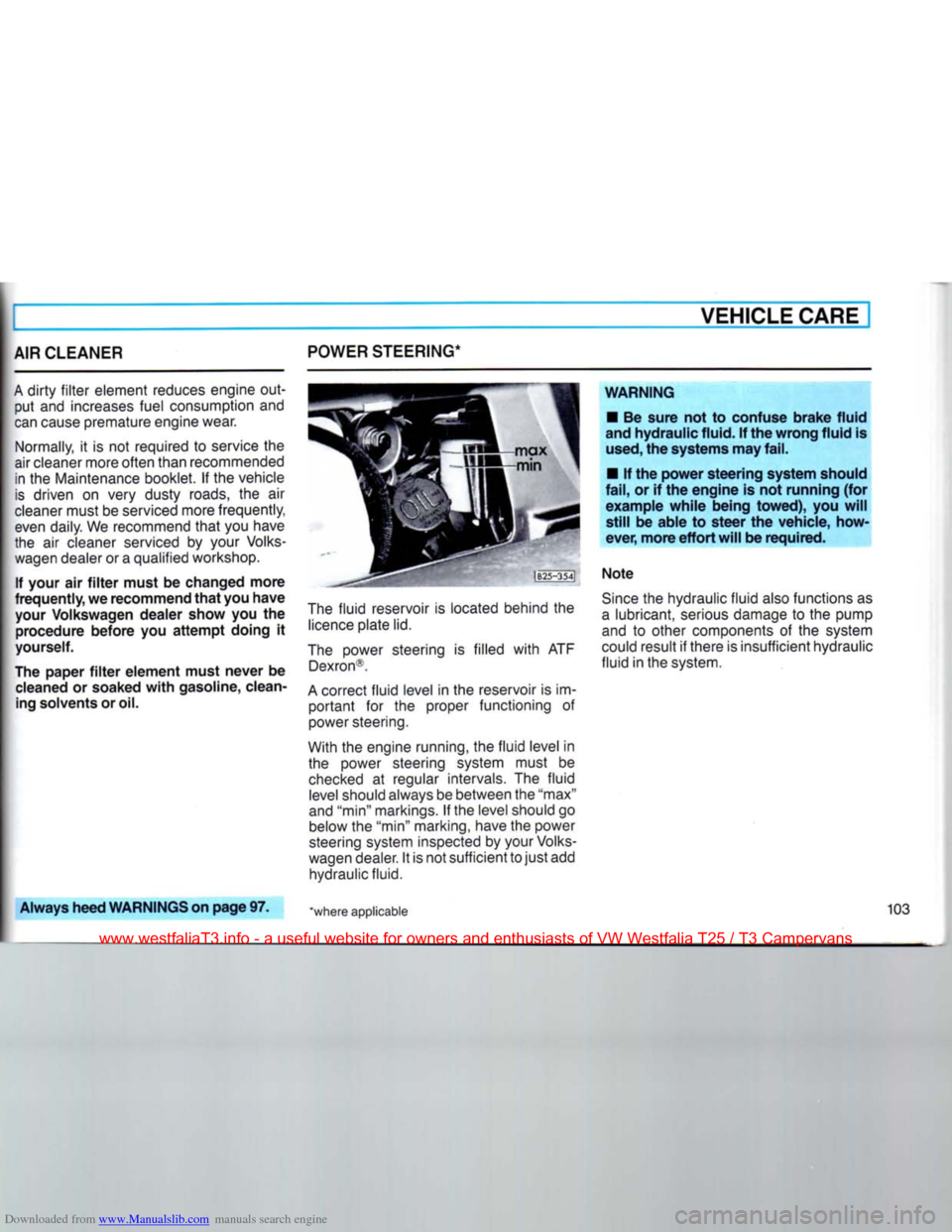
reservoir is located behind the
licence
plate lid.
The
power steering is filled
with
ATF Dexron®.
A
correct
fluid
level in the reservoir is im
portant
for the proper functioning of
power steering.
With the engine running, the
fluid
level in the power steering system must be
checked
at regular intervals. The
fluid
level
should always be between the "max"
and "min" markings. If the level should go below the "min" marking, have the power
steering system inspected by your
Volks
wagen dealer. It is not sufficient to
just
add hydraulic fluid.
WARNING
•
Be
sure
not to
confuse brake fluid
and
hydraulic fluid.
If
the wrong fluid
is
used,
the systems may fail.
•
If the
power steering system should
fail,
or if the
engine
is not
running
(for
example
while
being
towed),
you
will
still
be
able
to
steer
the
vehicle, how
ever, more
effort
will
be required.
Note
Since
the hydraulic
fluid
also functions as
a
lubricant, serious damage to the pump
and to other components of the system
could result if there is insufficient hydraulic
fluid
in the system.
Always
heed WARNINGS on page
97. "where applicable
www.westfaliaT3.info - a useful website for owners and enthusiasts of VW Westfalia T25 / T3 Campervans
Page 110 of 165
Downloaded from www.Manualslib.com manuals search engine
VEHICLE CARE
Refill
tank
Checking
the coolant level
The coolant level should
be
checked from time
to
time, and always before going on
a
longer
trip.
WARNING
To
reduce the risk of being burned, never open the hood if you see or hear
steam or coolant
escaping
from the en
gine compartment.
Wait
until
no steam
or
coolant can be seen or heard before
carefully opening the
hood.
Expansion
tank
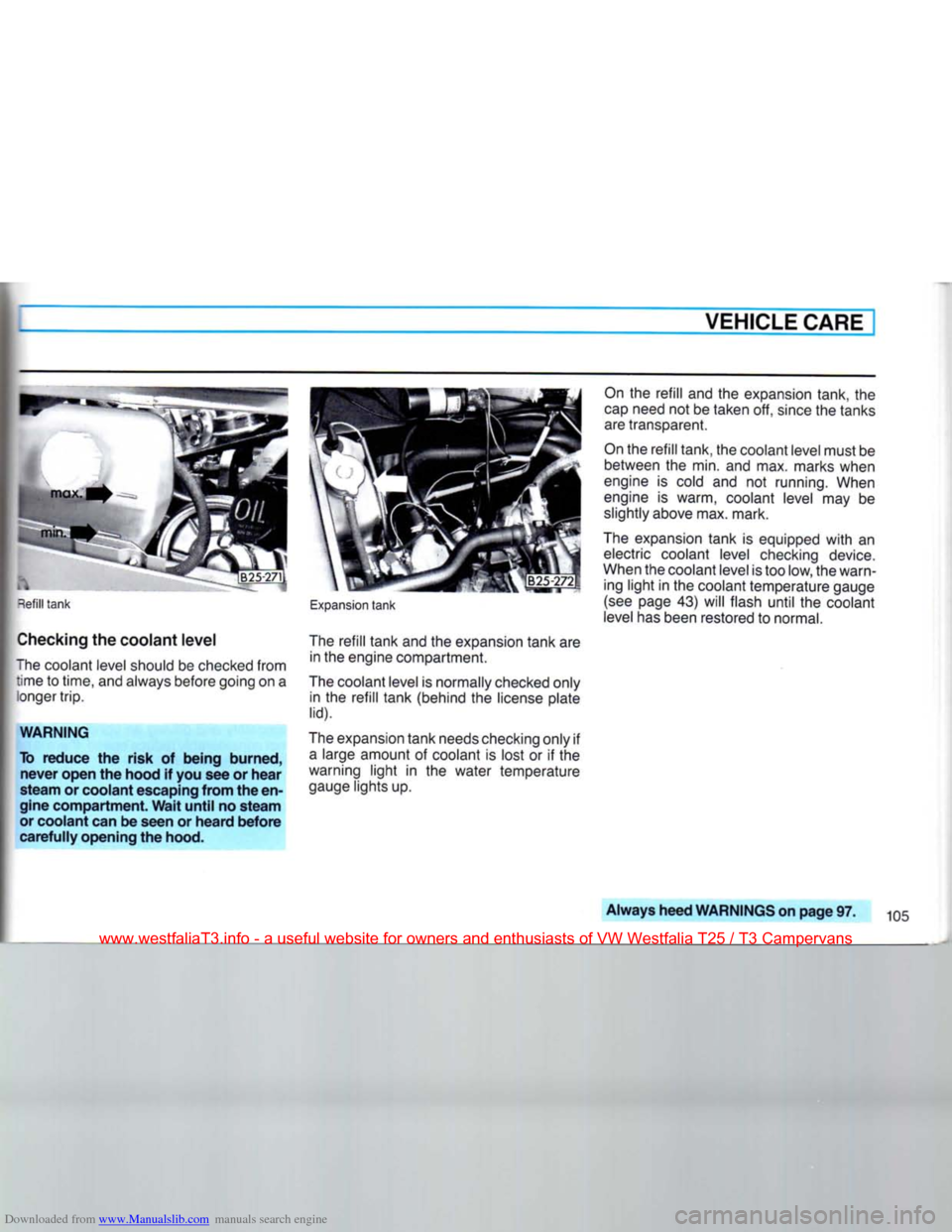
The refill tank and
the
expansion tank are in
the
engine compartment.
The coolant level
is
normally checked only in
the
refill tank (behind
the
license plate
lid).
The expansion tank needs checking only
if
a
large amount
of
coolant
is
lost
or if the
warning
light
in the
water temperature gauge lights up.
On
the
refill
and the
expansion tank,
the
cap
need
not
be taken
off,
since the tanks
are transparent.
On
the refill tank, the coolant level must
be
between
the
min.
and
max. marks when
engine
is
cold
and not
running. When
engine
is
warm, coolant level
may be
slightly above max. mark.
The expansion tank
is
equipped
with
an
electric coolant level checking device.
When the coolant level is too low, the warn ing
light
in the
coolant temperature gauge
(see
page
43)
will flash
until
the
coolant
level has been restored
to
normal.
Always heed WARNINGS on page 97.
105
www.westfaliaT3.info - a useful website for owners and enthusiasts of VW Westfalia T25 / T3 Campervans
Page 111 of 165
Downloaded from www.Manualslib.com manuals search engine
VEHICLE CARE
Adding
coolant
Turn
off the
engine
and allow it to cool
down.
WARNING
Reduce the
risk
of scalding
from
hot
coolant
by
following
these
steps.
• If the cap
from
the expansion
tank
must
be
removed
wait
until
the
engine
has cooled down. The cooling system
is
under
pressure.
•
Protect
face, hands and
arms
by
covering the cap
with
a
large,
thick
rag
to
protect
against
escaping
fluid
and steam.
•
Carefully
and
slowly
turn
cap one
turn
to
allow
excess pressure to es cape
before
completely
removing
cap.
Top
up coolant in refill tank. Only when
cooling
system was drained or a lot of
cool
ant needs to be added, also
fill
expansion
tank.
To
maintain the anti-corrosion properties of the coolant, the antifreeze concentra
tion should not be reduced, even during
the warm
season.
Increasing
the
antifreeze
in the
coolant
to
more
than
60% is not
only
unecono mical, it is also
detrimental
to
engine
cooling.
Only
use quality phosphate-free anti
freeze
containing ethylene glycol. Such antifreeze is available at your Volkswagen
dealer.
Antifreeze,
other
than
specified by Volks
wagen,
may cause corrosion of the cool ing system,
leading
to
engine
over
heating
and
damage.
Only
for topping-up coolant, a small amount of antifreeze containing ethylene
glycol
and phosphates may be
used,
if rec
ommended antifreeze is not available.
• After adding coolant, run the engine at
idle speed for a few seconds.
• Wait for the radiator fan to switch on
and
off again.
• Check coolant level. Add more coolant
if necessary.
Do
not overfill the system.
Excess
coolant will be forced out through
the pressure relief valve in the reservoir
when the engine becomes hot.
Screw cap on
again
tightly.
Radiator
fan
The
electric radiator fan (located in
fror:
r the car behind grille) is controlled by !':
moswitches
from the coolant and enc
TE
compartment temperature.
After
turning
off the
engine,
the
radiate
fan can
continue
to run (up to 10 r>
nutes).
It may also suddenly
start
to rx
again
even
with
the
ignition
switched
c*
Notes
• If the radiator fan does not come c
when the coolant temperature is very high
check
the fuse and replace it if necessar, - see page 129.
• The speed of the radiator fan does nc
depend
on the engine
speed,
therefore
cooling
effect cannot be increased b.
downshifting. As long as the engine runs smoothly and driving an uphill road does
not considerably reduce
speed,
there is n:
need
to downshift.
Always
heed
WARNINGS
on
page
97.
www.westfaliaT3.info - a useful website for owners and enthusiasts of VW Westfalia T25 / T3 Campervans
Page 112 of 165
Downloaded from www.Manualslib.com manuals search engine
V-BELT
winter operation
I the beginning of the winter season, have the coolant checked for anti-freeze
ecncentration. If you have to add, only use
Hality
phosphate-free anti-freeze con-
ra. ning ethylene glycol which is available
5".
your Volkswagen dealer.
Tie ratio between water and anti-freeze
r-pends
on the anticipated outside temp-
r'atures. Tension checking
Correct V-belt tension is important for over
all vehicle performance.
Tensioning and replacing of vehicle V- belts should be performed by your
Volkswagen dealer or a qualified work shop.
See page 147 for V-belt designation.
WARNING
To prevent personal injury stay well clear of the V-belt when the engine is
running.
Before checking V-belt
ten
sion turn the engine off and let it cool
down.
Hot components can burn skin
on contact.
Always heed WARNINGS on page 97. 107
www.westfaliaT3.info - a useful website for owners and enthusiasts of VW Westfalia T25 / T3 Campervans
Page 113 of 165
Downloaded from www.Manualslib.com manuals search engine
VEHICLE CARE
BRAKE FLUID 3 ATT
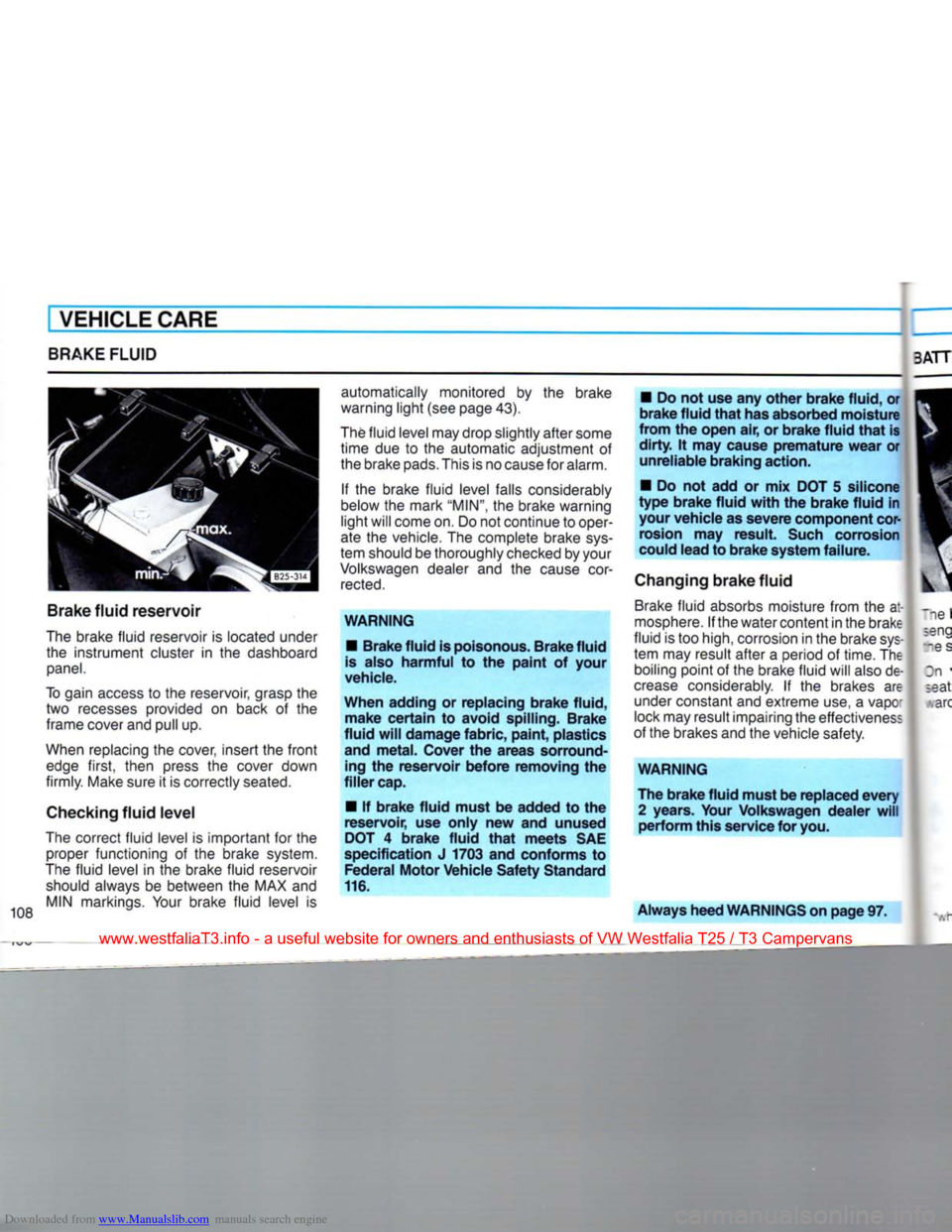
108 Brake fluid reservoir
The brake fluid reservoir is located under the instrument cluster in the dashboard
panel.
To gain access to the reservoir, grasp the two recesses provided on back of the frame cover and pull up.
When replacing the cover, insert the front edge first, then press the cover down
firmly. Make sure it is correctly seated.
Checking fluid level
The correct fluid level is important for the proper functioning of the brake system.
The fluid level in the brake fluid reservoir should always be between the MAX and MIN markings. Your brake fluid level is automatically monitored by the brake
warning light (see page 43).
The fluid level may drop slightly after some time due to the automatic adjustment of
the brake pads. This is no cause for alarm.
If the brake fluid level falls considerably
below the mark
"MIN",
the brake warning
light will come on. Do not continue to oper
ate the vehicle. The complete brake sys
tem should be thoroughly checked by your
Volkswagen dealer and the cause cor
rected.
WARNING • Brake fluid is poisonous. Brake fluid
is also harmful to the paint of your
vehicle.
When adding or replacing brake fluid, make certain to avoid spilling. Brake
fluid will damage fabric, paint, plastics and metal. Cover the areas sorround-ing the reservoir before removing the
filler cap.
• If brake fluid must be added to the
reservoir, use only new and unused
DOT 4 brake fluid that meets SAE
specification J 1703 and conforms to Federal Motor Vehicle Safety Standard
116.
• Do not use any other brake fluid, or
brake fluid that has absorbed moisture
from the open air, or brake fluid that is
dirty. It may cause premature wear or unreliable braking action.
• Do not add or mix DOT 5 silicone
type brake fluid with the brake fluid in your vehicle as severe component corrosion may result. Such corrosion
could lead to brake system failure.
Changing brake fluid Brake fluid absorbs moisture from the at
mosphere. If the watercontent in the brake
fluid is too high, corrosion in the brake sys
tem may result after a period of time. The boiling point of the brake fluid will also de
crease considerably. If the brakes are under constant and extreme use, a vapc
lock may result impairing the effectiveness
of the brakes and the vehicle safety. -e s
Dn seat arc
WARNING
The brake fluid must be replaced every 2 years. Your Volkswagen dealer will perform this service for you.
Always heed WARNINGS on page 97.
www.westfaliaT3.info - a useful website for owners and enthusiasts of VW Westfalia T25 / T3 Campervans
Page 114 of 165
Downloaded from www.Manualslib.com manuals search engine
VEHICLE CARE
3ATTERY
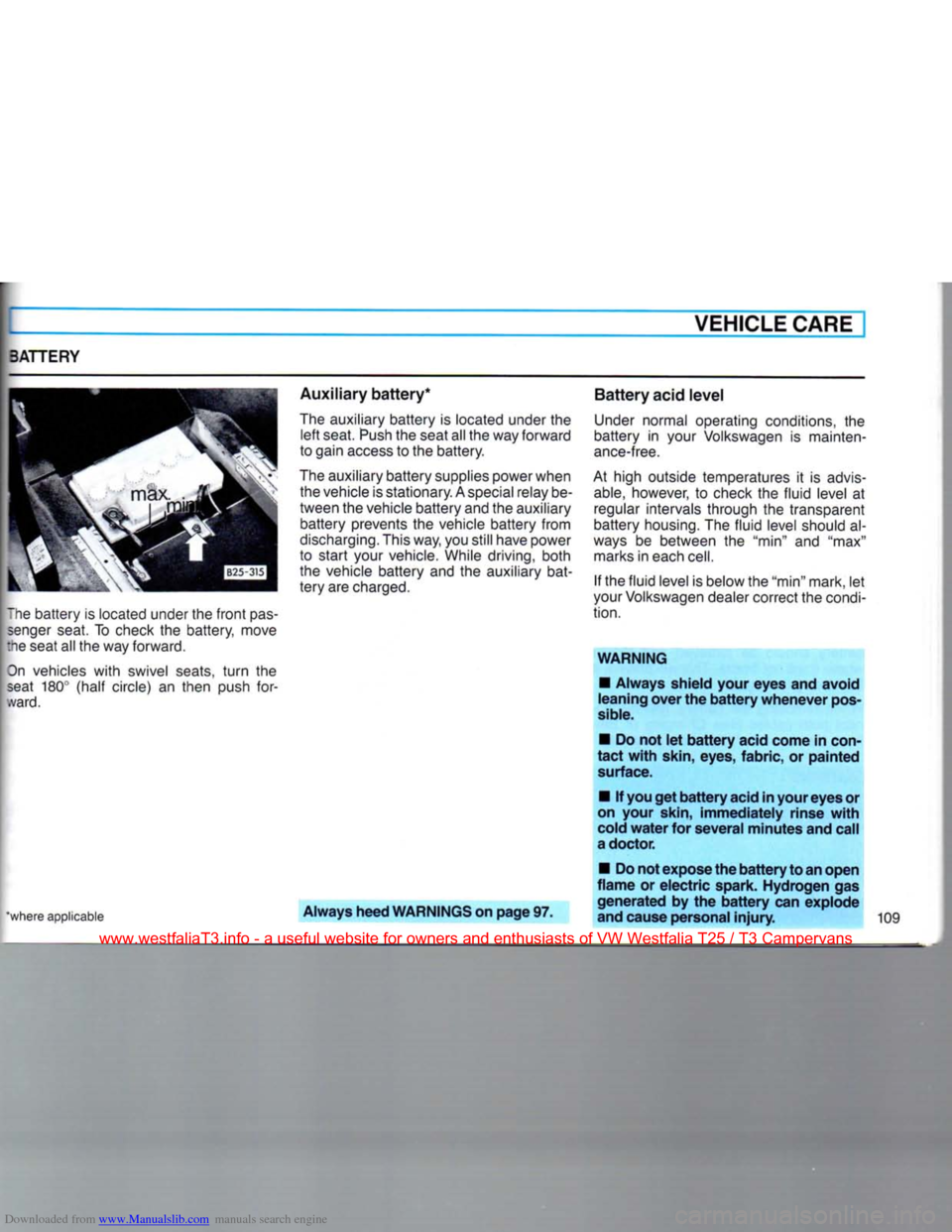
~he battery
is
located under the
front
pas
senger
seat.
To
check
the
battery, move
lie
seat all the way forward.
On
vehicles
with
swivel seats,
turn
the
seat
180°
(half circle)
an
then push
for
ward.
Auxiliary
battery*
The
auxiliary battery
is
located under
the
left
seat.
Push
the
seat all the way forward
to gain
access
to
the battery.
The
auxiliary battery supplies power when the vehicle is stationary.
A
special relay be
tween the vehicle battery and
the
auxiliary battery prevents
the
vehicle battery from
discharging.
This way, you still have power
to start your vehicle. While driving, both
the vehicle battery
and the
auxiliary bat
tery are charged.
'where applicable
Always heed WARNINGS on page 97. Battery acid level
Under
normal operating conditions,
the
battery
in
your Volkswagen
is
mainten
ance-free.
At high outside temperatures
it is
advis
able,
however,
to
check
the
fluid level
at
regular intervals through
the
transparent
battery housing. The fluid level should
al
ways
be
between
the "min" and "max"
marks
in
each
cell.
If
the fluid level
is
below the "min" mark,
let
your Volkswagen dealer correct
the
condi
tion.
WARNING
•
Always shield your eyes and avoid
leaning over the
battery
whenever
pos
sible.
•
Do not let
battery
acid come in
con
tact
with
skin,
eyes, fabric, or painted
surface.
•
If
you
get
battery
acid
in
your eyes or
on
your
skin,
immediately rinse
with
cold
water
for several minutes and call a doctor.
•
Do not expose the
battery
to an open
flame
or electric spark. Hydrogen gas generated by the
battery
can explode
and cause personal injury.
109
www.westfaliaT3.info - a useful website for owners and enthusiasts of VW Westfalia T25 / T3 Campervans
Page 119 of 165
Downloaded from www.Manualslib.com manuals search engine
VEHICLE CARE
TIRES/WHEELS
New tires
New
tires
do not
possess
maximum trac
tion
and
should
be
driven
at
moderate
speeds
and
with
caution
for the
first
100
miles (160 kilometers).
Tire traction
WARNING
When driving on wet or slushy roads, a wedge of
water
may build up
between
the tires and the road. This phenome non is known as aquaplaning or hydro
planing and may cause
partial
or
com
plete
loss
of traction, vehicle control or
stopping ability. Always reduce speed
on
wet roads.
Tire service life
The service
life
of
your tires depends
for
the most
part
on the following factors:
Tire pressures
WARNING
•
Incorrect
tire
pressures cause
increased
tire
wear
and adversely
affect
road holding of the vehicle, lead ing to
loss
of control and personal
injury.
•
Incorrect
tire
pressures can also
lead to
sudden
deflation, resulting
in
an
accident and personal injury.
Check
your
tire
pressures twice
a
month,
and especially before taking
a
long
trip.
Be
sure
not to
forget
to
check
the
spare tire.
Always check
tire
pressures when the tires are cold. When
the
tires
are
warm,
the
pressure
will
be
higher.
Do not
reduce
the
pressure
of
warm tires.
Use
an accurate
tire
pressure gauge when
checking inflation pressures.
Do not
exceed
the
maximum
tire
inflation pres sure listed
on the
tire
sidewalk Cold
tire
inflation pressure means: when
a
vehicle
has
been standing
for at
least
3
hours
or
driven
for
less than 1 mile.
Always include the spare
tire
during
a
pres sure check.
Driving habits
Fast
cornering, heavy acceleration
and
hard braking all increase
tire
wear.
Wheel balancing
The
front
wheels
on new
vehicles
are
balanced.
When driving, however, various
conditions can cause
a
wheel
to
become
unbalanced.
This may
be
noticed as vibra
tions
in the
steering.
Since
tire
imbalance
can
cause wear
or
the steering, suspension
and
tires,
you
should have your wheels rebalanced.
A
wheel should always
be
balanced
if a
nev,
tire
has
been mounted
or a
tire
was re
paired.
114
www.westfaliaT3.info - a useful website for owners and enthusiasts of VW Westfalia T25 / T3 Campervans
Page 121 of 165
Downloaded from www.Manualslib.com manuals search engine
VEHICLE CARE
Tire
care
Inspect your tires at least every 2,000
miles (3,000 km) for wear and damage.
WARNING
• Avoid
damaging
tires
and
wheel
rims.
If you
must
drive
over
a
curb
or
other
obstacle,
drive
slowly
and at an
angle.
Frequently
check
tires
for un
even
wear
and
damage.
•
Remove
imbedded
material.
•
Replace
worn
or
damaged
tires
immediately.
•
Replace
missing
valve
dust
caps.
• Keep oil,
fuel,
brake
fluid,
etc.
away
from
tires.
• Keep
tires
inflated
correctly.
• Mark tires before removing them.
Remount tires on the same vehicle side
because
the rotation direction should stay
the same.
• Store removed tires in a
cool,
dry and
preferably dark place. Tires which are not
on wheels should be stored standing up.
Tires
age even if they are not being
used.
Tires
which are older than 6 years should only be used cautiously in an emergency.
Wheels
and
tire
replacement
Wheels
and tires approved by the manu
facturer have been specially matched to
your vehicle and contribute largely to the road-holding and driving characteristics of
the vehicle.
• Fitting and repairing tires requires
expert knowledge and special tools. This
work should only be performed by a
spe
cialist.
• For safety reasons, tires should be
replaced
in pairs and not individually. The
tires
with
the deepest tread should always be mounted on the
front
wheels.
• In the interest of maximum safety and
best all-around vehicle handling, always
buy replacement radial tires
that
have the
same
specifications
with
regard to
tire
size,
design, load carrying capacity, tread pattern, tread depth etc. This also applies
to Volkswagen recommended alternate replacement tires.
• Never mount used tires if you are not
sure of their previous history.
• Whenever replacing a tubeless tire,
always install a new valve stem. Tire repair
should only be performed by a specialist.
WARNING
•
Never
mix
tires
of
different
design
such as
steel
belted
radials
with
radial
bias
belted
or
bias
ply
tires
etc.
Mixing
tire
types
will
adversely
affect
road
holding
and can
lead
to loss of
vehicle
control
and
personal
injury.
• New
tires
do not possess
maximum
traction.
They
tend
to be
slippery.
Break
new
tires
in by
driving
cautiously
at
moderate
speed for the
first
100
miles
(160
kilometers).
Applies
additionally
to the Syncro:
All
four wheels on the vehicle must always have tires of the same
size,
construction
and tread type so
that
the viscous coupling
does
not abnormally activate the
front
wheel drive. Different tires on the
front
or rear wheels exert additional stress on the
drive
train
components, causing increa
sed
tire
wear and impair vehicle control.
www.westfaliaT3.info - a useful website for owners and enthusiasts of VW Westfalia T25 / T3 Campervans
Page 122 of 165
Downloaded from www.Manualslib.com manuals search engine
VEHICLE
CARE
General notes
The original equipment tires
and
wheel
rims
on
your
vehicle comply with
all
applicable
Federal Motor Vehicle Safety
Standards.
If you
wish
to
equip
your
vehicle with tires
or wheels other than those installed
at the
factory, please note
the
following:
•
If
you plan
to
install other than the
ori
ginal
equipment tires
and
wheel rims,
ask
your
Volkswagen dealer.
•
For
technical reasons
it is not
possi
ble
in
every
case
to use
wheels from
other vehicles
-
under certain condi
tions
not
even wheels from
the
same
vehicle
model.
•
Wheel rims
and
wheel bolts
or lug
nuts are matched to fit
your
Volkswagen.
•
When installing different wheels
(for
example,
wheels with winter tires),
the
correct wheel bolts
or
lug nuts with
the
proper length
and
conical shape must
be used. The secure fit of the wheels and
the proper functioning
of the
brake system are dependent upon this.
•
Using tires and/or wheels which have
not been approved
by
the manufacturer
for
your
vehicle
type
can be detrimental
to vehicle safety.
•
If
wheel trim discs
or a
front
spoiler
are
installed,
make
sure the airflow for cooling
the brakes
is not
obstructed.
•
Before
you
plan
on
exchanging steel
wheels, light alloy wheels,
or
snow tires
already mounted on wheel rims, consult
your
Volkswagen dealer. He has the tech
nical
information necessary
to
advise
you which wheel rims and wheel bolts
or
lug
nuts are compatible with the original
factory installations.
WARNING
•
The
use of the wheel rims and wheel
bolts
or
lug nuts that do not meet
speci
fications
of the
original factory
install
ed equipment will affect the safe oper
ation
of
your
vehicle and may cause an
accident and personal
injury.
Tire specifications
Tire
specifications
are
imprinted
on the
sidewall
of
the tires.
If in
doubt, check with
your
Volkswagen dealer.
All
passenger car and some light trucks tires must conform
to
Federal Safety
Requirements
in
addition
to
these
grades.
Treadwear
The treadwear grade
is a
comparative
rating
based
on the
wear rate
of the
tire
when tested
on a
government test course. For example,
a
tire graded
150
would wear
one
and a
half
(IV2)
times
as
well
as a
tire
graded 100.
The
relative performance
of
tires depends
on
actual conditions
of use,
however,
and may
depart significantly
from
the
norm
due to
variations
in
driving
habits,
service practices
and
differences
in road characteristics and
climate.
Traction A, B, C
The traction grades, from highest
to
lowest,
are A, B and C and
represent
the
tire's ability
to
stop
on wet
pavement
as
measured
on
government test surfaces
of
asphalt
and concrete. Atire marked
C
may
have poor traction performance.
www.westfaliaT3.info - a useful website for owners and enthusiasts of VW Westfalia T25 / T3 Campervans