tow VOLKSWAGEN TRANSPORTER 1992 T4 / 4.G Owner's Manual
[x] Cancel search | Manufacturer: VOLKSWAGEN, Model Year: 1992, Model line: TRANSPORTER, Model: VOLKSWAGEN TRANSPORTER 1992 T4 / 4.GPages: 164, PDF Size: 25 MB
Page 80 of 164
Downloaded from www.Manualslib.com manuals search engine
DRIVING
TIPS
Driving
safely
Attention
The
operational
condition of your
vehicle
is
essential
to
safe
driving.
Therefore before moving off, always check
the following points:
• Lights and
turn
signals
•
Mirror
settings
• Cleanliness of
headlights,
lenses and
windows
Also
check at regular intervals, preferably
when filling the tank, all the checks listed on
page160
Furthermore compliance
with
the specified Inspection intervals - in particular the brake
fluid changing - is of great importance for operational safety - pages 93 and 98.
Attention
Safety
on the
road
depends to a
large
extent
on the personal
atti
tude
and
style
of driving.
To
be on the safe side you should:
•
Always
put
seat
belt
on
before
moving
off -
even
in
town
traffic
-
and
• Ensure
that
all your passengers - including
those
on the
rear
seat
- are
wearing
their
belts
correctly
- page
15
Passengers
without seat belts can en
danger
not only themselves, but also the
driver.
•
Adjust
head
rests
to body size.
The
upper edge of headrest must be approximately at eye
level.
• Ensure
that
no
articles
interfere
with
operation
of pedals - page 29
•
Stow
all
luggage
correctly:
- in
boot
- page 28
- on the shelves - page 27
- on the
roof
- page 75 • Do not
drive
when
you
feel
tired.
Stop
for a break at the latest after driving for
two hours.
•
Never
drive
when
your
reactions
are
impaired
in any way. Not only alcohol but also drugs and many
medicines
can be very detrimental to your
reactions.
•
Adapt
vehicle
speed to
traffic
and
road
conditions.
Remember
that
particularly on smooth slip
pery roads the handling and braking is li
mited by the adhesion of the tyres. On wet
roads
the
front
wheels can aquaplane at
high
speeds.
The vehicle can then no longer
be
steered and braked properly.
•
Strictly
adhere
to the
traffic
regu
lations
-
particularly
the speed li
mits
-.
Further instructions on safety are given in
the various chapters in this manual.
78
www.vwT4camper.info - a useful website for owners and enthusiasts of VW T4 Transporter Campervans
Page 81 of 164
Downloaded from www.Manualslib.com manuals search engine
DRIVING
TIPS
Driving economically and ecologically
.'arious
factors determine the fuel
con
sumption,
the burden on the environment
and
the wear on the engine, brakes and
lyres.
The personal style of driving
Determines
to a great extent the economi-
:al
aspect and the exhaust and noise
devel
opment:
jOp
Do not
warm
up the
engine
with
W» the
vehicle
stationary.
At idling speed it takes a very long
time
until
the engine becomes operationally
warm. However, in the warm-up phase,
wear and the discharge of pollutants is
oarticularly high. For
this
reason, drive
off immediately the engine has started
and avoid
high
engine speeds.
f
h Avoid
full
throttle
acceleration.
of only is the
fuel
consumption reduced
considerably
if one accelerates
with
feel
ing, but the disturbance to the environ
ment
and the wear are also reduced.
rflri
Do not
drive
with
unnecessarily
high
engine
revs
-
change
up as
soon as possible,
only
change
down
when
the
engine
no
longer
runs
smoothly.
The
fuel
consumption is for example
more
than
twice as
high
in 2nd gear
than
it is in top
gear.
At the same
time,
the re duced engine speed means a reduction
in engine noise.
On vehicles
with
an automatic gearbox
the economy programme should be se
lected.
c^p
Try not to
drive
at
maximum
TO
speed.
The
fuel
consumption, exhaust pollution
and noise increase disproportionately at
high
speeds. If approximately only 3
quarters of top speed is utilised, the
fuel
consumption
will
be reduced by about
half.
Experience has shown
that
the loss in
time
is only marginal.
c
j-,
Drive
as
smoothly
as possible and
look
well
ahead.
Unnecessary
acceleration and braking
must
be paid for
with
higher
fuel
con
sumption and more disturbance to the environment.
Switch
the
engine
off
during
hold-ups. The individual
operating
condi
tions
Naturally
also
affect fuel consumption.
The
following factors for instance are not fa
vourable
to good fuel consumption:
•
High traffic density, particularly large
.towns with numerous traffic lights.
•
Frequent stop/start driving, always restarting and warming up the engine.
•
Driving in heavy, slow moving traffic in
low
gear so that the engine speed is
rela
tively high in relation to the distance cov
ered.
CQ~, One
should,
therefore,
plan
trips
in
advance
and try to
avoid
local
traffic
and
overcrowded
motor
ways.
Obviously
the fuel consumption is
also
af
fected
by factors over which the driver has
no
control. It is for example normal for the
consumption
to increase in the winter or in
arduous
conditions (bad roads, trailer tow ing etc.).
79
www.vwT4camper.info - a useful website for owners and enthusiasts of VW T4 Transporter Campervans
Page 82 of 164
Downloaded from www.Manualslib.com manuals search engine
DRIVING
TIPS
The technical
prerequisites
"or
a low fuel consumption and efficiency were "built in" at the factory. Particular im
portance was placed on the lowest possible
disturbance
to the environment. To retain
and
make the best possible use of these
characteristics
attention should be paid to
the following points:
Vehicles
fitted
with
a
catalytic
converter
may
only
be
driven
on
unleaded
petrol.
Even
those
vehicles
which
do
not
have
a
catalytic
converter
should
be
driven
on
unleaded
petrol
for the
sake
of the
environment.
The
prescribed
maintenance
operations
should
be
carried
out
exactly
as
specified
in the
Service
Schedule - see
also
page
93.
Having your vehicle regularly serviced by
a Volkswagen dealer not
only
ensures
that
it is always operationally fit, but it
also ensures economy, lowest possible burden on the environment and a long
service
life.
Check the
tyre
pressures
every
4
weeks.
Low
tyre
pressures increase the rolling
resistance.
This not
only
increases the
fuel
consumption and
tyre
wear,
but the
handling is also impaired.
Do not
carry
unnecessary
ballast
in the
luggage
boot
Particularly in
town
traffic
when one has to accelerate
often,
weight
has a
great
in
fluence on the
fuel
consumption. As a
rule
of
thumb:
For every 100 kg of
weight
the consumption increases by approxi
mately
litre
per 100 km.
Remove
roof
rack
immediately
after
use
Particularly at
high
speeds the increased
air resistance makes
itself
felt
consider
ably.
gCK
Electrical
consumers
should
only
be
switched
on
when
they
are
actually
required
Heated rear windows, additional driving
lights
and heater blower consume a con
siderable amount of
current.
The higher
alternator
load
also increases the
fuel
consumption. For instance, over a period of 10 hours, the heated rear window
will
increase
the
fuel
consumption by ap
proximately 1
litre.
Check the
fuel
consumption
reg
ularly
The
fuel
consumption should be checked
each
time
the
tank
is
filled
up. By doing
this
inconsistencies on the vehicle which
lead to an increased
fuel
consumption
can be discovered sooner.
• Check the
engine
oil
level
each
time
the
tank
is
filled
up
The
oil consumption depends to a great ex
tent
on the engine load and
speed.
Depend
ing on the style of driving the consumption
can
be as much as 1.0 litres/1000 km.
It is normal for the oil consumption of a new
engine
to reach its lowest level after a cer
tain mileage has been covered. The
con
sumption cannot be properly
assessed
until
the vehicle has run approx. 5000 km.
This
also
applies to the fuel consumption
and
the engine output.
www.vwT4camper.info - a useful website for owners and enthusiasts of VW T4 Transporter Campervans
Page 83 of 164
Downloaded from www.Manualslib.com manuals search engine
DRIVING
TIPS
Trailer
towing
~~e
vehicle is intended mainly for the trans-
cctation of persons and luggage but it can, th the appropriate technical equipment,
=
so be used to tow a trailer.
Ibiler towing not only places more stress : - the vehicle, it also calls for more concen-
ration from the driver.
::r this reason the operating and driving inductions on the next pages must be strict- . adhered to.
Technical
requirements
" :he vehicle is supplied
with
a factory-
• ::ed towing bracket, all
that
is technically -
d
legally necessary for trailer towing will =ve been taken into account.
: should be noted
that
a 13 pin socket is
::ed
instead of the 7 pin one used previous- . This new socket makes it possible to con-
ect additional electrical components on trailer for which there were no connec-
ns
in the previous socket, such as a
cara-
n refrigerator, reversing lights etc.
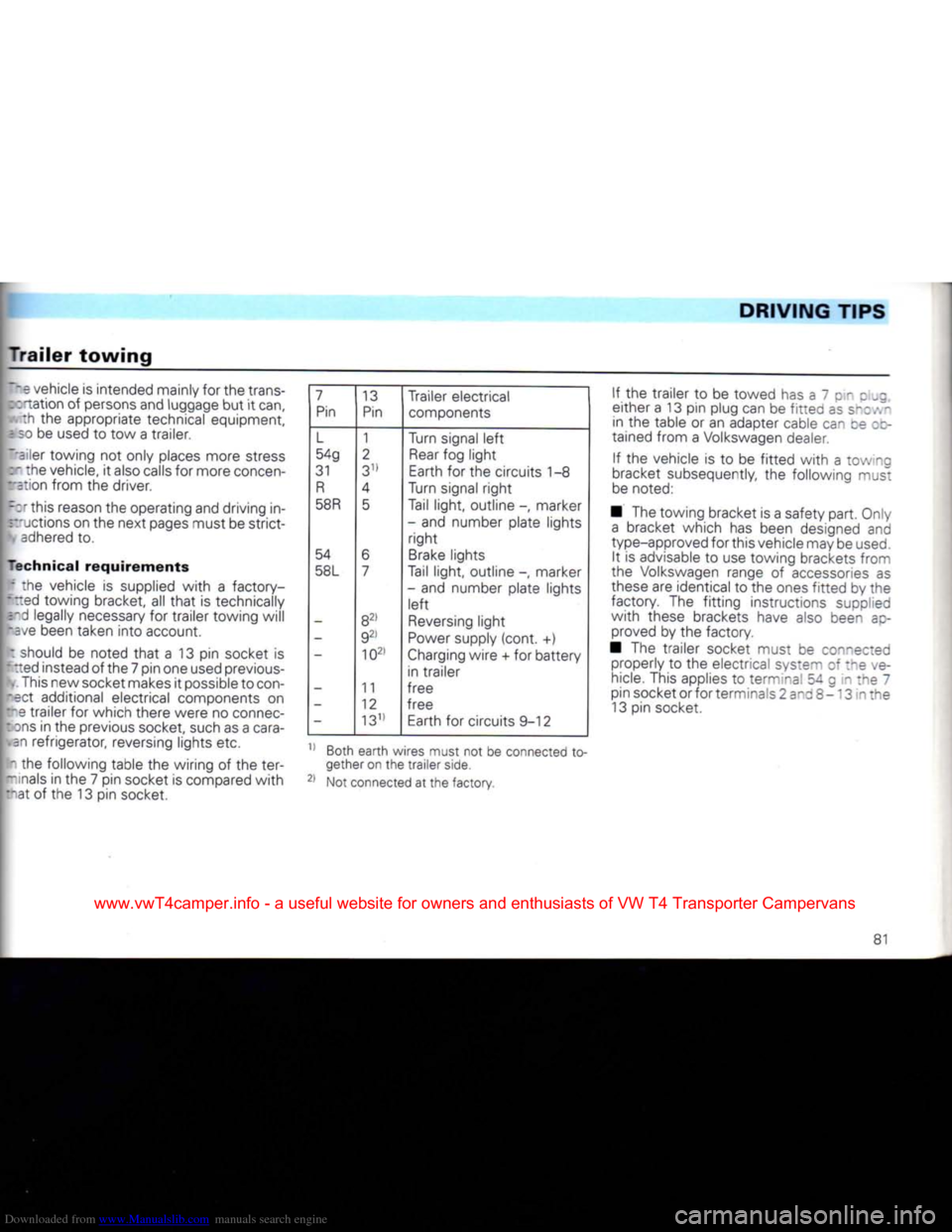
the following table the wiring of the ter-
nals
in the 7 pin socket is compared
with
at of the 13 pin socket.
I a 7
13
Trailer electrical
Pin Pin
components
L
1 Turn signal
left
54g
2
Rear
fog light
31
311
Earth
for the circuits 1-8
R
4
Turn signal
right
58
R
5
Tail
light, outline -, marker
- and number plate lights
right
54 6
Brake
lights
58L
7
Tail
light, outline -, marker
- and number plate lights
left
- 82>
Reversing
light
-
92!
Power
supply (cont. +)
-
102!
Charging
wire + for battery
in trailer
- 11
free
- 12
free
-
1311
Earth
for circuits 9-12
1) Both earth wires must not be connected to gether on the trailer side.
21 Not connected at the factory. If the trailer to be towed has a 7 pin plug,
either a 13 pin plug can be
fitted
as shown
in the table or an adapter cable can ce zz-
tained from a Volkswagen dealer.
If the vehicle is to be
fitted
with
a towing
bracket subsequently, the following must
be
noted:
• The towing bracket is a safety part. Only
a
bracket which has been designed and
type-approved for this vehicle may be
used.
It is advisable to use towing brackets from
the Volkswagen range of accessories as
these
are identical to the ones
fitted
by the
factory. The
fitting
instructions supplied
with
these brackets have also been ap proved by the factory.
• The trailer socket must be connected properly to the electrical system of the ve
hicle.
This applies to terminal 54 g in the 7
pin socket or for terminals 2 and 8 -13 in the
13
pin socket.
81
www.vwT4camper.info - a useful website for owners and enthusiasts of VW T4 Transporter Campervans
Page 84 of 164
Downloaded from www.Manualslib.com manuals search engine
DRIVING
TIPS
• As the factory installation of a towing bracket includes the modification of the
cooling
system, this should also be done
when service installing a bracket. Other
wise
overheating may occur when the en gine is pulling hard (mountains, high ambi
ent temperature, heavy trailer loads).
Certain
vehicle versions can be equipped
with
a heavy-duty cooling system ex fac
tory,
even though the vehicle is delivered
without
a towing bracket. Details can be ob
tained from Volkswagen dealers.
• Volkswagen dealers have all the
necess
ary information on the installation of towing
brackets
and the
fitting
of a heavy-duty
cooling
system. The installation should
therefore be done by them.
• If, when towing a trailer for commercial
purposes,
the permissible
total
weight of
vehicle
and trailer - also
with
passenger
cars
- exceeds 3500 kg, it is necessary to in
stall and use a tachograph in most European
countries.
Operations
instructions
• When inserting the 13 plug
into
the
socket
on the vehicle, the ribbed sleeve on
the plug must be turned fully to the
right.
The
lid of the socket then engages over the
boss
on the
sleeve.
• If the
traffic
behind the trailer cannot be
seen
properly
with
the standard rear view mirrors, additional outside mirrors will be
necessary.
Both outside mirrors must be
fitted
on folding arms and adjusted to give
a
good view to the rear at all times.
• Pitching movements between towing
vehicle
and trailer can be reduced by heavy-
duty springs and shock absorbers on the rear axle. If these springs and shock ab
sorbers
have not already been
fitted
at the
factory, they can, in many
cases,
be servi
ce-installed
by a Volkswagen dealer.
• Pitching and snaking movements can
also
be reduced by stabilizers which can be
obtained from and
fitted
by Volkswagen
dealers
in most European countries. • The permissible trailer weight11 - see
page
151 -must not be
exceeded
on any
ac
count.
• When towing a trailer in mountainous re
gions,
note
that
the trailer weights given ir
the "Technical data" are only valid for gradi ents up to 10 or 12 %. If the trailer weigh'
is
below the permissible maximum a corre
spondingly steeper gradient can be
climbed.
• The given trailer weights are only appli
cable
for altitudes up to 1000 m above see
level.
As the engine
output
and thus the
climbing ability drops due to the decreasing
air density, the weight of vehicle and trailer must also be reduced by 10 % for eacr
further
1000 m or part thereof.
1 The permissible vehicle/trailer weight
con
sists
of the permissible
total
weight of towing vehicle plus the permissible
total
weight
of trailer. If the permissible trailer load is to be
fully utilized it may be necessary to reduce
the weight of the towing vehicle appropriate ly. The towing vehicle must however not be
lighter than the trailer.
82
www.vwT4camper.info - a useful website for owners and enthusiasts of VW T4 Transporter Campervans
Page 85 of 164
Downloaded from www.Manualslib.com manuals search engine
DRIVING
TIPS
• Where possible make
full
use of the maximum permissible drawbar weight on
call
of the towing bracket - see page 151 -
cut do not exceed it.
• While observing the permissible trailer
and
drawbar weight, distribute the load in
the trailer so
that
heavy objects are as near
as
possible to the axle. The objects must
a
so be secured so
that
they cannot slip
aoout.
• Check the
tyre
pressures on the towing
/ehicle
and the trailer.
• The headlight settings, should be
:hecked
with
trailer attached before mov- ng off and adjusted as necessary.
On
vehicles
with
headlight beam control it
is
only necessary to
turn
the knurled disc in
:ash
in the appropriate direction.
Driving
instructions
To
obtain the best possible handling of ve
hicle
and trailer, the following should be
noted:
• Try to avoid driving
with
an unladen ve
hicle
and a loaded trailer. If this cannot be
avoided,
only drive slowly to allow for the unfavourable weight distribution.
• As driving stability of vehicle and trailer
decreases
when the speed increases do not
drive at the maximum permissible top
speed
in unfavourable road, weather or
wind conditions - particularly when going downhill. In any
case
the speed must be reduced im
mediately the trailer shows the slightest
sign
of snaking. On no account try to stop
the snaking by accelerating.
• For safety reasons one should not drive faster than 80 km/h (50 mph). This also
applies
in countries where higher speeds
are permitted. • Always brake in good time. If the trailer
has
an overrun brake, apply the brakes gen
tly at
first
then firmly. This will avoid the
jerk
ing caused by the trailer wheels locking.
Change
down before going down a steep hill so
that
the engine can act as a brake.
• When a long climb in a low gear
with
ex tremely high engine revs must be nego
tiated at exceptionally high ambient temperatures the coolant temperature gauge must be observed. When the gauge needle
moves
to the
>~zza'
e~z of :ne
scale,
the road speed must be reduced immediately. If nevertheless ~g amp flashes,
stop immediately and si ow the engine to
cool
off at idling speed for several minutes.
• The cooling effect of the radiator fan
can
not be increased by changing down, be
cause
the speec of t~e
~a~
s ~o! dependent
on the engine
speed.
One should therefore not change down even when towing a
trailer as long as :-e e-g -e zar cope with out the vehicle speed dropping too much.
83
www.vwT4camper.info - a useful website for owners and enthusiasts of VW T4 Transporter Campervans
Page 86 of 164
Downloaded from www.Manualslib.com manuals search engine
DRIVING
TIPS
General
notes
• During the running-in period avoid trailer "owing as much as possible.
• It is advisable to have the vehicle ser-
.ced
between the Inspection intervals if it
s
used frequently for towing a trailer.
• ""he trailer and drawbar load figures on
:re
data plate of the towing bracket are for
:es:
certification only. The correct figures
forthe
vehicle, which may be lower than the
acove
figures, are given in the vehicle docu-
~e~:s
and in this manual.
• The towing bracket increases the un-
535"
weight of the towing vehicle and the
pay-load
must be reduced to correspond. In some countries (for example Germany)
the following additional legal requirements
apply:
• A special warning lamp must be
fitted
within
the driver's range of vision to show
that
the trailer
turn
signals are working.
• The maximum draw bar weight - see
page
151 - must be shown on a clearly
vis
ible sticker at the rear of the towing vehicle.
• The installation of a towing bracket must
be
passed by a legally approved test centre
and
then proof of installation is entered in
the vehicle documents by the
traffic
author ity.
• The maximum speed permissible when towing a trailer is 80 km/h (50 mph).
84
www.vwT4camper.info - a useful website for owners and enthusiasts of VW T4 Transporter Campervans
Page 99 of 164
Downloaded from www.Manualslib.com manuals search engine
GENERAL
MAINTENANCE
The
multigrade-improved
lubricity
oils as per VW
Specification
500 00 m/e in addition the following advantages:
-
All year round use at practically all tem peratures.
-
Low frictional
losses
in the engine.
-
Best possible starting even at very low temperatures.
»Jotes
I
Single
grade
oils. Due to their limited
i-scosity
ranges these oils are not generally
j_::eptable for all year round use. "erefore these oils should only be used in
-
:reme climatic
zones.
•
When using SAE 5 W-30 multigrade oil, xntinuous high engine speeds and engine
seeding
should be avoided. This restriction
::es
not apply to multigrade-improved lu-
r city oils.
Checking
oil
level
Every
engine uses a certain amount of oil.
The
oil
consumption
can be up to 1.0
litres per 1000 km - see also page 80. The
engine oil level must therefore be checked
at regular intervals, preferably when filling
the tank and before a long journey.
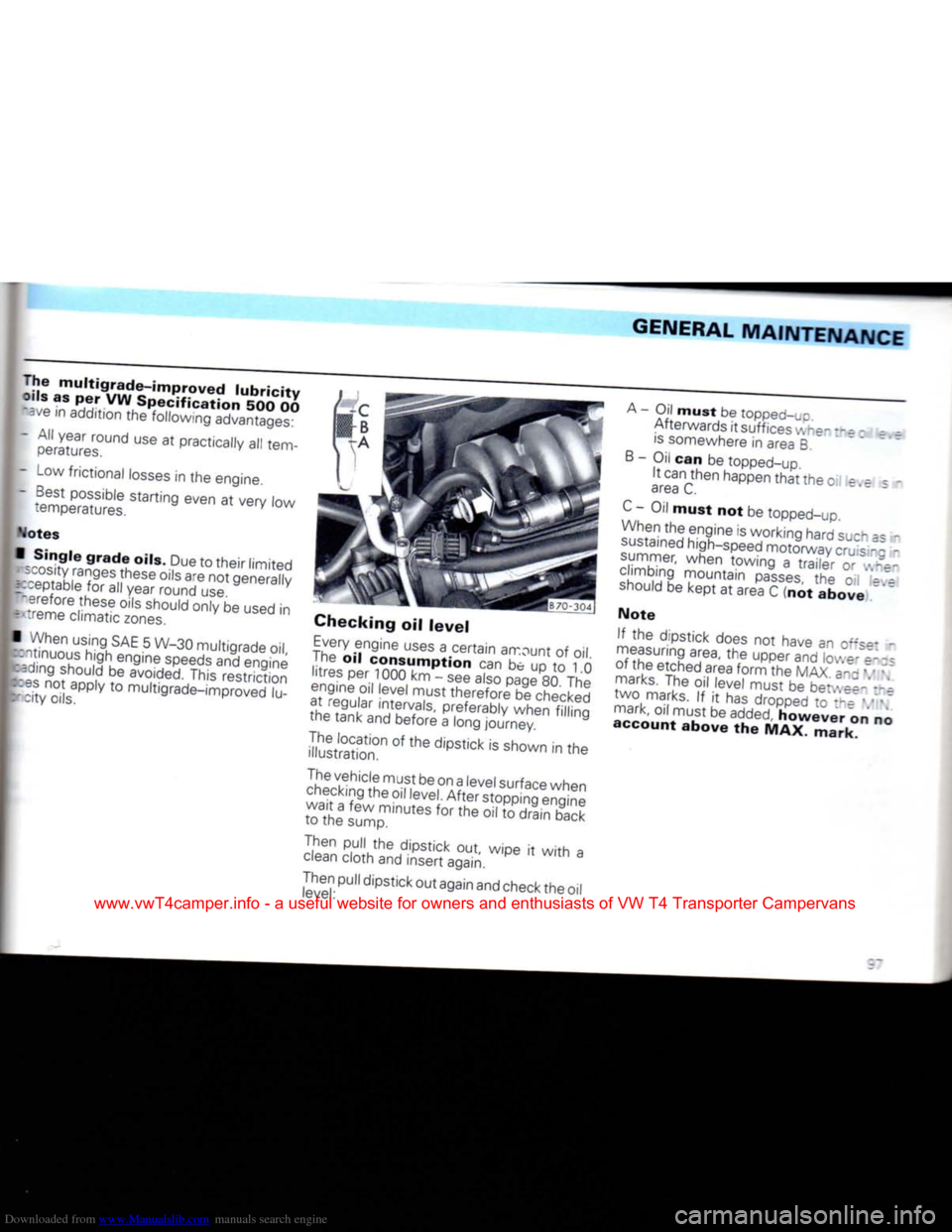
The
location of the dipstick is shown in the illustration.
The
vehicle must be on a level surface when
checking
the oil level. After stopping engine
wait a few minutes for the oil to drain back
to the sump.
Then
pull the dipstick out, wipe it
with
a
clean
cloth and insert again.
Then
pull dipstick out again and check the oil
level:
A
- Oil
must
be topped-L.c.
Afterwards it suffices v.-5-:_e : e e
is
somewhere in area B.
B
- Oil can be topped-up. It can then happen
that
the c e.e s -
area
C.
C
- Oil
must
not be topped-up.
When
the engine is working hard sue as -
sustained
high-speed motorway cruising in
summer, when towing a trailer or :re~
climbing mountain
passes,
the c: e.e
should
be kept at area C (not
above
Note
If the dipstick does not have a- c"ee: -
measuring
area,
the upper and lows- e~zi
of the etched area form the MAX.
a~
z '.'
marks.
The oil level must be betv.ee- re
two marks. If it has dropped to 're '.' ". mark, oil must be added,
however
on no
account
above
the MAX.
mark.
www.vwT4camper.info - a useful website for owners and enthusiasts of VW T4 Transporter Campervans
Page 101 of 164
Downloaded from www.Manualslib.com manuals search engine
GENERAL
MAINTENANCE
Gearbox
oil
Specifications
Manual
gearbox
and
final
drive
•
Gear
oil,
API-GL
4, SAE 80 or
•
Gear
oil, G 50, SAE 75 W-90
Automatic
gearbox
• Final drive:
Gear
oil, G 50, SAE 75 W-90 I Gearbox part: ATF Dexron®
Checking oil
level
rVith
a
manual
gearbox
and
final
drive
the oil level does not need checking.
'.ith the
automatic
gearbox
the oil
•e.
el in the final drive does not need check- *g either.
"he
ATF
level
in
gearbox
part
must ": .'/ever be checked in between the inter-
•BS
given in Service Schedule. To do this
ire vehicle must be standing on a level sur-
fe:e.
The
level must only be checked when
He ATF is
warm.
(Approximately 10 km
Irrer
starting from
cold,
the ATF has re
tted the required temperature.) If fluid is
l:: :: or too hot the reading will be incorrect.
1
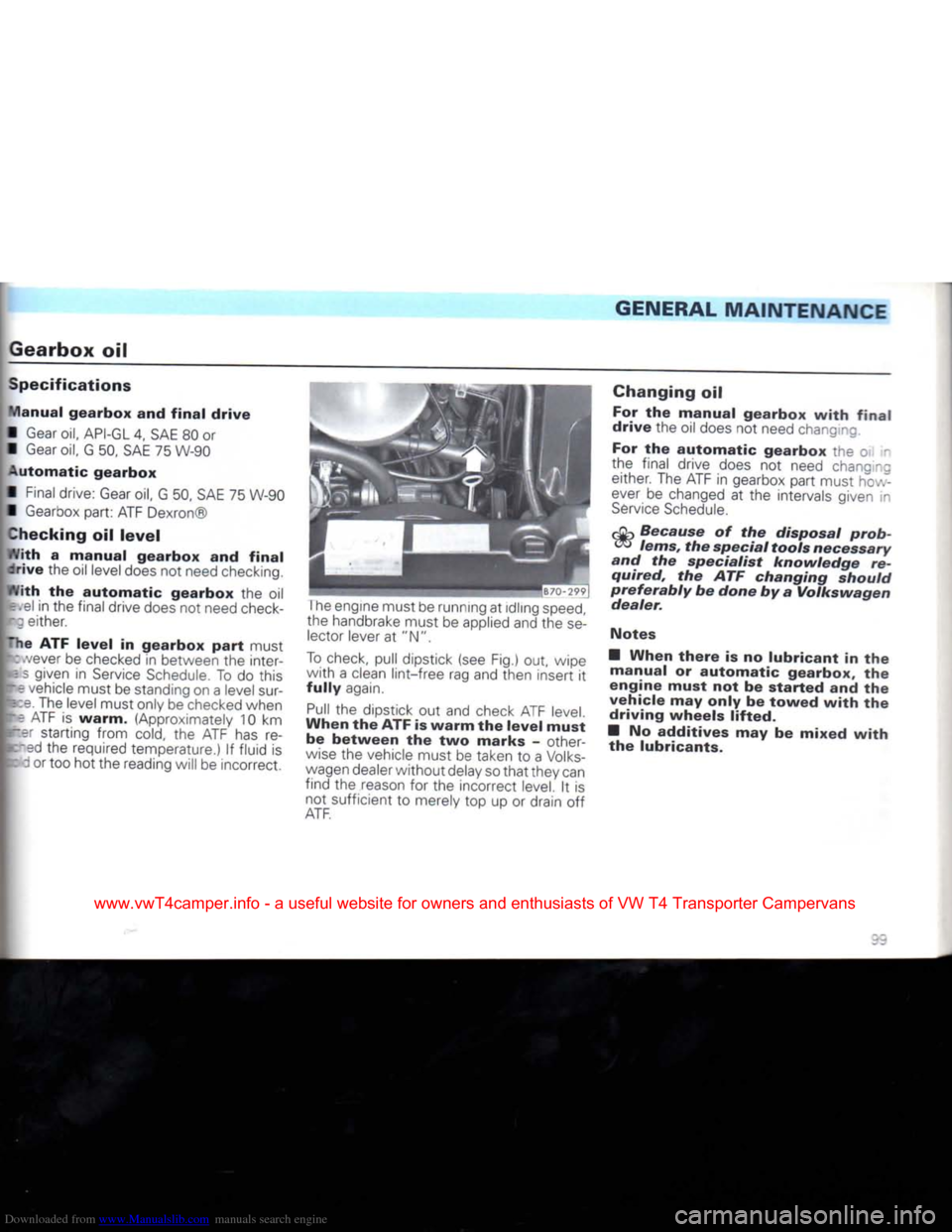
he engine must be running at idling
speed,
the handbrake must be applied and the se lector lever at "N".
To
check, pull dipstick (see Fig.) out, wipe
with a clean lint-free rag and then insert it
fully
again.
Pull
the dipstick out and check ATF
level.
When
the ATF is
warm
the
level
must
be
between
the two
marks
- other
wise
the vehicle must be taken to a
Volks
wagen
dealer without delay so that they can
find the reason for the incorrect
level.
It is not sufficient to merely top up or drain off
ATF.
Changing oil
For
the manual
gearbox
with
final
drive
the oil does not need changing.
For the
automatic
gearbox
the :
the final drive does not need
chariC-g
either. The ATF in gearbox part must how
ever
be changed at the intervals given in
Service
Schedule.
Because of the disposal
prob
lems,
the
special
tools
necessary
and the
specialist
knowledge
re
quired,
the ATF
changing
should
preferably
be
done
by a
Volkswagen
dealer.
Notes
•
When
there
is no
lubricant
in the
manual
or
automatic
gearbox,
the
engine
must
not be
started
and the
vehicle may only be
towed
with
the
driving
wheels
lifted.
• No
additives
may be
mixed
with
the lubricants.
www.vwT4camper.info - a useful website for owners and enthusiasts of VW T4 Transporter Campervans
Page 103 of 164
Downloaded from www.Manualslib.com manuals search engine
GENERAL
MAINTENANCE
nere are two marks
with
which the oil level
:an be
checked.
• Outside on container (Fig.) • Inside on dipstick attached to the cap. ~he oil level should always be between the
MAX."
and "MIN" marks. When the level
"as
dropped down below the "MIN" mark
:^e
power assisted steering should be
:necked
at a Volkswagen dealer. It is not
sufficient merely to top up
with
hydraulic oil.
Note
f the power assisted steering fails at any
: me or when engine is not running (vehicle on tow) the vehicle remains fully steerable cut more force must be used to
turn
the
steering wheel. Cooling
system
Under
normal conditions the cooling
sys
tem is almost maintenance-free.
The vehicle is
fitted
with
a hinged radiator
which can be folded forward when required
- see page 104.
The cooling system is filled at the factory
with
a permanent coolant which is not
changed.
The coolant consists of water and
a
40 % concentration of our coolant additive
G
11 V8B (anti-freeze on glycol basis
with
anti-corrosion additives). This mixture not
only gives the necessary frost protection
down to -25 degrees C but also protects the
alloy parts in the cooling system against cor
rosion.
In addition it prevents scaling and ra
ises
the boiling point of the coolant.
The concentration of the coolant therefore must not be reduced in the summer or in
warm countries, by topping up
with
plain
water. The
coolant
additive
propor
tion
must
be at
least
40 %.
If greater protection against frost is re
quired, the proportion of G 11 V8B additive
can
be increased, but only up to 60 % other
wise the anti-freeze protection is reduced
and furthermore the cooling effect is im
paired.
Vehicles
for export to cold countries -s~a .
have frost protection down to -35 decrees
C.
Only
our G 11 V8B or an additive v/rs :~e
specification
TL-VW 774 B (markea or
container) should be added to the coolant.
The additives can be obtained from
Volks
wagen dealers.
Other
additives
can be
very
detri
mental
to the
anti-corrosion
effect
in
particular.
The
subsequent
corrosion
damage
can
lead
to
coolant
loss
resulting
in
major
engine
damage.
www.vwT4camper.info - a useful website for owners and enthusiasts of VW T4 Transporter Campervans