tow VOLKSWAGEN TRANSPORTER 2013 Owner's Manual
[x] Cancel search | Manufacturer: VOLKSWAGEN, Model Year: 2013, Model line: TRANSPORTER, Model: VOLKSWAGEN TRANSPORTER 2013Pages: 486, PDF Size: 69.28 MB
Page 72 of 486
Seat functions, rear
Cl:lJ Introduction
This chapter contains information on the following subjects:
Single seats .
3-seat bench
Drawers in the 3-seat bench ......•.....
Bed extension (multi-flex board) ... Centre armrest ......................... .
Additional information and warnings:
• Adjusting the seat position 61
• Seat belts ""page 79
• Airbag system 87
• Child seats (accessories) :;.page 96
• Luggage compartment :;. page 130
• Guide rail system in rear vehicle floor :;.page 133
• Stowage ""page 150
• Vehicle tool kit ""page 416
A WARNING
73
74
76
77 78
Incorrect use of the seat functions can cause serious injuries.
• Always assume a correct sitting position before you drive and maintain this position throughout the trip. This also applies to all passengers.
721 Before the journey
A WARNING (Continued)
• Keep hands, fingers, feet and other body parts away from the moving parts of the seats.
A WARNING
Incorrect adjustment or removing and fitting single seats and/or the bench seats can cause accidents and severe Injuries.
• All adjustments as well as removing/fitting should be carried out only when the vehicle is stationary; otherwise the single seats and/ or the bench seats could move suddenly when the vehicle Is In motion. Furthermore, an Incorrect seating position Is adopted while adjusting the seat.
• All single seats and the bench seats must always be fitted In their retainers and must be securely engaged.
• Never use the table while the vehicle is In motion. All backrests must be In the upright position and securely engaged in this posi-tion while the vehicle Is In motion.
• Never fit single seats behind the 3-seat bench.
• Never fit two 3-seat benches In the vehi-cle.
• While fitting and removing the single seats and/or the bench seat, make sure that the seat feet are not soiled or damaged.
• Never use child seats In the groups 0 or 0+ on single seats that face the rear of the vehicle. <
Page 73 of 486
Single seats
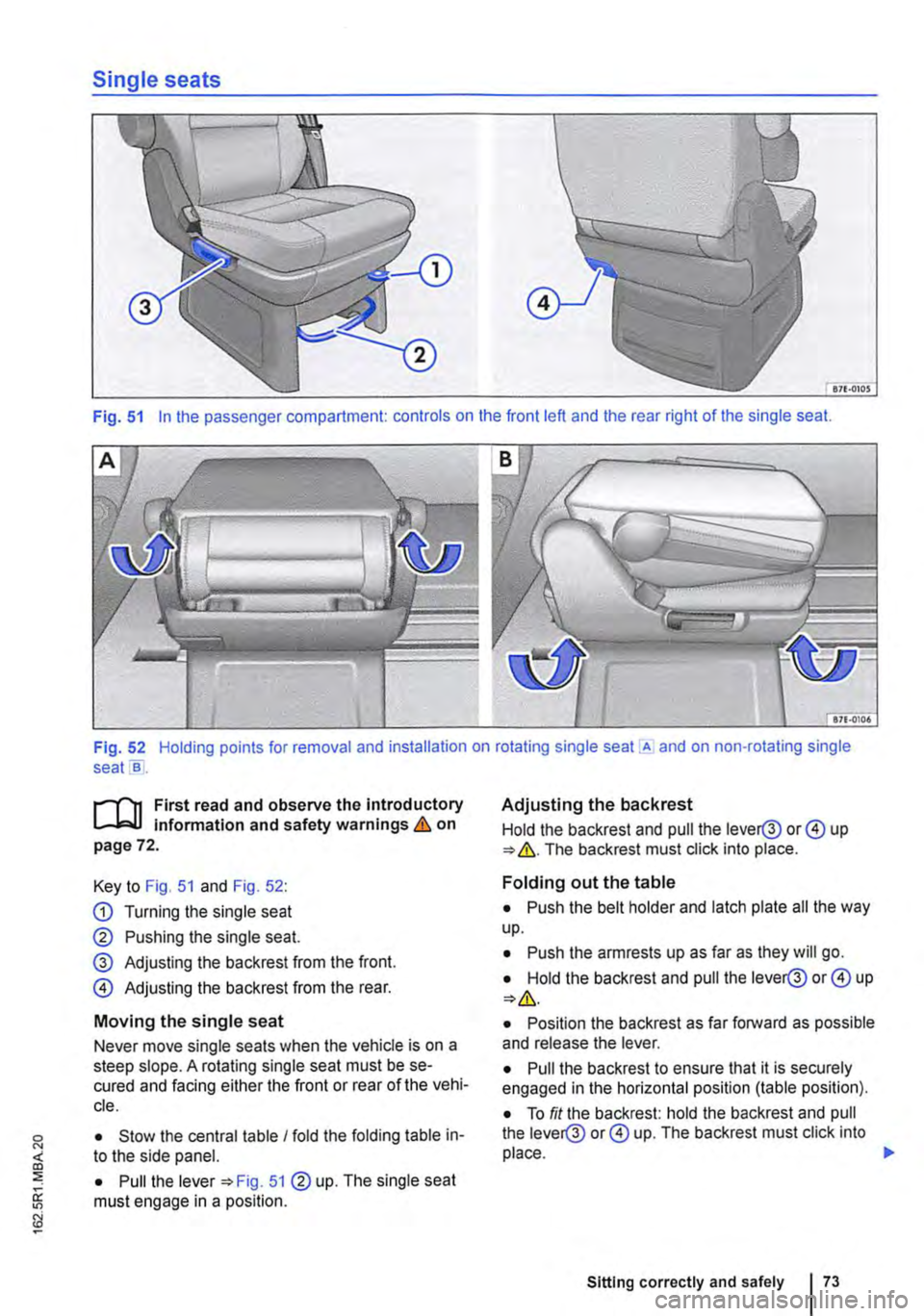
Fig. 51 In the passenger compartment: controls on the front left and the rear right of the single seat.
Fig. 52 Holding points for removal and installation on rotating single seat .A and on non-rotating single seats .
....-m First read and observe the introductory L.-.lo:.U Information and safety warnings & on page 72.
Key to Fig. 51 and Fig. 52:
CD Turning the single seat
@ Pushing the single seat.
@ Adjusting the backrest from the front.
0 Adjusting the backrest from the rear.
Moving the single seat
Never move single seats when the vehicle is on a steep slope. A rotating single seat must be se-cured and facing either the front or rear of the vehi-cle.
• Stow the central table I fold the folding table in-to the side panel.
• Pull the lever 51@ up. The single seat must engage in a position.
Adjusting the backrest
Hold the backrest and pull the lever@ or 0 up ""'&.The backrest must click into place.
Folding out the table
• Push the belt holder and latch plate all the way up.
• Push the armrests up as far as they will go.
• Hold the backrest and pull the lever@ or 0 up
• Position the backrest as far forward as possible and release the lever.
• Pull the backrest to ensure that it is securely engaged in the horizontal position (table position).
• To fit the backrest: hold the backrest and pull the lever@ or 0 up. The backrest must click into place. 11>
Sitting correctly and safely
Page 75 of 486
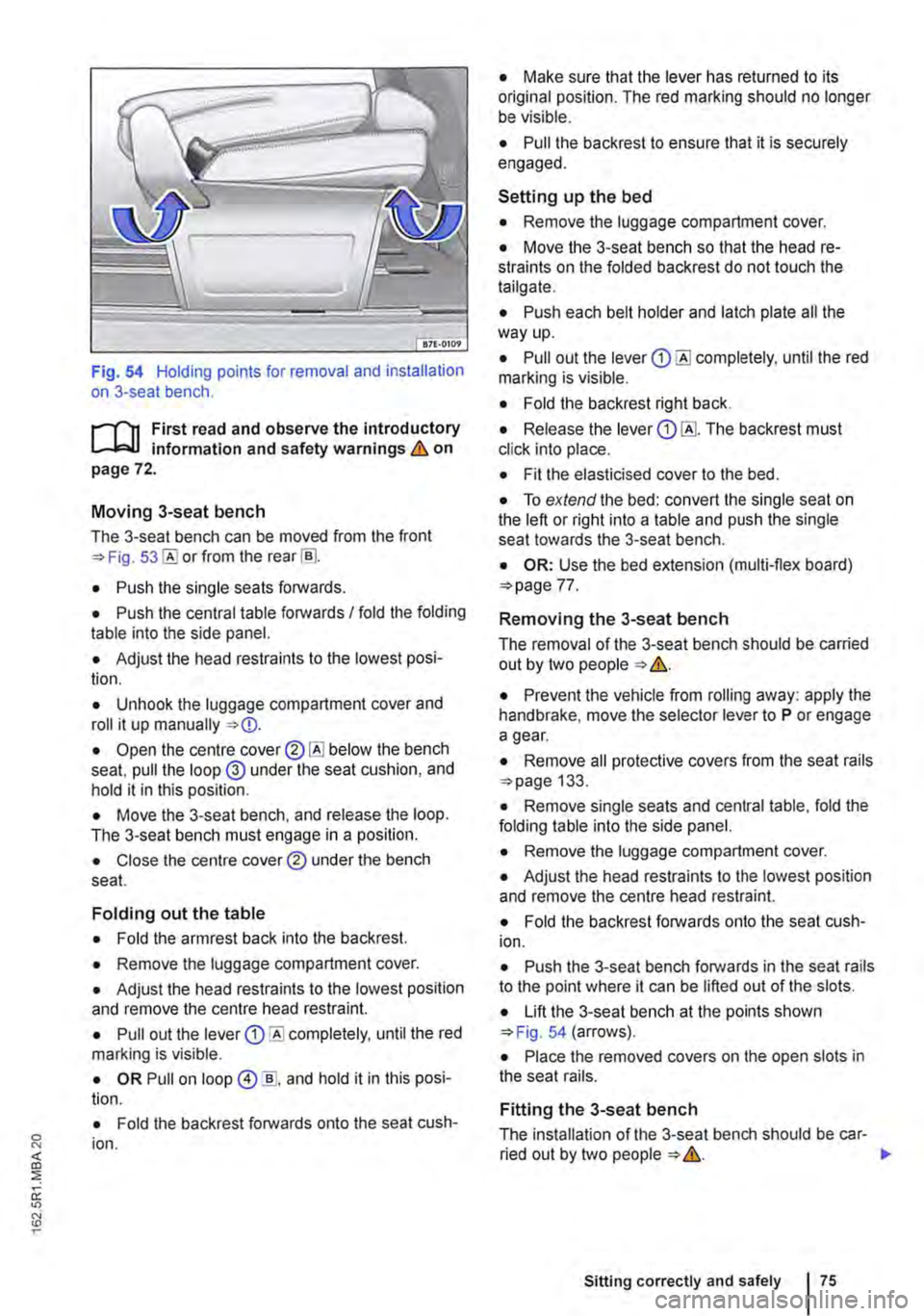
Fig. 54 Holding points for removal and installation on 3-seat bench.
,....-m First read and observe the introductory L-W.I information and safety warnings & on page 72.
Moving 3-seat bench
The 3-seat bench can be moved from the front =>Fig. or from the rear [ru.
• Push the single seats forwards.
• Push the central table forwards I fold the folding table into the side panel.
• Adjust the head restraints to the lowest posi-tion.
• Unhook the luggage compartment cover and roll it up manually =>
• Move the 3-seat bench, and release the loop. The 3-seat bench must engage in a position.
• Close the centre cover® under the bench seat.
Folding out the table
• Fold the armrest back into the backrest.
• Remove the luggage compartment cover.
• Adjust the head restraints to the lowest position and remove the centre head restraint.
• Pull out the lever Q) completely, until the red marking is visible.
• OR Pull on loop @ ]], and hold it in this posi· lion.
• Fold the backrest forwards onto the seat cush· ion.
• Make sure that the lever has returned to its original position. The red marking should no longer be visible.
• Pull the backrest to ensure that it is securely engaged.
Setting up the bed
• Remove the luggage compartment cover.
• Move the 3-seat bench so that the head re· straints on the folded backrest do not touch the tailgate.
• Push each belt holder and latch plate all the way up.
• Pull out the lever Q) until the red marking is visible.
• Fold the backrest right back.
• Release the lever Q) The backrest must click into place.
• Fit the elasticised cover to the bed.
• To extend the bed: convert the single seat on the left or right into a table and push the single seat towards the 3-seat bench.
• OR: Use the bed extension (multi-flex board) =>page 77.
Removing the 3-seat bench
The removal of the 3-seat bench should be carried out by two people => &.
• Prevent the vehicle from rolling away: apply the handbrake, move the selector lever to P or engage a gear.
• Remove all protective covers from the seat rails =>page 133.
• Remove single seats and central table, fold the folding table into the side panel.
• Remove the luggage compartment cover.
• Adjust the head restraints to the lowest position and remove the centre head restraint.
• Fold the backrest forwards onto the seat cush-ion.
• Push the 3-seat bench forwards in the seat rails to the point where it can be lifted out of the slots.
• Lift the 3-seat bench at the points shown =>Fig. 54 (arrows).
• Place the removed covers on the open slots in the seat rails.
Fitting the 3-seat bench
The installation of the 3-seat bench should be car-ried out by two people => &. .,.
Sitting correctly and safely
Page 76 of 486
• Remove all protective covers from the seat rails =-page 133.
• Lift the 3-seat bench at the points shown =>Fig. 54 (arrows).
• Place the feet of the 3-seat bench into the slots so that the backrest is facing the rear of the vehi-cle.
• Adjust the backrest to an upright position.
• Make sure that the lever or the loop has re-turned to its original position. The red marking should no longer be visible.
• Pull the backrest to ensure that it is securely engaged.
• Insert the single seats and the central table into the seat rails and push them back.
• Lock the single seats and the central table se-curely in the seat rails.
• Place the removed covers on the open slots in the seat rails.
Drawers in the 3-seat bench
r' ,f} I
---
VII f/l/ \\\
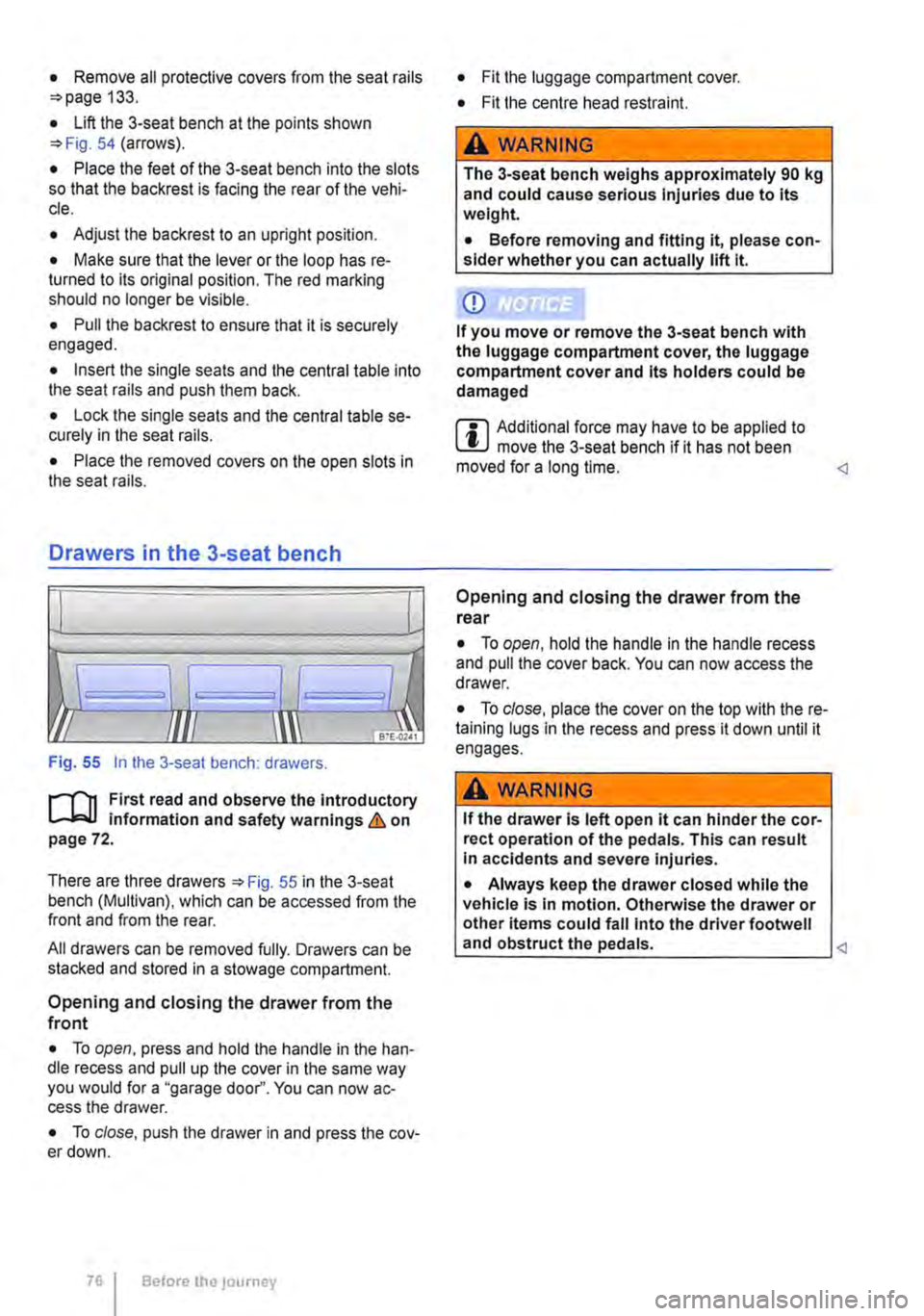
Fig. 55 In the 3-seat bench: drawers.
1""111 First read and observe the Introductory L-lo:oJJ information and safety warnings & on page 72.
There are three drawers =-Fig. 55 in the 3-seat bench (Multivan), which can be accessed from the front and from the rear.
All drawers can be removed fully. Drawers can be stacked and stored in a stowage compartment.
Opening and closing the drawer from the front
• To open, press and hold the handle in the han-dle recess and pull up the cover in the same way you would for a "garage door". You can now ac-cess the drawer.
• To close, push the drawer in and press the cov-er down.
76 Before the journey
• Fit the luggage compartment cover.
• Fit the centre head restraint.
A wARNING
The 3-seat bench weighs approximately 90 kg and could cause serious Injuries due to its weight.
• Before removing and fitting it, please con-sider whether you can actually lift it.
CD
If you move or remove the 3-seat bench with the luggage compartment cover, the luggage compartment cover and Its holders could be damaged
m Additional force may have to be applied to W move the 3-seat bench if it has not been moved for a long lime.
• To open, hold the handle in the handle recess and pull the cover back. You can now access the drawer.
• To close, place the cover on the top with the re-taining lugs in the recess and press it down until it engages.
A WARNING
If the drawer Is left open it can hinder the cor-rect operation of the pedals. This can result In accidents and severe Injuries.
• Always keep the drawer closed while the vehicle is in motion. Otherwise the drawer or other items could fall Into the driver footwell and obstruct the pedals.
Page 77 of 486
Bed extension (multi-flex board)
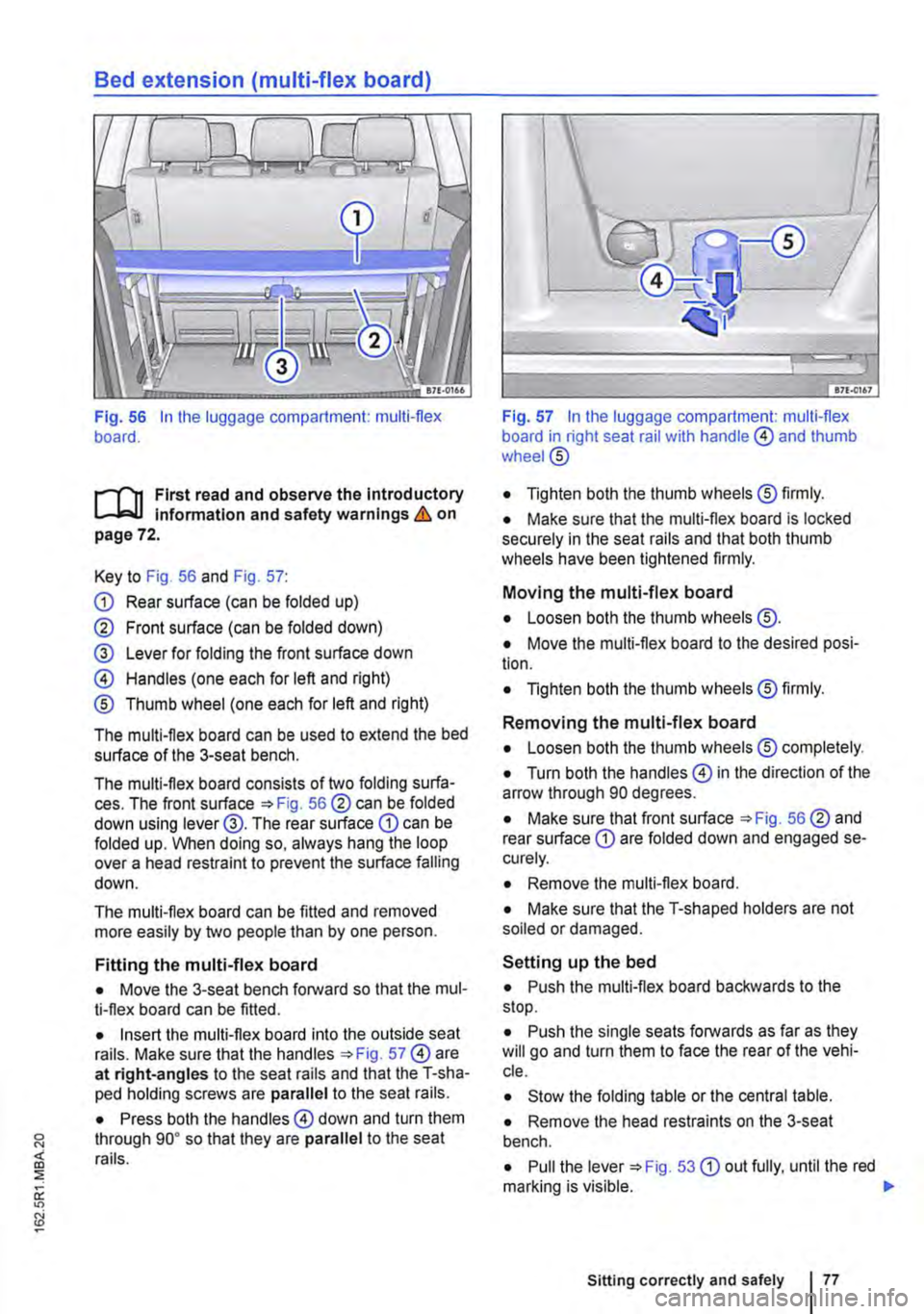
Fig. 56 In the luggage compartment: multi-flex board.
.--m First read and observe the Introductory L-.J,..U lnfonmatlon and safety warnings & on page 72.
Key to Fig. 56 and Fig. 57:
CD Rear surface (can be folded up)
@ Front surface (can be folded down)
@ Lever for folding the front surface down
@ Handles (one each for left and right)
® Thumb wheel (one each for left and right)
The multi-flex board can be used to extend the bed surface of the 3-seat bench.
The multi-flex board consists of two folding surfa-ces. The front surface =>Fig. 56@ can be folded down using lever@. The rear surface CD can be folded up. When doing so, always hang the loop over a head restraint to prevent the surface falling down.
The multi-flex board can be fitted and removed more easily by two people than by one person.
Fitting the multi-flex board
• Move the 3-seat bench forward so that the mul-ti-flex board can be fitted.
• Insert the multi-flex board into the outside seat rails. Make sure that the handles =>Fig. 57@ are at right-angles to the seat rails and that the T-sha-ped holding screws are parallel to the seat rails.
• Press both the handles@ down and turn them through go• so that they are parallel to the seat rails.
Fig. 57 In the luggage compartment: multi-flex board in right seat rail with handle @ and thumb wheel@
• Tighten both the thumb wheels® firmly.
• Make sure that the multi-flex board is locked securely in the seat rails and that both thumb wheels have been tightened firmly.
Moving the multi-flex board
• Loosen both the thumb wheels @.
• Move the multi-flex board to the desired posi-tion.
• Tighten both the thumb wheels® firmly.
Removing the multi-flex board
• Loosen both the thumb wheels® completely.
• Turn both the handles@ in the direction of the arrow through 90 degrees.
• Make sure that front surface =>Fig. 56@ and rear surface CD are folded down and engaged se-curely.
• Remove the multi-flex board.
• Make sure that the T-shaped holders are not soiled or damaged.
Setting up the bed
• Push the multi-flex board backwards to the stop.
• Push the single seats forwards as far as they will go and turn them to face the rear of the vehi-cle.
• Stow the folding table or the central table.
• Remove the head restraints on the 3-seat bench.
• Pull the lever =>Fig. 53 CD out fully, until the red marking is visible. 11>
Sitting correctly and safely
Page 79 of 486
Seat belts
o:n Introduction
This chapter contains information on the following subjects:
Warning lamp . . . . . . . . . . . 80
Frontal collisions and the laws of physics 81
What happens to vehicle occupants who have not fastened their seat belts 82
Seat belt protection . . . . . . . . . . . . . . . . . . . . . . 83 Using seat belts . . . . . . . . . . . . . . 83
Fastening and unfastening seat belts . 84 Seat belt routing . . . . . . . . . . . . . . . . . . 85
Belt height adjuster . . . . . . . . . . . . . . . . 86
Automatic belt retractor and belt tensioner . . . 86
Service and disposal of belt tensioners . . 87
Check the condition of all seat belts regularly. If the belt webbing, belt connections, belt retractor or seat belt buckle become damaged, the seat belt in question should be replaced immediately by a qualified workshop=:.&. The qualified workshop must use correct spare parts that are compatible with the vehicle, equipment level and model year. Volkswagen Commercial Vehicles recommends us-ing a Volkswagen Commercial Vehicles dealership for this purpose.
Additional information and warnings:
• Adjusting the seat position =:.page 61
• Seat functions, rear =>page 72
• Airbag system =>page 87
• Child seats (accessories) =:.page 96
• Integrated child seats =:.page 102
• Stowage =>page 150
• Seat functions, rear, Business =>page 182
• Seat functions, rear, California =:.page 193
• Cleaning and caring for the interior =:.page 388
• Accessories, modifications, repairs and renewal of parts =>page 394
A WARNING
Incorrectly fastened or unfastened seat belts increase the risk of severe or fatal injuries. Seat belts will only offer the optimum level of protection when they are fastened and used properly.
A WARNING (Continued)
• Seat belts are the most effective means of reducing the risk of serious and fatal injuries In the event of an accident. Seat belts must always be fastened properly when the vehicle Is In motion to protect the driver and all vehi-cle occupants.
• Before every trip, each vehicle occupant must adopt the correct sitting position, cor-rectly fasten the seat belt belonging to their seat and keep it fastened properly throughout the trip. This applies to all vehicle occupants and also In urban traffic.
• While the vehicle is in motion, secure all children travelling In the vehicle in a restraint system suitable for their weight and height. They must also wear correctly fastened seat belts =>page 96.
• Only start driving when all passengers have correctly fastened their seat belts.
• Only ever insert the latch plate into the buckle of the associated seat, and always en-sure that it engages properly. Using a buckle that does not belong to the seat that you are occupying reduces the level of protection and can lead to severe injuries.
• Avoid allowing foreign bodies or liquids to enter the slot for the seat belt buckle. This could prevent the belt buckle and seat belt from working properly.
• Never unfasten the seat belt while the ve-hicle is in motion.
• Never allow more than one person to share the same seat belt.
• Never travel when children or babies are being carried on somebody's lap and fas-tened with the same belt.
• Never travel wearing loose, bulky clothing (such as an overcoat over a jacket). This could prevent the seat belts from fitting and functioning properly.
A WARNING
Damaged seat belts are very dangerous and can cause severe or fatal Injuries.
• Never damage the belt by trapping it in the door or in the seat mechanism. 11>
Sitting correctly and safely
Page 97 of 486
![VOLKSWAGEN TRANSPORTER 2013 Owners Manual Basic information on fitting and using child seats
A AIRBAG
(®
(!]
c:::J
BTT·I20J
Fig. 77 Airbag information sticker on the sun vi-sor.
r""(n First read and observe the introductory L.....J](/img/18/55784/w960_55784-96.png "VOLKSWAGEN TRANSPORTER 2013 Owners Manual Basic information on fitting and using child seats
A AIRBAG
(®
(!]
c:::J
BTT·I20J
Fig. 77 Airbag information sticker on the sun vi-sor.
r\"\"(n First read and observe the introductory L.....J")
Basic information on fitting and using child seats
A AIRBAG
(®
(!]
c:::J
BTT·I20J
Fig. 77 Airbag information sticker on the sun vi-sor.
r""'('n First read and observe the introductory L.....Ja,U information and safety warnings & on page 96.
Information on fitting a child seat
Observe the following general information when fit-ling a child seat. This information is relevant what-ever child seat securing system is being used.
• Read and follow the instructions provided by the child seat manufacturer =:-&.
• Whenever possible, fit child seats to one of the rear seats on the front passenger side so that chil-dren can exit the vehicle on the kerb side.
• Deactivate the front passenger front airbag if fit-ting a rear-facing child seat on the front passenger seat.
• If a child seat is fitted on the front passenger seat, move the backrest to the upright position. slide the seat back as far as it will go, and set the seat height adjustment and belt height adjuster to the highest position.
• When fitting a child seat on the vehicle's rear seats, leave as much unencumbered space as possible around the child seat. If necessary, adjust the position of the relevant front seat. When doing so, ensure that the driver or front passenger can stili maintain a correct sitting position =:-page 61.
• Adjust the seat backrest angle so that the child seat lies flush against the backrest.
• When using child seats with a backrest, remove the vehicle head restraints and stow them safely in the vehicle =:-page 61. Reinstall the head restraint after the child seat has been removed.
Airbag sticker
The vehicle may be provided with stickers giving key information about the front passenger front air-bag. The information on these stickers may vary from country to country. The stickers may be at-tached on the sun visor for the driver and/or front passenger=:-Fig. 77.
11 is essential to note the warning information shown on these stickers before installing a rear-facing child seat =:-&.
Risks involved in carrying children on the front passenger seat
If you are using a rear-facing child seat, the front passenger front airbag can cause critical or poten-tially fatal injuries when it inflates =:-&.
Rear-facing child seat may only be used on the front passenger seat if the front passenger front airbag has been deactivated. An indicator lamp in the centre console lights up steadily when the front passenger front airbag has been effectively deacti-vated. Deactivating the front passenger front air-bag =:-page 87.
If using a front-facing child seat, do not deacti-vate the front passenger front airbag.
When fitting a child seat, make sure that it is as far away as possible from the front passenger airbag. The front passenger front airbag can cause severe injuries when it inflates =:-&.
Some child seats are not suitable for use on the front passenger seat. Any child seat fitted on the front passenger seat must be specially authorised by the manufacturer for this use in vehicles with front and side airbags. Volkswagen dealers hips keep an up-to-date list of authorised child seats.
Risks presented by side airbags
Any child on the front passenger seat may be hit on the head and severely injured by the front side airbag inflating =:-&.
If you use a rear-facing child seat on the front passenger seat the child in it is at increased risk of sustaining critical or fatal injuries In the event of an accident.
• Deactivate the front passenger front air-bag. If the front passenger front airbag can-not be deactivated no rear-facing child seat may be used. 11>
Sitting correctly and safely
Page 101 of 486
Installing child seats with ISOFIX ISOFIX/i-
Size
The location of the ISO FIX anchor points is shown either by a symbol or by a label marked "ISOFIX" 79.
• Observe the warnings 97, Basic infor-mation on fitting and using child seats.
• Push the attachment arms on the child seat into the ISOFIX anchor points 79 as shown by the arrows. The child seat must click and audibly securely into place.
• Pull on both sides of the child seat to check whether the seat has clicked properly into place.
• If the child seat is fitted with a support foot, the foot must sit firmly on the floor of the vehicle.
Using insert guides
If the child seat anchor points are not directly ac-cessible, insert guides make fitting and removing the child seat easier. First attach the insert guides to the anchor points. Then secure the child seat as per the installation guide.
CD
Avoid damage to the upholstery and seat cush-ions caused by the Insert guides.
• Always pull the insert guides off the anchor points before folding the rear seat forward, or when removing the child seat.
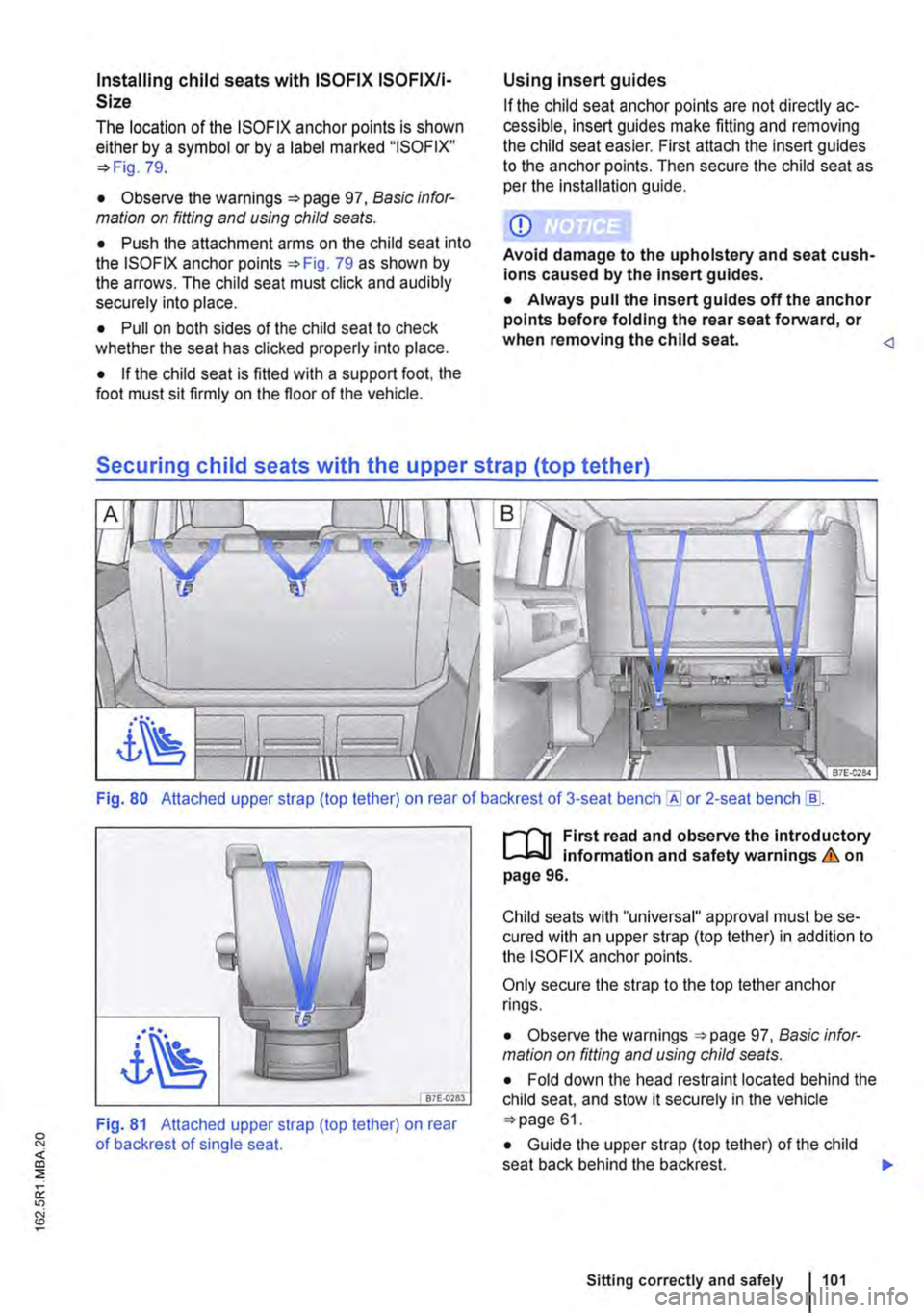
Fig. 80 Attached upper strap (top tether) on rear of backrest of 3-seat or 2-seat bench [ID.
87E-0783
Fig. 81 Attached upper strap (top tether) on rear of backrest of single seat.
r-1'11 First read and observe the Introductory L-lcJ.I Information and safety warnings & on page 96.
Child seats with "universal" approval must be se-cured with an upper strap (top tether) in addition to the ISOFIX anchor points.
Only secure the strap to the top tether anchor rings.
• Observe the warnings 97, Basic infor-mation on fitting and using child seats.
• Fold down the head restraint located behind the child seat, and stow it securely in the vehicle 61.
• Guide the upper strap (top tether) of the child seat back behind the backrest. )I>
Sitting correctly and safely 1101
Page 108 of 486
@ Main beam headlights switched on &. The indicator lamp m in the instrument cluster lights up.
Pull the lever briefly in the direction of the ar-row @to switch off the main beam headlights.
@ Operate headlight flasher. The headlight flash-er comes on for as long as the lever is pulled. The indicator lamp ID lights up.
Lane change flash
To operate the lane change flash, push the lever up or down to the point where you incur resistance and then release the lever. The turn signal flashes three times.
This lane change flash function can be deactivated at a qualified workshop.
A WARNING
Incorrect use of turn signals, a failure to use turn signals, or forgetting to switch off a turn signal can confuse other road users. This can lead to accidents and serious Injuries.
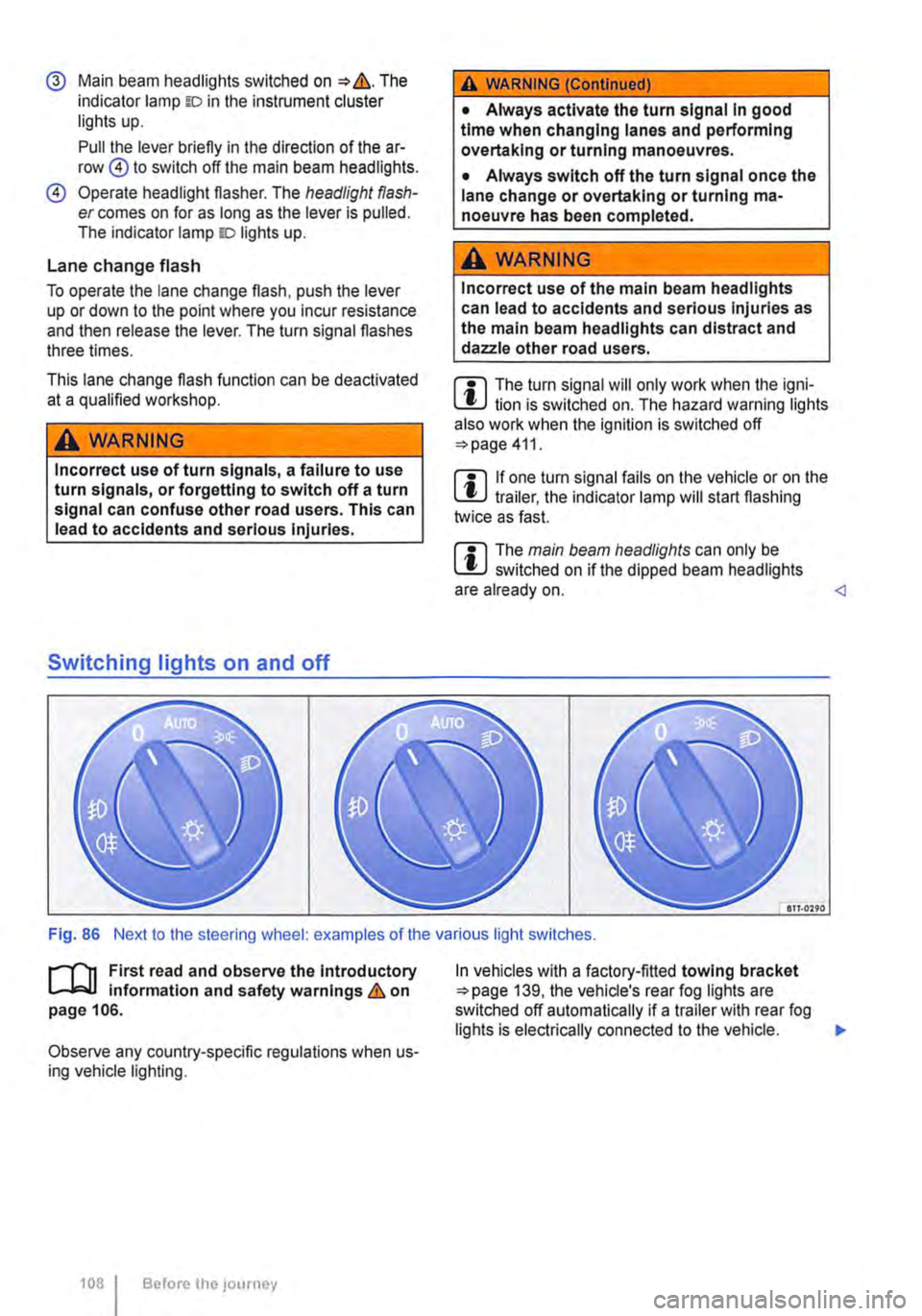
Switching lights on and off
A WARNING (Continued)
• Always activate the turn signal In good time when changing lanes and performing overtaking or turning manoeuvres.
• Always switch off the turn signal once the lane change or overtaking or turning ma-noeuvre has been completed.
A WARNING
Incorrect use of the main beam headlights can lead to accidents and serious Injuries as the main beam headlights can distract and dazzle other road users.
m The turn signal will only work when the igni-m lion is switched on. The hazard warning lights also work when the ignition is switched off 411.
m If one turn signal fails on the vehicle or on the m trailer, the indicator lamp will start flashing twice as fast.
m The main beam headlights can only be m switched on if the dipped beam headlights are already on.
l"'""'rT1 First read and observe the Introductory L--J,::.,U information and safety warnings & on page 106.
Observe any country-specific regulations when us-ing vehicle lighting.
1081 Before the; journey
In vehicles with a factory-fitted towing bracket 139, the vehicle's rear fog lights are switched off automatically if a trailer with rear fog lights is electrically connected to the vehicle. .,.
Page 110 of 486
Automatic headlight control AUTO
The automatic headlight control is merely an aid and will not always be able to detect all driving sit-uations.
If the light switch is in position AUTO, the vehicle lights and the lighting in instruments and switches will switch on and off automatically in the following situations => .&.:
Automatically switched on
• When the rain sensor detects darkness, e.g. when driving through tunnels.
• When the rain sensor detects that it is raining and switches the wipers on.
Automatically switched off
• When the rain sensor detects that there is enough light.
• When the wipers have not been used for a few minutes.
Static cornering light
When cornering slowly or travelling around very tight bends, a static cornering light is switched on automatically to illuminate the inside of the bend.
The static cornering light is integrated into the fog lights and only lights up at speeds below approxi-mately 40 km/h (25 mph).
When reverse gear is engaged, the static corner-ing light on both sides of the vehicle may switch on to provide better illumination of the area when ma-noeuvring.
Main beam assist
r-("'n First read and observe the introductory 1..-JcJl Information and safety warnings.&. on page 106.
Main beam assist can help to prevent other road users from being dazzled.
Main beam assist (Light Assist)
Within the limits of the system, the main beam as-sist automatically switches the main beam on at speeds of over approximately 60 kmlh (37 m ph),
110 I Before the journey
A WARNING
Accidents can occur if roads are not suffi-ciently Illuminated and other road users have difficulty seeing the vehicle, or cannot see it at all.
• The automatic headlight control (AUTO) only switches on the dipped beam headlights when there is a change In the level of bright-ness and not, for example, if it Is foggy.
• Never drive with daytime running lights if the street Is not sufficiently lit due to weather and lighting conditions. The daytime running lights are not bright enough to Illuminate the road ahead and to ensure that other road users are able to see you.
• The rear lights will not be switched on with the daytime running lights. If the rear lights are not switched on, the vehicle may not be visible to other road users If it Is dark, raining, or If visibility Is poor.
m In cool or damp weather, the interior of the l..!J headlights, rear lights and turn signals may mist up briefly. This is normal and does not affect the service life of the lighting system of your vehi-cle.
Main beam assist normally recognises illuminated areas such as towns and deactivates the main beam while driving through them. .,.