page VOLKSWAGEN TRANSPORTER 2013 Owners Manual
[x] Cancel search | Manufacturer: VOLKSWAGEN, Model Year: 2013, Model line: TRANSPORTER, Model: VOLKSWAGEN TRANSPORTER 2013Pages: 486, PDF Size: 69.28 MB
Page 398 of 486
Retrofitting two-way radios
.--m First read and observe the introductory L-.lc.U information and safety warnings & on page 394.
You will need an external aerial to use a two-way radio in the vehicle.
Any retrofit installation of electrical or electronic equipment in the vehicle will affect its vehicle type approval. Under certain circumstances, this can negate the type approval for the vehicle.
Volkswagen Commercial Vehicles has approved the vehicle for use with two-way radios providing the following conditions are observed:
• Correct installation of external aerial.
• A maximum transmitting power of 10 watts.
The equipment can only operate at maximum range with an external aerial.
Check first with a qualified workshop if you wish to use a two-way radio with a transmitting power of over 10 watts. Qualified workshops are familiar with the technical options for retrofitting. Volkswa-gen Commercial Vehicles recommends using a Volkswagen Commercial Vehicles dealership for this purpose.
Information stored in the control units
.--m First read and observe the introductory L-.lc.U Information and safety warnings & on page 394.
Your vehicle is factory fitted with electronic control units which are responsible for engine and gearbox management. The control units also monitor the function of the exhaust system and the airbags.
These electronic control units continuously evalu-ate data relevant to the vehicle while the vehicle is being driven. Only these data will be stored if there are any faults recorded or any deviations from the specified values. This is generally displayed by the indicator lamps on the instrument cluster.
Special units are required to read and evaluate da-ta stored in the control units.
These data are stored so that specialist workshops can diagnose and solve problems. The following data may have been stored:
• Engine and gearbox-relevant data.
• Speed.
• Direction of travel.
398 Cleaning and maintenance
Please comply with relevant legislation and the in-structions and information given in the operating manuals for radio equipment.
A WARNING
If radio equipment is not secured or not prop-erly secured in the vehicle, it could be flung though the interior during a sudden driving or braking manoeuvre, or In the event of an accident. This can cause Injuries.
• While the vehicle is in motion, always se-cure radio equipment properly outside the airbag deployment zone or stow them away safely.
A CAUTION
If you use two-way radios in the car without an external aerial, electromagnetic radiation in the vehicle could exceed limit values. This also applies to external aerials which have not been correctly installed.
• Two-way radios should only be used In the vehicle If an external aerial Is properly connected.
• Braking power.
• Seat belt monitor.
The control units never record conversations that take place in the vehicle. it is neither possible nor permitted to use the stored data to create move-ment profiles.
When the vehicle is being used, situations may arise in which the stored data (alone or in conjunc-tion with other information such as accident re-ports, vehicle damage, witness statements etc.) can become assignable to a particular person, whereby consultation of an expert and use of the expert's information may be necessary.
In vehicles with an emergency call function via a mobile telephone or other units, the current loca-tion can be transmitted. In the event of an accident in which the control units register that an airbag has been triggered, the system can automatically send out a signal. This depends on your service provider. Transmission is possible only in areas
Page 399 of 486
Additional functions that are contractually agreed with the customer, e.g. vehicle positioning in an emergency, allow certain vehicle data to be trans-mitted from the vehicle.
Event data recorder
The vehicle is not fitted with an event data record-er.
Event data recorders temporarily store vehicle in-formation. This provides precise information in the event of an accident. In vehicles with an airbag system, data that might be relevant in the event of an accident can be stored, e.g. impact speed, belt buckle status, seat positions and trigger speed. The scope of the data is manufacturer-specific.
An event data recorder may only be fitted if the owner has approved the procedure. This is cov-ered by legislation in some countries.
Reprogramming control units
All data for the control of components are stored in the control units. Some convenience functions, such as lane change flash, single door unlocking and displays, can be reprogrammed using special workshop equipment. If this is the case, the de-scriptions in your vehicle wallet will no longer cor-respond with the original functions. Volkswagen Commercial Vehicles recommends that any re-programming should be confirmed in the service schedule under "Workshop comments".
Information about possible reprogramming can be obtained from the Volkswagen dealership.
Reading the vehicle's event memory
There is a diagnostic interface for reading the event memories in the vehicle interior &. Data relating to the function and status of the electronic control units are stored in the event memory. Addi-tional information on the stored data is available from qualified workshops.
The diagnosis interface is located in the footwell on the driver side behind a cover next to the lever for opening the bonnet.
The event memory should only be read and reset by a qualified workshop.
After a fault has been rectified, the information in the memory pertaining to the fault is deleted. Other memory content is overwritten on an on-going ba-sis.
A WARNING
Incorrect use of the diagnostic Interface can cause faults, which can result in accidents and serious injuries.
• Never read the event memory using the di-agnostic Interface yourself.
• The diagnostic Interface should only be read by a qualified workshop.
external aerial
,...--.m First read and observe the introductory L--I=>U information and safety warnings & on page 394.
Both during telephone calls and in standby mode, mobile telephones transmit and receive radio waves, which may also be termed "high-frequency energy". Current scientific literature warns us that radio waves can be harmful to human beings if they exceed certain limits. Government bodies and international committees have introduced threshold values and guidelines to ensure that electromag-netic radiation produced by mobile telephones does not pose a hazard to health. However, there is no proven scientific evidence that demonstrates that cordless telephones are absolutely safe.
For this reason, some experts are calling for more precautions to be taken in the use of mobile tele-phones, by taking steps to reduce the level of per-sonal exposure to electromagnetic radiation.
If a mobile telephone that is not connected to the vehicle's external aerial is used inside the vehicle, the level of electromagnetic radiation could be higher than when the mobile telephone is connec-ted to an integrated aerial or any other external aerial.
If the vehicle is fitted with a suitable hands-free unit which enables the use of innumerable additional functions of Bluetooth® compatible mobile tele-phones, this will satisfy the legal requirements in many countries which permit the use of a mobile telephone in a vehicle only if a hands-free unit is used.
The factory-fitted hands-free system in your vehicle has been developed for use with mobile tele-phones that are compatible with Bluetooth®_ Mo-bile telephones must be carried in a suitable tele-phone holder or be stored securely in the vehicle. If a telephone holder is used it must be securely at-tached to the base plate. This is the only way to .,.
Vehicle care and maintenance 399
Page 401 of 486
Vehicle lifting points
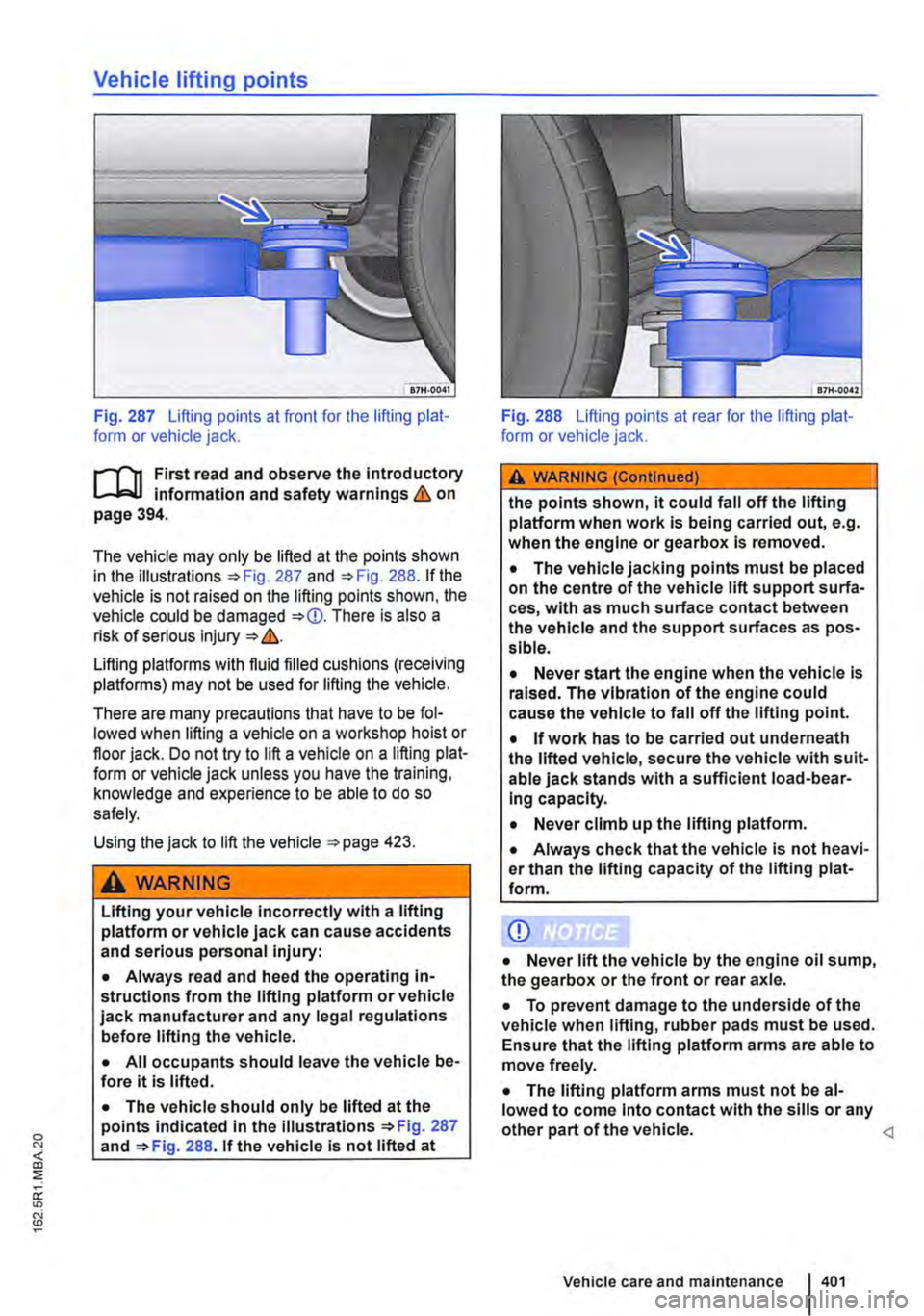
Fig. 287 Lifting points at front for the lifting plat-form or vehicle jack.
First read and observe the introductory l.-J,::..U information and safety warnings & on page 394.
The vehicle may only be lifted at the points shown in the illustrations =>Fig. 287 and =>Fig. 288. If the vehicle is not raised on the lifting points shown, the vehicle could be damaged =>
Lifting platforms with fluid filled cushions (receiving platforms) may not be used for lifting the vehicle.
There are many precautions that have to be fol-lowed when lifting a vehide on a workshop hoist or floor jack. Do not try to lift a vehicle on a lifting plat-form or vehicle jack unless you have the training, knowledge and experience to be able to do so safely.
Using the jack to lift the vehicle =>page 423.
A WARNING
Lifting your vehicle incorrectly with a lifting platform or vehicle jack can cause accidents and serious personal injury:
• Always read and heed the operating in-structions from the lifting platform or vehicle jack manufacturer and any legal regulations before lifting the vehicle.
• All occupants should leave the vehicle be-fore it is lifted.
• The vehicle should only be lifted at the points indicated In the illustrations =>Fig. 287 and =>Fig. 288. If the vehicle is not lifted at
Fig. 288 Lifting points at rear for lhe lifting plat-form or vehicle jack.
A WARNING_(Contlnued)
the points shown, it could fall off the lifting platform when work is being carried out, e.g. when the engine or gearbox is removed.
• The vehicle jacking points must be placed on the centre of the vehicle lift support surfa-ces, with as much surface contact between the vehicle and the support surfaces as pos-sible.
• Never start the engine when the vehicle is raised. The vibration of the engine could cause the vehicle to fall off the lifting point.
• If work has to be carried out underneath the lifted vehicle, secure the vehicle with suit-able jack stands with a sufficient load-bear-ing capacity.
• Never climb up the lifting platform.
• Always check that the vehicle is not heavi-er than the lifting capacity of the lifting plat-form.
CD
• Never lift the vehicle by the engine oil sump, the gearbox or the front or rear axle.
• To prevent damage to the underside of the vehicle when lifting, rubber pads must be used. Ensure that the lifting platform arms are able to move freely.
• The lifting platform arms must not be al-lowed to come Into contact with the sills or any other part of the vehicle.
Page 402 of 486
Mobile on line services
c:QJ Introduction
This chapter contains information on the following subjects:
Volkswagen Car-Net services Applications (apps) .. 402 404
Information on the Volkswagen Car-Net
mobile online services and applications
(apps) can be transmitted directly to your
vehicle and integrated.
For information on Volkswagen Car-Net services and applications, their availability and the related technical requirements and compatible devices go to www.volkswagen-commercial-vehicles-carnet.com.
Additional information and warnings:
• 399, Using a mobile telephone in the vehicle without a connection to the external aerial
• Radio. provision for mobile tele-phone, infotainment system, navigation system
A WARNING
If mobile equipment is not secured or Is in-correctly secured in the vehicle, it could be flung though the interior during a sudden driving or braking manoeuvre, or in the event of an accident. This can cause injuries.
Volkswagen Car-Net services
r--T'n First read and observe the introductory l-J,:.lJ information and safety warnings & on page 402.
402 I Cleaning and maintenance
A WARNING (Continued)
• While the vehicle is in motion, always se-cure mobile equipment properly outside the airbag deployment zone or stow them away safely.
A WARNING
Unsuitable or incorrect use of applications and Volkswagen Car-Net services can cause damage to the vehicle, accidents or serious injury.
• Volkswagen recommends that you only use Volkswagen applications and Volkswa-gen Car-Net services for your vehicle.
• Protect the mobile device and the applica-tions on it from misuse.
• Never make changes to applications or Volkswagen Car-Net services.
• Observe the user guide for your mobile device.
A WARNING
Using applications and Volkswagen Car-Net services while driving can distract you from the road. Accidents and Injuries can occur if the driver is distracted.
• Always drive carefully and responsibly.
CD
Your mobile devices must always be switched off In areas where special regulations apply and when the use of such devices Is not per-mitted. The radiation emitted by these mobile devices when switched on could interfere with sensitive technical and medical equipment, possibly resulting in malfunction of or damage to the equipment.
Page 404 of 486
In the interest of data protection. Depending on which services are activated, any relevant In-formation must also be given to the driver.
m Volkswagen collects, processes, transmits W and uses personal data entered by the user within the framework of legal regulations for the purpose of smooth functioning of individual Volks-wagen Car-Net services and their provision. Data
Applications (apps)
r""('n First read and observe the Introductory 1....-J,:.lJ Information and safety warnings & on page 402.
Many mobile devices have the option to download applications (apps). Apps can display additional in-formation regarding factory-fitted radio and naviga-tion systems or can allow you to activate, manage or deactivate certain functions in the vehicle.
Applications, use of applications and the required mobile network may be subject to fees.
The range of applications available can be wide or they can be vehicle-specific and country-specific =>CD. Content, range and provider of applications can vary. Some applications also depend on avail-ability of services offered by third parties. A mobile network with sufficient signal strength for exchange of data must be available for the use of applica-tions.
The provider of an application may provide a de-scription of it.
Due to the high number of mobile devices and the fast pace of software development, the applica-tions on offer cannot be operated on all mobile de-
Consumer information
CQJ Introduction
This chapter contains information on the following subjects:
Information stickers and plates . . . . . . . . . . . . 405 Using the vehicle in other countries and continents . . . . . . . . . . . . . . . . . . . . . . . . . . 405 Radio reception and aerials . . . . . . . . 406 Volkswagen Commercial Vehicles repair information . . . . . . . . . . . . . . . . . . . . 406
Declaration of conformity 406 Recycling and scrapping end-of-life vehicles . 407
404 Cleaning and maintenance
is not forwarded to third parties. Current terms of use can be found at www.volkswagen-commercial-vehicles-carnet.com.
m Volkswagen Car-Net services is a system W based on a mobile network. If a fault arises despite the fact that all requirements have been fulfilled, please try using the services again at a lat-er stage.
Applications can be changed, set, deactivated, re-activated and expanded without prior notice.
The network or cable connection between the fac-tory-fitted radio or navigation system and mobile device must be adequate and free of interruptions to allow for the use of applications.
Q)
Volkswagen Is not responsible for damage to the vehicle caused by poor quality or faulty ap-plications, Insufficient programming of applica-tions, Insufficient network strength or loss of data during transmission or by misuse of the mobile equipment.
• Exterior views =>page 5
• Pull-away assist systems =>page 282
• Accessories, modifications, repairs and renewal of parts =>page 394
• =>Booklet Service schedule .,.
Page 405 of 486
A WARNING
Handling the vehicle Incorrectly will Increase the risk of accident and Injuries.
• Comply with legal regulations.
• Observe the owner's manual.
Information stickers and plates
r--('n First read and observe the introductory L-1=.1.1 information and safety warnings & on page 404.
Safety certificates, stickers and plates showing im-portant vehicle operation information are factory-fit-ted in the engine compartment and on certain parts such as the tank flap, front passenger sun visor, the driver door pillar or in the luggage compart-ment floor.
• Never remove or damage the safety certifi-cates, stickers and plates. They must remain legi-ble at all times.
• If vehicle parts bearing safety certificates, stick-ers or plates are removed from the vehicle, re-placement safety certificates, stickers or plates with the same information must be applied properly to the new parts by the qualified workshop.
CD
Handling the vehicle incorrectly could lead to the vehicle becoming damaged.
• Comply with legal regulations.
• Carry out service jobs in accordance with the service schedule.
• Observe the owner's manual.
Safety certificate
A safety certificate on the door pillar of the driver door provides the information that all necessary safety standards and specifications of the transport safety authorities of the individual country have been met at the time of production. The month and year of production and the chassis number may al-so be listed.
High voltage warning sticker
There is a sticker near the bonnet lock showing a warning about the high voltage in the vehicle's electrical system. The vehicle's ignition system ful-fils the requirements of standards that include
r--('n First read and observe the lntrod uctory L-Jo-ll Information and safety warnings & on page 404.
The vehicle has been manufactured specifically for a particular country and complies with the registra-tion regulations that applied in that country at the time of vehicle production.
If you want to use the vehicle abroad for a short period, all relevant information and Instructions should be followed 34, Driving abroad.
If the vehicle is going to be sold in another country or used in another country for an extended period, the legal requirements applicable in that country must be observed.
In some cases, certain equipment will have to be fitted or removed and functions deactivated. The service scope and service types could also be af-
fected. This is particularly important if the vehicle is driven in another climate region for a long period of time.
Because different frequency bands are used in dif-ferent countries, the factory-fitted radio or naviga-tion system may not work in other countries.
Rail transport
Due to differing tunnel heights and loading stand-ards in some countries, there may be restrictions on transporting your vehicle by rail or special measures may be required. Volkswagen Commer-cial Vehicles Service will provide information on
Vehicle care and maintenance 405
Page 406 of 486
CD
• Volkswagen Commercial Vehicles Is not re-sponsible for any vehicle damage which Is caused by low-quality fuel, inadequate servic-ing work or lack of availability of Genuine Parts.
Radio reception and aerials
i"""(")1 First read and observe the Introductory l-J.::.U information and safety warnings & on page 404.
The vehicle aerials are located in the exterior mir-rors. If any metallic chrome plates, such as chrome mirror caps, are retrofitted to the exterior mirrors you may experience problems with the radio,
CD
• Volkswagen Commercial Vehicles cannot be held responsible If the vehicle does not comply with or only partly complies with the relevant legal requirements In other countries and conti-nents.
m Interference with AM radio reception could W occur if electrical devices are used in the vi-cinity of the aerial.
i"""(")1 and observe the introductory l-J.::.U mformat1on and safety warnings & on page 404.
Volkswagen Commercial Vehicles Service infonna-tion and official Volkswagen Commercial Vehicles repair infonnation can be purchased from the fol-lowing addresses:
Please contact a Volkswagen Commercial Vehicles dealership or a qualified workshop or order the lit-erature you require from www.erwin.volkswagen.de.
Declaration of conformity
i"""(")1 First read and observe the introductory l-J.::.U information and safety warnings & on page 404.
The individual manufacturer declares herewith that the following products conform, at the time of vehi-cle production, with the basic requirements and other relevant laws and regulations, including FCC Part 15.19, FCC Part 15.21 and RSS-Gen Issue 1:
4061 Clean1ng and mamtenance
A WARNING
Incorrect repairs and modifications can cause functional problems and damage to the vehicle and impair the effectiveness of the driver assist systems and the alrbag sys-tems. This can result In accidents and severe Injuries.
• Repairs and modifications to your vehicle should only be carried out by a qualified workshop.
• Electronic immobilizer.
• Remote control key for the vehicle.
• Remote control for the supplementary heating system (auxiliary heater).
Electrical equipment
• 12-volt socket.
Page 407 of 486
Recycling and scrapping end-of-life vehicles
rl'l1 First read and observe the Introductory L-J,:,JJ information and safety warnings & on page 404.
Recycling end-of-life vehicles
Volkswagen Commercial Vehicles has already made provision for the time when you choose to have your vehicle recycled in an environmentally-friendly manner. The recycling system operating in many European countries will take back your vehi-cle at the end of its useful life. Once the vehicle has been recycled, a certificate of destruction will be issued to show that the vehicle has been dis-posed of correctly.
End-of-life vehicles are recycled free of charge, provided that national legislation is complied with.
Further information on the recycling of end-of-life vehicles can be found at a Volkswagen Commer-cial Vehicles dealership.
Scrapping
The relevant safety requirements must be ob-served when the vehicle or components of the air-bag and the belt tensioners are scrapped. Quali-fied workshops are familiar with these require-ments.
o:JJ Introduction
This chapter contains information on the following subjects:
Indicator lamps . . . . . . . . . . . . . . . . 407
Catalytic converter . . . . . . . . . . . . . . . . . . . . . . 408 Diesel particulate filter . . . . . . . . . . 409
Additional information and warnings:
• Changing gear =>page 260
• Filling the tank =>page 340
• Fuel =>page 343
• Engine oil =>page 353
• Battery =>page 362
• Information stored in the control units =>page 394
• Tow-starting and towing =>page 446
Indicator lamps
A WARNING
The components of the exhaust system be-come very hot. This can cause fires.
• Park the vehicle so that no part of the ex-haust system can come into contact with any inflammable material underneath the vehicle, e.g. dry grass.
• Never apply undersea! or anti-corrosion coatings to the exhaust pipes, catalytic con-verter, diesel particulate fitter or the heat shields on the exhaust system.
lit up Possible cause Solution
Engine management system fault {Electron-The engine should be checked by a qualified
J ic Power Control). workshop as soon as possible.
R Diesel engine is preheating before starting. =>page 257
Decrease speed. Drive carefully to the next Fault in catalytic converter . qualified workshop. The engine should be ..... checked.
Vehicle care and maintenance 407
Page 408 of 486
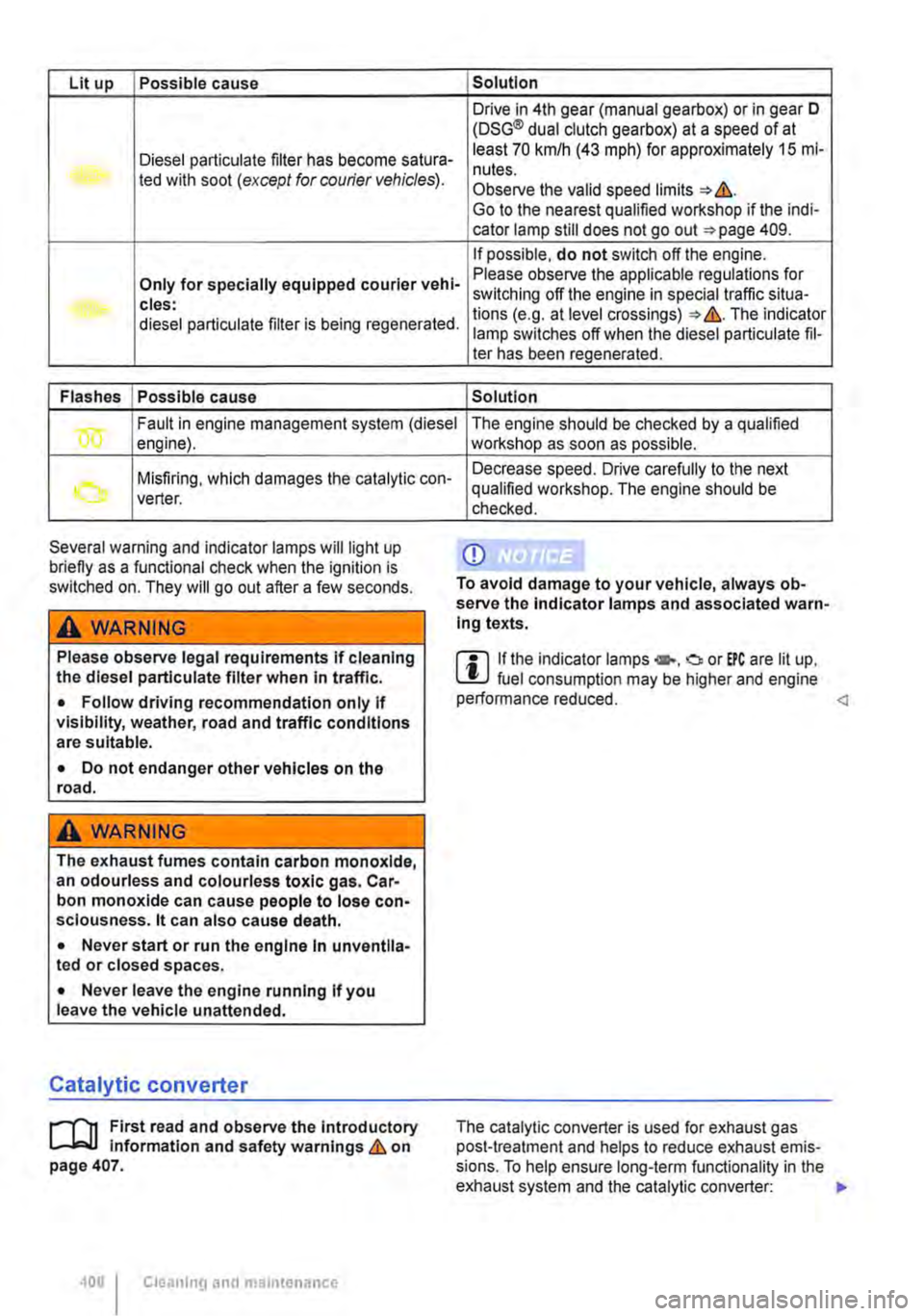
Lit up Possible cause Solution
Drive in 4th gear (manual gearbox) or in gear D (DSG® dual clutch gearbox) at a speed of at
Diesel particulate filter has become satura-least 70 km/h (43 mph) for approximately 15 mi-nutes. ted with soot (except for courier vehicles). Observe the valid speed limits &. Go to the nearest qualified workshop if the indi-cator lamp still does not go out 409.
If possible, do not switch off the engine.
Only for specially equipped courier vehi-Please observe the applicable regulations for switching off the engine in special traffic situa-cles: lions (e.g. at level The indicator diesel particulate filter is being regenerated. lamp switches off when the diesel particulate fil-ter has been regenerated.
Flashes Possible cause Solution
Fault in engine management system (diesel The engine should be checked by a qualified } engine).
Misfiring, which damages the catalytic con-vert er.
Several warning and indicator lamps will light up briefly as a functional check when the ignition is switched on. They will go out after a few seconds.
A WARNING
Please observe legal requirements If cleaning the diesel particulate filter when in traffic.
• Follow driving recommendation only if visibility, weather, road and traffic conditions are suitable.
• Do not endanger other vehicles on the road.
A WARNING
The exhaust fumes contain carbon monoxide, an odourless and colourless toxic gas. Car-bon monoxide can cause people to lose con-sclousness. lt can also cause death.
• Never start or run the engine In unventlla-ted or closed spaces.
• Never leave the engine running If you leave the vehicle unattended.
Catalytic converter
,..-('n First read and observe the introductory L-J,:.U Information and safety warnings & on page 407.
408 I Cleaning and maintenance
workshop as soon as possible.
Decrease speed. Drive carefully to the next qualified workshop. The engine should be checked.
CD
To avoid damage to your vehicle, always ob-serve the Indicator lamps and associated warn-Ing texts.
m If the indicator lamps -.. c or EPC are lit up, L!J fuel consumption may be higher and engine performance reduced.
Page 409 of 486
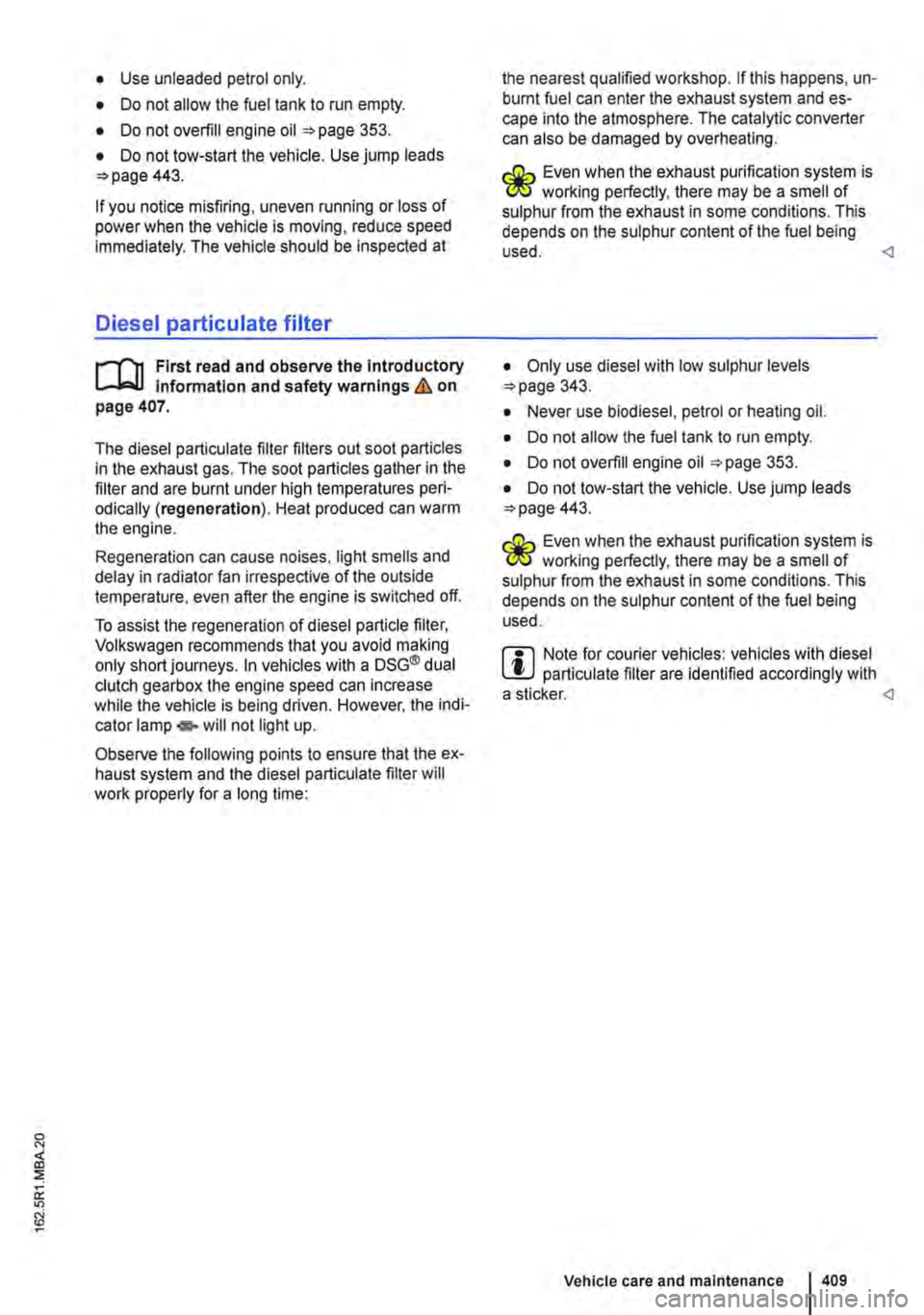
• Use unleaded petrol only.
• Do not allow the fuel tank to run empty.
• Do not overfill engine oil 353.
• Do not tow-start the vehicle. Use jump leads 443.
If you notice misfiring, uneven running or loss of power when the vehicle is moving, reduce speed Immediately. The vehicle should be inspected at
Diesel particulate filter
r-f'n First read and observe the Introductory L-J,:,.IJ Information and safety warnings & on page 407.
The diesel particulate filter filters out soot particles in the exhaust gas. The soot particles gather in the filter and are burnt under high temperatures peri-odically (regeneration). Heat produced can warm the engine.
Regeneration can cause noises, light smells and delay in radiator fan irrespective of the outside temperature, even after the engine is switched off.
To assist the regeneration of diesel particle filter, Volkswagen recommends that you avoid making only short journeys. In vehicles with a DSG® dual clutch gearbox the engine speed can increase while the vehicle is being driven. However, the indi-cator lamp • will not light up.
Observe the following points to ensure that the ex-haust system and the diesel particulate filter will work properly for a long time:
the nearest qualified workshop. If this happens, un-bumt fuel can enter the exhaust system and es-cape into the atmosphere. The catalytic converter can also be damaged by overheating.
Even when the exhaust purification system is W working perfectly, there may be a smell of sulphur from the exhaust in some conditions. This depends on the sulphur content of the fuel being used. <1
• Only use diesel with low sulphur levels 343.
• Never use biodiesel, petrol or heating oil.
• Do not allow the fuel tank to run empty.
• Do not overfill engine oil 353.
• Do not tow-start the vehicle. Use jump leads =page 443.
Even when the exhaust purification system is W working perfectly, there may be a smell of sulphur from the exhaust in some conditions. This depends on the sulphur content of the fuel being used.
m Note for courier vehicles: vehicles with diesel l!J particulate filter are identified accordingly with
Vehicle care and maintenance 409