ESP VOLKSWAGEN TRANSPORTER 2013 Manual Online
[x] Cancel search | Manufacturer: VOLKSWAGEN, Model Year: 2013, Model line: TRANSPORTER, Model: VOLKSWAGEN TRANSPORTER 2013Pages: 486, PDF Size: 69.28 MB
Page 345 of 486
CD
• Fuels that are identified at the fuel pump as containing metallic additives may not be used. LRP fuel (lead replacement petrol) also con-tains high concentrations of metallic additives. Risk of engine damage I
Diesel
r'""'('n First read and observe the Introductory L-J,:.U Information and safety warnings & on page 343.
Diesel
Diesel fuel must comply with the European stand-ard EN 590 (in Germany DIN EN 590).
The service intervals are shorter if you use diesel with a high sulphur content =>Booklet Service schedule =>CD. A Volkswagen Commercial Vehicles dealership will be able to tell you which countries have diesel with a high sulphur content.
Where diesel fuel complying with the EN 590 standard is not available, Volkswagen Commercial Vehicles dealerships and filling stations will have information on which fuels do comply with the EN 590 standard.
Do not mix fuel additives (thinners. or similar addi-tives) with diesel.
Winter diesel
When using summer-grade diesel. difficulties may be experienced at temperatures below o•c (+32.F)
because the fuel thickens due to paraffin separa-tion. For this reason winter-grade diesel which can be used at temperatures below -2o•c (·4°F) is available in countries such as Germany during the cold months.
In countries with different climatic conditions the diesel sold generally has different temperature characteristics. Check with a Volkswagen Com-mercial Vehicles dealer or filling stations in the country concerned regarding the type of diesel fuels available.
it is not unusual for a cold diesel engine to be loud-er in cold temperatures that in warm weather. In addition, exhaust emissions may be tinged with blue while the engine starts and reaches operating temperature. The amount of exhaust fumes de-pends on the outside temperature.
CD
• Just one tankful of leaded fuel, or fuel con-taining other metallic additives, can seriously Impair the efficiency of the catalytic converter and can also cause considerable damage to the catalytic converter and engine.
Diesel vehicles are equipped with a filter pre-heat-er system. This ensures that the fuel system re-mains operational even down to approximately -24•c (-11.F) provided that winter-grade diesel which is safe down to -15•c (+5.F) is used.
However, if the fuel has thickened to such an ex-tent that the engine will not start at temperatures below -24•c (-11.F) simply place the vehicle in a warm garage or workshop for a while.
Supplementary heater
Vehicles fitted with a diesel engine may also be equipped with a fuel-driven supplementary heater. This heater is powered with fuel from the vehicle tank. In this case, odour and water vapour may es-cape from the vehicle, and there may be a greater quantity of smoke. This is quite normal when the system is in use, and does not indicate damage or a fault in the system.
The supplementary heater will be switched off au-tomatically if the level in the fuel tank is low (re-serve level).
A WARNING
Never use a start booster. Start boosters may explode or cause the engine to suddenly run at high revs, which can cause serious Injuries and engine damage.
CD
• Before filling up with diesel, check whether the fuel corresponds to the vehicle's require-ments according to the fuel standard Informa-tion at the pump.
• Only use fuel that complies with the EN 590 standard and has the correct cetane number. Otherwise, the engine and the fuel system can suffer considerable damage. The engine can al-so lose power or fall. ..,.
At the filling station 1345
Page 352 of 486
CD
When refilling or changing service fluids, please ensure that the correct fluids are added through the correct openings. Incorrect service fluids can cause serious functional problems and engine damage.
r:(ib Service fluids leaks are harmful to the envi-f!f:J ronment. So you should regularly check the ground underneath your vehicle. If there are spots of oil or other fluids on the ground, the vehicle should be inspected by a qualified workshop. Any spilt service fluids must be disposed of properly and with respect to environmental legislation.
1"1'11 First read and observe the Introductory L-.J,::,jJ Information and safety warnings & on page 350.
Checklist
The following steps should always be carried out in the specified order before working In the engine compartment =:-&,:
..( Park the vehicle on a level and stable sur-face.
..! Depress and hold the brake pedal until the engine has stopped.
Apply the handbrake firmly ::-page 269.
Select the neutral position or move the se-lector lever toP =:-page 260 .
..( Stop the engine and remove the key from the ignition =:-page 257.
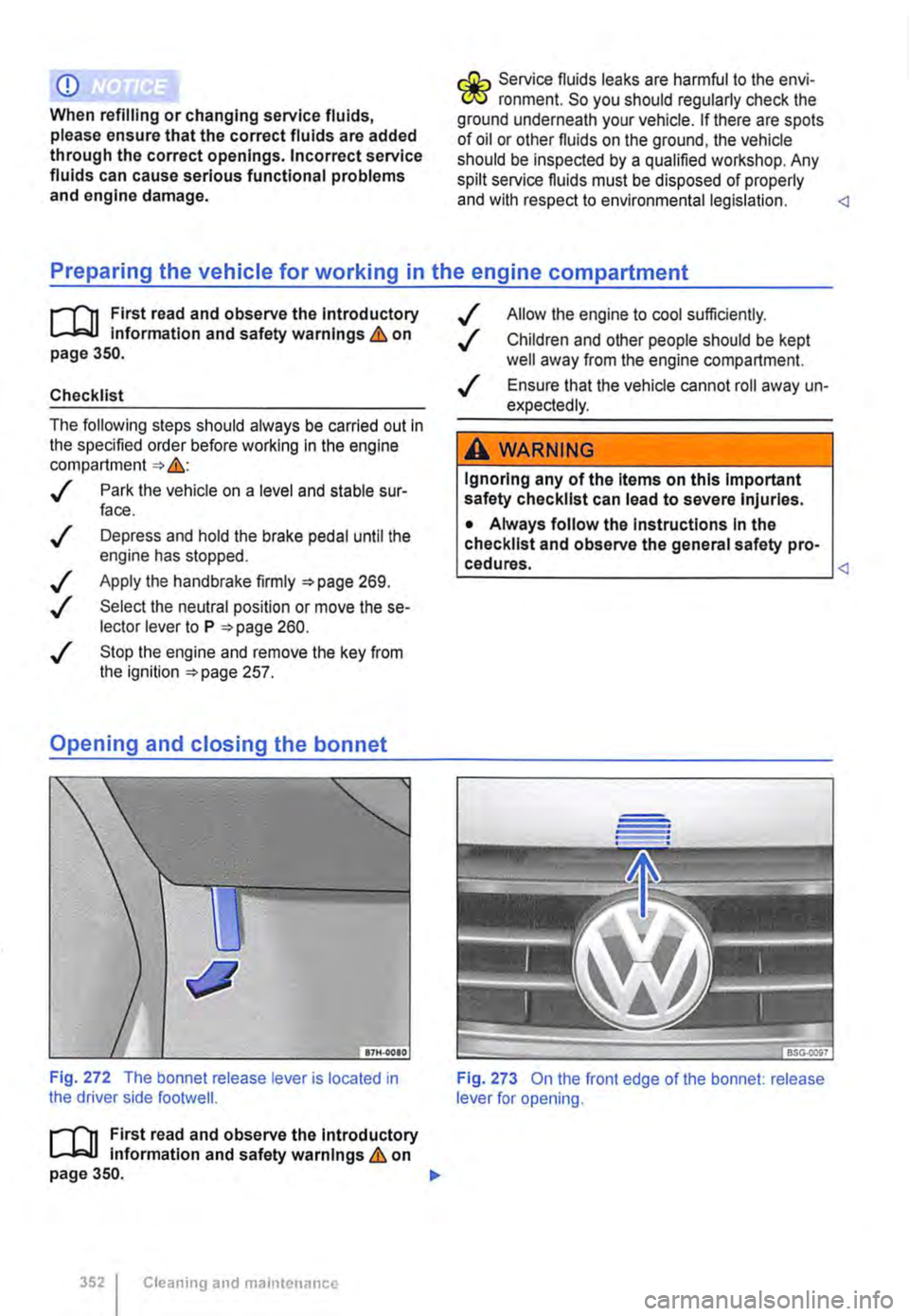
Opening and closing the bonnet
Fig. 272 The bonnet release lever is located in the driver side footwell.
1"1'11 First read and observe the introductory L-.J,::,,J Information and safety warnings & on page 350.
352 I Cleaning and maintenance
Allow the engine to cool sufficiently.
Children and other people should be kept well away from the engine compartment.
Ensure that the vehicle cannot roll away un-expectedly.
A WARNING
Ignoring any of the Items on this Important safety checklist can lead to severe Injuries.
• Always follow the Instructions In the checklist and observe the general safety pro-cedures.
Page 354 of 486
A WARNING
Incorrect handling of engine oil can cause se-rious burns and other Injuries.
• Always wear eye protection when han-dling engine oil.
• Engine oil is toxic and must be stored out of the reach of children.
• Engine oil must be kept in the closed orig-inal container. This also applies to used oil until it is disposed of.
• Never use empty food containers, bottles or other containers to store engine oil as oth-er people may then drink the engine oil.
Warning and indicator lamps
A WARNING (Continued)
• Regular contact with engine oil can dam-age the skin. Skin that has been in contact with engine oil should be washed thoroughly with water and soap.
• Engine oil becomes extremely hot when the engine is running and can scald skin se-verely. Always allow the engine to cool down.
Leaking or spilt engine oil can pollute the en-(!Jtf vironment. Spilt service fluids must be collec-ted then disposed of properly and in an environ-mentally responsible way.
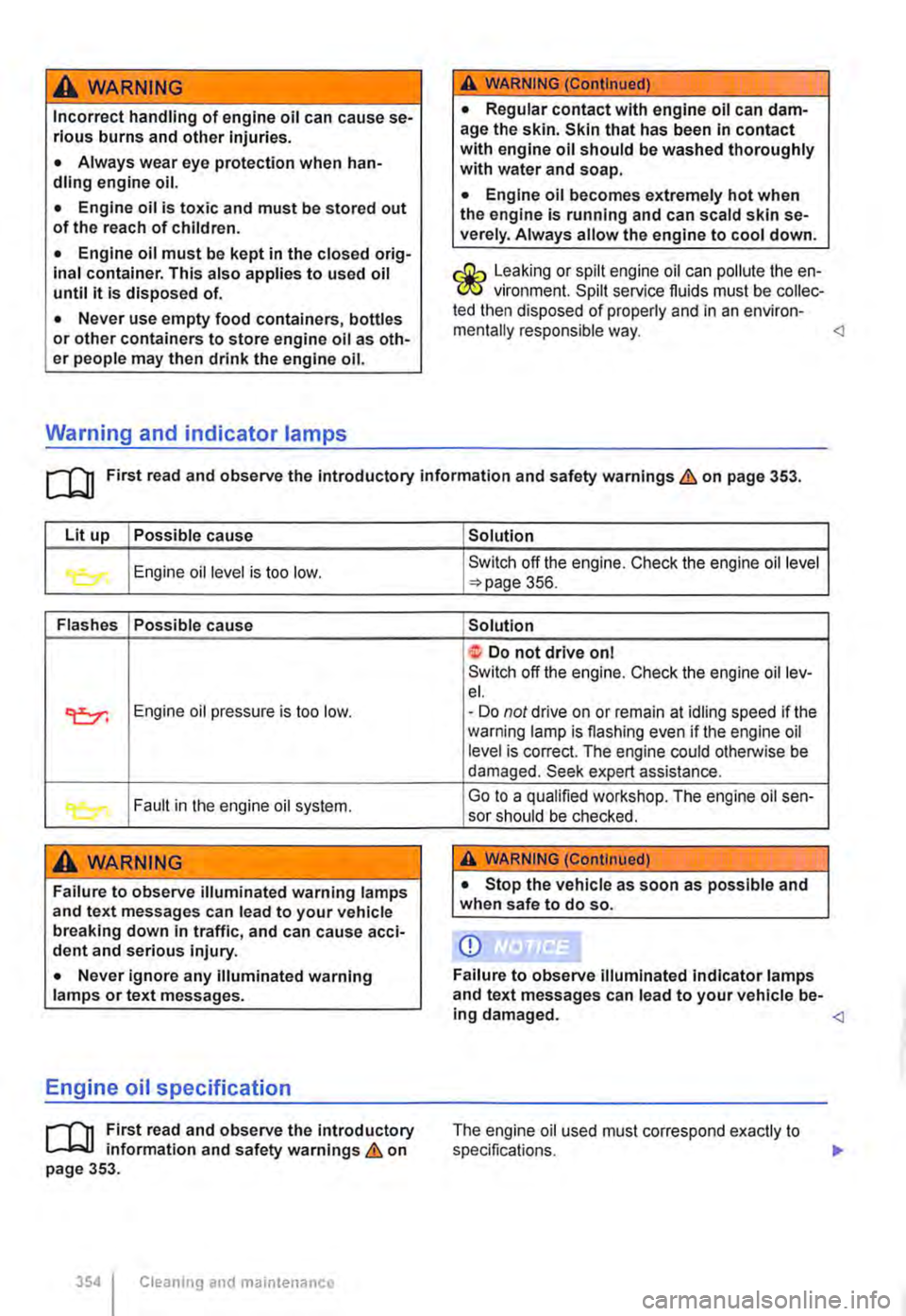
Lit up Possible cause
Engine oil level is too low. -
Flashes Possible cause
c:e:r. Engine oil pressure is too low.
r... Fault in the engine oil system.
A WARNING
Failure to observe illuminated warning lamps and text messages can lead to your vehicle breaking down in traffic, and can cause acci-dent and serious injury.
• Never ignore any illuminated warning lamps or text messages.
Engine oil specification
rT'n First read and observe the introductory L-J,::.U information and safety warnings & on page 353.
354 I Cleaning and maintenance
Solution
Switch off the engine. Check the engine oil level "'Page 356.
Solution
t Do not drive on I Switch off the engine. Check the engine oillev-el. • Do not drive on or remain at idling speed if the warning lamp is flashing even if the engine oil level is correct. The engine could otherwise be damaged. Seek expert assistance.
Go to a qualified workshop. The engine oil sen-sor should be checked.
A WARNING (Continued)
• Stop the vehicle as soon as possible and when safe to do so.
Q)
Failure to observe illuminated Indicator lamps and text messages can lead to your vehicle be-ing damaged.
Page 355 of 486
The correct engine oil is important for the function and service life of the engine. A special high quali-ty multigrade oil has been filled at the factory and this can normally be used as an all-season oil.
If possible, only use Volkswagen-approved engine oil =>CD. To comply with the requirements of the flexible service, only use approved flexible service engine oil that complies with the corresponding VW standard =>table on page 355. The engine oils listed are multigrade high-lubricity oils.
Engine oils are constantly being developed and im-proved. Volkswagen Commercial Vehicles dealers are kept up to date with regard to any changes. Volkswagen Commercial Vehicles therefore recom-mends having engine oil changes done by a Volks-wagen Commercial Vehicles dealer.
The quality of the engine oil is not only tailored to the requirements of engines and exhaust gas treat-ment systems, but also to fuel quality. Due to the
way in which a combustion engine works, engine oil always comes into contact with combustion resi-dues and fuel, which has a knock-on effect on the ageing process of the oil.
The quality of fuels can vary greatly between indi-vidual markets and this must be taken into account when selecting the correct engine oil.
The use of engine oils compliant with the VW 504 00 und VW 507 00 specifications requires a fuel quality compliant with EN 228 (petrol) and EN 590 (diesel), or fuel of an equivalent quality. Engine oils compliant with VW 504 00 und VW 507 00 are therefore unsuitable for use in a large number of markets.
Permitted engine oil specifications =>CD
Engine type Flexible service QIS, QIS Fixed service Ql1, Ql2, Q13, Ql4, Ql5
110 kW petrol engine VW504 00
150 kW petrol engine -
All diesel engines with DPF VW507 00
All diesel engines without DPF VW507 00
CD
• Do not add any additional lubricants to the engine oil. Any damage caused by the use of such additives is not covered by the warranty.
• Only engine oil specifications that have been approved for use with the engine should be used. Using other engine oils can cause en-gine damage.
• Another engine oil can be used in the event of an emergency if the listed engine oils (=>table on page 355) are not available. To
vw 502 00
VW502 00
VW507 00
VW505 01
CD
avoid damaging the engine, a maximum quanti-ty of 0.5 litres of the following engine oil may be used only once until the next oil change:
-Petrol engines: standards ACEAA3/B4 or API SN (API SM).
-Diesel engines: standards ACEA C3 or APICJ4.
In the engine compartment 1355
Page 356 of 486
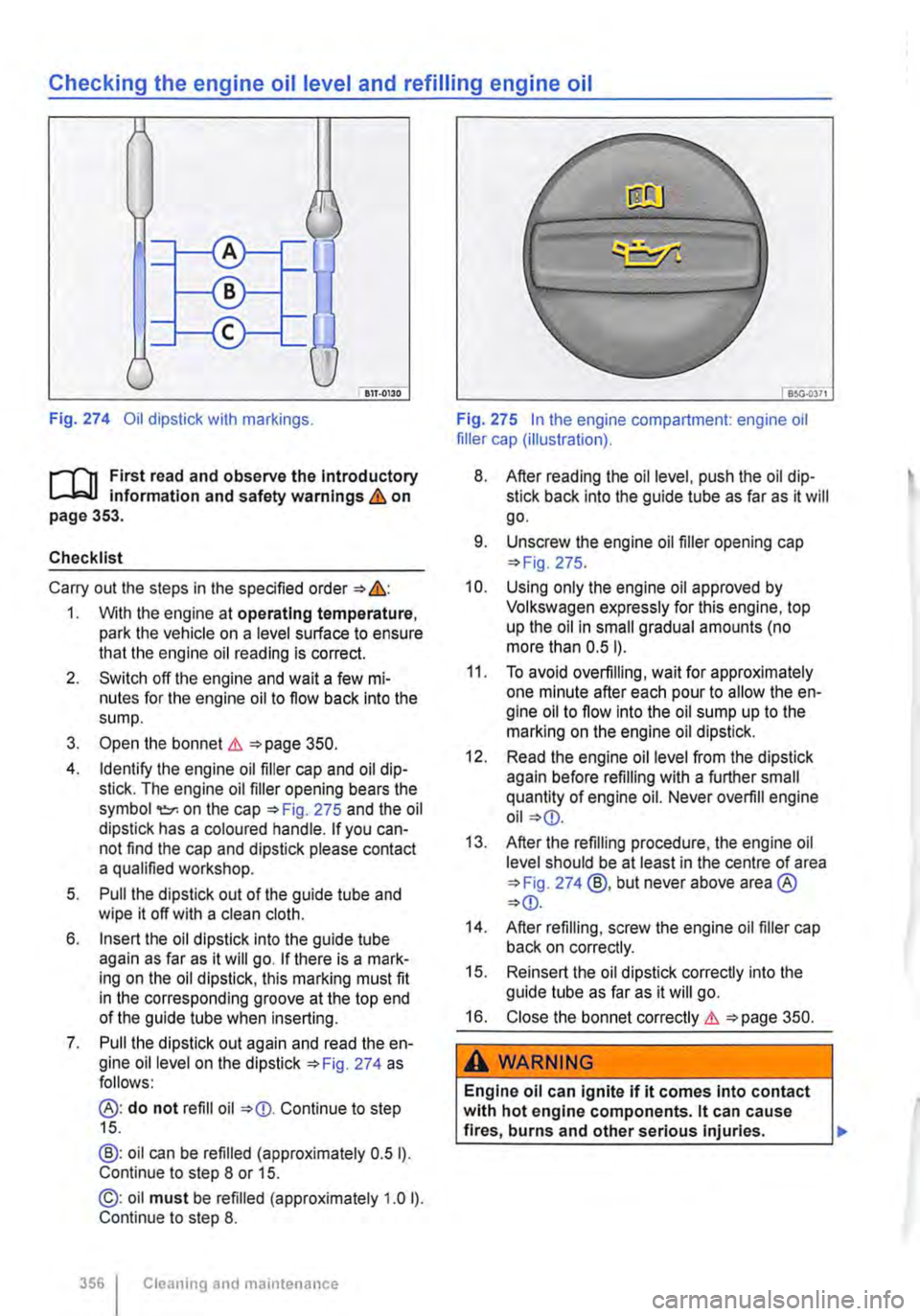
Checking the engine oil level and refilling engine oil
Fig. 274 Oil dipstick with markings.
r-111 First read and observe the Introductory L-W! information and safety warnings & on page 353.
Checklist
Carry out the steps in the specified order &:
1. With the engine at operating temperature, park the vehicle on a level surface to ensure that the engine oil reading is correct.
2. Switch off the engine and wait a few mi-nutes for the engine oil to flow back into the sump.
3. Open the bonnet&. 350.
4. Identify the engine oil filler cap and oil dip-stick. The engine oil filler opening bears the symbol 'l!:r. on the cap 275 and the oil dipstick has a coloured handle. If you can-not find the cap and dipstick please contact a qualified workshop.
5. Pull the dipstick out of the guide tube and wipe it off with a clean cloth.
6. Insert the oil dipstick into the guide tube again as far as it will go. If there is a mark-ing on the oil dipstick, this marking must fit in the corresponding groove at the top end of the guide tube when inserting.
7. Pull the dipstick out again and read the en-gine oil level on the dipstick 274 as follows:
@: do not refill oil Continue to step 15.
@: oil can be refilled (approximately 0.5 1). Continue to step 8 or 15.
©: oil must be refilled (approximately 1.0 1). Continue to step 8.
356 I Cleaning and maintenance
Fig. 275 in the engine compartment: engine oil filler cap (illustration).
8. After reading the oil level, push the oil dip-stick back into the guide tube as far as it will go.
9. Unscrew the engine oil filler opening cap =>Fig. 275.
1 0. Using only the engine oil approved by Volkswagen expressly for this engine, top up the oil in small gradual amounts (no more than 0.5 1).
11. To avoid overfilling, wait for approximately one minute after each pour to allow the en-gine oil to flow into the oil sump up to the marking on the engine oil dipstick.
12. Read the engine oil level from the dipstick again before refilling with a further small quantity of engine oil. Never overfill engine oil
13. After the refilling procedure, the engine oil level should be at least in the centre of area =>Fig. 274 @,but never above area®
14. After refilling, screw the engine oil filler cap back on correctly.
15. Re insert the oil dipstick correctly into the guide tube as far as it will go.
16. Close the bonnet correctly & 350.
A WARNING
Engine oil can Ignite if it comes into contact with hot engine components. lt can cause fires, burns and other serious Injuries.
Page 358 of 486
A WARNING (Continued)
• Always allow the engine to cool down completely to avoid burns.
• Avoid raising your arms when removing the oil drain plug with your fingers to help prevent oil from running down your arm.
• Use a suitable container when draining the used oil. it must be at least large enough to hold the entire quantity of engine oil re-quired for refilling.
• Never store engine oil in empty food con-tainers, bottles or any other non-original con-tainers as people finding these containers may not know that they contain engine oil.
Coolant
o:::n Introduction
This chapter contains information on the following subjects:
Warning lamp and coolant temperature display . . . . . . . . . . . . . . . . . . . . . . . . . 359
Coolant specification . . . . . 360 Checking the coolant level and refilling coolant . . . . . . . . . . . . . 361
Never carry out any work on the engine coolant system if you are not familiar with the requisite pro-cedures, or if you do not have access to the cor-rect tools, operating equipment and fluids &. The work should be carried out by a qualified work-shop if you are uncertain. Volkswagen Commercial Vehicles recommends using a Volkswagen Com-mercial Vehicles dealership for this purpose.
Serious injuries can be caused if work is carried out incorrectly.
Additional information and warnings:
• Towing a trailer 139
• Preparation for working in the engine compart-ment 350
• Accessories, modifications, repairs and renewal of parts =>page 394
358 I Cleaning and maintenance
A WARNING (Continued)
• Engine oil is toxic and must be stored out of the reach of children.
r:Q:.. Before changing the engine oil, first find out W where old oil can be disposed of properly near you.
Used oil must be disposed of in accordance W with regulations governing the protection of the environment. Never dispose of old oil in loca-tions such as gardens, woods, sewerage systems, on streets and roads, or in rivers and waterways.
Engine coolant is poisonous and can cause serious Injuries.
• Engine coolant should only be kept in sealed original containers In a safe place.
• Never store engine coolant In empty food containers, bottles or any other non-original containers as people finding these containers may then drink the engine coolant.
• The engine coolant must be stored out of the reach of children.
• Please note that the amount of correct coolant additive used must be sufficient for the lowest ambient temperature that you ex-pect the vehicle to be exposed to.
• Coolant can freeze at extremely cold out-side temperatures, causing the vehicle to break down. Vehicle occupants with Inade-quate winter clothing could then freeze to death as the heating will also no longer func-tion.
Coolant and coolant additives can pollute the W environment. Spilt service fluids must be col-lected then disposed of properly and in an environ-mentally responsible way.
Page 360 of 486
Coolant specification
r-l"'n First read and observe the Introductory l..-J,::,U Information and safety warnings & on page 358.
The cooling system is filled at the factory with a mixture of specially prepared water and at least 40% coolant additive G 13 (fl-VW 774 J). The coolant additive is dyed purple. This mixture of wa-ter and coolant additive gives the necessary frost protection down to -2s•c (-13.F) and protects the alloy parts of the cooling system against corrosion. The mixture also prevents scaling and raises the boiling point of the coolant.
In order to protect the coolant system, the propor-tion of coolant additive must always be at least 40%, even if anti-freeze is not required in warm weather and warm climates.
If greater frost protection is required in very cold climates, the proportion of anti-freeze additive can be increased. However, the percentage of coolant additive should not exceed 60%, as this would re-duce the frost protection and the cooling effect.
When refilling the coolant, a mixture of distilled water and at least 40% coolant additive G 13 or G 12 plus-plus (TL-VW 774 G) (both of which are dyed purple) must be used in order to obtain the optimum corrosion protection =>(]). Mixing G 13 with the coolant additives G 12 plus (Tl-VW774 F), G 12 (dyed red) orG 11 (dyed blue-green) will significantly decrease the level of corro-sion protection and should therefore be avoided =>
Insufficient anti-freeze In the coolant system can cause the engine to break down and cause serious Injuries.
• Please note that the amount of correct coolant additive used must be sufficient for the lowest ambient temperature that you ex-pect the vehicle to be exposed to.
• Coolant can freeze at extremely cold out-side temperatures, causing the vehicle to break down. Vehicle occupants with Inade-quate winter clothing could then freeze to death as the heating will also no longer func-tion.
360 I Cleaning and maintenance
CD
Never mix genuine coolant additives with other coolants that have not been approved by Volks-wagen. Mixing other coolants could cause seri-ous damage to the engine and cooling system.
• If the liquid in the coolant expansion tank is brown instead of purple, for example, G 13 has been mixed with another unsuitable engine coolant. The coolant must be changed as soon as possible if this Is the case. Failure to ob-serve this point can result In serious faults or engine damage.
Coolant and coolant additives can pollute the "7!1:5 environment. Spilt service fluids must be col-lected then disposed of properly and in an environ-mentally responsible way.
Page 363 of 486
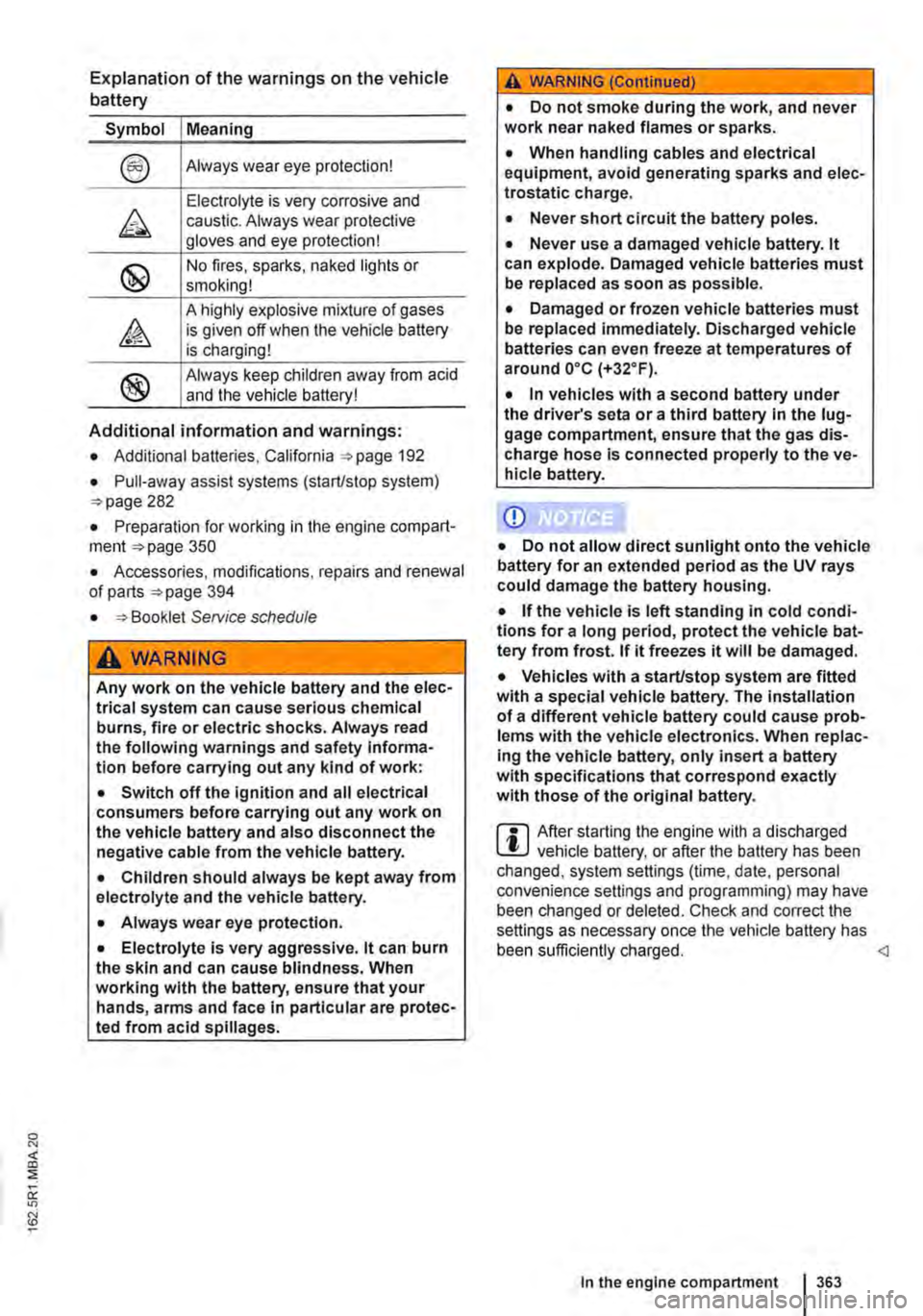
Explanation of the warnings on the vehicle battery
Symbol Meaning
Always wear eye protection!
Electrolyte is very corrosive and caustic. Always wear protective gloves and eye protection!
No fires, sparks, naked lights or smoking!
A highly explosive mixture of gases is given off when the vehicle battery is charging!
Always keep children away from acid and the vehicle battery!
Additional information and warnings:
• Additional batteries, California 192
• Pull-away assist systems (starUstop system) 282
• Preparation for working in the engine compart-ment 350
• Accessories, modifications, repairs and renewal of parts 394
• Service schedule
A WARNING
Any work on the vehicle battery and the elec-trical system can cause serious chemical burns, fire or electric shocks. Always read the following warnings and safety informa-tion before carrying out any kind of work:
• Switch off the ignition and all electrical consumers before carrying out any work on the vehicle battery and also disconnect the negative cable from the vehicle battery.
• Children should always be kept away from electrolyte and the vehicle battery.
• Always wear eye protection.
• Electrolyte Is very aggressive. lt can burn the skin and can cause blindness. When working with the battery, ensure that your hands, arms and face in particular are protec-ted from acid spillages.
A WARNING (Continued)
• Do not smoke during the work, and never work near naked flames or sparks.
• When handling cables and electrical equipment, avoid generating sparks and elec-trostatic charge.
• Never short circuit the battery poles.
• Never use a damaged vehicle battery. it can explode. Damaged vehicle batteries must be replaced as soon as possible.
• Damaged or frozen vehicle batteries must be replaced immediately. Discharged vehicle batteries can even freeze at temperatures of around ooc (+32°F).
• In vehicles with a second battery under the driver's seta or a third battery in the lug-gage compartment, ensure that the gas dis-charge hose is connected properly to the ve-hicle battery.
• If the vehicle is left standing in cold condi-tions for a long period, protect the vehicle bat-tery from frost. If it freezes it wilt be damaged.
• Vehicles with a starUstop system are fitted with a special vehicle battery. The installation of a different vehicle battery could cause prob-lems with the vehicle electronics. When replac-ing the vehicle battery, only insert a battery with specifications that correspond exactly with those of the original battery.
W After starting the engine with a discharged L!J vehicle battery, or after the battery has been changed, system settings (time, date, personal convenience settings and programming) may have been changed or deleted. Check and correct the settings as necessary once the vehicle battery has been sufficiently charged.
Page 366 of 486
Automatic switch-off for electrical consumers
The intelligent vehicle electrical system automati-cally implements a range of measures to prevent the battery from discharging under high loads:
• The idling speed is increased so that the alter-nator provides more electricity.
• The performance of large electrical consumers may be reduced or they may be switched off com-pletely.
• The supply of electricity to the 12-volt sockets and the cigarette lighter is interrupted temporarily while the engine is being started.
The vehicle electrical system cannot always pre-vent the vehicle battery from discharging. For ex-ample, if the ignition is left on for an extended peri-od of time with the engine off, or if the parking light is left on when the vehicle is parked for an exten-ded period.
What can cause the vehicle battery to discharge?
• Long periods at a standstill in which the engine is not running, especially if the ignition is switched on.
• The use of electrical consumers when the en-gine is switched off.
• When the supplementary heater is in operation =>page 332.
A WARNING
Incorrectly attaching the battery and using In-correct vehicle batteries can cause short cir-cuits, fire and serious Injuries.
366 I Cleaning and maintenance
A WARNING (Continued)
• Always use maintenance-free and leak-proof batteries that have the same properties, specifications and dimensions as the factory-fitted vehicle battery.
A WARNING
A highly explosive mixture of gases Is given off when the vehicle battery is being charged.
• Vehicle batteries should only be charged in well-ventilated spaces.
• Never charge a vehicle battery once it has been frozen. Discharged vehicle batteries can even freeze at temperatures of around o•c (+32.FJ.
• The vehicle battery has to be replaced if it has ever been frozen.
• Incorrectly connected cables can cause a short circuit. First connect the positive cable and then the negative cable.
CD
• Never make or break connections between vehicle batteries if the ignition is switched on or the engine is running. Never use a vehicle battery that does not correspond with the vehi-cle's specifications. The vehicle's electrical system or electronic components could be damaged, which could lead to electrical faults, for example In the start/stop system.
• Never connect equipment that provides electricity, such as solar panels or a battery charger, to the 12-volt socket or to the cigarette lighter to charge the vehicle battery. This can damage the vehicle electrical system.
Dispose of the vehicle baltery as required by legislation. Batteries may contain toxic sub-stances such as sulphuric acid and lead.
Electrolyte can pollute the environment. Clean up any service fluid leakages and dis-pose of them property.
Page 367 of 486
Wheels and tyres
Useful information about wheels and tyres
o:::n Introduction
This chapter contains information on the following subjects:
Handling wheels and tyres .............. .
Rims
368
369
New wheels and tyres . . . . . . . . . . . . . . . . . . . 370 Tyre pressure . . . . . . . . . . . . . . . . 371
Tread depth and wear indicators 372 Tyre damage 373
Spare wheel . . . . . . . . . . . . . . . . . . . . . . . . . . . . 374
Tyre lettering . . . . . . . . . . . . . . . . . . . . . . . . . . . 375
Winter tyres . . . . . . . . . . • . • • . . . . . . . . . . . . 378 Snow chains . . . . . . . . . . . . . . . . . 379
Volkswagen Commercial Vehicles recommends that work on tyres and wheels is carried out by a qualified workshop. They are familiar with the pro-cedure and have the necessary special tools and spare parts and the proper facilities for disposing of the old tyres. Volkswagen Commercial Vehicles recommends using a Volkswagen Commercial Ve-hicles dealership for this purpose.
Additional information and warnings:
• Transporting 125
• Towing a trailer 139
• Braking, stopping and parking 269
• Tyre monitoring system 318
• Cleaning and caring for the vehicle exterior 380
• Consumer information 404
• Vehicle tool kit 416
• Hubcaps 417
• Changing a wheel 420
• Breakdown set 425
A WARNING
New tyres or tyres which are old, worn down or damaged cannot provide full levels of vehi-cle control and braking power.
• Incorrect handling of wheels and tyres can reduce vehicle safety and cause accidents and serious injuries.
A WARNING (Continued)
• All four wheels must be fitted with radial tyres of the same type, size (rolling circum-ference) and the same tread.
• New tyres will have to be run In as they will initially have reduced grip and braking ef-fect. Drive particularly carefully for the first 600 km in order to prevent accidents and se-rious injury.
• Check tyre pressures regularly and always keep to the specified tyre pressure value. If the tyre pressure is too low, it Is possible that the tyre temperature will Increase to such an extent when driving that the tread peels off and the tyre bursts.
• Never drive with worn tyres or tyres that are damaged (cuts, cracks or blisters). Driv-Ing with tyres in this condition can result in blown tyres, accidents and serious Injuries. Worn or damaged tyres must be replaced as soon as possible.
• Never exceed the top speed and load per-mitted for the fitted tyres.
• The effectiveness of the driver assist sys-tems and brake support systems depends on the tyre grip.
• If you notice unusual vibration or if the ve-hicle pulls to one side when driving, stop the car immediately and check the wheels and tyres for damage.
• In order to reduce the risk of losing con-trol of the vehicle, and the risk of accident and serious injury, never loosen the bolts on rims with bolted on rim rings.
• Do not use wheels or tyres if you do not know their history. Used wheels and tyres could be damaged, even If the damage is not visible.
• Old tyres (even if never used) can sudden-ly Jose pressure or burst, especially at high speeds. This can cause accidents and seri-ous injuries. Avoid using tyres that are more than six years old. If you have no alternative, drive slowly and with extra care at all times.
m For technical reasons, it is not generally pos-L!.J sible to use the wheels from other vehicles. This can also apply to wheels of the same vehicle .,.
Wheels and tyres I 367