cooling VOLKSWAGEN TRANSPORTER 2015 Owner´s Manual
[x] Cancel search | Manufacturer: VOLKSWAGEN, Model Year: 2015, Model line: TRANSPORTER, Model: VOLKSWAGEN TRANSPORTER 2015Pages: 486, PDF Size: 72.17 MB
Page 279 of 486
Changing gear earlier
In principle, the highest gear is always the most economical gear. A rule of thumb for most vehicles: at a speed of 30 kmlh (19 m ph} drive in third gear, at 40 km/h (25 mph) in 4th gear and at 50 km/h (31 mph) In 5th gear.
If the traffic and driving situation allows it, skipping gears when changing up a gear will also save fuel.
Do not drive gears to their upper limit. Use first gear only for pulling away then quickly change up to second gear. Avoid using the kickdown func-tion in vehicles with a DSG® dual clutch gearbox.
Vehicles with a gear display help to improve fuel economy by indicating the optimum time to change gear.
Rolling to a stop
Taking your foot off the accelerator will interrupt the supply of fuel to the engine and decrease fuel con-sumption.
Therefore, in situations such as approaching a red traffic light, let the vehicle roll without applying the accelerator.
Only press on the dutch pedal to disengage if the vehicle becomes too slow or if the stopping dis-tance is longer. The engine will then run at idling speed 263.
Switch off the engine in situations when the vehicle might be stationary for a long time, e.g. at a level crossing. In vehicles with an active start/stop sys-tem, the engine will switch off automatically when the vehicle Is stationary.
Thinking ahead when driving, and driving with the flow of traffic
Applying the brake and accelerator too often will significantly increase fuel consumption. If you think ahead when driving and maintain a sufficient dis-tance from the vehicle in front, simply keeping your foot off the accelerator should stop the speed from fluctuating. This means that active braking and ac-celerating is not always necessary.
Driving smoothly and evenly
Smoothness is even more important than speed. The more evenly you drive, the lower your fuel consumption will be.
When driving on a motorway, it is much more ef-fective to drive at a constant moderate speed than to drive with constant acceleration and braking. As a rule, driving with a constant style will get you to your destination just as quickly.
The cruise control system will help you to maintain a constant driving style.
Using additional equipment in moderation
lt is always important to be comfortable in your ve-hicle, but it is also important to consider the envi-ronment.
Some equipment will increase fuel consumption when switched on:
• The cooling function of the air conditioning sys-tem: if the air conditioning system is set to a very high or low temperature it will require a lot of ener-gy, which is generated by the engine. Therefore the temperature setting in the vehicle should not vary too much from the outside temperature. lt may be a good idea to air the vehicle before setting off and then to travel a short distance with the win-dows open. The air conditioning system should then be switched on once the windows have been closed. Keep the windows closed when driving at high speeds. Having the windows open increases fuel consumption.
• Switch the seat heating off as soon as it has served its purpose.
• Switch the windscreen and rear window heating off as soon as the windows have defogged and are clear of ice.
• Do not leave the supplementary heating system on when the vehicle is moving 332.
Other factors that Increase fuel consumption (examples):
• Fault in engine management.
• Driving in hilly regions.
• Driving with a trailer.
Page 322 of 486
Air conditioning system
Heating, ventilating, cooling
o:n Introduction
This chapter contains information on the following subjects:
Controls for Climatic . . . . . . . . . . . . . . . . . . . . 323
Controls for Climatronic . . . . . . . . . . . . . . . . . 325
Controls for the heating and fresh air system . 327
Information on the air conditioning system . . . 328
..................... m
Air recirculation mode . . . . . . . • . . . . . . . . . . . . 330
Windscreen heating . . . . . . . . . . . . . . . . . . . . . 331
Roof ventilator . . . . . . . . . . . . . . . . . . . . . . . . . . 331
Displays for the Climatronic information
Depending on the vehicle equipment level, infor-mation on the Climatronic is displayed briefly on the screen of the factory-fitted radio or navigation system.
The dust and pollen filter
The dust and pollen filter with activated charcoal reduces the level of impurities in the outside air en-tering the vehicle.
The dust and pollen filler must be changed regular-ly to avoid impairing the performance of the air conditioning system.
The dust and pollen filter must be changed more frequently than stated in the service schedule if the efficiency of the filter declines prematurely due to the vehicle being used in areas with high levels of air pollution.
Additional information and warnings:
• Exterior views 5
• Wipers/washer 116
• Supplementary heaters (auxiliary air heater or auxiliary coolant heater) 332
• Cleaning and caring for the vehicle exterior 380
A WARNING
Poor visibility through all windows increases the risk of collisions and accidents, which can cause serious injuries.
• Always ensure that all windows are free of ice, snow and mist to ensure good visibility.
3221 While driving
A WARNING (Continued)
• Maximum heat output, which Is needed to defrost the windows as quickly as possible, is only available when the engine has reached Its operating temperature. Do not start your journey until you have good visibil-Ity.
• Always ensure that the heating and fresh air system or the air conditioning system and the rear window heating are used correctly so that you have good visibility.
• Never use the air reclrculatlon mode for an extended period. If the cooling system Is switched off, the windows can mist up very quickly In air reclrculatlon mode and reduce visibility considerably.
• Always switch off the air reclrculatlon mode when it Is not required.
A WARNING
Stale air can quickly make the driver tired and affect their concentration, which In turn can cause collisions, accidents and serious Inju-ries.
• Never switch off the blowers or switch on the air recirculatlon mode for an extended pe· riod as this prevents fresh air from entering the vehicle interior.
• Repairs to the air conditioning system re-quire specialist knowledge and special tools. Volkswagen Commercial Vehicles recommends using a Volkswagen Commercial Vehicles deal-ership for this purpose.
Page 323 of 486
m If the cooling system is switched off. the out-W side air that is drawn into the vehicle is not dehumidified. To prevent the windows misting over, Volkswagen Commercial Vehicles recommends that you leave the air conditioning (air conditioning co'!!E.'"essor) switched on. To do this, press the @ button. The indicator lamp in the button must light up.
m Maximum heat output, which is needed to de-W frost the windows as quickly as possible, is only available when the engine has reached its op-erating temperature.
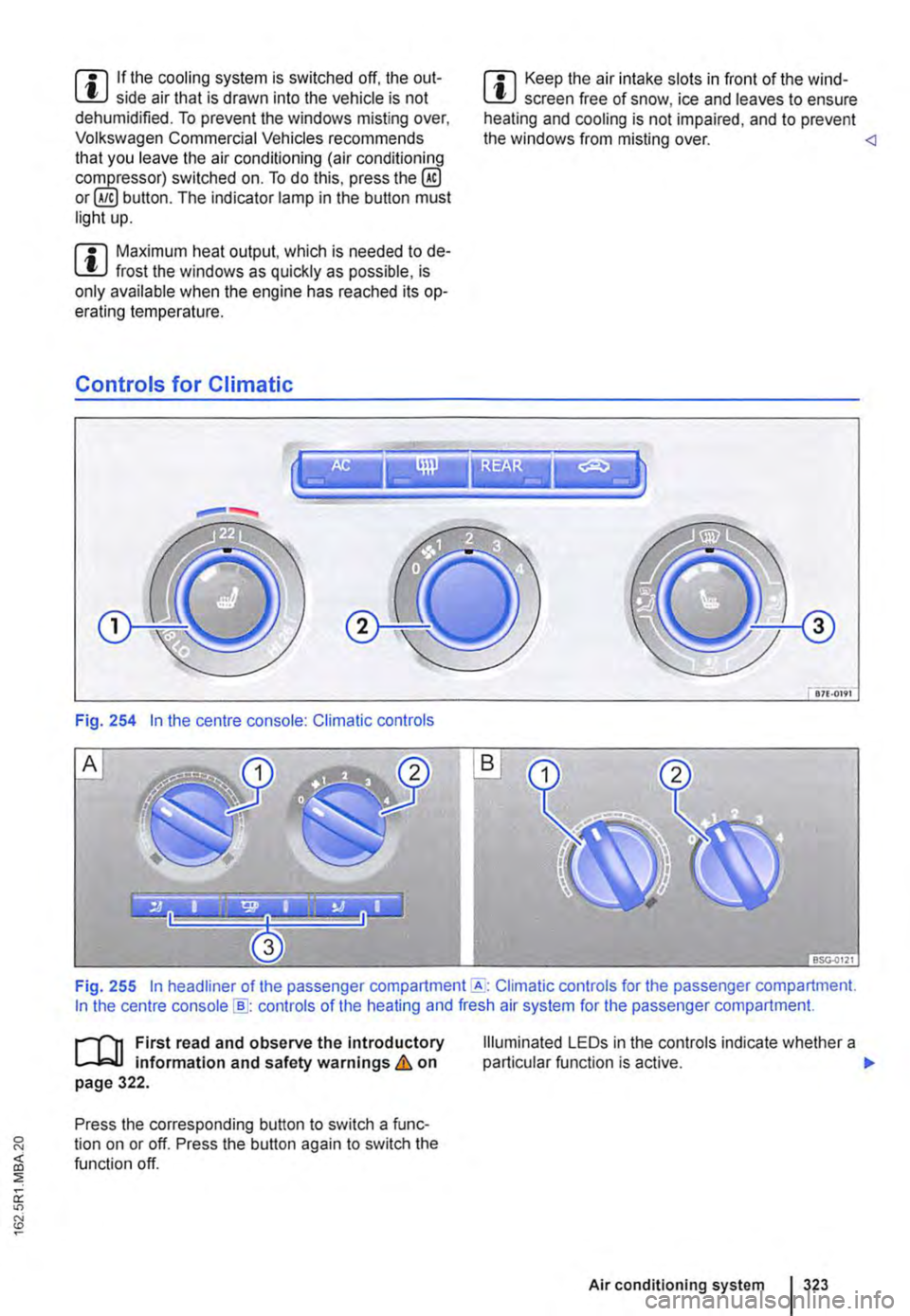
Controls for Climatic
Fig. 254 In the centre console: Climatic controls
m Keep the air intake slots in front of the wind-W screen free of snow, ice and leaves to ensure heating and cooling is not impaired, and to prevent the windows from misting over.
Fig. 255 In headliner of the passenger Climatic controls for the passenger compartment. In the centre console [ID: controls of the heating and fresh air system for the passenger compartment.
ill1 First read and observe the Introductory l..-Wl information and safety warnings & on page 322.
Press the corresponding button to switch a func-tion on or off. Press the button again to switch the function off.
Illuminated LE Os in the controls indicate whether a particular function is active. .,.
Air conditioning system I 323
Page 324 of 486
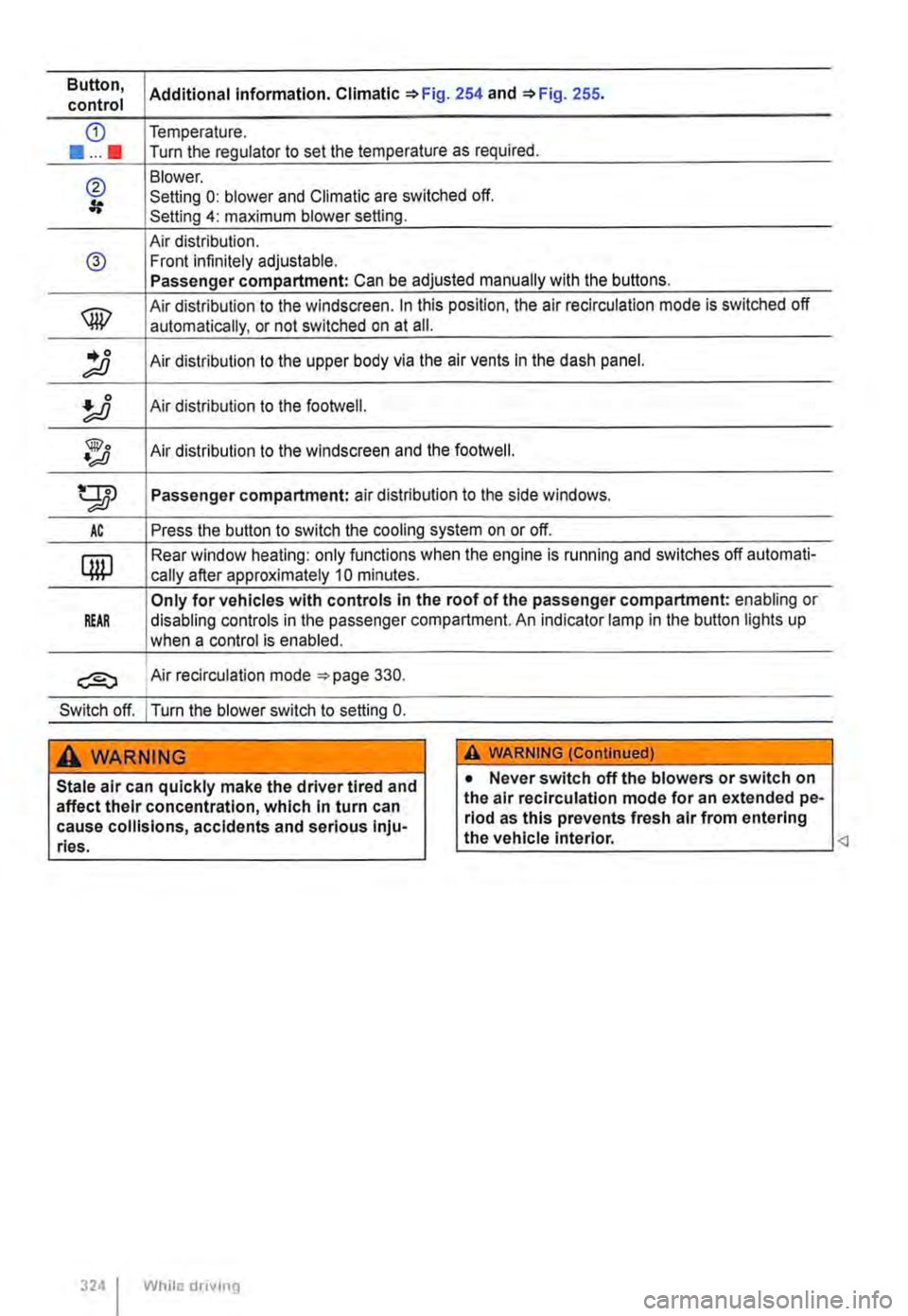
Button, Additional information. Climatic '*Fig. 254 and '*Fig. 255. control
CD Temperature .
••••• Turn the regulator to set the temperature as required.
@ Blower. Setting 0: blower and Climatic are switched off. Setting 4: maximum blower setting.
Air distribution. @ Front infinitely adjustable. Passenger compartment: Can be adjusted manually with the buttons.
® Air distribution to the windscreen. In this position, the air re circulation mode is switched off
automatically, or not switched on at ail .
.. 0 ;;;o Air distribution to the upper body via the air vents In the dash panel.
Air distribution to the footwell.
@o •;;JJ Air distribution to the windscreen and the footweii.
gp Passenger compartment: air distribution to the side windows.
AC Press the button to switch the cooling system on or off.
QW Rear window heating: only functions when the engine is running and switches off automati-
cally after approximately 10 minutes.
Only for vehicles with controls in the roof of the passenger compartment: enabling or REAR disabling controls in the passenger compartment. An indicator lamp in the button lights up
when a control is enabled.
Air recirculation mode =-page 330.
Switch off. I Turn the blower switch to setting 0.
A WARNING
Stale air can quickly make the driver tired and affect their concentration, which in turn can cause collisions, accidents and serious Inju-ries.
324 I While drivmg
A WARNING (ConUnued)
• Never switch off the blowers or switch on the air recirculation mode for an extended pe-riod as this prevents fresh air from entering the vehicle interior.
Page 326 of 486
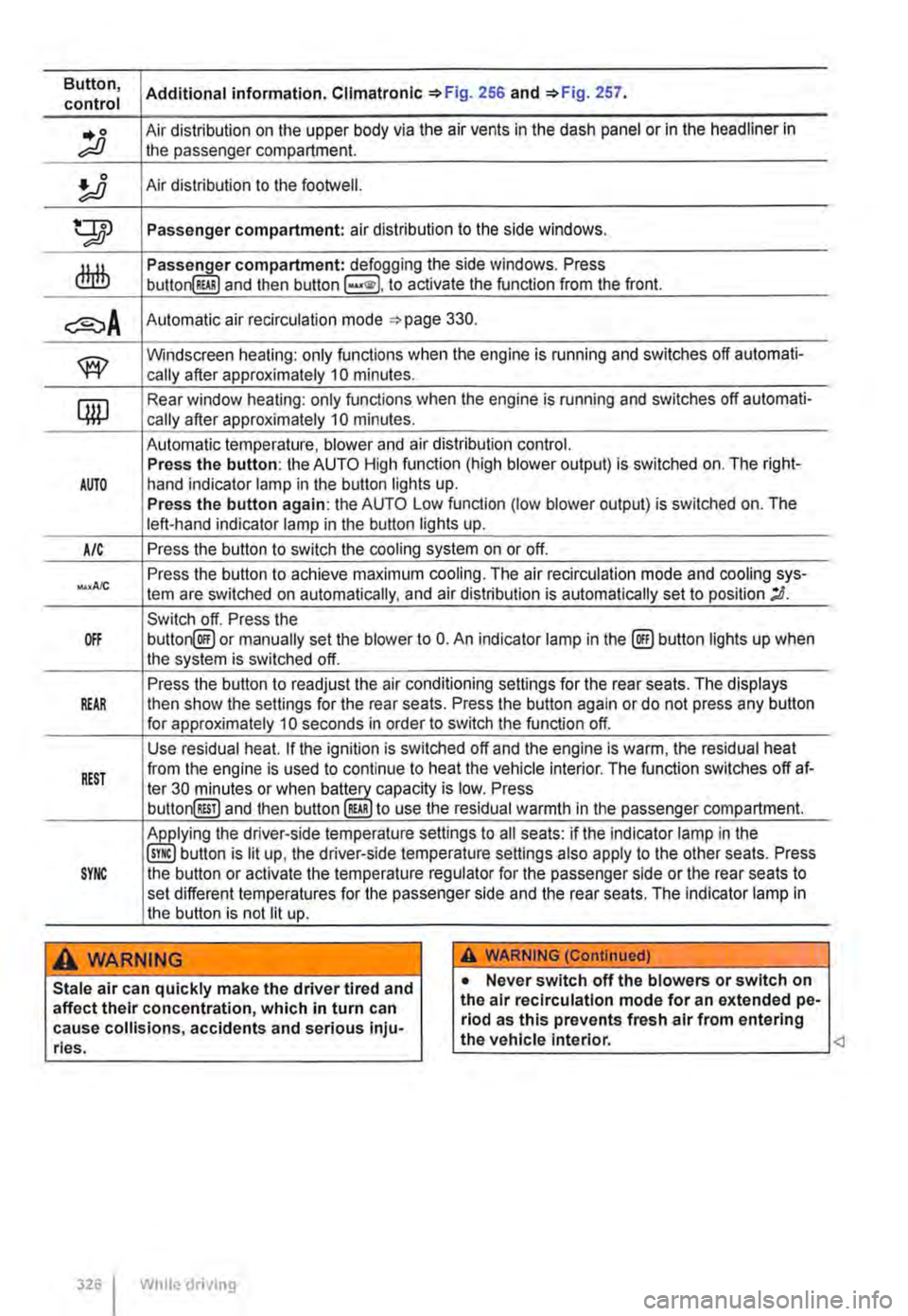
Button, Additional information. Climatronlc 256 and 257. control
.. 0 Air distribution on the upper body via the air vents in the dash panel or in the headliner in ;;;o the passenger compartment.
!J Air distribution to the footwetl.
tTIJ Passenger compartment: air distribution to the side windows.
dlrlb compartment: defogging the side windows. Press button RWI and then button to activate the function from the front.
Automatic air recirculation mode 330.
w Windscreen heating: only functions when the engine is running and switches off automati-cally after approximately 10 minutes.
qw Rear window heating: only functions when the engine is running and switches off automati-cally after approximately 10 minutes.
Automatic temperature, blower and air distribution control. Press the button: the AUTO High function (high blower output) is switched on. The right-AUTO hand indicator lamp in the button lights up. Press the button again: the AUTO Low function (low blower output) is switched on. The left-hand indicator lamp in the button lights up.
A/C Press the button to switch the cooling system on or off.
Press the button to achieve maximum cooling. The air recirculation mode and cooling sys-tern are switched on automatically, and air distribution is automatically set to position ;D.
Switch off. Press the OFF button@ or manually set the blower to 0. An indicator lamp in the@) button lights up when the system is switched off.
Press the button to readjust the air conditioning settings for the rear seats. The displays REAR then show the settings for the rear seats. Press the button again or do not press any button for approximately 10 seconds in order to switch the function off.
Use residual heat. If the ignition is switched off and the engine is warm, the residual heat
REST from the engine is used to continue to heat the vehicle interior. The function switches off at-ter 30 minutes or when capacity is low. Press button@!] and then button RWI to use the residual warmth in the passenger compartment.
the driver-side temperature settings to all seats: if the indicator lamp in the button is lit up, the driver-side temperature settings also apply to the other seats. Press SYNC the button or activate the temperature regulator for the passenger side or the rear seats to set different temperatures for the passenger side and the rear seats. The indicator lamp in the button is not lit up.
A wARNING A WARNING (Continued)
Stale air can quickly make the driver tired and affect their concentration, which in turn can cause collisions, accidents and serious inju-ries.
326 I While driving
• Never switch off the blowers or switch on the air recirculatlon mode for an extended pe-riod as this prevents fresh air from entering the vehicle interior.
Page 328 of 486
Settings for optimal road visibility
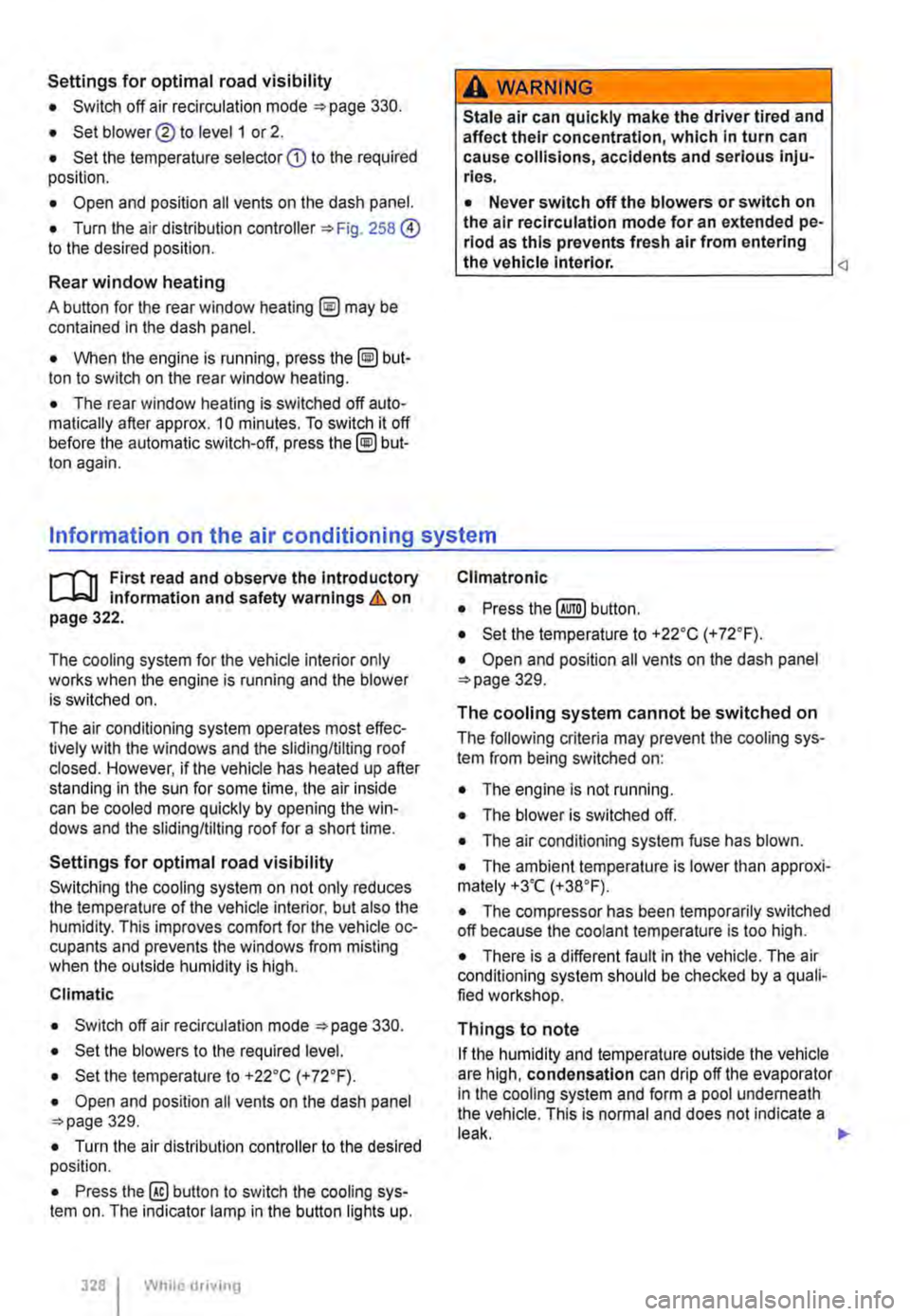
• Switch off air recirculation mode 330.
• Set blower® to level 1 or 2.
• Set the temperature selector G) to the required position.
• Open and position all vents on the dash panel.
• Turn the air distribution Fig. 258 0 to the desired position.
Rear window heating
A button for the rear window heating @ may be contained in the dash panel.
• When the engine is running, press the @ but-ton to switch on the rear window heating.
• The rear window heating is switched off auto-matically after approx. 10 minutes. To switch it off before the automatic switch-off, press the(!) but-ton again.
A WARNING
Stale air can quickly make the driver tired and affect their concentration, which in turn can cause collisions, accidents and serious inju-ries.
• Never switch off the blowers or switch on the air recirculatlon mode for an extended pe-riod as this prevents fresh air from entering the vehicle Interior.
.........r'n First read and observe the Introductory L-.lr:.ll Information and safety warnings & on page 322.
The cooling system for the vehicle interior only works when the engine is running and the blower is switched on.
The air conditioning system operates most effec-tively with the windows and the sliding/tilting roof closed. However, if the vehicle has heated up after standing in the sun for some time, the air inside can be cooled more quickly by opening the win-dows and the sliding/tilting roof for a short time.
Settings for optimal road visibility
Switching the cooling system on not only reduces the temperature of the vehicle interior, but also the humidity. This improves comfort for the vehicle oc-cupants and prevents the windows from misting when the outside humidity is high.
Climatic
• Switch off air recirculation mode 330.
• Set the blowers to the required level.
• Set the temperature to +22•c (+72.F).
• Open and position all vents on the dash panel 329.
• Turn the air distribution controller to the desired position.
• Press the@) button to switch the cooling sys-tem on. The indicator lamp in the button lights up.
328 I While driving
Cllmatronlc
• Press button.
• Set the temperature to +22•c (+72.F).
• Open and position all vents on the dash panel 329.
The cooling system cannot be switched on
The following criteria may prevent the cooling sys-tem from being switched on:
• The engine is not running.
• The blower is switched off.
• The air conditioning system fuse has blown.
• The ambient temperature is lower than approxi-mately +3"C (+38°F).
• The compressor has been temporarily switched off because the coolant temperature is too high.
• There is a different fault in the vehicle. The air conditioning system should be checked by a quali-fied workshop.
Things to note
If the humidity and temperature outside the vehicle are high, condensation can drip off the evaporator in the cooling system and form a pool underneath the vehicle. This is normal and does not indicate a
Page 330 of 486
Air recirculation mode
.-r'n First read and observe the introductory information and safety warnings .1:!. on page 322.
General notes
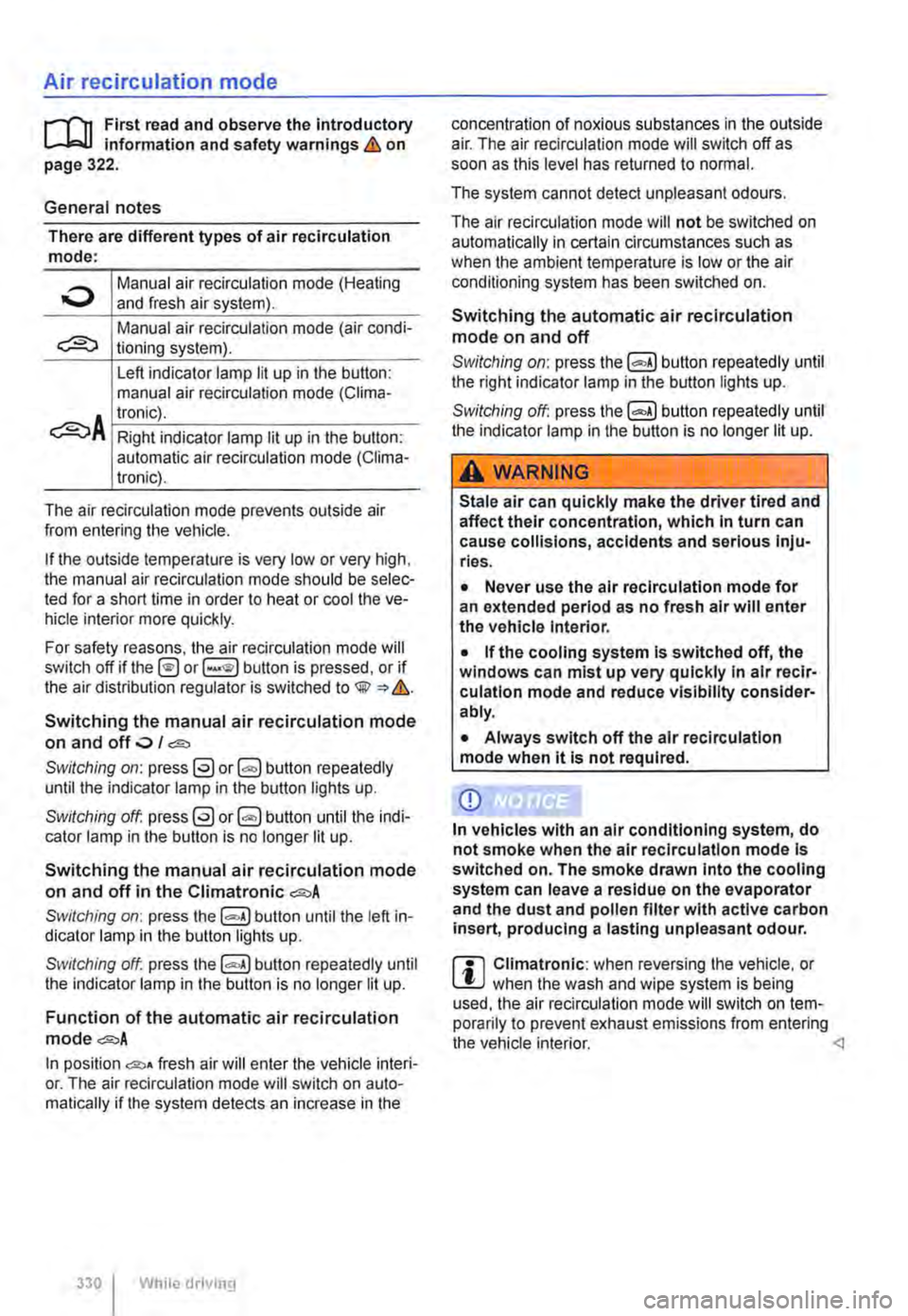
There are different types of air recirculation mode:
Manual air recirculation mode (Heating and fresh air system).
Manual air recirculation mode (air condi-tioning system).
Left indicator lamp lit up in the button: manual air recirculation mode (Ciima-
------------Right indicator lamp lit up in the button: automatic air recircutation mode (Ciima-tronic).
The air recirculation mode prevents outside air from entering the vehicle.
if the outside temperature is very low or very high, the manual air recirculation mode should be selec-ted for a short time in order to heat or cool the ve-hicle interior more quickly.
For safety reasons, the air recirculation mode will switch off if the@ button is pressed, or if the air distribution regulator is switched to lliil => .1:!,.
Switching the manual air recirculation mode on and off .o I c:;;:,
Switching on: press button repeatedly until the indicator lamp in the button lights up.
Switching off. press@) button until the indi-cator lamp in the button is no longer lit up.
Switching the manual air recirculation mode on and off in the Climatronic e<>A
Switching on: press the button until the left in-dicator lamp in the button tights up.
Switching off. press the repeatedly until the indicator lamp in the button is no longer lit up.
Function of the automatic air recirculation mode e<>A
In position a>• fresh air will enter the vehicle interi-or. The air recirculation mode will switch on auto-matically if the system detects an increase in the
330 I While driving
concentration of noxious substances in the outside air. The air recirculation mode will switch off as soon as this level has returned to normal.
The system cannot detect unpleasant odours.
The air recirculation mode will not be switched on automatically in certain circumstances such as when the ambient temperature is low or the air conditioning system has been switched on.
Switching the automatic air recirculation mode on and off
Switching on: press button repeatedly until the right indicator lamp in the button lights up.
Switching off: press button repeatedly until the indicator lamp in the button is no longer lit up.
A WARNING
Stale air can quickly make the driver tired and affect their concentration, which In turn can cause collisions, accidents and serious inju-ries.
• Never use the air reclrculation mode for an extended period as no fresh air will enter the vehicle Interior.
• If the cooling system is switched off, the windows can mist up very quickly In air recir-culatlon mode and reduce visibility consider-ably.
• Always switch off the air reclrculation mode when it is not required.
CD
In vehicles with an air conditioning system, do not smoke when the air reclrculatlon mode Is switched on. The smoke drawn Into the cooling system can leave a residue on the evaporator and the dust and pollen filter with active carbon insert, producing a lasting unpleasant odour.
m Cllmatronic: when reversing the vehicle, or l!J when the wash and wipe system is being used, the air recirculation mode will switch on tem-porarily to prevent exhaust emissions from entering the vehicle interior.
Page 351 of 486
A WARNING (Continued)
-Remove the vehicle key from the igni-tion lock.
-Always keep children away from the en-gine compartment and never leave the ve-hicle unattended.
• The engine cooling system Is under pres-sure when the engine Is hot. Never open the cap of the coolant expansion tank when the engine Is hot. Coolant may spray out and cause serious burns and other Injuries.
-Turn the cap slowly and very carefully anti-clockwise while exerting gentle down-ward pressure on the cap.
-Always protect the face, hands and arms from hot coolant or steam with a large, thick cloth.
• When refilling, do not spill any service flu-ids on engine components or on the exhaust system. The spilt service fluids can start a fire.
A WARNING
High voltages in the electrical system can cause electric shocks, burns, serious injuries and death!
• Never short circuit the electric system. The vehicle battery could explode.
• Please note the following guidelines to help reduce the risk of an electric shock and serious Injuries while the engine is running or being started:
-Never touch the electrical wiring of the Ignition system.
A WARNING
There are rotating components in the engine compartment that can cause serious injury.
• Never place your hand near these compo-nents or In the radiator fan. Touching the ro-tary blades can result in serious injuries. The fan Is temperature-controlled and can start automatically, even if the engine has been switched off and the vehicle key has been re-moved from the ignition lock.
• If any work has to be performed when the engine Is started or with the engine running, there is an additional, potentially fatal, safety risk from the rotating parts, such as the drive belts, alternator, radiator fan, etc., and from the high-voltage ignition system. Always be particularly careful.
A WARNING (Continued)
-Always ensure that no body parts, jew-ellery, ties, loose items of clothing or long hair can be caught up in rotating engine components. Before starting work, re-move any jewellery and ties, tie up long hair and pull clothes In tightly to avoid them getting caught In the engine com-partment.
-Always depress the accelerator careful-ly and never without due consideration. The vehicle can start to move even if the handbrake is applied.
• Always ensure that you have not left any objects, such as cleaning cloths and tools, in the engine compartment. Any forgotten items can cause malfunctions, engine damage and fires.
A WARNING
Additional insulating materials such as cov-ers in the engine compartment could disrupt the operation of the engine, cause damage and lead to severe Injuries.
• Never cover the engine with any Insulating materials.
A WARNING
Service fluids and some materials In the en-glne compartment are highly flammable and can cause fires and serious Injuries!
• Never smoke while working on the vehl-cl e.
• Never work near naked flames or sparks .
• Never spill fluids onto the engine. They could Ignite on hot engine components and hence cause injuries.
• Please note the following when carrying out any work on the fuel system or the elec-trlcal system:
-Always disconnect the vehicle battery. Ensure that the vehicle Is unlocked when the vehicle battery Is disconnected as oth-erwlse the anti-theft alarm will be activa-ted.
-Never work in the direct proximity of heating systems, water heaters or any oth-er open flames.
• Always have a fully functional and tested fire extinguisher to hand.
In the engine compartment I 351
...
Page 360 of 486
Coolant specification
r-l"'n First read and observe the Introductory l..-J,::,U Information and safety warnings & on page 358.
The cooling system is filled at the factory with a mixture of specially prepared water and at least 40% coolant additive G 13 (fl-VW 774 J). The coolant additive is dyed purple. This mixture of wa-ter and coolant additive gives the necessary frost protection down to -2s•c (-13.F) and protects the alloy parts of the cooling system against corrosion. The mixture also prevents scaling and raises the boiling point of the coolant.
In order to protect the coolant system, the propor-tion of coolant additive must always be at least 40%, even if anti-freeze is not required in warm weather and warm climates.
If greater frost protection is required in very cold climates, the proportion of anti-freeze additive can be increased. However, the percentage of coolant additive should not exceed 60%, as this would re-duce the frost protection and the cooling effect.
When refilling the coolant, a mixture of distilled water and at least 40% coolant additive G 13 or G 12 plus-plus (TL-VW 774 G) (both of which are dyed purple) must be used in order to obtain the optimum corrosion protection =>(]). Mixing G 13 with the coolant additives G 12 plus (Tl-VW774 F), G 12 (dyed red) orG 11 (dyed blue-green) will significantly decrease the level of corro-sion protection and should therefore be avoided =>
Insufficient anti-freeze In the coolant system can cause the engine to break down and cause serious Injuries.
• Please note that the amount of correct coolant additive used must be sufficient for the lowest ambient temperature that you ex-pect the vehicle to be exposed to.
• Coolant can freeze at extremely cold out-side temperatures, causing the vehicle to break down. Vehicle occupants with Inade-quate winter clothing could then freeze to death as the heating will also no longer func-tion.
360 I Cleaning and maintenance
CD
Never mix genuine coolant additives with other coolants that have not been approved by Volks-wagen. Mixing other coolants could cause seri-ous damage to the engine and cooling system.
• If the liquid in the coolant expansion tank is brown instead of purple, for example, G 13 has been mixed with another unsuitable engine coolant. The coolant must be changed as soon as possible if this Is the case. Failure to ob-serve this point can result In serious faults or engine damage.
Coolant and coolant additives can pollute the "7!1:5 environment. Spilt service fluids must be col-lected then disposed of properly and in an environ-mentally responsible way.
Page 362 of 486
A WARNING (Continued)
-Always keep children away from the en-gine compartment and never leave the ve-hicle unattended.
• The engine cooling system is under pres-sure when the engine is hot. Never open the cap of the coolant expansion tank when the engine is hot. Coolant may spray out and cause serious burns and other injuries.
-Turn the cap slowly and very carefully anti-clockwise while exerting gentle down-ward pressure on the cap.
-Always protect the face, hands and arms from hot coolant or steam with a large, thick cloth.
• When refilling, do not spill any service flu-ids on engine components or on the exhaust system. The spilt service fluids can start a fire. In certain circumstances, the ethylene glycol in the engine can catch fire.
CD
• Refill only with distilled water. All other types of water can cause corrosion in the en-gine due to the chemical components con-
Vehicle battery
CQJ Introduction
This chapter conlains information on the following subjects:
Warning lamp . . . . . . . . . . . . . . . . . . . . . . . . . . . 364
Checking the electrolyte level of the vehicle battery ................................. 364 Charging, replacing, disconnecling and connecting the vehicle battery . . . . . . . . . . . . . 365
The vehicle battery is a component of the electrical system in the vehicle.
Never carry out any work on the electrical system if you are not familiar with the necessary procedures and the general safety requirements and only un-suitable tools are available => &. The work should be carried out by a qualified workshop if you are uncertain. Volkswagen Commercial Vehicles rec-ommends using a Volkswagen Commercial Vehi-cles dealership for this purpose. Serious injuries can be caused if work is carried out incorrectly.
3621 Cleaning and maintenance
(j)
tained therein. This can also lead to engine fail-ure. If any other type of water is refilled, the flu-id in the engine cooling system should be com-pletely replaced immediately by a qualified workshop.
• Do not fill coolant above the top of the marked area =>Fig. 277. Otherwise the excess coolant will be pressed out of the cooling sys-tem when the engine is hot and could cause damage.
• If a large amount of coolant has been lost, do not refill the coolant until the engine has cooled completely. Heavy coolant loss is an in-dication of leaks in the engine cooling system. The engine cooling system should be checked by a qualified workshop as soon as possible. Failure to do so can result in engine damage.
• Do not top up with coolant if there is no more coolant in the coolant expansion tank. Air could enter the cooling system. Do not drive on! Seek expert assistance. Failure to do so can result in engine damage.
• When refilling service fluids, please ensure that the correct container is filled. The use of incorrect service fluids can result In serious faults and engine damage.
The vehicle battery is located on the left of the en-gine compartment.
Depending on the vehicle equipment level, the ve-hicle could have two vehicle batteries. Camper vans can have up to three vehicle batteries. The second vehicle battery is located under the left front seat: the third battery in camper vans is loca-ted in the wardrobe on the rear left of the vehicle. •