Oil VOLKSWAGEN TRANSPORTER 2018 Workshop Manual
[x] Cancel search | Manufacturer: VOLKSWAGEN, Model Year: 2018, Model line: TRANSPORTER, Model: VOLKSWAGEN TRANSPORTER 2018Pages: 486, PDF Size: 69.28 MB
Page 381 of 486
Washing the vehicle
r-f'n First read and observe the introductory Information and safety warnings & on page 380.
The longer substances such as insects, bird drop-pings, resinous tree sap, road dirt, industrial de-posits, tar, soot or road salt and other corrosive materials remain on the vehicle, the more damage they do to the paintwork. High temperatures (for in-stance in strong sunlight) accelerate the corrosion process. The underside of the vehicle should also be cleaned thoroughly and regularly.
Car washes
Please observe the signs on the automatic car wash. Before using an automatic car wash take the usual precautions, such as closing all windows and folding in the exterior mirrors, in order to avoid damage to the vehicle. You must consult the car wash operator if there are special parts on your ve-hicle such as spoilers, roof luggage carrier systems or radio aerials ::.CD.
The paint is so hard-wearing that the car can nor-mally be washed without problems in an automatic car wash. However, the effect on the paint de-pends to a large extent on the design of the car wash. Volkswagen Commercial Vehicles recom-mends the use of car washes without brushes.
To remove any wax residue from the windows and to stop wipers rubbing, please note the following points ::.page 382, Cleaning windows and exterior mirrors.
Washing the car by hand
When washing by hand, first soften the dirt with plenty of water and rinse off as well as possible.
Then clean the vehicle with a soft sponge, a glove or a brush using only light pressure. Start with the roof and work from the top to the bottom. Use a shampoo for very stubborn dirt only.
The sponge or glove should be wrung out thor-oughly at regular intervals.
Clean the wheels, sill panels etc. last. Use a differ-ent sponge for this purpose.
A WARNING
Parts of the vehicle with sharp edges can cause Injury.
• Protect your hands and arms from cuts on sharp parts, for example when cleaning the underbody or the inside of the wheel hous-lngs.
A WARNING
After the car has been washed, the braking effect could set in later than normal and ex-tend the braking distance as the brake discs and brake pads will be wet, or iced up In win-ter.
• You can "dry and de-ice" the brakes by performing careful braking manoeuvres. Make sure that you do not endanger any oth-er road users or violate any legal regulations when doing so.
CD
• The water should be no warmer than +so•c (+140.FJ.
• Do not wash the vehicle in direct sunlight in order to avoid damage to the vehicle palntwork.
• Never clean with insect sponges, rough kitchen sponges or similar products as these can damage the surface.
• Never clean the headlights with a dry cloth or sponge. Always use a wet cloth or sponge. lt is best to use soapy water.
• Washing the vehicle In cold weather: if the vehicle is rinsed with a hose, do not direct the water at the lock cylinders or the gaps around the doors, boot, or bonnet. The locks and seals could freeze.
CD
Observe the following guidelines before driving the vehicle into an automatic car wash in order to avoid damage to the vehicle:
• Ensure that the gap between the guide rails In the car wash is sufficient for the vehicle track. If the track is too narrow your wheels and tyres will be damaged.
• Switch off the rain sensor before driving the vehicle Into an automatic car wash.
• Check that the car wash is tall and wide enough for your vehicle.
• Fold In the exterior mirrors. Electrically fold-Ing exterior mirrors must be moved electrically. Do not fold them in and out by hand.
• In order to prevent damage to the palntwork on the bonnet, fold the wipers back onto the windscreen after drying the wiper blades. Do not drop the wipers onto the glass.
• Lock the tailgate to prevent it from opening accidentally In the car wash.
Page 382 of 486
Washing the vehicle with a high-pressure cleaner
I""""'T'n First read and observe the Introductory L.-lo:oJ.I information and safety warnings & on page 380.
Follow the instructions provided by the manufactur-er when cleaning your vehicle using a high-pres-sure cleaner. This applies in particular to the pres-sure and the spraying distance=>&.
Maintain sufficient distance to soft materials such as rubber hoses, insulation, and the ParkPilot sen-sors. The ParkPilot sensors are located in the front bumper, and in some cases also in the rear bump-er =>
A WARNING
The incorrect use of a high-pressure cleaner can cause visible and invisible long-term damage to tyres and other materials. This can cause accidents and serious injuries.
• Maintain sufficient distance between the washer jet and the tyres.
• Never clean the tyres with concentrated jet nozzles (dirt blasters). The tyres may incur visible and invisible damage even if cleaned briefly with the spray at a distance.
A WARNING
After the car has been washed, the braking effect could set in later than normal and ex-tend the braking distance as the brake discs and brake pads will be wet, or iced up in win-ter.
• You can "dry and de-ice" the brakes by performing careful braking manoeuvres. Make sure that you do not endanger any oth-er road users or violate any legal regulations when doing so.
CD
• The water may be no warmer than +so·c (+140.FJ.
• Do not wash the vehicle In direct sunlight In order to avoid damage to the vehicle palntwork.
• The ParkPilot sensors In the bumpers must be kept clean and free of Ice. When cleaning with pressure hoses or steam cleaners, the sensors should only be sprayed briefly and the steam/hose nozzle must be kept more than 10 cm away.
• Do not clean windows that are iced over or covered In snow with a high-pressure cleaner.
• Washing the vehicle in cold weather: If the vehicle is rinsed with a hose, do not direct the water Into the lock cylinders or the gaps round the doors, boot, or bonnet. The locks and seals could freeze.
I""""'T'n First read and observe the introductory L.-lo:oJ.I information and safety warnings & on page 380.
Cleaning windows and exterior mirrors
Moisten the windows and exterior mirrors with commercially available, alcohol-based glass clean-er.
382 Cleaning and maintenance
Dry the glass surfaces with a clean chamois leath-er or a lint-free cloth. Chamois leathers that have been used on painted surfaces are not suitable for use on glass surfaces. They will be soiled with wax deposits which could smear the surfaces.
Use window cleaner or a silicone remover to clean off rubber, oil, grease and silicone deposits =>
Page 385 of 486
Cleaning and caring for chrome and aluminium trim parts
r-('n First read and observe the Introductory l..Jo:-1.1 Information and safety warnings & on page 380.
• Use a damp, clean, lint-free and soft cloth to clean the surfaces.
• For heavy soiling use a special solvent-free cleaning product.
• Polish the chrome and aluminium trim parts us-ing a soft, dry cloth.
CD
To ensure that the chrome and aluminium parts are not damaged:
• Do not clean or polish In direct sunlight.
• Do not clean or polish in sandy or dusty en-vironments.
CD
• Do not use any abrasive care products (e.g. cream cleaners).
• Never clean with Insect sponges, rough kitchen sponges or similar products.
• Do not polish any dirty surfaces.
• Do not use solvent-based cleaning prod-ucts.
• Do not use hard wax.
CD
Chrome rims or wheel covers may also have an additional varnish finish and should not be treated using chrome or aluminium cleaning agents or chrome or aluminium polish. A nor-mal commercially available paint cleaning product should be used instead.
r-('n First read and observe the introductory l..Jo:-1.1 information and safety warnings & on page 380.
Decorative film is a design feature and is made up of soft polyvinyl chloride (PVC).
In the areas of the vehicle where there is decora-tive film, the underlying paint layer is protected from weather and environmental conditions.
If the decorative film remains on the vehicle for a long time, the appearances of paint on the area protected by the decorative film and the area not covered by the film may begin to show differences. This can usually be rectified by polishing.
Volkswagen Commercial Vehicles recommends that you seek advice from a Volkswagen Commer-cial Vehicles partner or workshop as to a suitable care product.
Durability of the decorative film
Environmental conditions such as sunlight, mois-ture, pollution, stone impact, etc. affect the durabili-ty and colour of the decorative film. Signs of wear and age are normal and do not indicate a defect in quality.
After the decorative film is fitted, bubble formation may appear due to strong summer heat for exam-ple. These bubbles will usually go away without in-tervention. This will not limit the serviceability of the film in any way.
In warm or moderate climates slight bubble forma-tion may be noticeable after two or three years. In warm or hot climates the decorative film can show signs of wear and slight bubble formation may ap-pear after just one year.
Decorative film may become faded within one year in very hot climates, particularly when there is a build-up of heat due to exposure to sunlight.
Cleaning the decorative film
Decorative film is suitable for automatic car washes provided you do not select a programme with hot wax.
Please pay attention to the information and notes on washing the vehicle =>page 381 and on wash-ing using a high-pressure cleaner =>page 382.
When using presprays and vapour jets always maintain a distance of at least 20 cm between the spray nozzle and the decorative film =>CD.
Insect residue, bird droppings, road dirt, industrial deposits. tar, soot, road salt and other aggressive deposits can cause damage to the decorative film.
The longer the aggressive deposits remain on the decorative film, the worse the negative impact will be. High temperatures (for instance in strong sun-light) accelerate the corrosion process. Immediate-ly wash the vehicle thoroughly using warm water or soapy water =>CD. .,.
Vehicle care and maintenance 385
Page 388 of 486
r1ih In the interests of environmental protection, 'r!!S the engine compartment should be washed only in specially provided wash bays. This pre-vents toxic waste water containing oil, grease and
fuel from entering the sewerage system. In some districts, washing the engine compartment any-where else may be prohibited.
o::JJ Introduction
This chapter contains information on the following subjects:
Handling seat covers . . . . . . . . . . . . . . . . . . . . 389
Cleaning cloth seat covers, fabric trim and Alcantara® upholstery . . . . . . . . . . . . . . . . . . . . 389
Cleaning and caring for natural leather covers 391
Cleaning leatherette upholstery . . 392
Cleaning stowage compartments, drink holders and ash trays . . . . . . . . . . . . . . . . . . . . 392 Cleaning and caring for the dash panel, wooden trims and plastic parts . . . . . . . . . . 392
Cleaning seat belts . . . . . . . . . . . . . . . . . . . . . . 392 Cleaning cool box . . . . . . . . . . . . . • . . . . . . . . . 393
Cleaning seat rails . . . . . . . . . . . . . . . . . . . 393
Cleaning opaque shades 393
Modern fabrics, such as dark denim, are often not colourfast. Light-coloured upholstery (soft materials or leather) is particularly sensitive to staining caused by these fabrics, even if you are careful. This is not caused by a fault in the upholstery, but by the non-colourfast nature of the garments.
Leaving stains, dirt and other deposits on the sur-face of vehicle components and cloth seat covers for a long time can make it difficult to clean and treat them. Stains, dirt and deposits may become impossible to remove, particularly if left for a long time.
Additional information and warnings:
• Cleaning and caring for the vehicle exterior 380
• Accessories, modifications, repairs and renewal of parts 394
A WARNING
Car care products can be toxic and hazard-ous. Unsuitable care products and Incorrect application of care products can cause acci-dents, serious injuries, burns or poisoning.
388 Cleaning and maintenance
A WARNING (Continued)
• The care product must be kept In its origi-nal sealed container.
• Read the manufacturer's Instructions.
• Never store car care products in empty food containers, bottles or any other non-original containers as people finding these containers may not know that they contain care products.
• Keep children away from care products.
• The products can give off harmful fumes during use. They should therefore only be used outside or In well-ventilated spaces.
• Never use fuel, turpentine, engine oil, nail varnish remover or other volatile fluids to wash, clean or care for your vehicle. These substances are toxic and highly Inflammable.
A WARNING
Incorrect care and cleaning of vehicle parts can Impair the safety features of the vehicle and cause serious Injury.
• Vehicle parts must be cleaned according to the manufacturer's Instructions.
• Only use approved or recommended cleaning products.
CD
• Cleaning products that contain solvents at-tack the material and may cause Irreparable damage.
• Stains, dirt and other deposits containing aggressive and solvent-based Ingredients at-tack the material and may cause Irreparable damage, even If only left for a short time.
• Stains, dirt and other deposits should be re-moved as quickly as possible and not allowed to dry In.
• To avoid damage, stubborn stains should be removed by a specialist cleaning company, .,.
Page 390 of 486
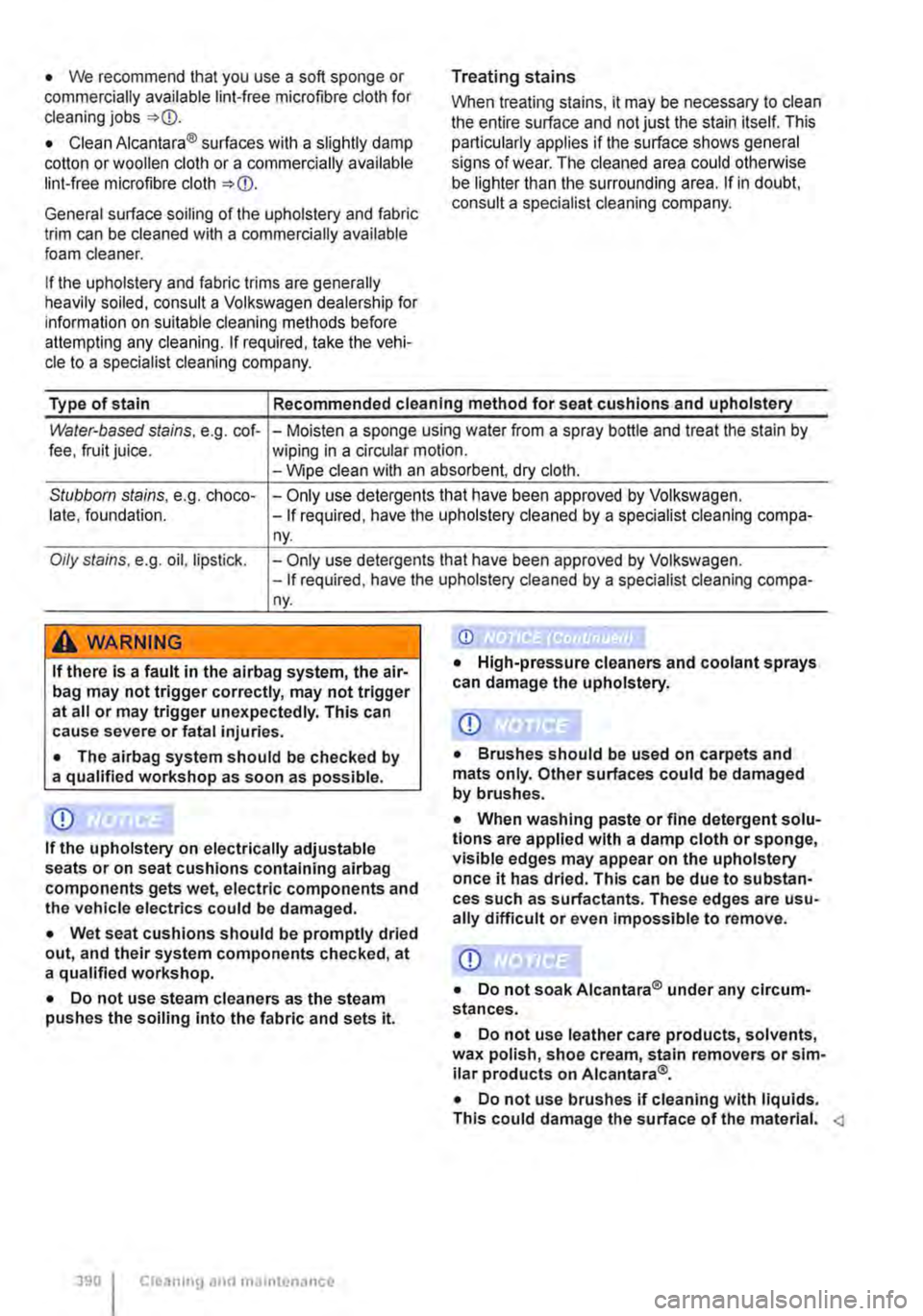
• We recommend that you use a soft sponge or commercially available lint-free microfibre cloth for cleaning jobs
• Clean Alcantara® surfaces with a slightly damp cotton or woollen cloth or a commercially available lint-free microfibre cloth
General surface soiling of the upholstery and fabric trim can be cleaned with a commercially available foam cleaner.
If the upholstery and fabric trims are generally heavily soiled, consult a Volkswagen dealership for information on suitable cleaning methods before attempting any cleaning. If required, take the vehi-cle to a specialist cleaning company.
Treating stains
When treating stains, it may be necessary to clean the entire surface and not just the stain itself. This particularly applies if the surface shows general signs of wear. The cleaned area could otherwise be lighter than the surrounding area. If in doubt, consult a specialist cleaning company.
Type of stain Recommended cleaning method for seat cushions and upholstery
Water-based stains, e.g. cof-fee, fruit juice. -Moisten a sponge using water from a spray bottle and treat the stain by wiping in a circular motion. -Wipe clean with an absorbent, dry cloth.
Stubborn stains, e.g. choco--Only use detergents that have been approved by Volkswagen. late, foundation. -If required, have the upholstery cleaned by a specialist cleaning compa-ny.
Oily stains, e.g. oil, lipstick. -Only use detergents that have been approved by Volkswagen. -If required, have the upholstery cleaned by a specialist cleaning compa-ny.
A WARNING CD
If there is a fault in the airbag system, the air-bag may not trigger correctly, may not trigger at all or may trigger unexpectedly. This can cause severe or fatal injuries.
• The airbag system should be checked by a qualified workshop as soon as possible.
Q)
If the upholstery on electrically adjustable seats or on seat cushions containing airbag components gets wet, electric components and the vehicle electrics could be damaged.
• Wet seat cushions should be promptly dried out, and their system components checked, at a qualified workshop.
• Do not use steam cleaners as the steam pushes the soiling into the fabric and sets it.
390 Cleaning and maintenance
• High-pressure cleaners and coolant sprays can damage the upholstery.
Q)
• Brushes should be used on carpets and mats only. Other surfaces could be damaged by brushes.
• When washing paste or fine detergent solu-tions are applied with a damp cloth or sponge, visible edges may appear on the upholstery once it has dried. This can be due to substan-ces such as surfactants. These edges are usu-ally difficult or even Impossible to remove.
Q)
• Do not soak Alcantara® under any circum-stances.
• Do not use leather care products, solvents, wax polish, shoe cream, stain removers or sim-ilar products on Alcantara®.
• Do not use brushes if cleaning with liquids. This could damage the surface of the material.
Page 391 of 486
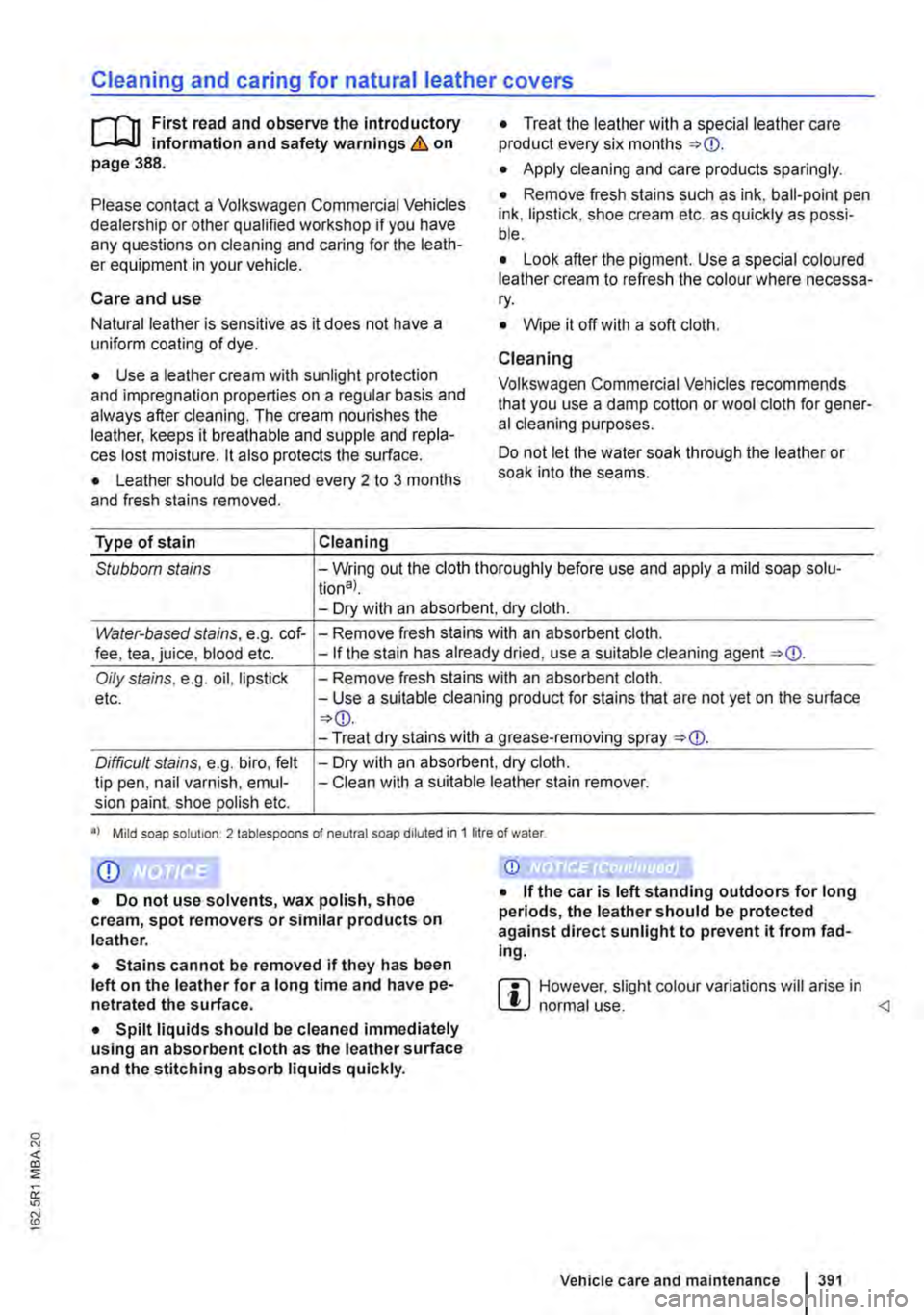
Cleaning and caring for natural leather covers
r-f"'n First read and observe the introductory L-.I.::.U information and safety warnings & on page 388.
Please contact a Volkswagen Commercial Vehicles dealership or other qualified workshop if you have any questions on cleaning and caring for the leath-er equipment in your vehicle.
Care and use
Natural leather is sensitive as it does not have a uniform coating of dye.
• Use a leather cream with sunlight protection and impregnation properties on a regular basis and always after cleaning. The cream nourishes the leather, keeps it breathable and supple and repla-ces lost moisture. lt also protects the surface.
• Leather should be cleaned every 2 to 3 months and fresh stains removed.
Type of stain Cleaning
• Treat the leather with a special leather care product every six months
• Apply cleaning and care products sparingly.
• Remove fresh stains such as ink, ball-point pen ink, lipstick, shoe cream etc. as quickly as possi-ble.
• Look after the pigment. Use a special coloured leather cream to refresh the colour where necessa-ry.
• Wipe it off with a soft cloth.
Cleaning
Volkswagen Commercial Vehicles recommends that you use a damp cotton or wool cloth for gener-al cleaning purposes.
Do not let the water soak through the leather or soak into the seams.
Stubborn stains -Wring out the cloth thoroughly before use and apply a mild soap solu-tional. -Dry with an absorbent, dry cloth.
Water-based stains, e.g. cof--Remove fresh stains with an absorbent cloth. fee, tea, juice, blood etc. -If the stain has already dried, use a suitable cleaning agent
Oily stains, e.g. oil, lipstick etc. -Remove fresh stains with an absorbent cloth. -Use a suitable cleaning product for stains that are not yet on the surface
-Treat dry stains with a grease-removing spray
Difficult stains, e.g. biro, felt tip pen, nail varnish, emul-sion paint. shoe polish etc.
-Dry with an absorbent, dry cloth. -Clean with a suitable leather stain remover.
•I Mild soap solut1on: 2 tablespoons of neutral soap diluted in 1 lilre of water
CD
• Do not use solvents, wax polish, shoe cream, spot removers or similar products on leather.
• Stains cannot be removed if they has been left on the leather for a long time and have pe-netrated the surface.
• Spilt liquids should be cleaned immediately using an absorbent cloth as the leather surface and the stitching absorb liquids quickly.
CD
• If the car is left standing outdoors for long periods, the leather should be protected against direct sunlight to prevent it from fad-Ing.
m However, slight colour variations will arise in W normal use.
Page 392 of 486
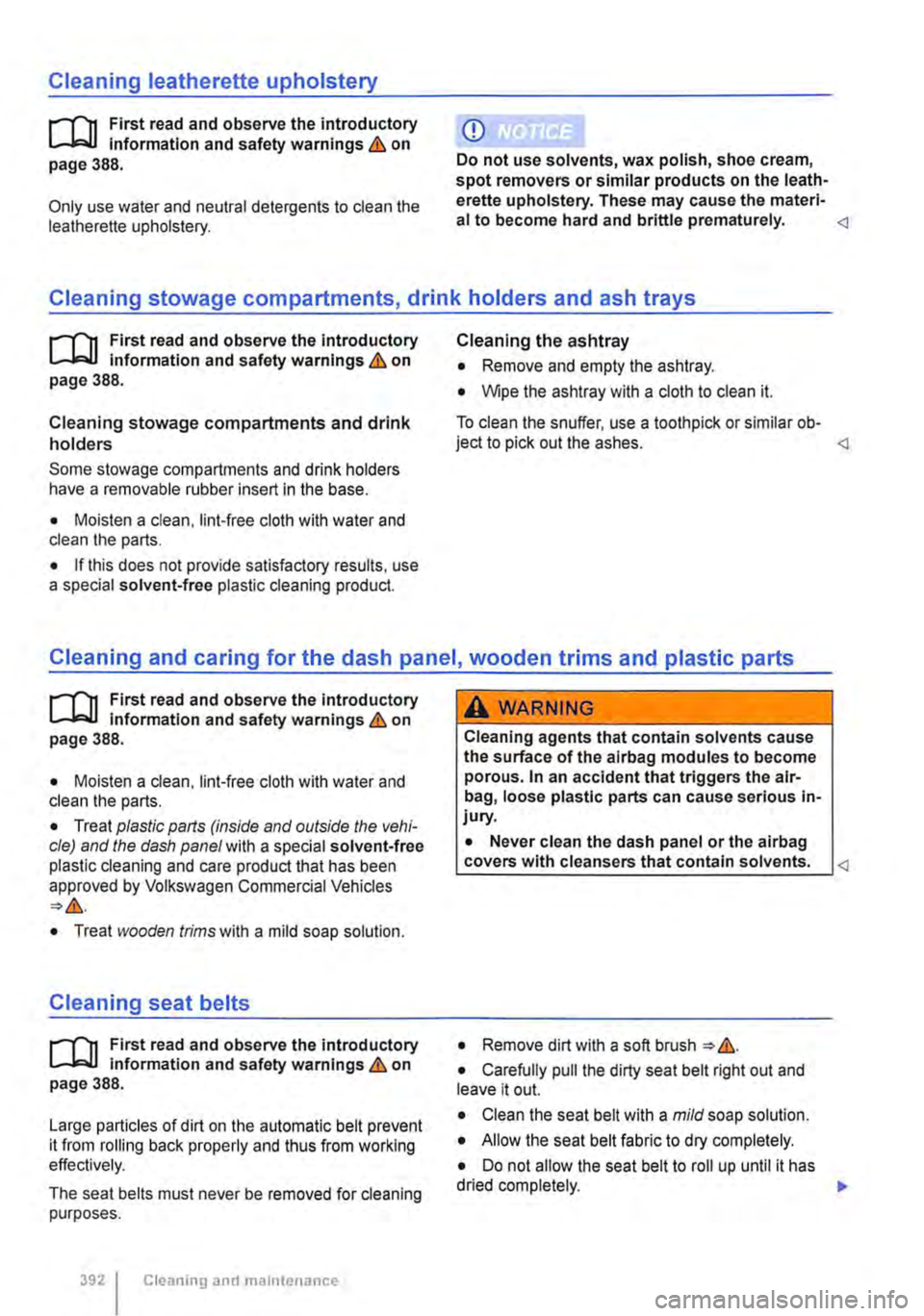
Cleaning leatherette upholstery
,......-('n First read and observe the introductory information and safety warnings & on page 388.
Only use water and neutral detergents to clean the ieatherette upholstery.
CD
Do not use solvents, wax polish, shoe cream, spot removers or similar products on the leath-erette upholstery. These may cause the materi-al to become hard and brittle prematurely.
,......-('n First read and observe the introductory information and safety warnings & on page 388.
Cleaning stowage compartments and drink holders
Some stowage compartments and drink holders have a removable rubber insert in the base.
• Moisten a clean, lint-free cloth with water and clean the parts.
• If this does not provide satisfactory results, use a special solvent-free plastic cleaning product.
Cleaning the ashtray
• Remove and empty the ashtray.
• Wipe the ashtray with a cloth to clean it.
To clean the snuffer, use a toothpick or similar ob-ject to pick out the ashes.
,......-('n First read and observe the introductory Information and safety warnings & on page 388.
• Moisten a clean, lint-free cloth with water and clean the parts.
• Treat plastic parts (inside and outside the vehi-cle) and the dash panel with a special solvent-free plastic cleaning and care product that has been approved by Volkswagen Commercial Vehicles
""'&.
• Treat wooden trims with a mild soap solution.
Cleaning seat belts
,......-('n First read and observe the introductory information and safety warnings & on page 388.
Large particles of dirt on the automatic belt prevent it from roiling back properly and thus from working effectively.
The seat belts must never be removed for cleaning purposes.
3921 Cleaning and maintenance
A WARNING
Cleaning agents that contain solvents cause the surface of the airbag modules to become porous. In an accident that triggers the air-bag, loose plastic parts can cause serious in-jury.
• Never clean the dash panel or the airbag covers with cleansers that contain solvents.
• Carefully pull the dirty seat belt right out and leave it out.
• Clean the seat belt with a mild soap solution.
• Allow the seat belt fabric to dry completely.
• Do not allow the seat belt to roil up until it has dried completely. 11>
Page 393 of 486
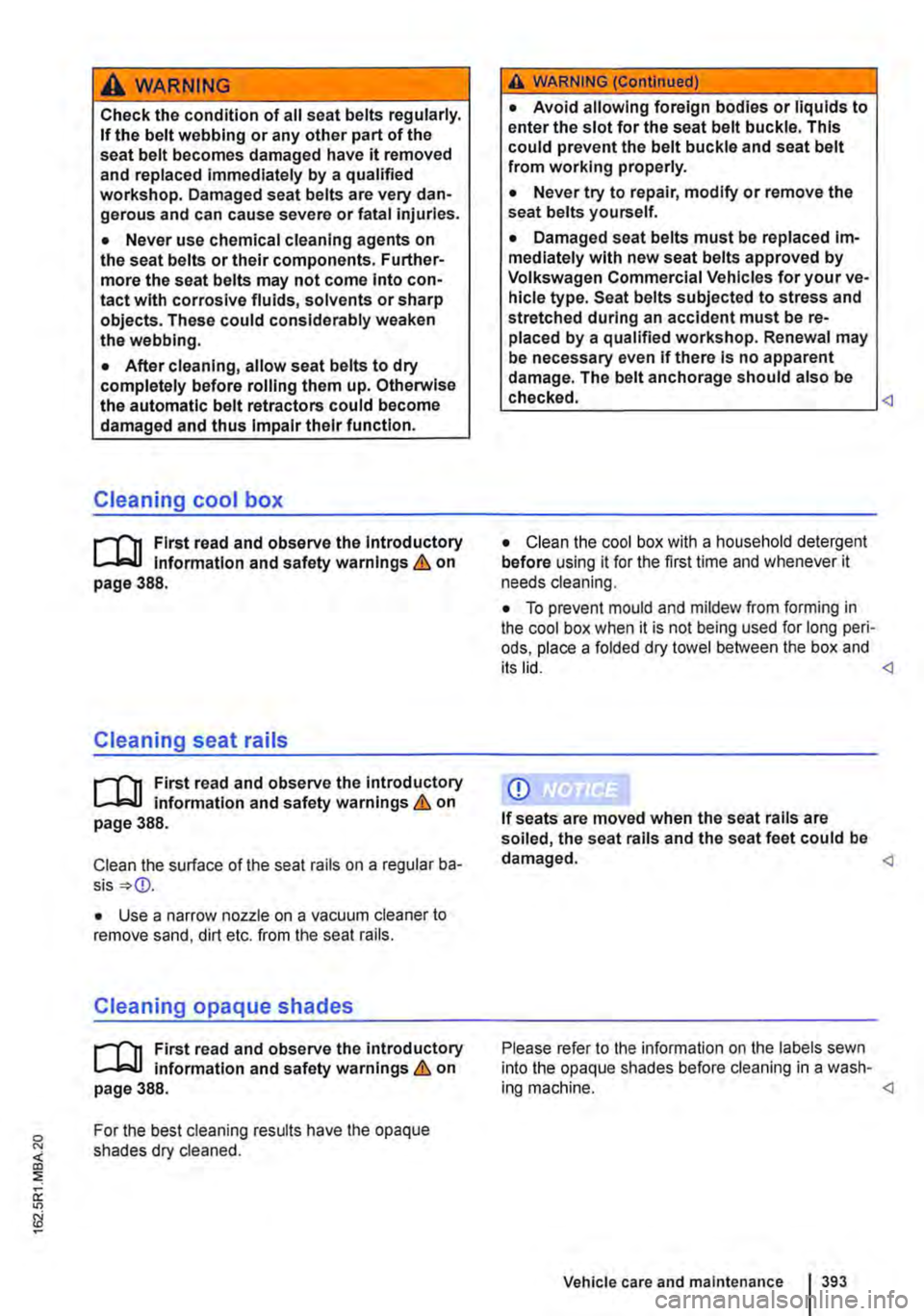
A wARNING
Check the condition of all seat belts regularly. If the belt webbing or any other part of the seat belt becomes damaged have it removed and replaced immediately by a qualified workshop. Damaged seat belts are very dan-gerous and can cause severe or fatal injuries.
• Never use chemical cleaning agents on the seat belts or their components. Further-more the seat belts may not come Into con-tact with corrosive fluids, solvents or sharp objects. These could considerably weaken the webbing.
• After cleaning, allow seat belts to dry completely before rolling them up. Otherwise the automatic belt retractors could become damaged and thus Impair their function.
Cleaning cool box
)""""'('n First read and observe the Introductory L.-J,:,JJ Information and safety warnings & on page 388.
Cleaning seat rails
)""""'('n First read and observe the introductory information and safety warnings & on page 388.
Clean the surface of the seat rails on a regular ba-sis
• Use a narrow nozzle on a vacuum cleaner to remove sand, dirt etc. from the seat rails.
Cleaning opaque shades
)""""'('n First read and observe the introductory information and safety warnings & on page 388.
For the best cleaning results have the opaque shades dry cleaned.
A WARNING (ConUnued)
• Avoid allowing foreign bodies or liquids to enter the slot for the seat belt buckle. This could prevent the belt buckle and seat belt from working properly.
• Never try to repair, modify or remove the seat belts yourself.
• Damaged seat belts must be replaced im-mediately with new seat belts approved by Volkswagen Commercial Vehicles for your ve-hicle type. Seat belts subjected to stress and stretched during an accident must be re-placed by a qualified workshop. Renewal may be necessary even if there is no apparent damage. The belt anchorage should also be checked.
• Clean the cool box with a household detergent before using it for the first time and whenever it needs cleaning.
• To prevent mould and mildew from forming in the cool box when it is not being used for long peri-ods, place a folded dry towel between the box and its lid.
CD
If seats are moved when the seat rails are soiled, the seat rails and the seat feet could be damaged.
Please refer to the information on the labels sewn into the opaque shades before cleaning in a wash-ing machine.
Vehicle care and maintenance 393
Page 394 of 486
Accessories, modifications, repairs and renewal of parts
o::n Introduction
This chapter contains information on the following subjects:
Running-in 394
Accessories and replacement parts 395 Service fluids and consumables . . . . . . . . . . . 395
Repairs and technical modifications . . . . . . . . 396
Repairs and faults in the airbag system . . . . . 397
Retrofitting two-way radios . . . . . . . . . . . . . . . . 398
Information stored in the control units . . . . . . . 398 Using a mobile telephone in the vehicle without a connection to the external aerial . . 399
Vehicle lifting points 401
Additional information and warnings:
• Seat belts '*page 79
• Airbag system '*page 87
• Towing a trailer 139
• Ashtray and cigarette lighter 161
• Electrical sockets 163
• Braking, stopping and parking '*page 269
• Pull-away assist systems 282
• ParkPilot 287
• Reversing camera (Rear Assist) '*page 291
• Cruise control system (CCS) 295
• Driver Alert System 315
• Tyre monitoring system 318
• Preparation for working in the engine compart-ment page 350
• Engine oil 353
• Engine coolant '*page 358
• Battery 362
Running-in
r--('n First read and observe the introductory L-J.:.lJ information and safety warnings & on page 394.
Please follow the regulations concerning running-in new parts.
394 I Cleaning and maintenance
• Cleaning and caring for the vehicle exterior 380
• Cleaning and caring for the interior 388
• Consumer information 404
• Radio, provision for mobile tele-phone, infotainment system, navigation system
A WARNING
Unsuitable spare parts and accessories, In-correctly carried out work, modifications and repairs can lead to damage to the vehicle and cause accidents and serious Injuries.
• Volkswagen Commercial Vehicles strongly recommends you use only approved Volks-wagen accessories and Volkswagen Genuine Parts®. These parts and accessories have been specially tested by Volkswagen Com-mercial Vehicles for suitability, reliability and safety.
• Repairs and modifications to your vehicle should only be carried out by a qualified workshop. Qualified workshops have the nec-essary tools, diagnostic equipment, repair In-formation and qualified personnel.
• Never fit parts to your vehicle that are In any way different from the factory-fitted parts.
• Never secure or mount objects such as drink holders or telephone holders on or next to the airbag covers or within the deployment zone of the airbag.
• Only use rim/tyre combinations which have been approved by Volkswagen Commer-cial Vehicles for your vehicle type.
Any new engine has to be run in during the first 1 ,500 kilometres. During its first few hours of run-ning, the internal friction in the engine is greater than later on when all the moving parts have bed-ded down.
The style of driving during the first 1 ,500 kilometres will also affect the engine quality. Even after this time-and especially with a cold engine-drive the .,.
Page 395 of 486
vehicle at moderate speeds in order to reduce en-gine wear and to increase the mileage that the en-gine can cover. Do not drive at engine speeds that are too low. Always shift down gear if the engine is not running smoothly. The following applies up to 1,000 kilometres:
• Do not depress the accelerator fully.
• Do not drive the vehicle at more than 2/3 of the top engine speed.
• Do not drive with a trailer attached.
Accessories and replacement parts
r-1'11 First read and observe the introductory l-J,:::JJ information and safety warnings & on page 394.
Volkswagen Commercial Vehicles recommends that you seek advice from a Volkswagen Commer-cial Vehicles dealership before purchasing acces-sories, spare parts or service fluids. For example, if the vehicle is to be retrofitted with accessories or if parts have to be renewed. Volkswagen Commer-cial Vehicle dealerships can recommend accesso-ries, parts and service fluids which are suitable for your requirements. They can also answer any questions you might have regarding official regula-tions.
Volkswagen Commercial Vehicles recommends you use only approved Volkswagen accessories and Volkswagen Genuine Parts®. These parts and accessories have been specially tested by Volkswagen Commercial Vehicles for suitability, re-liability and safety. A Volkswagen Commercial Ve-hicles dealership is also qualified for correct instal-lation.
Although the market is constantly scrutinised, Volkswagen Commercial Vehicles cannot assume responsibility for the reliability, safety and suitability of products Volkswagen Commercial Vehicles has not approved. Volkswagen Commercial Vehi-cles can therefore assume no responsibility for these parts, even if they have been approved by an official testing agency or are covered by an offi-cial approval certificate.
Service fluids and consumables
r-1'11 First read and observe the introductory l-J,:::JJ information and safety warnings & on page 394.
From 1,000 to 1,500 kilometres, gradually in-crease driving performance to top speed and high-est engine speed.
Running in new tyres and brake pads
• New wheels and tyres =>page 367
• Information on the brakes =>page 272
r:lib If the engine is run in gently, the life of the en-W gine will be increased and its oil consumption
Any retro-fitted equipment which has a direct ef-fect on the vehicle and/or the way it is driven must be approved by Volkswagen Commercial Vehicles for use in your vehicle and bear the e mark (the European Union's authorization symbol). These devices include cruise control systems or an elec-tronically controlled suspension.
Any additional electrical components fitted that do not serve to control the vehicle itself must bear the
Incorrectly performed repairs or modifica-tions to your vehicle can impair the effective-ness of the airbags, cause faults, accidents and fatal injury.
• Never secure or mount objects such as drink holders, telephone holders either on or next to the airbag covers or within the de-ployment zone of the airbag.
• Objects either on or next to the airbag module covers or are in the deployment zone of the airbags can cause serious or even fatal injuries should the airbags be activated.
All service fluids and consumables, e.g. toothed belts, tyres, coolant, engine oil, spark plugs and vehicle batteries, are being constantly developed. For this reason, service fluids and consumables
Vehicle care and maintenance I 395