brake VOLKSWAGEN TRANSPORTER 2018 Manual PDF
[x] Cancel search | Manufacturer: VOLKSWAGEN, Model Year: 2018, Model line: TRANSPORTER, Model: VOLKSWAGEN TRANSPORTER 2018Pages: 486, PDF Size: 69.28 MB
Page 368 of 486

type. Refer to the vehicle documentation and ask a Volkswagen Commercial Vehicles dealership if necessary.
//.(/ '\
'(j
... '5I'
IJ
7rr.Oii2
Fig. 280 How to swap wheels.
.....-r'n First read and observe the introductory L-W! Information and safety warnings & on page 367.
The tyres are the most used and most underesti-mated parts of a vehicle. Tyres are very important as the narrow tyre surfaces are the only contact between the vehicle and the road.
The service life of tyres is dependent on tyre pres-sure, driving style handling and fitting.
The tyres and wheel rims are an essential part of the vehicle's design. The tyres and rims approved by Volkswagen Commercial Vehicles are specially matched to the characteristics of the vehicle and make a major contribution to good road holding and safe handling.
Avoiding damage to the tyres
• If you have to drive over a kerb or similar obsta-cle, drive slowly and at a right angle if possible.
• Inspect the tyres regularly for damage such as cuts. cracks or blisters.
• Remove foreign objects that are in the outer tyre tread and have not penetrated the Inner tyre 373.
• Always respond to any warning messages giv-en by the tyre monitoring system=:opage 318.
• Damaged or worn tyres must be replaced im-mediately =:o page 373.
• Regularly check the tyres for hidden damage =:-page 373.
368 Cleaning and maintenance
• Never exceed the top speed and load permitted for the tyres that are fitted =:o page 375.
• Protect the wheels, including the spare wheel, from contact with corrosive substances, including oils, lubricants, fuel and brake fluid =:o &.
• Replace missing dust caps immediately.
Tyres with directional tread pattern
Tyres with directional tread pattern have been de-veloped to roll in one direction only. An arrow on the tyre sidewall indicates the direction of rotation on tyres with directional tread =:o page 375. The di-rection of rotation must be adhered to. This is the only guarantee for optimum grip and helps to avoid aquaplaning, excessive noise and wear.
If, however, the tyre is fitted in the opposite direc-tion to the tread pattern, you must take more care when driving as the tyre is now no longer being used according to its designation. This is particu-larly important on wet roads. The tyres must be re-placed as quickly as possible or be fitted with the tread in the correct direction.
Rotating wheels front to rear
Regularly rotating the wheels as shown in the illus-tration =:o Fig. 280 is recommended to help ensure that tyres wear evenly. All the tyres will then last for about the same time.
Volkswagen Commercial Vehicles recommends having the wheels changed by a qualified work-shop.
Tyres that are older than 6 years
Tyres age through physical and chemical process-es that can impair their function. Tyres that are stored unused for an extended period will harden and become brittle more quickly than tyres which are in constant use.
Volkswagen Commercial Vehicles recommends re-placing tyres that are more than 6 years old with new tyres. This also applies for tyres, including the spare wheel, which appear to still be in good con-dition and whose tread depth has not yet reached the minimum value stipulated by legislation =:o &.
The age of a tyre can be determined from the man-ufacturing date, which Is a component of the tyre identification number (TIN) =:o page 375. .,..
Page 369 of 486
Storing tyres
Mark tyres before you remove them to indicate the direction of rotation. This ensures you will be able to mount them correctly when you replace them (left, right, front, rear). When removed, the wheels or tyres should be stored in a cool, dry and pref-erably dark place. Do not store tyres mounted on the rim vertically.
Any tyres not fitted on rims should be kept in suita-ble sleeves to protect against dirt and should be stored vertically (standing on the tread).
All-terrain tyres
Some vehicles can be fitted at the factory with "all-terrain tyres". These tyres have a deep-tread pro-file that alters the vehicle's driving properties (such as comfort, consumption, braking distance, corner-Ing behaviour, rolling noise)=>&.
A WARNING
Corrosive liquids and other substances can cause visible and Invisible damage to the tyres, which can cause the tyre to burst.
• Always keep chemicals, oils, lubricants, fuel, brake fluid and other corrosive substan-ces away from the tyres.
A WARNING
Old tyres (even if never used) can suddenly lose pressure or burst, especially at high speeds. This can cause accidents and seri-ous injuries.
• Avoid using tyres that are more than six years old. If you have no alternative, drive slowly and with extra care at all times.
Rims
,....-('n First read and observe the Introductory L-J.:.ll information and safety warnings & on page 367.
The design of the wheel bolts is matched to the rims. If different rims are fitted, the correct wheel bolts with the right length and correctly shaped bolt heads must be used. This ensures that wheels are fitted securely and that the brake system works properly =>page 420.
For technical reasons, it is not generally possible to use the wheels from other vehicles. This can al-so apply to wheels of the same vehicle type.
A WARNING
The deep-tread profile of all-terrain tyres can considerably increase the braking distance or cornering behaviour and thus cause acci-dents and serious injuries.
• Always bear the modified vehicle handling in mind, and drive carefully.
CD
Avoid heavy impacts and drive round obstacles whenever possible. Tyres, particularly low-pro-file tyres, can be considerably compressed and deformed by potholes and curb edges especial-ly. This can cause the tyre's webbing reinforce-ment to brake, and cause dents or rips on the side walls or deformations or cracks on the rims.
Old tyres should be disposed of as required !!IS by legislation.
Wheel bolts
Wheel boils must always be tightened with the cor-rect tightening torque =>page 420.
Rims with bolted-on rings
Rims with bolted-on rings consist of several com-ponents. These components are fastened using special bolts and special fastening technology. This ensures that the wheel functions proper1y, does not leak, remains safe and runs true. For this reason, damaged rims should be replaced. They may only .,..
Wheels and tyres I 369
Page 371 of 486
A wARNING
New tyres will have to be run in as they will Initially have reduced grip and braking effect.
• Drive particularly carefully for the first 600 km in order to prevent accidents and se-rious injury.
A WARNING
Wheels must have the necessary freedom of operation. If the wheels do not have the nec-essary freedom of operation, the tyre could rub on parts of the running gear, the vehicle body and the brake lines. This can lead to a fault in the brake system and to tread separa-tion and thus to a tyre bursting.
Tyre pressure
r-T'n First read and observe the introductory L-k.U Information and safety warnings & on page 367.
The correct tyre pressure for factory-fitted tyres is shown on the tyre pressure label and applies to all-season, summer and winter tyres. The tyre pres-sure label is located on the lock column on the left front door.
If the tyre pressure is too low or too high, the tyres will wear prematurely and the vehicle will not han-dle well => &. The correct tyre pressure is particu-larly important at high speeds. Incorrect tyre pres-sure causes premature wear and can cause a tyre burst.
The pressure should therefore be checked at least once a month and before starting a journey.
The given tyre pressure applies to cold tyres. Tyre pressure is always higher in warm tyres than it is in cold tyres.
For this reason, never reduce the pressure in warm tyres to adjust the tyre pressure. This would result in low tyre pressures that could potentially cause the tyre to burst suddenly.
Checking tyre pressure
Always check the tyre inflation pressure on "cold" tyres. A "cold" tyre can be defined as one on a ve-hicle that has only been driven a few kilometres (miles) within 3 hours prior to the test and at low speeds.
A WARNING (Continued)
• The actual tyre size must not exceed the tyre dimensions of manufacturers approved by Volkswagen Commercial Vehicles and must not rub on any vehicle body parts.
m Despite identical size details, the actual size L!..J of the various tyre makes may vary from these specified dimensions, or the tyre contours may vary considerably.
m Volkswagen Commercial Vehicles-approved L!..J tyres are guaranteed to have the dimensions that are suitable for the vehicle. The salesperson will have to provide a certificate from the tyre man-ufacturer for other tyre makes to prove that the tyre is also suitable for the vehicle. This certificate must be stored in a safe place in the vehicle.
• The tyre pressures must be adjusted to suit a heavy vehicle load.
• After altering the tyre pressures, please ensure that the valve caps are screwed on and observe any information and instructions on setting the tyre monitoring system =>page 318.
The temporary spare wheel is filled to the highest tyre pressure permissible for the vehicle.
A WARNING
Too high or too low a pressure may cause the tyre to suddenly lose pressure or burst while the vehicle is in motion. This can cause seri-ous accidents and fatal Injuries.
• If the tyre pressure Is too low, it is possi-ble that the tyre temperature will increase to such an extent when driving that the tread peels off and the tyre bursts.
• Fast speeds or overloading of the vehicle can cause overheating, sudden tyre damage including tyre bursts and ripping of the tread surface and thus to a loss of control of the vehicle.
• If the tyre pressure is too low or too high, the tyres will wear prematurely and the vehi-cle will not handle well. .,.
Wheels and tyres 371
Page 375 of 486
A WARNING (Continued)
• In some vehicles, the spare wheel could be smaller than the standard wheel. The small spare wheel has a sticker with the text "80 km/h" or "50 mph". This is the maximum speed at which you are permitted to drive with this tyre.
• Never drive faster than 80 km/h (50 mph). Do not accelerate quickly, brake suddenly or drive at high speed through bends.
• The spare wheel must always be secured firmly with the wheel bolts supplied by the factory.
Tyre lettering
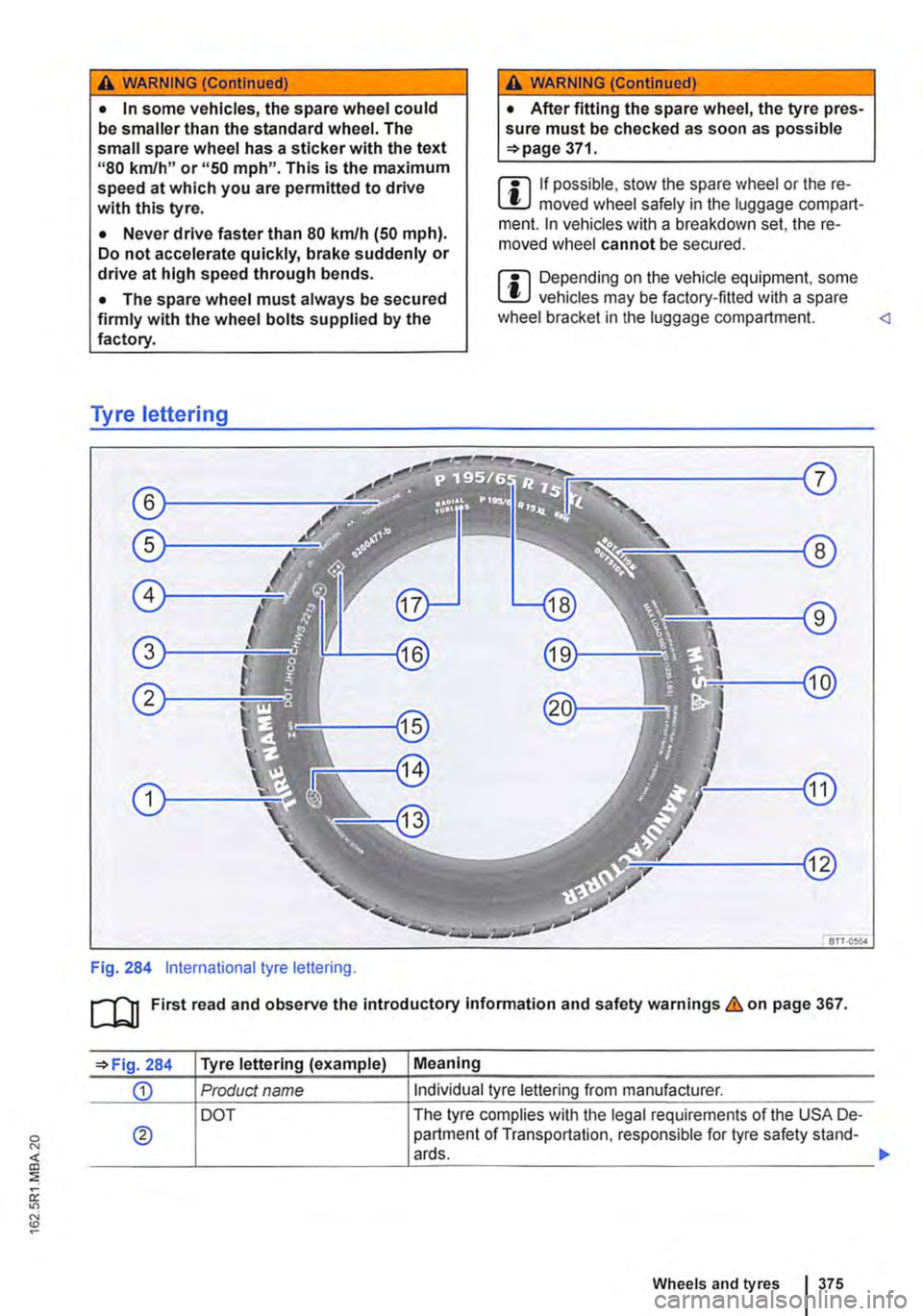
Fig. 284 International tyre lettering.
A WARNING (Continued)
• After fitting the spare wheel, the tyre pres-sure must be checked as soon as possible =>page 371.
m If possible, stow the spare wheel or the re-L!..J moved wheel safely in the luggage compart-ment. In vehicles with a breakdown set, the re-moved wheel cannot be secured.
m Depending on the vehicle equipment, some L!..J vehicles may be factory-fitted with a spare wheel bracket in the luggage compartment.
=>Fig. 284 Tyre lettering (example) Meaning
G) Product name Individual tyre lettering from manufacturer.
DOT The tyre complies with the legal requirements of the USA De-
0 partment of Transportation, responsible for tyre safety stand-ards.
Wheels and tyres 375
Page 381 of 486
Washing the vehicle
r-f'n First read and observe the introductory Information and safety warnings & on page 380.
The longer substances such as insects, bird drop-pings, resinous tree sap, road dirt, industrial de-posits, tar, soot or road salt and other corrosive materials remain on the vehicle, the more damage they do to the paintwork. High temperatures (for in-stance in strong sunlight) accelerate the corrosion process. The underside of the vehicle should also be cleaned thoroughly and regularly.
Car washes
Please observe the signs on the automatic car wash. Before using an automatic car wash take the usual precautions, such as closing all windows and folding in the exterior mirrors, in order to avoid damage to the vehicle. You must consult the car wash operator if there are special parts on your ve-hicle such as spoilers, roof luggage carrier systems or radio aerials ::.CD.
The paint is so hard-wearing that the car can nor-mally be washed without problems in an automatic car wash. However, the effect on the paint de-pends to a large extent on the design of the car wash. Volkswagen Commercial Vehicles recom-mends the use of car washes without brushes.
To remove any wax residue from the windows and to stop wipers rubbing, please note the following points ::.page 382, Cleaning windows and exterior mirrors.
Washing the car by hand
When washing by hand, first soften the dirt with plenty of water and rinse off as well as possible.
Then clean the vehicle with a soft sponge, a glove or a brush using only light pressure. Start with the roof and work from the top to the bottom. Use a shampoo for very stubborn dirt only.
The sponge or glove should be wrung out thor-oughly at regular intervals.
Clean the wheels, sill panels etc. last. Use a differ-ent sponge for this purpose.
A WARNING
Parts of the vehicle with sharp edges can cause Injury.
• Protect your hands and arms from cuts on sharp parts, for example when cleaning the underbody or the inside of the wheel hous-lngs.
A WARNING
After the car has been washed, the braking effect could set in later than normal and ex-tend the braking distance as the brake discs and brake pads will be wet, or iced up In win-ter.
• You can "dry and de-ice" the brakes by performing careful braking manoeuvres. Make sure that you do not endanger any oth-er road users or violate any legal regulations when doing so.
CD
• The water should be no warmer than +so•c (+140.FJ.
• Do not wash the vehicle in direct sunlight in order to avoid damage to the vehicle palntwork.
• Never clean with insect sponges, rough kitchen sponges or similar products as these can damage the surface.
• Never clean the headlights with a dry cloth or sponge. Always use a wet cloth or sponge. lt is best to use soapy water.
• Washing the vehicle In cold weather: if the vehicle is rinsed with a hose, do not direct the water at the lock cylinders or the gaps around the doors, boot, or bonnet. The locks and seals could freeze.
CD
Observe the following guidelines before driving the vehicle into an automatic car wash in order to avoid damage to the vehicle:
• Ensure that the gap between the guide rails In the car wash is sufficient for the vehicle track. If the track is too narrow your wheels and tyres will be damaged.
• Switch off the rain sensor before driving the vehicle Into an automatic car wash.
• Check that the car wash is tall and wide enough for your vehicle.
• Fold In the exterior mirrors. Electrically fold-Ing exterior mirrors must be moved electrically. Do not fold them in and out by hand.
• In order to prevent damage to the palntwork on the bonnet, fold the wipers back onto the windscreen after drying the wiper blades. Do not drop the wipers onto the glass.
• Lock the tailgate to prevent it from opening accidentally In the car wash.
Page 382 of 486
Washing the vehicle with a high-pressure cleaner
I""""'T'n First read and observe the Introductory L.-lo:oJ.I information and safety warnings & on page 380.
Follow the instructions provided by the manufactur-er when cleaning your vehicle using a high-pres-sure cleaner. This applies in particular to the pres-sure and the spraying distance=>&.
Maintain sufficient distance to soft materials such as rubber hoses, insulation, and the ParkPilot sen-sors. The ParkPilot sensors are located in the front bumper, and in some cases also in the rear bump-er =>
A WARNING
The incorrect use of a high-pressure cleaner can cause visible and invisible long-term damage to tyres and other materials. This can cause accidents and serious injuries.
• Maintain sufficient distance between the washer jet and the tyres.
• Never clean the tyres with concentrated jet nozzles (dirt blasters). The tyres may incur visible and invisible damage even if cleaned briefly with the spray at a distance.
A WARNING
After the car has been washed, the braking effect could set in later than normal and ex-tend the braking distance as the brake discs and brake pads will be wet, or iced up in win-ter.
• You can "dry and de-ice" the brakes by performing careful braking manoeuvres. Make sure that you do not endanger any oth-er road users or violate any legal regulations when doing so.
CD
• The water may be no warmer than +so·c (+140.FJ.
• Do not wash the vehicle In direct sunlight In order to avoid damage to the vehicle palntwork.
• The ParkPilot sensors In the bumpers must be kept clean and free of Ice. When cleaning with pressure hoses or steam cleaners, the sensors should only be sprayed briefly and the steam/hose nozzle must be kept more than 10 cm away.
• Do not clean windows that are iced over or covered In snow with a high-pressure cleaner.
• Washing the vehicle in cold weather: If the vehicle is rinsed with a hose, do not direct the water Into the lock cylinders or the gaps round the doors, boot, or bonnet. The locks and seals could freeze.
I""""'T'n First read and observe the introductory L.-lo:oJ.I information and safety warnings & on page 380.
Cleaning windows and exterior mirrors
Moisten the windows and exterior mirrors with commercially available, alcohol-based glass clean-er.
382 Cleaning and maintenance
Dry the glass surfaces with a clean chamois leath-er or a lint-free cloth. Chamois leathers that have been used on painted surfaces are not suitable for use on glass surfaces. They will be soiled with wax deposits which could smear the surfaces.
Use window cleaner or a silicone remover to clean off rubber, oil, grease and silicone deposits =>
Page 386 of 486
Remove stubborn impurities carefully using white spirits. and then rinse using warm water. Do not use any aggressive substances such as petrol, thinner or solvents.
Care of the decorative film
Basically, the same care instructions for vehicle paint apply =>page 384.
Treat the decorative film regularly, every 3 months (no longer) with liquid hot wax. Hot wax smooths the surface and has a dirt-repellent effect.
Only use soft microfibre clothes to apply it.
Volkswagen Commercial Vehicles recommends that you seek advice from a Volkswagen Commer-cial Vehicles partner or workshop as to a suitable care product.
Cleaning wheels
rill First read and observe the introductory information and safety warnings & on page 380.
Cleaning steel wheels
An industrial cleaner is needed to remove accumu-lated brake dust. Steel wheels should therefore be cleaned regularly with a separate sponge.
Any damage to the paint on steel wheels should be touched up before the metal starts to rust.
Caring for and cleaning alloy wheels
Wash grit and brake dust from alloy wheels ap-proximately every 2 weeks. Then use an acid-free detergent to clean the wheels. Volkswagen Corn-
Care of rubber seals
rill First read and observe the Introductory Information and safety warnings & on page 380.
The rubber seals on the doors, windows etc. will seal better, remain flexible and last longer if they are treated at regular intervals with a suitable care product.
386 Cleanmg and maintenance
• Depending on the condition of the brushes and car wash, fine scratches may appear In the decorative film.
• Remove impurities on the decorative film as soon as possible using suitable cleaning agents in order to avoid long-term damage to the film.
r::l If the surface of the decorative film is dam-L!.J aged, e.g. by the impact of gravel, the dam-age can only be rectified by replacing the whole decorative film element. Volkswagen Commercial Vehicles recommends having the work carried out by a qualified workshop.
it is important to remove road salt and brake dust by washing the wheels at regular intervals, to deter corrosion to the alloy.
Always use an acid-free detergent for alloy wheels. Car polish or other abrasive agents should not be used on the wheels.
If the protective coating is damaged, e.g. by stone impact, the damaged area should be repaired im-mediately.
Page 395 of 486
vehicle at moderate speeds in order to reduce en-gine wear and to increase the mileage that the en-gine can cover. Do not drive at engine speeds that are too low. Always shift down gear if the engine is not running smoothly. The following applies up to 1,000 kilometres:
• Do not depress the accelerator fully.
• Do not drive the vehicle at more than 2/3 of the top engine speed.
• Do not drive with a trailer attached.
Accessories and replacement parts
r-1'11 First read and observe the introductory l-J,:::JJ information and safety warnings & on page 394.
Volkswagen Commercial Vehicles recommends that you seek advice from a Volkswagen Commer-cial Vehicles dealership before purchasing acces-sories, spare parts or service fluids. For example, if the vehicle is to be retrofitted with accessories or if parts have to be renewed. Volkswagen Commer-cial Vehicle dealerships can recommend accesso-ries, parts and service fluids which are suitable for your requirements. They can also answer any questions you might have regarding official regula-tions.
Volkswagen Commercial Vehicles recommends you use only approved Volkswagen accessories and Volkswagen Genuine Parts®. These parts and accessories have been specially tested by Volkswagen Commercial Vehicles for suitability, re-liability and safety. A Volkswagen Commercial Ve-hicles dealership is also qualified for correct instal-lation.
Although the market is constantly scrutinised, Volkswagen Commercial Vehicles cannot assume responsibility for the reliability, safety and suitability of products Volkswagen Commercial Vehicles has not approved. Volkswagen Commercial Vehi-cles can therefore assume no responsibility for these parts, even if they have been approved by an official testing agency or are covered by an offi-cial approval certificate.
Service fluids and consumables
r-1'11 First read and observe the introductory l-J,:::JJ information and safety warnings & on page 394.
From 1,000 to 1,500 kilometres, gradually in-crease driving performance to top speed and high-est engine speed.
Running in new tyres and brake pads
• New wheels and tyres =>page 367
• Information on the brakes =>page 272
r:lib If the engine is run in gently, the life of the en-W gine will be increased and its oil consumption
Any retro-fitted equipment which has a direct ef-fect on the vehicle and/or the way it is driven must be approved by Volkswagen Commercial Vehicles for use in your vehicle and bear the e mark (the European Union's authorization symbol). These devices include cruise control systems or an elec-tronically controlled suspension.
Any additional electrical components fitted that do not serve to control the vehicle itself must bear the
Incorrectly performed repairs or modifica-tions to your vehicle can impair the effective-ness of the airbags, cause faults, accidents and fatal injury.
• Never secure or mount objects such as drink holders, telephone holders either on or next to the airbag covers or within the de-ployment zone of the airbag.
• Objects either on or next to the airbag module covers or are in the deployment zone of the airbags can cause serious or even fatal injuries should the airbags be activated.
All service fluids and consumables, e.g. toothed belts, tyres, coolant, engine oil, spark plugs and vehicle batteries, are being constantly developed. For this reason, service fluids and consumables
Vehicle care and maintenance I 395
Page 410 of 486
If and when
Practical tips
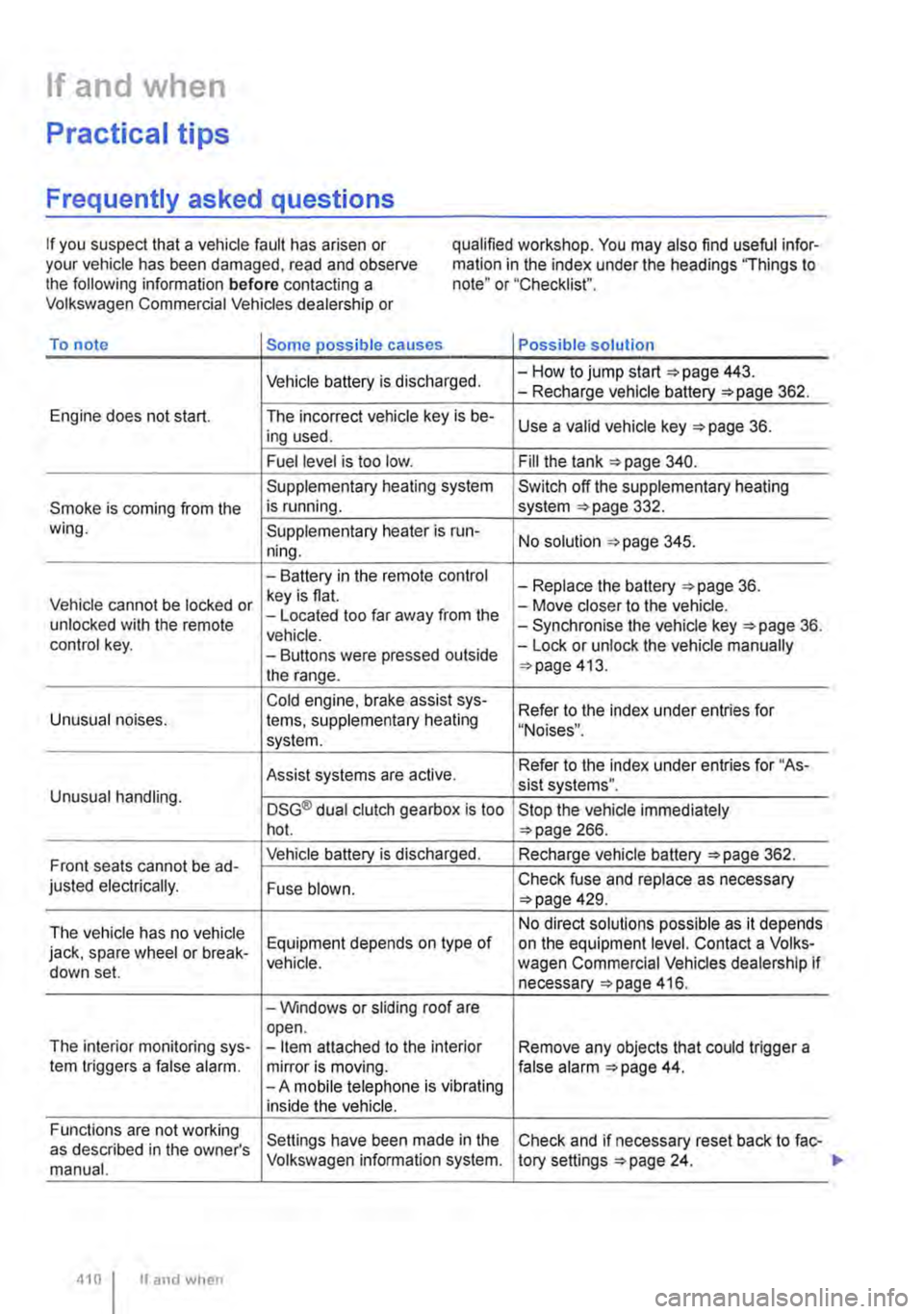
Frequently asked questions
If you suspect that a vehicle fault has arisen or your vehicle has been damaged, read and observe the following information before contacting a Volkswagen Commercial Vehicles dealership or
qualified workshop. You may also find useful infor-mation in the index under the headings "Things to note" or "Checklist".
To note Some possible causes Possible solution
Vehicle battery is discharged. -How to jump start =>page 443. -Recharge vehicle battery 362.
Engine does not start. The incorrect vehicle key is be-Use a valid vehicle key 36. ing used.
Fuel level is too low. Fill the tank 340.
Supplementary heating system Switch off the supplementary heating
Smoke is coming from the is running. system 332. wing. Supplementary heater is run-No solution 345. ning.
-Battery in the remote control -Replace the battery 36. Vehicle cannot be locked or key is flat. -Move closer to the vehicle. unlocked with the remote -Located too far away from the -Synchronise the vehicle key =>page 36. vehicle. control key. -Buttons were pressed outside -Lock or unlock the vehicle manually
the range. 413.
Cold engine. brake assist sys-Refer to the index under entries for Unusual noises. tems, supplementary heating "Noises". system.
Assist systems are active. Refer to the index under entries for "As-sist systems". Unusual handling. DSG® dual clutch gearbox is too Stop the vehicle immediately hot. 266.
Front seats cannot be ad-Vehicle battery is discharged. Recharge vehicle battery 362.
justed electrically. Fuse blown. Check fuse and replace as necessary 429.
The vehicle has no vehicle No direct solutions possible as it depends
jack, spare wheel or break-Equipment depends on type of on the equipment level. Contact a Volks-vehicle. wagen Commercial Vehicles dealership if down set. necessary 416.
-Windows or sliding roof are open. The interior monitoring sys--Item attached to the interior Remove any objects that could trigger a tem triggers a false alarm. mirror is moving. false alarm 44. -A mobile telephone is vibrating inside the vehicle.
Functions are not working Settings have been made in the Check and if necessary reset back to fac-as described in the owner's manual. Volkswagen information system. tory settings 24.
410 I If and when
Page 412 of 486
Making you and your vehicle safe
8S0.00)7
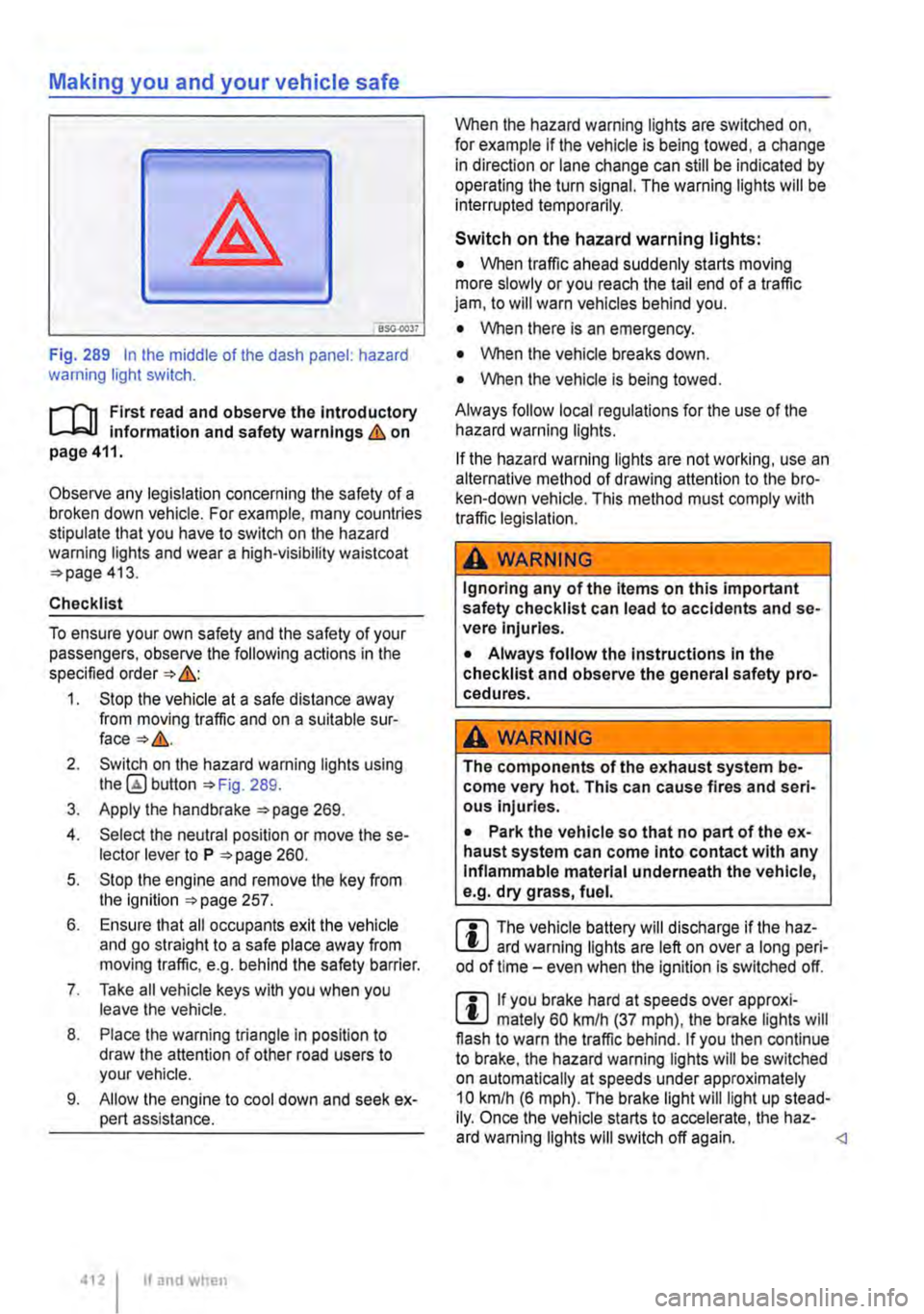
Fig. 289 In the middle of the dash panel: hazard warning light switch.
f"'""'('n First read and observe the Introductory L-lo:.U Information and safety warnings Lb. on page 411.
Observe any legislation concerning the safety of a broken down vehicle. For example, many countries stipulate that you have to switch on the hazard warning lights and wear a high-visibility waistcoat =>page 413.
Checklist
To ensure your own safety and the safety of your passengers, observe the following actions in the specified order => &:
1. Stop the vehicle at a safe distance away from moving traffic and on a suitable sur-face=>&.
2. Switch on the hazard warning lights using button =>Fig. 289.
3. Apply the handbrake =>page 269.
4. Select the neutral position or move the se-lector lever to P =>page 260.
5. Stop the engine and remove the key from the ignition =>page 257.
6. Ensure that all occupants exit the vehicle and go straight to a safe place away from moving traffic, e.g. behind the safety barrier.
7. Take all vehicle keys with you when you leave the vehicle.
8. Place the warning triangle in position to draw the attention of other road users to your vehicle.
9. Allow the engine to cool down and seek ex-pert assistance.
4121 If and when
When the hazard warning lights are switched on, for example if the vehicle is being towed, a change in direction or lane change can still be indicated by operating the turn signal. The warning lights will be interrupted temporarily.
Switch on the hazard warning lights:
• When traffic ahead suddenly starts moving more slowly or you reach the tail end of a traffic jam, to will warn vehicles behind you.
• When there is an emergency.
• When the vehicle breaks down.
• When the vehicle is being towed.
Always follow local regulations for the use of the hazard warning lights.
If the hazard warning lights are not working, use an alternative method of drawing attention to the bro-ken-down vehicle. This method must comply with traffic legislation.
A WARNING
Ignoring any of the items on this important safety checklist can lead to accidents and se-vere Injuries.
• Always follow the Instructions In the checklist and observe the general safety pro-cedures.
A wARNING
The components of the exhaust system be-come very hot. This can cause fires and seri-ous Injuries.
• Park the vehicle so that no part of the ex-haust system can come Into contact with any Inflammable material underneath the vehicle, e.g. dry grass, fuel.
m The vehicle battery will discharge if the haz-L.:!J ard warning lights are left on over a long peri-od of time -even when the Ignition is switched off.
m If you brake hard at speeds over approxi-L.:!J mately 60 km/h (37 mph), the brake lights will flash to warn the traffic behind. If you then continue to brake, the hazard warning lights will be switched on automatically at speeds under approximately 10 km/h (6 mph). The brake light will light up stead-Ily. Once the vehicle starts to accelerate, the haz-ard warning lights will switch off again.