warning VOLKSWAGEN UP! 2021 Owner´s Manual
[x] Cancel search | Manufacturer: VOLKSWAGEN, Model Year: 2021, Model line: UP!, Model: VOLKSWAGEN UP! 2021Pages: 211, PDF Size: 5.98 MB
Page 115 of 211
It can take a few seconds for the acoustic or optical signals to be emitted.
Further information on the portable navigation device (delivered by Volkswagen) can be
found in the user's manual for the device ⇒ Accessories, modifications, repairs and renewal of
parts.
Cruise control system (CCS)
Introduction
This chapter contains information on the followingsubjects:
⇒ Indicator lamp
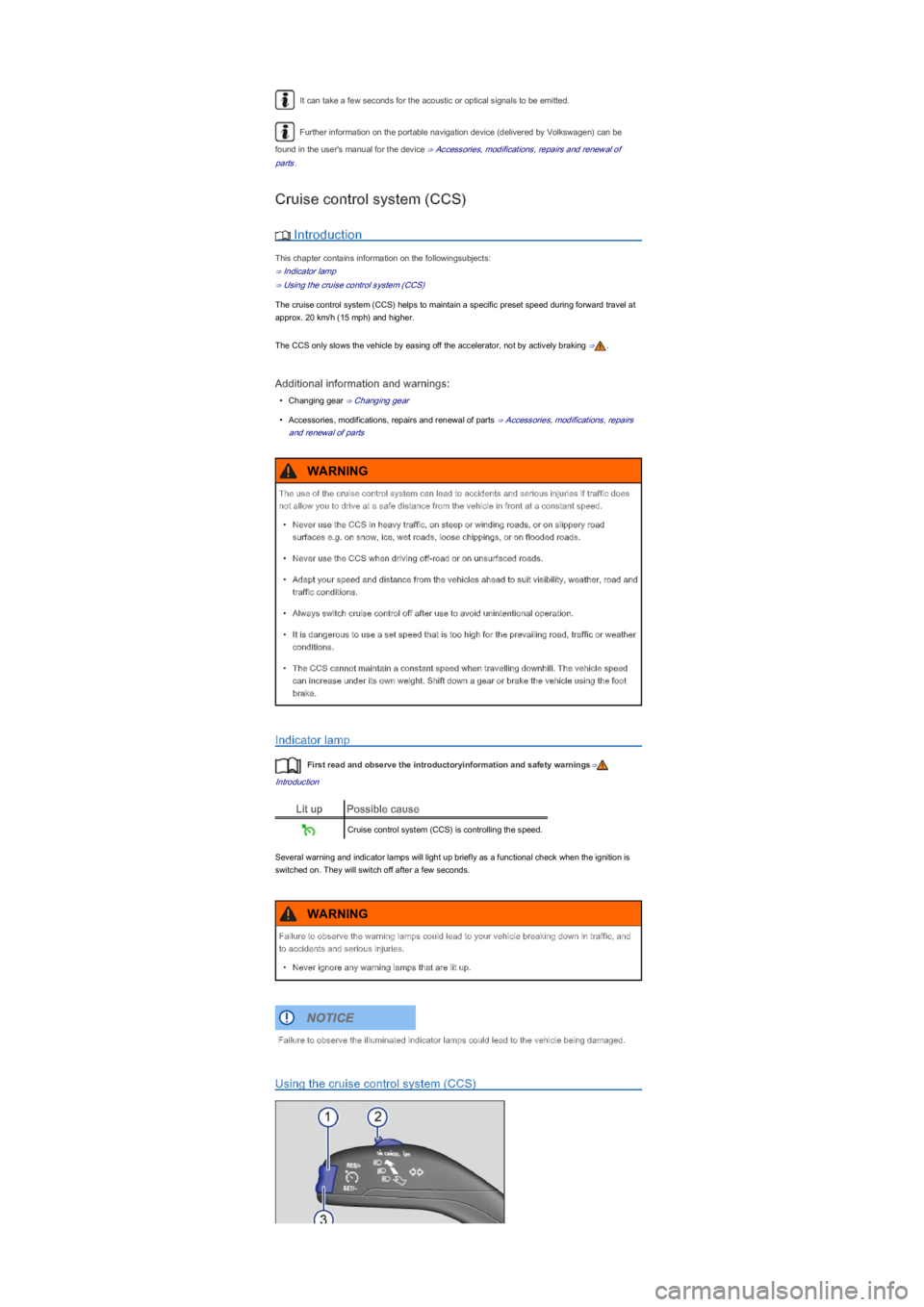
⇒ Using the cruise control system (CCS)
The cruise control system (CCS) helps to maintain a specific preset speed during forward travel at
approx. 20 km/h (15 mph) and higher.
The CCS only slows the vehicle by easing off the accelerator, not by actively braking ⇒.
Additional information and warnings:
•Changing gear ⇒ Changing gear
•Accessories, modifications, repairs and renewal of parts ⇒ Accessories, modifications, repairs
and renewal of parts
Indicator lamp
First read and observe the introductoryinformation and safety warnings⇒
Introduction
Lit upPossible cause
Cruise control system (CCS) is controlling the speed.
Several warning and indicator lamps will light up briefly as a functional check when the ignition is
switched on. They will switch off after a few seconds.
Using the cruise control system (CCS)
The use of the cruise control system can lead to accidents and serious injuries if traffic does
not allow you to drive at a safe distance from the vehicle in front at a constant speed.
•Never use the CCS in heavy traffic, on steep or winding roads, or on slippery road
surfaces e.g. on snow, ice, wet roads, loose chippings, or on flooded roads.
•Never use the CCS when driving off-road or on unsurfaced roads.
•Adapt your speed and distance from the vehicles ahead to suit visibility, weather, road and
traffic conditions.
•Always switch cruise control off after use to avoid unintentional operation.
•It is dangerous to use a set speed that is too high for the prevailing road, traffic or weather
conditions.
•The CCS cannot maintain a constant speed when travelling downhill. The vehicle speed
can increase under its own weight. Shift down a gear or brake the vehicle using the foot
brake.
WARNING
Failure to observe the warning lamps could lead to your vehicle breaking down in traffic, and
to accidents and serious injuries.
•Never ignore any warning lamps that are lit up.
WARNING
Failure to observe the illuminated indicator lamps could lead to the vehicle being damaged.
NOTICE
Page 116 of 211
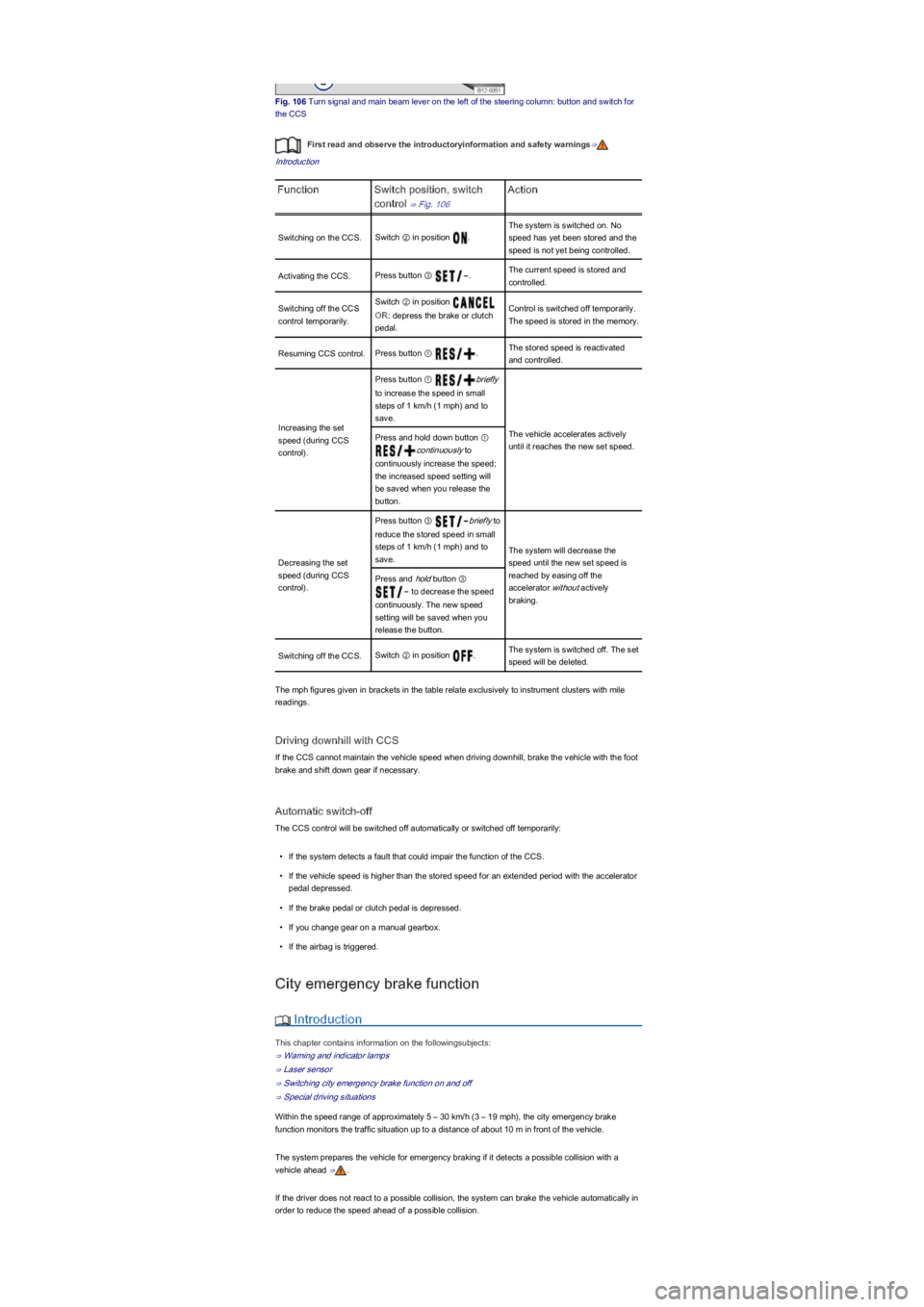
Fig. 106 Turn signal and main beam lever on the left of the steering column: button and switch for
the CCS
First read and observe the introductoryinformation and safety warnings⇒
Introduction
FunctionSwitch position, switch
control ⇒ Fig. 106
Action
Switching on the CCS.Switch ② in position .
The system is switched on. No
speed has yet been stored and the
speed is not yet being controlled.
Activating the CCS.Press button ③ .The current speed is stored and
controlled.
Switching off the CCS
control temporarily.
Switch ② in position
OR: depress the brake or clutch
pedal.
Control is switched off temporarily.
The speed is stored in the memory.
Resuming CCS control.Press button ① .The stored speed is reactivated
and controlled.
Increasing the set
speed (during CCS
control).
Press button ① briefly
to increase the speed in small
steps of 1 km/h (1 mph) and to
save.
The vehicle accelerates actively
until it reaches the new set speed.
Press and hold down button ①
continuously to
continuously increase the speed;
the increased speed setting will
be saved when you release the
button.
Decreasing the set
speed (during CCS
control).
Press button ③ briefly to
reduce the stored speed in small
steps of 1 km/h (1 mph) and to
save.
The system will decrease the
speed until the new set speed is
reached by easing off the
accelerator without actively
braking.
Press and hold button ③
to decrease the speed
continuously. The new speed
setting will be saved when you
release the button.
Switching off the CCS.Switch ② in position .The system is switched off. The set
speed will be deleted.
The mph figures given in brackets in the table relate exclusively to instrument clusters with mile
readings.
Driving downhill with CCS
If the CCS cannot maintain the vehicle speed when driving downhill, brake the vehicle with the foot
brake and shift down gear if necessary.
Automatic switch-off
The CCS control will be switched off automatically or switched off temporarily:
•If the system detects a fault that could impair the function of the CCS.
•If the vehicle speed is higher than the stored speed for an extended period with the accelerator
pedal depressed.
•If the brake pedal or clutch pedal is depressed.
•If you change gear on a manual gearbox.
•If the airbag is triggered.
City emergency brake function
Introduction
This chapter contains information on the followingsubjects:
⇒ Warning and indicator lamps
⇒ Laser sensor
⇒ Switching city emergency brake function on and off
⇒ Special driving situations
Within the speed range of approximately 5 – 30 km/h (3 – 19 mph), the city emergency brake
function monitors the traffic situation up to a distance of about 10 m in front of the vehicle.
The system prepares the vehicle for emergency braking if it detects a possible collision with a
vehicle ahead ⇒.
If the driver does not react to a possible collision, the system can brake the vehicle automatically in
order to reduce the speed ahead of a possible collision.
Page 117 of 211
If, in a potential collision scenario, the city emergency brake function detects that the driver is
applying the brakes with insufficient pressure, the system can increase the brake pressure in order
to reduce speed ahead of the collision. Hence the system can help minimise the consequences of
an accident.
Additional information and warnings:
•Exterior views ⇒ Exterior views
•Lower section of the centre console ⇒ Overview of the centre console
•Instrument cluster ⇒ Instrument cluster
•Accessories, modifications, repairs and renewal of parts ⇒ Accessories, modifications, repairs
and renewal of parts
The brake pedal travel decreases when the city emergency brake function is triggered. This
may make the brake pedal feel stiffer.
Automatic brake intervention by the city emergency brake function can be stopped by using
the clutch, the accelerator or steering intervention.
Unusual noises may be heard if the city emergency brake function is applying an automatic
braking procedure. This is normal and the noises are caused by the braking system.
Warning and indicator lamps
First read and observe the introductoryinformation and safety warnings⇒
Introduction
The city emergency brake function is switched on every time the ignition is switched on. No display
will be shown to alert you of this.
The indicator lamp will be lit up if the city emergency brake function is switched off, is working or if
there is a fault in the system.
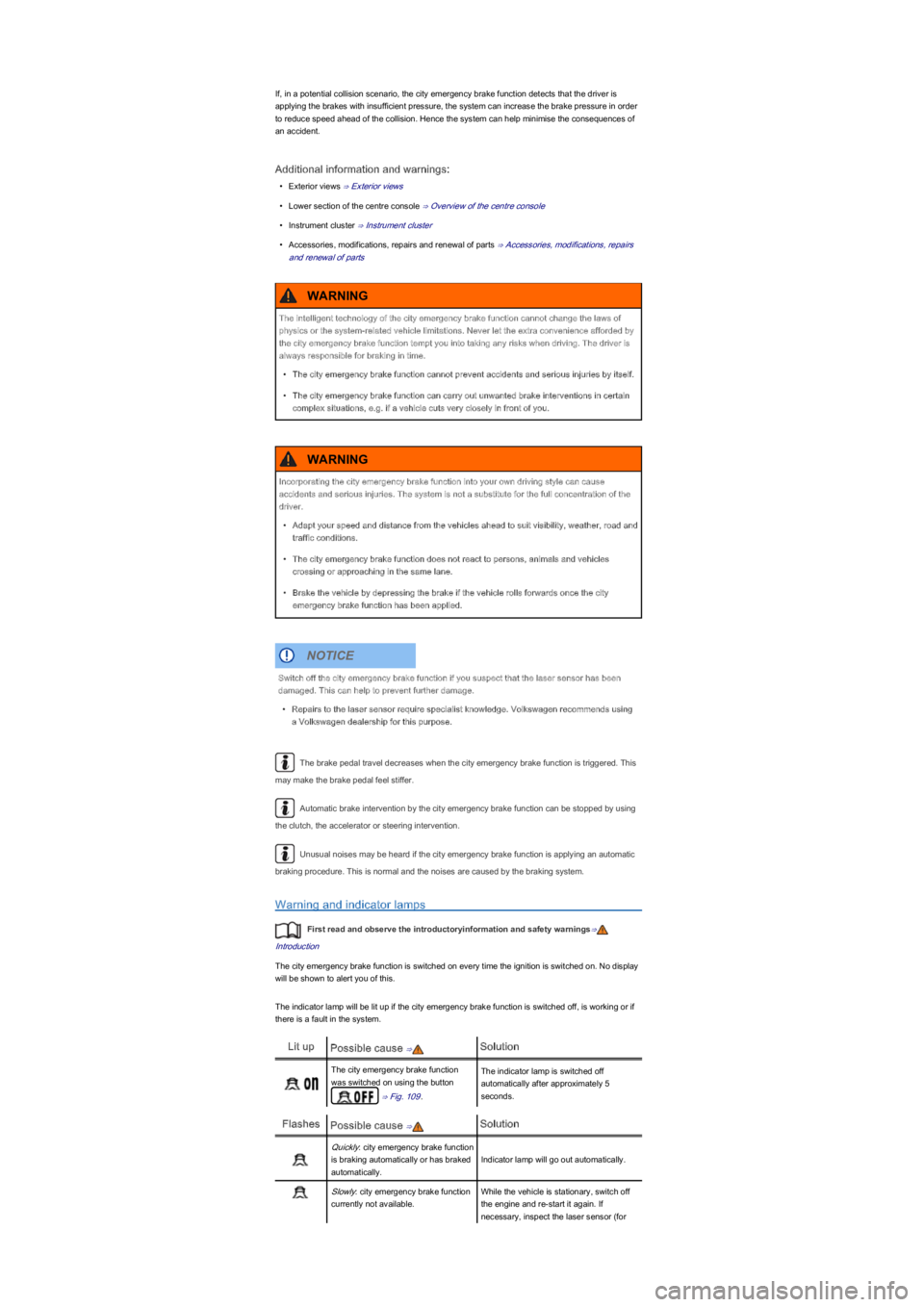
Lit upPossible cause ⇒Solution
The city emergency brake function
was switched on using the button
⇒ Fig. 109.
The indicator lamp is switched off
automatically after approximately 5
seconds.
FlashesPossible cause ⇒Solution
Quickly: city emergency brake function
is braking automatically or has braked
automatically.
Indicator lamp will go out automatically.
Slowly: city emergency brake function
currently not available.
While the vehicle is stationary, switch off
the engine and re-start it again. If
necessary, inspect the laser sensor (for
The intelligent technology of the city emergency brake function cannot change the laws of
physics or the system-related vehicle limitations. Never let the extra convenience afforded by
the city emergency brake function tempt you into taking any risks when driving. The driver is
always responsible for braking in time.
•The city emergency brake function cannot prevent accidents and serious injuries by itself.
•The city emergency brake function can carry out unwanted brake interventions in certain
complex situations, e.g. if a vehicle cuts very closely in front of you.
WARNING
Incorporating the city emergency brake function into your own driving style can cause
accidents and serious injuries. The system is not a substitute for the full concentration of the
driver.
•Adapt your speed and distance from the vehicles ahead to suit visibility, weather, road and
traffic conditions.
•The city emergency brake function does not react to persons, animals and vehicles
crossing or approaching in the same lane.
•Brake the vehicle by depressing the brake if the vehicle rolls forwards once the city
emergency brake function has been applied.
WARNING
Switch off the city emergency brake function if you suspect that the laser sensor has been
damaged. This can help to prevent further damage.
•Repairs to the laser sensor require specialist knowledge. Volkswagen recommends using
a Volkswagen dealership for this purpose.
NOTICE
Page 118 of 211
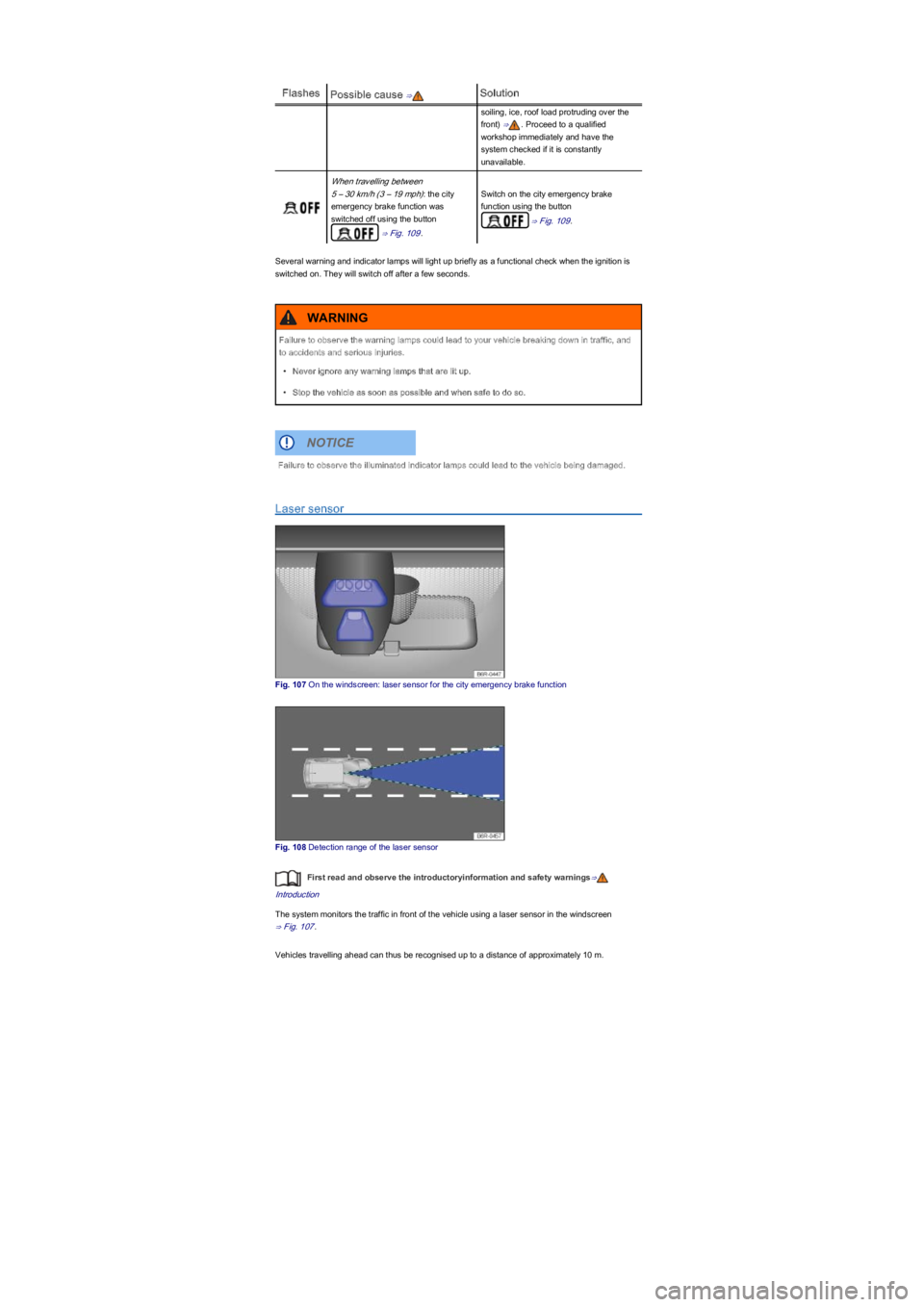
FlashesPossible cause ⇒Solution
soiling, ice, roof load protruding over the
front) ⇒. Proceed to a qualified
workshop immediately and have the
system checked if it is constantly
unavailable.
When travelling between
5 – 30 km/h (3 – 19 mph): the city
emergency brake function was
switched off using the button
⇒ Fig. 109.
Switch on the city emergency brake
function using the button
⇒ Fig. 109.
Several warning and indicator lamps will light up briefly as a functional check when the ignition is
switched on. They will switch off after a few seconds.
Laser sensor
Fig. 107 On the windscreen: laser sensor for the city emergency brake function
Fig. 108 Detection range of the laser sensor
First read and observe the introductoryinformation and safety warnings⇒
Introduction
The system monitors the traffic in front of the vehicle using a laser sensor in the windscreen
⇒ Fig. 107.
Vehicles travelling ahead can thus be recognised up to a distance of approximately 10 m.
Failure to observe the warning lamps could lead to your vehicle breaking down in traffic, and
to accidents and serious injuries.
•Never ignore any warning lamps that are lit up.
•Stop the vehicle as soon as possible and when safe to do so.
WARNING
Failure to observe the illuminated indicator lamps could lead to the vehicle being damaged.
NOTICE
Page 119 of 211
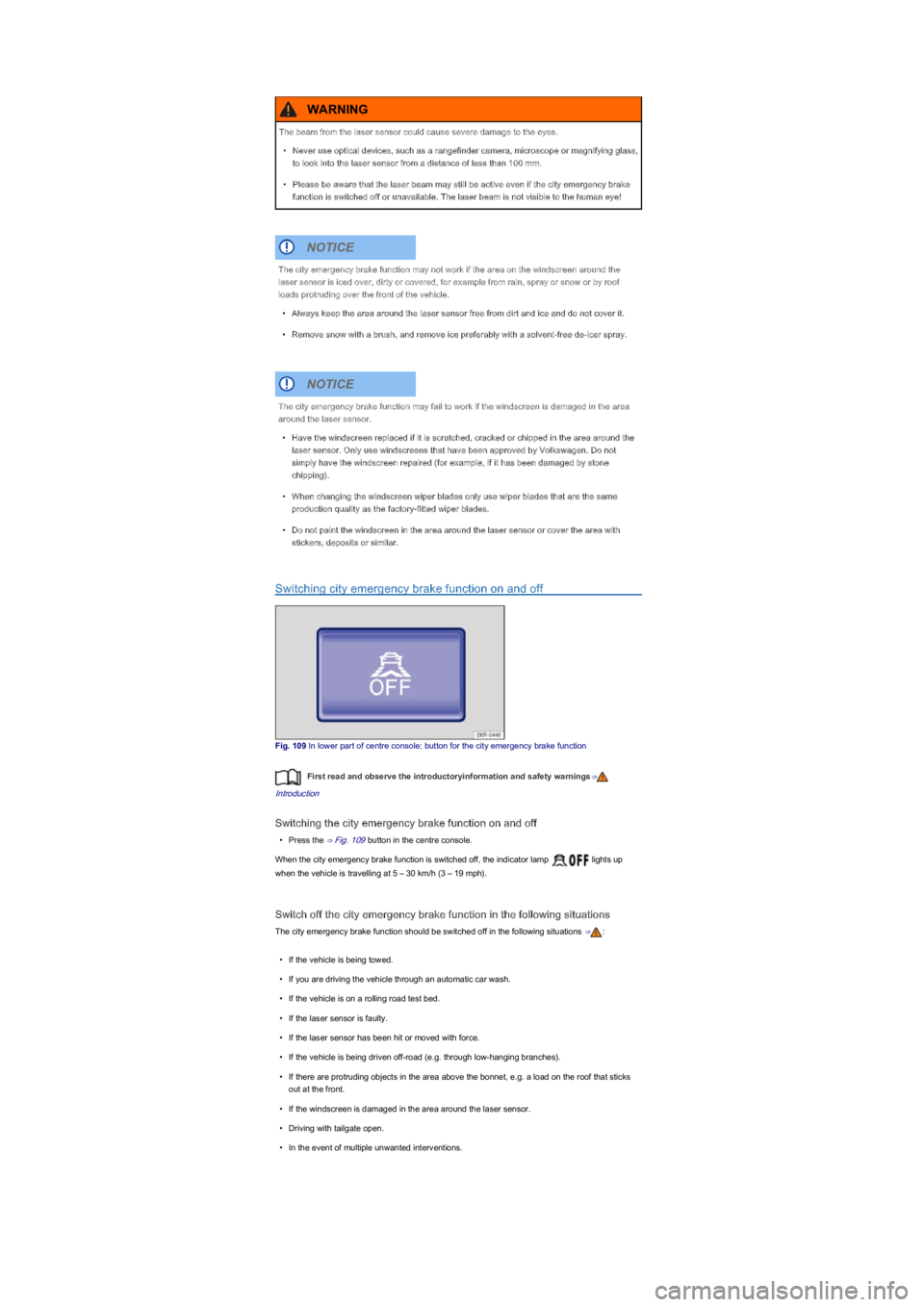
Switching city emergency brake function on and off
Fig. 109 In lower part of centre console: button for the city emergency brake function
First read and observe the introductoryinformation and safety warnings⇒
Introduction
Switching the city emergency brake function on and off
•Press the ⇒ Fig. 109 button in the centre console.
When the city emergency brake function is switched off, the indicator lamp lights up
when the vehicle is travelling at 5 – 30 km/h (3 – 19 mph).
Switch off the city emergency brake function in the following situations
The city emergency brake function should be switched off in the following situations ⇒:
•If the vehicle is being towed.
•If you are driving the vehicle through an automatic car wash.
•If the vehicle is on a rolling road test bed.
•If the laser sensor is faulty.
•If the laser sensor has been hit or moved with force.
•If the vehicle is being driven off-road (e.g. through low-hanging branches).
•If there are protruding objects in the area above the bonnet, e.g. a load on the roof that sticks
out at the front.
•If the windscreen is damaged in the area around the laser sensor.
•Driving with tailgate open.
•In the event of multiple unwanted interventions.
The beam from the laser sensor could cause severe damage to the eyes.
•Never use optical devices, such as a rangefinder camera, microscope or magnifying glass,
to look into the laser sensor from a distance of less than 100 mm.
•Please be aware that the laser beam may still be active even if the city emergency brake
function is switched off or unavailable. The laser beam is not visible to the human eye!
WARNING
The city emergency brake function may not work if the area on the windscreen around the
laser sensor is iced over, dirty or covered, for example from rain, spray or snow or by roof
loads protruding over the front of the vehicle.
•Always keep the area around the laser sensor free from dirt and ice and do not cover it.
•Remove snow with a brush, and remove ice preferably with a solvent-free de-icer spray.
NOTICE
The city emergency brake function may fail to work if the windscreen is damaged in the area
around the laser sensor.
•Have the windscreen replaced if it is scratched, cracked or chipped in the area around the
laser sensor. Only use windscreens that have been approved by Volkswagen. Do not
simply have the windscreen repaired (for example, if it has been damaged by stone
chipping).
•When changing the windscreen wiper blades only use wiper blades that are the same
production quality as the factory-fitted wiper blades.
•Do not paint the windscreen in the area around the laser sensor or cover the area with
stickers, deposits or similar.
NOTICE
Page 120 of 211
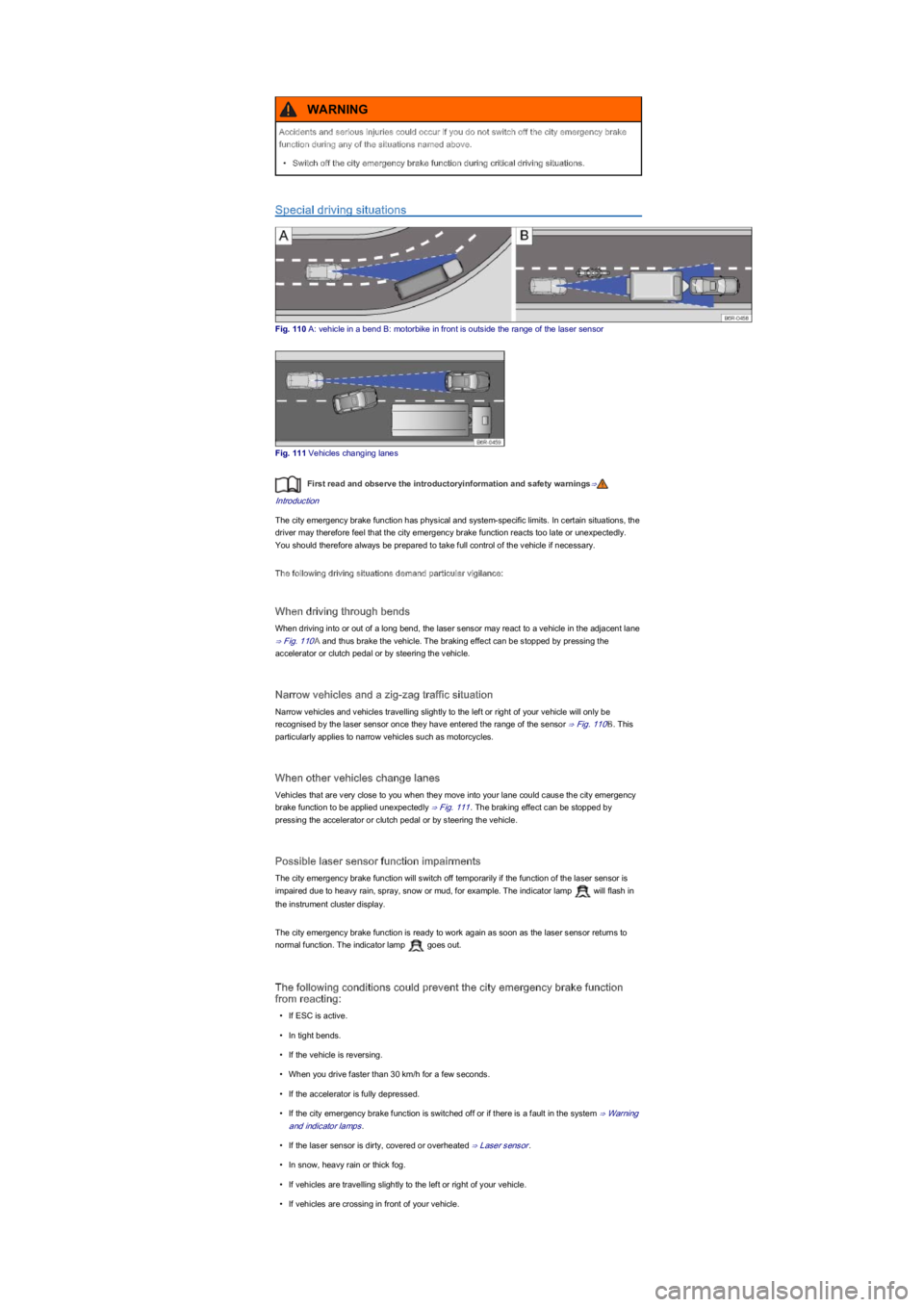
Special driving situations
Fig. 110 A: vehicle in a bend B: motorbike in front is outside the range of the laser sensor
Fig. 111 Vehicles changing lanes
First read and observe the introductoryinformation and safety warnings⇒
Introduction
The city emergency brake function has physical and system-specific limits. In certain situations, the
driver may therefore feel that the city emergency brake function reacts too late or unexpectedly.
You should therefore always be prepared to take full control of the vehicle if necessary.
The following driving situations demand particular vigilance:
When driving through bends
When driving into or out of a long bend, the laser sensor may react to a vehicle in the adjacent lane
⇒ Fig. 110A and thus brake the vehicle. The braking effect can be stopped by pressing the
accelerator or clutch pedal or by steering the vehicle.
Narrow vehicles and a zig-zag traffic situation
Narrow vehicles and vehicles travelling slightly to the left or right of your vehicle will only be
recognised by the laser sensor once they have entered the range of the sensor ⇒ Fig. 110B. This
particularly applies to narrow vehicles such as motorcycles.
When other vehicles change lanes
Vehicles that are very close to you when they move into your lane could cause the city emergency
brake function to be applied unexpectedly ⇒ Fig. 111. The braking effect can be stopped by
pressing the accelerator or clutch pedal or by steering the vehicle.
Possible laser sensor function impairments
The city emergency brake function will switch off temporarily if the function of the laser sensor is
impaired due to heavy rain, spray, snow or mud, for example. The indicator lamp will flash in
the instrument cluster display.
The city emergency brake function is ready to work again as soon as the laser sensor returns to
normal function. The indicator lamp goes out.
The following conditions could prevent the city emergency brake function
from reacting:
•If ESC is active.
•In tight bends.
•If the vehicle is reversing.
•When you drive faster than 30 km/h for a few seconds.
•If the accelerator is fully depressed.
•If the city emergency brake function is switched off or if there is a fault in the system ⇒ Warning
and indicator lamps.
•If the laser sensor is dirty, covered or overheated ⇒ Laser sensor.
•In snow, heavy rain or thick fog.
•If vehicles are travelling slightly to the left or right of your vehicle.
•If vehicles are crossing in front of your vehicle.
Accidents and serious injuries could occur if you do not switch off the city emergency brake
function during any of the situations named above.
•Switch off the city emergency brake function during critical driving situations.
WARNING
Page 121 of 211
•If vehicles are travelling towards you in the same lane.
•If the surrounding vehicles are very dirty and therefore not very reflective.
•If there is a lot of dust.
Air conditioning system
Heating, ventilating, cooling
Introduction
This chapter contains information on the followingsubjects:
⇒ Controls
⇒ General information on the heating and fresh air system
⇒ Information on the air conditioning system
⇒ Vents
⇒ Air recirculation mode
Dust and pollen filter
The dust and pollen filter reduces the level of impurities in the outside air entering the vehicle.
The dust and pollen filter must be changed regularly to avoid impairing the performance of the air
conditioning system.
The dust and pollen filter must be changed more frequently than stated in the service schedule if
the efficiency of the filter declines prematurely due to the vehicle being used in areas with high
levels of air pollution.
Additional information and warnings:
•Exterior views ⇒ Exterior views
•Volkswagen information system ⇒ Volkswagen information system
•Windscreen wiper/washer ⇒ Windscreen wiper and washer
•Cleaning and caring for the vehicle exterior ⇒ Caring for and cleaning the vehicle exterior
If the cooling system is switched off, the outside air that is drawn into the vehicle is not
dehumidified. To prevent the windows misting over, Volkswagen recommends that you leave the air
conditioning (compressor) switched on. Press the button. The indicator lamp in the button
must light up.
Maximum heat output, which is needed to defrost the windows as quickly as possible, is only
available when the engine has reached its operating temperature.
Poor visibility through all windows increases the risk of collisions and accidents, which can
cause serious injuries.
•Always ensure that all windows are free of ice, snow and mist to ensure good visibility.
•Maximum heat output, which is needed to defrost the windows as quickly as possible, is
only available when the engine has reached its operating temperature. Do not start your
journey until you have good visibility.
•Always ensure that the heating and fresh air system or the air conditioning system and the
heated rear window are used correctly in order to have good visibility.
•Never use the air recirculation mode for an extended period. If the cooling system is
switched off, the windows can mist up very quickly in air recirculation mode and reduce
visibility considerably.
•Always switch off the air recirculation mode when it is not required.
WARNING
Stale air can quickly cause tiredness and lack of concentration in the driver, which in turn can
cause collisions, accidents and serious injuries.
•Never switch off the blowers or switch on the air recirculation mode for an extended period
as this prevents fresh air from entering the vehicle interior.
WARNING
•Switch off the air conditioning system if you suspect that it has been damaged. This can
help to prevent further damage. The air conditioning system should be checked by a
qualified workshop.
•Repairs to the air conditioning system require specialist knowledge and special tools.
Volkswagen recommends using a Volkswagen dealership for this purpose.
NOTICE
Page 122 of 211
Keep the air intake slots in front of the windscreen free of snow, ice and leaves to ensure
heating and cooling is not impaired, and to prevent the windows from misting over.
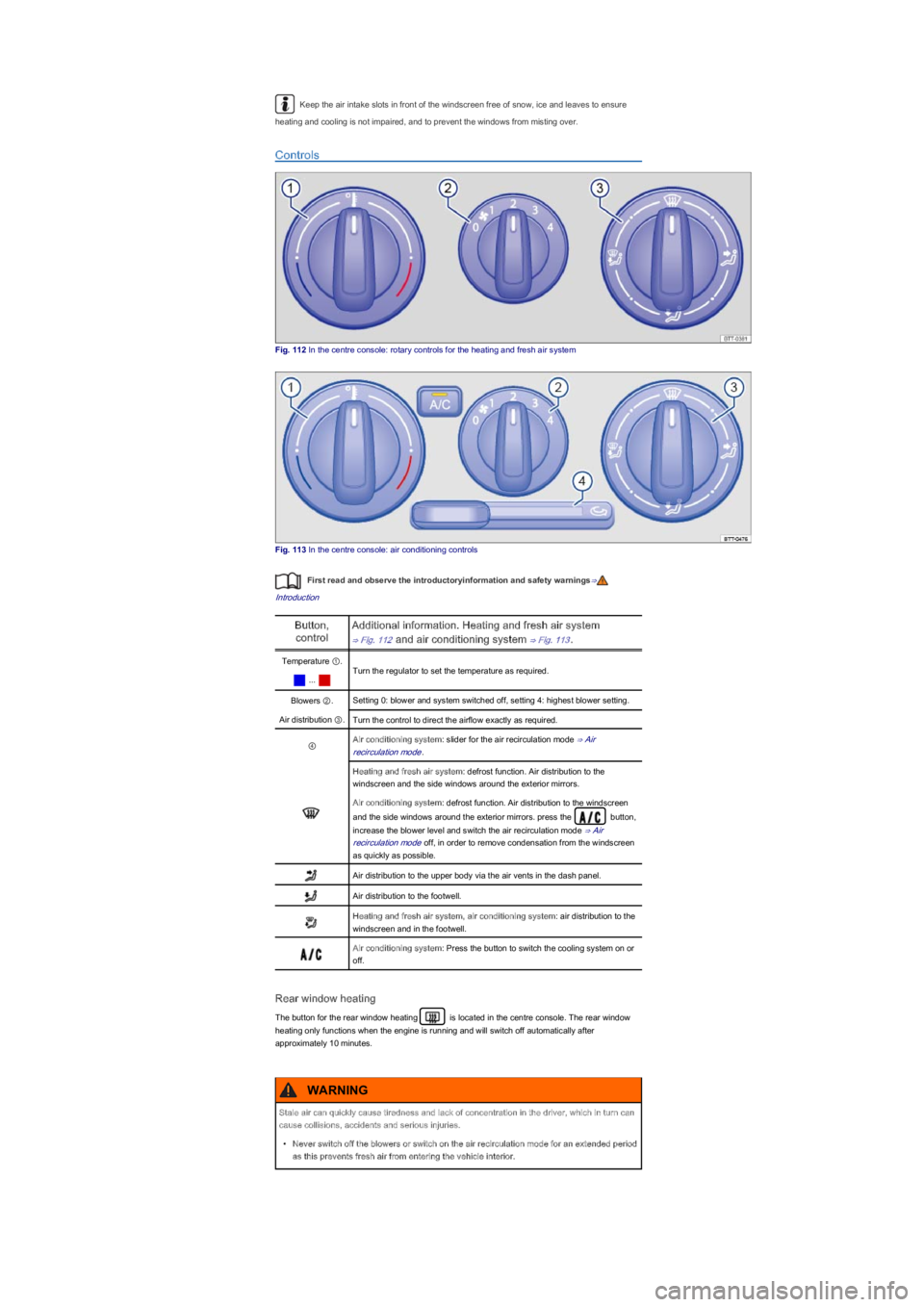
Controls
Fig. 112 In the centre console: rotary controls for the heating and fresh air system
Fig. 113 In the centre console: air conditioning controls
First read and observe the introductoryinformation and safety warnings⇒
Introduction
Button,
control
Additional information. Heating and fresh air system
⇒ Fig. 112 and air conditioning system ⇒ Fig. 113.
Temperature ①.
Turn the regulator to set the temperature as required.
...
Blowers ②.Setting 0: blower and system switched off, setting 4: highest blower setting.
Air distribution ③.Turn the control to direct the airflow exactly as required.
④Air conditioning system: slider for the air recirculation mode ⇒ Air
recirculation mode.
Heating and fresh air system: defrost function. Air distribution to the
windscreen and the side windows around the exterior mirrors.
Air conditioning system: defrost function. Air distribution to the windscreen
and the side windows around the exterior mirrors. press the button,
increase the blower level and switch the air recirculation mode ⇒ Air
recirculation mode off, in order to remove condensation from the windscreen
as quickly as possible.
Air distribution to the upper body via the air vents in the dash panel.
Air distribution to the footwell.
Heating and fresh air system, air conditioning system: air distribution to the
windscreen and in the footwell.
Air conditioning system: Press the button to switch the cooling system on or
off.
Rear window heating
The button for the rear window heating is located in the centre console. The rear window
heating only functions when the engine is running and will switch off automatically after
approximately 10 minutes.
Stale air can quickly cause tiredness and lack of concentration in the driver, which in turn can
cause collisions, accidents and serious injuries.
•Never switch off the blowers or switch on the air recirculation mode for an extended period
as this prevents fresh air from entering the vehicle interior.
WARNING
Page 123 of 211
General information on the heating and fresh air system
First read and observe the introductoryinformation and safety warnings⇒
Introduction
The required interior temperature cannot be lower than the outside temperature as the heating and
fresh air system cannot cool or dehumidify the air.
Settings for optimal road visibility
•Set blower ⇒ Fig. 112② to level 1 or 2.
•Open and position all vents on the dash panel ⇒ Vents.
•Turn the air distribution controller ⇒ Fig. 112③ to the defrost position.
Information on the air conditioning system
First read and observe the introductoryinformation and safety warnings⇒
Introduction
The cooling system for the vehicle interior only works when the engine is running and the blower is
switched on.
The air conditioning system operates most effectively with the windows and the electric panorama
sliding and tilting glass roof closed. However, if the vehicle has heated up after standing in the sun
for some time, the air inside can be cooled more quickly by opening the windows and the electric
panorama sliding and tilting glass roof for a short time.
Settings for optimal road visibility
Switching the cooling system on not only reduces the temperature of the vehicle interior, but also
the humidity. This improves comfort for the vehicle occupants and prevents the windows from
misting when the outside humidity is high.
•Switch off air recirculation mode ⇒ Air recirculation mode.
•Set the blowers to the required level.
•Open and position all vents on the dash panel ⇒ Vents.
•Turn the air distribution controller to the defrost position.
•Press the button to switch the cooling system on. The indicator lamp in the button
lights up.
The cooling system cannot be switched on
The following criteria may prevent the cooling system from being switched on:
•The engine is not running.
•The blower is switched off.
•The air conditioning system fuse has blown.
•The ambient temperature is lower than approximately +2℃ (+36°F).
•The compressor has been temporarily switched off because the coolant temperature is too high.
•There is a different fault in the vehicle. The air conditioning system should be checked by a
qualified workshop.
Things to note
If the humidity and temperature outside the vehicle are high, condensation can drip off the
evaporator in the cooling system and form a pool underneath the vehicle. This is normal and does
not indicate a leak.
The windscreen may mist up after starting the engine due to residual humidity in the air
conditioning system. Switch the defrost function on in order to clear the windscreen of condensation
or mist as quickly as possible.
Vents
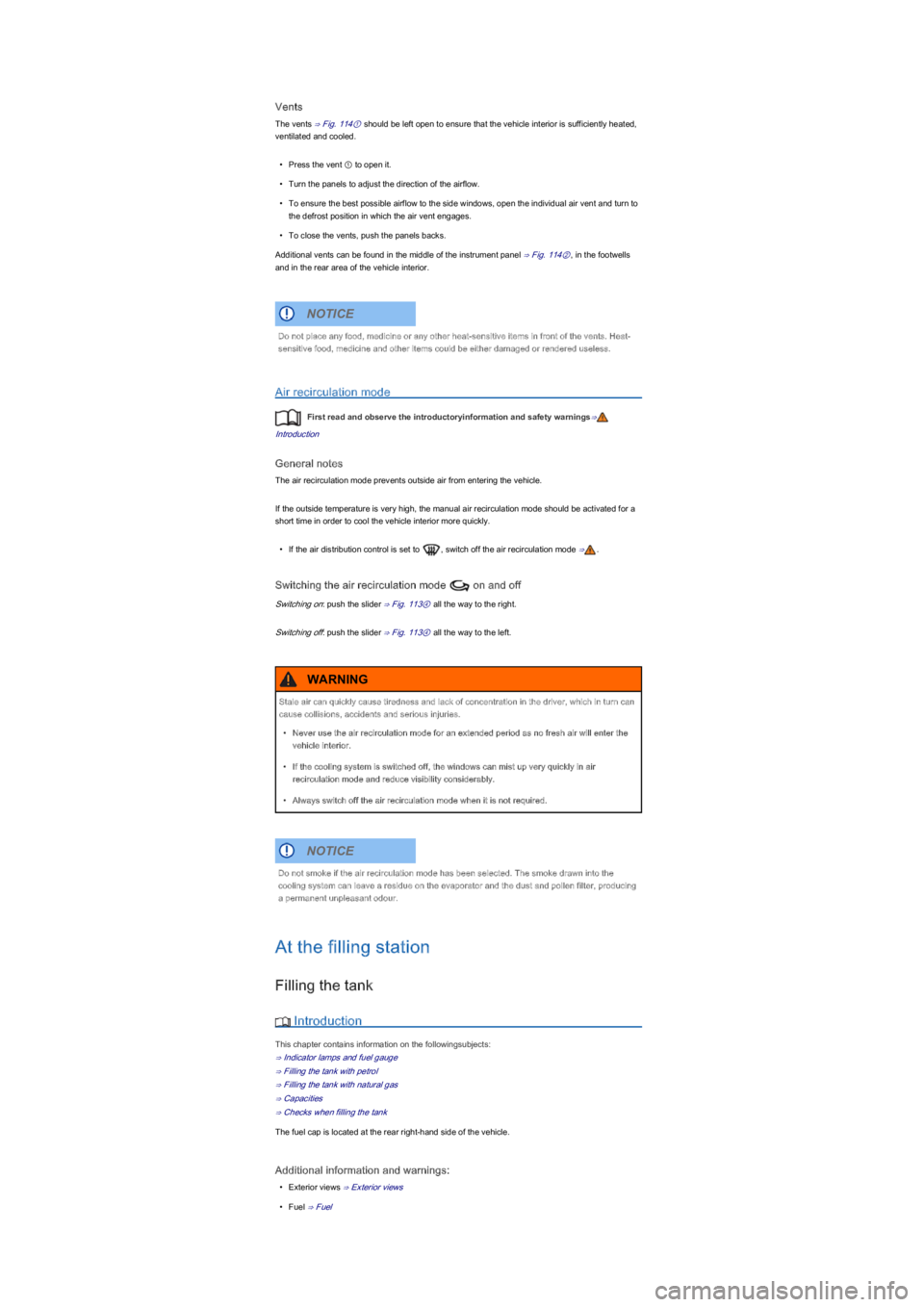
Fig. 114 In the dash panel: vents
First read and observe the introductoryinformation and safety warnings⇒
Introduction
Page 124 of 211
Vents
The vents ⇒ Fig. 114① should be left open to ensure that the vehicle interior is sufficiently heated,
ventilated and cooled.
•Press the vent ① to open it.
•Turn the panels to adjust the direction of the airflow.
•To ensure the best possible airflow to the side windows, open the individual air vent and turn to
the defrost position in which the air vent engages.
•To close the vents, push the panels backs.
Additional vents can be found in the middle of the instrument panel ⇒ Fig. 114②, in the footwells
and in the rear area of the vehicle interior.
Air recirculation mode
First read and observe the introductoryinformation and safety warnings⇒
Introduction
General notes
The air recirculation mode prevents outside air from entering the vehicle.
If the outside temperature is very high, the manual air recirculation mode should be activated for a
short time in order to cool the vehicle interior more quickly.
•If the air distribution control is set to , switch off the air recirculation mode ⇒.
Switching the air recirculation mode on and off
Switching on: push the slider ⇒ Fig. 113④ all the way to the right.
Switching off: push the slider ⇒ Fig. 113④ all the way to the left.
At the filling station
Filling the tank
Introduction
This chapter contains information on the followingsubjects:
⇒ Indicator lamps and fuel gauge
⇒ Filling the tank with petrol
⇒ Filling the tank with natural gas
⇒ Capacities
⇒ Checks when filling the tank
The fuel cap is located at the rear right-hand side of the vehicle.
Additional information and warnings:
•Exterior views ⇒ Exterior views
•Fuel ⇒ Fuel
Do not place any food, medicine or any other heat-sensitive items in front of the vents. Heat-
sensitive food, medicine and other items could be either damaged or rendered useless.
NOTICE
Stale air can quickly cause tiredness and lack of concentration in the driver, which in turn can
cause collisions, accidents and serious injuries.
•Never use the air recirculation mode for an extended period as no fresh air will enter the
vehicle interior.
•If the cooling system is switched off, the windows can mist up very quickly in air
recirculation mode and reduce visibility considerably.
•Always switch off the air recirculation mode when it is not required.
WARNING
Do not smoke if the air recirculation mode has been selected. The smoke drawn into the
cooling system can leave a residue on the evaporator and the dust and pollen filter, producing
a permanent unpleasant odour.
NOTICE