clutch VOLKSWAGEN UP! 2021 Owner´s Manual
[x] Cancel search | Manufacturer: VOLKSWAGEN, Model Year: 2021, Model line: UP!, Model: VOLKSWAGEN UP! 2021Pages: 211, PDF Size: 5.98 MB
Page 117 of 211
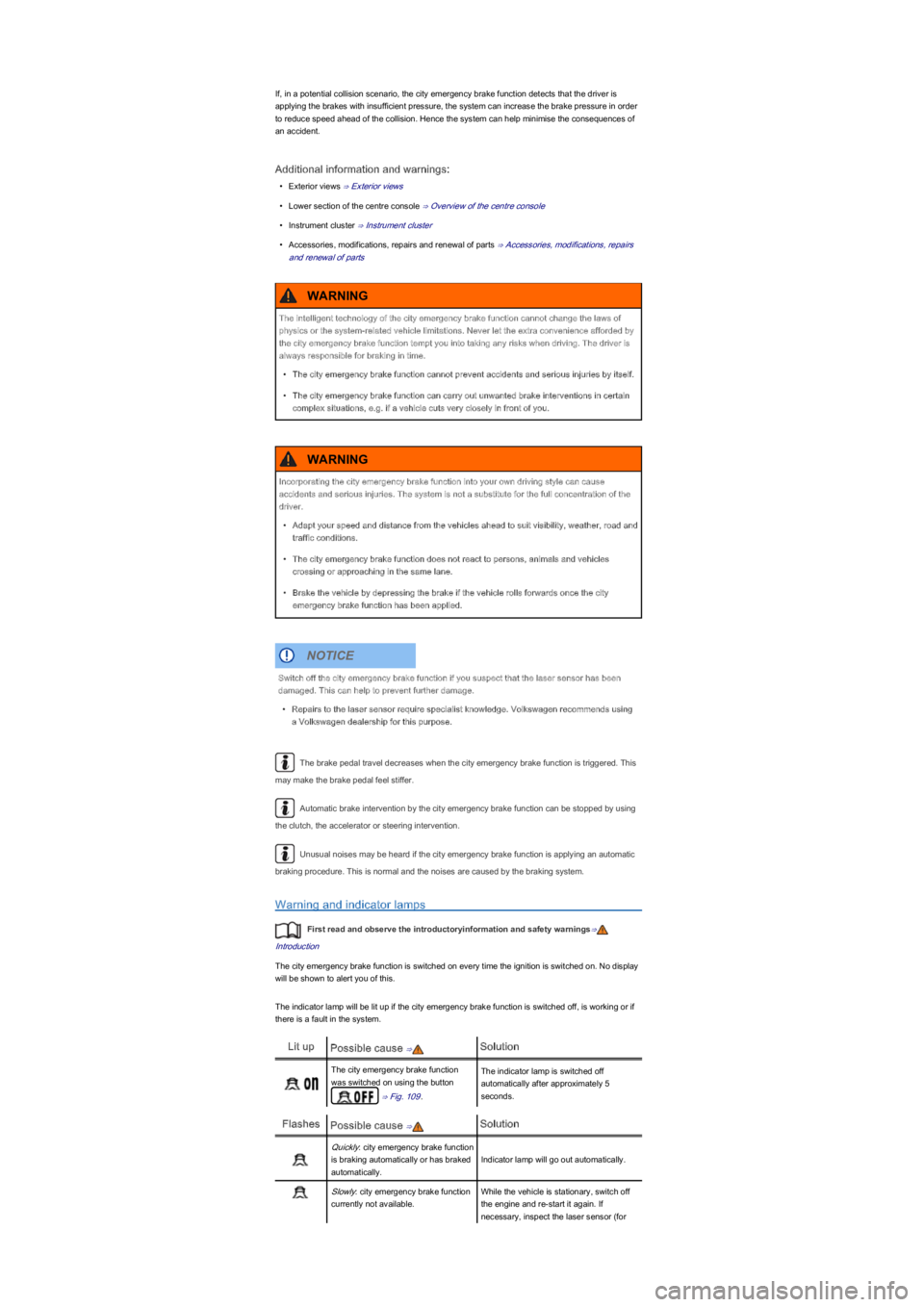
If, in a potential collision scenario, the city emergency brake function detects that the driver is
applying the brakes with insufficient pressure, the system can increase the brake pressure in order
to reduce speed ahead of the collision. Hence the system can help minimise the consequences of
an accident.
Additional information and warnings:
•Exterior views ⇒ Exterior views
•Lower section of the centre console ⇒ Overview of the centre console
•Instrument cluster ⇒ Instrument cluster
•Accessories, modifications, repairs and renewal of parts ⇒ Accessories, modifications, repairs
and renewal of parts
The brake pedal travel decreases when the city emergency brake function is triggered. This
may make the brake pedal feel stiffer.
Automatic brake intervention by the city emergency brake function can be stopped by using
the clutch, the accelerator or steering intervention.
Unusual noises may be heard if the city emergency brake function is applying an automatic
braking procedure. This is normal and the noises are caused by the braking system.
Warning and indicator lamps
First read and observe the introductoryinformation and safety warnings⇒
Introduction
The city emergency brake function is switched on every time the ignition is switched on. No display
will be shown to alert you of this.
The indicator lamp will be lit up if the city emergency brake function is switched off, is working or if
there is a fault in the system.
Lit upPossible cause ⇒Solution
The city emergency brake function
was switched on using the button
⇒ Fig. 109.
The indicator lamp is switched off
automatically after approximately 5
seconds.
FlashesPossible cause ⇒Solution
Quickly: city emergency brake function
is braking automatically or has braked
automatically.
Indicator lamp will go out automatically.
Slowly: city emergency brake function
currently not available.
While the vehicle is stationary, switch off
the engine and re-start it again. If
necessary, inspect the laser sensor (for
The intelligent technology of the city emergency brake function cannot change the laws of
physics or the system-related vehicle limitations. Never let the extra convenience afforded by
the city emergency brake function tempt you into taking any risks when driving. The driver is
always responsible for braking in time.
•The city emergency brake function cannot prevent accidents and serious injuries by itself.
•The city emergency brake function can carry out unwanted brake interventions in certain
complex situations, e.g. if a vehicle cuts very closely in front of you.
WARNING
Incorporating the city emergency brake function into your own driving style can cause
accidents and serious injuries. The system is not a substitute for the full concentration of the
driver.
•Adapt your speed and distance from the vehicles ahead to suit visibility, weather, road and
traffic conditions.
•The city emergency brake function does not react to persons, animals and vehicles
crossing or approaching in the same lane.
•Brake the vehicle by depressing the brake if the vehicle rolls forwards once the city
emergency brake function has been applied.
WARNING
Switch off the city emergency brake function if you suspect that the laser sensor has been
damaged. This can help to prevent further damage.
•Repairs to the laser sensor require specialist knowledge. Volkswagen recommends using
a Volkswagen dealership for this purpose.
NOTICE
Page 120 of 211
Special driving situations
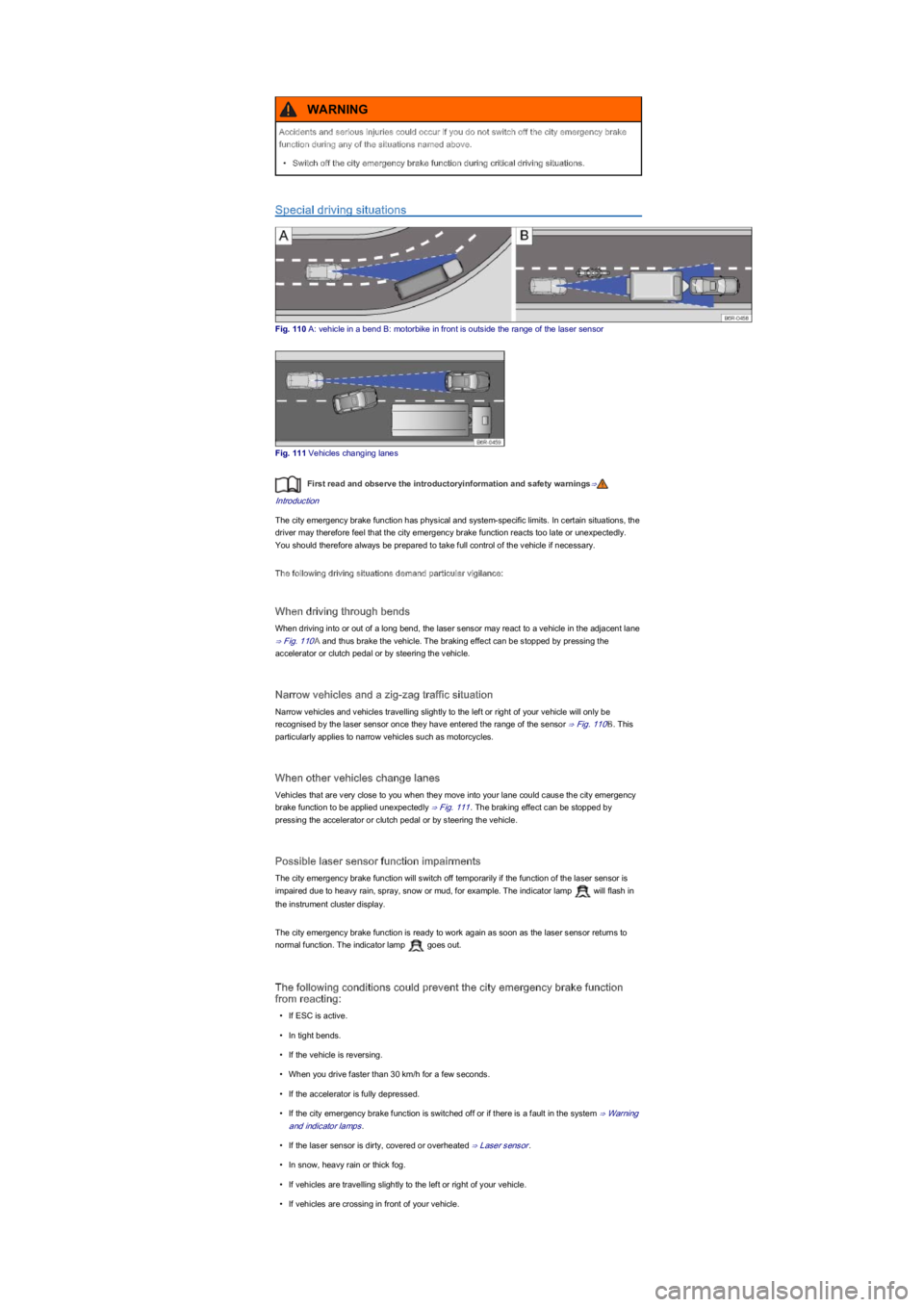
Fig. 110 A: vehicle in a bend B: motorbike in front is outside the range of the laser sensor
Fig. 111 Vehicles changing lanes
First read and observe the introductoryinformation and safety warnings⇒
Introduction
The city emergency brake function has physical and system-specific limits. In certain situations, the
driver may therefore feel that the city emergency brake function reacts too late or unexpectedly.
You should therefore always be prepared to take full control of the vehicle if necessary.
The following driving situations demand particular vigilance:
When driving through bends
When driving into or out of a long bend, the laser sensor may react to a vehicle in the adjacent lane
⇒ Fig. 110A and thus brake the vehicle. The braking effect can be stopped by pressing the
accelerator or clutch pedal or by steering the vehicle.
Narrow vehicles and a zig-zag traffic situation
Narrow vehicles and vehicles travelling slightly to the left or right of your vehicle will only be
recognised by the laser sensor once they have entered the range of the sensor ⇒ Fig. 110B. This
particularly applies to narrow vehicles such as motorcycles.
When other vehicles change lanes
Vehicles that are very close to you when they move into your lane could cause the city emergency
brake function to be applied unexpectedly ⇒ Fig. 111. The braking effect can be stopped by
pressing the accelerator or clutch pedal or by steering the vehicle.
Possible laser sensor function impairments
The city emergency brake function will switch off temporarily if the function of the laser sensor is
impaired due to heavy rain, spray, snow or mud, for example. The indicator lamp will flash in
the instrument cluster display.
The city emergency brake function is ready to work again as soon as the laser sensor returns to
normal function. The indicator lamp goes out.
The following conditions could prevent the city emergency brake function
from reacting:
•If ESC is active.
•In tight bends.
•If the vehicle is reversing.
•When you drive faster than 30 km/h for a few seconds.
•If the accelerator is fully depressed.
•If the city emergency brake function is switched off or if there is a fault in the system ⇒ Warning
and indicator lamps.
•If the laser sensor is dirty, covered or overheated ⇒ Laser sensor.
•In snow, heavy rain or thick fog.
•If vehicles are travelling slightly to the left or right of your vehicle.
•If vehicles are crossing in front of your vehicle.
Accidents and serious injuries could occur if you do not switch off the city emergency brake
function during any of the situations named above.
•Switch off the city emergency brake function during critical driving situations.
WARNING
Page 207 of 211
⇒ Fitting the front towing eye
⇒ Driving tips when towing
Observe any legal requirements when towing or tow-starting.
For technical reasons, vehicles with a discharged battery must not be tow-started.
For technical reasons, vehicles with an automated manual gearbox must not be tow started
unless it has been ascertained that the gearbox is in position N⇒ When a vehicle with an
automated manual gearbox has to be towed:.
Towing a vehicle when the engine is switched off and the ignition is switched on discharges the
vehicle battery. In some vehicles battery charge level, the drop in voltage can be large enough after
just a few minutes that electrical consumers in the vehicle will no longer function, e.g. the hazard
warning lights.
Additional information and warnings:
•Exterior views ⇒ Exterior views
•Changing gear ⇒ Changing gear
•Engine management system and exhaust purification system ⇒ Engine management system
and exhaust purification system
•Starting the engine with jump leads ⇒ Starting the engine with jump leads
You will not be able to fit a towing eye onto the rear bumper. The vehicle is not suited for
towing other vehicles.
Notes on tow-starting
First read and observe the introductoryinformation and safety warnings⇒
Introduction
Vehicles should not be tow-started wherever possible. Use jump leads to start the engine
instead⇒ Starting the engine with jump leads.
For technical reasons, the following vehicles cannot be tow-started:
•If the vehicle battery has discharged, the engine control unit will not function properly.
However, if the vehicle still has to be tow-started (manual gearbox):
•Engage 2nd or 3rd gear.
•Keep the clutch pressed down.
Never tow a vehicle that has no power supply.
•Never remove the key from the ignition. This could cause the steering lock to engage
suddenly. You will no longer be able to steer the vehicle. This can lead to a loss of control
of the vehicle, accidents and serious injuries.
•If the power supply to the towed vehicle is disconnected, stop towing immediately and
seek expert assistance.
WARNING
If a vehicle is being towed, the vehicle handling and braking effect will change significantly.
Please note the following in order to reduce the risk of an accident or serious injuries:
•Notes for the driver of the towed vehicle:
- You will need to depress the brake pedal more vigorously than normal as the brake
servo is not working. Always be careful not to drive into the vehicle that is pulling your
vehicle.
- You will need to turn the steering wheel more vigorously as the power-assisted
steering function is not working.
•Notes for the driver of the towing vehicle
- Accelerate carefully and gently.
- Avoid sudden braking and driving manoeuvres.
- Brake earlier than normal by pressing lightly on the brake pedal.
WARNING
•Remove and install the cover and the towing eye carefully so as to avoid damage to the
vehicle, e.g. the paintwork.
•Unburnt fuel can enter the catalytic converter and damage it while the vehicle is being
towed.
NOTICE
Page 208 of 211
•Switch on the ignition and the hazard warning lights.
•Once both vehicles are in motion, release the clutch.
•As soon as the engine starts, press the clutch and put the gear into neutral. This helps to
prevent driving into the towing vehicle.
However, if the vehicle still has to be tow-started (automated manual
gearbox):
•Switch on the ignition and the hazard warning lights.
•Place the selector lever in position N.
•When both vehicles are in motion and the brake pedal indicator lamp goes out, move the
selector lever to position D.
•As soon as the engine starts, press the brake pedal and move the selector lever to position N.
This helps to prevent driving into the towing vehicle.
Notes on towing
First read and observe the introductoryinformation and safety warnings⇒
Introduction
Tow rope or tow bar
It is easier and safer to tow a vehicle with a tow bar. Only use a tow rope if you do not have a tow
bar.
The tow rope should be slightly elastic to reduce the strain on both vehicles. It is advisable to use a
tow rope made of synthetic fibre or similarly elastic material.
Only attach the tow rope or tow bar to the specially provided towing eyes or to the towing bracket.
When a vehicle with a manual gearbox has to be towed:
Check whether the vehicle can be towed ⇒ When should your vehicle not be towed?.
•Move the gear stick to neutral ⇒ Changing gear.
•Do not allow the vehicle to be towed at speeds faster than 50 km/h (30 mph).
•Do not have the vehicle towed further than 50 km (30 miles).
When a vehicle with an automated manual gearbox has to be towed:
Check whether the vehicle can be towed ⇒ When should your vehicle not be towed?
•Switch on the ignition.
•Move the selector lever to N⇒ Changing gear.
•Check whether the automated manual gearbox is really in neutral. To do this drive the car a few
metres as a test. The automated manual gearbox is in neutral if the vehicle can be easily
moved.
•Seek expert assistance if the automated manual gearbox cannot be put into neutral ⇒.
•Do not allow the vehicle to be towed at speeds faster than 50 km/h (30 mph).
•Do not have the vehicle towed further than 50 km (30 miles).
•If a breakdown truck is used, the vehicle must be towed with the front wheels raised.
When should your vehicle not be towed?
•If, due to damage, the vehicle gearbox no longer contains any lubricant.
•If the automated manual gearbox cannot be put into neutral ⇒.
•If the distance to be towed is further than 50 km - applies to vehicles with an automated manual
gearbox only.
•If the steering function or the operating clearance of the wheels cannot be ensured, e.g. after an
accident.
The vehicle can only be towed when the handbrake and steering lock are not engaged.
Fitting the front towing eye
When tow-starting, unburnt fuel can enter the catalytic converter and damage it.
NOTICE
Never tow a vehicle with automated manual gearbox if the automated manual gearbox cannot
be put into neutral. Otherwise, the gearbox and engine can suffer considerable damage.
NOTICE