coolant VOLKSWAGEN UP! 2021 Owner´s Manual
[x] Cancel search | Manufacturer: VOLKSWAGEN, Model Year: 2021, Model line: UP!, Model: VOLKSWAGEN UP! 2021Pages: 211, PDF Size: 5.98 MB
Page 140 of 211
Coolant and coolant additives can pollute the environment. Spilt operating fluids must be
collected and disposed of properly and with respect for the environment.
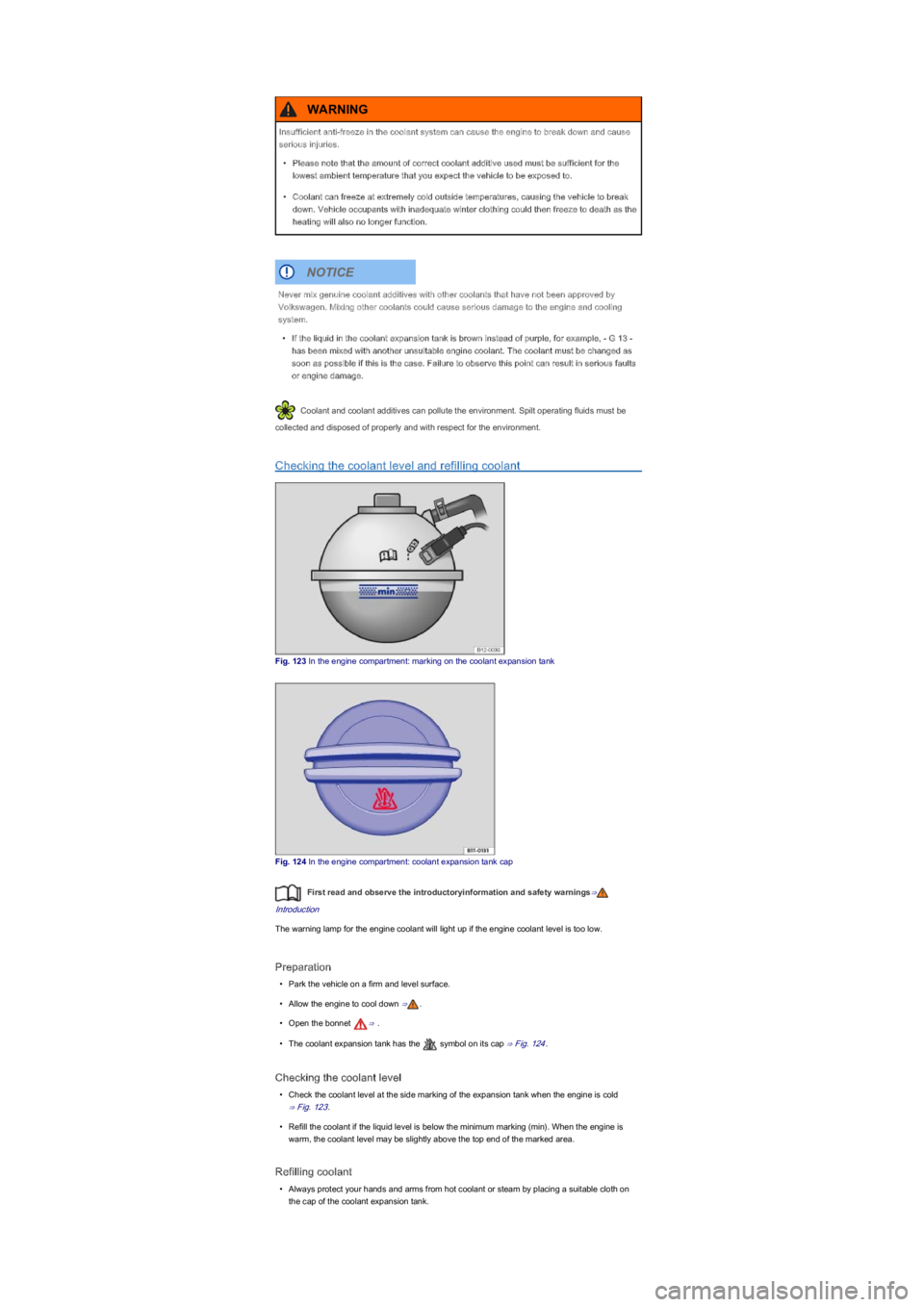
Checking the coolant level and refilling coolant
Fig. 123 In the engine compartment: marking on the coolant expansion tank
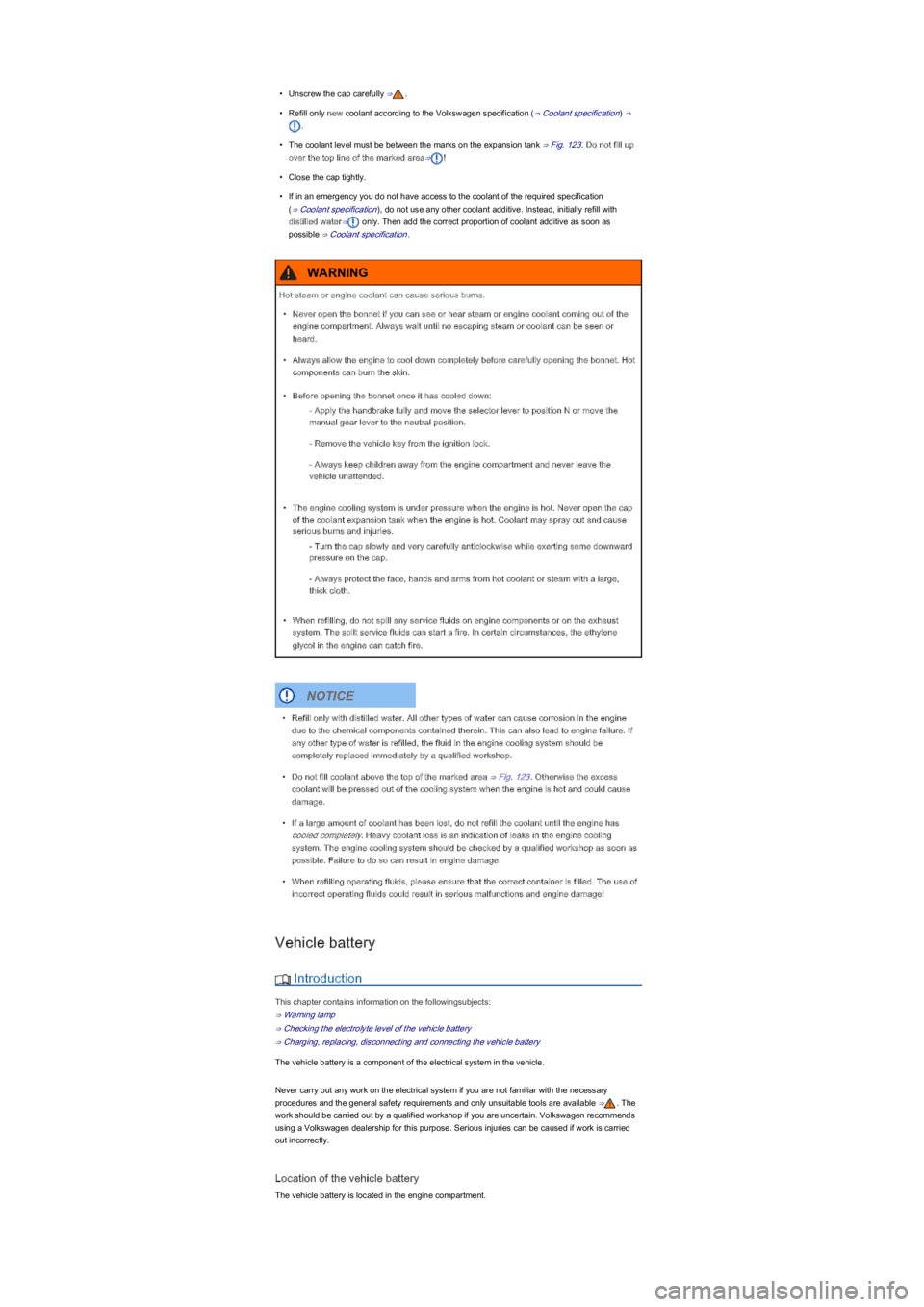
Fig. 124 In the engine compartment: coolant expansion tank cap
First read and observe the introductoryinformation and safety warnings⇒
Introduction
The warning lamp for the engine coolant will light up if the engine coolant level is too low.
Preparation
•Park the vehicle on a firm and level surface.
•Allow the engine to cool down ⇒.
•Open the bonnet ⇒ .
•The coolant expansion tank has the symbol on its cap ⇒ Fig. 124.
Checking the coolant level
•Check the coolant level at the side marking of the expansion tank when the engine is cold
⇒ Fig. 123.
•Refill the coolant if the liquid level is below the minimum marking (min). When the engine is
warm, the coolant level may be slightly above the top end of the marked area.
Refilling coolant
•Always protect your hands and arms from hot coolant or steam by placing a suitable cloth on
the cap of the coolant expansion tank.
Insufficient anti-freeze in the coolant system can cause the engine to break down and cause
serious injuries.
•Please note that the amount of correct coolant additive used must be sufficient for the
lowest ambient temperature that you expect the vehicle to be exposed to.
•Coolant can freeze at extremely cold outside temperatures, causing the vehicle to break
down. Vehicle occupants with inadequate winter clothing could then freeze to death as the
heating will also no longer function.
WARNING
Never mix genuine coolant additives with other coolants that have not been approved by
Volkswagen. Mixing other coolants could cause serious damage to the engine and cooling
system.
•If the liquid in the coolant expansion tank is brown instead of purple, for example, - G 13 -
has been mixed with another unsuitable engine coolant. The coolant must be changed as
soon as possible if this is the case. Failure to observe this point can result in serious faults
or engine damage.
NOTICE
Page 141 of 211
•Unscrew the cap carefully ⇒.
•Refill only new coolant according to the Volkswagen specification (⇒ Coolant specification) ⇒
.
•The coolant level must be between the marks on the expansion tank ⇒ Fig. 123. Do not fill up
over the top line of the marked area⇒!
•Close the cap tightly.
•If in an emergency you do not have access to the coolant of the required specification
(⇒ Coolant specification), do not use any other coolant additive. Instead, initially refill with
distilled water⇒ only. Then add the correct proportion of coolant additive as soon as
possible ⇒ Coolant specification.
Vehicle battery
Introduction
This chapter contains information on the followingsubjects:
⇒ Warning lamp
⇒ Checking the electrolyte level of the vehicle battery
⇒ Charging, replacing, disconnecting and connecting the vehicle battery
The vehicle battery is a component of the electrical system in the vehicle.
Never carry out any work on the electrical system if you are not familiar with the necessary
procedures and the general safety requirements and only unsuitable tools are available ⇒. The
work should be carried out by a qualified workshop if you are uncertain. Volkswagen recommends
using a Volkswagen dealership for this purpose. Serious injuries can be caused if work is carried
out incorrectly.
Location of the vehicle battery
The vehicle battery is located in the engine compartment.
Hot steam or engine coolant can cause serious burns.
•Never open the bonnet if you can see or hear steam or engine coolant coming out of the
engine compartment. Always wait until no escaping steam or coolant can be seen or
heard.
•Always allow the engine to cool down completely before carefully opening the bonnet. Hot
components can burn the skin.
•Before opening the bonnet once it has cooled down:
- Apply the handbrake fully and move the selector lever to position N or move the
manual gear lever to the neutral position.
- Remove the vehicle key from the ignition lock.
- Always keep children away from the engine compartment and never leave the
vehicle unattended.
•The engine cooling system is under pressure when the engine is hot. Never open the cap
of the coolant expansion tank when the engine is hot. Coolant may spray out and cause
serious burns and injuries.
- Turn the cap slowly and very carefully anticlockwise while exerting some downward
pressure on the cap.
- Always protect the face, hands and arms from hot coolant or steam with a large,
thick cloth.
•When refilling, do not spill any service fluids on engine components or on the exhaust
system. The spilt service fluids can start a fire. In certain circumstances, the ethylene
glycol in the engine can catch fire.
WARNING
•Refill only with distilled water. All other types of water can cause corrosion in the engine
due to the chemical components contained therein. This can also lead to engine failure. If
any other type of water is refilled, the fluid in the engine cooling system should be
completely replaced immediately by a qualified workshop.
•Do not fill coolant above the top of the marked area ⇒ Fig. 123. Otherwise the excess
coolant will be pressed out of the cooling system when the engine is hot and could cause
damage.
•If a large amount of coolant has been lost, do not refill the coolant until the engine has
cooled completely. Heavy coolant loss is an indication of leaks in the engine cooling
system. The engine cooling system should be checked by a qualified workshop as soon as
possible. Failure to do so can result in engine damage.
•When refilling operating fluids, please ensure that the correct container is filled. The use of
incorrect operating fluids could result in serious malfunctions and engine damage!
NOTICE
Page 154 of 211
Cleaning upholstery on seat cushions with seat heating, electrically
adjustable seats, or seats containing airbag components
Airbag-related components and electrical connectors may be installed in the driver seat, passenger
seat and sometimes also in the rear outer seats. Seat cushions or backrests that are damaged,
incorrectly cleaned or treated, or that become wet, may cause damage to the vehicle electrics or
trigger a fault in the airbag system ⇒.
Electrical components and connectors are installed in electrically adjustable seats and seat
cushions with seat heating. These can be damaged if cleaned or treated incorrectly ⇒. This can
also result in damage to other parts of the vehicle electrics.
For this reason, please follow these cleaning guidelines:
•Do not use high-pressure cleaners, steam cleaners or coolant spray.
•Do not use washing paste or fine detergent solutions.
•Avoid getting the seat wet.
•Only use detergents that have been approved by Volkswagen.
•If in doubt, consult a specialist cleaning company.
Cleaning upholstery on seat cushions without seat heating, seats that are
not electrically adjustable, and seats that do not contain airbag components
•Please read and follow the instructions, notes and warnings on the package before using
cleaning products.
•Upholstery, fabric trims, Alcantara seat covers and carpeting should be cleaned regularly with
a vacuum cleaner (brush).
•Do not use high-pressure cleaners, steam cleaners or coolant spray.
•We recommend that you use a soft sponge or commercially available lint-free microfibre cloth
for cleaning jobs ⇒.
•Clean Alcantara surfaces with a slightly damp cotton or woollen cloth or a commercially
available lint-free microfibre cloth ⇒.
General surface soiling of the upholstery and fabric trim can be cleaned with a commercially
available foam cleaner.
If the upholstery and fabric trims are generally heavily soiled, consult a Volkswagen dealership for
information on suitable cleaning methods before attempting any cleaning. If required, take the
vehicle to a specialist cleaning company.
Treating stains
When treating stains, it may be necessary to clean the entire surface and not just the stain itself.
This particularly applies if the surface shows general signs of wear. The cleaned area could
otherwise be lighter than the surrounding area. If in doubt, consult a specialist cleaning company.
Type of stainRecommended cleaning method for seat cushions
and upholstery
Water-based stains, e.g.
coffee, fruit juice.
– Moisten a sponge using a spray bottle and treat the stain by
rubbing it in a circular motion.
– Wipe with a dry absorbent cloth.
Stubborn stains, e.g.
chocolate, foundation.
– Only use detergents approved by Volkswagen.
– If required, take the vehicle to a specialist cleaning firm to have the
upholstery cleaned.
Oily stains, e.g. oil,
lipstick.
– Only use detergents approved by Volkswagen.
– If required, take the vehicle to a specialist cleaning firm to have the
upholstery cleaned.
®
®
If there is a fault in the airbag system, the airbag may not function properly, or not function at
all or function unexpectedly. This could cause accidents and fatal injuries.
•The airbag system should be checked by a qualified workshop as soon as possible.
WARNING
If the upholstery on electrically adjustable seats or on seat cushions containing airbag
components gets wet, electric components and the vehicle electrics could be damaged.
•A wet seat cushion should always be dried out, and system components checked, by a
qualified workshop.
•Do not use steam cleaners as the steam pushes the soiling into the fabric and sets it.
•High-pressure cleaners and coolant sprays can damage the upholstery.
NOTICE
Page 168 of 211
Snow chains are available in a range of sizes for a vehicle type.
Accessories, modifications, repairs and renewal of
parts
Introduction
This chapter contains information on the followingsubjects:
⇒ Running-in
⇒ Accessories and parts
⇒ Service fluids and consumables
⇒ Repairs and technical modifications
⇒ Repairs and faults in the airbag system
⇒ Retrofitting two-way radios
⇒ Information stored in the control units
⇒ Using a mobile telephone in the vehicle without a connection to the external aerial
⇒ Portable navigation device
⇒ Vehicle lifting points
Additional information and warnings:
•Seat belts ⇒ Seat belts
•Airbag system ⇒ Airbag system
•Roof carrier ⇒ Roof carrier
•Ashtray and cigarette lighter ⇒ Ashtray and cigarette lighter
•Electrical socket ⇒ Socket
•Braking, stopping and parking ⇒ Braking, stopping and parking
•Pull-away assist systems ⇒ Pull-away assist systems
•ParkPilot ⇒ ParkPilot
•Cruise Control System (CCS) ⇒ Cruise control system (CCS)
•Preparation for working in the engine compartment ⇒ Preparation for working in the engine
compartment
•Engine oil ⇒ Engine oil
•Engine coolant ⇒ Coolant
•Battery ⇒ Vehicle battery
•Cleaning and caring for the vehicle exterior ⇒ Caring for and cleaning the vehicle exterior
•Cleaning and caring for the interior ⇒ Cleaning and caring for the interior
•Consumer information ⇒ Consumer information
•⇒BookletRadio,
•User's manual for the portable navigation device (delivered by Volkswagen)
The use of snow chains that are unsuitable for your vehicle or the incorrect installation of
snow chains can cause accidents and serious injuries.
•Always use the correct snow chains.
•Follow the assembly instructions provided by the snow chain manufacturer.
•Never exceed the maximum speed permitted for the snow chains that are fitted.
WARNING
•Remove the snow chains when driving on roads that are free of snow. The snow chains will
otherwise impair handling, damage the tyres and wear out very quickly.
•Snow chains that are in direct contact with the wheel can scratch or damage it.
Volkswagen recommends using non-scratch snow chains.
NOTICE
Page 170 of 211
Service fluids and consumables
First read and observe the introductoryinformation and safety warnings⇒
Introduction
All service fluids and consumables, e.g. toothed belts, tyres, coolant, engine oil, spark plugs and
vehicle batteries, are being constantly developed. For this reason, service fluids and consumables
should be replaced at a qualified workshop. A Volkswagen dealership is always kept up to date on
innovations.
Leaking service fluids can pollute the environment. Spilt service fluids must be collected in
suitable containers and disposed of properly and with respect for the environment.
Repairs and technical modifications
First read and observe the introductoryinformation and safety warnings⇒
Introduction
Repairs and modifications must always be carried out according to Volkswagen specifications⇒
.
Unauthorised modifications to the electronic components or software in the vehicle may cause
faults. As the electronic components are linked together in networks, these faults may indirectly
affect the working of other systems. This can seriously impair safety, lead to excessive wear of
components, and also invalidate the type approval for the vehicle.
The Volkswagen dealership cannot be held liable for any damage caused by technical
modifications and/or work performed incorrectly.
The Volkswagen dealership cannot be held liable for any damage caused by technical
modifications and/or work performed incorrectly, nor are these covered by the Volkswagen
guarantee.
Volkswagen recommends that all repairs and technical modifications are performed by an
authorised Volkswagen dealership using Volkswagen Genuine Parts.
Vehicles with special auxiliary equipment or body parts
The manufacturer of these components must ensure that these parts (fittings) adhere to the
stipulated environmental laws and regulations, particularly the EU directive 2000/53/EC concerning
end-of-life vehicles and EU directive 2003/11/EC concerning the restriction on the marketing and
use of certain dangerous substances and preparations.
Incorrectly performed repairs or modifications to your vehicle can impair the effectiveness of
the airbags, cause faults, accidents and fatal injury.
•Never secure or mount objects such as drink holders or telephone holders either on or
next to the airbag covers or within the deployment zones of the airbag modules.
•Objects either on or next to the airbag module covers or are in the deployment zone of the
airbags can cause serious or even fatal injuries should the airbags be activated.
WARNING
Unsuitable service fluids and consumables, and the incorrect use of these fluids and
consumables, can cause accidents, serious injuries, burns or poisoning.
•Service fluids must be kept in their original sealed container.
•Never store service fluids in empty food containers, bottles or any other non-original
containers as people finding these containers could drink them.
•Keep children away from all service fluids and consumables.
•Always read and follow the information and warnings on the service fluid packaging.
•When using products that give off harmful fumes, always work outdoors or in a well-
ventilated area.
•Never use fuel, turpentine, engine oil, nail varnish remover or other volatile fluids for
vehicle care. They are toxic and highly flammable. They could cause fires and explosions.
WARNING
•Only use suitable service fluids for refilling. Never use the wrong service fluid. Failure to
observe this warning can result in serious malfunctions and engine damage.
•Optional equipment and other accessories in front of the air inlet reduce the cooling effect
of the coolant. The engine may overheat at high ambient temperatures and high engine
loads.
NOTICE
®