fuel consumption VOLKSWAGEN UP! 2021 Owner´s Manual
[x] Cancel search | Manufacturer: VOLKSWAGEN, Model Year: 2021, Model line: UP!, Model: VOLKSWAGEN UP! 2021Pages: 211, PDF Size: 5.98 MB
Page 130 of 211
than the engine requires. However, this does not provide any advantage in terms of fuel
consumption or engine output.
Volkswagen recommends using fuel with a low sulphur content or sulphur-free fuel for petrol
engines in order to achieve reduced fuel consumption.
Petrol additives
The quality of petrol influences the running properties, performance and service life of the engine.
This is why the vehicle should be refuelled with good quality petrol that has only non-metallic
additives pre-added by the petroleum industry. These petrol additives help to prevent corrosion,
keep the fuel system clean, and prevent the build-up of deposits in the engine.
If good quality petrol containing non-metallic additives is not available, or if engine problems arise,
the necessary petrol additives must be added to the petrol when refuelling ⇒.
Not all petrol additives are effective. The use of unsuitable petrol additives can cause considerable
damage to the engine and catalytic converter. Metallic additives should be avoided at all times.
Petrol additives on sale that are intended to improve knock resistance or increase the octane
number can also contain metallic additives ⇒.
Volkswagen recommends genuine Volkswagen or Audi fuel additives for petrol engines. These
additives and information on how to use them are available from your Volkswagen dealership.
Natural gas engines
Run the petrol tank empty every 6 months until the indicator lamp lights up. This is necessary to
maintain the required system function for petrol mode and fuel quality.
Natural gas
First read and observe the introductoryinformation and safety warnings⇒
Introduction
Natural gas
Natural gas can be delivered in compressed or liquefied form.
Liquefied Natural Gas (LNG) is produced by rapid cooling of the natural gas. This decreases the
volume considerably in comparison to Compressed Natural Gas (CNG). A vehicle equipped with a
natural gas engine may not be refilled directly with liquefied natural gas as the gas would expand
too much once in the tank in the vehicle.
Vehicles fitted with a natural gas engine may therefore only be refilled and driven using
compressed natural gas ⇒.
Natural gas quality and consumption
Natural gas is available in two grades: H-gas and L-gas.
H-gas has a higher calorific value and a lower nitrogen and carbon dioxide content. The higher the
calorific value of the natural gas the lower the levels of consumption.
The calorific value and the nitrogen or carbon dioxide values may, however, vary within one quality
group. For this reason, the vehicle consumption may vary when using natural gas of the same
quality.
•Before filling up with petrol, check whether the fuel corresponds to the vehicle's
requirements according to the fuel standard information at the pump.
•Only use fuel that complies with EN 228 or DIN 51626-1 and has the correct octane
number. Otherwise, the engine and the fuel system can suffer considerable damage. The
engine can also lose power or fail.
•The use of unsuitable petrol additives can cause considerable damage to the engine and
catalytic converter.
•If, in an emergency, you have to use petrol with an octane number lower than the
recommended number, drive at medium engine speeds and avoid high engine loading.
Avoid high engine speeds and heavy engine loads. Failure to do so can result in engine
damage. Fill the tank with petrol with the correct octane number as soon as possible.
•Fuels that are identified at the fuel pump as containing metallic additives may not be used.
LRP fuel (lead replacement petrol) also contains high concentrations of metallic additives.
Risk of engine damage!
•Just one tankful of leaded fuel, or fuel containing other metallic additives, can seriously
impair the efficiency of the catalytic converter and can also cause considerable damage to
the catalytic converter and engine.
NOTICE
Page 137 of 211

With the engine at operating temperature, park the vehicle on a level surface to ensure
that the engine oil reading is correct.
Switch off the engine and wait a few minutes for the engine oil to flow back into the sump.
Open the bonnet .
Identify the engine oil filler cap and oil dipstick. The engine oil filler opening bears the
symbol on the cap and the oil dipstick has a coloured handle. If you cannot find the cap
and dipstick please contact a qualified workshop.
Pull the dipstick out of the guide tube and wipe it off with a clean cloth.
Insert the oil dipstick into the guide tube again as far as it will go. If there is a marking on
the oil dipstick, this marking must fit in the corresponding groove at the top end of the
guide tube when inserting.
After reading the oil level, push the oil dipstick back into the guide tube as far as it will go.
Unscrew the engine oil filler opening cap .
Using only the engine oil approved by Volkswagen expressly for this engine, top up the oil
in small gradual amounts (no more than 0.5 l).
To avoid overfilling, wait for approximately one minute after each pour to allow the engine
oil to flow into the oil sump up to the marking on the engine oil dipstick.
Read the engine oil level from the dipstick again before refilling with a further small
quantity of engine oil. Never overfill engine oil .
After the refilling procedure, the engine oil level should be at least in the centre of area Ⓑ,
but never above area Ⓐ .
After refilling, screw the engine oil filler cap back on correctly.
Reinsert the oil dipstick correctly into the guide tube as far as it will go.
Close the bonnet correctly .
Checklist
Carry out the steps in the specified order ⇒:
Pull the dipstick out again and read the engine oil level on the dipstick as follows: Ⓐ: do not
refill oil . Proceed to step 15. Ⓑ: oil can be refilled (approximately 0.5 l). Proceed to step 8
or 15. Ⓒ: oil must be refilled (approximately 1.0 l). Proceed to step 8.
The engine oil level must never be above area ⇒ Fig. 121Ⓐ. Otherwise oil can be drawn in
through the crankcase breather and escape into the atmosphere via the exhaust system.
Engine oil consumption
First read and observe the introductoryinformation and safety warnings⇒
Introduction
Engine oil consumption can vary from engine to engine and can change during the working life of
an engine.
Depending on how you drive and the conditions in which the car is used, oil consumption can be up
to 1.0 litre/2,000 km – and is likely to be higher for the first 5,000 km for new vehicles. The engine
oil level must therefore be checked at regular intervals, preferably when refuelling and before long
journeys.
When the engine is working hard the oil level must be kept within the area shown in ⇒ Fig. 121Ⓐ,
for instance during long motorway cruising in summer or climbing mountain passes.
Engine oil can ignite if it comes into contact with hot engine components. It can cause fires,
burns and other serious injuries.
•If engine oil is spilt on cold engine parts it can heat up and ignite when the engine is
running.
•Always ensure that the engine oil filler cap is securely tightened after refilling, and that the
dipstick is properly inserted back into the guide tube. This will prevent the engine oil from
draining out on to hot engine components when the engine is running.
WARNING
•Do not start the engine if the engine oil level is above area ⇒ Fig. 121Ⓐ. Seek expert
assistance. The catalytic converter and the engine could otherwise be damaged.
•When refilling or changing operating fluids please ensure that the fluids are in the correct
container. Incorrect operating fluids can cause serious functional problems and engine
damage.
NOTICE
Page 162 of 211
•After altering the tyre pressures, ensure that the valve caps are screwed on.
The spare wheel or temporary spare wheel are filled to the highest tyre pressure permissible for
the vehicle.
Under-inflated tyres can contribute to an increase in fuel consumption.
Tread depth and wear indicators
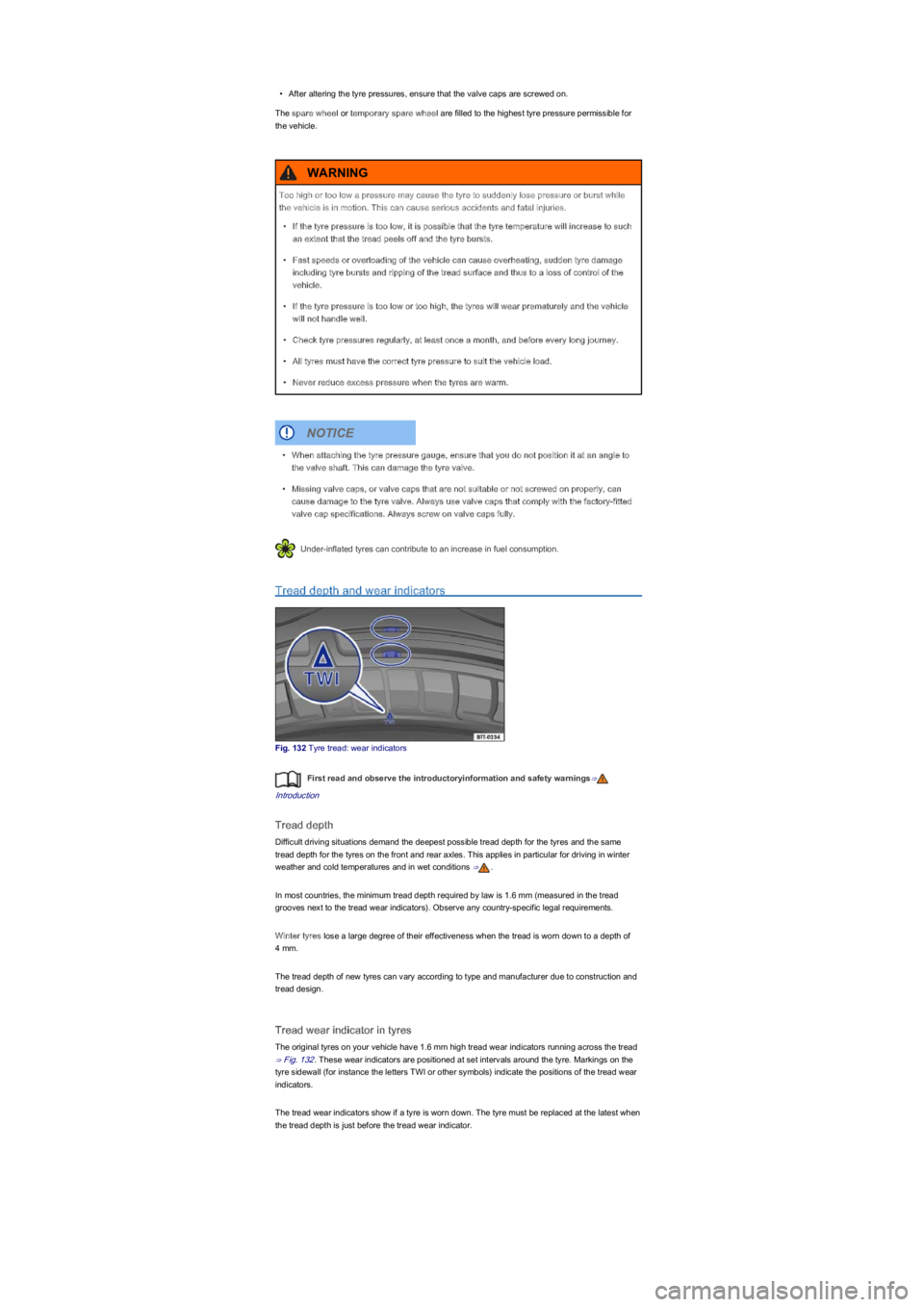
Fig. 132 Tyre tread: wear indicators
First read and observe the introductoryinformation and safety warnings⇒
Introduction
Tread depth
Difficult driving situations demand the deepest possible tread depth for the tyres and the same
tread depth for the tyres on the front and rear axles. This applies in particular for driving in winter
weather and cold temperatures and in wet conditions ⇒.
In most countries, the minimum tread depth required by law is 1.6 mm (measured in the tread
grooves next to the tread wear indicators). Observe any country-specific legal requirements.
Winter tyres lose a large degree of their effectiveness when the tread is worn down to a depth of
4 mm.
The tread depth of new tyres can vary according to type and manufacturer due to construction and
tread design.
Tread wear indicator in tyres
The original tyres on your vehicle have 1.6 mm high tread wear indicators running across the tread
⇒ Fig. 132. These wear indicators are positioned at set intervals around the tyre. Markings on the
tyre sidewall (for instance the letters TWI or other symbols) indicate the positions of the tread wear
indicators.
The tread wear indicators show if a tyre is worn down. The tyre must be replaced at the latest when
the tread depth is just before the tread wear indicator.
Too high or too low a pressure may cause the tyre to suddenly lose pressure or burst while
the vehicle is in motion. This can cause serious accidents and fatal injuries.
•If the tyre pressure is too low, it is possible that the tyre temperature will increase to such
an extent that the tread peels off and the tyre bursts.
•Fast speeds or overloading of the vehicle can cause overheating, sudden tyre damage
including tyre bursts and ripping of the tread surface and thus to a loss of control of the
vehicle.
•If the tyre pressure is too low or too high, the tyres will wear prematurely and the vehicle
will not handle well.
•Check tyre pressures regularly, at least once a month, and before every long journey.
•All tyres must have the correct tyre pressure to suit the vehicle load.
•Never reduce excess pressure when the tyres are warm.
WARNING
•When attaching the tyre pressure gauge, ensure that you do not position it at an angle to
the valve shaft. This can damage the tyre valve.
•Missing valve caps, or valve caps that are not suitable or not screwed on properly, can
cause damage to the tyre valve. Always use valve caps that comply with the factory-fitted
valve cap specifications. Always screw on valve caps fully.
NOTICE
Page 167 of 211
Winter tyres lose their effectiveness when the tread is worn down to a depth of 4 mm. Winter tyres
also largely lose their effectiveness through ageing – regardless of the tread depth.
The following applies when using winter tyres:
•Observe any country-specific legal requirements.
•Use winter tyres on all four wheels at the same time.
•Only use in winter road conditions.
•Only use the sizes of winter tyre that have been approved for the vehicle.
•Winter tyres must have the same type, size (rolling circumference) and the same tread pattern.
•Heed the maximum speed permitted by the speed index ⇒.
Speed limitation
Winter tyres have a speed limitation depending on the speed index ⇒ Tyre lettering.
In some vehicle versions, a speed warning can be set in the MFD (multifunction display) menu in
the instrument cluster ⇒ Volkswagen information system.
If you use V-rated tyres the speed limits and required tyre pressure will be determined by the
engine size. You must ask a Volkswagen dealership about the highest permitted speed and
required tyre pressure.
Summer tyres should be fitted in good time at the end of the winter. The vehicle handling is
better if summer tyres are fitted at temperatures above +7°C (+45°F). They are quieter, do not wear
so quickly and reduce fuel consumption.
Volkswagen dealerships can provide details on permissible winter tyre sizes.
Snow chains
First read and observe the introductoryinformation and safety warnings⇒
Introduction
Please heed legislation and also the permitted speed when driving your vehicle with snow chains.
In winter conditions, snow chains will not only improve acceleration, but also braking response.
Snow chains may be fitted only to the front wheels. They may be fitted only to the following tyre
and wheel combinations:
Tyre sizeWheel
165 / 70 R 145 J x 14 offset 35
Volkswagen recommends that you ask your Volkswagen dealership for information about
appropriate wheel, tyre and snow chain size.
If possible, use snow chains with fine-pitch links which do not protrude more than 15 mm, including
the tensioner.
Remove wheel centre covers and trim rings before fitting snow chains ⇒. For safety reasons
cover caps must then be fitted over the wheel bolts. These are available from your Volkswagen
dealership.
Temporary spare wheel
For technical reasons, snow chains must not be used on the temporary spare wheel ⇒ Spare wheel
or temporary spare wheel.
If you have to use snow chains with the temporary spare wheel fitted, the temporary spare wheel
should be fitted to the rear axle even when a front wheel is damaged. You can then use the wheel
taken from the rear axle to replace the damaged front wheel. Please note the direction of rotation.
Volkswagen recommends fitting the snow chains before mounting the wheel on the car.
The improved winter driving characteristics afforded by the winter tyres should not encourage
you to take any risks.
•Adapt your speed and driving style to suit visibility, weather, road and traffic conditions.
•Never exceed the top speed and load permitted for the winter tyres that are fitted.
WARNING
Page 180 of 211
⇒ Catalytic converter
Additional information and warnings:
•Changing gear ⇒ Changing gear
•Filling the tank ⇒ Filling the tank
•Fuel ⇒ Fuel
•Engine oil ⇒ Engine oil
•Battery ⇒ Vehicle battery
•Information stored in the control units ⇒ Accessories, modifications, repairs and renewal of parts
•Tow-starting and towing ⇒ Tow-starting and towing
Indicator lamps
First read and observe the introductoryinformation and safety warnings⇒
Introduction
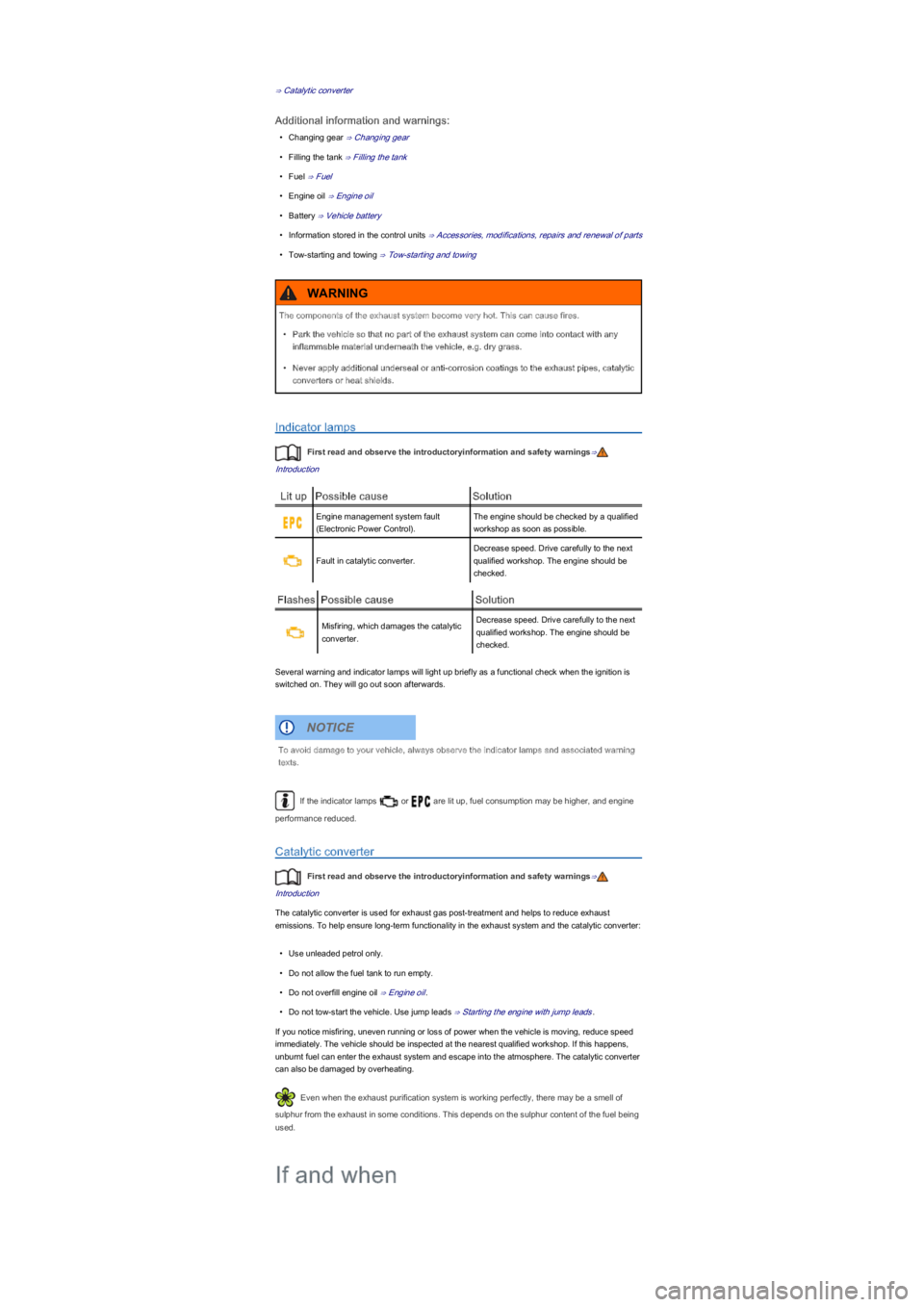
Lit upPossible causeSolution
Engine management system fault
(Electronic Power Control).
The engine should be checked by a qualified
workshop as soon as possible.
Fault in catalytic converter.
Decrease speed. Drive carefully to the next
qualified workshop. The engine should be
checked.
FlashesPossible causeSolution
Misfiring, which damages the catalytic
converter.
Decrease speed. Drive carefully to the next
qualified workshop. The engine should be
checked.
Several warning and indicator lamps will light up briefly as a functional check when the ignition is
switched on. They will go out soon afterwards.
If the indicator lamps or are lit up, fuel consumption may be higher, and engine
performance reduced.
Catalytic converter
First read and observe the introductoryinformation and safety warnings⇒
Introduction
The catalytic converter is used for exhaust gas post-treatment and helps to reduce exhaust
emissions. To help ensure long-term functionality in the exhaust system and the catalytic converter:
•Use unleaded petrol only.
•Do not allow the fuel tank to run empty.
•Do not overfill engine oil ⇒ Engine oil.
•Do not tow-start the vehicle. Use jump leads ⇒ Starting the engine with jump leads.
If you notice misfiring, uneven running or loss of power when the vehicle is moving, reduce speed
immediately. The vehicle should be inspected at the nearest qualified workshop. If this happens,
unburnt fuel can enter the exhaust system and escape into the atmosphere. The catalytic converter
can also be damaged by overheating.
Even when the exhaust purification system is working perfectly, there may be a smell of
sulphur from the exhaust in some conditions. This depends on the sulphur content of the fuel being
used.
The components of the exhaust system become very hot. This can cause fires.
•Park the vehicle so that no part of the exhaust system can come into contact with any
inflammable material underneath the vehicle, e.g. dry grass.
•Never apply additional underseal or anti-corrosion coatings to the exhaust pipes, catalytic
converters or heat shields.
WARNING
To avoid damage to your vehicle, always observe the indicator lamps and associated warning
texts.
NOTICE
If and when
Page 181 of 211
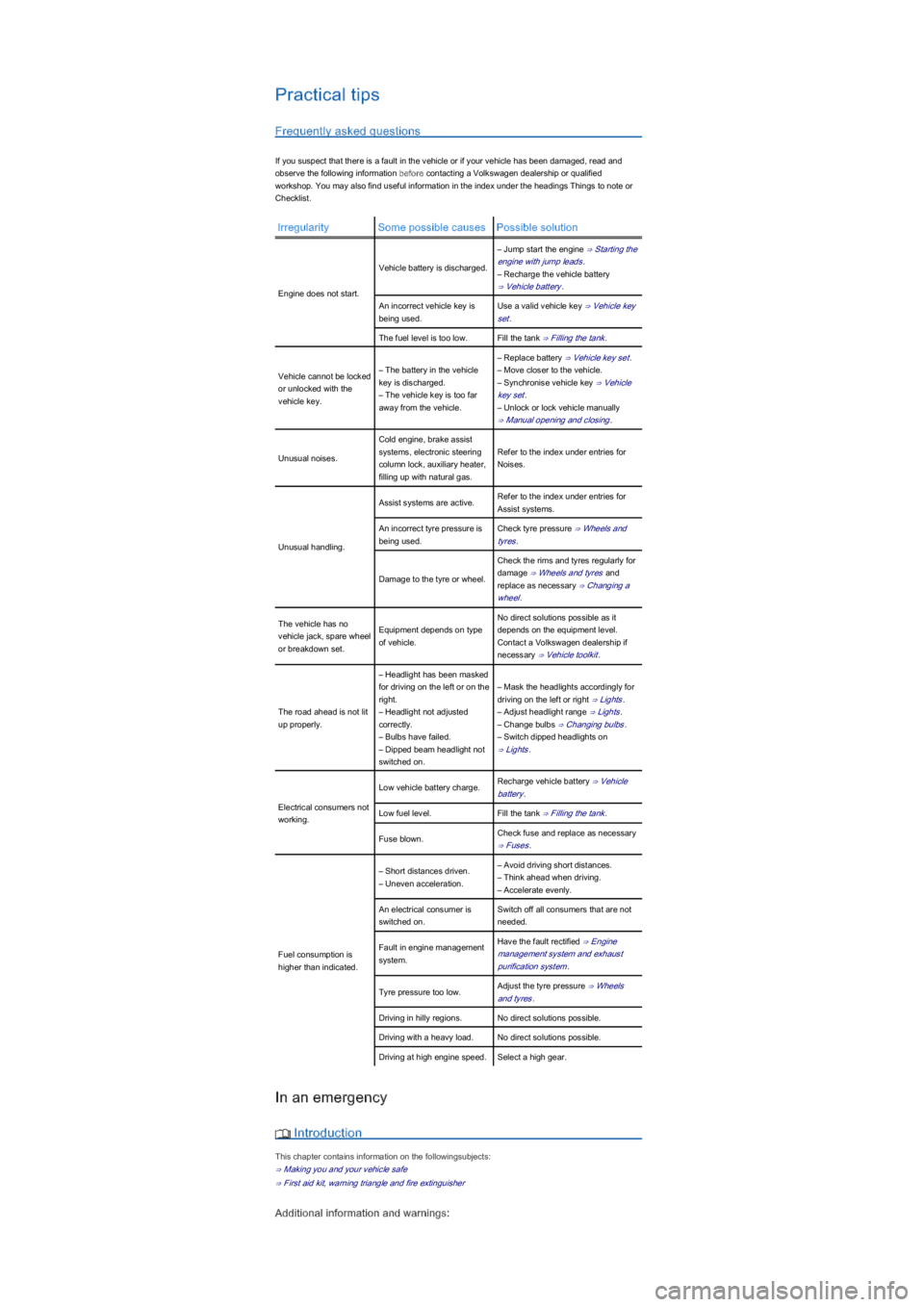
Practical tips
Frequently asked questions
If you suspect that there is a fault in the vehicle or if your vehicle has been damaged, read and
observe the following information before contacting a Volkswagen dealership or qualified
workshop. You may also find useful information in the index under the headings Things to note or
Checklist.
IrregularitySome possible causesPossible solution
Engine does not start.
Vehicle battery is discharged.
– Jump start the engine ⇒ Starting the
engine with jump leads.
– Recharge the vehicle battery
⇒ Vehicle battery.
An incorrect vehicle key is
being used.
Use a valid vehicle key ⇒ Vehicle key
set.
The fuel level is too low.Fill the tank ⇒ Filling the tank.
Vehicle cannot be locked
or unlocked with the
vehicle key.
– The battery in the vehicle
key is discharged.
– The vehicle key is too far
away from the vehicle.
– Replace battery ⇒ Vehicle key set.
– Move closer to the vehicle.
– Synchronise vehicle key ⇒ Vehicle
key set.
– Unlock or lock vehicle manually
⇒ Manual opening and closing.
Unusual noises.
Cold engine, brake assist
systems, electronic steering
column lock, auxiliary heater,
filling up with natural gas.
Refer to the index under entries for
Noises.
Unusual handling.
Assist systems are active.Refer to the index under entries for
Assist systems.
An incorrect tyre pressure is
being used.
Check tyre pressure ⇒ Wheels and
tyres.
Damage to the tyre or wheel.
Check the rims and tyres regularly for
damage ⇒ Wheels and tyres and
replace as necessary ⇒ Changing a
wheel.
The vehicle has no
vehicle jack, spare wheel
or breakdown set.
Equipment depends on type
of vehicle.
No direct solutions possible as it
depends on the equipment level.
Contact a Volkswagen dealership if
necessary ⇒ Vehicle toolkit.
The road ahead is not lit
up properly.
– Headlight has been masked
for driving on the left or on the
right.
– Headlight not adjusted
correctly.
– Bulbs have failed.
– Dipped beam headlight not
switched on.
– Mask the headlights accordingly for
driving on the left or right ⇒ Lights.
– Adjust headlight range ⇒ Lights.
– Change bulbs ⇒ Changing bulbs.
– Switch dipped headlights on
⇒ Lights.
Electrical consumers not
working.
Low vehicle battery charge.Recharge vehicle battery ⇒ Vehicle
battery.
Low fuel level.Fill the tank ⇒ Filling the tank.
Fuse blown.Check fuse and replace as necessary
⇒ Fuses.
Fuel consumption is
higher than indicated.
– Short distances driven.
– Uneven acceleration.
– Avoid driving short distances.
– Think ahead when driving.
– Accelerate evenly.
An electrical consumer is
switched on.
Switch off all consumers that are not
needed.
Fault in engine management
system.
Have the fault rectified ⇒ Engine
management system and exhaust
purification system.
Tyre pressure too low.Adjust the tyre pressure ⇒ Wheels
and tyres.
Driving in hilly regions.No direct solutions possible.
Driving with a heavy load.No direct solutions possible.
Driving at high engine speed.Select a high gear.
In an emergency
Introduction
This chapter contains information on the followingsubjects:
⇒ Making you and your vehicle safe
⇒ First aid kit, warning triangle and fire extinguisher
Additional information and warnings:
Page 210 of 211
•You will need to depress the brake pedal more vigorously than normal as the brake servo is not
working. Do not drive too close to the towing vehicle.
•Read and comply with the information and notes in the owner's manual of the towing vehicle.
Notes for the driver of the towing vehicle
•Accelerate carefully and gently. Avoid any sudden driving manoeuvres.
•Brake earlier than normal by pressing lightly on the brake pedal.
•Read and comply with any information and notes in the owner's manual of the towed vehicle.
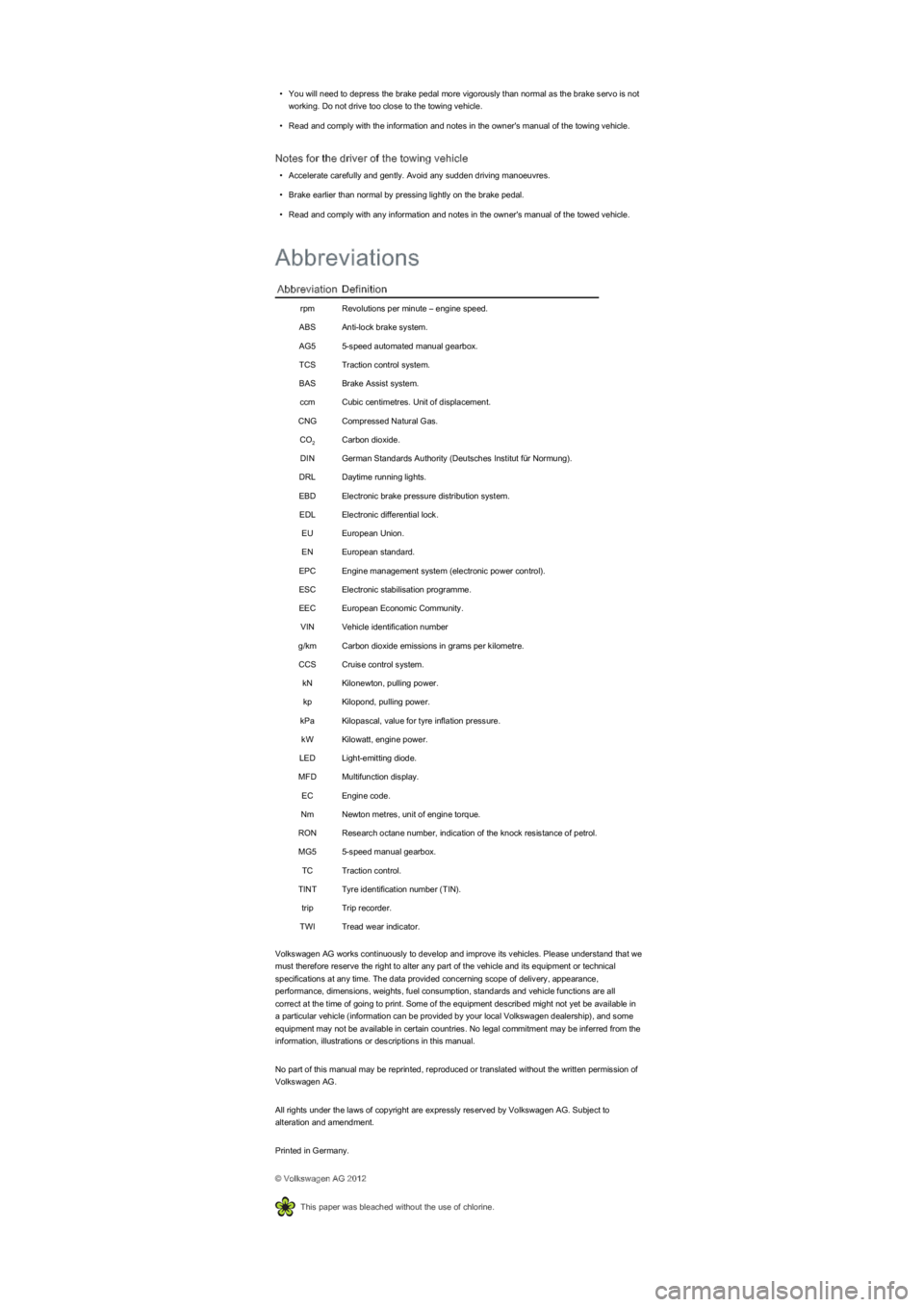
AbbreviationDefinition
rpmRevolutions per minute – engine speed.
ABSAnti-lock brake system.
AG55-speed automated manual gearbox.
TCSTraction control system.
BASBrake Assist system.
ccmCubic centimetres. Unit of displacement.
CNGCompressed Natural Gas.
COCarbon dioxide.
DINGerman Standards Authority (Deutsches Institut für Normung).
DRLDaytime running lights.
EBDElectronic brake pressure distribution system.
EDLElectronic differential lock.
EUEuropean Union.
ENEuropean standard.
EPCEngine management system (electronic power control).
ESCElectronic stabilisation programme.
EECEuropean Economic Community.
VINVehicle identification number
g/kmCarbon dioxide emissions in grams per kilometre.
CCSCruise control system.
kNKilonewton, pulling power.
kpKilopond, pulling power.
kPaKilopascal, value for tyre inflation pressure.
kWKilowatt, engine power.
LEDLight-emitting diode.
MFDMultifunction display.
ECEngine code.
NmNewton metres, unit of engine torque.
RONResearch octane number, indication of the knock resistance of petrol.
MG55-speed manual gearbox.
TCTraction control.
TINT Tyre identification number (TIN).
tripTrip recorder.
TWITread wear indicator.
Volkswagen AG works continuously to develop and improve its vehicles. Please understand that we
must therefore reserve the right to alter any part of the vehicle and its equipment or technical
specifications at any time. The data provided concerning scope of delivery, appearance,
performance, dimensions, weights, fuel consumption, standards and vehicle functions are all
correct at the time of going to print. Some of the equipment described might not yet be available in
a particular vehicle (information can be provided by your local Volkswagen dealership), and some
equipment may not be available in certain countries. No legal commitment may be inferred from the
information, illustrations or descriptions in this manual.
No part of this manual may be reprinted, reproduced or translated without the written permission of
Volkswagen AG.
All rights under the laws of copyright are expressly reserved by Volkswagen AG. Subject to
alteration and amendment.
Printed in Germany.
© Volkswagen AG 2012
This paper was bleached without the use of chlorine.
Abbreviations
2