headlights VOLKSWAGEN UP! 2021 Owner´s Manual
[x] Cancel search | Manufacturer: VOLKSWAGEN, Model Year: 2021, Model line: UP!, Model: VOLKSWAGEN UP! 2021Pages: 211, PDF Size: 5.98 MB
Page 199 of 211
Preparation
•Switch off the ignition, the lights and all electrical consumers.
•Open the appropriate fuse box ⇒ Fuses in the vehicle.
Detecting a blown fuse
A melted metal strip indicates that the fuse has blown ⇒ Fig. 160.
Shine a torch onto the fuse. This will help you to spot the blown fuse more easily.
Changing a fuse
•Take the plastic pliers ⇒ Fig. 161① out of the holder if needed. The holder is on the rear side of
the fuse box near the diagnosis connection.
•For small fuses, push on the catch ⇒ Fig. 161① from above ⇒ Fig. 161A.
•For bigger fuses, push the catch ⇒ Fig. 161① onto the fuse from the side ⇒ Fig. 161B.
•Remove the fuse
•If the fuse has blown, replace it with a new fuse of the same amp rating (same colour and same
markings) and same size ⇒.
•Insert the cover again or close the fuse box cover.
•If used, replace the pliers in the holder behind the fuse box.
Changing bulbs
Introduction
This chapter contains information on the followingsubjects:
⇒ Information on changing bulbs
⇒ Changing bulbs in the front headlights
⇒ Changing bulbs in the front bumper
⇒ Changing bulbs in the tail light cluster
⇒ Changing the bulb in the number plate light
⇒ Changing bulbs in the side turn signals
Changing the vehicle bulbs requires considerable technical skill. If you do not feel confident with the
procedure, Volkswagen recommends that you have the bulbs changed by a Volkswagen
dealership, or that you seek other expert assistance. Contact a qualified workshop if other vehicle
parts around the lights need to be removed.
You should keep a box with spare light bulbs for the lights that ensure the vehicle is roadworthy in
the vehicle at all times. Spare bulbs are available from Volkswagen dealerships. In some countries
it is a legal requirement to have these spare bulbs in the vehicle.
It may be illegal to drive with a defective bulb in the exterior lighting.
Additional bulb specifications
Some bulbs in headlights or in tail light clusters might have factory specifications that are different
to standard bulbs. The designation is inscribed on the bulb, either on the glass part or on the base.
Additional information and warnings:
•Exterior views ⇒ Exterior views
•Lights and vision ⇒ Lights and vision
•Preparation for working in the engine compartment ⇒ Preparation for working in the engine
compartment
•Vehicle toolkit ⇒ Vehicle toolkit
•Fuses ⇒ Fuses
You can damage another position in the electrical system by using a fuse with a higher amp
rating.
NOTICE
Page 201 of 211
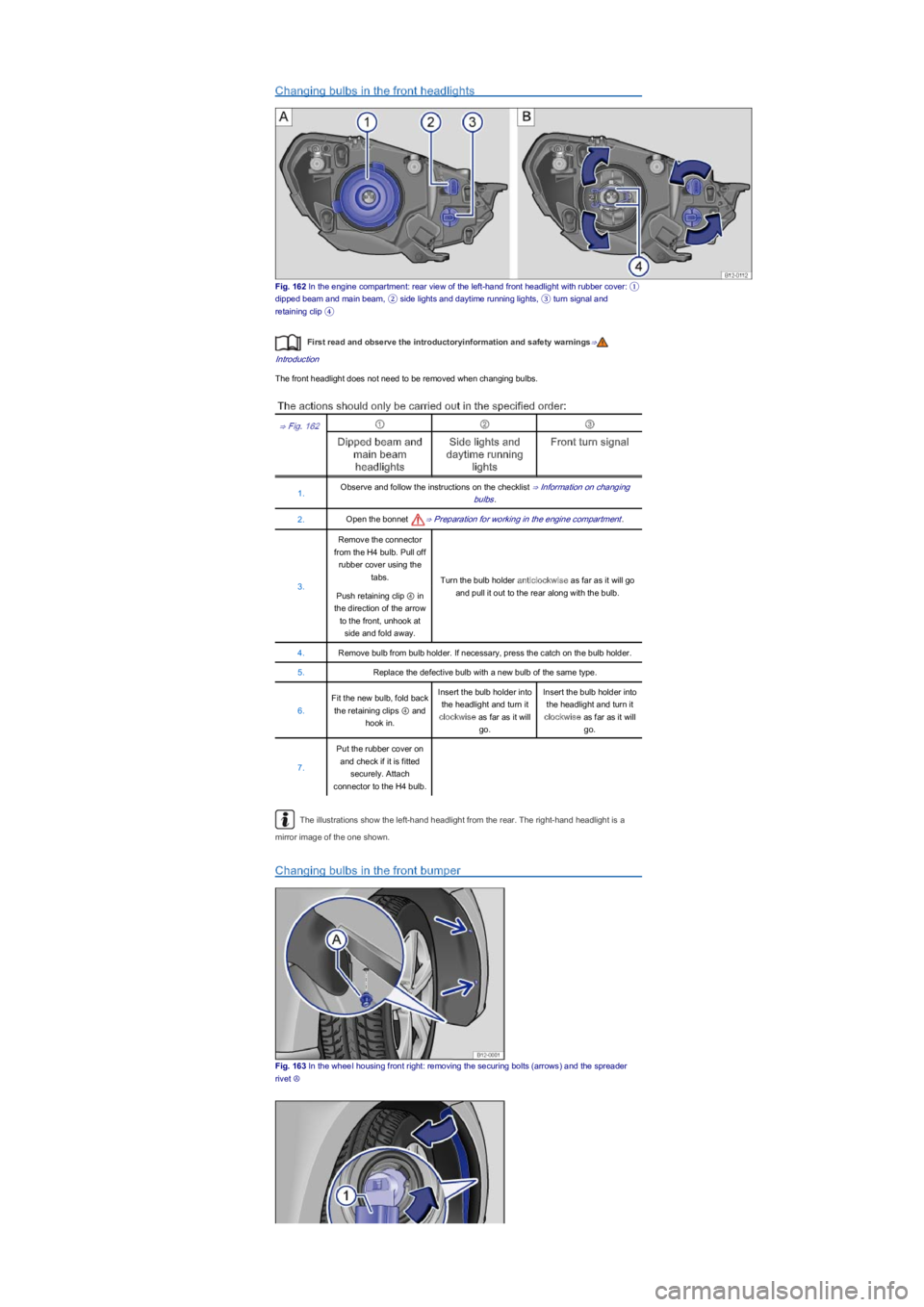
Changing bulbs in the front headlights
Fig. 162 In the engine compartment: rear view of the left-hand front headlight with rubber cover: ①
dipped beam and main beam, ② side lights and daytime running lights, ③ turn signal and
retaining clip ④
First read and observe the introductoryinformation and safety warnings⇒
Introduction
The front headlight does not need to be removed when changing bulbs.
The actions should only be carried out in the specified order:
⇒ Fig. 162①②③
Dipped beam and
main beam
headlights
Side lights and
daytime running
lights
Front turn signal
1.Observe and follow the instructions on the checklist ⇒ Information on changing
bulbs.
2.Open the bonnet ⇒ Preparation for working in the engine compartment.
3.
Remove the connector
from the H4 bulb. Pull off
rubber cover using the
tabs.Turn the bulb holder anticlockwise as far as it will go
and pull it out to the rear along with the bulb.Push retaining clip ④ in
the direction of the arrow
to the front, unhook at
side and fold away.
4.Remove bulb from bulb holder. If necessary, press the catch on the bulb holder.
5.Replace the defective bulb with a new bulb of the same type.
6.
Fit the new bulb, fold back
the retaining clips ④ and
hook in.
Insert the bulb holder into
the headlight and turn it
clockwise as far as it will
go.
Insert the bulb holder into
the headlight and turn it
clockwise as far as it will
go.
7.
Put the rubber cover on
and check if it is fitted
securely. Attach
connector to the H4 bulb.
The illustrations show the left-hand headlight from the rear. The right-hand headlight is a
mirror image of the one shown.
Changing bulbs in the front bumper
Fig. 163 In the wheeI housing front right: removing the securing bolts (arrows) and the spreader
rivet Ⓐ
Page 202 of 211
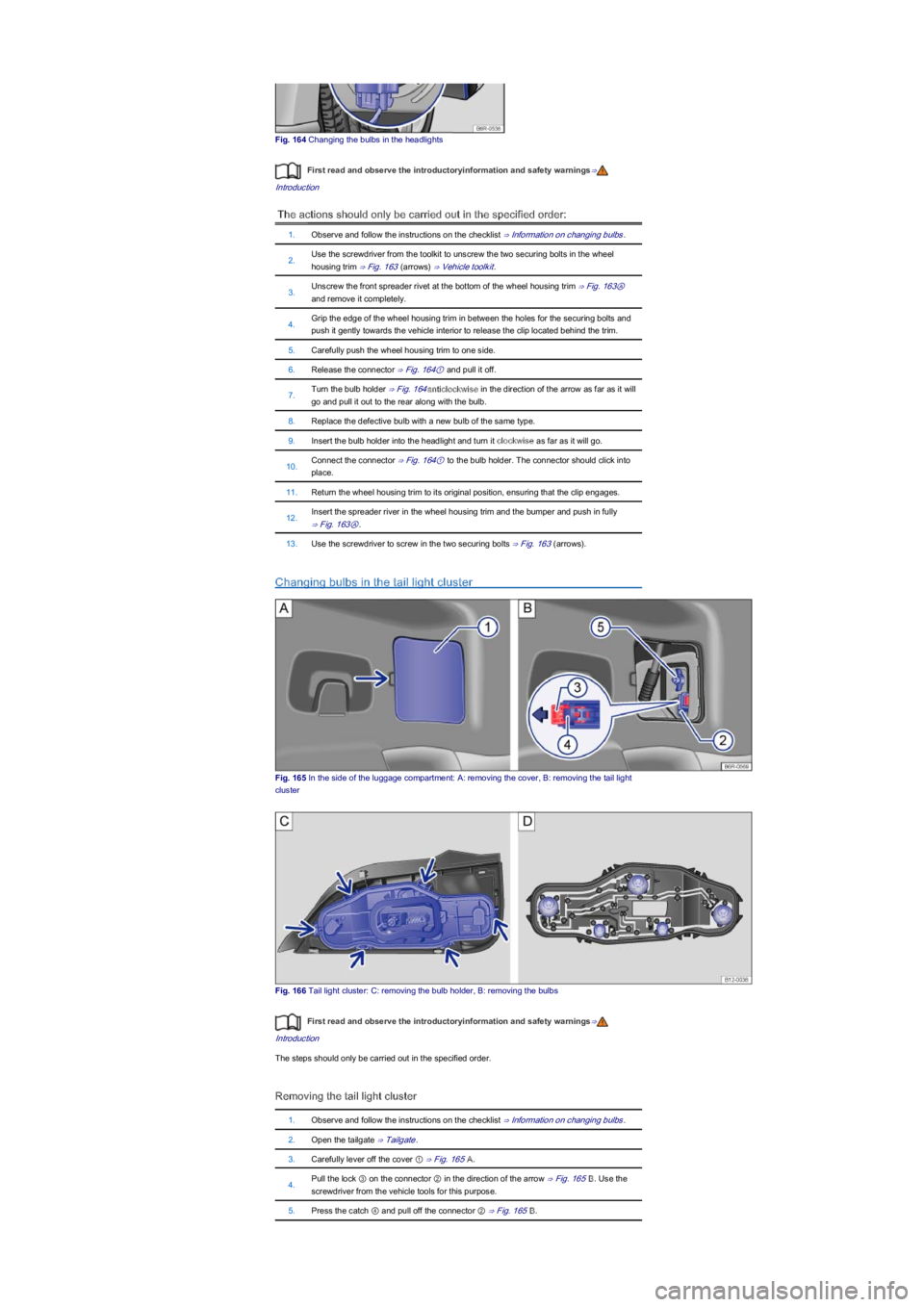
Fig. 164 Changing the bulbs in the headlights
First read and observe the introductoryinformation and safety warnings⇒
Introduction
The actions should only be carried out in the specified order:
1.Observe and follow the instructions on the checklist ⇒ Information on changing bulbs.
2.Use the screwdriver from the toolkit to unscrew the two securing bolts in the wheel
housing trim ⇒ Fig. 163 (arrows) ⇒ Vehicle toolkit.
3.Unscrew the front spreader rivet at the bottom of the wheel housing trim ⇒ Fig. 163Ⓐ
and remove it completely.
4.Grip the edge of the wheel housing trim in between the holes for the securing bolts and
push it gently towards the vehicle interior to release the clip located behind the trim.
5.Carefully push the wheel housing trim to one side.
6.Release the connector ⇒ Fig. 164① and pull it off.
7.Turn the bulb holder ⇒ Fig. 164anticlockwise in the direction of the arrow as far as it will
go and pull it out to the rear along with the bulb.
8.Replace the defective bulb with a new bulb of the same type.
9.Insert the bulb holder into the headlight and turn it clockwise as far as it will go.
10.Connect the connector ⇒ Fig. 164① to the bulb holder. The connector should click into
place.
11.Return the wheel housing trim to its original position, ensuring that the clip engages.
12.Insert the spreader river in the wheel housing trim and the bumper and push in fully
⇒ Fig. 163Ⓐ.
13.Use the screwdriver to screw in the two securing bolts ⇒ Fig. 163 (arrows).
Changing bulbs in the tail light cluster
Fig. 165 In the side of the luggage compartment: A: removing the cover, B: removing the tail light
cluster
Fig. 166 Tail light cluster: C: removing the bulb holder, B: removing the bulbs
First read and observe the introductoryinformation and safety warnings⇒
Introduction
The steps should only be carried out in the specified order.
Removing the tail light cluster
1.Observe and follow the instructions on the checklist ⇒ Information on changing bulbs.
2.Open the tailgate ⇒ Tailgate.
3.Carefully lever off the cover ① ⇒ Fig. 165A.
4.Pull the lock ③ on the connector ② in the direction of the arrow ⇒ Fig. 165B. Use the
screwdriver from the vehicle tools for this purpose.
5.Press the catch ④ and pull off the connector ② ⇒ Fig. 165B.
Page 206 of 211
The discharged vehicle battery must be properly connected to the vehicle's electrical system.
The vehicles must not touch. Otherwise electricity could flow as soon as the positive terminals are
connected.
Ensure that the battery clamps have good metal-to-metal contact with the battery terminals.
If the engine does not start immediately, switch off the starter after about 10 seconds and try again
after about half a minute.
The steps should only be carried out in the specified order.
Attaching the jump leads
•Switch off the ignition in both vehicles ⇒ Starting and stopping the engine.
•If necessary, open the battery cover in the engine compartment ⇒ Vehicle battery.
•Connect one end of the red jump lead to the positive terminal ⇒ Fig. 171⊕ or ⇒ Fig. 172⊕ in
the vehicle with the discharged battery Ⓐ ⇒.
•Connect the other end of the red jump lead to the positive terminal ⊕ in the vehicle providing
assistance Ⓑ.
•In vehicles without start/stop system: connect one end of the black jump lead to the negative
terminal ㊀ in the vehicle providing assistance Ⓑ ⇒ Fig. 171.
•In vehicles with start/stop system: connect one end of the black jump lead Ⓧ to a suitable
earth connection, to a solid metal part that is securely bolted onto the cylinder or to the cylinder
block itself ⇒ Fig. 172.
•Connect the other end of the black jump lead Ⓧ to a solid metal component bolted on to the
engine block, or onto the engine block in the vehicle with the discharged battery. Do not
connect it to a point near the battery Ⓐ ⇒.
•Position the leads in such a way that they cannot come into contact with any moving parts in the
engine compartment.
Starting the engine
•Start the engine of the vehicle providing assistance and let it run at idle.
•Start the engine of the car with the discharged vehicle battery and wait two or three minutes
until the engine is running smoothly.
Removing the jump leads
•Before disconnecting the jump leads, switch off the dipped beam headlights if they are switched
on.
•Turn on the heater blower and rear window heater in the vehicle battery with the discharged
battery. This helps minimise the voltage peaks generated when the leads are disconnected.
•With the engines running, disconnect the jump leads in the exact reverse order to the
instructions given above.
•Close the battery cover.
Tow-starting and towing
Introduction
This chapter contains information on the followingsubjects:
⇒ Notes on tow-starting
⇒ Notes on towing
Jump starting the vehicle incorrectly can cause the battery to explode, which can lead to
serious injuries. Please note the following in order to reduce the risk of the battery exploding:
•All work on the vehicle battery and the electrical system can cause serious chemical
burns, fire and electric shocks. Always read the warnings and safety information before
carrying out any kind of work on the vehicle battery ⇒ Vehicle battery.
•Always wear suitable eye protection and never lean over the vehicle battery.
•Attach the connector cables in the correct order – the positive cable first, followed by the
negative.
•Never connect the negative cable to parts of the fuel system or to the brake lines.
•The non-insulated parts of the battery clamps must not be allowed to touch. The jump lead
attached to the positive vehicle battery terminal must not touch metal parts of the vehicle.
•Check the window on the vehicle battery using a torch if necessary. If the display is light
yellow or colourless, do not jump start the vehicle. Seek expert assistance.
•Avoid electrostatic discharge in the vicinity of the vehicle battery. The gas emitted from the
vehicle battery could be ignited by sparks.
•Do not use jump leads to start the engine if the vehicle battery is damaged or if it is or has
ever been frozen.
WARNING