height VOLKSWAGEN UP! 2021 Owner´s Manual
[x] Cancel search | Manufacturer: VOLKSWAGEN, Model Year: 2021, Model line: UP!, Model: VOLKSWAGEN UP! 2021Pages: 211, PDF Size: 5.98 MB
Page 71 of 211
Driving a loaded vehicle
First read and observe the introductoryinformation and safety warnings⇒
Introduction
For good vehicle handling when driving a loaded vehicle, please observe the following:
•Stow all items of luggage securely ⇒ Stowing items of luggage.
•Accelerate carefully and gently.
•Avoid sudden braking and driving manoeuvres.
•Brake earlier than in normal driving.
•If applicable, heed the information about driving with a roof carrier ⇒ Roof carrier.
Vehicle-specific weight ratings
First read and observe the introductoryinformation and safety warnings⇒
Introduction
All data in the official vehicle documents take precedence over these data. All data in this manual
apply to the basic model. The vehicle data sticker in the service schedule and the official vehicle
documents show which engine is installed in your vehicle.
The values quoted here may differ if additional equipment is fitted, for different models or for special
vehicles.
The values for the kerb weight in the following table apply for the road-ready vehicle with driver
(75 kg), service fluids including fuel tank carrying 90% of its capacity and, if applicable, tools and
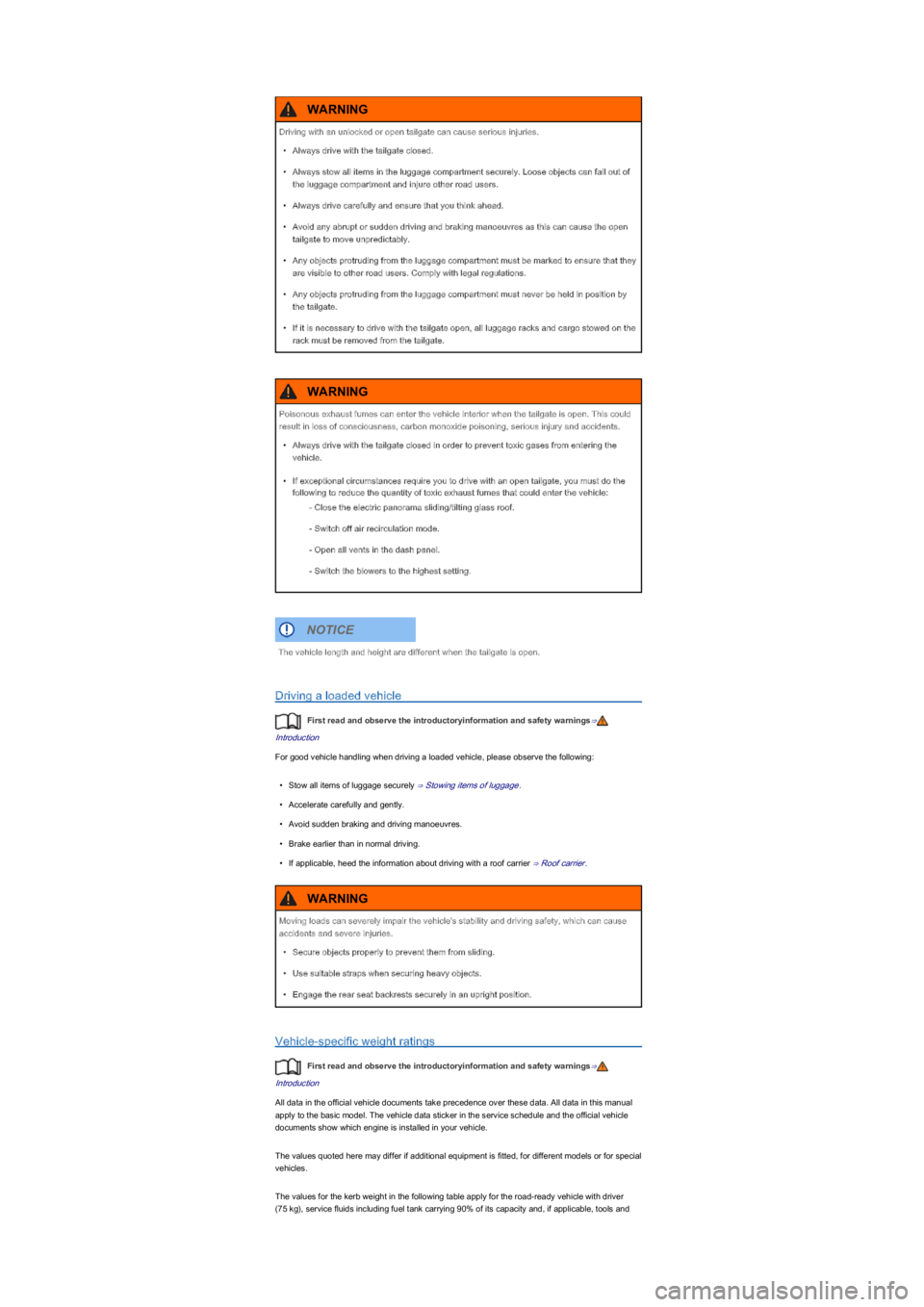
Driving with an unlocked or open tailgate can cause serious injuries.
•Always drive with the tailgate closed.
•Always stow all items in the luggage compartment securely. Loose objects can fall out of
the luggage compartment and injure other road users.
•Always drive carefully and ensure that you think ahead.
•Avoid any abrupt or sudden driving and braking manoeuvres as this can cause the open
tailgate to move unpredictably.
•Any objects protruding from the luggage compartment must be marked to ensure that they
are visible to other road users. Comply with legal regulations.
•Any objects protruding from the luggage compartment must never be held in position by
the tailgate.
•If it is necessary to drive with the tailgate open, all luggage racks and cargo stowed on the
rack must be removed from the tailgate.
WARNING
Poisonous exhaust fumes can enter the vehicle interior when the tailgate is open. This could
result in loss of consciousness, carbon monoxide poisoning, serious injury and accidents.
•Always drive with the tailgate closed in order to prevent toxic gases from entering the
vehicle.
•If exceptional circumstances require you to drive with an open tailgate, you must do the
following to reduce the quantity of toxic exhaust fumes that could enter the vehicle:
- Close the electric panorama sliding/tilting glass roof.
- Switch off air recirculation mode.
- Open all vents in the dash panel.
- Switch the blowers to the highest setting.
WARNING
The vehicle length and height are different when the tailgate is open.
NOTICE
Moving loads can severely impair the vehicle's stability and driving safety, which can cause
accidents and severe injuries.
•Secure objects properly to prevent them from sliding.
•Use suitable straps when securing heavy objects.
•Engage the rear seat backrests securely in an upright position.
WARNING
Page 77 of 211
Roof carrier
Introduction
This chapter contains information on the followingsubjects:
⇒ Attaching the mounts and load carrier system
⇒ Loading the load carrier system
The roof of the vehicle has been designed for optimum aerodynamic effect. It is therefore no longer
possible to attach conventional roof carrier systems to a rain channel on the roof.
As the rain channels have been integrated into the roof for better aerodynamics, only mounts or
roof carriers approved by Volkswagen can be used.
When should the roof carrier be removed?
•When it is no longer being used.
•When the vehicle is driving through a car wash.
•When the vehicle height exceeds the required clearance height, e.g. in a garage.
Additional information and warnings:
•Lights ⇒ Lights
•Transporting ⇒ Transporting
•Driving with respect for the environment ⇒ Driving with respect for the environment
•Wheels and tyres ⇒ Wheels and tyres
•Accessories, modifications, repairs and renewal of parts ⇒ Accessories, modifications, repairs
and renewal of parts
Driving with a fitted roof carrier will increase air resistance and thus increase fuel
consumption.
Attaching the mounts and load carrier system
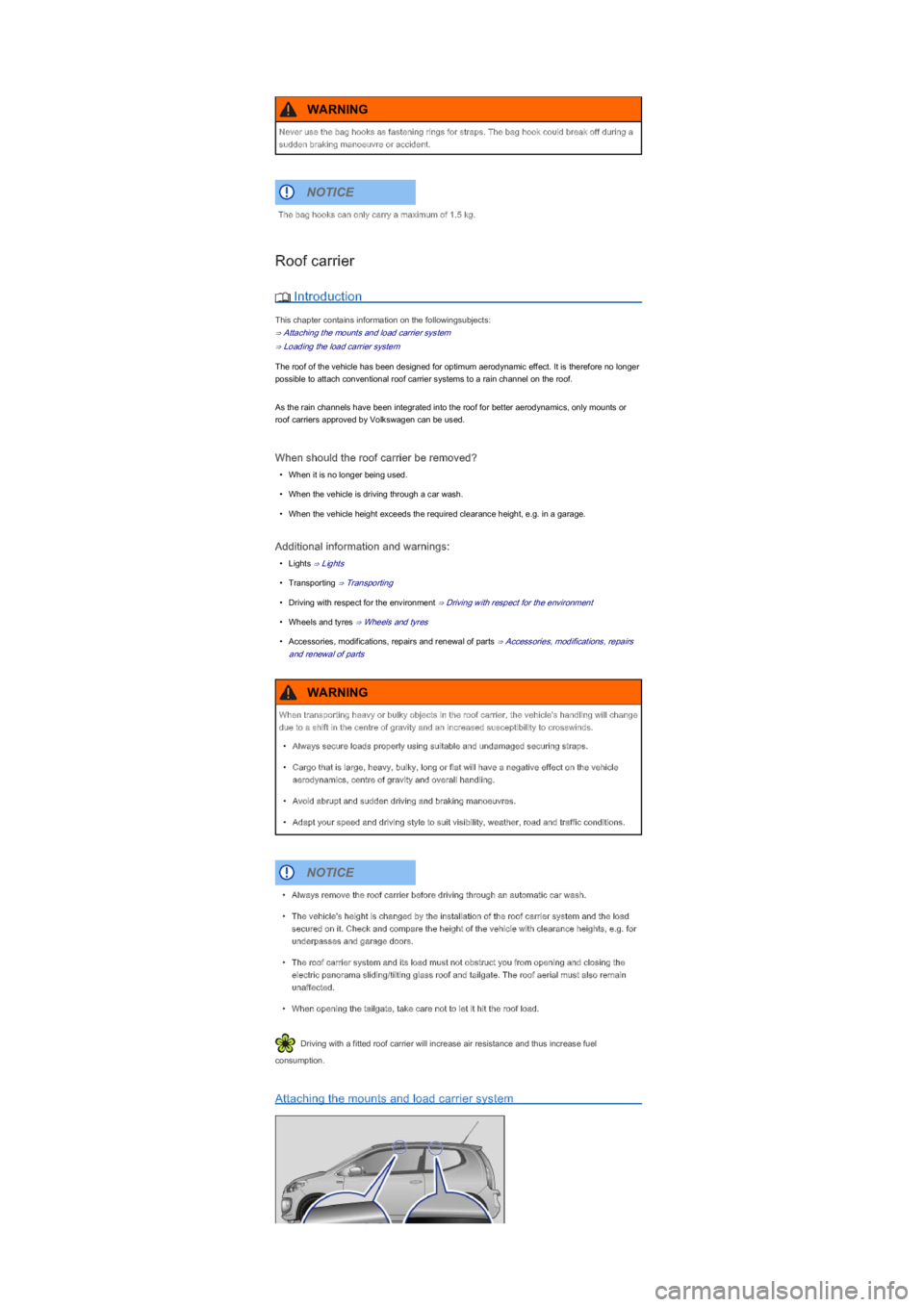
Never use the bag hooks as fastening rings for straps. The bag hook could break off during a
sudden braking manoeuvre or accident.
WARNING
The bag hooks can only carry a maximum of 1.5 kg.
NOTICE
When transporting heavy or bulky objects in the roof carrier, the vehicle's handling will change
due to a shift in the centre of gravity and an increased susceptibility to crosswinds.
•Always secure loads properly using suitable and undamaged securing straps.
•Cargo that is large, heavy, bulky, long or flat will have a negative effect on the vehicle
aerodynamics, centre of gravity and overall handling.
•Avoid abrupt and sudden driving and braking manoeuvres.
•Adapt your speed and driving style to suit visibility, weather, road and traffic conditions.
WARNING
•Always remove the roof carrier before driving through an automatic car wash.
•The vehicle's height is changed by the installation of the roof carrier system and the load
secured on it. Check and compare the height of the vehicle with clearance heights, e.g. for
underpasses and garage doors.
•The roof carrier system and its load must not obstruct you from opening and closing the
electric panorama sliding/tilting glass roof and tailgate. The roof aerial must also remain
unaffected.
•When opening the tailgate, take care not to let it hit the roof load.
NOTICE
Page 134 of 211
Opening and closing the bonnet
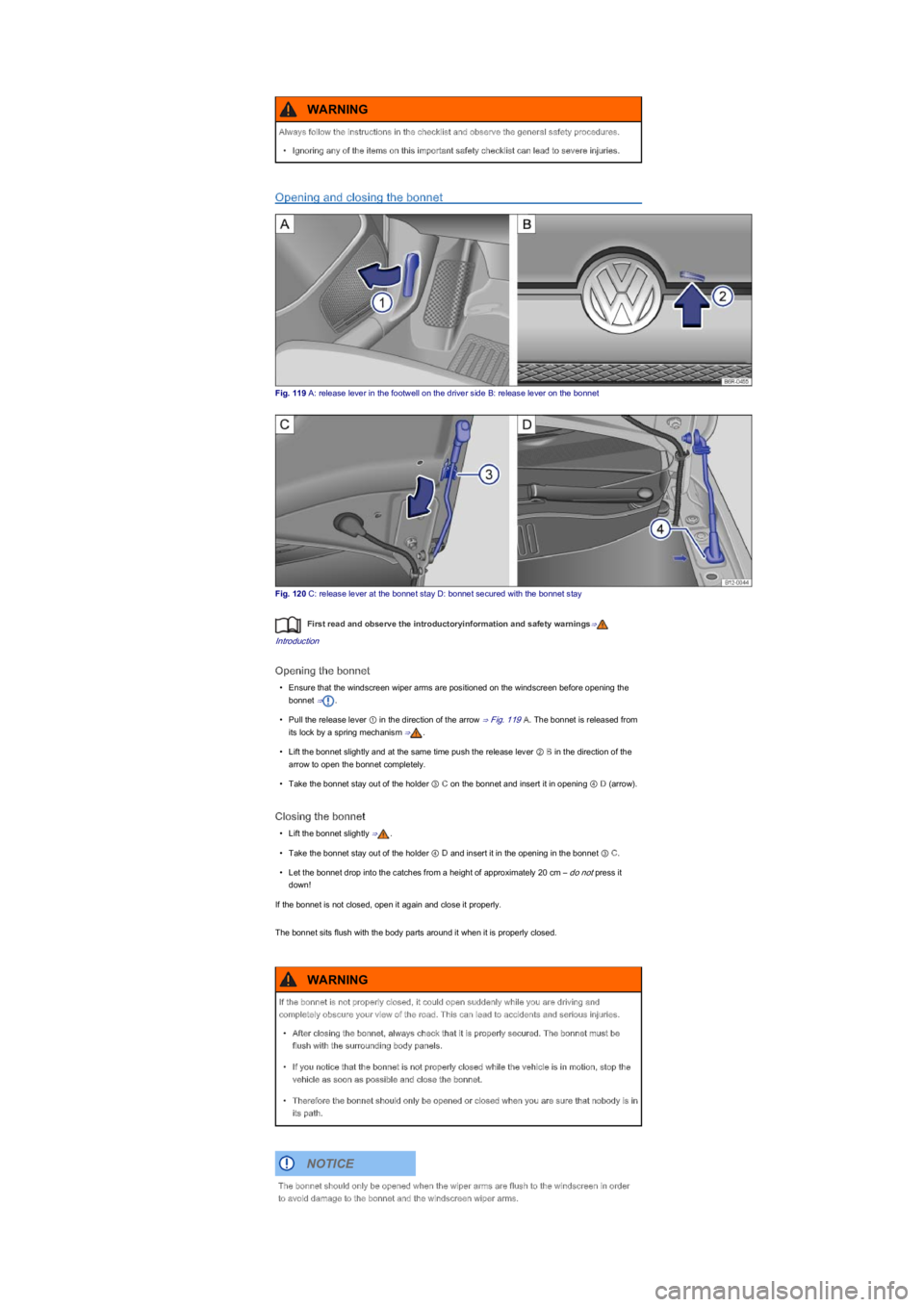
Fig. 119 A: release lever in the footwell on the driver side B: release lever on the bonnet
Fig. 120 C: release lever at the bonnet stay D: bonnet secured with the bonnet stay
First read and observe the introductoryinformation and safety warnings⇒
Introduction
Opening the bonnet
•Ensure that the windscreen wiper arms are positioned on the windscreen before opening the
bonnet ⇒.
•Pull the release lever ① in the direction of the arrow ⇒ Fig. 119A. The bonnet is released from
its lock by a spring mechanism ⇒.
•Lift the bonnet slightly and at the same time push the release lever ② B in the direction of the
arrow to open the bonnet completely.
•Take the bonnet stay out of the holder ③ C on the bonnet and insert it in opening ④ D (arrow).
Closing the bonnet
•Lift the bonnet slightly ⇒.
•Take the bonnet stay out of the holder ④ D and insert it in the opening in the bonnet ③ C.
•Let the bonnet drop into the catches from a height of approximately 20 cm – do not press it
down!
If the bonnet is not closed, open it again and close it properly.
The bonnet sits flush with the body parts around it when it is properly closed.
Always follow the instructions in the checklist and observe the general safety procedures.
•Ignoring any of the items on this important safety checklist can lead to severe injuries.
WARNING
If the bonnet is not properly closed, it could open suddenly while you are driving and
completely obscure your view of the road. This can lead to accidents and serious injuries.
•After closing the bonnet, always check that it is properly secured. The bonnet must be
flush with the surrounding body panels.
•If you notice that the bonnet is not properly closed while the vehicle is in motion, stop the
vehicle as soon as possible and close the bonnet.
•Therefore the bonnet should only be opened or closed when you are sure that nobody is in
its path.
WARNING
The bonnet should only be opened when the wiper arms are flush to the windscreen in order
to avoid damage to the bonnet and the windscreen wiper arms.
NOTICE
Page 165 of 211
If possible, stow the spare wheel, temporary spare wheel or the removed wheel safely in the
luggage compartment. In vehicles with a breakdown set, the removed wheel cannot be secured.
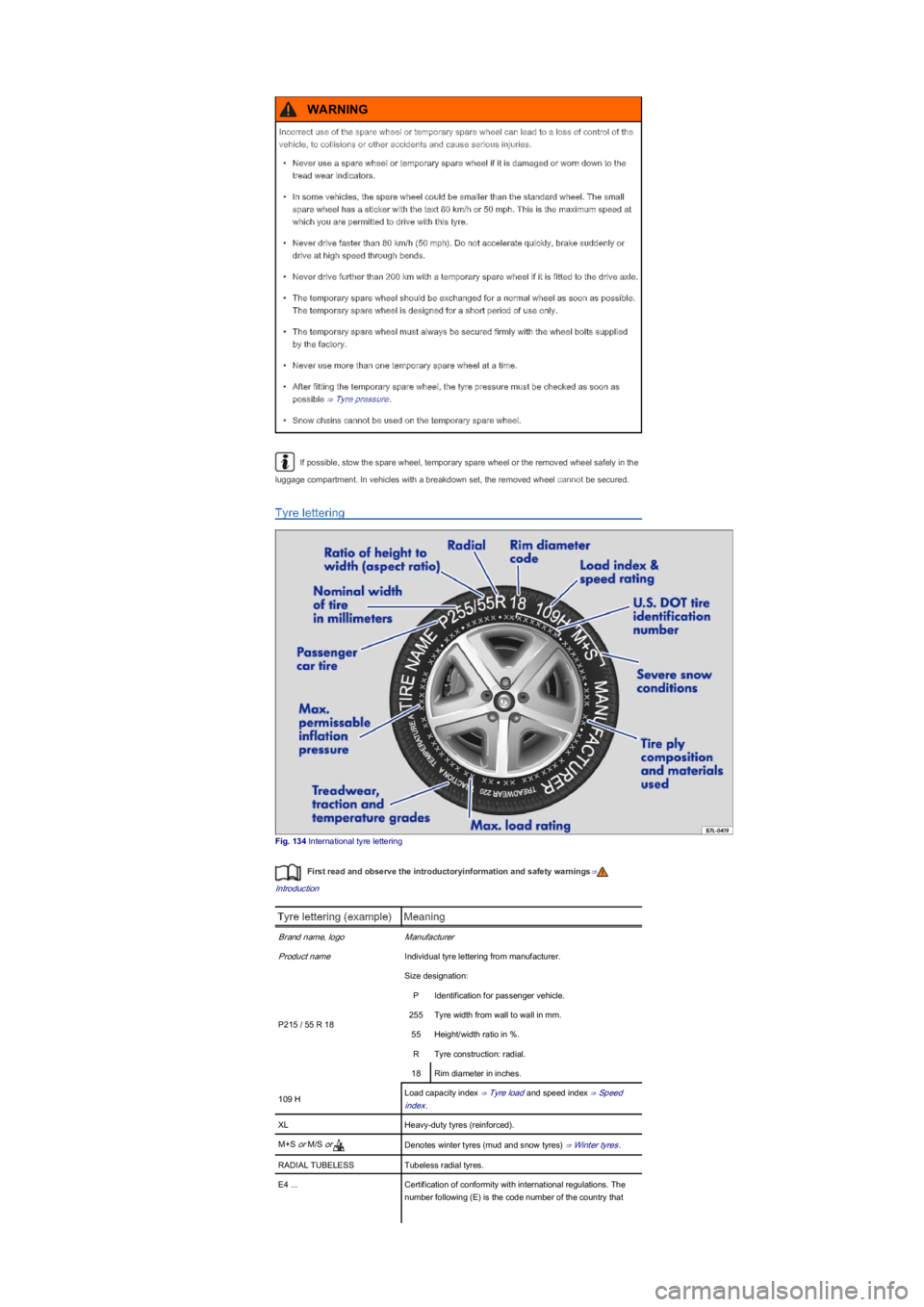
Tyre lettering
Fig. 134 International tyre lettering
First read and observe the introductoryinformation and safety warnings⇒
Introduction
Tyre lettering (example)Meaning
Brand name, logoManufacturer
Product nameIndividual tyre lettering from manufacturer.
P215 / 55 R 18
Size designation:
PIdentification for passenger vehicle.
255Tyre width from wall to wall in mm.
55Height/width ratio in %.
RTyre construction: radial.
18Rim diameter in inches.
109 HLoad capacity index ⇒ Tyre load and speed index ⇒ Speed
index.
XLHeavy-duty tyres (reinforced).
M+S or M/S orDenotes winter tyres (mud and snow tyres) ⇒ Winter tyres.
RADIAL TUBELESSTubeless radial tyres.
E4 ...Certification of conformity with international regulations. The
number following (E) is the code number of the country that
Incorrect use of the spare wheel or temporary spare wheel can lead to a loss of control of the
vehicle, to collisions or other accidents and cause serious injuries.
•Never use a spare wheel or temporary spare wheel if it is damaged or worn down to the
tread wear indicators.
•In some vehicles, the spare wheel could be smaller than the standard wheel. The small
spare wheel has a sticker with the text 80 km/h or 50 mph. This is the maximum speed at
which you are permitted to drive with this tyre.
•Never drive faster than 80 km/h (50 mph). Do not accelerate quickly, brake suddenly or
drive at high speed through bends.
•Never drive further than 200 km with a temporary spare wheel if it is fitted to the drive axle.
•The temporary spare wheel should be exchanged for a normal wheel as soon as possible.
The temporary spare wheel is designed for a short period of use only.
•The temporary spare wheel must always be secured firmly with the wheel bolts supplied
by the factory.
•Never use more than one temporary spare wheel at a time.
•After fitting the temporary spare wheel, the tyre pressure must be checked as soon as
possible ⇒ Tyre pressure.
•Snow chains cannot be used on the temporary spare wheel.
WARNING