while driving VOLKSWAGEN UP! 2021 Owner´s Manual
[x] Cancel search | Manufacturer: VOLKSWAGEN, Model Year: 2021, Model line: UP!, Model: VOLKSWAGEN UP! 2021Pages: 211, PDF Size: 5.98 MB
Page 41 of 211
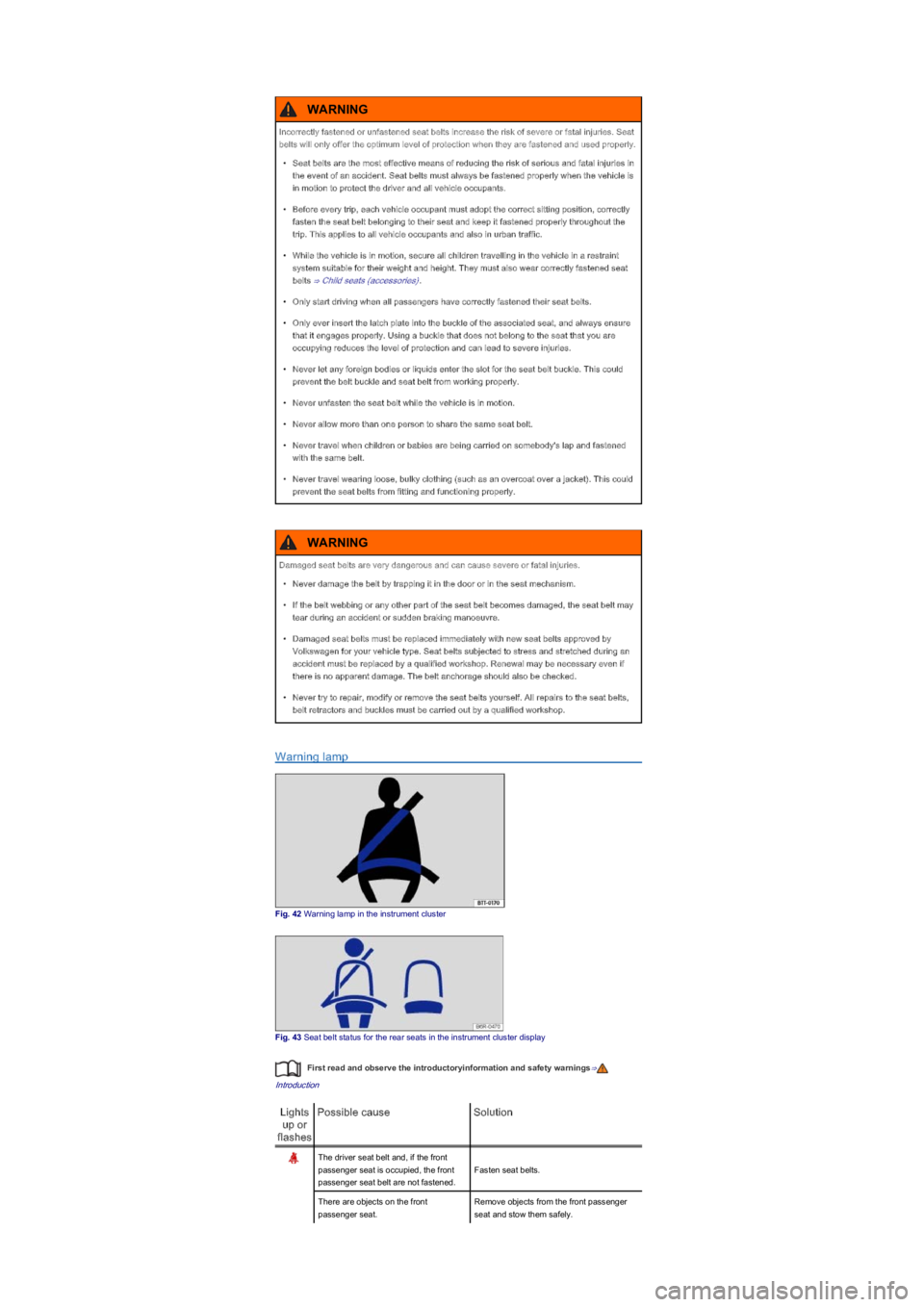
Warning lamp
Fig. 42 Warning lamp in the instrument cluster
Fig. 43 Seat belt status for the rear seats in the instrument cluster display
First read and observe the introductoryinformation and safety warnings⇒
Introduction
Lights
up or
flashes
Possible causeSolution
The driver seat belt and, if the front
passenger seat is occupied, the front
passenger seat belt are not fastened.
Fasten seat belts.
There are objects on the front
passenger seat.
Remove objects from the front passenger
seat and stow them safely.
Incorrectly fastened or unfastened seat belts increase the risk of severe or fatal injuries. Seat
belts will only offer the optimum level of protection when they are fastened and used properly.
•Seat belts are the most effective means of reducing the risk of serious and fatal injuries in
the event of an accident. Seat belts must always be fastened properly when the vehicle is
in motion to protect the driver and all vehicle occupants.
•Before every trip, each vehicle occupant must adopt the correct sitting position, correctly
fasten the seat belt belonging to their seat and keep it fastened properly throughout the
trip. This applies to all vehicle occupants and also in urban traffic.
•While the vehicle is in motion, secure all children travelling in the vehicle in a restraint
system suitable for their weight and height. They must also wear correctly fastened seat
belts ⇒ Child seats (accessories).
•Only start driving when all passengers have correctly fastened their seat belts.
•Only ever insert the latch plate into the buckle of the associated seat, and always ensure
that it engages properly. Using a buckle that does not belong to the seat that you are
occupying reduces the level of protection and can lead to severe injuries.
•Never let any foreign bodies or liquids enter the slot for the seat belt buckle. This could
prevent the belt buckle and seat belt from working properly.
•Never unfasten the seat belt while the vehicle is in motion.
•Never allow more than one person to share the same seat belt.
•Never travel when children or babies are being carried on somebody's lap and fastened
with the same belt.
•Never travel wearing loose, bulky clothing (such as an overcoat over a jacket). This could
prevent the seat belts from fitting and functioning properly.
WARNING
Damaged seat belts are very dangerous and can cause severe or fatal injuries.
•Never damage the belt by trapping it in the door or in the seat mechanism.
•If the belt webbing or any other part of the seat belt becomes damaged, the seat belt may
tear during an accident or sudden braking manoeuvre.
•Damaged seat belts must be replaced immediately with new seat belts approved by
Volkswagen for your vehicle type. Seat belts subjected to stress and stretched during an
accident must be replaced by a qualified workshop. Renewal may be necessary even if
there is no apparent damage. The belt anchorage should also be checked.
•Never try to repair, modify or remove the seat belts yourself. All repairs to the seat belts,
belt retractors and buckles must be carried out by a qualified workshop.
WARNING
Page 46 of 211
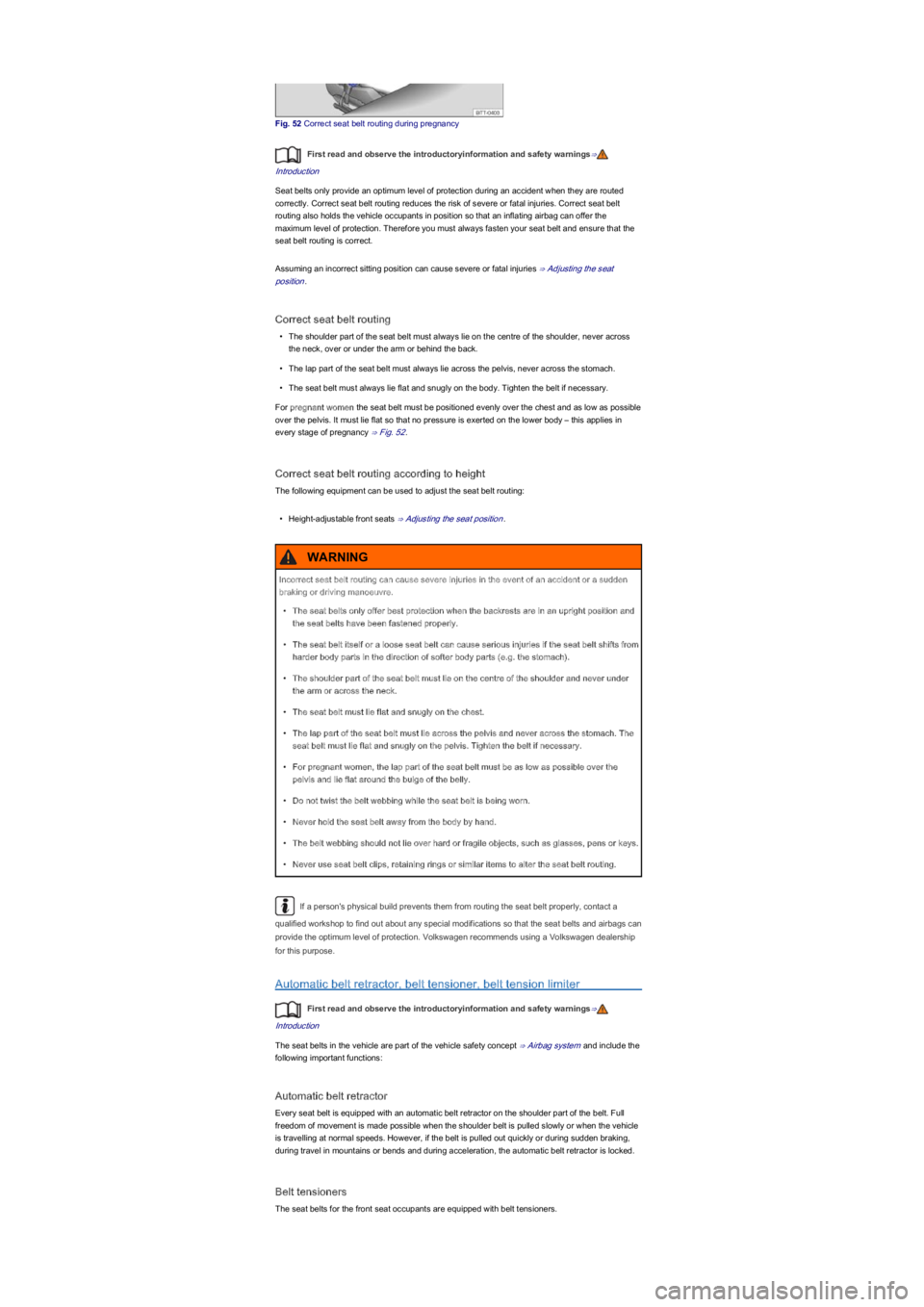
Fig. 52 Correct seat belt routing during pregnancy
First read and observe the introductoryinformation and safety warnings⇒
Introduction
Seat belts only provide an optimum level of protection during an accident when they are routed
correctly. Correct seat belt routing reduces the risk of severe or fatal injuries. Correct seat belt
routing also holds the vehicle occupants in position so that an inflating airbag can offer the
maximum level of protection. Therefore you must always fasten your seat belt and ensure that the
seat belt routing is correct.
Assuming an incorrect sitting position can cause severe or fatal injuries ⇒ Adjusting the seat
position.
Correct seat belt routing
•The shoulder part of the seat belt must always lie on the centre of the shoulder, never across
the neck, over or under the arm or behind the back.
•The lap part of the seat belt must always lie across the pelvis, never across the stomach.
•The seat belt must always lie flat and snugly on the body. Tighten the belt if necessary.
For pregnant women the seat belt must be positioned evenly over the chest and as low as possible
over the pelvis. It must lie flat so that no pressure is exerted on the lower body – this applies in
every stage of pregnancy ⇒ Fig. 52.
Correct seat belt routing according to height
The following equipment can be used to adjust the seat belt routing:
•Height-adjustable front seats ⇒ Adjusting the seat position.
If a person's physical build prevents them from routing the seat belt properly, contact a
qualified workshop to find out about any special modifications so that the seat belts and airbags can
provide the optimum level of protection. Volkswagen recommends using a Volkswagen dealership
for this purpose.
Automatic belt retractor, belt tensioner, belt tension limiter
First read and observe the introductoryinformation and safety warnings⇒
Introduction
The seat belts in the vehicle are part of the vehicle safety concept ⇒ Airbag system and include the
following important functions:
Automatic belt retractor
Every seat belt is equipped with an automatic belt retractor on the shoulder part of the belt. Full
freedom of movement is made possible when the shoulder belt is pulled slowly or when the vehicle
is travelling at normal speeds. However, if the belt is pulled out quickly or during sudden braking,
during travel in mountains or bends and during acceleration, the automatic belt retractor is locked.
Belt tensioners
The seat belts for the front seat occupants are equipped with belt tensioners.
Incorrect seat belt routing can cause severe injuries in the event of an accident or a sudden
braking or driving manoeuvre.
•The seat belts only offer best protection when the backrests are in an upright position and
the seat belts have been fastened properly.
•The seat belt itself or a loose seat belt can cause serious injuries if the seat belt shifts from
harder body parts in the direction of softer body parts (e.g. the stomach).
•The shoulder part of the seat belt must lie on the centre of the shoulder and never under
the arm or across the neck.
•The seat belt must lie flat and snugly on the chest.
•The lap part of the seat belt must lie across the pelvis and never across the stomach. The
seat belt must lie flat and snugly on the pelvis. Tighten the belt if necessary.
•For pregnant women, the lap part of the seat belt must be as low as possible over the
pelvis and lie flat around the bulge of the belly.
•Do not twist the belt webbing while the seat belt is being worn.
•Never hold the seat belt away from the body by hand.
•The belt webbing should not lie over hard or fragile objects, such as glasses, pens or keys.
•Never use seat belt clips, retaining rings or similar items to alter the seat belt routing.
WARNING
Page 47 of 211
The belt tensioners are activated by sensors during severe frontal, side and rear collisions. They
tighten the seat belts against the direction in which they are pulled. A loose seat belt is retracted,
which can reduce the forward movement or the movement of the vehicle occupants in the direction
of the impact. The belt tensioner works together with the airbag system. If the side airbags are not
activated, the belt tensioner will not be activated if the vehicle rolls over.
A fine dust may be produced when the airbags are triggered. This is quite normal and does not
mean that there is a fire in the vehicle.
Belt tension limiter
The belt tension limiter reduces the pressure exerted by the seat belt on the body during an
accident.
All safety requirements must be observed when the vehicle or components of the system are
scrapped. Qualified workshops are familiar with these requirements ⇒ Service and disposal of belt
tensioners.
Service and disposal of belt tensioners
First read and observe the introductoryinformation and safety warnings⇒
Introduction
Seat belts may become damaged during any work on the belt tensioners or while removing or
refitting any vehicle parts in conjunction with any other repair work. This damage will not always be
noticeable. The consequence may be that the belt tensioners could function incorrectly, or not
function at all, in the event of an accident.
Regulations must be observed to ensure that the effectiveness of the belt tensioner is not reduced
and that removed parts do not cause any injuries or environmental pollution. Qualified workshops
are familiar with these requirements.
The airbag modules and belt tensioners may contain perchlorate. Please comply with
legislation regarding disposal.
Airbag system
Introduction
This chapter contains information on the followingsubjects:
⇒ Types of front passenger front airbag system
⇒ Indicator lamps
⇒ Description and function of the airbags
⇒ Front airbags
⇒ Switching the front passenger front airbag on and off manually using the key-operated switch
⇒ Side airbags
The vehicle is equipped with a front airbag for the driver and front passenger. The front airbags can
provide front seat occupants with additional chest and head protection if the seat, seat belts, head
restraints and, in the case of the driver, steering wheel are adjusted and used correctly. Airbags are
meant only for additional protection. The airbags are not a substitute for seat belts. Seat belts must
always be worn, even when the front seats are equipped with front airbags.
Additional information and warnings:
•Driving tips ⇒ Driving tips
•Central locking system ⇒ Central locking system
•Correct sitting position ⇒ Adjusting the seat position
•Seat belts ⇒ Seat belts
•Child seats (accessories) ⇒ Child seats (accessories)
•Cleaning and caring for the interior ⇒ Cleaning and caring for the interior
•Accessories, modifications, repairs and renewal of parts ⇒ Accessories, modifications, repairs
and renewal of parts
•Consumer information ⇒ Consumer information
The risk of severe or fatal injuries may be increased if the seat belts, automatic belt retractors
and belt tensioners are not used correctly, or if they are repaired by a non-professional. As a
result, the belt tensioners may not be triggered when they should, or they may be triggered
unexpectedly.
•Any repairs, adjustments or removal and refitting of parts in the belt tensioners or seat
belts should always be carried out by a qualified workshop and never by yourself
⇒ Accessories, modifications, repairs and renewal of parts.
•Belt tensioners and automatic belt retractors cannot be repaired. They must be replaced.
WARNING
Page 48 of 211
Types of front passenger front airbag system
First read and observe the introductoryinformation and safety warnings⇒
Introduction
Never rely solely on the airbag system for your protection.
•Even if an airbag is triggered, it only offers auxiliary protection.
•The airbag system offers the best level of protection, and reduces the risk of injury, when
seat belts are properly worn ⇒ Seat belts.
•Before every trip, each vehicle occupant must adopt the correct sitting position, correctly
fasten the seat belt belonging to their seat and keep it fastened properly throughout the
trip. This applies to all vehicle occupants.
WARNING
The risk of injury increases if there are any objects located between the vehicle occupants
and the deployment area of the airbag when it is triggered. This will alter the deployment zone
of the airbag, or the objects will be flung against the body.
•Never hold any objects in your hand or on your lap while the vehicle is in motion.
•Never transport any objects on the front passenger seat. The objects could enter the
deployment zone of the airbag during sudden braking or driving manoeuvres and then be
flung dangerously through the vehicle interior if the airbag is activated.
•Occupants of the front seats and rear seats must never carry any people, pets or objects
in the deployment space between them and the airbags. Ensure that children and
passengers keep to this rule.
WARNING
The airbag system can only be triggered once. The system will have to be replaced if the
airbags have been triggered.
•Airbags that have been triggered, and any affected system parts, must immediately be
replaced with new parts that are approved by Volkswagen for the vehicle.
•Repairs and modifications to your vehicle should only be carried out by a qualified
workshop. Qualified workshops have the necessary tools, diagnostic equipment, repair
information and qualified personnel.
•Never use recycled airbag components or components that have been taken from end-of-
life vehicles in your vehicle.
•Never alter any components of the airbag system.
WARNING
A fine dust may develop when the airbags trigger. This is normal and does not mean that
there is a fire in the vehicle.
•The fine dust can cause irritation to the skin and eye membranes and cause breathing
difficulties, particularly for people suffering from asthma or people who have (had) other
respiratory problems. To help reduce breathing difficulties, get out of the vehicle or open
the windows or doors for more fresh air.
•If you come into contact with the dust, you should wash your hands and face with a mild
soap and water before eating.
•Do not let the dust get into your eyes or into open wounds.
•If dust has entered your eyes, rinse them with water.
WARNING
Cleaning agents that contain solvents cause the surface of the airbag modules to become
porous. In an accident that triggers the airbag, loose plastic parts can cause serious injury.
•Never clean the dash panel or the airbag covers with cleansers that contain solvents.
WARNING
Page 58 of 211
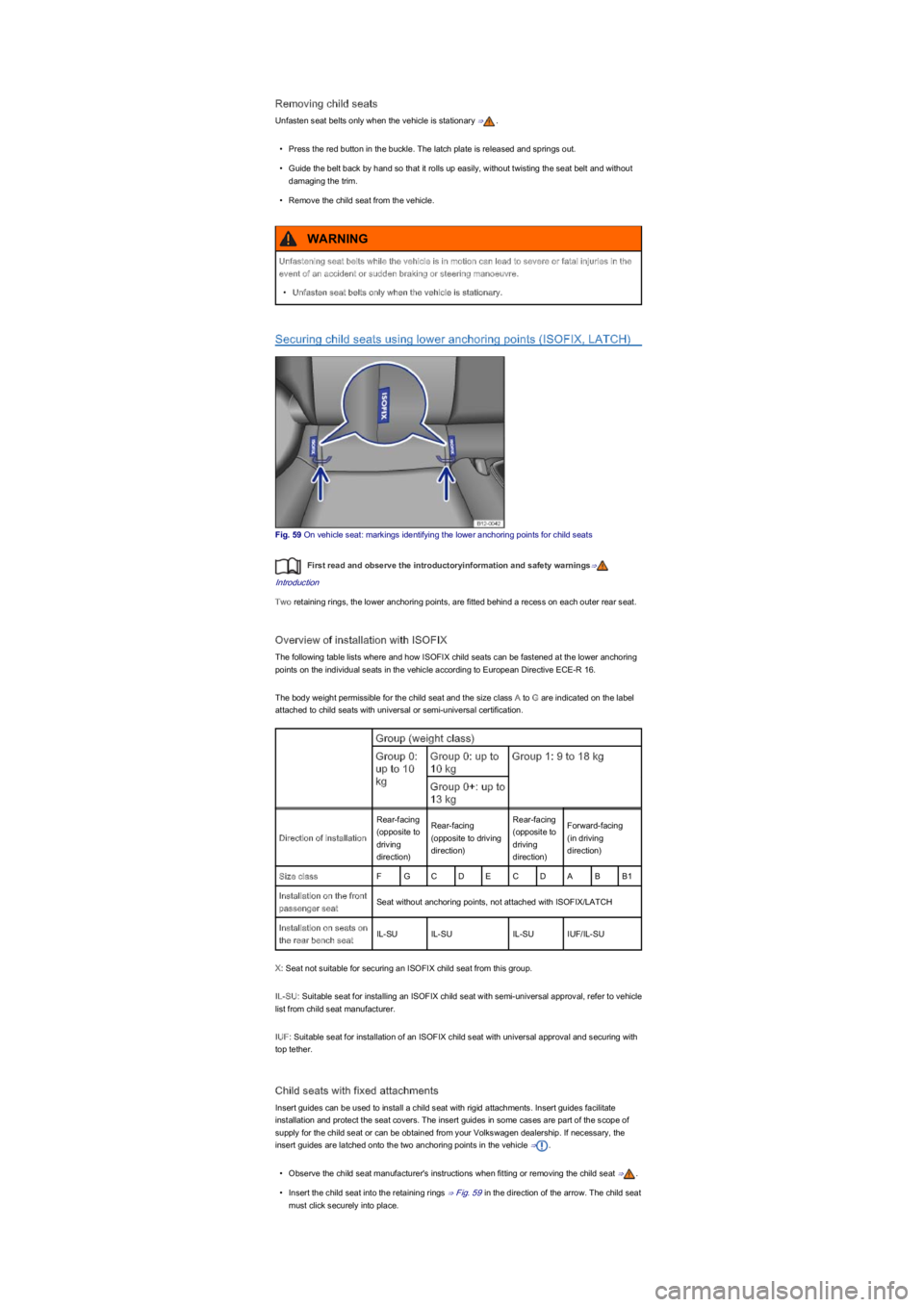
Removing child seats
Unfasten seat belts only when the vehicle is stationary ⇒.
•Press the red button in the buckle. The latch plate is released and springs out.
•Guide the belt back by hand so that it rolls up easily, without twisting the seat belt and without
damaging the trim.
•Remove the child seat from the vehicle.
Securing child seats using lower anchoring points (ISOFIX, LATCH)
Fig. 59 On vehicle seat: markings identifying the lower anchoring points for child seats
First read and observe the introductoryinformation and safety warnings⇒
Introduction
Two retaining rings, the lower anchoring points, are fitted behind a recess on each outer rear seat.
Overview of installation with ISOFIX
The following table lists where and how ISOFIX child seats can be fastened at the lower anchoring
points on the individual seats in the vehicle according to European Directive ECE-R 16.
The body weight permissible for the child seat and the size class A to G are indicated on the label
attached to child seats with universal or semi-universal certification.
Group (weight class)
Group 0:
up to 10
kg
Group 0: up to
10 kg
Group 1: 9 to 18 kg
Group 0+: up to
13 kg
Direction of installation
Rear-facing
(opposite to
driving
direction)
Rear-facing
(opposite to driving
direction)
Rear-facing
(opposite to
driving
direction)
Forward-facing
(in driving
direction)
Size classFGCDECDABB1
Installation on the front
passenger seatSeat without anchoring points, not attached with ISOFIX/LATCH
Installation on seats on
the rear bench seatIL-SUIL-SUIL-SUIUF/IL-SU
X: Seat not suitable for securing an ISOFIX child seat from this group.
IL-SU: Suitable seat for installing an ISOFIX child seat with semi-universal approval, refer to vehicle
list from child seat manufacturer.
IUF: Suitable seat for installation of an ISOFIX child seat with universal approval and securing with
top tether.
Child seats with fixed attachments
Insert guides can be used to install a child seat with rigid attachments. Insert guides facilitate
installation and protect the seat covers. The insert guides in some cases are part of the scope of
supply for the child seat or can be obtained from your Volkswagen dealership. If necessary, the
insert guides are latched onto the two anchoring points in the vehicle ⇒.
•Observe the child seat manufacturer's instructions when fitting or removing the child seat ⇒.
•Insert the child seat into the retaining rings ⇒ Fig. 59 in the direction of the arrow. The child seat
must click securely into place.
Unfastening seat belts while the vehicle is in motion can lead to severe or fatal injuries in the
event of an accident or sudden braking or steering manoeuvre.
•Unfasten seat belts only when the vehicle is stationary.
WARNING
Page 66 of 211
The windscreen wipers will only function when the ignition is switched on.
The interval wipe for the windscreen depends on the speed of the vehicle. The wipers will
wipe more frequently as the vehicle moves faster.
The rear window wiper is switched on automatically if the front windscreen wipers are
switched on and reverse gear is engaged.
Windscreen wiper functions
First read and observe the introductoryinformation and safety warnings⇒
Introduction
Windscreen wiper response in various situations:
When the vehicle is
stationary:
When switched on, the wipers will temporarily be switched to the next
setting down.
When the interval wipe is
switched on:
The wiper intervals are adjusted depending on the vehicle speed.
The faster the vehicle is travelling, the shorter the interval.
The wiper will try to wipe away any obstacles that are on the windscreen. The wiper will stop
moving if the obstacle blocks its path. Remove the obstacle and switch the wiper back on again.
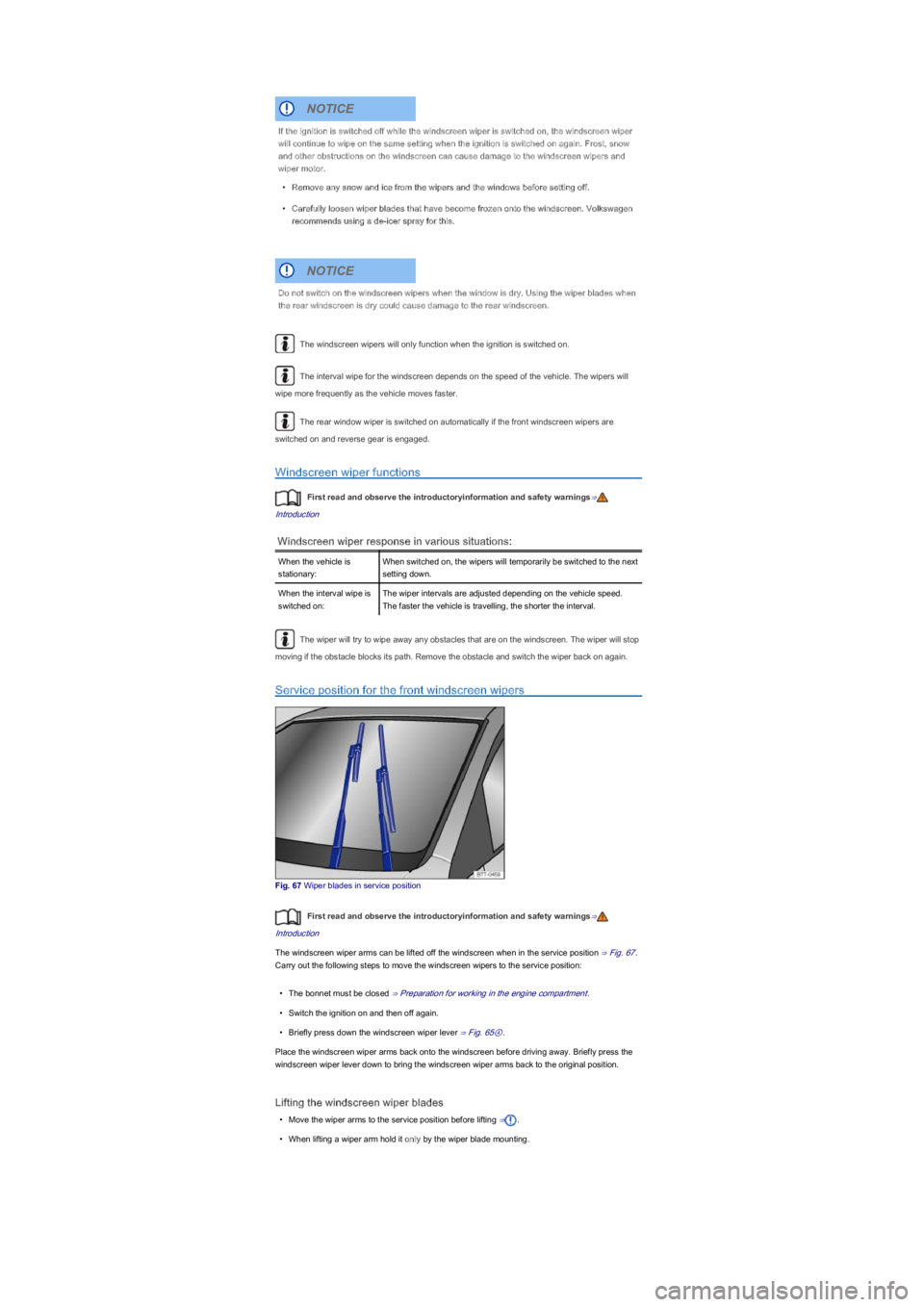
Service position for the front windscreen wipers
Fig. 67 Wiper blades in service position
First read and observe the introductoryinformation and safety warnings⇒
Introduction
The windscreen wiper arms can be lifted off the windscreen when in the service position ⇒ Fig. 67.
Carry out the following steps to move the windscreen wipers to the service position:
•The bonnet must be closed ⇒ Preparation for working in the engine compartment.
•Switch the ignition on and then off again.
•Briefly press down the windscreen wiper lever ⇒ Fig. 65④.
Place the windscreen wiper arms back onto the windscreen before driving away. Briefly press the
windscreen wiper lever down to bring the windscreen wiper arms back to the original position.
Lifting the windscreen wiper blades
•Move the wiper arms to the service position before lifting ⇒.
•When lifting a wiper arm hold it only by the wiper blade mounting.
If the ignition is switched off while the windscreen wiper is switched on, the windscreen wiper
will continue to wipe on the same setting when the ignition is switched on again. Frost, snow
and other obstructions on the windscreen can cause damage to the windscreen wipers and
wiper motor.
•Remove any snow and ice from the wipers and the windows before setting off.
•Carefully loosen wiper blades that have become frozen onto the windscreen. Volkswagen
recommends using a de-icer spray for this.
NOTICE
Do not switch on the windscreen wipers when the window is dry. Using the wiper blades when
the rear windscreen is dry could cause damage to the rear windscreen.
NOTICE
Page 68 of 211
allow the driver to see the entre side and rear area of the vehicle. The area that cannot be seen is
known as the blind spot. Objects and other road users may also be located in the blind spot.
Additional information and warnings:
•Exterior views ⇒ Exterior views
•Adjusting the seat position ⇒ Adjusting the seat position
•Changing gear ⇒ Changing gear
•Braking, stopping and parking ⇒ Braking, stopping and parking
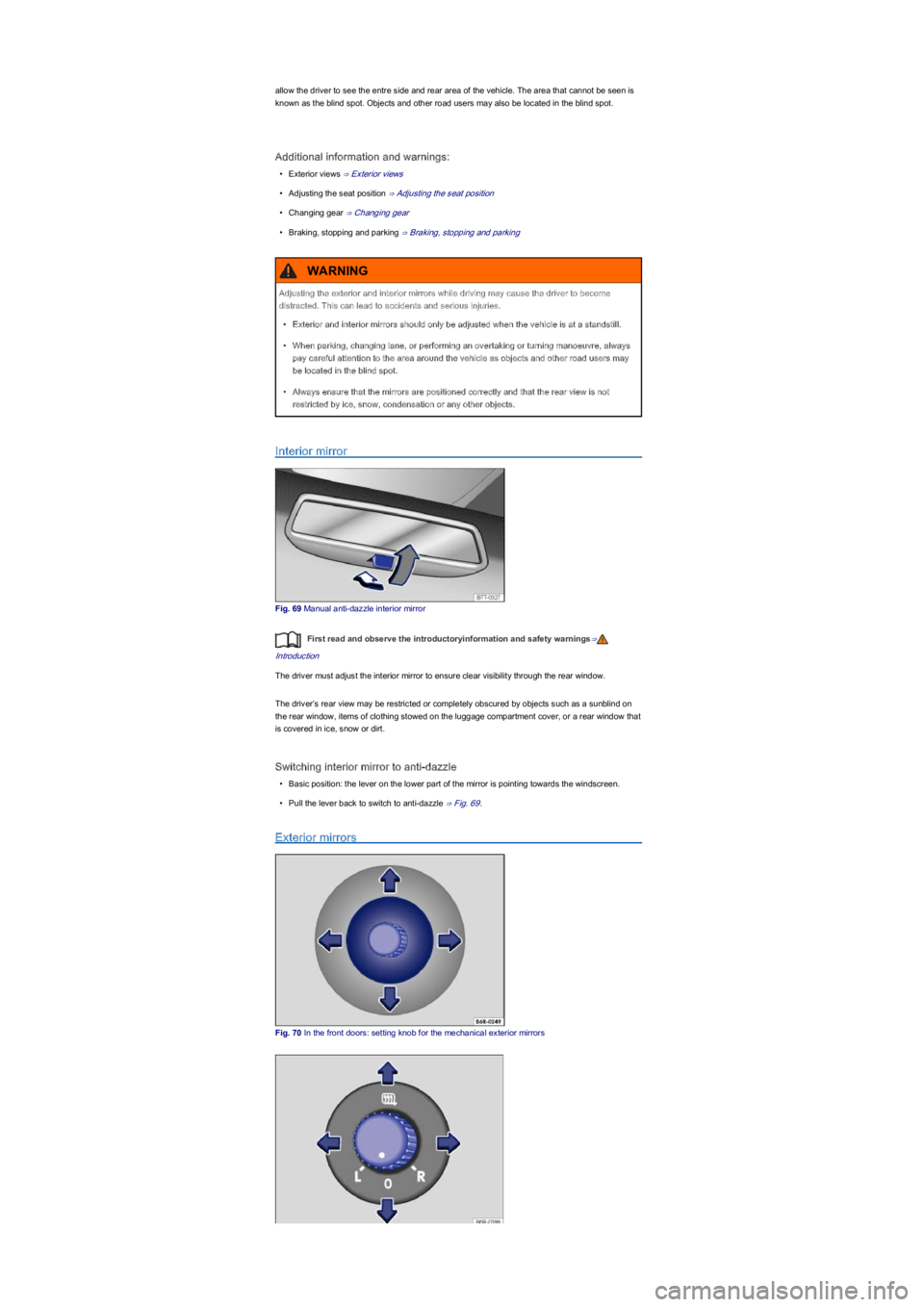
Interior mirror
Fig. 69 Manual anti-dazzle interior mirror
First read and observe the introductoryinformation and safety warnings⇒
Introduction
The driver must adjust the interior mirror to ensure clear visibility through the rear window.
The driver’s rear view may be restricted or completely obscured by objects such as a sunblind on
the rear window, items of clothing stowed on the luggage compartment cover, or a rear window that
is covered in ice, snow or dirt.
Switching interior mirror to anti-dazzle
•Basic position: the lever on the lower part of the mirror is pointing towards the windscreen.
•Pull the lever back to switch to anti-dazzle ⇒ Fig. 69.
Exterior mirrors
Fig. 70 In the front doors: setting knob for the mechanical exterior mirrors
Adjusting the exterior and interior mirrors while driving may cause the driver to become
distracted. This can lead to accidents and serious injuries.
•Exterior and interior mirrors should only be adjusted when the vehicle is at a standstill.
•When parking, changing lane, or performing an overtaking or turning manoeuvre, always
pay careful attention to the area around the vehicle as objects and other road users may
be located in the blind spot.
•Always ensure that the mirrors are positioned correctly and that the rear view is not
restricted by ice, snow, condensation or any other objects.
WARNING
Page 70 of 211
•Luggage compartment ⇒ Luggage compartment
•Roof carrier ⇒ Roof carrier
•Wheels and tyres ⇒ Wheels and tyres
Stowing items of luggage
First read and observe the introductoryinformation and safety warnings⇒
Introduction
Always stow all items of luggage in the vehicle securely.
•Always distribute any loads in the vehicle and on the roof as evenly as possible.
•Place heavy objects as far forward in the luggage compartment as possible. Position the rear
seat backrests securely in the upright position.
•Secure luggage in the luggage compartment to the fastening rings with suitable straps
⇒ Luggage compartment.
•Adjust the headlight range ⇒ Lights.
•Adjust the tyre pressure according to the vehicle load. Please read the tyre pressure sticker
⇒ Wheels and tyres.
Observe any information concerning the loading of a roof carrier ⇒ Roof carrier.
Driving with an open tailgate
First read and observe the introductoryinformation and safety warnings⇒
Introduction
Driving with an open tailgate is particularly dangerous. Ensure that the open tailgate and any
objects are secured properly, and take appropriate measures to reduce the quantity of toxic
exhaust fumes entering the vehicle.
Objects that are not secured, or are secured incorrectly, can cause serious injuries in the
event of a sudden driving or braking manoeuvre or accident. This applies particularly if
objects are struck by the airbag when activated and then flung through the vehicle interior.
Please apply the following rules to reduce the risk of accidents:
•Always stow all objects in the vehicle securely. Always stow luggage and heavy objects in
the luggage compartment.
•Always use suitable straps to prevent luggage from entering the deployment zones of the
side airbag or the front airbag in the event of a sudden driving or braking manoeuvre or an
accident.
•Objects should be stowed in the vehicle interior in such a way that they can never enter
the airbag deployment zones while the vehicle is in motion.
•Always keep stowage compartments closed while the vehicle is in motion.
•All objects must be removed from the seat cushion of the front passenger seat if the front
passenger backrest is folded forward. Even light and small objects could be pressed into
the weight detection mat underneath the seat cushion by the backrest when it is folded
forwards and thus send incorrect information to the airbag control units.
•The front airbag must be switched off and the indicator lamp PASSENGER AIR BAG OFF
must light up for as long as the front passenger seat backrest is folded forwards.
•Stowed objects must never cause passengers to assume an incorrect sitting position.
•Any seat blocked by stowed objects must not be used by any passengers.
WARNING
The vehicle handling and braking effect may alter significantly if large or heavy objects are
being transported.
•Adapt your speed and driving style to suit visibility, weather, road and traffic conditions.
•Accelerate carefully and gently.
•Avoid sudden braking and driving manoeuvres.
•Brake earlier than in normal driving.
WARNING
Hard objects on the shelf can chafe against the wires of the heating element in the rear
window and cause damage.
NOTICE
Page 73 of 211
The ventilation openings between the rear window and the luggage compartment cover must
not be covered as this would prevent stale air escaping from the vehicle.
Folding the backrests on the rear bench seat forwards and backwards
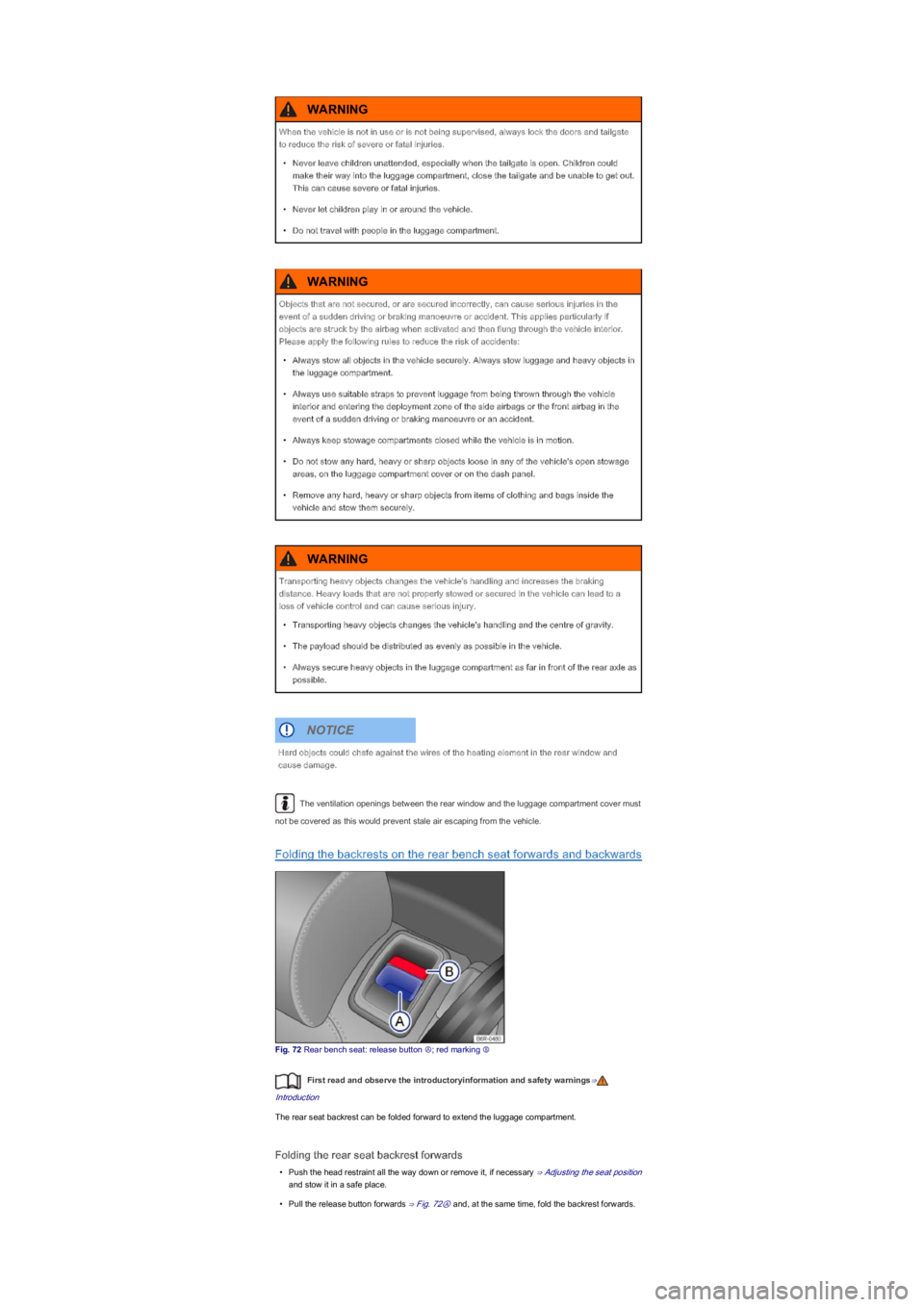
Fig. 72 Rear bench seat: release button Ⓐ; red marking Ⓑ
First read and observe the introductoryinformation and safety warnings⇒
Introduction
The rear seat backrest can be folded forward to extend the luggage compartment.
Folding the rear seat backrest forwards
•Push the head restraint all the way down or remove it, if necessary ⇒ Adjusting the seat position
and stow it in a safe place.
•Pull the release button forwards ⇒ Fig. 72Ⓐ and, at the same time, fold the backrest forwards.
When the vehicle is not in use or is not being supervised, always lock the doors and tailgate
to reduce the risk of severe or fatal injuries.
•Never leave children unattended, especially when the tailgate is open. Children could
make their way into the luggage compartment, close the tailgate and be unable to get out.
This can cause severe or fatal injuries.
•Never let children play in or around the vehicle.
•Do not travel with people in the luggage compartment.
WARNING
Objects that are not secured, or are secured incorrectly, can cause serious injuries in the
event of a sudden driving or braking manoeuvre or accident. This applies particularly if
objects are struck by the airbag when activated and then flung through the vehicle interior.
Please apply the following rules to reduce the risk of accidents:
•Always stow all objects in the vehicle securely. Always stow luggage and heavy objects in
the luggage compartment.
•Always use suitable straps to prevent luggage from being thrown through the vehicle
interior and entering the deployment zone of the side airbags or the front airbag in the
event of a sudden driving or braking manoeuvre or an accident.
•Always keep stowage compartments closed while the vehicle is in motion.
•Do not stow any hard, heavy or sharp objects loose in any of the vehicle's open stowage
areas, on the luggage compartment cover or on the dash panel.
•Remove any hard, heavy or sharp objects from items of clothing and bags inside the
vehicle and stow them securely.
WARNING
Transporting heavy objects changes the vehicle's handling and increases the braking
distance. Heavy loads that are not properly stowed or secured in the vehicle can lead to a
loss of vehicle control and can cause serious injury.
•Transporting heavy objects changes the vehicle's handling and the centre of gravity.
•The payload should be distributed as evenly as possible in the vehicle.
•Always secure heavy objects in the luggage compartment as far in front of the rear axle as
possible.
WARNING
Hard objects could chafe against the wires of the heating element in the rear window and
cause damage.
NOTICE
Page 74 of 211
•The rear seat backrest is unlocked when you can see a red marking in the button ⇒ Fig. 72Ⓑ.
•Passengers (adults and children) must not use seats if the backrest is folded forwards.
Folding the rear seat backrest backwards
•Fold back the rear backrest and push it firmly into the lock until it clicks securely into place ⇒
.
•The red marking on the release button ⇒ Fig. 72Ⓑ should no longer be visible.
•The rear seat backrest must always be securely engaged.
•If necessary, fit the head restraints and adjust to the correct position ⇒ Sitting correctly and
safely.
Luggage compartment cover
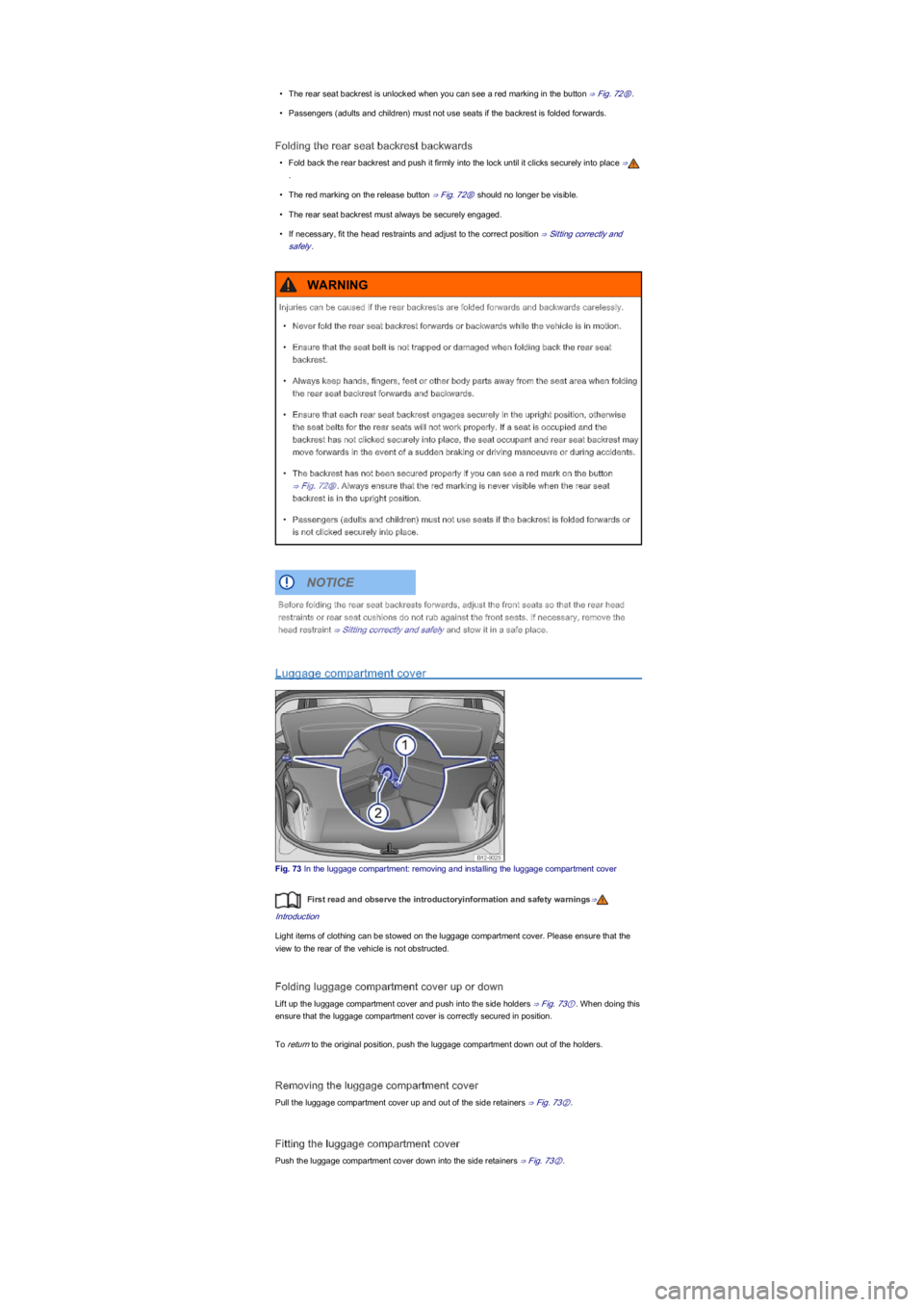
Fig. 73 In the luggage compartment: removing and installing the luggage compartment cover
First read and observe the introductoryinformation and safety warnings⇒
Introduction
Light items of clothing can be stowed on the luggage compartment cover. Please ensure that the
view to the rear of the vehicle is not obstructed.
Folding luggage compartment cover up or down
Lift up the luggage compartment cover and push into the side holders ⇒ Fig. 73①. When doing this
ensure that the luggage compartment cover is correctly secured in position.
To return to the original position, push the luggage compartment down out of the holders.
Removing the luggage compartment cover
Pull the luggage compartment cover up and out of the side retainers ⇒ Fig. 73②.
Fitting the luggage compartment cover
Push the luggage compartment cover down into the side retainers ⇒ Fig. 73②.
Injuries can be caused if the rear backrests are folded forwards and backwards carelessly.
•Never fold the rear seat backrest forwards or backwards while the vehicle is in motion.
•Ensure that the seat belt is not trapped or damaged when folding back the rear seat
backrest.
•Always keep hands, fingers, feet or other body parts away from the seat area when folding
the rear seat backrest forwards and backwards.
•Ensure that each rear seat backrest engages securely in the upright position, otherwise
the seat belts for the rear seats will not work properly. If a seat is occupied and the
backrest has not clicked securely into place, the seat occupant and rear seat backrest may
move forwards in the event of a sudden braking or driving manoeuvre or during accidents.
•The backrest has not been secured properly if you can see a red mark on the button
⇒ Fig. 72Ⓑ. Always ensure that the red marking is never visible when the rear seat
backrest is in the upright position.
•Passengers (adults and children) must not use seats if the backrest is folded forwards or
is not clicked securely into place.
WARNING
Before folding the rear seat backrests forwards, adjust the front seats so that the rear head
restraints or rear seat cushions do not rub against the front seats. If necessary, remove the
head restraint ⇒ Sitting correctly and safely and stow it in a safe place.
NOTICE