air condition VOLKSWAGEN UP! 2021 Owner´s Manual
[x] Cancel search | Manufacturer: VOLKSWAGEN, Model Year: 2021, Model line: UP!, Model: VOLKSWAGEN UP! 2021Pages: 211, PDF Size: 5.98 MB
Page 142 of 211
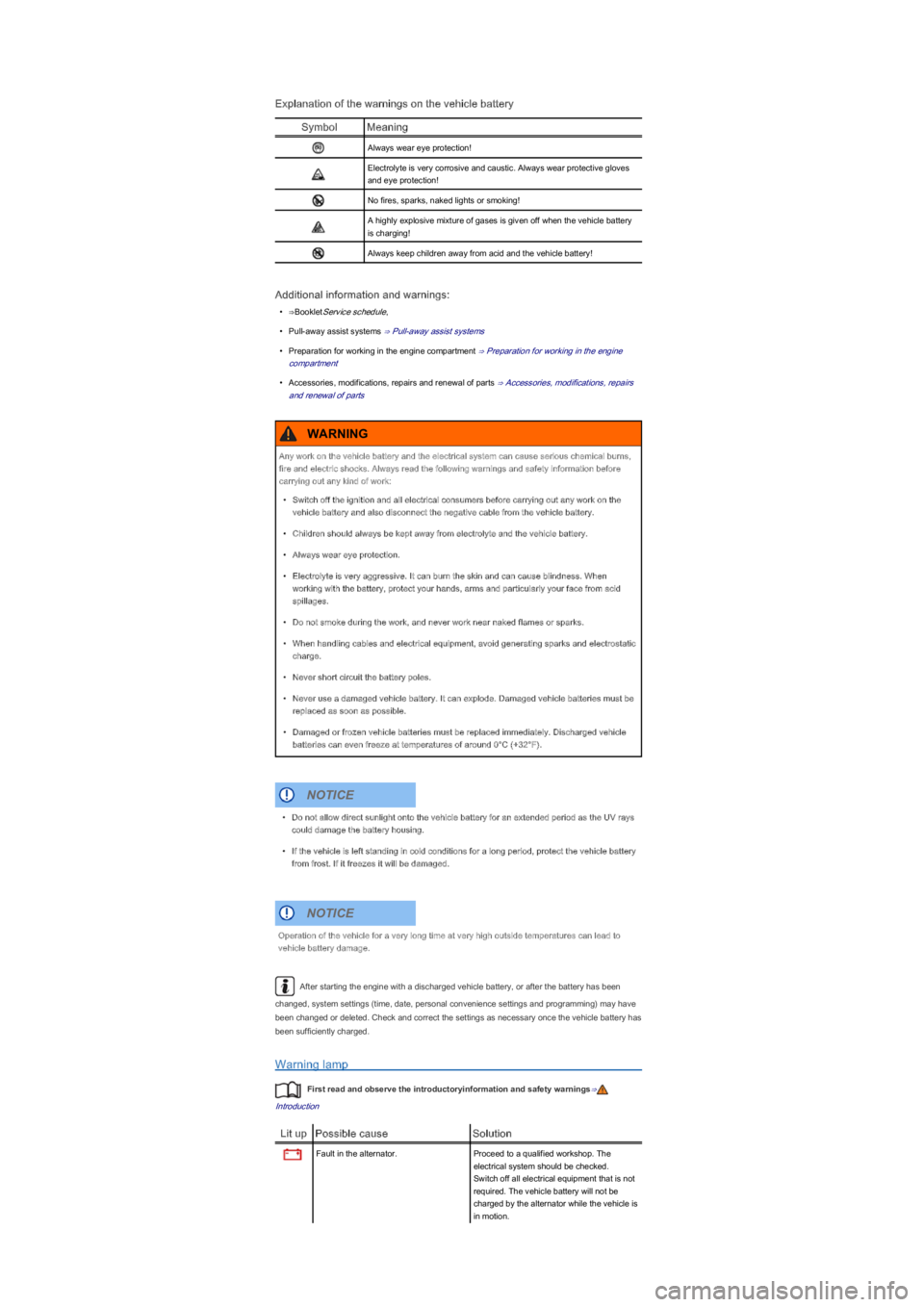
Explanation of the warnings on the vehicle battery
SymbolMeaning
Always wear eye protection!
Electrolyte is very corrosive and caustic. Always wear protective gloves
and eye protection!
No fires, sparks, naked lights or smoking!
A highly explosive mixture of gases is given off when the vehicle battery
is charging!
Always keep children away from acid and the vehicle battery!
Additional information and warnings:
•⇒BookletService schedule,
•Pull-away assist systems ⇒ Pull-away assist systems
•Preparation for working in the engine compartment ⇒ Preparation for working in the engine
compartment
•Accessories, modifications, repairs and renewal of parts ⇒ Accessories, modifications, repairs
and renewal of parts
After starting the engine with a discharged vehicle battery, or after the battery has been
changed, system settings (time, date, personal convenience settings and programming) may have
been changed or deleted. Check and correct the settings as necessary once the vehicle battery has
been sufficiently charged.
Warning lamp
First read and observe the introductoryinformation and safety warnings⇒
Introduction
Lit upPossible causeSolution
Fault in the alternator.Proceed to a qualified workshop. The
electrical system should be checked.
Switch off all electrical equipment that is not
required. The vehicle battery will not be
charged by the alternator while the vehicle is
in motion.
Any work on the vehicle battery and the electrical system can cause serious chemical burns,
fire and electric shocks. Always read the following warnings and safety information before
carrying out any kind of work:
•Switch off the ignition and all electrical consumers before carrying out any work on the
vehicle battery and also disconnect the negative cable from the vehicle battery.
•Children should always be kept away from electrolyte and the vehicle battery.
•Always wear eye protection.
•Electrolyte is very aggressive. It can burn the skin and can cause blindness. When
working with the battery, protect your hands, arms and particularly your face from acid
spillages.
•Do not smoke during the work, and never work near naked flames or sparks.
•When handling cables and electrical equipment, avoid generating sparks and electrostatic
charge.
•Never short circuit the battery poles.
•Never use a damaged vehicle battery. It can explode. Damaged vehicle batteries must be
replaced as soon as possible.
•Damaged or frozen vehicle batteries must be replaced immediately. Discharged vehicle
batteries can even freeze at temperatures of around 0°C (+32°F).
WARNING
•Do not allow direct sunlight onto the vehicle battery for an extended period as the UV rays
could damage the battery housing.
•If the vehicle is left standing in cold conditions for a long period, protect the vehicle battery
from frost. If it freezes it will be damaged.
NOTICE
Operation of the vehicle for a very long time at very high outside temperatures can lead to
vehicle battery damage.
NOTICE
Page 152 of 211
recommends that the protective coating on the underside of the vehicle and on the running gear
should be checked regularly and repaired if necessary.
Cleaning the engine compartment
First read and observe the introductoryinformation and safety warnings⇒
Introduction
The engine compartment of any motor vehicle is a hazardous area ⇒ Preparation for working in the
engine compartment.
The engine compartment should be cleaned by a qualified workshop. An incorrect cleaning
procedure could possibly remove corrosion protection and damage electrical components.
Furthermore, water could enter the vehicle interior directly via the plenum chamber ⇒.
If the engine compartment is very dirty, we recommend that you always proceed to a qualified
workshop to have it cleaned by a professional mechanic. Volkswagen recommends using a
Volkswagen dealership for this purpose.
Plenum chamber
The plenum chamber is located in the engine compartment between the windscreen and the engine
and has a perforated cover. Air from outside is drawn in from the plenum chamber and is passed
into the vehicle interior via the heating and air conditioning system.
Leaves and other loose objects must be removed from the cover of the plenum chamber at regular
intervals using a vacuum cleaner or by hand.
In the interests of environmental protection, the engine compartment should be washed only
in specially provided wash bays. This prevents toxic waste water containing oil, grease and fuel
from entering the sewerage system. In some districts, washing the engine compartment anywhere
else may be prohibited.
Cleaning and caring for the interior
Introduction
This chapter contains information on the followingsubjects:
⇒ Seat covers
⇒ Cleaning cloth seat covers, fabric trim and Alcantara upholstery
⇒ Cleaning and caring for natural leather covers
⇒ Cleaning leatherette upholstery
⇒ Cleaning stowage compartments, drink holders and ash trays
⇒ Cleaning and caring for the dash panel, wooden trims and plastic parts
⇒ Cleaning seat belts
Modern fabrics, such as dark denim, are often not colourfast. Light-coloured upholstery (soft
materials or leather) is particularly sensitive to staining caused by these fabrics, even if you are
careful. This is not caused by a fault in the upholstery, but by the non-colourfast nature of the
garments.
Leaving stains, dirt and other deposits on the surface of vehicle components and cloth seat covers
for a long time can make it difficult to clean and treat them. Stains, dirt and deposits may become
impossible to remove, particularly if left for a long time.
Additional information and warnings:
•Cleaning and caring for the vehicle exterior ⇒ Caring for and cleaning the vehicle exterior
Underseal and anti-corrosion coatings can ignite on the hot exhaust system or on other hot
engine parts.
•Never apply underseal or anti-corrosion coatings to the exhaust pipes, catalytic converter,
heat shields or other vehicle components that become hot.
CAUTION
All work in the engine compartment carries the risk of injury, scalding, accidents and fire.
•Before carrying out any work ensure that you are familiar with the requisite procedures
and general safety regulations ⇒ Preparation for working in the engine compartment.
•Volkswagen recommends having the work carried out by a qualified workshop.
WARNING
Water that has entered the plenum chamber via a manual process (e.g. from a high-pressure
cleaner) can cause considerable damage to the vehicle.
NOTICE
Page 157 of 211
Cleaning and caring for the dash panel, wooden trims and plastic
parts
First read and observe the introductoryinformation and safety warnings⇒
Introduction
•Moisten a clean, lint-free cloth with water and clean the parts.
•Treat plastic parts (inside and outside the vehicle) and the dash panel with a special solvent-
free plastic cleaning and care product that has been approved by Volkswagen ⇒.
•Treat wooden trims with a mild soap solution.
•Clean the mount for the portable navigation device using a dry cloth only.
Cleaning seat belts
First read and observe the introductoryinformation and safety warnings⇒
Introduction
Large particles of dirt on the automatic belt prevent it from rolling back properly and thus from
working effectively.
The seat belts must never be removed for cleaning purposes.
•Remove dirt with a soft brush ⇒.
•Carefully pull the dirty seat belt right out and leave it out.
•Clean the seat belt with a mild soap solution.
•Allow the seat belt fabric to dry completely.
•Do not allow the seat belt to roll up until it has dried completely.
Wheels and tyres
Introduction
This chapter contains information on the followingsubjects:
⇒ Handling wheels and tyres
⇒ Rims
⇒ New wheels and tyres
⇒ Tyre pressure
⇒ Tread depth and wear indicators
⇒ Tyre damage
⇒ Spare wheel or temporary spare wheel
⇒ Tyre lettering
⇒ Winter tyres
⇒ Snow chains
Volkswagen recommends that work on tyres and wheels is carried out by a qualified workshop.
They are familiar with the procedure and have the necessary special tools and spare parts and the
Cleaning agents that contain solvents cause the surface of the airbag modules to become
porous. In an accident that triggers the airbag, loose plastic parts can cause serious injury.
•Never clean the dash panel or the airbag covers with cleansers that contain solvents.
WARNING
When cleaning the dash panel, ensure that the contacts for the portable navigation device do
not become wet as this could cause damage to the electrical system.
NOTICE
Check the condition of all seat belts regularly. If the belt webbing or any other part of the seat
belt becomes damaged have it removed and replaced immediately by a qualified workshop.
Damaged seat belts are very dangerous and can cause severe or fatal injuries.
•Never use chemical cleaning agents on the seat belts or their components. Furthermore
the seat belts may not come into contact with corrosive fluids, solvents or sharp objects.
These could considerably weaken the webbing.
•After cleaning, allow seat belts to dry completely before rolling them up. Otherwise the
automatic belt retractors could become damaged and thus impair their function.
•Never let any foreign bodies or liquids enter the slot for the seat belt buckle. This could
prevent the belt buckle and seat belt from working properly.
•Never try to repair, modify or remove the seat belts yourself.
•Damaged seat belts must be replaced immediately with seat belts approved by
Volkswagen for your vehicle type. Seat belts subjected to stress and stretched during an
accident must be replaced by a qualified workshop. Renewal may be necessary even if
there is no apparent damage. The belt anchorage should also be checked.
WARNING
Page 159 of 211
The tyres and wheel rims are an essential part of the vehicle's design. The tyres and rims approved
by Volkswagen are specifically matched to the characteristics of the vehicle and make a major
contribution to good road holding and safe handling.
Avoiding damage to the tyres
•If you have to drive over a kerb or similar obstacle, drive slowly and at a right angle if possible.
•Inspect the tyres regularly for damage such as cuts, cracks or blisters.
•Remove foreign objects that are in the outer tyre tread and have not penetrated the inner
tyre⇒ Tyre damage.
•Always respond to any warning messages given by the tyre monitoring system.
•Damaged or worn tyres must be replaced immediately ⇒ Tyre damage.
•Regularly check the tyres for hidden damage ⇒ Tyre damage.
•Never exceed the top speed and load permitted for the tyres that are fitted ⇒ Tyre lettering.
•Protect the wheels, including the spare wheel, from contact with corrosive substances, including
oils, lubricants, fuel and brake fluid ⇒.
•Replace missing dust caps immediately.
Tyres with directional tread pattern
Tyres with directional tread pattern have been developed to roll in one direction only. An arrow on
the tyre sidewall indicates the direction of rotation on tyres with directional tread ⇒ Tyre lettering.
The direction of rotation must be adhered to. This is the only guarantee for optimum grip and helps
to avoid aquaplaning, excessive noise and wear.
If, however, the tyre is fitted in the opposite direction to the tread pattern, you must take more care
when driving as the tyre is now no longer being used according to its designation. This is
particularly important on wet roads. The tyres must be replaced as quickly as possible or be fitted
with the tread in the correct direction.
Rotating wheels front to rear
Regularly rotating the wheels as shown in the illustration ⇒ Fig. 130 is recommended to help
ensure that tyres wear evenly. All the tyres will then last for about the same time.
Volkswagen recommends having the wheels changed by a qualified workshop.
Tyres that are older than 6 years
Tyres age through physical and chemical processes that can impair their function. Tyres that are
stored unused for an extended period will harden and become brittle more quickly than tyres which
are in constant use.
Volkswagen recommends replacing tyres that are older than 6 years with new tyres. This also
applies to tyres, including the spare wheel, which appear to still be in good condition and whose
tread depth has not yet reached the minimum value stipulated by legislation ⇒.
The age of a tyre can be determined from the manufacturing date, which is a component of the tyre
identification number () ⇒ Tyre lettering.
Storing tyres
Mark tyres before you remove them to indicate the direction of rotation. This ensures you will be
able to mount them correctly when you replace them (left, right, front, rear). When removed, the
wheels or tyres should be stored in a cool, dry and preferably dark place. Do not store tyres
mounted on the rim vertically.
Any tyres not fitted on rims should be kept in suitable sleeves to protect against dirt and should be
stored vertically (standing on the tread).
Old tyres should be disposed of as required by legislation.
Corrosive liquids and other substances can cause visible and invisible damage to the tyres,
which can cause the tyre to burst.
•Always keep chemicals, oils, lubricants, fuel, brake fluid and other corrosive substances
away from the tyres.
WARNING
Old tyres – even if they have not been used – can suddenly lose pressure or burst, especially
at high speeds, and thus cause accidents and serious injuries.
•Avoid using tyres that are more than six years old. If you have no alternative, drive slowly
and with extra care at all times.
WARNING
Page 166 of 211
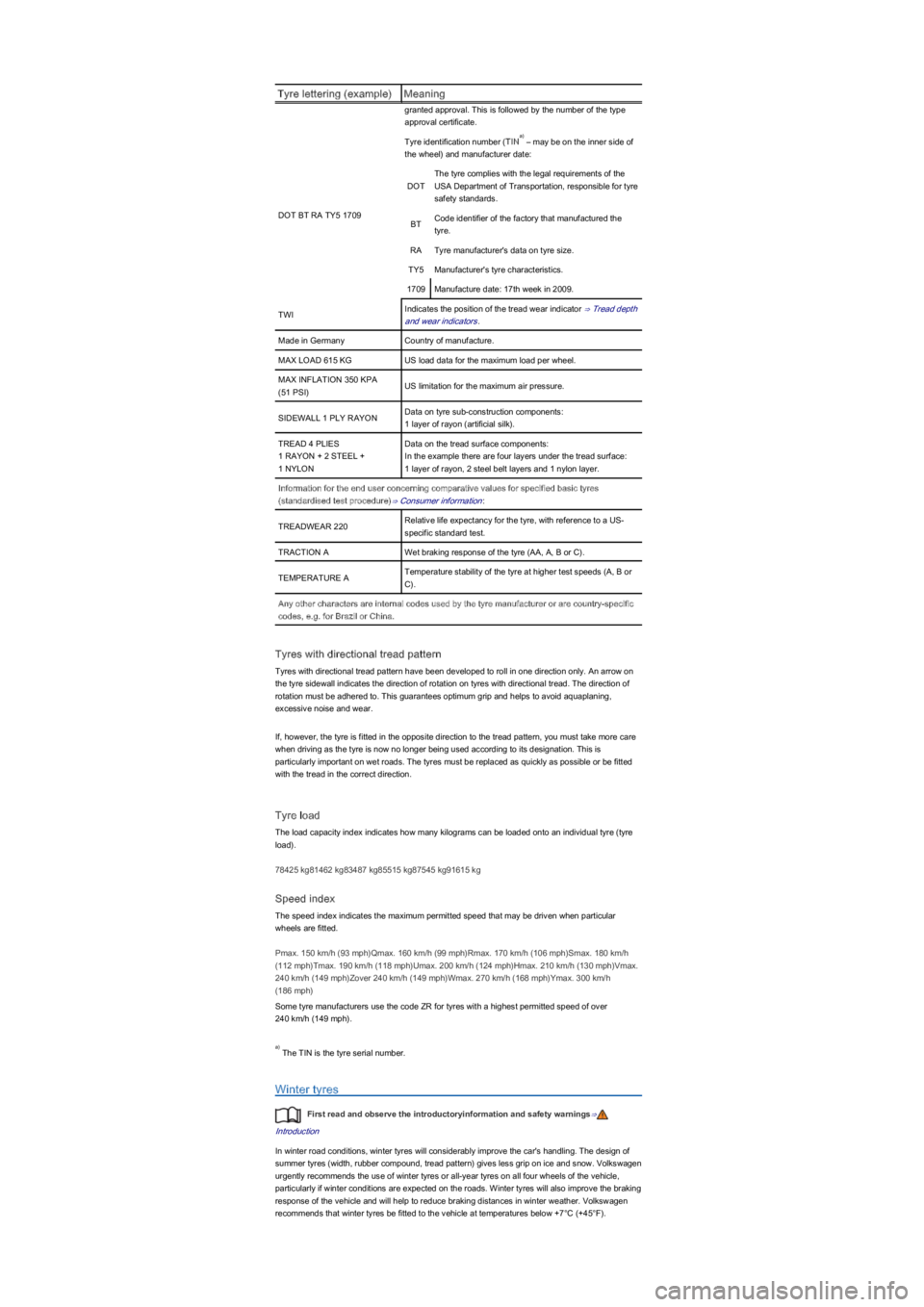
Tyre lettering (example)Meaning
granted approval. This is followed by the number of the type
approval certificate.
DOT BT RA TY5 1709
Tyre identification number (TIN – may be on the inner side of
the wheel) and manufacturer date:
DOT
The tyre complies with the legal requirements of the
USA Department of Transportation, responsible for tyre
safety standards.
BTCode identifier of the factory that manufactured the
tyre.
RATyre manufacturer's data on tyre size.
TY5Manufacturer's tyre characteristics.
1709Manufacture date: 17th week in 2009.
TWIIndicates the position of the tread wear indicator ⇒ Tread depth
and wear indicators.
Made in GermanyCountry of manufacture.
MAX LOAD 615 KGUS load data for the maximum load per wheel.
MAX INFLATION 350 KPA
(51 PSI)US limitation for the maximum air pressure.
SIDEWALL 1 PLY RAYONData on tyre sub-construction components:
1 layer of rayon (artificial silk).
TREAD 4 PLIES
1 RAYON + 2 STEEL +
1 NYLON
Data on the tread surface components:
In the example there are four layers under the tread surface:
1 layer of rayon, 2 steel belt layers and 1 nylon layer.
Information for the end user concerning comparative values for specified basic tyres
(standardised test procedure)⇒ Consumer information:
TREADWEAR 220Relative life expectancy for the tyre, with reference to a US-
specific standard test.
TRACTION AWet braking response of the tyre (AA, A, B or C).
TEMPERATURE ATemperature stability of the tyre at higher test speeds (A, B or
C).
Any other characters are internal codes used by the tyre manufacturer or are country-specific
codes, e.g. for Brazil or China.
Tyres with directional tread pattern
Tyres with directional tread pattern have been developed to roll in one direction only. An arrow on
the tyre sidewall indicates the direction of rotation on tyres with directional tread. The direction of
rotation must be adhered to. This guarantees optimum grip and helps to avoid aquaplaning,
excessive noise and wear.
If, however, the tyre is fitted in the opposite direction to the tread pattern, you must take more care
when driving as the tyre is now no longer being used according to its designation. This is
particularly important on wet roads. The tyres must be replaced as quickly as possible or be fitted
with the tread in the correct direction.
Tyre load
The load capacity index indicates how many kilograms can be loaded onto an individual tyre (tyre
load).
78425 kg81462 kg83487 kg85515 kg87545 kg91615 kg
Speed index
The speed index indicates the maximum permitted speed that may be driven when particular
wheels are fitted.
Pmax. 150 km/h (93 mph)Qmax. 160 km/h (99 mph)Rmax. 170 km/h (106 mph)Smax. 180 km/h
(112 mph)Tmax. 190 km/h (118 mph)Umax. 200 km/h (124 mph)Hmax. 210 km/h (130 mph)Vmax.
240 km/h (149 mph)Zover 240 km/h (149 mph)Wmax. 270 km/h (168 mph)Ymax. 300 km/h
(186 mph)
Some tyre manufacturers use the code ZR for tyres with a highest permitted speed of over
240 km/h (149 mph).
The TIN is the tyre serial number.
Winter tyres
First read and observe the introductoryinformation and safety warnings⇒
Introduction
In winter road conditions, winter tyres will considerably improve the car's handling. The design of
summer tyres (width, rubber compound, tread pattern) gives less grip on ice and snow. Volkswagen
urgently recommends the use of winter tyres or all-year tyres on all four wheels of the vehicle,
particularly if winter conditions are expected on the roads. Winter tyres will also improve the braking
response of the vehicle and will help to reduce braking distances in winter weather. Volkswagen
recommends that winter tyres be fitted to the vehicle at temperatures below +7°C (+45°F).
a)
a)
Page 172 of 211
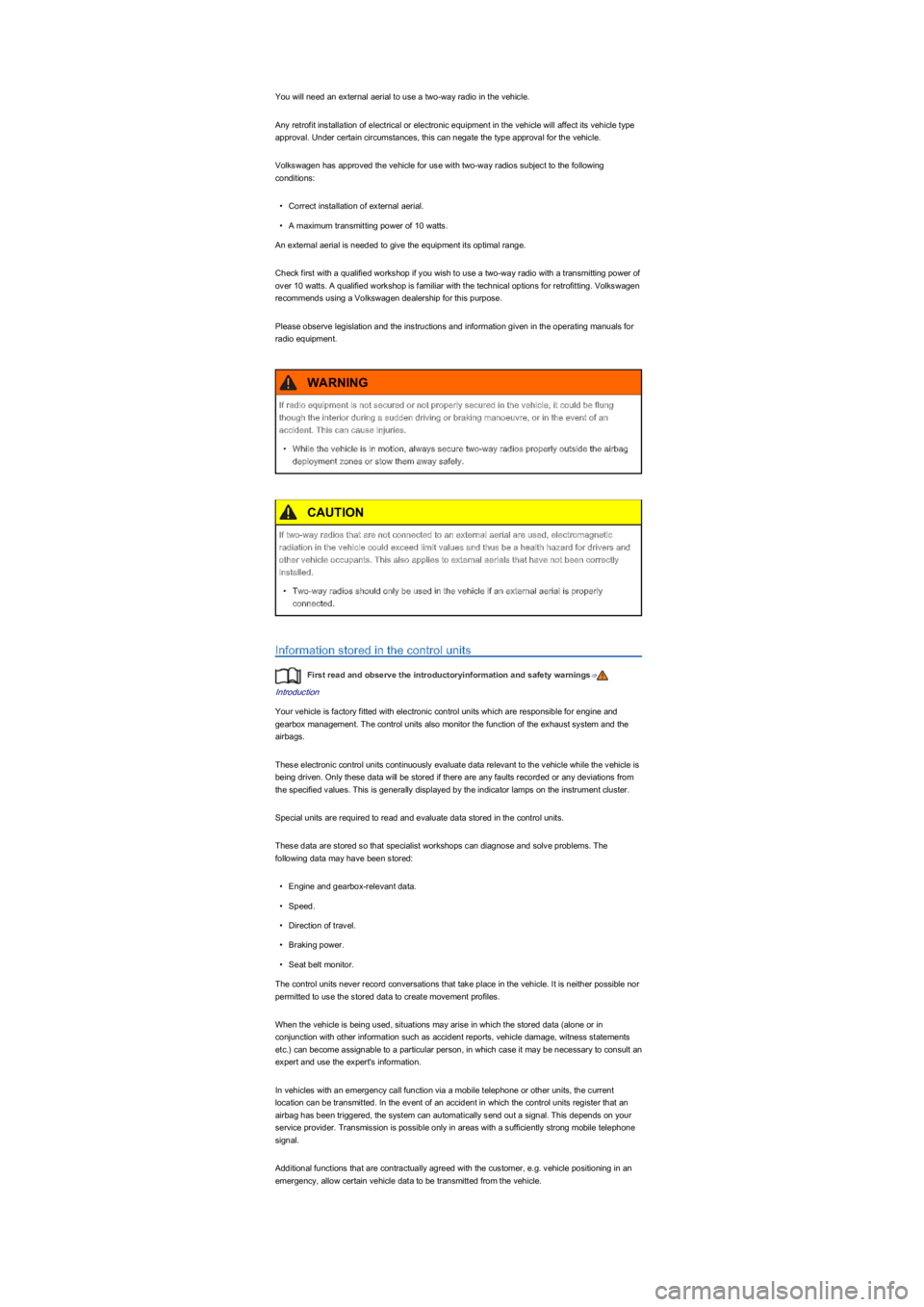
You will need an external aerial to use a two-way radio in the vehicle.
Any retrofit installation of electrical or electronic equipment in the vehicle will affect its vehicle type
approval. Under certain circumstances, this can negate the type approval for the vehicle.
Volkswagen has approved the vehicle for use with two-way radios subject to the following
conditions:
•Correct installation of external aerial.
•A maximum transmitting power of 10 watts.
An external aerial is needed to give the equipment its optimal range.
Check first with a qualified workshop if you wish to use a two-way radio with a transmitting power of
over 10 watts. A qualified workshop is familiar with the technical options for retrofitting. Volkswagen
recommends using a Volkswagen dealership for this purpose.
Please observe legislation and the instructions and information given in the operating manuals for
radio equipment.
Information stored in the control units
First read and observe the introductoryinformation and safety warnings⇒
Introduction
Your vehicle is factory fitted with electronic control units which are responsible for engine and
gearbox management. The control units also monitor the function of the exhaust system and the
airbags.
These electronic control units continuously evaluate data relevant to the vehicle while the vehicle is
being driven. Only these data will be stored if there are any faults recorded or any deviations from
the specified values. This is generally displayed by the indicator lamps on the instrument cluster.
Special units are required to read and evaluate data stored in the control units.
These data are stored so that specialist workshops can diagnose and solve problems. The
following data may have been stored:
•Engine and gearbox-relevant data.
•Speed.
•Direction of travel.
•Braking power.
•Seat belt monitor.
The control units never record conversations that take place in the vehicle. It is neither possible nor
permitted to use the stored data to create movement profiles.
When the vehicle is being used, situations may arise in which the stored data (alone or in
conjunction with other information such as accident reports, vehicle damage, witness statements
etc.) can become assignable to a particular person, in which case it may be necessary to consult an
expert and use the expert's information.
In vehicles with an emergency call function via a mobile telephone or other units, the current
location can be transmitted. In the event of an accident in which the control units register that an
airbag has been triggered, the system can automatically send out a signal. This depends on your
service provider. Transmission is possible only in areas with a sufficiently strong mobile telephone
signal.
Additional functions that are contractually agreed with the customer, e.g. vehicle positioning in an
emergency, allow certain vehicle data to be transmitted from the vehicle.
If radio equipment is not secured or not properly secured in the vehicle, it could be flung
though the interior during a sudden driving or braking manoeuvre, or in the event of an
accident. This can cause injuries.
•While the vehicle is in motion, always secure two-way radios properly outside the airbag
deployment zones or stow them away safely.
WARNING
If two-way radios that are not connected to an external aerial are used, electromagnetic
radiation in the vehicle could exceed limit values and thus be a health hazard for drivers and
other vehicle occupants. This also applies to external aerials that have not been correctly
installed.
•Two-way radios should only be used in the vehicle if an external aerial is properly
connected.
CAUTION
Page 180 of 211
⇒ Catalytic converter
Additional information and warnings:
•Changing gear ⇒ Changing gear
•Filling the tank ⇒ Filling the tank
•Fuel ⇒ Fuel
•Engine oil ⇒ Engine oil
•Battery ⇒ Vehicle battery
•Information stored in the control units ⇒ Accessories, modifications, repairs and renewal of parts
•Tow-starting and towing ⇒ Tow-starting and towing
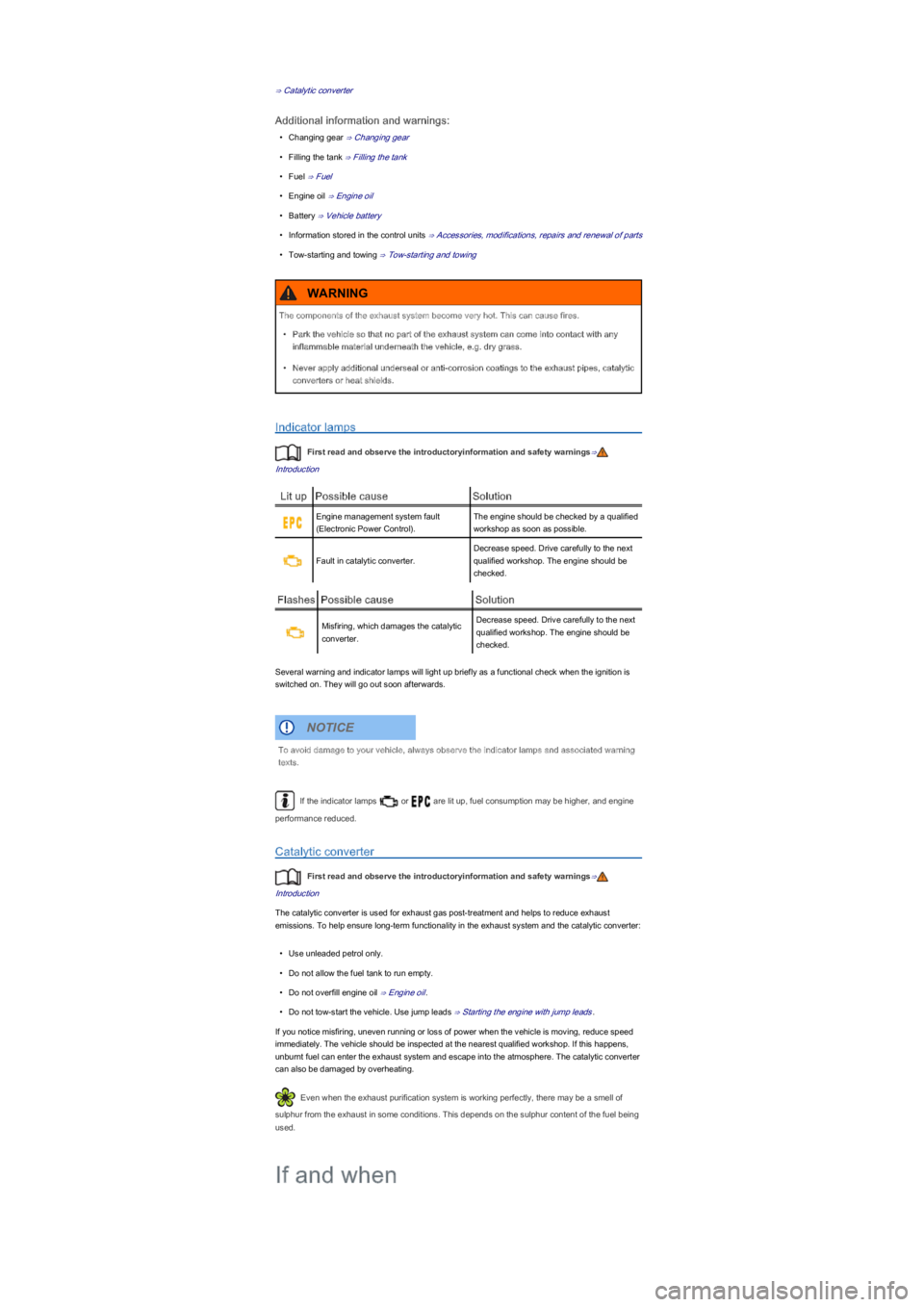
Indicator lamps
First read and observe the introductoryinformation and safety warnings⇒
Introduction
Lit upPossible causeSolution
Engine management system fault
(Electronic Power Control).
The engine should be checked by a qualified
workshop as soon as possible.
Fault in catalytic converter.
Decrease speed. Drive carefully to the next
qualified workshop. The engine should be
checked.
FlashesPossible causeSolution
Misfiring, which damages the catalytic
converter.
Decrease speed. Drive carefully to the next
qualified workshop. The engine should be
checked.
Several warning and indicator lamps will light up briefly as a functional check when the ignition is
switched on. They will go out soon afterwards.
If the indicator lamps or are lit up, fuel consumption may be higher, and engine
performance reduced.
Catalytic converter
First read and observe the introductoryinformation and safety warnings⇒
Introduction
The catalytic converter is used for exhaust gas post-treatment and helps to reduce exhaust
emissions. To help ensure long-term functionality in the exhaust system and the catalytic converter:
•Use unleaded petrol only.
•Do not allow the fuel tank to run empty.
•Do not overfill engine oil ⇒ Engine oil.
•Do not tow-start the vehicle. Use jump leads ⇒ Starting the engine with jump leads.
If you notice misfiring, uneven running or loss of power when the vehicle is moving, reduce speed
immediately. The vehicle should be inspected at the nearest qualified workshop. If this happens,
unburnt fuel can enter the exhaust system and escape into the atmosphere. The catalytic converter
can also be damaged by overheating.
Even when the exhaust purification system is working perfectly, there may be a smell of
sulphur from the exhaust in some conditions. This depends on the sulphur content of the fuel being
used.
The components of the exhaust system become very hot. This can cause fires.
•Park the vehicle so that no part of the exhaust system can come into contact with any
inflammable material underneath the vehicle, e.g. dry grass.
•Never apply additional underseal or anti-corrosion coatings to the exhaust pipes, catalytic
converters or heat shields.
WARNING
To avoid damage to your vehicle, always observe the indicator lamps and associated warning
texts.
NOTICE
If and when