airbag VOLKSWAGEN UP! 2021 Owner´s Manual
[x] Cancel search | Manufacturer: VOLKSWAGEN, Model Year: 2021, Model line: UP!, Model: VOLKSWAGEN UP! 2021Pages: 211, PDF Size: 5.98 MB
Page 54 of 211
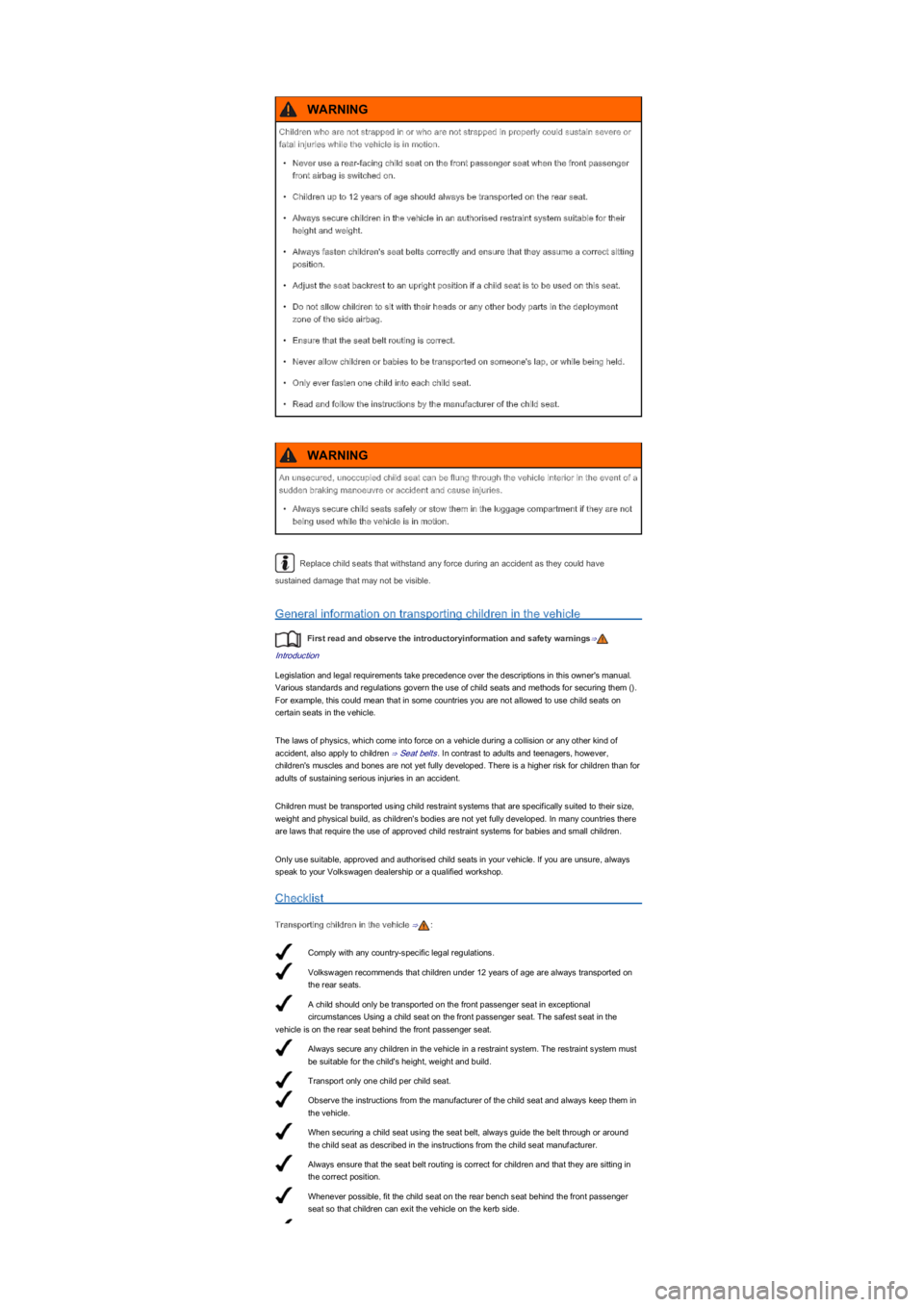
Comply with any country-specific legal regulations.
Volkswagen recommends that children under 12 years of age are always transported on
the rear seats.
A child should only be transported on the front passenger seat in exceptional
circumstances Using a child seat on the front passenger seat. The safest seat in the
vehicle is on the rear seat behind the front passenger seat.
Always secure any children in the vehicle in a restraint system. The restraint system must
be suitable for the child's height, weight and build.
Transport only one child per child seat.
Observe the instructions from the manufacturer of the child seat and always keep them in
the vehicle.
When securing a child seat using the seat belt, always guide the belt through or around
the child seat as described in the instructions from the child seat manufacturer.
Always ensure that the seat belt routing is correct for children and that they are sitting in
the correct position.
Whenever possible, fit the child seat on the rear bench seat behind the front passenger
seat so that children can exit the vehicle on the kerb side.
Replace child seats that withstand any force during an accident as they could have
sustained damage that may not be visible.
General information on transporting children in the vehicle
First read and observe the introductoryinformation and safety warnings⇒
Introduction
Legislation and legal requirements take precedence over the descriptions in this owner's manual.
Various standards and regulations govern the use of child seats and methods for securing them ().
For example, this could mean that in some countries you are not allowed to use child seats on
certain seats in the vehicle.
The laws of physics, which come into force on a vehicle during a collision or any other kind of
accident, also apply to children ⇒ Seat belts. In contrast to adults and teenagers, however,
children's muscles and bones are not yet fully developed. There is a higher risk for children than for
adults of sustaining serious injuries in an accident.
Children must be transported using child restraint systems that are specifically suited to their size,
weight and physical build, as children's bodies are not yet fully developed. In many countries there
are laws that require the use of approved child restraint systems for babies and small children.
Only use suitable, approved and authorised child seats in your vehicle. If you are unsure, always
speak to your Volkswagen dealership or a qualified workshop.
Checklist
Transporting children in the vehicle ⇒:
Children who are not strapped in or who are not strapped in properly could sustain severe or
fatal injuries while the vehicle is in motion.
•Never use a rear-facing child seat on the front passenger seat when the front passenger
front airbag is switched on.
•Children up to 12 years of age should always be transported on the rear seat.
•Always secure children in the vehicle in an authorised restraint system suitable for their
height and weight.
•Always fasten children's seat belts correctly and ensure that they assume a correct sitting
position.
•Adjust the seat backrest to an upright position if a child seat is to be used on this seat.
•Do not allow children to sit with their heads or any other body parts in the deployment
zone of the side airbag.
•Ensure that the seat belt routing is correct.
•Never allow children or babies to be transported on someone's lap, or while being held.
•Only ever fasten one child into each child seat.
•Read and follow the instructions by the manufacturer of the child seat.
WARNING
An unsecured, unoccupied child seat can be flung through the vehicle interior in the event of a
sudden braking manoeuvre or accident and cause injuries.
•Always secure child seats safely or stow them in the luggage compartment if they are not
being used while the vehicle is in motion.
WARNING
Page 56 of 211
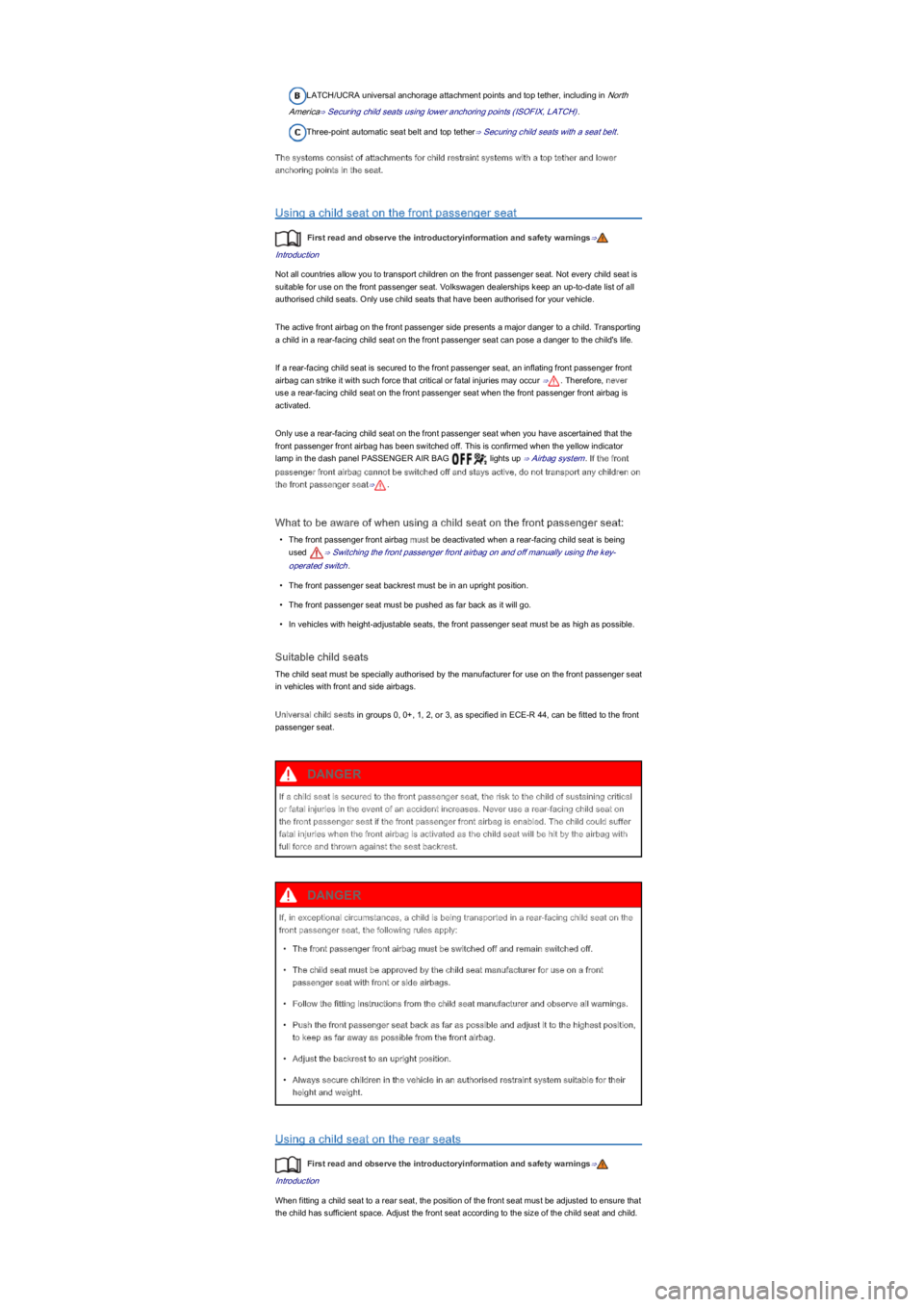
LATCH/UCRA universal anchorage attachment points and top tether, including in North
America⇒ Securing child seats using lower anchoring points (ISOFIX, LATCH).
Three-point automatic seat belt and top tether⇒ Securing child seats with a seat belt.
The systems consist of attachments for child restraint systems with a top tether and lower
anchoring points in the seat.
Using a child seat on the front passenger seat
First read and observe the introductoryinformation and safety warnings⇒
Introduction
Not all countries allow you to transport children on the front passenger seat. Not every child seat is
suitable for use on the front passenger seat. Volkswagen dealerships keep an up-to-date list of all
authorised child seats. Only use child seats that have been authorised for your vehicle.
The active front airbag on the front passenger side presents a major danger to a child. Transporting
a child in a rear-facing child seat on the front passenger seat can pose a danger to the child's life.
If a rear-facing child seat is secured to the front passenger seat, an inflating front passenger front
airbag can strike it with such force that critical or fatal injuries may occur ⇒. Therefore, never
use a rear-facing child seat on the front passenger seat when the front passenger front airbag is
activated.
Only use a rear-facing child seat on the front passenger seat when you have ascertained that the
front passenger front airbag has been switched off. This is confirmed when the yellow indicator
lamp in the dash panel PASSENGER AIR BAG lights up ⇒ Airbag system. If the front
passenger front airbag cannot be switched off and stays active, do not transport any children on
the front passenger seat⇒.
What to be aware of when using a child seat on the front passenger seat:
•The front passenger front airbag must be deactivated when a rear-facing child seat is being
used ⇒ Switching the front passenger front airbag on and off manually using the key-
operated switch.
•The front passenger seat backrest must be in an upright position.
•The front passenger seat must be pushed as far back as it will go.
•In vehicles with height-adjustable seats, the front passenger seat must be as high as possible.
Suitable child seats
The child seat must be specially authorised by the manufacturer for use on the front passenger seat
in vehicles with front and side airbags.
Universal child seats in groups 0, 0+, 1, 2, or 3, as specified in ECE-R 44, can be fitted to the front
passenger seat.
Using a child seat on the rear seats
First read and observe the introductoryinformation and safety warnings⇒
Introduction
When fitting a child seat to a rear seat, the position of the front seat must be adjusted to ensure that
the child has sufficient space. Adjust the front seat according to the size of the child seat and child.
If a child seat is secured to the front passenger seat, the risk to the child of sustaining critical
or fatal injuries in the event of an accident increases. Never use a rear-facing child seat on
the front passenger seat if the front passenger front airbag is enabled. The child could suffer
fatal injuries when the front airbag is activated as the child seat will be hit by the airbag with
full force and thrown against the seat backrest.
DANGER
If, in exceptional circumstances, a child is being transported in a rear-facing child seat on the
front passenger seat, the following rules apply:
•The front passenger front airbag must be switched off and remain switched off.
•The child seat must be approved by the child seat manufacturer for use on a front
passenger seat with front or side airbags.
•Follow the fitting instructions from the child seat manufacturer and observe all warnings.
•Push the front passenger seat back as far as possible and adjust it to the highest position,
to keep as far away as possible from the front airbag.
•Adjust the backrest to an upright position.
•Always secure children in the vehicle in an authorised restraint system suitable for their
height and weight.
DANGER
Page 57 of 211
Ensure that the front passenger can still maintain a correct sitting position ⇒ Adjusting the seat
position.
Suitable child seats
The child seat must have been approved by the manufacturer for use on the rear bench seat with
side airbag.
Universal child seats in groups 0, 0+, 1, 2, or 3 as specified in ECE-R 44 can be fitted to the rear
seats.
The seats are suitable for child seats with the ISOFIX system that are specially approved for this
vehicle type by ECE-R 44.
ISOFIX child seats approved for use on rear seats
There are different categories of ISOFIX child seats: universal, semi-universal and vehicle-specific.
•If the ISOFIX child seat has universal approval, the child seat must be fastened with the lower
anchoring points and the top tether.
•If ISOFIX child seats have semi-universal or vehicle-specific approval, a check must be made
prior to use in order to find out whether the child seat has been approved for the vehicle. For
this purpose, the child-seat manufacturer supplies the ISOFIX child seat with a list of vehicles
for which the respective ISOFIX child seat has been approved. If necessary, contact the child
seat manufacturer for an up-to-date list of vehicles.
Securing child seats with a seat belt
First read and observe the introductoryinformation and safety warnings⇒
Introduction
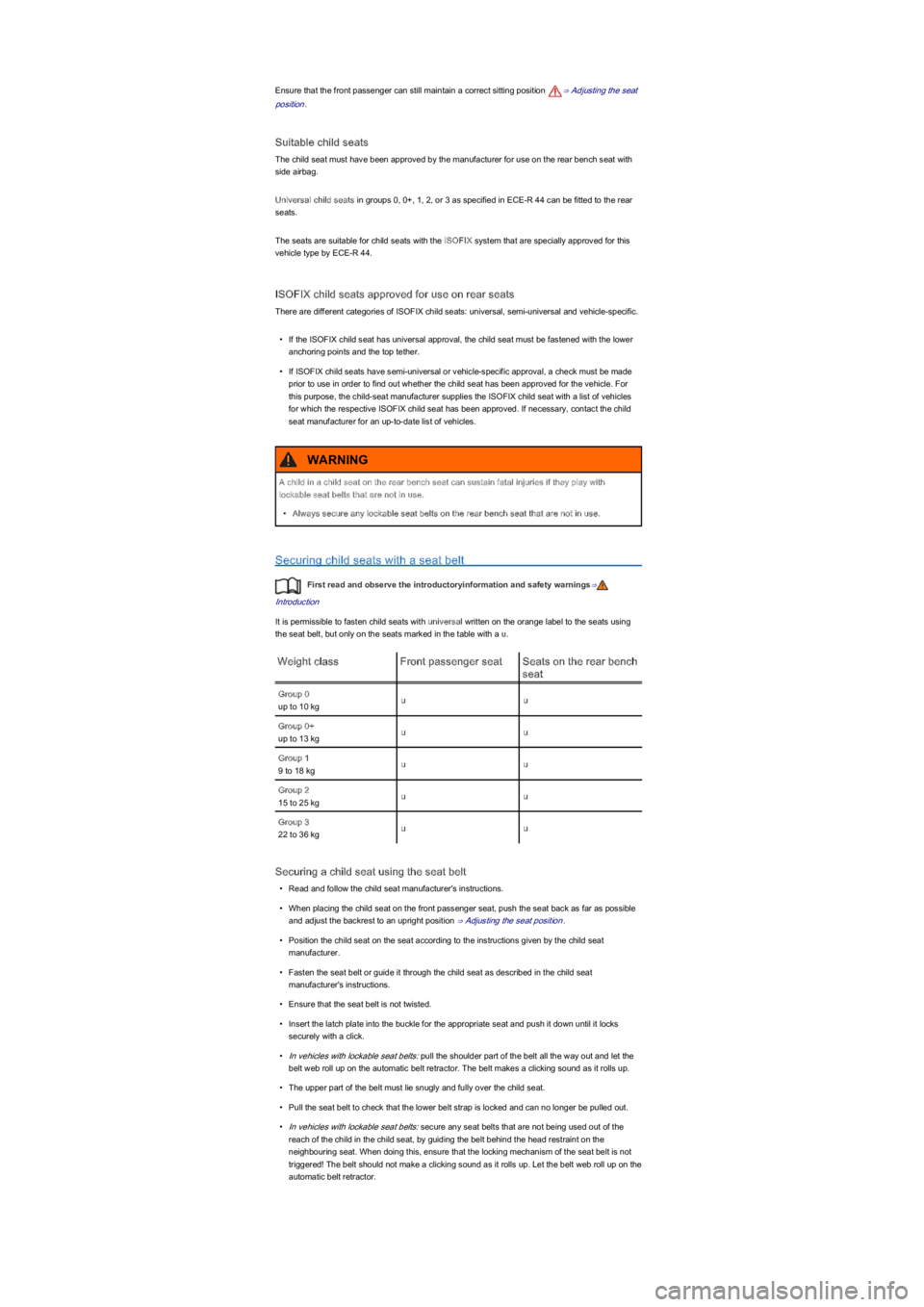
It is permissible to fasten child seats with universal written on the orange label to the seats using
the seat belt, but only on the seats marked in the table with a u.
Weight classFront passenger seatSeats on the rear bench
seat
Group 0
up to 10 kguu
Group 0+
up to 13 kguu
Group 1
9 to 18 kguu
Group 2
15 to 25 kguu
Group 3
22 to 36 kguu
Securing a child seat using the seat belt
•Read and follow the child seat manufacturer's instructions.
•When placing the child seat on the front passenger seat, push the seat back as far as possible
and adjust the backrest to an upright position ⇒ Adjusting the seat position.
•Position the child seat on the seat according to the instructions given by the child seat
manufacturer.
•Fasten the seat belt or guide it through the child seat as described in the child seat
manufacturer's instructions.
•Ensure that the seat belt is not twisted.
•Insert the latch plate into the buckle for the appropriate seat and push it down until it locks
securely with a click.
•In vehicles with lockable seat belts: pull the shoulder part of the belt all the way out and let the
belt web roll up on the automatic belt retractor. The belt makes a clicking sound as it rolls up.
•The upper part of the belt must lie snugly and fully over the child seat.
•Pull the seat belt to check that the lower belt strap is locked and can no longer be pulled out.
•In vehicles with lockable seat belts: secure any seat belts that are not being used out of the
reach of the child in the child seat, by guiding the belt behind the head restraint on the
neighbouring seat. When doing this, ensure that the locking mechanism of the seat belt is not
triggered! The belt should not make a clicking sound as it rolls up. Let the belt web roll up on the
automatic belt retractor.
A child in a child seat on the rear bench seat can sustain fatal injuries if they play with
lockable seat belts that are not in use.
•Always secure any lockable seat belts on the rear bench seat that are not in use.
WARNING
Page 70 of 211
•Luggage compartment ⇒ Luggage compartment
•Roof carrier ⇒ Roof carrier
•Wheels and tyres ⇒ Wheels and tyres
Stowing items of luggage
First read and observe the introductoryinformation and safety warnings⇒
Introduction
Always stow all items of luggage in the vehicle securely.
•Always distribute any loads in the vehicle and on the roof as evenly as possible.
•Place heavy objects as far forward in the luggage compartment as possible. Position the rear
seat backrests securely in the upright position.
•Secure luggage in the luggage compartment to the fastening rings with suitable straps
⇒ Luggage compartment.
•Adjust the headlight range ⇒ Lights.
•Adjust the tyre pressure according to the vehicle load. Please read the tyre pressure sticker
⇒ Wheels and tyres.
Observe any information concerning the loading of a roof carrier ⇒ Roof carrier.
Driving with an open tailgate
First read and observe the introductoryinformation and safety warnings⇒
Introduction
Driving with an open tailgate is particularly dangerous. Ensure that the open tailgate and any
objects are secured properly, and take appropriate measures to reduce the quantity of toxic
exhaust fumes entering the vehicle.
Objects that are not secured, or are secured incorrectly, can cause serious injuries in the
event of a sudden driving or braking manoeuvre or accident. This applies particularly if
objects are struck by the airbag when activated and then flung through the vehicle interior.
Please apply the following rules to reduce the risk of accidents:
•Always stow all objects in the vehicle securely. Always stow luggage and heavy objects in
the luggage compartment.
•Always use suitable straps to prevent luggage from entering the deployment zones of the
side airbag or the front airbag in the event of a sudden driving or braking manoeuvre or an
accident.
•Objects should be stowed in the vehicle interior in such a way that they can never enter
the airbag deployment zones while the vehicle is in motion.
•Always keep stowage compartments closed while the vehicle is in motion.
•All objects must be removed from the seat cushion of the front passenger seat if the front
passenger backrest is folded forward. Even light and small objects could be pressed into
the weight detection mat underneath the seat cushion by the backrest when it is folded
forwards and thus send incorrect information to the airbag control units.
•The front airbag must be switched off and the indicator lamp PASSENGER AIR BAG OFF
must light up for as long as the front passenger seat backrest is folded forwards.
•Stowed objects must never cause passengers to assume an incorrect sitting position.
•Any seat blocked by stowed objects must not be used by any passengers.
WARNING
The vehicle handling and braking effect may alter significantly if large or heavy objects are
being transported.
•Adapt your speed and driving style to suit visibility, weather, road and traffic conditions.
•Accelerate carefully and gently.
•Avoid sudden braking and driving manoeuvres.
•Brake earlier than in normal driving.
WARNING
Hard objects on the shelf can chafe against the wires of the heating element in the rear
window and cause damage.
NOTICE
Page 72 of 211
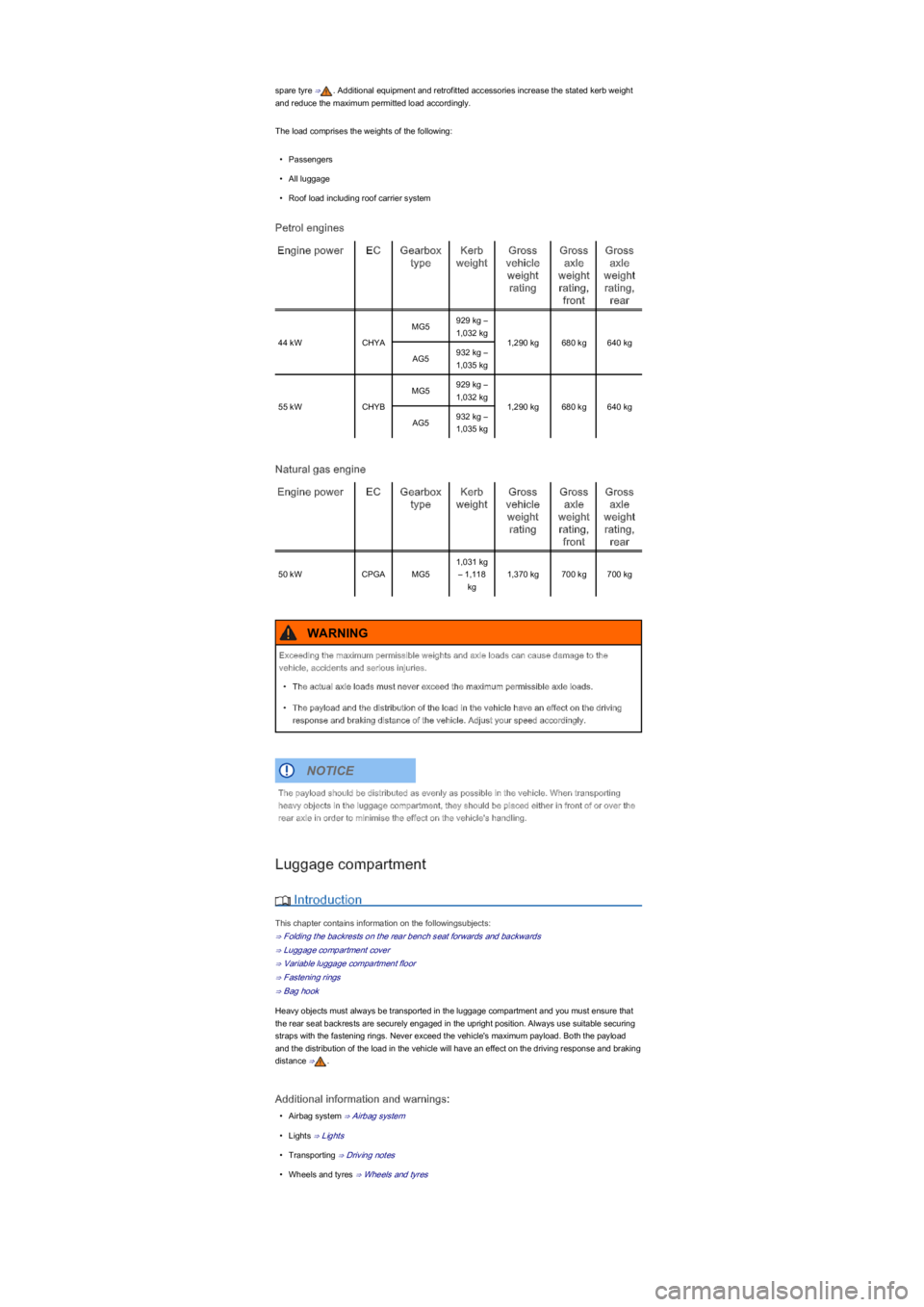
spare tyre ⇒. Additional equipment and retrofitted accessories increase the stated kerb weight
and reduce the maximum permitted load accordingly.
The load comprises the weights of the following:
•Passengers
•All luggage
•Roof load including roof carrier system
Petrol engines
Engine powerECGearbox
type
Kerb
weight
Gross
vehicle
weight
rating
Gross
axle
weight
rating,
front
Gross
axle
weight
rating,
rear
44 kWCHYA
MG5929 kg –
1,032 kg
1,290 kg680 kg640 kg
AG5932 kg –
1,035 kg
55 kWCHYB
MG5929 kg –
1,032 kg
1,290 kg680 kg640 kg
AG5932 kg –
1,035 kg
Natural gas engine
Engine powerECGearbox
type
Kerb
weight
Gross
vehicle
weight
rating
Gross
axle
weight
rating,
front
Gross
axle
weight
rating,
rear
50 kWCPGAMG5
1,031 kg
– 1,118
kg
1,370 kg700 kg700 kg
Luggage compartment
Introduction
This chapter contains information on the followingsubjects:
⇒ Folding the backrests on the rear bench seat forwards and backwards
⇒ Luggage compartment cover
⇒ Variable luggage compartment floor
⇒ Fastening rings
⇒ Bag hook
Heavy objects must always be transported in the luggage compartment and you must ensure that
the rear seat backrests are securely engaged in the upright position. Always use suitable securing
straps with the fastening rings. Never exceed the vehicle's maximum payload. Both the payload
and the distribution of the load in the vehicle will have an effect on the driving response and braking
distance ⇒.
Additional information and warnings:
•Airbag system ⇒ Airbag system
•Lights ⇒ Lights
•Transporting ⇒ Driving notes
•Wheels and tyres ⇒ Wheels and tyres
Exceeding the maximum permissible weights and axle loads can cause damage to the
vehicle, accidents and serious injuries.
•The actual axle loads must never exceed the maximum permissible axle loads.
•The payload and the distribution of the load in the vehicle have an effect on the driving
response and braking distance of the vehicle. Adjust your speed accordingly.
WARNING
The payload should be distributed as evenly as possible in the vehicle. When transporting
heavy objects in the luggage compartment, they should be placed either in front of or over the
rear axle in order to minimise the effect on the vehicle's handling.
NOTICE
Page 73 of 211
The ventilation openings between the rear window and the luggage compartment cover must
not be covered as this would prevent stale air escaping from the vehicle.
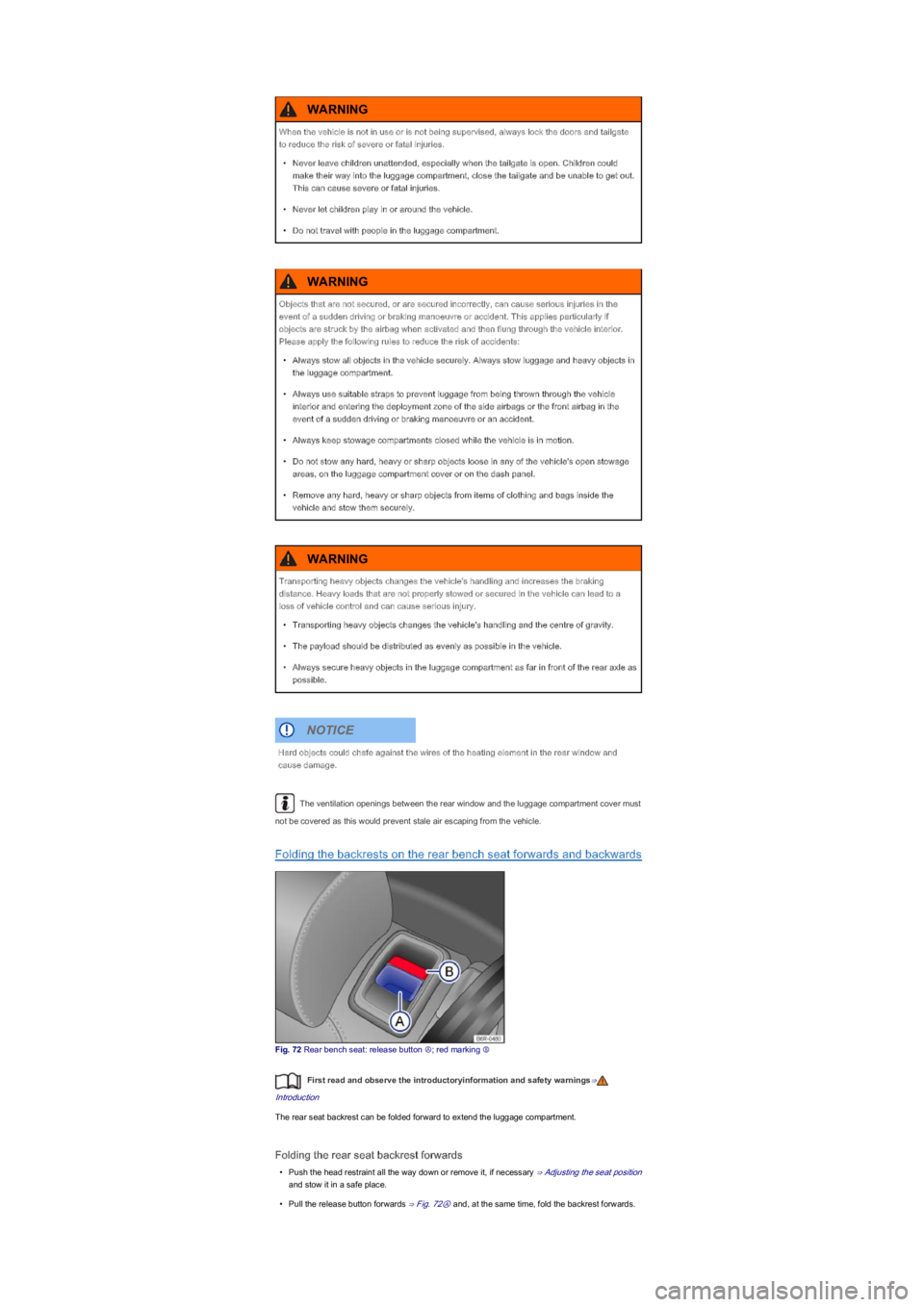
Folding the backrests on the rear bench seat forwards and backwards
Fig. 72 Rear bench seat: release button Ⓐ; red marking Ⓑ
First read and observe the introductoryinformation and safety warnings⇒
Introduction
The rear seat backrest can be folded forward to extend the luggage compartment.
Folding the rear seat backrest forwards
•Push the head restraint all the way down or remove it, if necessary ⇒ Adjusting the seat position
and stow it in a safe place.
•Pull the release button forwards ⇒ Fig. 72Ⓐ and, at the same time, fold the backrest forwards.
When the vehicle is not in use or is not being supervised, always lock the doors and tailgate
to reduce the risk of severe or fatal injuries.
•Never leave children unattended, especially when the tailgate is open. Children could
make their way into the luggage compartment, close the tailgate and be unable to get out.
This can cause severe or fatal injuries.
•Never let children play in or around the vehicle.
•Do not travel with people in the luggage compartment.
WARNING
Objects that are not secured, or are secured incorrectly, can cause serious injuries in the
event of a sudden driving or braking manoeuvre or accident. This applies particularly if
objects are struck by the airbag when activated and then flung through the vehicle interior.
Please apply the following rules to reduce the risk of accidents:
•Always stow all objects in the vehicle securely. Always stow luggage and heavy objects in
the luggage compartment.
•Always use suitable straps to prevent luggage from being thrown through the vehicle
interior and entering the deployment zone of the side airbags or the front airbag in the
event of a sudden driving or braking manoeuvre or an accident.
•Always keep stowage compartments closed while the vehicle is in motion.
•Do not stow any hard, heavy or sharp objects loose in any of the vehicle's open stowage
areas, on the luggage compartment cover or on the dash panel.
•Remove any hard, heavy or sharp objects from items of clothing and bags inside the
vehicle and stow them securely.
WARNING
Transporting heavy objects changes the vehicle's handling and increases the braking
distance. Heavy loads that are not properly stowed or secured in the vehicle can lead to a
loss of vehicle control and can cause serious injury.
•Transporting heavy objects changes the vehicle's handling and the centre of gravity.
•The payload should be distributed as evenly as possible in the vehicle.
•Always secure heavy objects in the luggage compartment as far in front of the rear axle as
possible.
WARNING
Hard objects could chafe against the wires of the heating element in the rear window and
cause damage.
NOTICE
Page 88 of 211
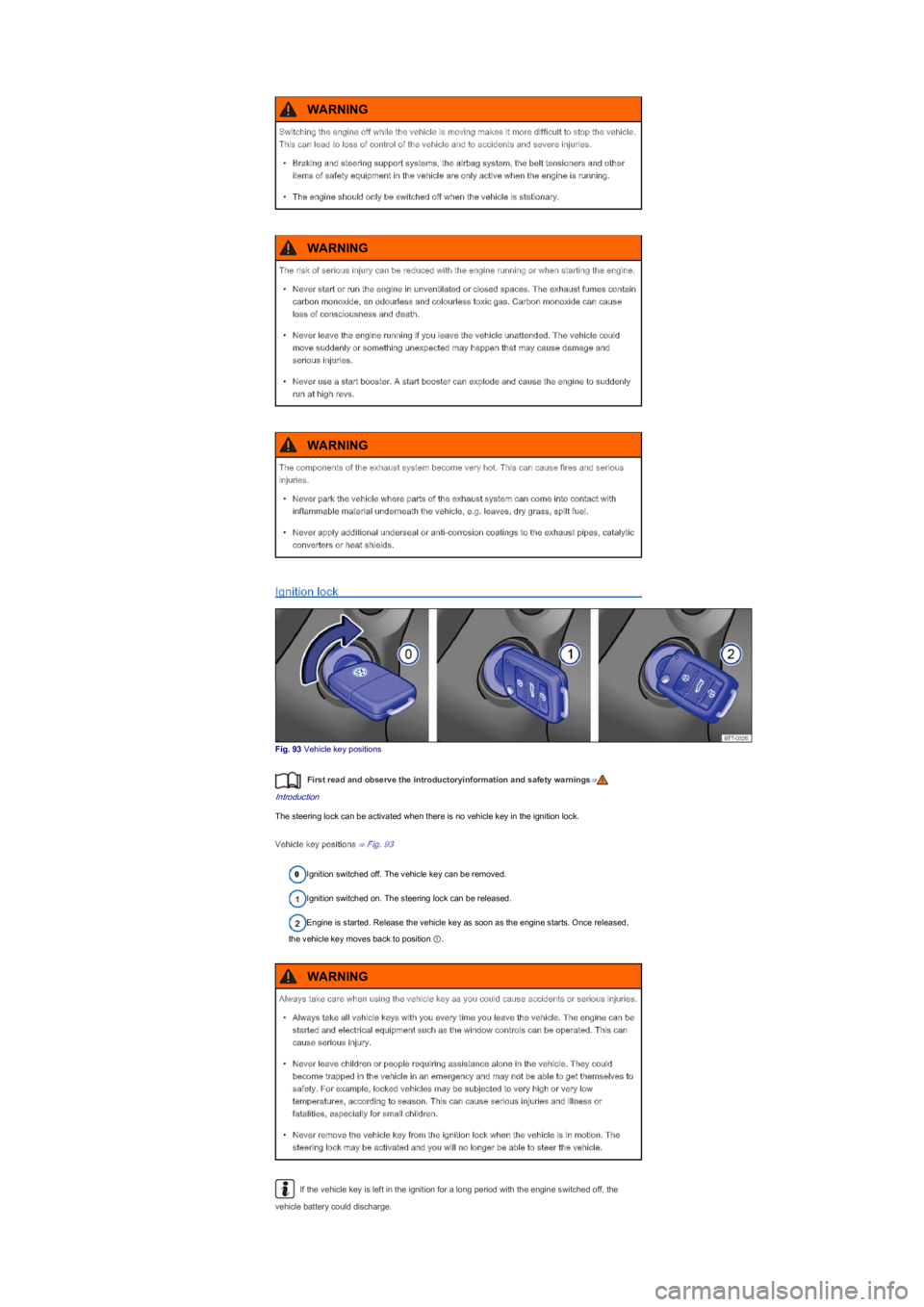
Ignition lock
Fig. 93 Vehicle key positions
First read and observe the introductoryinformation and safety warnings⇒
Introduction
The steering lock can be activated when there is no vehicle key in the ignition lock.
Vehicle key positions ⇒ Fig. 93
Ignition switched off. The vehicle key can be removed.
Ignition switched on. The steering lock can be released.
Engine is started. Release the vehicle key as soon as the engine starts. Once released,
the vehicle key moves back to position ①.
If the vehicle key is left in the ignition for a long period with the engine switched off, the
vehicle battery could discharge.
Switching the engine off while the vehicle is moving makes it more difficult to stop the vehicle.
This can lead to loss of control of the vehicle and to accidents and severe injuries.
•Braking and steering support systems, the airbag system, the belt tensioners and other
items of safety equipment in the vehicle are only active when the engine is running.
•The engine should only be switched off when the vehicle is stationary.
WARNING
The risk of serious injury can be reduced with the engine running or when starting the engine.
•Never start or run the engine in unventilated or closed spaces. The exhaust fumes contain
carbon monoxide, an odourless and colourless toxic gas. Carbon monoxide can cause
loss of consciousness and death.
•Never leave the engine running if you leave the vehicle unattended. The vehicle could
move suddenly or something unexpected may happen that may cause damage and
serious injuries.
•Never use a start booster. A start booster can explode and cause the engine to suddenly
run at high revs.
WARNING
The components of the exhaust system become very hot. This can cause fires and serious
injuries.
•Never park the vehicle where parts of the exhaust system can come into contact with
inflammable material underneath the vehicle, e.g. leaves, dry grass, spilt fuel.
•Never apply additional underseal or anti-corrosion coatings to the exhaust pipes, catalytic
converters or heat shields.
WARNING
Always take care when using the vehicle key as you could cause accidents or serious injuries.
•Always take all vehicle keys with you every time you leave the vehicle. The engine can be
started and electrical equipment such as the window controls can be operated. This can
cause serious injury.
•Never leave children or people requiring assistance alone in the vehicle. They could
become trapped in the vehicle in an emergency and may not be able to get themselves to
safety. For example, locked vehicles may be subjected to very high or very low
temperatures, according to season. This can cause serious injuries and illness or
fatalities, especially for small children.
•Never remove the vehicle key from the ignition lock when the vehicle is in motion. The
steering lock may be activated and you will no longer be able to steer the vehicle.
WARNING
Page 90 of 211
After the engine is switched off, the radiator fan in the engine compartment may run on for
some minutes, even if the ignition is switched off or the vehicle key has been removed. The radiator
fan will switch itself off automatically.
Electronic immobilizer
First read and observe the introductoryinformation and safety warnings⇒
Introduction
The immobilizer helps to prevent the engine from being started and driven with an unauthorised
vehicle key.
There is a chip in the key. It automatically deactivates the immobilizer when the vehicle key is
inserted into the ignition lock.
The electronic immobilizer is automatically activated when the vehicle key is removed from the
ignition lock.
The engine can only be started using a genuine Volkswagen vehicle key with the correct code.
Coded vehicle keys are available from a Volkswagen dealership ⇒ Vehicle key set.
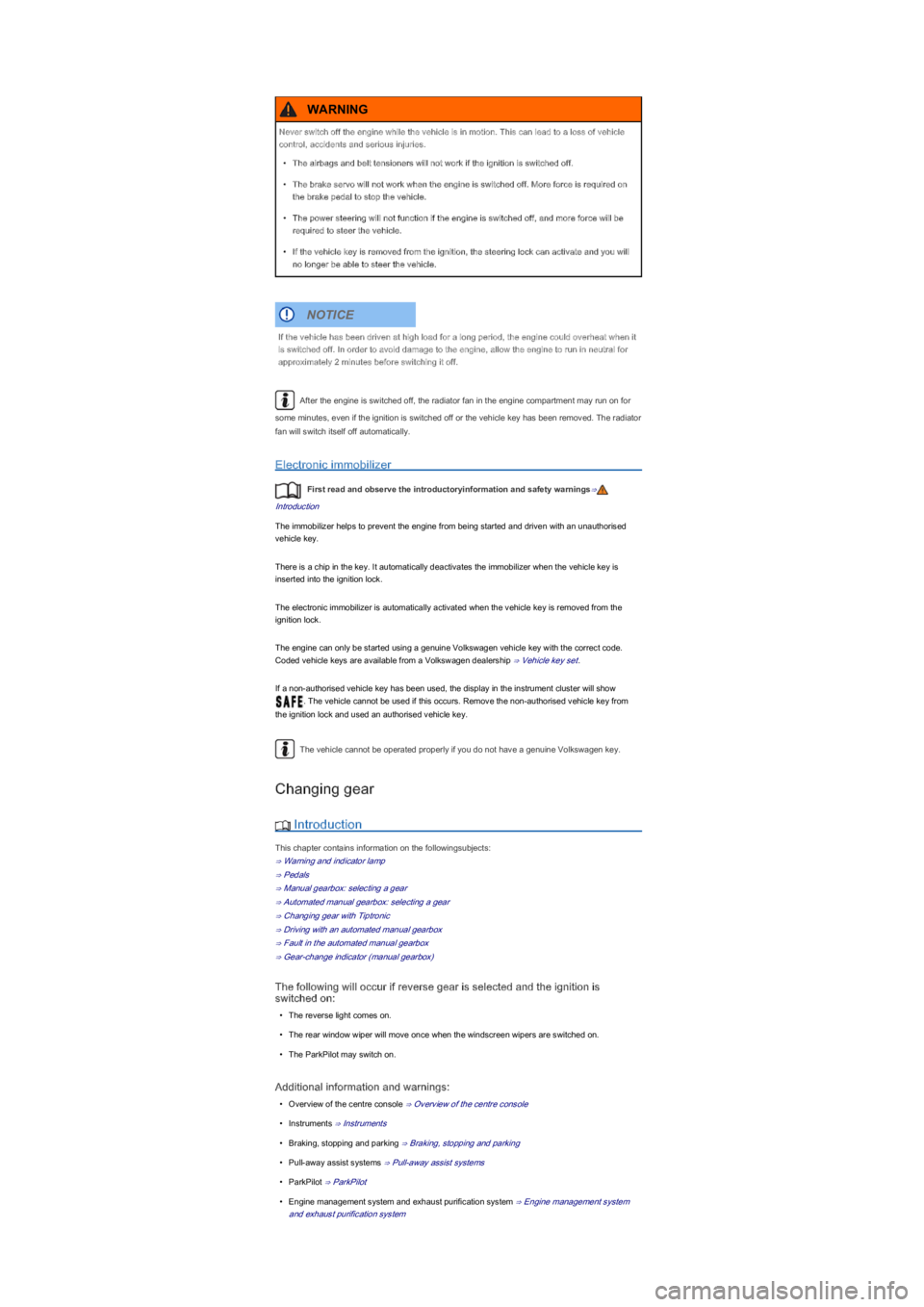
If a non-authorised vehicle key has been used, the display in the instrument cluster will show
. The vehicle cannot be used if this occurs. Remove the non-authorised vehicle key from
the ignition lock and used an authorised vehicle key.
The vehicle cannot be operated properly if you do not have a genuine Volkswagen key.
Changing gear
Introduction
This chapter contains information on the followingsubjects:
⇒ Warning and indicator lamp
⇒ Pedals
⇒ Manual gearbox: selecting a gear
⇒ Automated manual gearbox: selecting a gear
⇒ Changing gear with Tiptronic
⇒ Driving with an automated manual gearbox
⇒ Fault in the automated manual gearbox
⇒ Gear-change indicator (manual gearbox)
The following will occur if reverse gear is selected and the ignition is
switched on:
•The reverse light comes on.
•The rear window wiper will move once when the windscreen wipers are switched on.
•The ParkPilot may switch on.
Additional information and warnings:
•Overview of the centre console ⇒ Overview of the centre console
•Instruments ⇒ Instruments
•Braking, stopping and parking ⇒ Braking, stopping and parking
•Pull-away assist systems ⇒ Pull-away assist systems
•ParkPilot ⇒ ParkPilot
•Engine management system and exhaust purification system ⇒ Engine management system
and exhaust purification system
Never switch off the engine while the vehicle is in motion. This can lead to a loss of vehicle
control, accidents and serious injuries.
•The airbags and belt tensioners will not work if the ignition is switched off.
•The brake servo will not work when the engine is switched off. More force is required on
the brake pedal to stop the vehicle.
•The power steering will not function if the engine is switched off, and more force will be
required to steer the vehicle.
•If the vehicle key is removed from the ignition, the steering lock can activate and you will
no longer be able to steer the vehicle.
WARNING
If the vehicle has been driven at high load for a long period, the engine could overheat when it
is switched off. In order to avoid damage to the engine, allow the engine to run in neutral for
approximately 2 minutes before switching it off.
NOTICE
Page 116 of 211
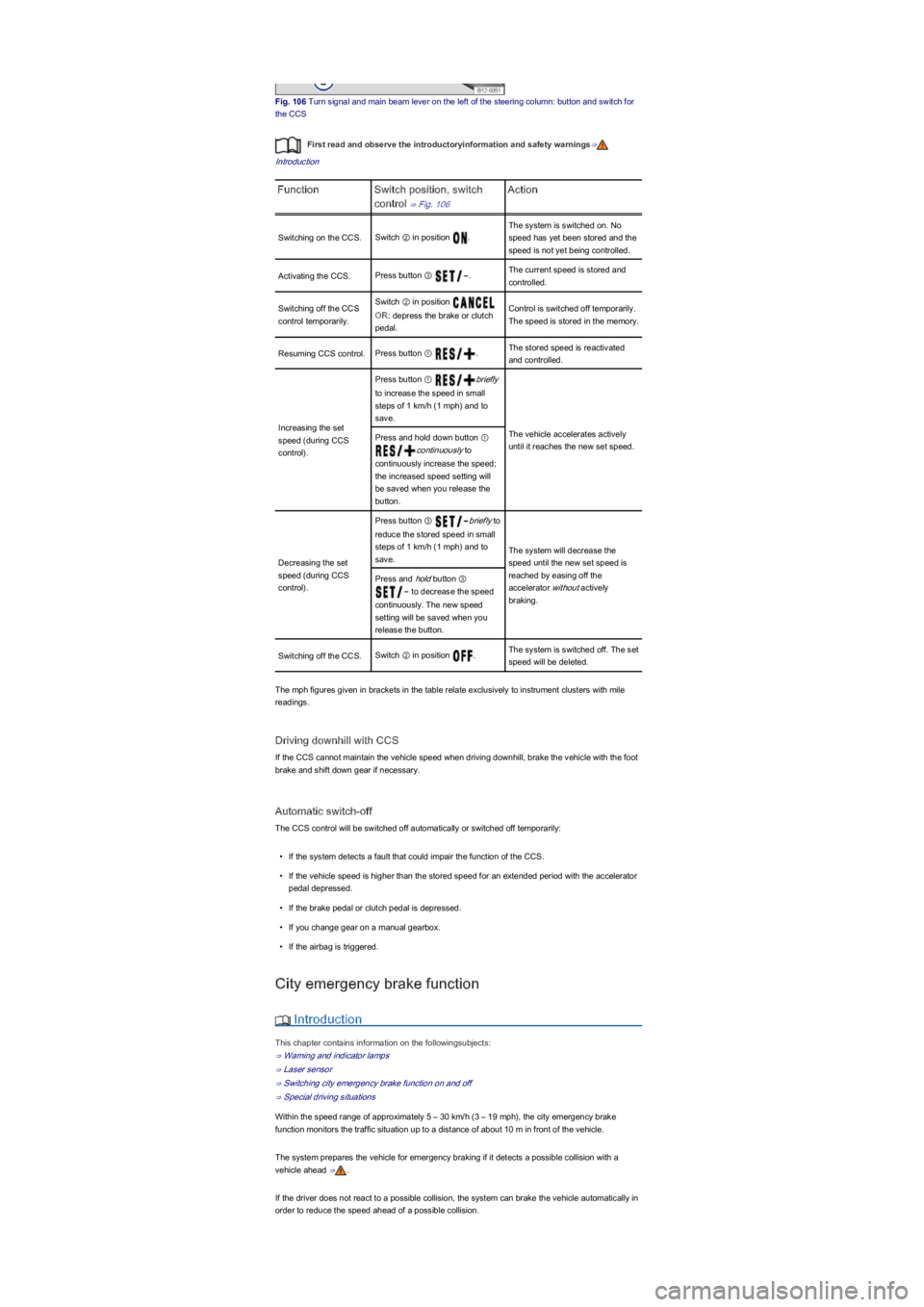
Fig. 106 Turn signal and main beam lever on the left of the steering column: button and switch for
the CCS
First read and observe the introductoryinformation and safety warnings⇒
Introduction
FunctionSwitch position, switch
control ⇒ Fig. 106
Action
Switching on the CCS.Switch ② in position .
The system is switched on. No
speed has yet been stored and the
speed is not yet being controlled.
Activating the CCS.Press button ③ .The current speed is stored and
controlled.
Switching off the CCS
control temporarily.
Switch ② in position
OR: depress the brake or clutch
pedal.
Control is switched off temporarily.
The speed is stored in the memory.
Resuming CCS control.Press button ① .The stored speed is reactivated
and controlled.
Increasing the set
speed (during CCS
control).
Press button ① briefly
to increase the speed in small
steps of 1 km/h (1 mph) and to
save.
The vehicle accelerates actively
until it reaches the new set speed.
Press and hold down button ①
continuously to
continuously increase the speed;
the increased speed setting will
be saved when you release the
button.
Decreasing the set
speed (during CCS
control).
Press button ③ briefly to
reduce the stored speed in small
steps of 1 km/h (1 mph) and to
save.
The system will decrease the
speed until the new set speed is
reached by easing off the
accelerator without actively
braking.
Press and hold button ③
to decrease the speed
continuously. The new speed
setting will be saved when you
release the button.
Switching off the CCS.Switch ② in position .The system is switched off. The set
speed will be deleted.
The mph figures given in brackets in the table relate exclusively to instrument clusters with mile
readings.
Driving downhill with CCS
If the CCS cannot maintain the vehicle speed when driving downhill, brake the vehicle with the foot
brake and shift down gear if necessary.
Automatic switch-off
The CCS control will be switched off automatically or switched off temporarily:
•If the system detects a fault that could impair the function of the CCS.
•If the vehicle speed is higher than the stored speed for an extended period with the accelerator
pedal depressed.
•If the brake pedal or clutch pedal is depressed.
•If you change gear on a manual gearbox.
•If the airbag is triggered.
City emergency brake function
Introduction
This chapter contains information on the followingsubjects:
⇒ Warning and indicator lamps
⇒ Laser sensor
⇒ Switching city emergency brake function on and off
⇒ Special driving situations
Within the speed range of approximately 5 – 30 km/h (3 – 19 mph), the city emergency brake
function monitors the traffic situation up to a distance of about 10 m in front of the vehicle.
The system prepares the vehicle for emergency braking if it detects a possible collision with a
vehicle ahead ⇒.
If the driver does not react to a possible collision, the system can brake the vehicle automatically in
order to reduce the speed ahead of a possible collision.
Page 154 of 211
Cleaning upholstery on seat cushions with seat heating, electrically
adjustable seats, or seats containing airbag components
Airbag-related components and electrical connectors may be installed in the driver seat, passenger
seat and sometimes also in the rear outer seats. Seat cushions or backrests that are damaged,
incorrectly cleaned or treated, or that become wet, may cause damage to the vehicle electrics or
trigger a fault in the airbag system ⇒.
Electrical components and connectors are installed in electrically adjustable seats and seat
cushions with seat heating. These can be damaged if cleaned or treated incorrectly ⇒. This can
also result in damage to other parts of the vehicle electrics.
For this reason, please follow these cleaning guidelines:
•Do not use high-pressure cleaners, steam cleaners or coolant spray.
•Do not use washing paste or fine detergent solutions.
•Avoid getting the seat wet.
•Only use detergents that have been approved by Volkswagen.
•If in doubt, consult a specialist cleaning company.
Cleaning upholstery on seat cushions without seat heating, seats that are
not electrically adjustable, and seats that do not contain airbag components
•Please read and follow the instructions, notes and warnings on the package before using
cleaning products.
•Upholstery, fabric trims, Alcantara seat covers and carpeting should be cleaned regularly with
a vacuum cleaner (brush).
•Do not use high-pressure cleaners, steam cleaners or coolant spray.
•We recommend that you use a soft sponge or commercially available lint-free microfibre cloth
for cleaning jobs ⇒.
•Clean Alcantara surfaces with a slightly damp cotton or woollen cloth or a commercially
available lint-free microfibre cloth ⇒.
General surface soiling of the upholstery and fabric trim can be cleaned with a commercially
available foam cleaner.
If the upholstery and fabric trims are generally heavily soiled, consult a Volkswagen dealership for
information on suitable cleaning methods before attempting any cleaning. If required, take the
vehicle to a specialist cleaning company.
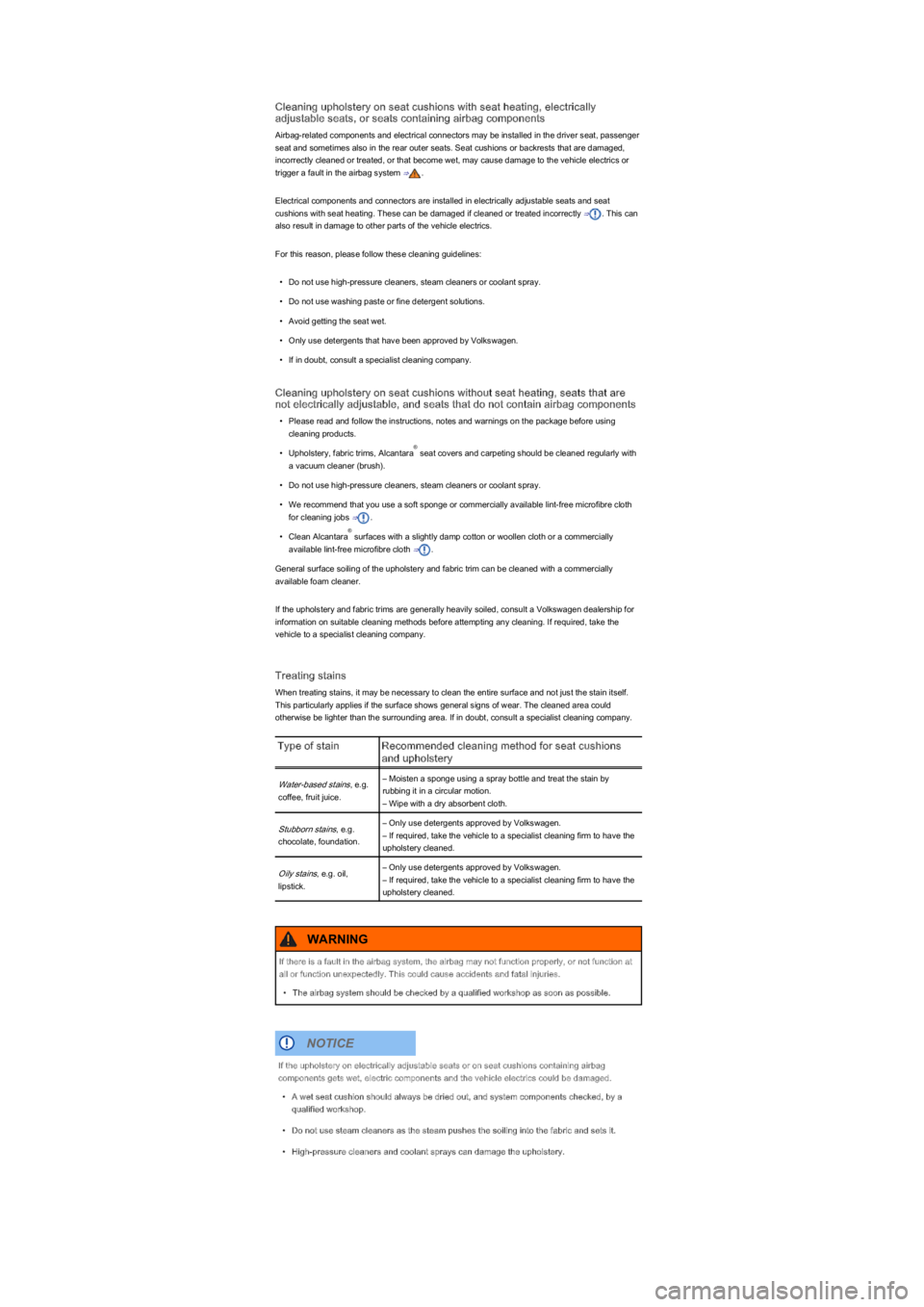
Treating stains
When treating stains, it may be necessary to clean the entire surface and not just the stain itself.
This particularly applies if the surface shows general signs of wear. The cleaned area could
otherwise be lighter than the surrounding area. If in doubt, consult a specialist cleaning company.
Type of stainRecommended cleaning method for seat cushions
and upholstery
Water-based stains, e.g.
coffee, fruit juice.
– Moisten a sponge using a spray bottle and treat the stain by
rubbing it in a circular motion.
– Wipe with a dry absorbent cloth.
Stubborn stains, e.g.
chocolate, foundation.
– Only use detergents approved by Volkswagen.
– If required, take the vehicle to a specialist cleaning firm to have the
upholstery cleaned.
Oily stains, e.g. oil,
lipstick.
– Only use detergents approved by Volkswagen.
– If required, take the vehicle to a specialist cleaning firm to have the
upholstery cleaned.
®
®
If there is a fault in the airbag system, the airbag may not function properly, or not function at
all or function unexpectedly. This could cause accidents and fatal injuries.
•The airbag system should be checked by a qualified workshop as soon as possible.
WARNING
If the upholstery on electrically adjustable seats or on seat cushions containing airbag
components gets wet, electric components and the vehicle electrics could be damaged.
•A wet seat cushion should always be dried out, and system components checked, by a
qualified workshop.
•Do not use steam cleaners as the steam pushes the soiling into the fabric and sets it.
•High-pressure cleaners and coolant sprays can damage the upholstery.
NOTICE