engine oil VOLKSWAGEN UP! 2021 Owner´s Manual
[x] Cancel search | Manufacturer: VOLKSWAGEN, Model Year: 2021, Model line: UP!, Model: VOLKSWAGEN UP! 2021Pages: 211, PDF Size: 5.98 MB
Page 139 of 211
Coolant and coolant additives can pollute the environment. Spilt operating fluids must be
collected and disposed of properly and with respect for the environment.
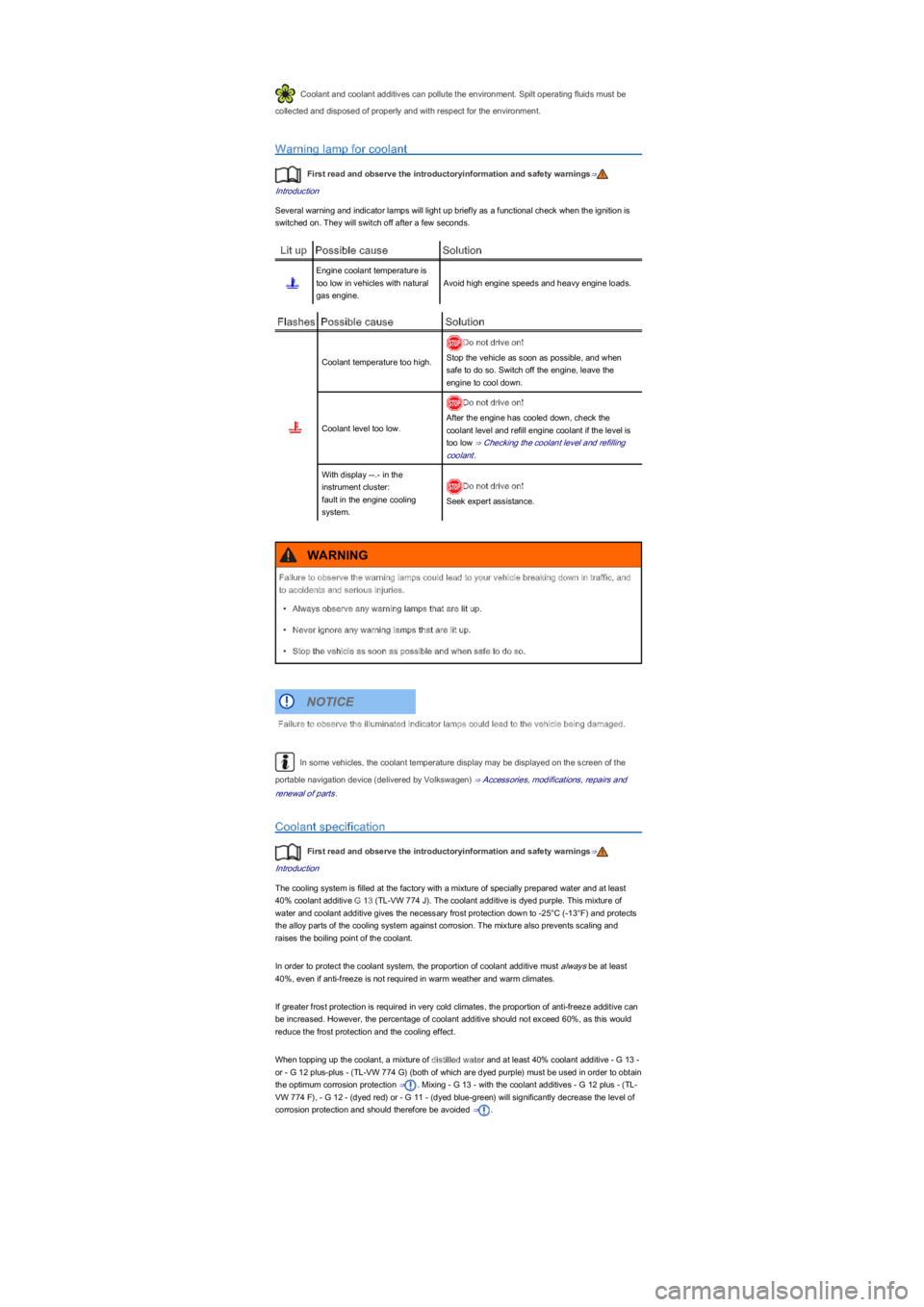
Warning lamp for coolant
First read and observe the introductoryinformation and safety warnings⇒
Introduction
Several warning and indicator lamps will light up briefly as a functional check when the ignition is
switched on. They will switch off after a few seconds.
Lit upPossible causeSolution
Engine coolant temperature is
too low in vehicles with natural
gas engine.
Avoid high engine speeds and heavy engine loads.
FlashesPossible causeSolution
Coolant temperature too high.
Do not drive on!
Stop the vehicle as soon as possible, and when
safe to do so. Switch off the engine, leave the
engine to cool down.
Coolant level too low.
Do not drive on!
After the engine has cooled down, check the
coolant level and refill engine coolant if the level is
too low ⇒ Checking the coolant level and refilling
coolant.
With display --.- in the
instrument cluster:
fault in the engine cooling
system.
Do not drive on!
Seek expert assistance.
In some vehicles, the coolant temperature display may be displayed on the screen of the
portable navigation device (delivered by Volkswagen) ⇒ Accessories, modifications, repairs and
renewal of parts.
Coolant specification
First read and observe the introductoryinformation and safety warnings⇒
Introduction
The cooling system is filled at the factory with a mixture of specially prepared water and at least
40% coolant additive G 13 (TL-VW 774 J). The coolant additive is dyed purple. This mixture of
water and coolant additive gives the necessary frost protection down to -25°C (-13°F) and protects
the alloy parts of the cooling system against corrosion. The mixture also prevents scaling and
raises the boiling point of the coolant.
In order to protect the coolant system, the proportion of coolant additive must always be at least
40%, even if anti-freeze is not required in warm weather and warm climates.
If greater frost protection is required in very cold climates, the proportion of anti-freeze additive can
be increased. However, the percentage of coolant additive should not exceed 60%, as this would
reduce the frost protection and the cooling effect.
When topping up the coolant, a mixture of distilled water and at least 40% coolant additive - G 13 -
or - G 12 plus-plus - (TL-VW 774 G) (both of which are dyed purple) must be used in order to obtain
the optimum corrosion protection ⇒. Mixing - G 13 - with the coolant additives - G 12 plus - (TL-
VW 774 F), - G 12 - (dyed red) or - G 11 - (dyed blue-green) will significantly decrease the level of
corrosion protection and should therefore be avoided ⇒.
Failure to observe the warning lamps could lead to your vehicle breaking down in traffic, and
to accidents and serious injuries.
•Always observe any warning lamps that are lit up.
•Never ignore any warning lamps that are lit up.
•Stop the vehicle as soon as possible and when safe to do so.
WARNING
Failure to observe the illuminated indicator lamps could lead to the vehicle being damaged.
NOTICE
Page 146 of 211
In the interests of environmental protection, the vehicle should only be washed in specially
provided wash bays. This prevents waste water contaminated with oil, grease or fuel from entering
the sewerage system. In some countries, washing vehicles anywhere else may be prohibited.
Environmentally-friendly care products should be used.
Leftover car care products should not be disposed of with ordinary household waste. Read
the manufacturer's instructions.
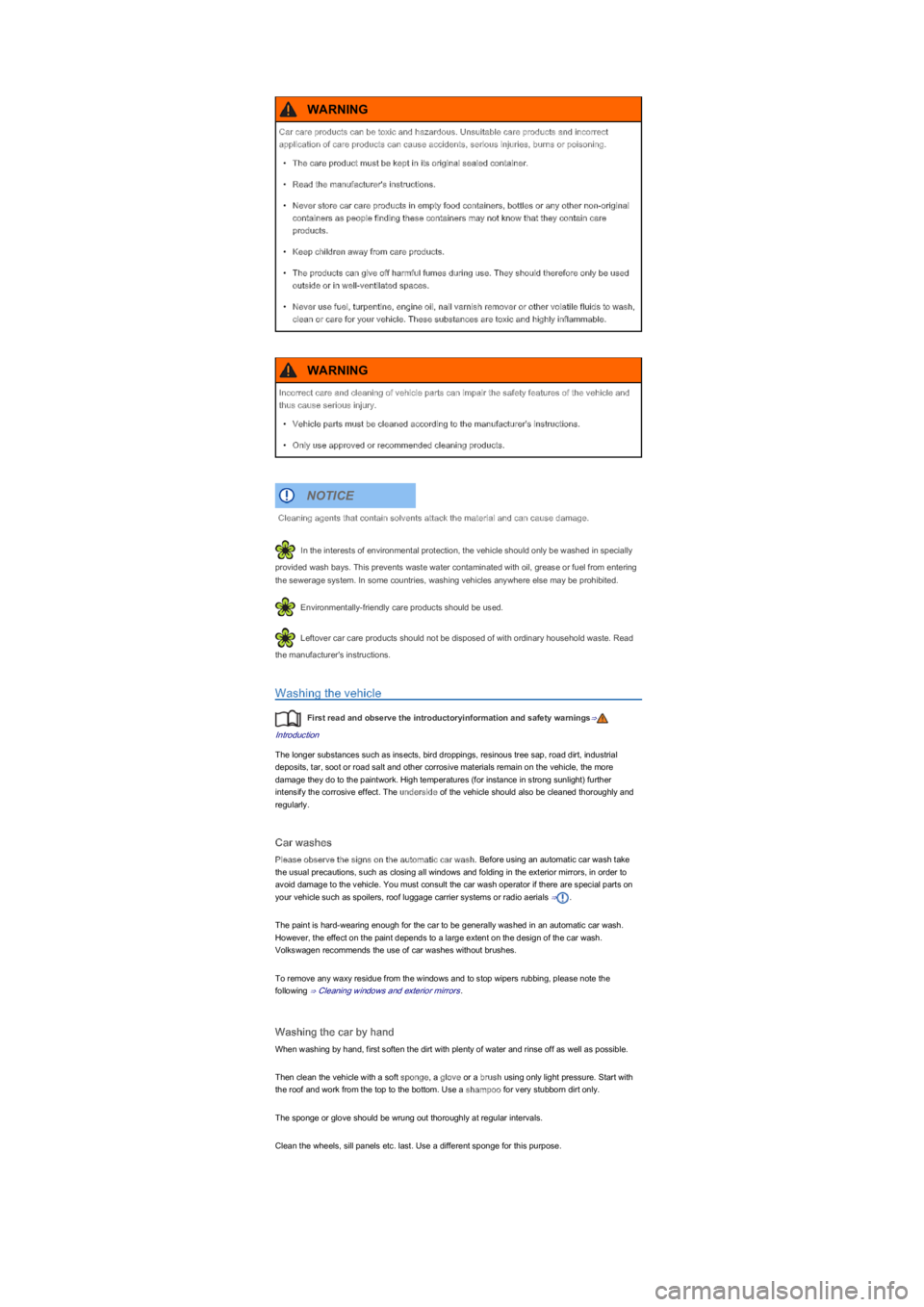
Washing the vehicle
First read and observe the introductoryinformation and safety warnings⇒
Introduction
The longer substances such as insects, bird droppings, resinous tree sap, road dirt, industrial
deposits, tar, soot or road salt and other corrosive materials remain on the vehicle, the more
damage they do to the paintwork. High temperatures (for instance in strong sunlight) further
intensify the corrosive effect. The underside of the vehicle should also be cleaned thoroughly and
regularly.
Car washes
Please observe the signs on the automatic car wash. Before using an automatic car wash take
the usual precautions, such as closing all windows and folding in the exterior mirrors, in order to
avoid damage to the vehicle. You must consult the car wash operator if there are special parts on
your vehicle such as spoilers, roof luggage carrier systems or radio aerials ⇒.
The paint is hard-wearing enough for the car to be generally washed in an automatic car wash.
However, the effect on the paint depends to a large extent on the design of the car wash.
Volkswagen recommends the use of car washes without brushes.
To remove any waxy residue from the windows and to stop wipers rubbing, please note the
following ⇒ Cleaning windows and exterior mirrors.
Washing the car by hand
When washing by hand, first soften the dirt with plenty of water and rinse off as well as possible.
Then clean the vehicle with a soft sponge, a glove or a brush using only light pressure. Start with
the roof and work from the top to the bottom. Use a shampoo for very stubborn dirt only.
The sponge or glove should be wrung out thoroughly at regular intervals.
Clean the wheels, sill panels etc. last. Use a different sponge for this purpose.
Car care products can be toxic and hazardous. Unsuitable care products and incorrect
application of care products can cause accidents, serious injuries, burns or poisoning.
•The care product must be kept in its original sealed container.
•Read the manufacturer's instructions.
•Never store car care products in empty food containers, bottles or any other non-original
containers as people finding these containers may not know that they contain care
products.
•Keep children away from care products.
•The products can give off harmful fumes during use. They should therefore only be used
outside or in well-ventilated spaces.
•Never use fuel, turpentine, engine oil, nail varnish remover or other volatile fluids to wash,
clean or care for your vehicle. These substances are toxic and highly inflammable.
WARNING
Incorrect care and cleaning of vehicle parts can impair the safety features of the vehicle and
thus cause serious injury.
•Vehicle parts must be cleaned according to the manufacturer's instructions.
•Only use approved or recommended cleaning products.
WARNING
Cleaning agents that contain solvents attack the material and can cause damage.
NOTICE
Page 152 of 211
recommends that the protective coating on the underside of the vehicle and on the running gear
should be checked regularly and repaired if necessary.
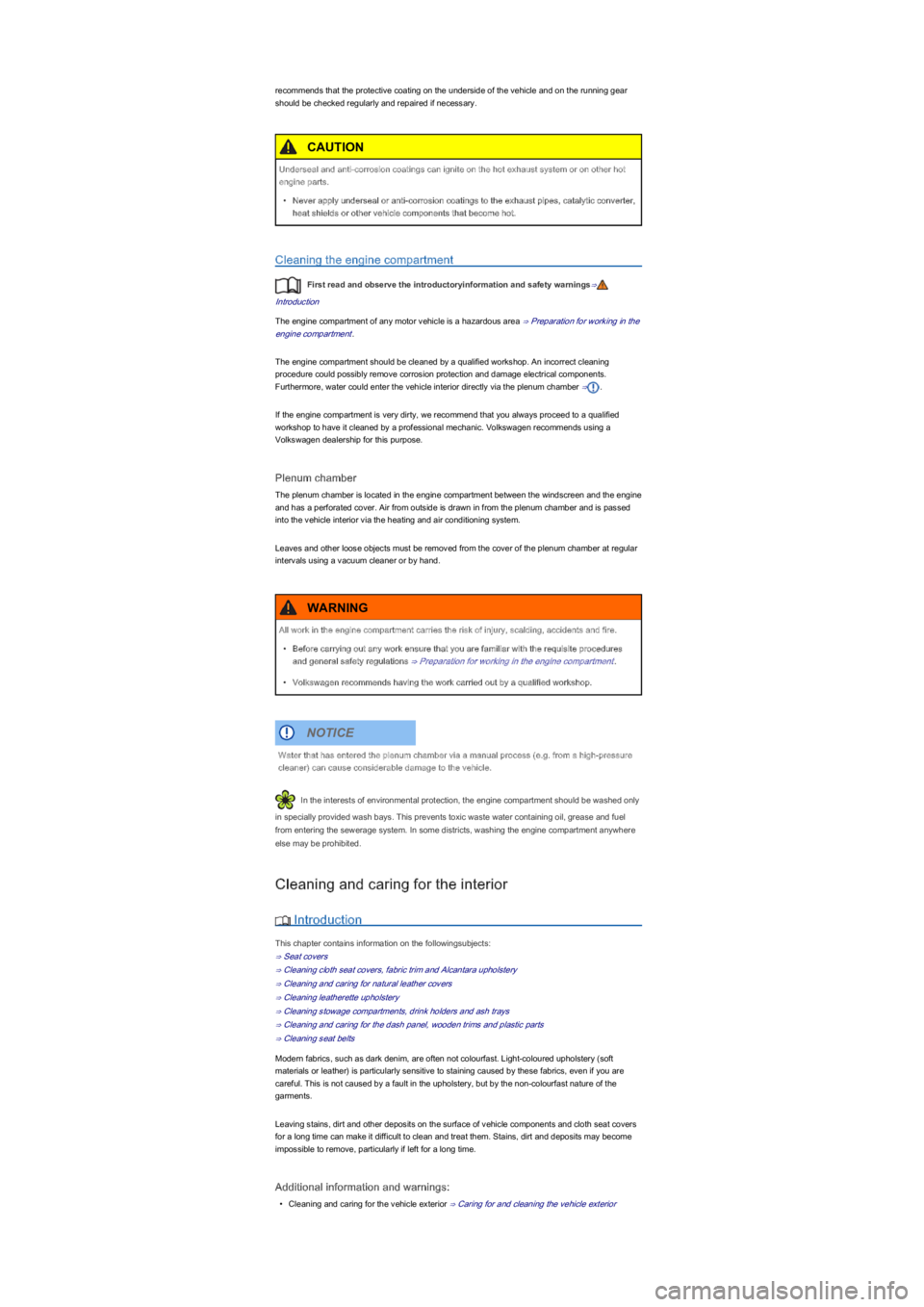
Cleaning the engine compartment
First read and observe the introductoryinformation and safety warnings⇒
Introduction
The engine compartment of any motor vehicle is a hazardous area ⇒ Preparation for working in the
engine compartment.
The engine compartment should be cleaned by a qualified workshop. An incorrect cleaning
procedure could possibly remove corrosion protection and damage electrical components.
Furthermore, water could enter the vehicle interior directly via the plenum chamber ⇒.
If the engine compartment is very dirty, we recommend that you always proceed to a qualified
workshop to have it cleaned by a professional mechanic. Volkswagen recommends using a
Volkswagen dealership for this purpose.
Plenum chamber
The plenum chamber is located in the engine compartment between the windscreen and the engine
and has a perforated cover. Air from outside is drawn in from the plenum chamber and is passed
into the vehicle interior via the heating and air conditioning system.
Leaves and other loose objects must be removed from the cover of the plenum chamber at regular
intervals using a vacuum cleaner or by hand.
In the interests of environmental protection, the engine compartment should be washed only
in specially provided wash bays. This prevents toxic waste water containing oil, grease and fuel
from entering the sewerage system. In some districts, washing the engine compartment anywhere
else may be prohibited.
Cleaning and caring for the interior
Introduction
This chapter contains information on the followingsubjects:
⇒ Seat covers
⇒ Cleaning cloth seat covers, fabric trim and Alcantara upholstery
⇒ Cleaning and caring for natural leather covers
⇒ Cleaning leatherette upholstery
⇒ Cleaning stowage compartments, drink holders and ash trays
⇒ Cleaning and caring for the dash panel, wooden trims and plastic parts
⇒ Cleaning seat belts
Modern fabrics, such as dark denim, are often not colourfast. Light-coloured upholstery (soft
materials or leather) is particularly sensitive to staining caused by these fabrics, even if you are
careful. This is not caused by a fault in the upholstery, but by the non-colourfast nature of the
garments.
Leaving stains, dirt and other deposits on the surface of vehicle components and cloth seat covers
for a long time can make it difficult to clean and treat them. Stains, dirt and deposits may become
impossible to remove, particularly if left for a long time.
Additional information and warnings:
•Cleaning and caring for the vehicle exterior ⇒ Caring for and cleaning the vehicle exterior
Underseal and anti-corrosion coatings can ignite on the hot exhaust system or on other hot
engine parts.
•Never apply underseal or anti-corrosion coatings to the exhaust pipes, catalytic converter,
heat shields or other vehicle components that become hot.
CAUTION
All work in the engine compartment carries the risk of injury, scalding, accidents and fire.
•Before carrying out any work ensure that you are familiar with the requisite procedures
and general safety regulations ⇒ Preparation for working in the engine compartment.
•Volkswagen recommends having the work carried out by a qualified workshop.
WARNING
Water that has entered the plenum chamber via a manual process (e.g. from a high-pressure
cleaner) can cause considerable damage to the vehicle.
NOTICE
Page 153 of 211
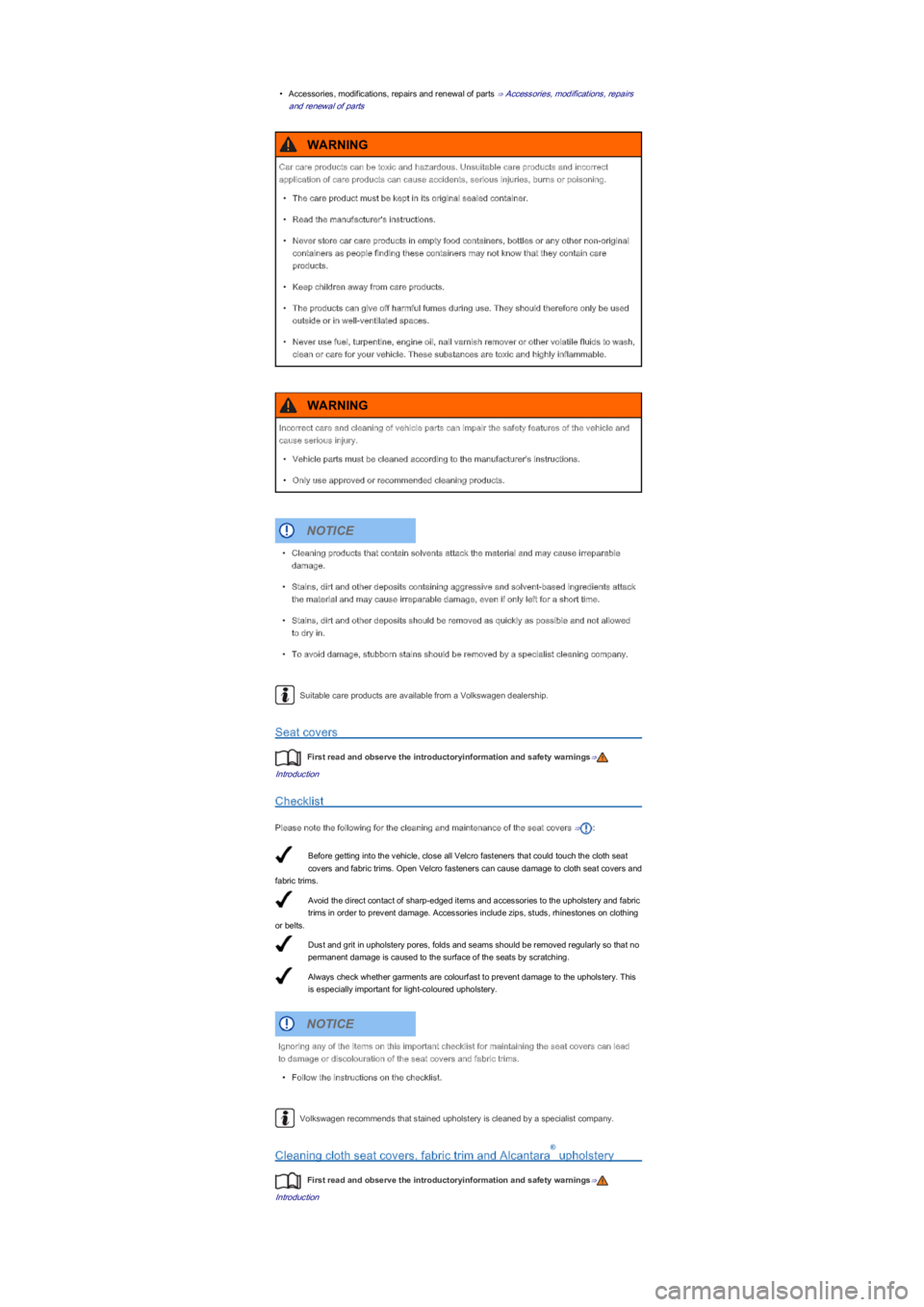
Before getting into the vehicle, close all Velcro fasteners that could touch the cloth seat
covers and fabric trims. Open Velcro fasteners can cause damage to cloth seat covers and
fabric trims.
Avoid the direct contact of sharp-edged items and accessories to the upholstery and fabric
trims in order to prevent damage. Accessories include zips, studs, rhinestones on clothing
or belts.
Dust and grit in upholstery pores, folds and seams should be removed regularly so that no
permanent damage is caused to the surface of the seats by scratching.
Always check whether garments are colourfast to prevent damage to the upholstery. This
is especially important for light-coloured upholstery.
•Accessories, modifications, repairs and renewal of parts ⇒ Accessories, modifications, repairs
and renewal of parts
Suitable care products are available from a Volkswagen dealership.
Seat covers
First read and observe the introductoryinformation and safety warnings⇒
Introduction
Checklist
Please note the following for the cleaning and maintenance of the seat covers ⇒:
Volkswagen recommends that stained upholstery is cleaned by a specialist company.
Cleaning cloth seat covers, fabric trim and Alcantara upholstery
First read and observe the introductoryinformation and safety warnings⇒
Introduction
Car care products can be toxic and hazardous. Unsuitable care products and incorrect
application of care products can cause accidents, serious injuries, burns or poisoning.
•The care product must be kept in its original sealed container.
•Read the manufacturer's instructions.
•Never store car care products in empty food containers, bottles or any other non-original
containers as people finding these containers may not know that they contain care
products.
•Keep children away from care products.
•The products can give off harmful fumes during use. They should therefore only be used
outside or in well-ventilated spaces.
•Never use fuel, turpentine, engine oil, nail varnish remover or other volatile fluids to wash,
clean or care for your vehicle. These substances are toxic and highly inflammable.
WARNING
Incorrect care and cleaning of vehicle parts can impair the safety features of the vehicle and
cause serious injury.
•Vehicle parts must be cleaned according to the manufacturer's instructions.
•Only use approved or recommended cleaning products.
WARNING
•Cleaning products that contain solvents attack the material and may cause irreparable
damage.
•Stains, dirt and other deposits containing aggressive and solvent-based ingredients attack
the material and may cause irreparable damage, even if only left for a short time.
•Stains, dirt and other deposits should be removed as quickly as possible and not allowed
to dry in.
•To avoid damage, stubborn stains should be removed by a specialist cleaning company.
NOTICE
Ignoring any of the items on this important checklist for maintaining the seat covers can lead
to damage or discolouration of the seat covers and fabric trims.
•Follow the instructions on the checklist.
NOTICE
®
Page 168 of 211
Snow chains are available in a range of sizes for a vehicle type.
Accessories, modifications, repairs and renewal of
parts
Introduction
This chapter contains information on the followingsubjects:
⇒ Running-in
⇒ Accessories and parts
⇒ Service fluids and consumables
⇒ Repairs and technical modifications
⇒ Repairs and faults in the airbag system
⇒ Retrofitting two-way radios
⇒ Information stored in the control units
⇒ Using a mobile telephone in the vehicle without a connection to the external aerial
⇒ Portable navigation device
⇒ Vehicle lifting points
Additional information and warnings:
•Seat belts ⇒ Seat belts
•Airbag system ⇒ Airbag system
•Roof carrier ⇒ Roof carrier
•Ashtray and cigarette lighter ⇒ Ashtray and cigarette lighter
•Electrical socket ⇒ Socket
•Braking, stopping and parking ⇒ Braking, stopping and parking
•Pull-away assist systems ⇒ Pull-away assist systems
•ParkPilot ⇒ ParkPilot
•Cruise Control System (CCS) ⇒ Cruise control system (CCS)
•Preparation for working in the engine compartment ⇒ Preparation for working in the engine
compartment
•Engine oil ⇒ Engine oil
•Engine coolant ⇒ Coolant
•Battery ⇒ Vehicle battery
•Cleaning and caring for the vehicle exterior ⇒ Caring for and cleaning the vehicle exterior
•Cleaning and caring for the interior ⇒ Cleaning and caring for the interior
•Consumer information ⇒ Consumer information
•⇒BookletRadio,
•User's manual for the portable navigation device (delivered by Volkswagen)
The use of snow chains that are unsuitable for your vehicle or the incorrect installation of
snow chains can cause accidents and serious injuries.
•Always use the correct snow chains.
•Follow the assembly instructions provided by the snow chain manufacturer.
•Never exceed the maximum speed permitted for the snow chains that are fitted.
WARNING
•Remove the snow chains when driving on roads that are free of snow. The snow chains will
otherwise impair handling, damage the tyres and wear out very quickly.
•Snow chains that are in direct contact with the wheel can scratch or damage it.
Volkswagen recommends using non-scratch snow chains.
NOTICE
Page 169 of 211
Running-in
First read and observe the introductoryinformation and safety warnings⇒
Introduction
Please follow the regulations concerning running-in new parts.
Running in a new engine
Any new engine has to be run in during the first 1,500 kilometres. During its first few hours of
running, the internal friction in the engine is greater than later on when all the moving parts have
bedded down.
The style of driving during the first 1,500 kilometres will also affect the engine quality. Even after
this time – and especially with a cold engine – drive the vehicle at moderate speeds in order to
reduce engine wear and to increase the mileage that the engine can cover. Do not drive at engine
speeds that are too low. Always shift down gear if the engine is not running smoothly. The
following applies up to 1,000 kilometres:
•Do not depress the accelerator fully.
•Do not drive the vehicle at more than 2/3 of the top engine speed.
From 1,000 to 1,500 kilometres, gradually increase driving performance to top speed and highest
engine speed.
Running in new tyres and brake pads
•New wheels and tyres ⇒ Wheels and tyres
•Information on the brakes ⇒ Braking, stopping and parking
If the engine is run in gently, the life of the engine will be increased and its oil consumption
reduced.
Accessories and parts
First read and observe the introductoryinformation and safety warnings⇒
Introduction
Volkswagen recommends that you seek advice from a Volkswagen dealership before purchasing
accessories, spare parts or service fluids. For example, if the vehicle is to be retrofitted with
accessories or if parts have to be renewed. Volkswagen dealerships can recommend accessories,
parts and service fluids suitable for your requirements. They can also answer any questions you
might have regarding official regulations.
Volkswagen recommends that you only use approved Volkswagen accessories and Volkswagen
Genuine Parts. These parts and accessories have been specially tested by Volkswagen for
suitability, reliability and safety. And Volkswagen dealerships are qualified to install them correctly.
Although the market is constantly scrutinised, Volkswagen cannot assume responsibility for the
reliability, safety and suitability of products Volkswagen has not approved. Volkswagen can
therefore assume no responsibility for these parts, even if they have been approved by an official
testing agency or are covered by an official approval certificate.
Any retro-fitted equipment that has a direct effect on the vehicle and/or the way it is driven must be
approved by Volkswagen for use in your vehicle and bear the e mark (the European Union's
authorization symbol). These devices include cruise control systems or an electronically controlled
suspension.
Any additional electrical components fitted that do not serve to control the vehicle itself must bear
the mark (manufacturer conformity declaration in the European Union). Such devices include
refrigerator boxes, laptops and ventilator fans.
Unsuitable spare parts and accessories, incorrectly carried out work, modifications and
repairs can lead to damage to the vehicle and cause accidents and serious injuries.
•Volkswagen strongly recommends that you only use approved Volkswagen accessories
and Volkswagen Genuine Parts. These parts and accessories have been specially tested
by Volkswagen for suitability, reliability and safety.
•Repairs and modifications to your vehicle should only be carried out by a qualified
workshop. Qualified workshops have the necessary tools, diagnostic equipment, repair
information and qualified personnel.
•Never fit parts to your vehicle that are in any way different from the factory-fitted parts.
•Never secure or mount objects such as drink holders or telephone holders on or next to
the airbag covers or within the deployment zone of the airbag.
•Only use rim/tyre combinations that have been approved by Volkswagen for your vehicle
type.
WARNING
®
®
Page 170 of 211
Service fluids and consumables
First read and observe the introductoryinformation and safety warnings⇒
Introduction
All service fluids and consumables, e.g. toothed belts, tyres, coolant, engine oil, spark plugs and
vehicle batteries, are being constantly developed. For this reason, service fluids and consumables
should be replaced at a qualified workshop. A Volkswagen dealership is always kept up to date on
innovations.
Leaking service fluids can pollute the environment. Spilt service fluids must be collected in
suitable containers and disposed of properly and with respect for the environment.
Repairs and technical modifications
First read and observe the introductoryinformation and safety warnings⇒
Introduction
Repairs and modifications must always be carried out according to Volkswagen specifications⇒
.
Unauthorised modifications to the electronic components or software in the vehicle may cause
faults. As the electronic components are linked together in networks, these faults may indirectly
affect the working of other systems. This can seriously impair safety, lead to excessive wear of
components, and also invalidate the type approval for the vehicle.
The Volkswagen dealership cannot be held liable for any damage caused by technical
modifications and/or work performed incorrectly.
The Volkswagen dealership cannot be held liable for any damage caused by technical
modifications and/or work performed incorrectly, nor are these covered by the Volkswagen
guarantee.
Volkswagen recommends that all repairs and technical modifications are performed by an
authorised Volkswagen dealership using Volkswagen Genuine Parts.
Vehicles with special auxiliary equipment or body parts
The manufacturer of these components must ensure that these parts (fittings) adhere to the
stipulated environmental laws and regulations, particularly the EU directive 2000/53/EC concerning
end-of-life vehicles and EU directive 2003/11/EC concerning the restriction on the marketing and
use of certain dangerous substances and preparations.
Incorrectly performed repairs or modifications to your vehicle can impair the effectiveness of
the airbags, cause faults, accidents and fatal injury.
•Never secure or mount objects such as drink holders or telephone holders either on or
next to the airbag covers or within the deployment zones of the airbag modules.
•Objects either on or next to the airbag module covers or are in the deployment zone of the
airbags can cause serious or even fatal injuries should the airbags be activated.
WARNING
Unsuitable service fluids and consumables, and the incorrect use of these fluids and
consumables, can cause accidents, serious injuries, burns or poisoning.
•Service fluids must be kept in their original sealed container.
•Never store service fluids in empty food containers, bottles or any other non-original
containers as people finding these containers could drink them.
•Keep children away from all service fluids and consumables.
•Always read and follow the information and warnings on the service fluid packaging.
•When using products that give off harmful fumes, always work outdoors or in a well-
ventilated area.
•Never use fuel, turpentine, engine oil, nail varnish remover or other volatile fluids for
vehicle care. They are toxic and highly flammable. They could cause fires and explosions.
WARNING
•Only use suitable service fluids for refilling. Never use the wrong service fluid. Failure to
observe this warning can result in serious malfunctions and engine damage.
•Optional equipment and other accessories in front of the air inlet reduce the cooling effect
of the coolant. The engine may overheat at high ambient temperatures and high engine
loads.
NOTICE
®
Page 177 of 211
There are many precautions that have to be followed when lifting a vehicle on a workshop hoist or
floor jack. Do not try to lift a vehicle on a lifting platform or vehicle jack unless you have the training,
knowledge and experience to be able to do so safely.
Using the jack to lift the vehicle ⇒ Changing a wheel.
Consumer information
Introduction
This chapter contains information on the followingsubjects:
⇒ Information stickers and plates
⇒ Using the vehicle in other countries and continents
⇒ Radio reception and aerials
⇒ Volkswagen repair information
⇒ Declaration of conformity
⇒ Declaration of conformity for wheels and tyres
⇒ Recycling and scrapping end-of-life vehicles
Additional information and warnings:
•Exterior views ⇒ Exterior views
•Pull-away assist systems ⇒ Pull-away assist systems
•Accessories, modifications, repairs and renewal of parts ⇒ Accessories, modifications, repairs
and renewal of parts
•⇒BookletService schedule,
Lifting your vehicle incorrectly with a lifting platform or vehicle jack can cause accidents and
serious personal injury:
•Always read and heed the operating instructions from the lifting platform or vehicle jack
manufacturer and any legal regulations before lifting the vehicle.
•All occupants should leave the vehicle before it is lifted.
•The vehicle should only be lifted at the points indicated in the illustrations ⇒ Fig. 137 and
⇒ Fig. 138. If the vehicle is not lifted at the points shown, it could fall off the lifting platform
when work is carried out, e.g. when the engine or gearbox is removed.
•The vehicle jacking points must be placed on the centre of the vehicle lift support surfaces,
with as much surface contact between the vehicle and the support surfaces as possible.
•Never start the engine when the vehicle is raised. The vibration of the engine could cause
the vehicle to fall off the lifting point.
•If work has to be carried out underneath the lifted vehicle, secure the vehicle with suitable
jack stands with a sufficient load-bearing capacity.
•Never climb up the lifting platform.
•Always ensure that the vehicle is not heavier than the lifting capacity of the lifting platform.
WARNING
•Never lift the vehicle by the engine oil sump, the gearbox or the front or rear axle.
•To prevent damage to the underside of the vehicle when lifting, rubber pads must be used.
Ensure that the lifting platform arms are able to move freely.
•The lifting platform arms must not be allowed to come into contact with the sills or any
other part of the vehicle.
NOTICE
Handling the vehicle incorrectly will increase the risk of accident and injuries.
•Comply with legal regulations.
•Observe the owner's manual.
WARNING
Handling the vehicle incorrectly could lead to the vehicle becoming damaged.
•Comply with legal regulations.
•Carry out service jobs in accordance with the service schedule.
•Observe the owner's manual.
NOTICE
Page 180 of 211
⇒ Catalytic converter
Additional information and warnings:
•Changing gear ⇒ Changing gear
•Filling the tank ⇒ Filling the tank
•Fuel ⇒ Fuel
•Engine oil ⇒ Engine oil
•Battery ⇒ Vehicle battery
•Information stored in the control units ⇒ Accessories, modifications, repairs and renewal of parts
•Tow-starting and towing ⇒ Tow-starting and towing
Indicator lamps
First read and observe the introductoryinformation and safety warnings⇒
Introduction
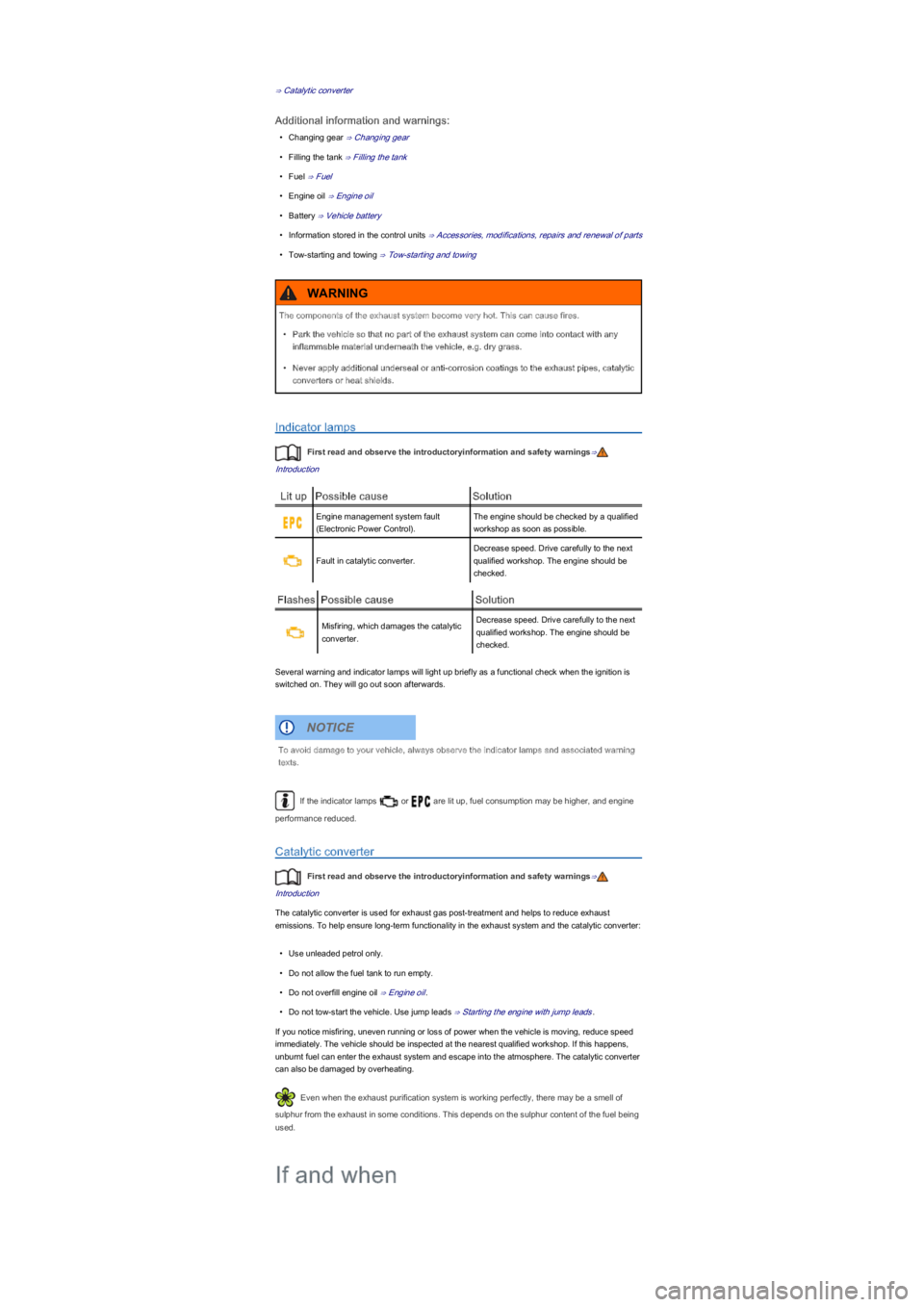
Lit upPossible causeSolution
Engine management system fault
(Electronic Power Control).
The engine should be checked by a qualified
workshop as soon as possible.
Fault in catalytic converter.
Decrease speed. Drive carefully to the next
qualified workshop. The engine should be
checked.
FlashesPossible causeSolution
Misfiring, which damages the catalytic
converter.
Decrease speed. Drive carefully to the next
qualified workshop. The engine should be
checked.
Several warning and indicator lamps will light up briefly as a functional check when the ignition is
switched on. They will go out soon afterwards.
If the indicator lamps or are lit up, fuel consumption may be higher, and engine
performance reduced.
Catalytic converter
First read and observe the introductoryinformation and safety warnings⇒
Introduction
The catalytic converter is used for exhaust gas post-treatment and helps to reduce exhaust
emissions. To help ensure long-term functionality in the exhaust system and the catalytic converter:
•Use unleaded petrol only.
•Do not allow the fuel tank to run empty.
•Do not overfill engine oil ⇒ Engine oil.
•Do not tow-start the vehicle. Use jump leads ⇒ Starting the engine with jump leads.
If you notice misfiring, uneven running or loss of power when the vehicle is moving, reduce speed
immediately. The vehicle should be inspected at the nearest qualified workshop. If this happens,
unburnt fuel can enter the exhaust system and escape into the atmosphere. The catalytic converter
can also be damaged by overheating.
Even when the exhaust purification system is working perfectly, there may be a smell of
sulphur from the exhaust in some conditions. This depends on the sulphur content of the fuel being
used.
The components of the exhaust system become very hot. This can cause fires.
•Park the vehicle so that no part of the exhaust system can come into contact with any
inflammable material underneath the vehicle, e.g. dry grass.
•Never apply additional underseal or anti-corrosion coatings to the exhaust pipes, catalytic
converters or heat shields.
WARNING
To avoid damage to your vehicle, always observe the indicator lamps and associated warning
texts.
NOTICE
If and when
Page 191 of 211
Find a firm and level surface suitable for lifting the vehicle.
Stop the engine, select a gear on a manual gearbox or with an automated manual
gearbox, move the selector lever to D or R with the ignition switched onChanging gear
then apply the handbrake firmly Braking, stopping and parking.
Chock the wheel diagonally opposite using the collapsible chocks or other suitable objects.
Loosen the wheel bolts on the wheel that is being changed Wheel bolts.
Find the jacking point under the vehicle which is closest to the wheel that is being
changed.
Raise the vehicle jack until it just fits under the jacking point of the vehicle.
Ensure that the foot of the jack is resting securely on the ground with its whole surface and
that the foot of the jack is positioned precisely, i.e. vertically beneath the point of
application .
Position the vehicle jack. At the same time, continue to crank the claw up until it is in
position around the vertical rib underneath the vehicle .
Lifting the vehicle with the jack
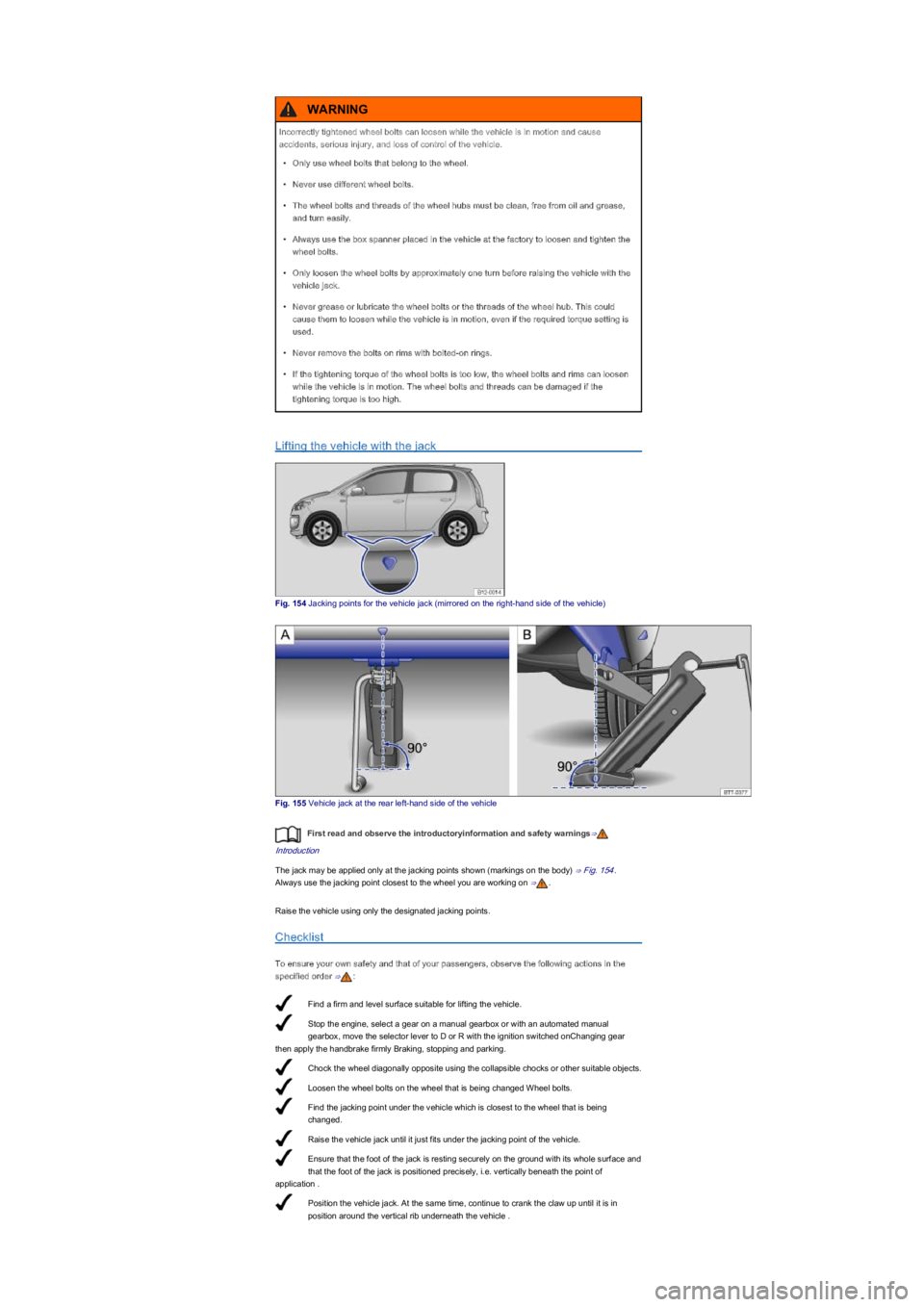
Fig. 154 Jacking points for the vehicle jack (mirrored on the right-hand side of the vehicle)
Fig. 155 Vehicle jack at the rear left-hand side of the vehicle
First read and observe the introductoryinformation and safety warnings⇒
Introduction
The jack may be applied only at the jacking points shown (markings on the body) ⇒ Fig. 154.
Always use the jacking point closest to the wheel you are working on ⇒.
Raise the vehicle using only the designated jacking points.
Checklist
To ensure your own safety and that of your passengers, observe the following actions in the
specified order ⇒:
Incorrectly tightened wheel bolts can loosen while the vehicle is in motion and cause
accidents, serious injury, and loss of control of the vehicle.
•Only use wheel bolts that belong to the wheel.
•Never use different wheel bolts.
•The wheel bolts and threads of the wheel hubs must be clean, free from oil and grease,
and turn easily.
•Always use the box spanner placed in the vehicle at the factory to loosen and tighten the
wheel bolts.
•Only loosen the wheel bolts by approximately one turn before raising the vehicle with the
vehicle jack.
•Never grease or lubricate the wheel bolts or the threads of the wheel hub. This could
cause them to loosen while the vehicle is in motion, even if the required torque setting is
used.
•Never remove the bolts on rims with bolted-on rings.
•If the tightening torque of the wheel bolts is too low, the wheel bolts and rims can loosen
while the vehicle is in motion. The wheel bolts and threads can be damaged if the
tightening torque is too high.
WARNING