light VOLKSWAGEN UP! 2021 Owner´s Manual
[x] Cancel search | Manufacturer: VOLKSWAGEN, Model Year: 2021, Model line: UP!, Model: VOLKSWAGEN UP! 2021Pages: 211, PDF Size: 5.98 MB
Page 119 of 211
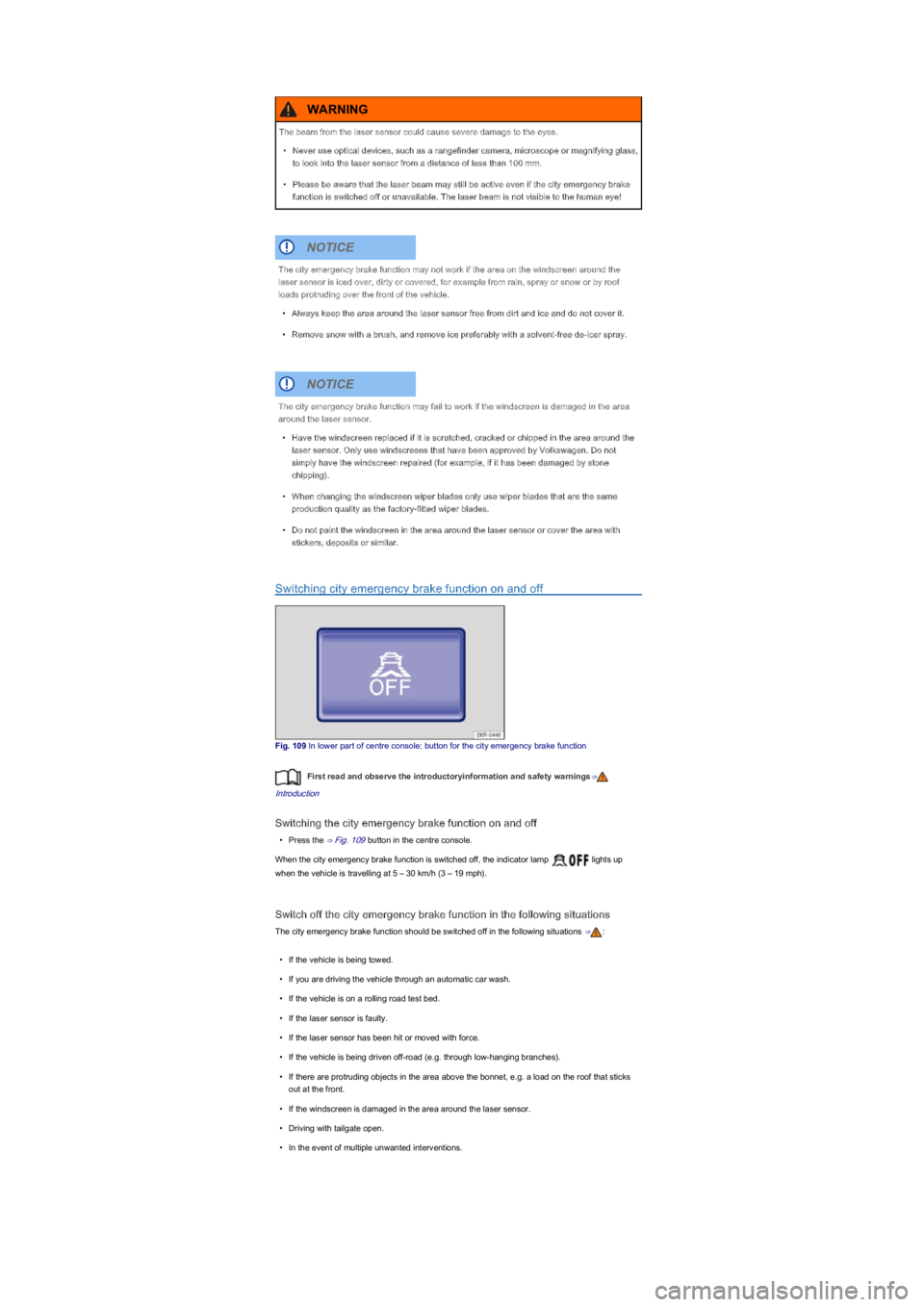
Switching city emergency brake function on and off
Fig. 109 In lower part of centre console: button for the city emergency brake function
First read and observe the introductoryinformation and safety warnings⇒
Introduction
Switching the city emergency brake function on and off
•Press the ⇒ Fig. 109 button in the centre console.
When the city emergency brake function is switched off, the indicator lamp lights up
when the vehicle is travelling at 5 – 30 km/h (3 – 19 mph).
Switch off the city emergency brake function in the following situations
The city emergency brake function should be switched off in the following situations ⇒:
•If the vehicle is being towed.
•If you are driving the vehicle through an automatic car wash.
•If the vehicle is on a rolling road test bed.
•If the laser sensor is faulty.
•If the laser sensor has been hit or moved with force.
•If the vehicle is being driven off-road (e.g. through low-hanging branches).
•If there are protruding objects in the area above the bonnet, e.g. a load on the roof that sticks
out at the front.
•If the windscreen is damaged in the area around the laser sensor.
•Driving with tailgate open.
•In the event of multiple unwanted interventions.
The beam from the laser sensor could cause severe damage to the eyes.
•Never use optical devices, such as a rangefinder camera, microscope or magnifying glass,
to look into the laser sensor from a distance of less than 100 mm.
•Please be aware that the laser beam may still be active even if the city emergency brake
function is switched off or unavailable. The laser beam is not visible to the human eye!
WARNING
The city emergency brake function may not work if the area on the windscreen around the
laser sensor is iced over, dirty or covered, for example from rain, spray or snow or by roof
loads protruding over the front of the vehicle.
•Always keep the area around the laser sensor free from dirt and ice and do not cover it.
•Remove snow with a brush, and remove ice preferably with a solvent-free de-icer spray.
NOTICE
The city emergency brake function may fail to work if the windscreen is damaged in the area
around the laser sensor.
•Have the windscreen replaced if it is scratched, cracked or chipped in the area around the
laser sensor. Only use windscreens that have been approved by Volkswagen. Do not
simply have the windscreen repaired (for example, if it has been damaged by stone
chipping).
•When changing the windscreen wiper blades only use wiper blades that are the same
production quality as the factory-fitted wiper blades.
•Do not paint the windscreen in the area around the laser sensor or cover the area with
stickers, deposits or similar.
NOTICE
Page 120 of 211
Special driving situations
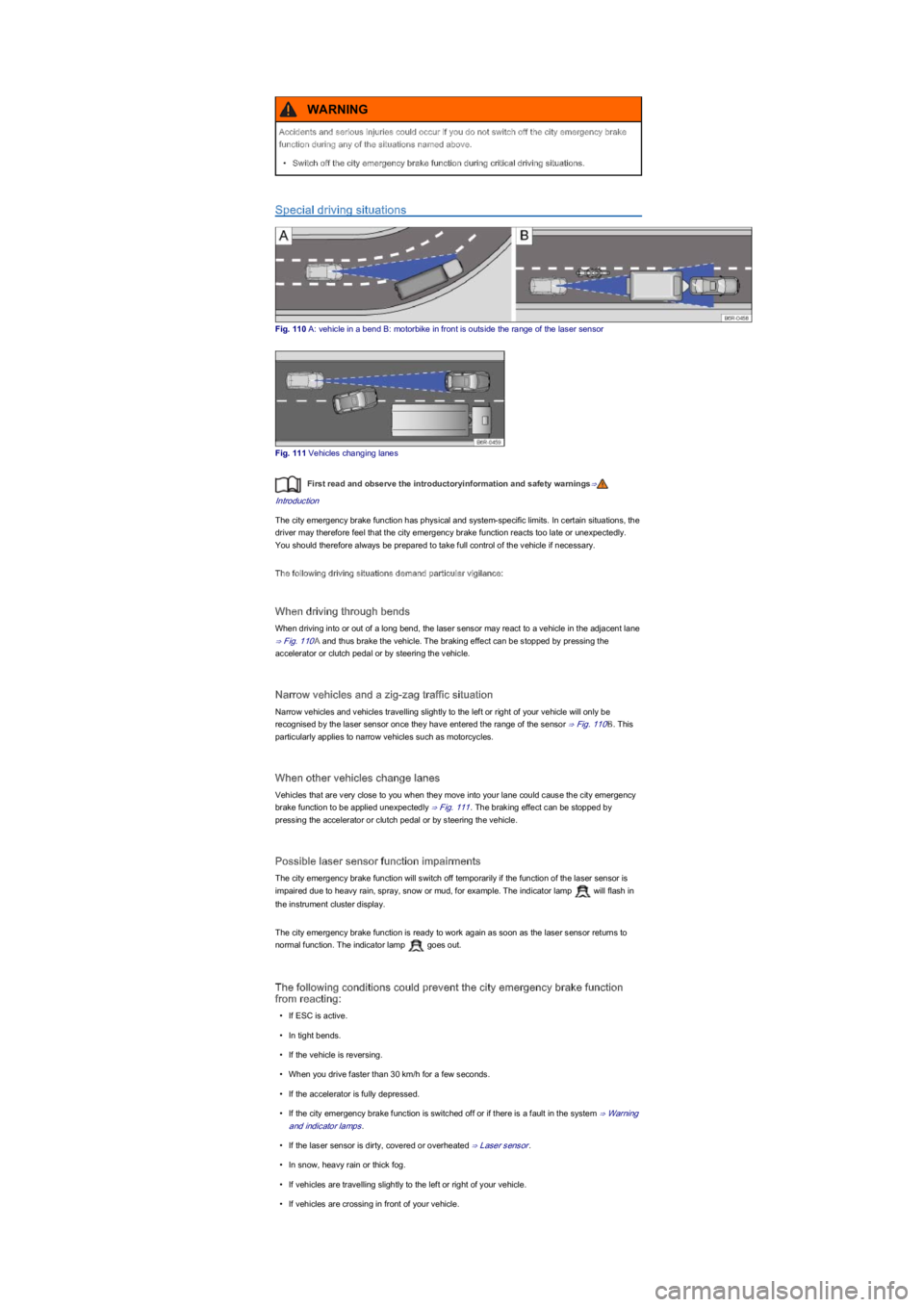
Fig. 110 A: vehicle in a bend B: motorbike in front is outside the range of the laser sensor
Fig. 111 Vehicles changing lanes
First read and observe the introductoryinformation and safety warnings⇒
Introduction
The city emergency brake function has physical and system-specific limits. In certain situations, the
driver may therefore feel that the city emergency brake function reacts too late or unexpectedly.
You should therefore always be prepared to take full control of the vehicle if necessary.
The following driving situations demand particular vigilance:
When driving through bends
When driving into or out of a long bend, the laser sensor may react to a vehicle in the adjacent lane
⇒ Fig. 110A and thus brake the vehicle. The braking effect can be stopped by pressing the
accelerator or clutch pedal or by steering the vehicle.
Narrow vehicles and a zig-zag traffic situation
Narrow vehicles and vehicles travelling slightly to the left or right of your vehicle will only be
recognised by the laser sensor once they have entered the range of the sensor ⇒ Fig. 110B. This
particularly applies to narrow vehicles such as motorcycles.
When other vehicles change lanes
Vehicles that are very close to you when they move into your lane could cause the city emergency
brake function to be applied unexpectedly ⇒ Fig. 111. The braking effect can be stopped by
pressing the accelerator or clutch pedal or by steering the vehicle.
Possible laser sensor function impairments
The city emergency brake function will switch off temporarily if the function of the laser sensor is
impaired due to heavy rain, spray, snow or mud, for example. The indicator lamp will flash in
the instrument cluster display.
The city emergency brake function is ready to work again as soon as the laser sensor returns to
normal function. The indicator lamp goes out.
The following conditions could prevent the city emergency brake function
from reacting:
•If ESC is active.
•In tight bends.
•If the vehicle is reversing.
•When you drive faster than 30 km/h for a few seconds.
•If the accelerator is fully depressed.
•If the city emergency brake function is switched off or if there is a fault in the system ⇒ Warning
and indicator lamps.
•If the laser sensor is dirty, covered or overheated ⇒ Laser sensor.
•In snow, heavy rain or thick fog.
•If vehicles are travelling slightly to the left or right of your vehicle.
•If vehicles are crossing in front of your vehicle.
Accidents and serious injuries could occur if you do not switch off the city emergency brake
function during any of the situations named above.
•Switch off the city emergency brake function during critical driving situations.
WARNING
Page 121 of 211
•If vehicles are travelling towards you in the same lane.
•If the surrounding vehicles are very dirty and therefore not very reflective.
•If there is a lot of dust.
Air conditioning system
Heating, ventilating, cooling
Introduction
This chapter contains information on the followingsubjects:
⇒ Controls
⇒ General information on the heating and fresh air system
⇒ Information on the air conditioning system
⇒ Vents
⇒ Air recirculation mode
Dust and pollen filter
The dust and pollen filter reduces the level of impurities in the outside air entering the vehicle.
The dust and pollen filter must be changed regularly to avoid impairing the performance of the air
conditioning system.
The dust and pollen filter must be changed more frequently than stated in the service schedule if
the efficiency of the filter declines prematurely due to the vehicle being used in areas with high
levels of air pollution.
Additional information and warnings:
•Exterior views ⇒ Exterior views
•Volkswagen information system ⇒ Volkswagen information system
•Windscreen wiper/washer ⇒ Windscreen wiper and washer
•Cleaning and caring for the vehicle exterior ⇒ Caring for and cleaning the vehicle exterior
If the cooling system is switched off, the outside air that is drawn into the vehicle is not
dehumidified. To prevent the windows misting over, Volkswagen recommends that you leave the air
conditioning (compressor) switched on. Press the button. The indicator lamp in the button
must light up.
Maximum heat output, which is needed to defrost the windows as quickly as possible, is only
available when the engine has reached its operating temperature.
Poor visibility through all windows increases the risk of collisions and accidents, which can
cause serious injuries.
•Always ensure that all windows are free of ice, snow and mist to ensure good visibility.
•Maximum heat output, which is needed to defrost the windows as quickly as possible, is
only available when the engine has reached its operating temperature. Do not start your
journey until you have good visibility.
•Always ensure that the heating and fresh air system or the air conditioning system and the
heated rear window are used correctly in order to have good visibility.
•Never use the air recirculation mode for an extended period. If the cooling system is
switched off, the windows can mist up very quickly in air recirculation mode and reduce
visibility considerably.
•Always switch off the air recirculation mode when it is not required.
WARNING
Stale air can quickly cause tiredness and lack of concentration in the driver, which in turn can
cause collisions, accidents and serious injuries.
•Never switch off the blowers or switch on the air recirculation mode for an extended period
as this prevents fresh air from entering the vehicle interior.
WARNING
•Switch off the air conditioning system if you suspect that it has been damaged. This can
help to prevent further damage. The air conditioning system should be checked by a
qualified workshop.
•Repairs to the air conditioning system require specialist knowledge and special tools.
Volkswagen recommends using a Volkswagen dealership for this purpose.
NOTICE
Page 123 of 211
General information on the heating and fresh air system
First read and observe the introductoryinformation and safety warnings⇒
Introduction
The required interior temperature cannot be lower than the outside temperature as the heating and
fresh air system cannot cool or dehumidify the air.
Settings for optimal road visibility
•Set blower ⇒ Fig. 112② to level 1 or 2.
•Open and position all vents on the dash panel ⇒ Vents.
•Turn the air distribution controller ⇒ Fig. 112③ to the defrost position.
Information on the air conditioning system
First read and observe the introductoryinformation and safety warnings⇒
Introduction
The cooling system for the vehicle interior only works when the engine is running and the blower is
switched on.
The air conditioning system operates most effectively with the windows and the electric panorama
sliding and tilting glass roof closed. However, if the vehicle has heated up after standing in the sun
for some time, the air inside can be cooled more quickly by opening the windows and the electric
panorama sliding and tilting glass roof for a short time.
Settings for optimal road visibility
Switching the cooling system on not only reduces the temperature of the vehicle interior, but also
the humidity. This improves comfort for the vehicle occupants and prevents the windows from
misting when the outside humidity is high.
•Switch off air recirculation mode ⇒ Air recirculation mode.
•Set the blowers to the required level.
•Open and position all vents on the dash panel ⇒ Vents.
•Turn the air distribution controller to the defrost position.
•Press the button to switch the cooling system on. The indicator lamp in the button
lights up.
The cooling system cannot be switched on
The following criteria may prevent the cooling system from being switched on:
•The engine is not running.
•The blower is switched off.
•The air conditioning system fuse has blown.
•The ambient temperature is lower than approximately +2℃ (+36°F).
•The compressor has been temporarily switched off because the coolant temperature is too high.
•There is a different fault in the vehicle. The air conditioning system should be checked by a
qualified workshop.
Things to note
If the humidity and temperature outside the vehicle are high, condensation can drip off the
evaporator in the cooling system and form a pool underneath the vehicle. This is normal and does
not indicate a leak.
The windscreen may mist up after starting the engine due to residual humidity in the air
conditioning system. Switch the defrost function on in order to clear the windscreen of condensation
or mist as quickly as possible.
Vents
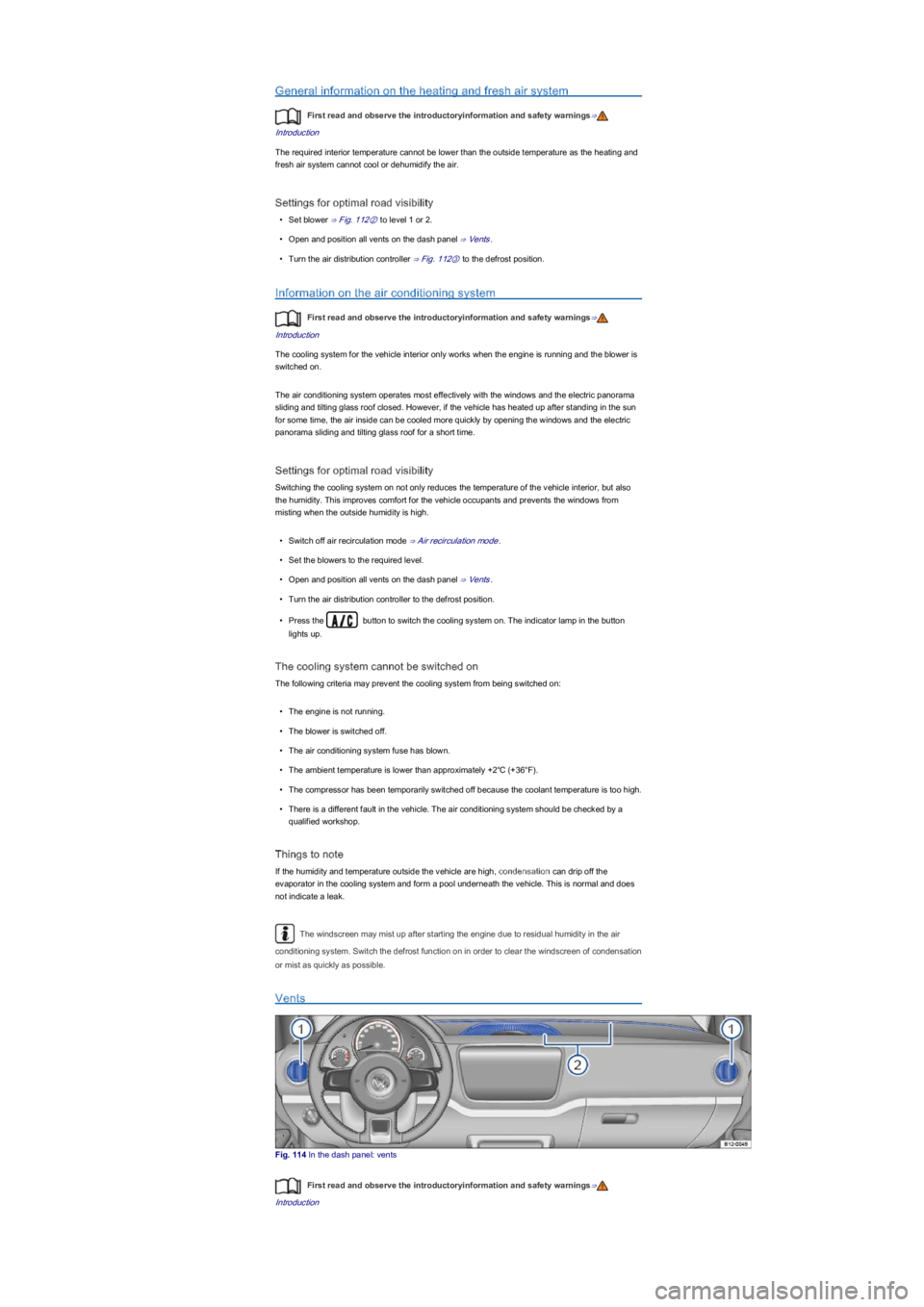
Fig. 114 In the dash panel: vents
First read and observe the introductoryinformation and safety warnings⇒
Introduction
Page 126 of 211
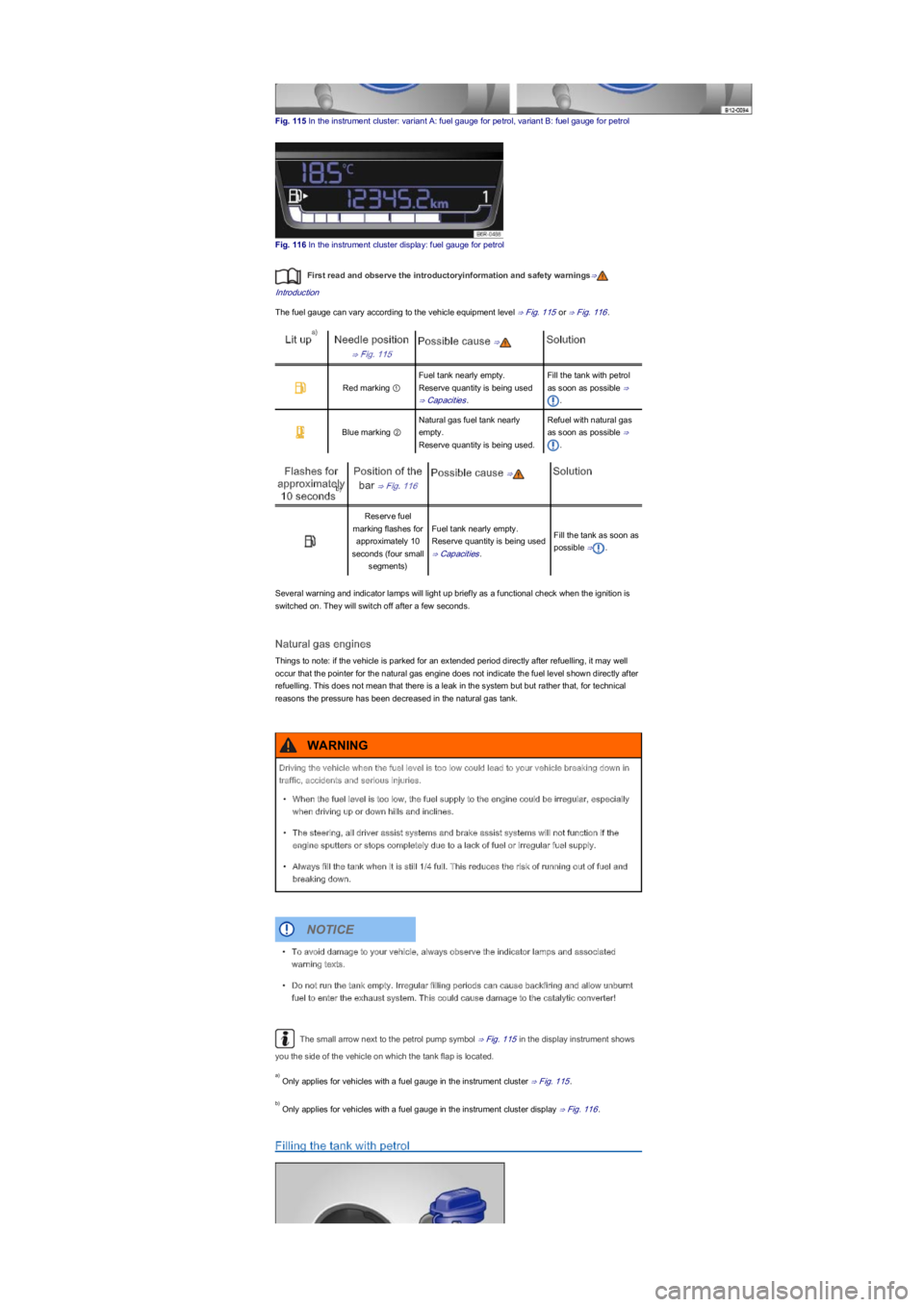
Fig. 115 In the instrument cluster: variant A: fuel gauge for petrol, variant B: fuel gauge for petrol
Fig. 116 In the instrument cluster display: fuel gauge for petrol
First read and observe the introductoryinformation and safety warnings⇒
Introduction
The fuel gauge can vary according to the vehicle equipment level ⇒ Fig. 115 or ⇒ Fig. 116.
Lit upNeedle position
⇒ Fig. 115
Possible cause ⇒Solution
Red marking ①
Fuel tank nearly empty.
Reserve quantity is being used
⇒ Capacities.
Fill the tank with petrol
as soon as possible ⇒
.
Blue marking ②
Natural gas fuel tank nearly
empty.
Reserve quantity is being used.
Refuel with natural gas
as soon as possible ⇒
.
Flashes for
approximately
10 seconds
Position of the
bar ⇒ Fig. 116
Possible cause ⇒Solution
Reserve fuel
marking flashes for
approximately 10
seconds (four small
segments)
Fuel tank nearly empty.
Reserve quantity is being used
⇒ Capacities.
Fill the tank as soon as
possible ⇒.
Several warning and indicator lamps will light up briefly as a functional check when the ignition is
switched on. They will switch off after a few seconds.
Natural gas engines
Things to note: if the vehicle is parked for an extended period directly after refuelling, it may well
occur that the pointer for the natural gas engine does not indicate the fuel level shown directly after
refuelling. This does not mean that there is a leak in the system but but rather that, for technical
reasons the pressure has been decreased in the natural gas tank.
The small arrow next to the petrol pump symbol ⇒ Fig. 115 in the display instrument shows
you the side of the vehicle on which the tank flap is located.
Only applies for vehicles with a fuel gauge in the instrument cluster ⇒ Fig. 115.
Only applies for vehicles with a fuel gauge in the instrument cluster display ⇒ Fig. 116.
Filling the tank with petrol
a)
b)
Driving the vehicle when the fuel level is too low could lead to your vehicle breaking down in
traffic, accidents and serious injuries.
•When the fuel level is too low, the fuel supply to the engine could be irregular, especially
when driving up or down hills and inclines.
•The steering, all driver assist systems and brake assist systems will not function if the
engine sputters or stops completely due to a lack of fuel or irregular fuel supply.
•Always fill the tank when it is still 1/4 full. This reduces the risk of running out of fuel and
breaking down.
WARNING
•To avoid damage to your vehicle, always observe the indicator lamps and associated
warning texts.
•Do not run the tank empty. Irregular filling periods can cause backfiring and allow unburnt
fuel to enter the exhaust system. This could cause damage to the catalytic converter!
NOTICE
a)
b)
Page 127 of 211
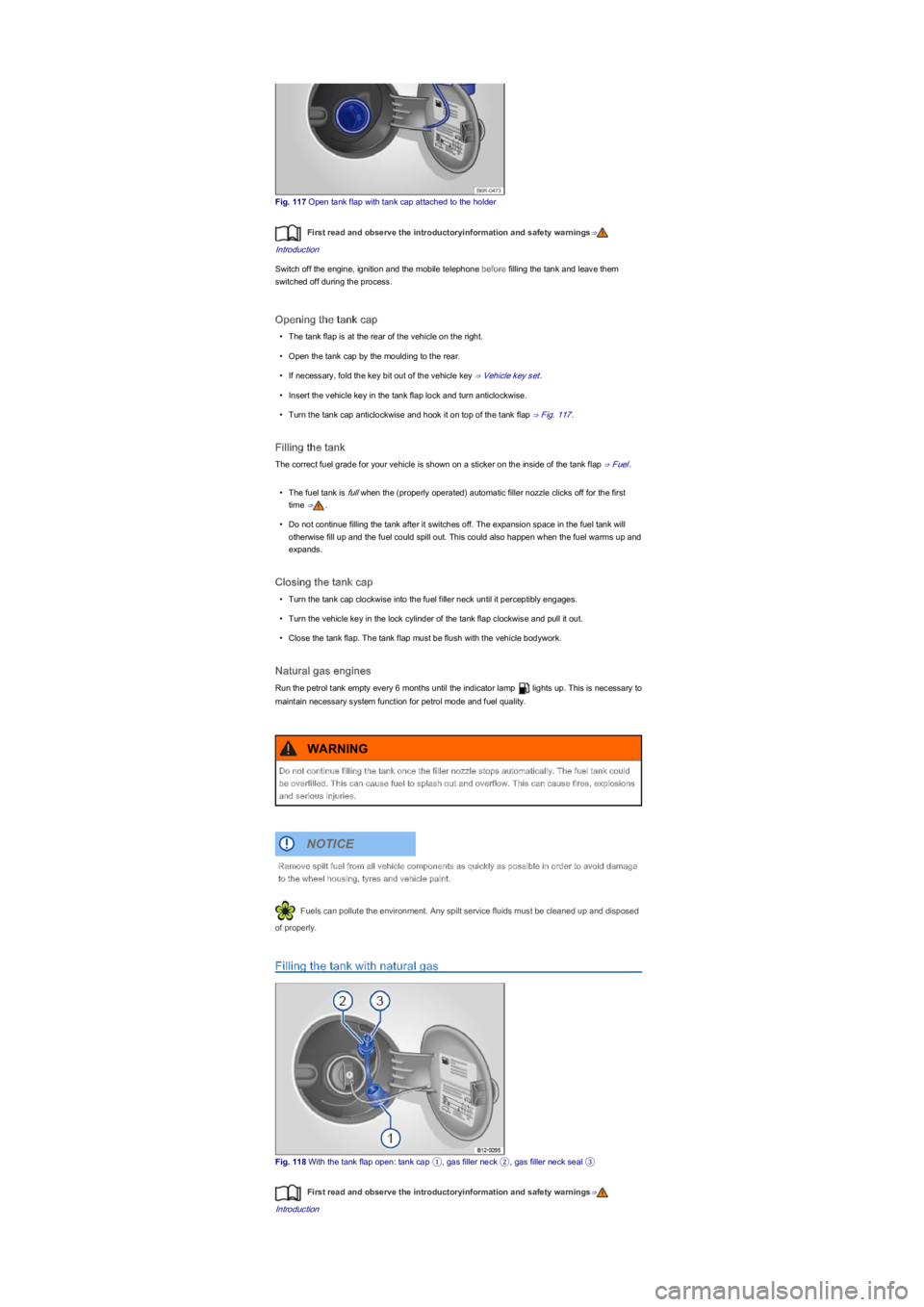
Fig. 117 Open tank flap with tank cap attached to the holder
First read and observe the introductoryinformation and safety warnings⇒
Introduction
Switch off the engine, ignition and the mobile telephone before filling the tank and leave them
switched off during the process.
Opening the tank cap
•The tank flap is at the rear of the vehicle on the right.
•Open the tank cap by the moulding to the rear.
•If necessary, fold the key bit out of the vehicle key ⇒ Vehicle key set.
•Insert the vehicle key in the tank flap lock and turn anticlockwise.
•Turn the tank cap anticlockwise and hook it on top of the tank flap ⇒ Fig. 117.
Filling the tank
The correct fuel grade for your vehicle is shown on a sticker on the inside of the tank flap ⇒ Fuel.
•The fuel tank is full when the (properly operated) automatic filler nozzle clicks off for the first
time ⇒.
•Do not continue filling the tank after it switches off. The expansion space in the fuel tank will
otherwise fill up and the fuel could spill out. This could also happen when the fuel warms up and
expands.
Closing the tank cap
•Turn the tank cap clockwise into the fuel filler neck until it perceptibly engages.
•Turn the vehicle key in the lock cylinder of the tank flap clockwise and pull it out.
•Close the tank flap. The tank flap must be flush with the vehicle bodywork.
Natural gas engines
Run the petrol tank empty every 6 months until the indicator lamp lights up. This is necessary to
maintain necessary system function for petrol mode and fuel quality.
Fuels can pollute the environment. Any spilt service fluids must be cleaned up and disposed
of properly.
Filling the tank with natural gas
Fig. 118 With the tank flap open: tank cap ①, gas filler neck ②, gas filler neck seal ③
First read and observe the introductoryinformation and safety warnings⇒
Introduction
Do not continue filling the tank once the filler nozzle stops automatically. The fuel tank could
be overfilled. This can cause fuel to splash out and overflow. This can cause fires, explosions
and serious injuries.
WARNING
Remove spilt fuel from all vehicle components as quickly as possible in order to avoid damage
to the wheel housing, tyres and vehicle paint.
NOTICE
Page 129 of 211
Windscreen washer fluid level Windscreen wiper and washer
Engine oil level Engine oil
Engine coolant level Coolant
Brake fluid level Braking, stopping and parking
Tyre pressure Wheels and tyres
equipment, service fluids and unsuitable tools are not available ⇒ Preparation for working in the
engine compartment! The work should be carried out by a qualified workshop if you are
uncertain. Please ensure that the following are checked regularly, preferably every time you fill
the tank:
Vehicle lighting necessary for traffic safety:
- Turn signals
- Side lights, dipped beam headlights and main beam headlights
- Tail light cluster
- Brake lights
- Rear fog light ⇒ Lights
Information on changing bulbs ⇒ Changing bulbs.
Fuel
Introduction
This chapter contains information on the followingsubjects:
⇒ Petrol
⇒ Natural gas
Different engines require different fuels. The factory-fitted sticker on the inside of the tank flap
indicates the fuel type that is required for your particular vehicle.
Volkswagen recommends using low-sulphur or sulphur-free fuels, to help reduce fuel consumption
and prevent damage to the engine.
If the engine is not running smoothly or begins to judder, this can indicate poor or inadequate fuel
quality, e.g. water in the fuel. If these symptoms appear, reduce the vehicle speed immediately and
drive to the nearest qualified workshop at medium engine speeds, avoiding high engine loading. If
these symptoms occur immediately after the vehicle has been refuelled, switch the engine off as
soon as it is safe to do so and seek expert assistance. This can help to prevent further damage.
Additional information and warnings:
•⇒BookletService schedule,
•Filling the tank ⇒ Filling the tank
•Engine management and exhaust system ⇒ Engine management system and exhaust
purification system
Petrol
First read and observe the introductoryinformation and safety warnings⇒
Introduction
Petrol types
Vehicles with a petrol engine must be run on unleaded petrol in compliance with the European
standard EN 228 or DIN 51626-1 ⇒. Fuels with a maximum ethanol content of 10% (E10) can
be used for refuelling.
Petrol types are categorised according to their octane number, e.g. 91, 95, 98 or 99 RON (RON =
Research Octane Number). The vehicle may be filled with petrol that has a higher octane number
Incorrect handling of fuel can cause explosions, fire and serious burns and injuries.
•Fuel is highly explosive and inflammable.
•Never handle fuel near open flames, sparks or glowing matter (e.g. cigarettes).
•Keep naked flames, hot parts and sparks at a safe distance.
•Switch off your mobile telephone or two-way radio when dealing with fuel. Electromagnetic
radiation can generate sparks which can in turn start a fire.
•Avoid electrostatic discharge and electromagnetic radiation in the direct vicinity of fuels.
•Never spill fuel in the vehicle or in the luggage compartment.
•Comply with any relevant safety information and legislation concerning the handling of
fuels.
WARNING
Page 130 of 211
than the engine requires. However, this does not provide any advantage in terms of fuel
consumption or engine output.
Volkswagen recommends using fuel with a low sulphur content or sulphur-free fuel for petrol
engines in order to achieve reduced fuel consumption.
Petrol additives
The quality of petrol influences the running properties, performance and service life of the engine.
This is why the vehicle should be refuelled with good quality petrol that has only non-metallic
additives pre-added by the petroleum industry. These petrol additives help to prevent corrosion,
keep the fuel system clean, and prevent the build-up of deposits in the engine.
If good quality petrol containing non-metallic additives is not available, or if engine problems arise,
the necessary petrol additives must be added to the petrol when refuelling ⇒.
Not all petrol additives are effective. The use of unsuitable petrol additives can cause considerable
damage to the engine and catalytic converter. Metallic additives should be avoided at all times.
Petrol additives on sale that are intended to improve knock resistance or increase the octane
number can also contain metallic additives ⇒.
Volkswagen recommends genuine Volkswagen or Audi fuel additives for petrol engines. These
additives and information on how to use them are available from your Volkswagen dealership.
Natural gas engines
Run the petrol tank empty every 6 months until the indicator lamp lights up. This is necessary to
maintain the required system function for petrol mode and fuel quality.
Natural gas
First read and observe the introductoryinformation and safety warnings⇒
Introduction
Natural gas
Natural gas can be delivered in compressed or liquefied form.
Liquefied Natural Gas (LNG) is produced by rapid cooling of the natural gas. This decreases the
volume considerably in comparison to Compressed Natural Gas (CNG). A vehicle equipped with a
natural gas engine may not be refilled directly with liquefied natural gas as the gas would expand
too much once in the tank in the vehicle.
Vehicles fitted with a natural gas engine may therefore only be refilled and driven using
compressed natural gas ⇒.
Natural gas quality and consumption
Natural gas is available in two grades: H-gas and L-gas.
H-gas has a higher calorific value and a lower nitrogen and carbon dioxide content. The higher the
calorific value of the natural gas the lower the levels of consumption.
The calorific value and the nitrogen or carbon dioxide values may, however, vary within one quality
group. For this reason, the vehicle consumption may vary when using natural gas of the same
quality.
•Before filling up with petrol, check whether the fuel corresponds to the vehicle's
requirements according to the fuel standard information at the pump.
•Only use fuel that complies with EN 228 or DIN 51626-1 and has the correct octane
number. Otherwise, the engine and the fuel system can suffer considerable damage. The
engine can also lose power or fail.
•The use of unsuitable petrol additives can cause considerable damage to the engine and
catalytic converter.
•If, in an emergency, you have to use petrol with an octane number lower than the
recommended number, drive at medium engine speeds and avoid high engine loading.
Avoid high engine speeds and heavy engine loads. Failure to do so can result in engine
damage. Fill the tank with petrol with the correct octane number as soon as possible.
•Fuels that are identified at the fuel pump as containing metallic additives may not be used.
LRP fuel (lead replacement petrol) also contains high concentrations of metallic additives.
Risk of engine damage!
•Just one tankful of leaded fuel, or fuel containing other metallic additives, can seriously
impair the efficiency of the catalytic converter and can also cause considerable damage to
the catalytic converter and engine.
NOTICE
Page 134 of 211
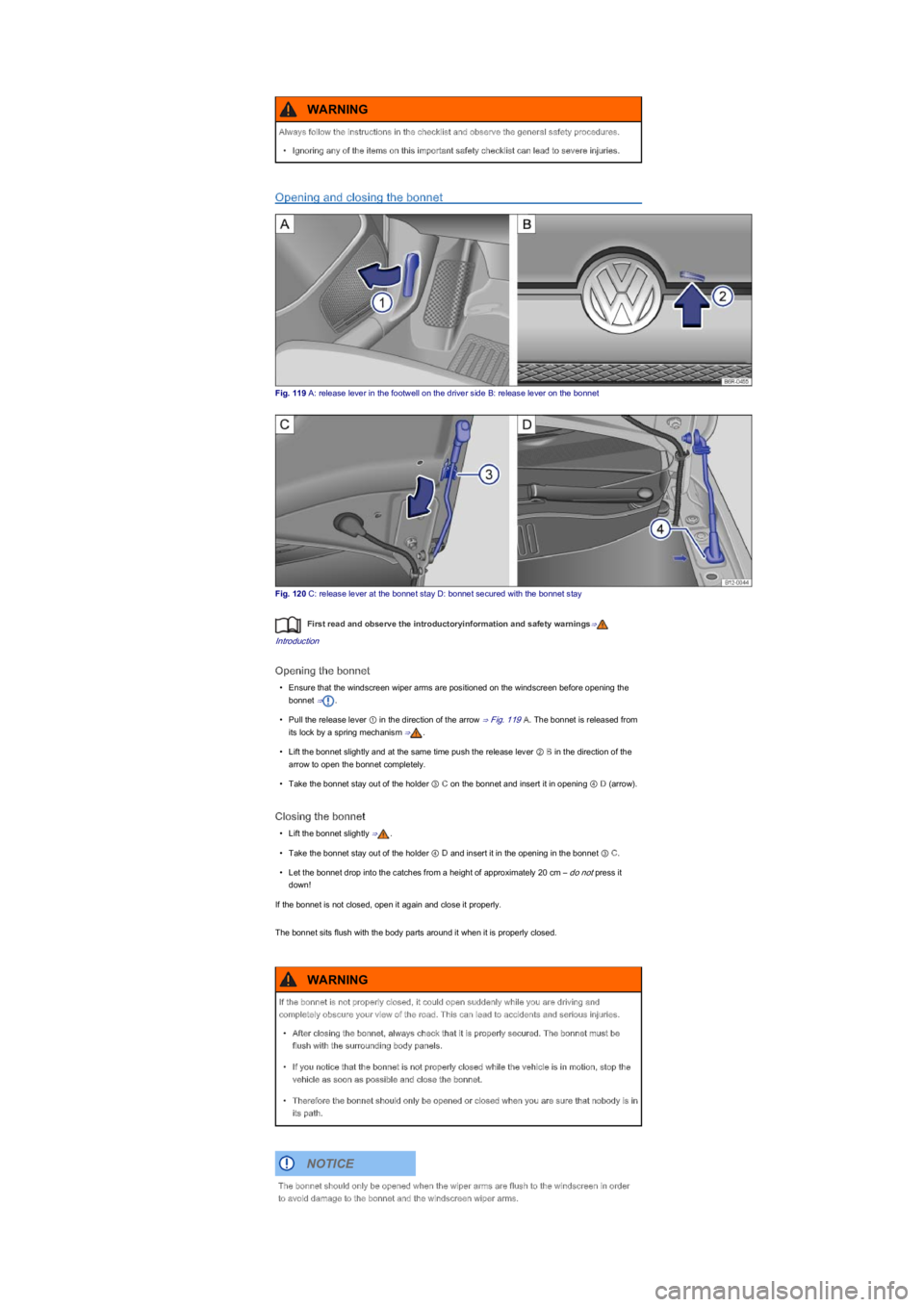
Opening and closing the bonnet
Fig. 119 A: release lever in the footwell on the driver side B: release lever on the bonnet
Fig. 120 C: release lever at the bonnet stay D: bonnet secured with the bonnet stay
First read and observe the introductoryinformation and safety warnings⇒
Introduction
Opening the bonnet
•Ensure that the windscreen wiper arms are positioned on the windscreen before opening the
bonnet ⇒.
•Pull the release lever ① in the direction of the arrow ⇒ Fig. 119A. The bonnet is released from
its lock by a spring mechanism ⇒.
•Lift the bonnet slightly and at the same time push the release lever ② B in the direction of the
arrow to open the bonnet completely.
•Take the bonnet stay out of the holder ③ C on the bonnet and insert it in opening ④ D (arrow).
Closing the bonnet
•Lift the bonnet slightly ⇒.
•Take the bonnet stay out of the holder ④ D and insert it in the opening in the bonnet ③ C.
•Let the bonnet drop into the catches from a height of approximately 20 cm – do not press it
down!
If the bonnet is not closed, open it again and close it properly.
The bonnet sits flush with the body parts around it when it is properly closed.
Always follow the instructions in the checklist and observe the general safety procedures.
•Ignoring any of the items on this important safety checklist can lead to severe injuries.
WARNING
If the bonnet is not properly closed, it could open suddenly while you are driving and
completely obscure your view of the road. This can lead to accidents and serious injuries.
•After closing the bonnet, always check that it is properly secured. The bonnet must be
flush with the surrounding body panels.
•If you notice that the bonnet is not properly closed while the vehicle is in motion, stop the
vehicle as soon as possible and close the bonnet.
•Therefore the bonnet should only be opened or closed when you are sure that nobody is in
its path.
WARNING
The bonnet should only be opened when the wiper arms are flush to the windscreen in order
to avoid damage to the bonnet and the windscreen wiper arms.
NOTICE
Page 139 of 211
Coolant and coolant additives can pollute the environment. Spilt operating fluids must be
collected and disposed of properly and with respect for the environment.
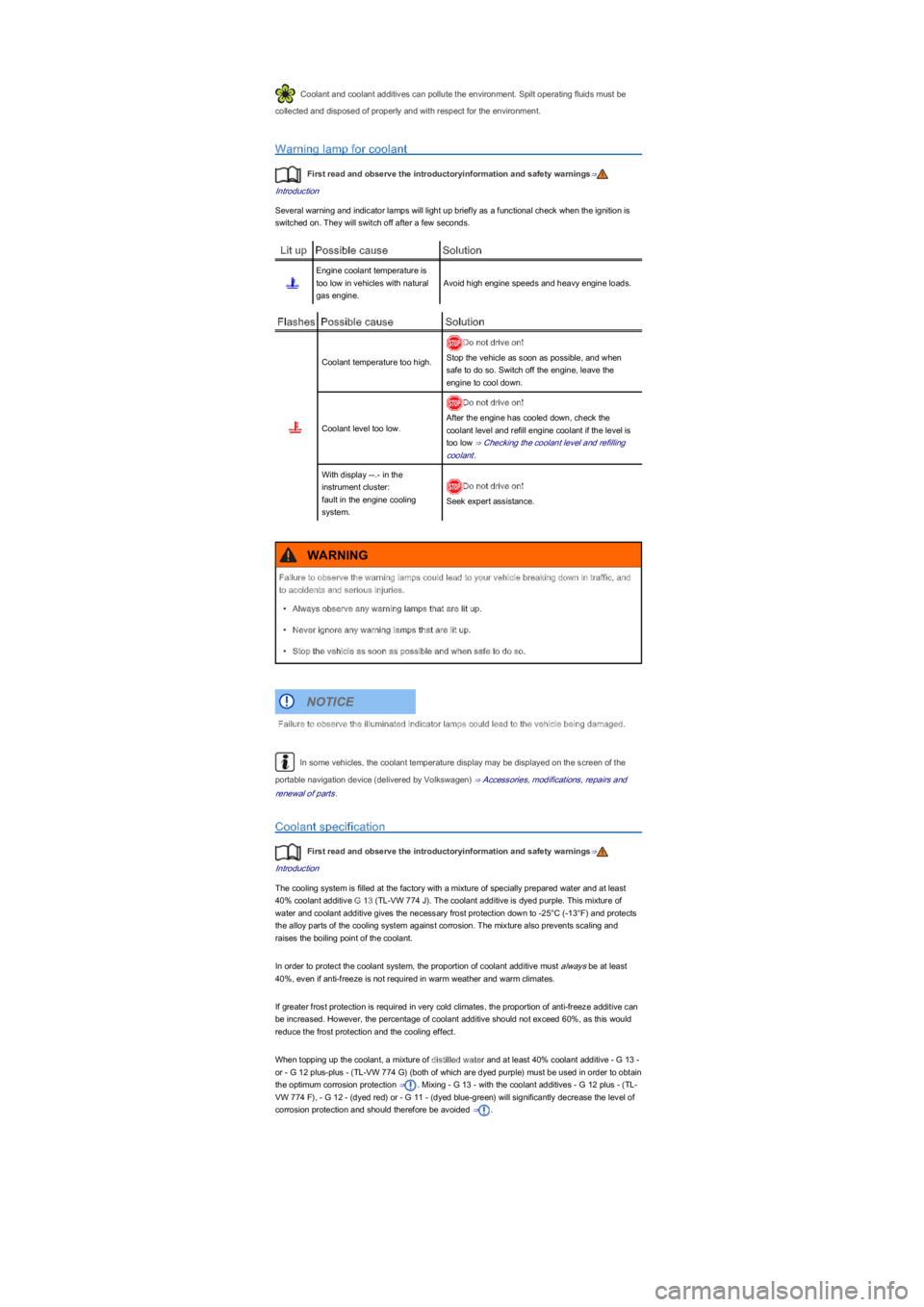
Warning lamp for coolant
First read and observe the introductoryinformation and safety warnings⇒
Introduction
Several warning and indicator lamps will light up briefly as a functional check when the ignition is
switched on. They will switch off after a few seconds.
Lit upPossible causeSolution
Engine coolant temperature is
too low in vehicles with natural
gas engine.
Avoid high engine speeds and heavy engine loads.
FlashesPossible causeSolution
Coolant temperature too high.
Do not drive on!
Stop the vehicle as soon as possible, and when
safe to do so. Switch off the engine, leave the
engine to cool down.
Coolant level too low.
Do not drive on!
After the engine has cooled down, check the
coolant level and refill engine coolant if the level is
too low ⇒ Checking the coolant level and refilling
coolant.
With display --.- in the
instrument cluster:
fault in the engine cooling
system.
Do not drive on!
Seek expert assistance.
In some vehicles, the coolant temperature display may be displayed on the screen of the
portable navigation device (delivered by Volkswagen) ⇒ Accessories, modifications, repairs and
renewal of parts.
Coolant specification
First read and observe the introductoryinformation and safety warnings⇒
Introduction
The cooling system is filled at the factory with a mixture of specially prepared water and at least
40% coolant additive G 13 (TL-VW 774 J). The coolant additive is dyed purple. This mixture of
water and coolant additive gives the necessary frost protection down to -25°C (-13°F) and protects
the alloy parts of the cooling system against corrosion. The mixture also prevents scaling and
raises the boiling point of the coolant.
In order to protect the coolant system, the proportion of coolant additive must always be at least
40%, even if anti-freeze is not required in warm weather and warm climates.
If greater frost protection is required in very cold climates, the proportion of anti-freeze additive can
be increased. However, the percentage of coolant additive should not exceed 60%, as this would
reduce the frost protection and the cooling effect.
When topping up the coolant, a mixture of distilled water and at least 40% coolant additive - G 13 -
or - G 12 plus-plus - (TL-VW 774 G) (both of which are dyed purple) must be used in order to obtain
the optimum corrosion protection ⇒. Mixing - G 13 - with the coolant additives - G 12 plus - (TL-
VW 774 F), - G 12 - (dyed red) or - G 11 - (dyed blue-green) will significantly decrease the level of
corrosion protection and should therefore be avoided ⇒.
Failure to observe the warning lamps could lead to your vehicle breaking down in traffic, and
to accidents and serious injuries.
•Always observe any warning lamps that are lit up.
•Never ignore any warning lamps that are lit up.
•Stop the vehicle as soon as possible and when safe to do so.
WARNING
Failure to observe the illuminated indicator lamps could lead to the vehicle being damaged.
NOTICE