interior lights VOLKSWAGEN UP! 2021 Owner´s Manual
[x] Cancel search | Manufacturer: VOLKSWAGEN, Model Year: 2021, Model line: UP!, Model: VOLKSWAGEN UP! 2021Pages: 211, PDF Size: 5.98 MB
Page 4 of 211
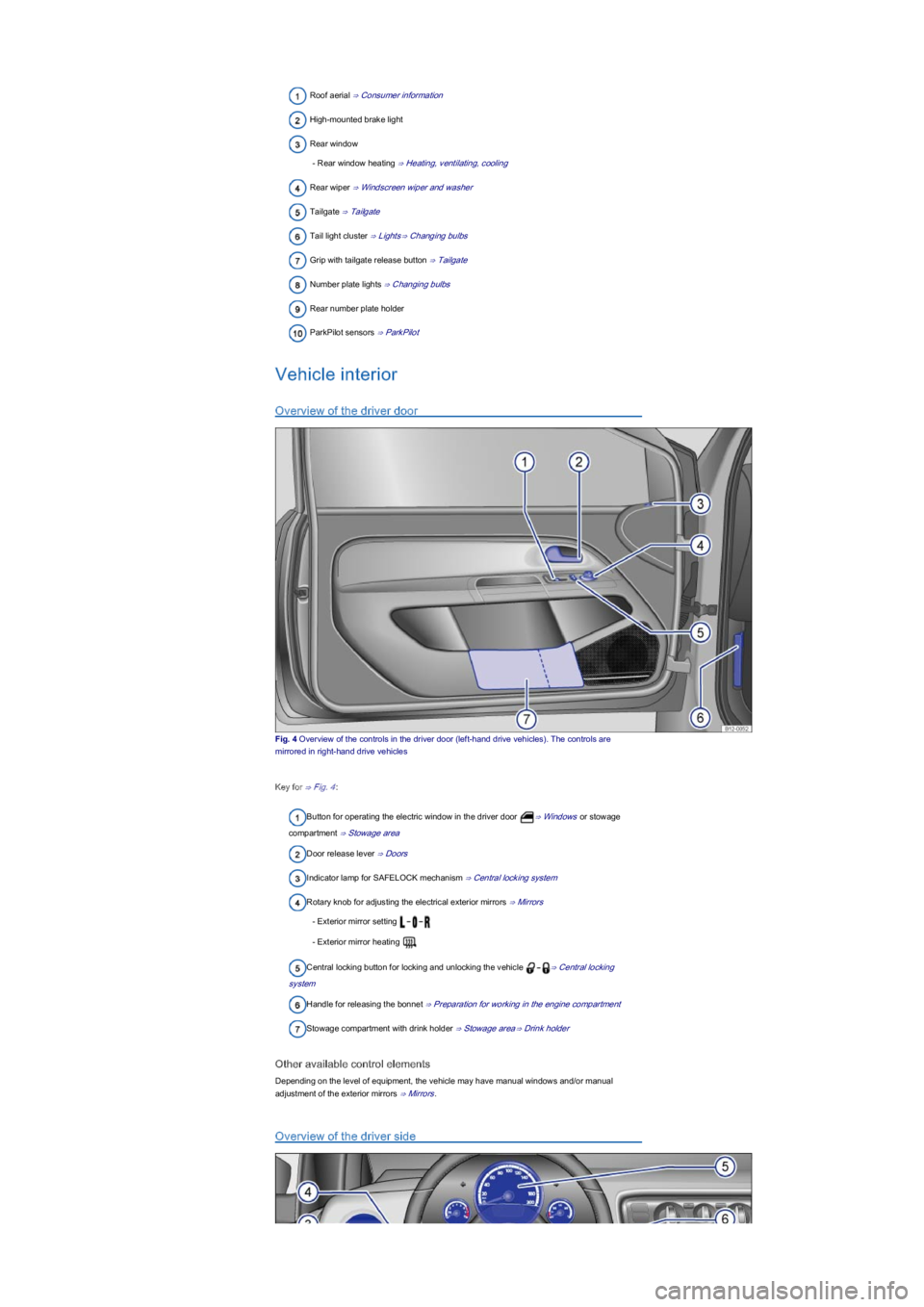
Roof aerial ⇒ Consumer information
High-mounted brake light
Rear window
- Rear window heating ⇒ Heating, ventilating, cooling
Rear wiper ⇒ Windscreen wiper and washer
Tailgate ⇒ Tailgate
Tail light cluster ⇒ Lights⇒ Changing bulbs
Grip with tailgate release button ⇒ Tailgate
Number plate lights ⇒ Changing bulbs
Rear number plate holder
ParkPilot sensors ⇒ ParkPilot
Vehicle interior
Overview of the driver door
Fig. 4 Overview of the controls in the driver door (left-hand drive vehicles). The controls are
mirrored in right-hand drive vehicles
Key for ⇒ Fig. 4:
Button for operating the electric window in the driver door ⇒ Windows or stowage
compartment ⇒ Stowage area
Door release lever ⇒ Doors
Indicator lamp for SAFELOCK mechanism ⇒ Central locking system
Rotary knob for adjusting the electrical exterior mirrors ⇒ Mirrors
- Exterior mirror setting
- Exterior mirror heating
Central locking button for locking and unlocking the vehicle ⇒ Central locking
system
Handle for releasing the bonnet ⇒ Preparation for working in the engine compartment
Stowage compartment with drink holder ⇒ Stowage area⇒ Drink holder
Other available control elements
Depending on the level of equipment, the vehicle may have manual windows and/or manual
adjustment of the exterior mirrors ⇒ Mirrors.
Overview of the driver side
Page 7 of 211
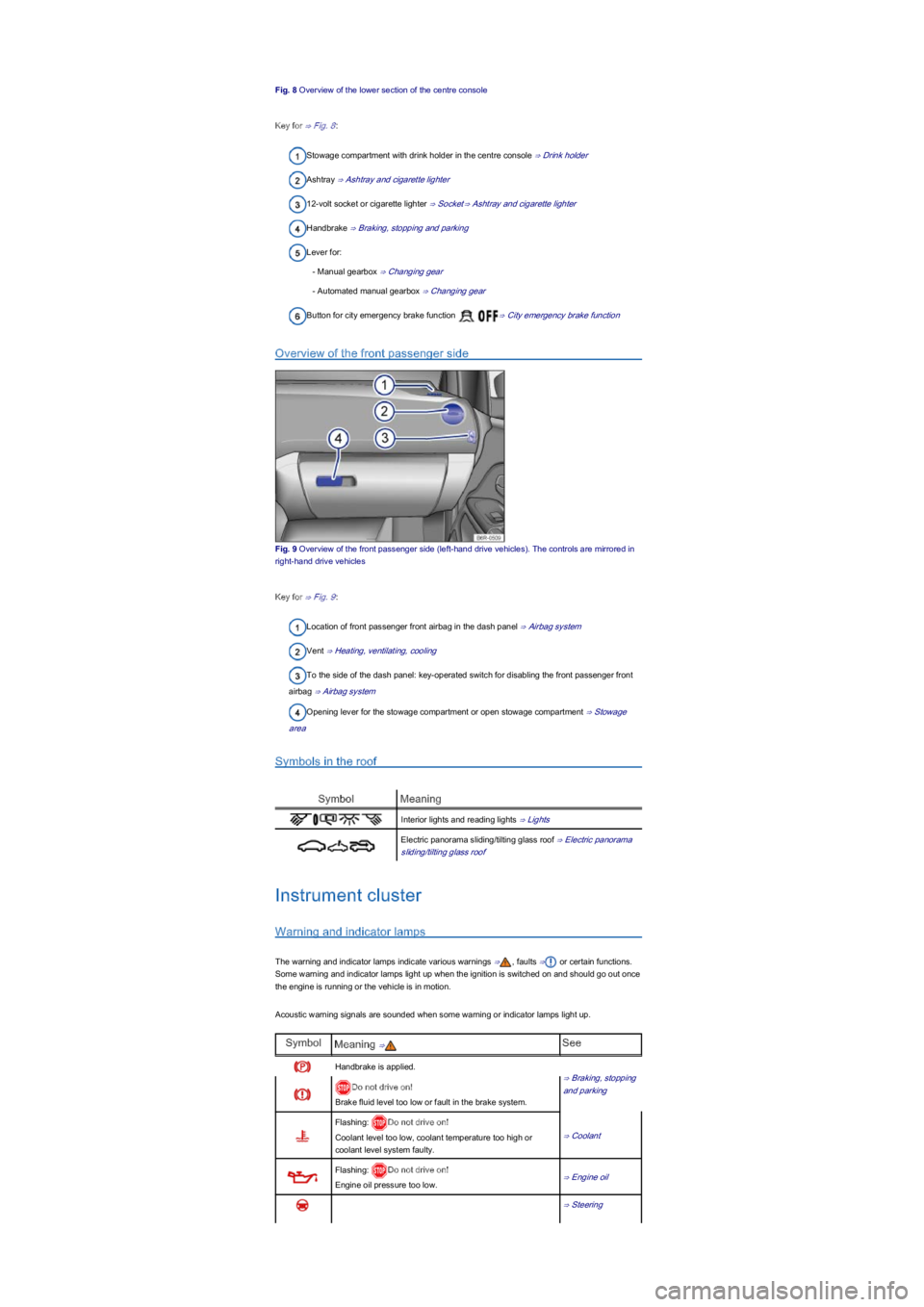
Fig. 8 Overview of the lower section of the centre console
Key for ⇒ Fig. 8:
Stowage compartment with drink holder in the centre console ⇒ Drink holder
Ashtray ⇒ Ashtray and cigarette lighter
12-volt socket or cigarette lighter ⇒ Socket⇒ Ashtray and cigarette lighter
Handbrake ⇒ Braking, stopping and parking
Lever for:
- Manual gearbox ⇒ Changing gear
- Automated manual gearbox ⇒ Changing gear
Button for city emergency brake function ⇒ City emergency brake function
Overview of the front passenger side
Fig. 9 Overview of the front passenger side (left-hand drive vehicles). The controls are mirrored in
right-hand drive vehicles
Key for ⇒ Fig. 9:
Location of front passenger front airbag in the dash panel ⇒ Airbag system
Vent ⇒ Heating, ventilating, cooling
To the side of the dash panel: key-operated switch for disabling the front passenger front
airbag ⇒ Airbag system
Opening lever for the stowage compartment or open stowage compartment ⇒ Stowage
area
Symbols in the roof
SymbolMeaning
Interior lights and reading lights ⇒ Lights
Electric panorama sliding/tilting glass roof ⇒ Electric panorama
sliding/tilting glass roof
Instrument cluster
Warning and indicator lamps
The warning and indicator lamps indicate various warnings ⇒, faults ⇒ or certain functions.
Some warning and indicator lamps light up when the ignition is switched on and should go out once
the engine is running or the vehicle is in motion.
Acoustic warning signals are sounded when some warning or indicator lamps light up.
SymbolMeaning ⇒See
Handbrake is applied.
⇒ Braking, stopping
and parkingDo not drive on!
Brake fluid level too low or fault in the brake system.
Flashing: Do not drive on!
Coolant level too low, coolant temperature too high or
coolant level system faulty.
⇒ Coolant
Flashing: Do not drive on!
Engine oil pressure too low.⇒ Engine oil
⇒ Steering
Page 24 of 211
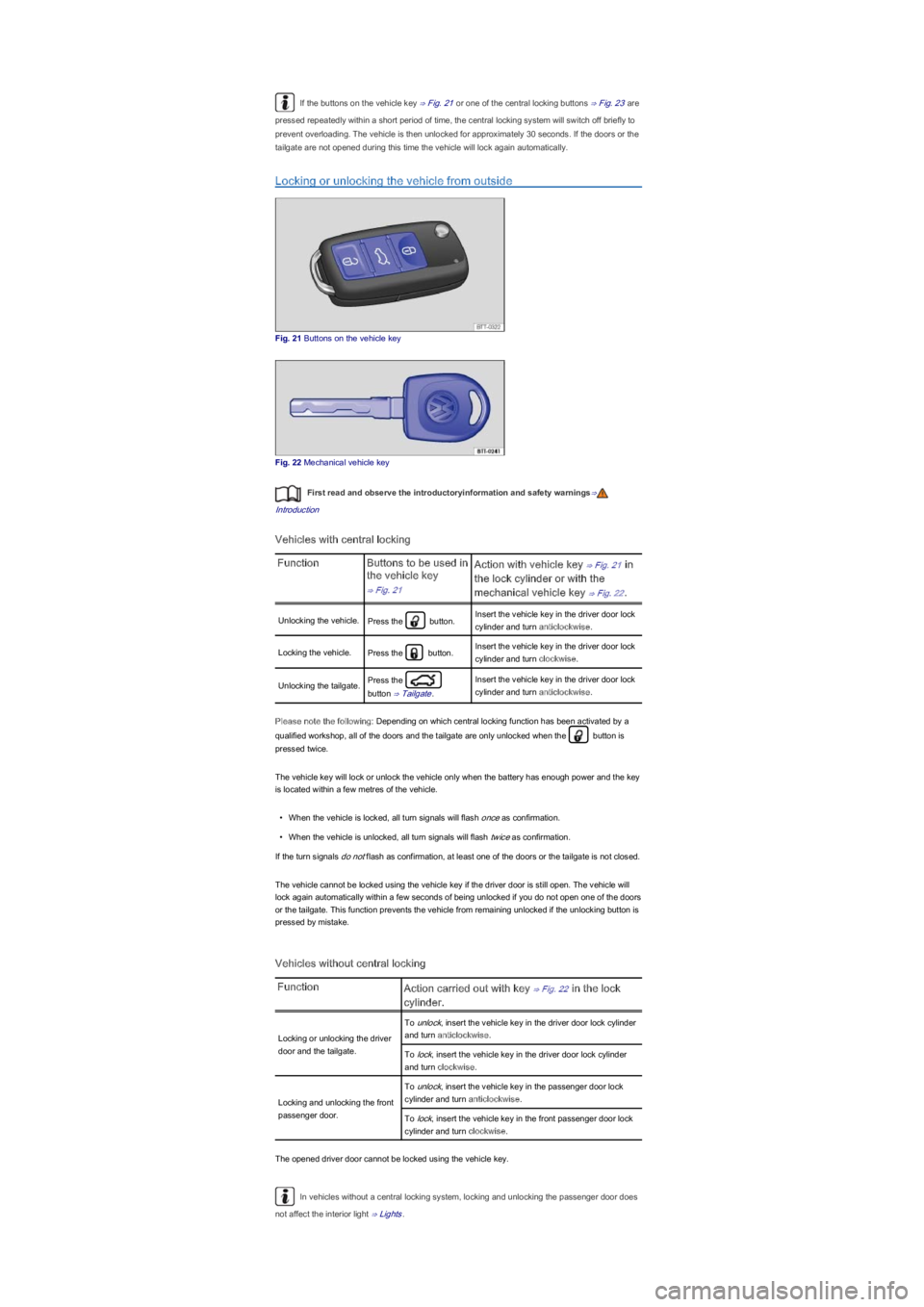
If the buttons on the vehicle key ⇒ Fig. 21 or one of the central locking buttons ⇒ Fig. 23 are
pressed repeatedly within a short period of time, the central locking system will switch off briefly to
prevent overloading. The vehicle is then unlocked for approximately 30 seconds. If the doors or the
tailgate are not opened during this time the vehicle will lock again automatically.
Locking or unlocking the vehicle from outside
Fig. 21 Buttons on the vehicle key
Fig. 22 Mechanical vehicle key
First read and observe the introductoryinformation and safety warnings⇒
Introduction
Vehicles with central locking
FunctionButtons to be used in
the vehicle key
⇒ Fig. 21
Action with vehicle key ⇒ Fig. 21 in
the lock cylinder or with the
mechanical vehicle key ⇒ Fig. 22.
Unlocking the vehicle.Press the button.Insert the vehicle key in the driver door lock
cylinder and turn anticlockwise.
Locking the vehicle.Press the button.Insert the vehicle key in the driver door lock
cylinder and turn clockwise.
Unlocking the tailgate.Press the
button ⇒ Tailgate.
Insert the vehicle key in the driver door lock
cylinder and turn anticlockwise.
Please note the following: Depending on which central locking function has been activated by a
qualified workshop, all of the doors and the tailgate are only unlocked when the button is
pressed twice.
The vehicle key will lock or unlock the vehicle only when the battery has enough power and the key
is located within a few metres of the vehicle.
•When the vehicle is locked, all turn signals will flash once as confirmation.
•When the vehicle is unlocked, all turn signals will flash twice as confirmation.
If the turn signals do not flash as confirmation, at least one of the doors or the tailgate is not closed.
The vehicle cannot be locked using the vehicle key if the driver door is still open. The vehicle will
lock again automatically within a few seconds of being unlocked if you do not open one of the doors
or the tailgate. This function prevents the vehicle from remaining unlocked if the unlocking button is
pressed by mistake.
Vehicles without central locking
FunctionAction carried out with key ⇒ Fig. 22 in the lock
cylinder.
Locking or unlocking the driver
door and the tailgate.
To unlock, insert the vehicle key in the driver door lock cylinder
and turn anticlockwise.
To lock, insert the vehicle key in the driver door lock cylinder
and turn clockwise.
Locking and unlocking the front
passenger door.
To unlock, insert the vehicle key in the passenger door lock
cylinder and turn anticlockwise.
To lock, insert the vehicle key in the front passenger door lock
cylinder and turn clockwise.
The opened driver door cannot be locked using the vehicle key.
In vehicles without a central locking system, locking and unlocking the passenger door does
not affect the interior light ⇒ Lights.
Page 60 of 211
Introduction
This chapter contains information on the followingsubjects:
⇒ Indicator lamps
⇒ Turn signal and main beam lever
⇒ Switching lights on and off
⇒ Lights and vision – functions
⇒ Attaching adhesive strips to headlights
⇒ Headlight range control, instrument and switch lighting
⇒ Interior and reading lights
Observe any country-specific regulations when using vehicle lighting.
The driver is responsible for the correct headlight position and the correct headlight setting.
Additional information and warnings:
•Exterior views ⇒ Exterior views
•Volkswagen information system ⇒ Volkswagen information system
•Changing bulbs ⇒ Changing bulbs
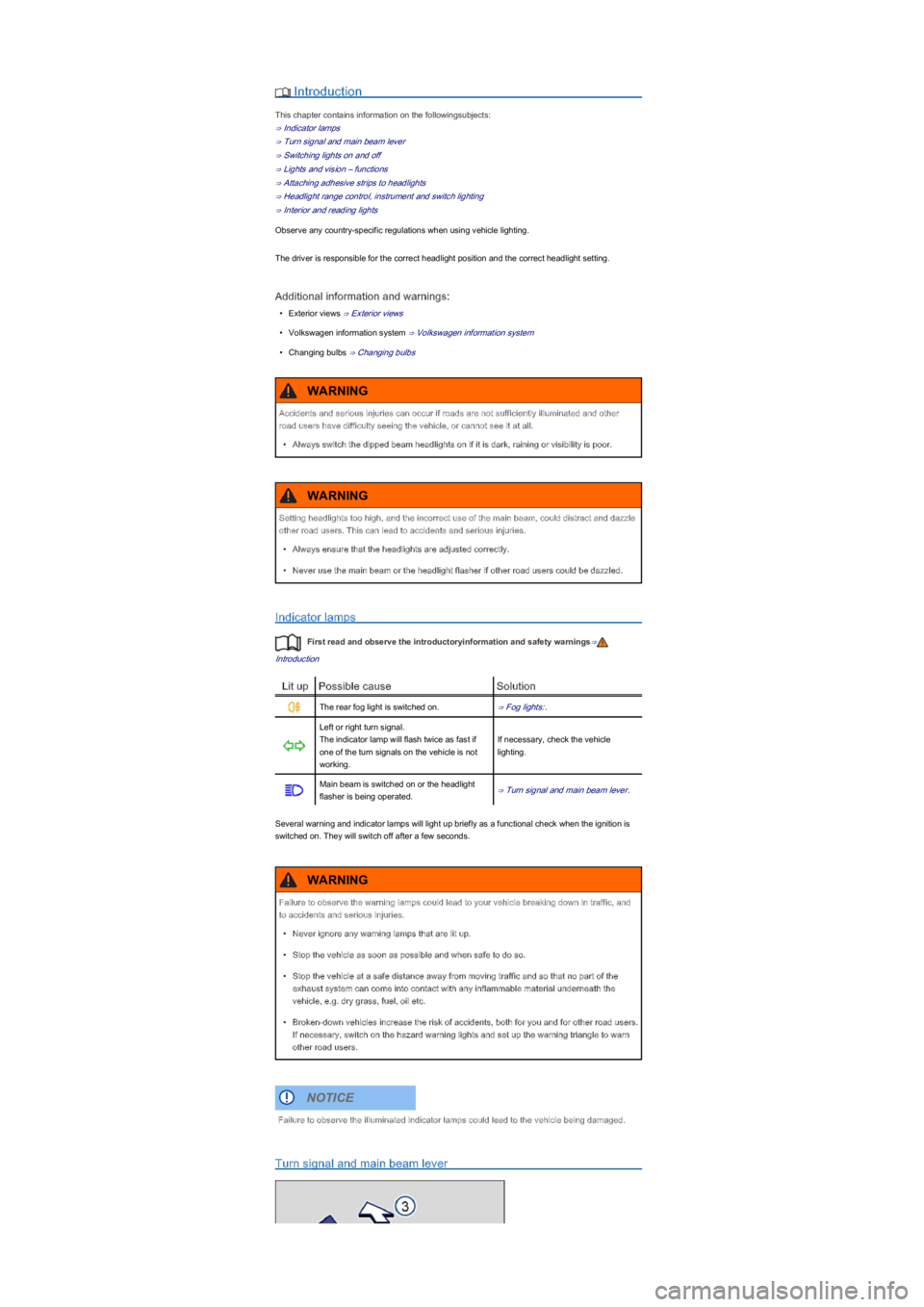
Indicator lamps
First read and observe the introductoryinformation and safety warnings⇒
Introduction
Lit upPossible causeSolution
The rear fog light is switched on.⇒ Fog lights:.
Left or right turn signal.
The indicator lamp will flash twice as fast if
one of the turn signals on the vehicle is not
working.
If necessary, check the vehicle
lighting.
Main beam is switched on or the headlight
flasher is being operated.⇒ Turn signal and main beam lever.
Several warning and indicator lamps will light up briefly as a functional check when the ignition is
switched on. They will switch off after a few seconds.
Turn signal and main beam lever
Accidents and serious injuries can occur if roads are not sufficiently illuminated and other
road users have difficulty seeing the vehicle, or cannot see it at all.
•Always switch the dipped beam headlights on if it is dark, raining or visibility is poor.
WARNING
Setting headlights too high, and the incorrect use of the main beam, could distract and dazzle
other road users. This can lead to accidents and serious injuries.
•Always ensure that the headlights are adjusted correctly.
•Never use the main beam or the headlight flasher if other road users could be dazzled.
WARNING
Failure to observe the warning lamps could lead to your vehicle breaking down in traffic, and
to accidents and serious injuries.
•Never ignore any warning lamps that are lit up.
•Stop the vehicle as soon as possible and when safe to do so.
•Stop the vehicle at a safe distance away from moving traffic and so that no part of the
exhaust system can come into contact with any inflammable material underneath the
vehicle, e.g. dry grass, fuel, oil etc.
•Broken-down vehicles increase the risk of accidents, both for you and for other road users.
If necessary, switch on the hazard warning lights and set up the warning triangle to warn
other road users.
WARNING
Failure to observe the illuminated indicator lamps could lead to the vehicle being damaged.
NOTICE
Page 62 of 211
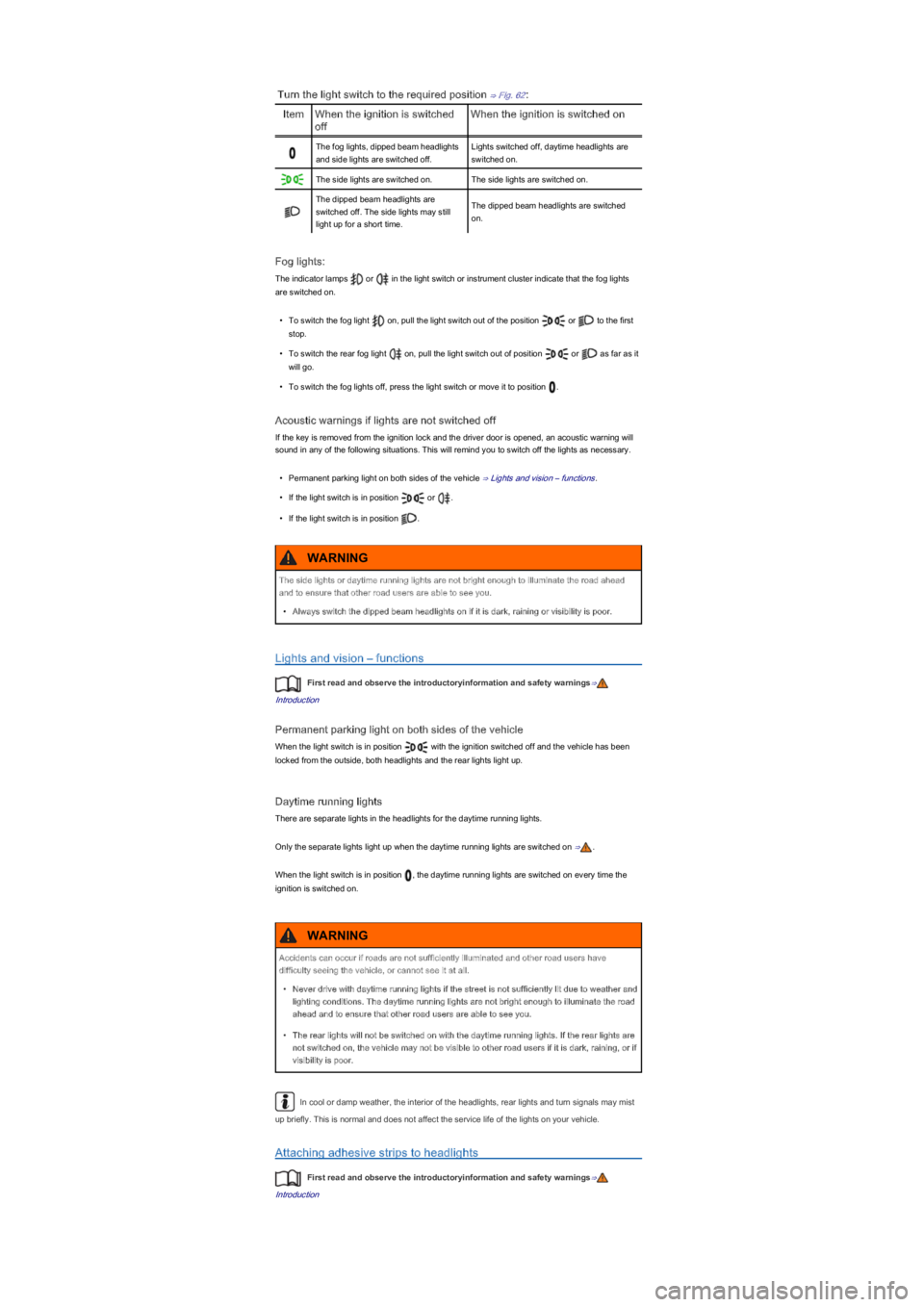
Turn the light switch to the required position ⇒ Fig. 62:
ItemWhen the ignition is switched
off
When the ignition is switched on
The fog lights, dipped beam headlights
and side lights are switched off.
Lights switched off, daytime headlights are
switched on.
The side lights are switched on.The side lights are switched on.
The dipped beam headlights are
switched off. The side lights may still
light up for a short time.
The dipped beam headlights are switched
on.
Fog lights:
The indicator lamps or in the light switch or instrument cluster indicate that the fog lights
are switched on.
•To switch the fog light on, pull the light switch out of the position or to the first
stop.
•To switch the rear fog light on, pull the light switch out of position or as far as it
will go.
•To switch the fog lights off, press the light switch or move it to position .
Acoustic warnings if lights are not switched off
If the key is removed from the ignition lock and the driver door is opened, an acoustic warning will
sound in any of the following situations. This will remind you to switch off the lights as necessary.
•Permanent parking light on both sides of the vehicle ⇒ Lights and vision – functions.
•If the light switch is in position or .
•If the light switch is in position .
Lights and vision – functions
First read and observe the introductoryinformation and safety warnings⇒
Introduction
Permanent parking light on both sides of the vehicle
When the light switch is in position with the ignition switched off and the vehicle has been
locked from the outside, both headlights and the rear lights light up.
Daytime running lights
There are separate lights in the headlights for the daytime running lights.
Only the separate lights light up when the daytime running lights are switched on ⇒.
When the light switch is in position , the daytime running lights are switched on every time the
ignition is switched on.
In cool or damp weather, the interior of the headlights, rear lights and turn signals may mist
up briefly. This is normal and does not affect the service life of the lights on your vehicle.
Attaching adhesive strips to headlights
First read and observe the introductoryinformation and safety warnings⇒
Introduction
The side lights or daytime running lights are not bright enough to illuminate the road ahead
and to ensure that other road users are able to see you.
•Always switch the dipped beam headlights on if it is dark, raining or visibility is poor.
WARNING
Accidents can occur if roads are not sufficiently illuminated and other road users have
difficulty seeing the vehicle, or cannot see it at all.
•Never drive with daytime running lights if the street is not sufficiently lit due to weather and
lighting conditions. The daytime running lights are not bright enough to illuminate the road
ahead and to ensure that other road users are able to see you.
•The rear lights will not be switched on with the daytime running lights. If the rear lights are
not switched on, the vehicle may not be visible to other road users if it is dark, raining, or if
visibility is poor.
WARNING
Page 63 of 211
If you have to drive a right-hand drive vehicle in a left-hand drive country, or vice versa, the
asymmetric dipped beam headlights may dazzle oncoming traffic.
Therefore you may have to apply stickers to certain parts of the headlight lenses if you are driving
abroad. A qualified workshop can provide you with further information. Volkswagen recommends
using a Volkswagen dealership for this purpose.
Stickers may only be used on the headlights for a limited period. Please contact a qualified
workshop for a permanent alteration. Volkswagen recommends using a Volkswagen dealership for
this purpose.
Headlight range control, instrument and switch lighting
Fig. 63 Next to steering wheel: headlight range control
First read and observe the introductoryinformation and safety warnings⇒
Introduction
Headlight range control
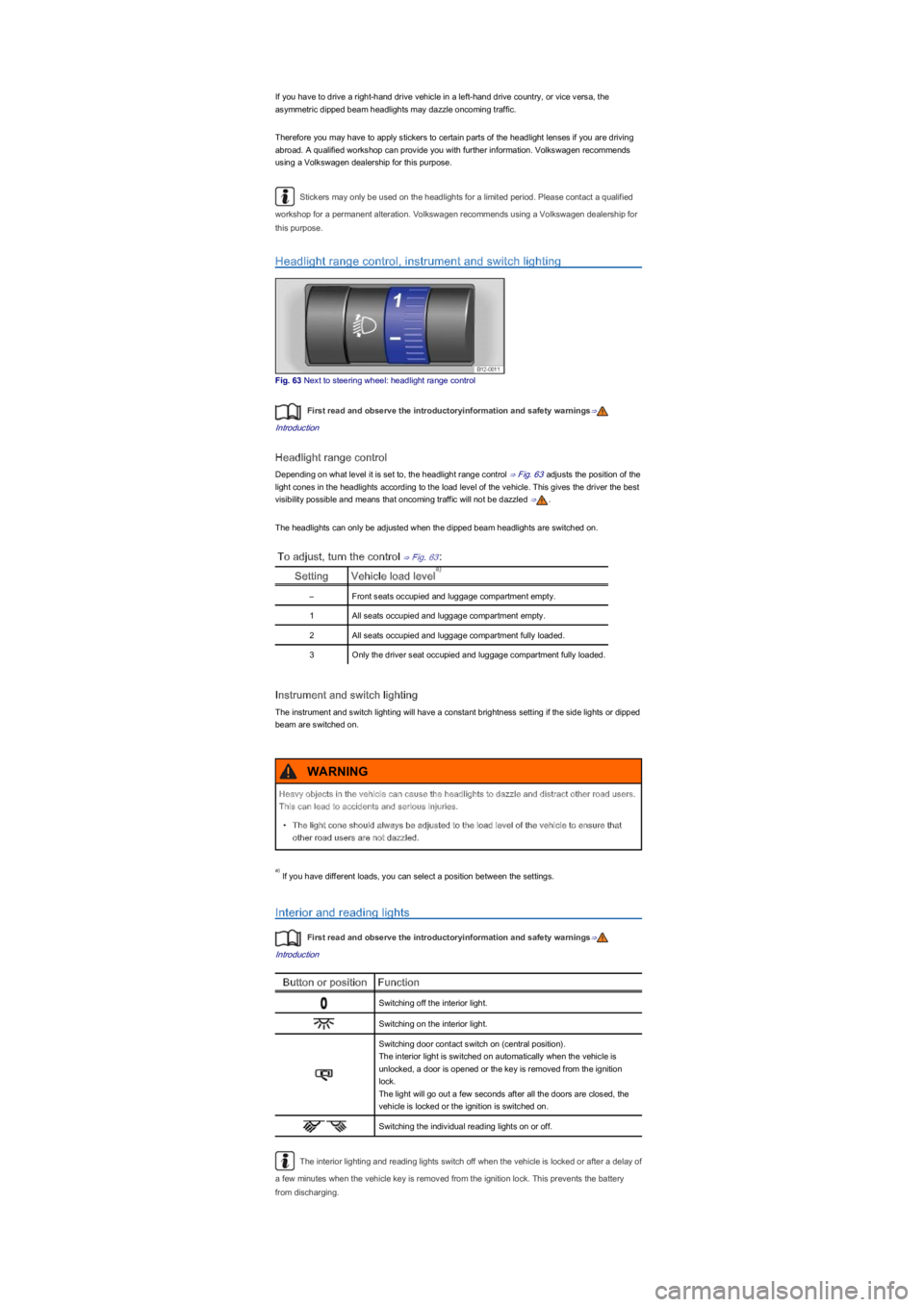
Depending on what level it is set to, the headlight range control ⇒ Fig. 63 adjusts the position of the
light cones in the headlights according to the load level of the vehicle. This gives the driver the best
visibility possible and means that oncoming traffic will not be dazzled ⇒.
The headlights can only be adjusted when the dipped beam headlights are switched on.
To adjust, turn the control ⇒ Fig. 63:
SettingVehicle load level
–Front seats occupied and luggage compartment empty.
1All seats occupied and luggage compartment empty.
2All seats occupied and luggage compartment fully loaded.
3Only the driver seat occupied and luggage compartment fully loaded.
Instrument and switch lighting
The instrument and switch lighting will have a constant brightness setting if the side lights or dipped
beam are switched on.
If you have different loads, you can select a position between the settings.
Interior and reading lights
First read and observe the introductoryinformation and safety warnings⇒
Introduction
Button or positionFunction
Switching off the interior light.
Switching on the interior light.
Switching door contact switch on (central position).
The interior light is switched on automatically when the vehicle is
unlocked, a door is opened or the key is removed from the ignition
lock.
The light will go out a few seconds after all the doors are closed, the
vehicle is locked or the ignition is switched on.
Switching the individual reading lights on or off.
The interior lighting and reading lights switch off when the vehicle is locked or after a delay of
a few minutes when the vehicle key is removed from the ignition lock. This prevents the battery
from discharging.
a)
Heavy objects in the vehicle can cause the headlights to dazzle and distract other road users.
This can lead to accidents and serious injuries.
•The light cone should always be adjusted to the load level of the vehicle to ensure that
other road users are not dazzled.
WARNING
a)
Page 69 of 211
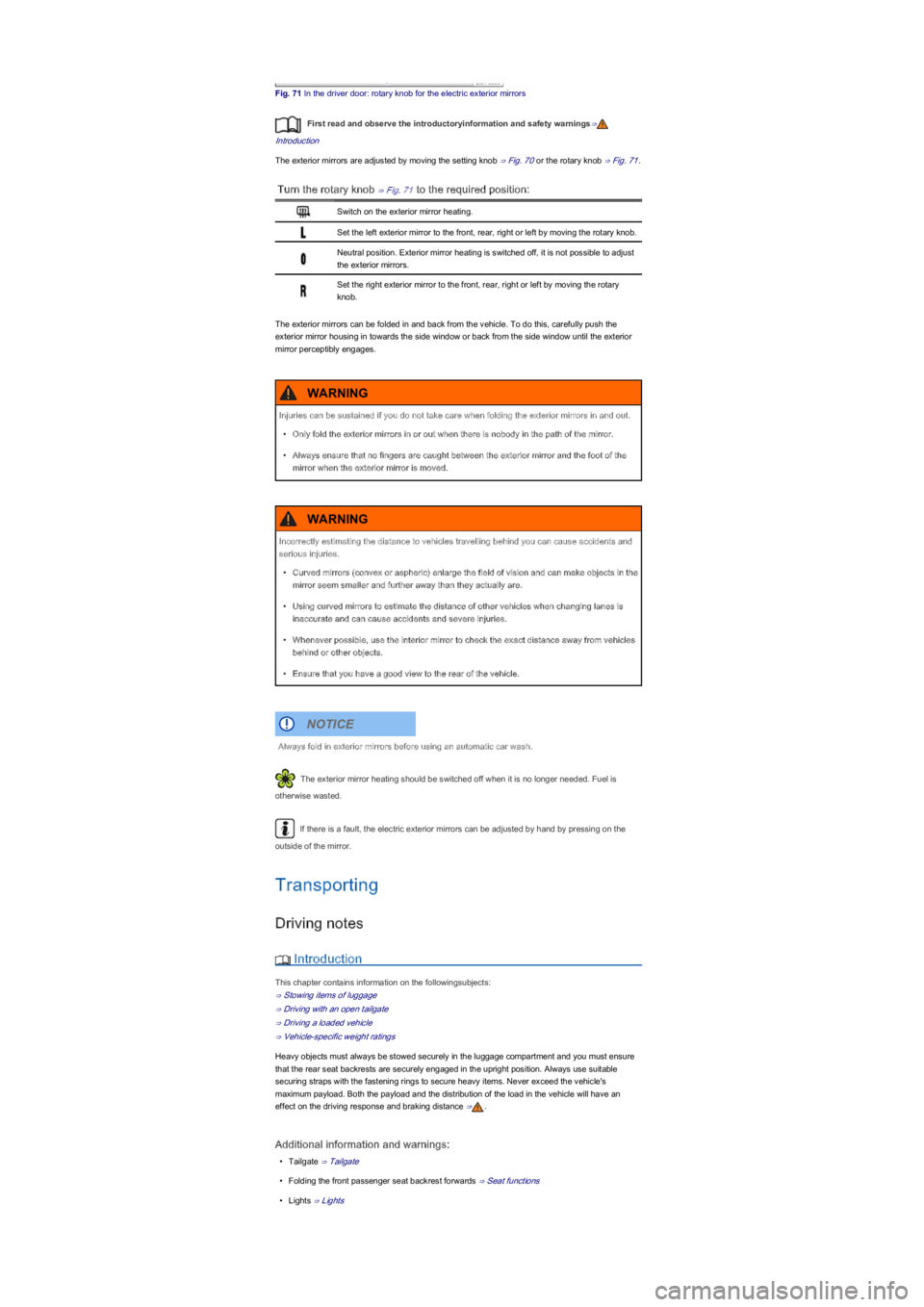
Fig. 71 In the driver door: rotary knob for the electric exterior mirrors
First read and observe the introductoryinformation and safety warnings⇒
Introduction
The exterior mirrors are adjusted by moving the setting knob ⇒ Fig. 70 or the rotary knob ⇒ Fig. 71.
Turn the rotary knob ⇒ Fig. 71 to the required position:
Switch on the exterior mirror heating.
Set the left exterior mirror to the front, rear, right or left by moving the rotary knob.
Neutral position. Exterior mirror heating is switched off, it is not possible to adjust
the exterior mirrors.
Set the right exterior mirror to the front, rear, right or left by moving the rotary
knob.
The exterior mirrors can be folded in and back from the vehicle. To do this, carefully push the
exterior mirror housing in towards the side window or back from the side window until the exterior
mirror perceptibly engages.
The exterior mirror heating should be switched off when it is no longer needed. Fuel is
otherwise wasted.
If there is a fault, the electric exterior mirrors can be adjusted by hand by pressing on the
outside of the mirror.
Transporting
Driving notes
Introduction
This chapter contains information on the followingsubjects:
⇒ Stowing items of luggage
⇒ Driving with an open tailgate
⇒ Driving a loaded vehicle
⇒ Vehicle-specific weight ratings
Heavy objects must always be stowed securely in the luggage compartment and you must ensure
that the rear seat backrests are securely engaged in the upright position. Always use suitable
securing straps with the fastening rings to secure heavy items. Never exceed the vehicle's
maximum payload. Both the payload and the distribution of the load in the vehicle will have an
effect on the driving response and braking distance ⇒.
Additional information and warnings:
•Tailgate ⇒ Tailgate
•Folding the front passenger seat backrest forwards ⇒ Seat functions
•Lights ⇒ Lights
Injuries can be sustained if you do not take care when folding the exterior mirrors in and out.
•Only fold the exterior mirrors in or out when there is nobody in the path of the mirror.
•Always ensure that no fingers are caught between the exterior mirror and the foot of the
mirror when the exterior mirror is moved.
WARNING
Incorrectly estimating the distance to vehicles travelling behind you can cause accidents and
serious injuries.
•Curved mirrors (convex or aspheric) enlarge the field of vision and can make objects in the
mirror seem smaller and further away than they actually are.
•Using curved mirrors to estimate the distance of other vehicles when changing lanes is
inaccurate and can cause accidents and severe injuries.
•Whenever possible, use the interior mirror to check the exact distance away from vehicles
behind or other objects.
•Ensure that you have a good view to the rear of the vehicle.
WARNING
Always fold in exterior mirrors before using an automatic car wash.
NOTICE
Page 70 of 211
•Luggage compartment ⇒ Luggage compartment
•Roof carrier ⇒ Roof carrier
•Wheels and tyres ⇒ Wheels and tyres
Stowing items of luggage
First read and observe the introductoryinformation and safety warnings⇒
Introduction
Always stow all items of luggage in the vehicle securely.
•Always distribute any loads in the vehicle and on the roof as evenly as possible.
•Place heavy objects as far forward in the luggage compartment as possible. Position the rear
seat backrests securely in the upright position.
•Secure luggage in the luggage compartment to the fastening rings with suitable straps
⇒ Luggage compartment.
•Adjust the headlight range ⇒ Lights.
•Adjust the tyre pressure according to the vehicle load. Please read the tyre pressure sticker
⇒ Wheels and tyres.
Observe any information concerning the loading of a roof carrier ⇒ Roof carrier.
Driving with an open tailgate
First read and observe the introductoryinformation and safety warnings⇒
Introduction
Driving with an open tailgate is particularly dangerous. Ensure that the open tailgate and any
objects are secured properly, and take appropriate measures to reduce the quantity of toxic
exhaust fumes entering the vehicle.
Objects that are not secured, or are secured incorrectly, can cause serious injuries in the
event of a sudden driving or braking manoeuvre or accident. This applies particularly if
objects are struck by the airbag when activated and then flung through the vehicle interior.
Please apply the following rules to reduce the risk of accidents:
•Always stow all objects in the vehicle securely. Always stow luggage and heavy objects in
the luggage compartment.
•Always use suitable straps to prevent luggage from entering the deployment zones of the
side airbag or the front airbag in the event of a sudden driving or braking manoeuvre or an
accident.
•Objects should be stowed in the vehicle interior in such a way that they can never enter
the airbag deployment zones while the vehicle is in motion.
•Always keep stowage compartments closed while the vehicle is in motion.
•All objects must be removed from the seat cushion of the front passenger seat if the front
passenger backrest is folded forward. Even light and small objects could be pressed into
the weight detection mat underneath the seat cushion by the backrest when it is folded
forwards and thus send incorrect information to the airbag control units.
•The front airbag must be switched off and the indicator lamp PASSENGER AIR BAG OFF
must light up for as long as the front passenger seat backrest is folded forwards.
•Stowed objects must never cause passengers to assume an incorrect sitting position.
•Any seat blocked by stowed objects must not be used by any passengers.
WARNING
The vehicle handling and braking effect may alter significantly if large or heavy objects are
being transported.
•Adapt your speed and driving style to suit visibility, weather, road and traffic conditions.
•Accelerate carefully and gently.
•Avoid sudden braking and driving manoeuvres.
•Brake earlier than in normal driving.
WARNING
Hard objects on the shelf can chafe against the wires of the heating element in the rear
window and cause damage.
NOTICE
Page 123 of 211
General information on the heating and fresh air system
First read and observe the introductoryinformation and safety warnings⇒
Introduction
The required interior temperature cannot be lower than the outside temperature as the heating and
fresh air system cannot cool or dehumidify the air.
Settings for optimal road visibility
•Set blower ⇒ Fig. 112② to level 1 or 2.
•Open and position all vents on the dash panel ⇒ Vents.
•Turn the air distribution controller ⇒ Fig. 112③ to the defrost position.
Information on the air conditioning system
First read and observe the introductoryinformation and safety warnings⇒
Introduction
The cooling system for the vehicle interior only works when the engine is running and the blower is
switched on.
The air conditioning system operates most effectively with the windows and the electric panorama
sliding and tilting glass roof closed. However, if the vehicle has heated up after standing in the sun
for some time, the air inside can be cooled more quickly by opening the windows and the electric
panorama sliding and tilting glass roof for a short time.
Settings for optimal road visibility
Switching the cooling system on not only reduces the temperature of the vehicle interior, but also
the humidity. This improves comfort for the vehicle occupants and prevents the windows from
misting when the outside humidity is high.
•Switch off air recirculation mode ⇒ Air recirculation mode.
•Set the blowers to the required level.
•Open and position all vents on the dash panel ⇒ Vents.
•Turn the air distribution controller to the defrost position.
•Press the button to switch the cooling system on. The indicator lamp in the button
lights up.
The cooling system cannot be switched on
The following criteria may prevent the cooling system from being switched on:
•The engine is not running.
•The blower is switched off.
•The air conditioning system fuse has blown.
•The ambient temperature is lower than approximately +2℃ (+36°F).
•The compressor has been temporarily switched off because the coolant temperature is too high.
•There is a different fault in the vehicle. The air conditioning system should be checked by a
qualified workshop.
Things to note
If the humidity and temperature outside the vehicle are high, condensation can drip off the
evaporator in the cooling system and form a pool underneath the vehicle. This is normal and does
not indicate a leak.
The windscreen may mist up after starting the engine due to residual humidity in the air
conditioning system. Switch the defrost function on in order to clear the windscreen of condensation
or mist as quickly as possible.
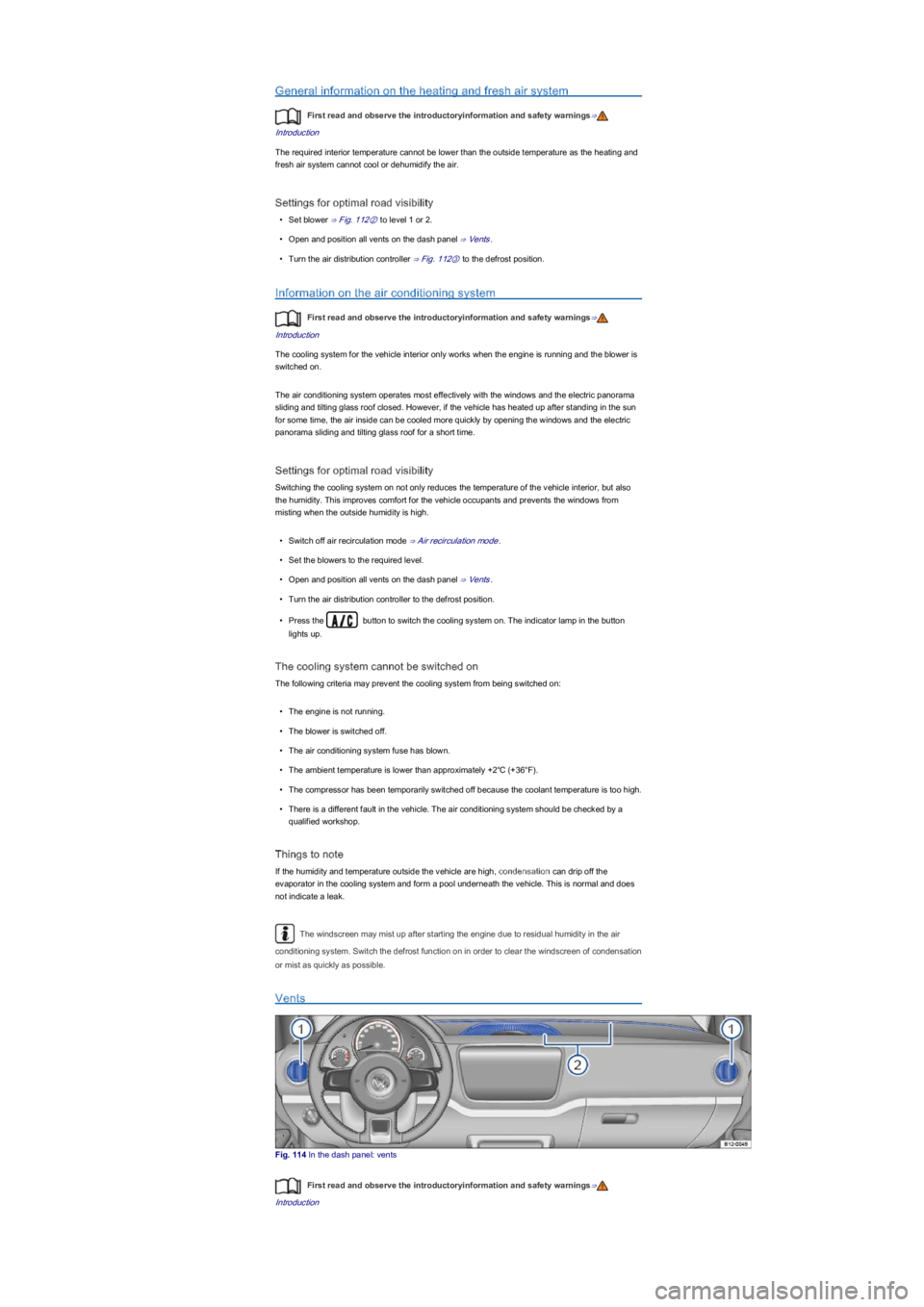
Vents
Fig. 114 In the dash panel: vents
First read and observe the introductoryinformation and safety warnings⇒
Introduction
Page 202 of 211
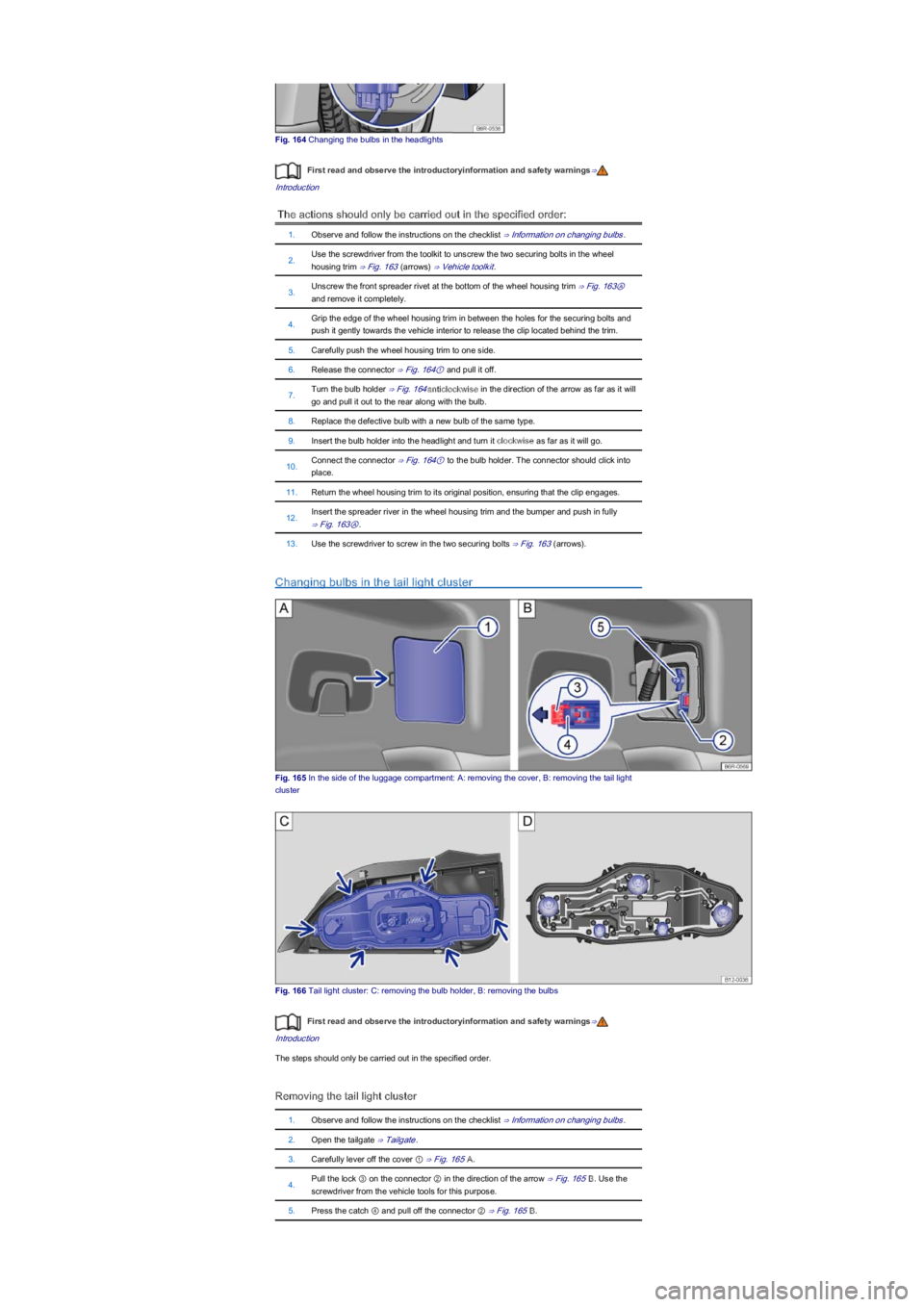
Fig. 164 Changing the bulbs in the headlights
First read and observe the introductoryinformation and safety warnings⇒
Introduction
The actions should only be carried out in the specified order:
1.Observe and follow the instructions on the checklist ⇒ Information on changing bulbs.
2.Use the screwdriver from the toolkit to unscrew the two securing bolts in the wheel
housing trim ⇒ Fig. 163 (arrows) ⇒ Vehicle toolkit.
3.Unscrew the front spreader rivet at the bottom of the wheel housing trim ⇒ Fig. 163Ⓐ
and remove it completely.
4.Grip the edge of the wheel housing trim in between the holes for the securing bolts and
push it gently towards the vehicle interior to release the clip located behind the trim.
5.Carefully push the wheel housing trim to one side.
6.Release the connector ⇒ Fig. 164① and pull it off.
7.Turn the bulb holder ⇒ Fig. 164anticlockwise in the direction of the arrow as far as it will
go and pull it out to the rear along with the bulb.
8.Replace the defective bulb with a new bulb of the same type.
9.Insert the bulb holder into the headlight and turn it clockwise as far as it will go.
10.Connect the connector ⇒ Fig. 164① to the bulb holder. The connector should click into
place.
11.Return the wheel housing trim to its original position, ensuring that the clip engages.
12.Insert the spreader river in the wheel housing trim and the bumper and push in fully
⇒ Fig. 163Ⓐ.
13.Use the screwdriver to screw in the two securing bolts ⇒ Fig. 163 (arrows).
Changing bulbs in the tail light cluster
Fig. 165 In the side of the luggage compartment: A: removing the cover, B: removing the tail light
cluster
Fig. 166 Tail light cluster: C: removing the bulb holder, B: removing the bulbs
First read and observe the introductoryinformation and safety warnings⇒
Introduction
The steps should only be carried out in the specified order.
Removing the tail light cluster
1.Observe and follow the instructions on the checklist ⇒ Information on changing bulbs.
2.Open the tailgate ⇒ Tailgate.
3.Carefully lever off the cover ① ⇒ Fig. 165A.
4.Pull the lock ③ on the connector ② in the direction of the arrow ⇒ Fig. 165B. Use the
screwdriver from the vehicle tools for this purpose.
5.Press the catch ④ and pull off the connector ② ⇒ Fig. 165B.