ECO mode VOLVO 240 1990 User Guide
[x] Cancel search | Manufacturer: VOLVO, Model Year: 1990, Model line: 240, Model: VOLVO 240 1990Pages: 143, PDF Size: 2.32 MB
Page 51 of 143
Volvo 1990 240 Model
pg. 41 Operating the car
42Service inspection
42Break-in period
43Driving economy, shift indicator light
44Starting the engine
45Manual transmission
46Automatic transmission
48Emergency towing
49Towing information
50Trailer hauling
51Automatic transmission, brake system
52Catalytic converter
pg. 42 Break-in period, Service inspection
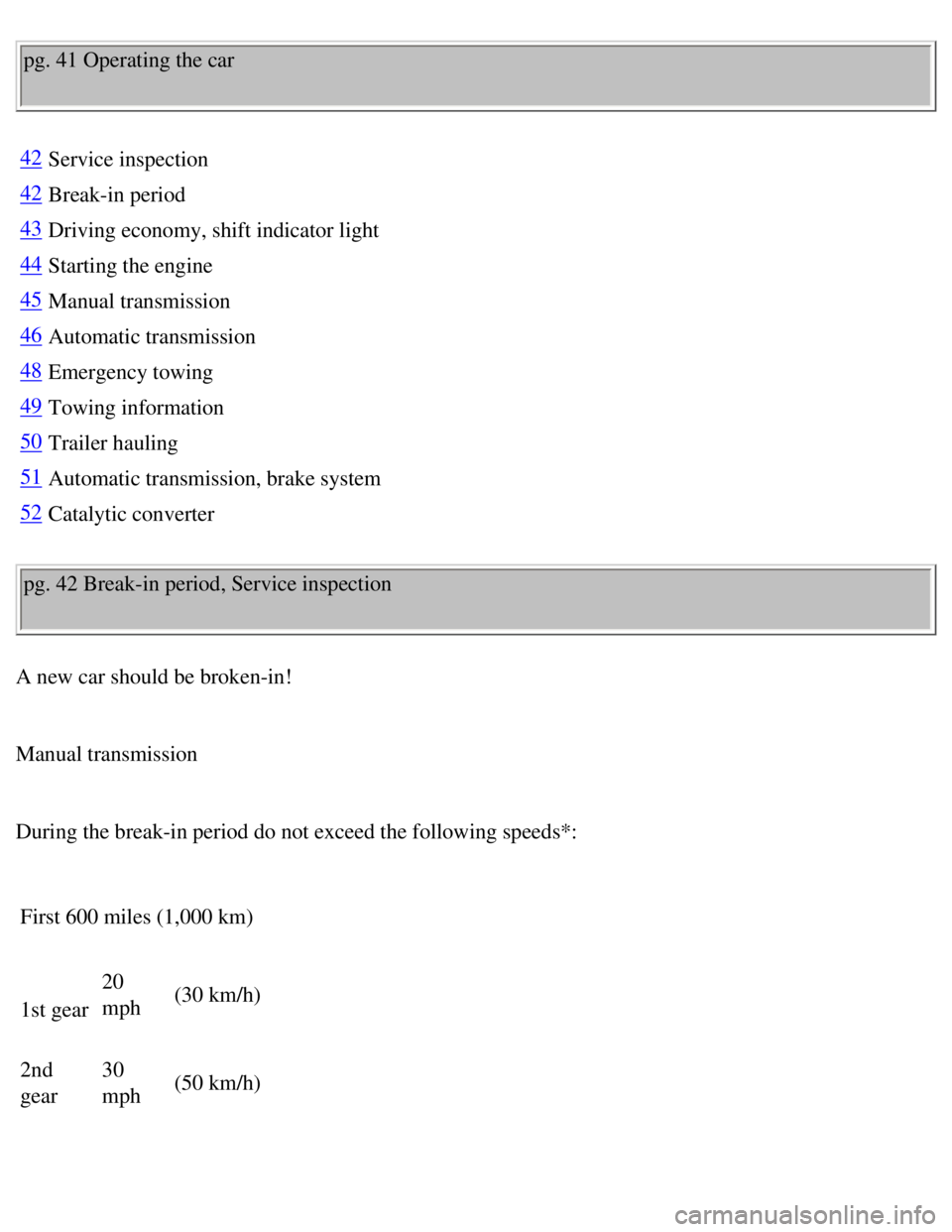
A new car should be broken-in!
Manual transmission
During the break-in period do not exceed the following speeds*:
First 600 miles (1,000 km)
1st gear 20
mph
(30 km/h)
2nd
gear 30
mph
(50 km/h)
file:///K|/ownersdocs/1990/1990_240/90240_09.htm (1 of 6)12/30/2006 8:\
25:05 AM
Page 52 of 143

Volvo 1990 240 Model
3rd
gear 50
mph
(80 km/h)
4th
gear 70
mph (110 km/
h)
5th
gear 80
mph (130 km/
h)
600 - 1,200 miles (1,000 - 2,000 km)
1st gear 25 mph
(40 km/h)
2nd gear 40 mph (65 km/in)
3rd gear 60 mph (100 km/h)
4th gear 80 mph (130 km/h)
5th gear 90 mph (150 km/h)
Avoid driving at low speed in high gear.
* These are the maximum speeds recommended by the factory. Note that leg\
islation in different
countries and states can stipulate other max. speeds than those given he\
re.
Automatic transmission
Do not depress the accelerator to the extent that "kick-down" is actuate\
d during the first 1,200 miles
(2,000 km) when driving a car equipped with an automatic transmission.\
Breaking in parking brakes
file:///K|/ownersdocs/1990/1990_240/90240_09.htm (2 of 6)12/30/2006 8:\
25:05 AM
Page 53 of 143
, transmission in neutral, applyin\
g the parking brake")
Volvo 1990 240 Model
To obtain best parking brake performance, the brake linings should be br\
oken in.
Stop 5-7 times from 30 mph (50 km/h), transmission in neutral, applyin\
g the parking brake with the
release button pressed in during the stop. The force must not lock the r\
ear wheels. If this happens,
release the brake enough to let the wheels rotate. Drive a mile between \
each stop to cool the brakes.
Check for proper parking brake operation.
Note: The brake lights are not illuminated when applying the parking bra\
ke. To warn traffic from
behind it is therefore advisable to depress the brake pedal slightly to \
illuminate the brake lights.
600 - 1,200 mile maintenance service
To ensure proper operation the car should be taken to a Volvo dealer bet\
ween the first 600 - 1,200 miles
(1,000 - 2,000 km) for a maintenance service. The oil in the engine, m\
anual transmission and rear axle
will then be changed. This is very important since the oil rapidly colle\
cts impurities during the break-in
period.
pg. 43 Driving economy, Shift indicator light
Economical driving does not necessarily mean driving slowly
Better driving economy may be obtained by thinking ahead, avoiding rapid\
starts and stops and
adjusting the speed of your vehicle to immediate traffic conditions. Obs\
erve the following rules:
l Bring the engine to normal operating temperature as soon as possible by \
driving with a light foot on
the accelerator pedal instead of allowing the engine to idle for a prolo\
nged period. A cold engine uses
more fuel and is subject to increased wear.
l When possible avoid using the car for driving short distances. This does\
not allow the engine to reach
normal operating temperature.
l Drive carefully and avoid rapid acceleration and hard braking.
l Do not exceed speed limit.
l Avoid carrying unnecessary items (extra load) in the car.
l Check tire pressures regularly (cold tires).
l Remove snow tires when threat of snow or ice has ended.
l Note that roof racks, ski racks, etc., increase air resistance and there\
by fuel consumption.
file:///K|/ownersdocs/1990/1990_240/90240_09.htm (3 of 6)12/30/2006 8:\
25:05 AM
Page 54 of 143

Volvo 1990 240 Model
l Avoid using automatic transmission kick-down feature unless necessary.
Other factors which decrease gas mileage are:
l Worn or dirty spark plugs
l Incorrect spark plug gap
l Dirty air filter
l Incorrect valve clearance
l Incorrect idle speed
l Dirty engine oil and clogged oil filter
l Dragging brakes
l Incorrect front end alignment
l Low tire pressure
Shift indicator light
(manual transmission models only)
The Volvo shift indicator light (S.I.L.) is a device designed to help \
you get even better gas mileage from
your Volvo car. Studies have shown that the best fuel economy is obtaine\
d by shifting gears at low
engine rpm and high relative engine load. The Volvo S.I.L. is calibrated\
to show you when to shift for
improved mileage without sacrificing smooth acceleration .
Use of the S.I.L. is simple. Shift to next higher gear as soon as the li\
ght comes on. You may find after
using the S.I.L. for some time that your natural shifting rhythm will ad\
apt to the S.I.L.'s suggestion.
Some drivers may even shift before the light comes on.
Obviously, there will be times when you need to shift later than the lig\
ht would indicate (for example,
when climbing hills or trailer towing). Using the light regularly, howe\
ver, should result in a mileage
improvement of six percent or more, depending on how you normally drive.\
Programming instructions for shift indicator
If the current supply to the control unit is cut (battery disconnected)\
, the control unit will have to be re-
programmed as the control unit memory will be erased.
Drive the car in each gear (first gear not necessary) for approximatel\
y 8 seconds.
The gear change indicator light will flicker once (0.5 seconds), as ea\
ch gear is programmed.
file:///K|/ownersdocs/1990/1990_240/90240_09.htm (4 of 6)12/30/2006 8:\
25:05 AM
Page 55 of 143

Volvo 1990 240 Model
Note: Remove foot completely from the clutch pedal after each gear chang\
e when programming the
control unit.
pg. 44 Starting the engine
To start the engine;
1 Enter the car and check that the seat is adjusted properly. Make sure \
that the brake (and clutch) pedal
can be depressed completely. Move the seat closer if necessary.
2 Fasten the seat belt.
3 Apply the parking brake if not already set. Depress the brake pedal wi\
th your right foot.
4 Place the gear selector lever in neutral (position N or P, automatic \
transmission).
5 Depress the clutch pedal (manual transmission).
6 Without touching the accelerator pedal turn the ignition key to starti\
ng position. Release the key as
soon as the engine starts.
Avoid repeated short attempts to start (fuel is injected every time the\
starter is engaged when engine is
cold).
Allow the starter to operate for a longer time (but not more than 15-20\
seconds).
Do not race a cold engine immediately starting.
Engine warm-up-initial driving procedure
Experience shows that engines in vehicles driven short distances are sub\
ject to abnormally rapid wear
because the engine never reaches normal operating temperature.
It is therefore beneficial to reach normal operating temperature as soon\
as possible by driving with a
light foot on the accelerator pedal.
Warning: Always open the garage doors fully before starting the engine i\
nside the garage to ensure
adequate ventilation. The exhaust gases contain carbon monoxide, which i\
s invisible and odorless but
very poisonous.
file:///K|/ownersdocs/1990/1990_240/90240_09.htm (5 of 6)12/30/2006 8:\
25:05 AM
Page 57 of 143
Volvo 1990 240 Model
pg. 45 Manual transmission
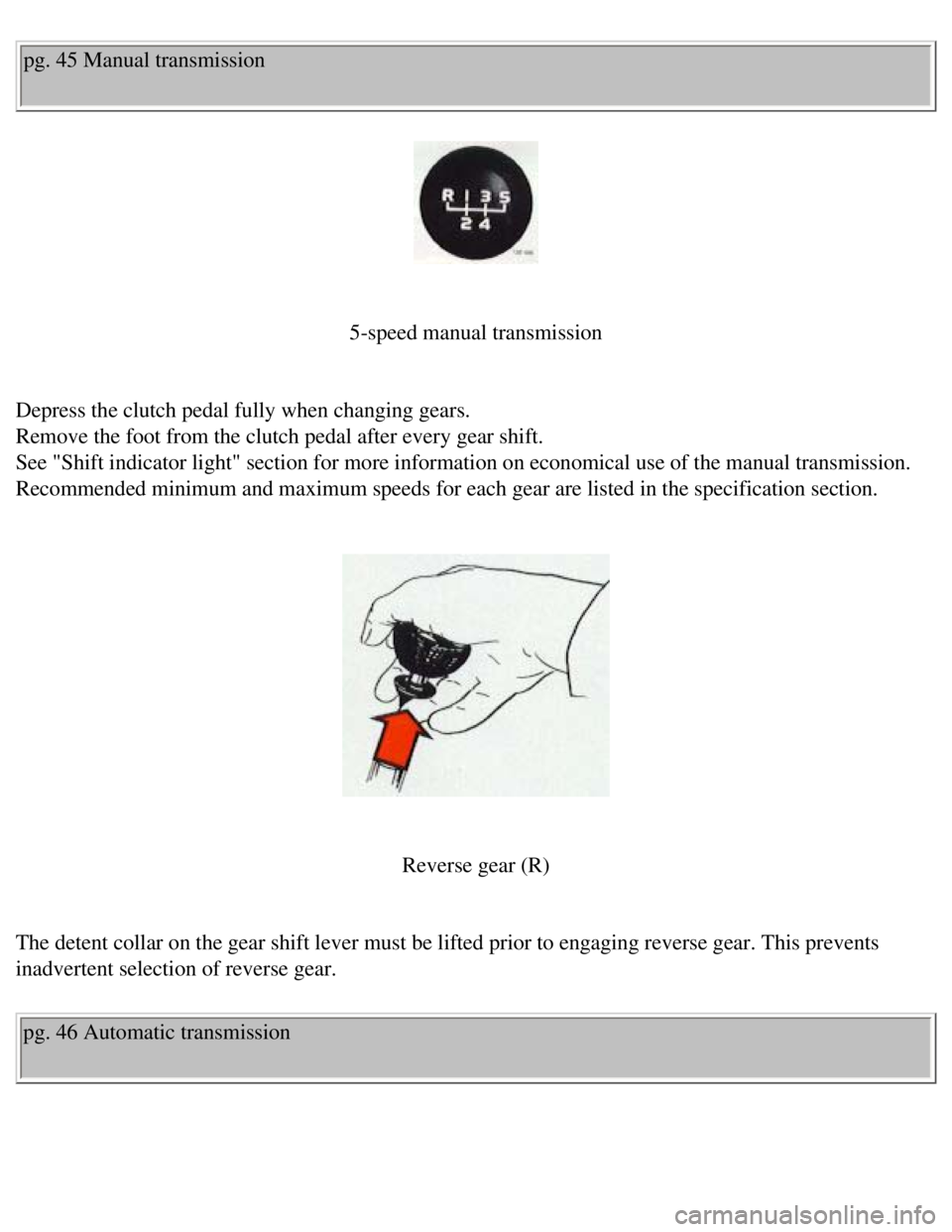
5-speed manual transmission
Depress the clutch pedal fully when changing gears.
Remove the foot from the clutch pedal after every gear shift.
See "Shift indicator light" section for more information on economical u\
se of the manual transmission.
Recommended minimum and maximum speeds for each gear are listed in the s\
pecification section.
Reverse gear (R)
The detent collar on the gear shift lever must be lifted prior to engagi\
ng reverse gear. This prevents
inadvertent selection of reverse gear.
pg. 46 Automatic transmission
file:///K|/ownersdocs/1990/1990_240/90240_10.htm (1 of 7)12/30/2006 8:\
25:05 AM
Page 60 of 143

Volvo 1990 240 Model
Button on gear selector knob and indicator light
symbol.
Disengaging 4th gear
The transmission will engage 4th gear automatically after upshifting thr\
ough first, second and third gears
unless the disengagement button on the side of the gear knob is pushed. \
When the button is pushed to disengage 4th gear, the transmission operat\
es as a 3-speed unit. If the
button is pushed while 4th gear is engaged, then a downshift to 3rd gear\
will occur. The transmission,
then, cannot upshift to 4th gear until the button is pushed again. As a \
reminder, when 4th gear is
disengaged, the indicator light (
) in the instrument panel is illuminated.
Be aware that, if 4th gear is disengaged (reminder light illuminated) \
when the engine is switched off, the
transmission will revert automatically to 4-speed operation (reminder l\
ight not illuminated) when the
engine is restarted.
Disengage 4th gear (reminder light illuminated) when:
* towing a trailer
* driving on hilly roads where precise speed control is desired.
Kick-down
Automatic down-shift to a lower gear is achieved by depressing the throt\
tle pedal fully and briskly.
An up-shift will be achieved when approaching the top speed for a partic\
ular gear or by releasing the
throttle pedal slightly.
Kick-down can be used for maximum acceleration or when passing at highwa\
y speeds.
Starting and stopping a car equipped with automatic transmission
file:///K|/ownersdocs/1990/1990_240/90240_10.htm (4 of 7)12/30/2006 8:\
25:05 AM
Page 64 of 143

Volvo 1990 240 Model
pg. 50 Trailer hauling
When preparing for trailer hauling, observe the following:
l Use a trailer hitch which meets Federal Safety Standards for rear end co\
llisions (FMVSS 301 -75).
For trailer weights exceeding 2,000 lbs (908 kgs) use only a trailer h\
itch offered as a Genuine Volvo
Accessory.
l Maximum trailer weight recommended by Volvo is 3,300 lbs (1,500 kg). \
However, for cars with automatic transmission, an optional Volvo automat\
ic transmission oil cooler
must be installed when trailer weight exceeds 2,000 lbs (908 kgs). Wit\
h manual transmission, 5th gear
should not be used while towing. Observe legal requirements of the state\
in which the vehicles are
registered.
All Volvo models are equipped with energy absorbing shock mounted bumper\
s. Trailer hitch installation
should not interfere with the proper operation of the bumper system.
WARNING! Bumper-attached trailer hitches must not be used on Volvo's, no\
r should safety chains be
attached to the bumper.
Trailer hitches attaching to the vehicle rear axle must not be used.
WARNING! Never connect a trailer's hydraulic-brake system directly to th\
e vehicle brake system, nor
a trailer's lighting system directly to the vehicle lighting system. Con\
sult your nearest authorized
Volvo dealer for correct installation.
Trailer hauling does not normally present any particular problems, but t\
ake into consideration:
l Recommended hitch tongue load is 110 lbs (50 kgs) for trailer weights \
below 2,650 lbs (1,200 kgs)
and 143-154 lbs (65-70 kgs) for trailer weights above 2,650 lbs (1,20\
0 kgs). However, it must not
exceed 200 lbs (90 kgs).
l For trailer weights between 2,650-3,300 lbs (1,200-1,500 kgs) a top sp\
eed of 50 mph (80 km/h)
should never be exceeded.
l Engine and transmission are subject to increased loads. Therefore, engin\
e coolant temperature should
be closely watched when driving in hot climate or hilly terrain. Use low\
er gear and turn off air
conditioner if temperature gauge pointer enters the red range.
l Avoid overload and other abusive operation.
l Hauling a trailer affects handling, durability and economy.
file:///K|/ownersdocs/1990/1990_240/90240_11.htm (1 of 6)12/30/2006 8:\
25:06 AM
Page 65 of 143
.
l More frequent vehicle maint")
Volvo 1990 240 Model
l It is necessary to balance trailer brakes with the towing vehicle brakes\
to provide a safe stop (check
and observe State regulations).
l More frequent vehicle maintenance is required.
l Remove the ball and drawbar assembly when the hitch is not being used.
l Increase tire pressure to recommended full-load pressure. See section 'W\
heels and Tires."
Note: Refer to section entitled "Automatic transmission" for additional \
trailer hauling
tips.
Warning: Do not drive with trunk lid or tailgate
open!
Poisonous exhaust gases may enter via the open trunk lid or tailgate. (\
This is especially true for wagon
models.)
If the trunk lid or tailgate for any reason must be open, proceed as fol\
lows:
l Close the windows.
l Set the heating system controls for floor and defroster to max. and the \
blower to full speed (4). See
section titled "Heating and Ventilation".
Handling, roadholding
Vehicle load, tire design and inflation pressure are important for prope\
r handling. Therefore check that
the tires are inflated to the recommended pressure according to the vehi\
cle load.
Loads should be distributed so that capacity weight or maximum permissib\
le axle loads are not
exceeded.
It is recommended to use tires of the same make and dimensions on all fo\
ur wheels.
Warning: Do not mix radial ply and bias ply tires as this will adversely\
alter the vehicle handling
characteristics.
Roof rack
Permanent and removable roof racks are available from Volvo Accessories.\
file:///K|/ownersdocs/1990/1990_240/90240_11.htm (2 of 6)12/30/2006 8:\
25:06 AM
Page 66 of 143
Volvo 1990 240 Model
l Observe the following points when in use.
l Avoid point loads. Distribute the load evenly.
l Place the heavy cargo at bottom of load.
l Observe that center of gravity and handling are influenced by the load w\
eight.
l Increasing load size increases wind resistance.
l Anchor the cargo correctly with a cord.
l Drive carefully. Avoid rapid starts, heavy cornering and heavy braking. \
l Max. roof load is 220 lbs (100 kg); use a root rack with a sufficient \
load rating.
pg. 51 Automatic transmission, Brake system
The following "Special Tips" apply to cars with automatic transmission
l For steep hills and when driving for prolonged periods at low speeds, po\
sition 1 should be selected.
Avoid, however, repeated changes since this can cause overheating of the\
transmission oil. For driving
on mountain roads with long persistent uphill gradients, select position\
2.
l When negotiating long, steep, downhill slopes, position 1 should be sele\
cted and position 2 for less
severe inclines, in order to obtain the best possible engine braking eff\
ect.
Do not hold the car stationary on an incline by using the accelerator pe\
dal. Instead, engage the hand
brake. This prevents the transmission oil from becoming overheated.
l 4th gear must be disengaged when hauling a trailer!
l If an additional transmission oil cooler is installed you can haul a tra\
iler with the overdrive engaged.
See next "special tip".
l When driving with heavy trailers, it is recommended that an additional o\
il cooler be installed. This
applies especially when driving under severe conditions e.g. mountain dr\
iving or prolonged driving at
high speeds without breaks. The additional oil cooler is available as a \
genuine Volvo accessory.
Regarding oil change, see section titled "Transmission oil".
Moisture on brake discs and brake pads affects braking.
Driving in rain and slush or passing through a normal car wash can cause\
water to collect on the brake
discs and pads. This will cause a delay in braking effect when the pedal\
is depressed. To avoid such a
delay, when the brakes are needed, depress the pedal occasionally when d\
riving in rain or slush.
This will remove the water from the brakes.
This should also be done after washing or starting in very damp weather.\
If the brake power assist does not function --
file:///K|/ownersdocs/1990/1990_240/90240_11.htm (3 of 6)12/30/2006 8:\
25:06 AM