fuel VOLVO 240 1990 Owners Manual
[x] Cancel search | Manufacturer: VOLVO, Model Year: 1990, Model line: 240, Model: VOLVO 240 1990Pages: 143, PDF Size: 2.32 MB
Page 6 of 143
Volvo 1990 240 Model
pg. 34Hood release, long load storage
pg. 35Rear/side view mirrors
pg. 36Interior light, sun roof, fuel tank cap
pg. 37Rear seat (wagon)
pg. 38Tailgate (wagon)
pg. 39Cargo compartment (wagon)
pg. 40Front seats
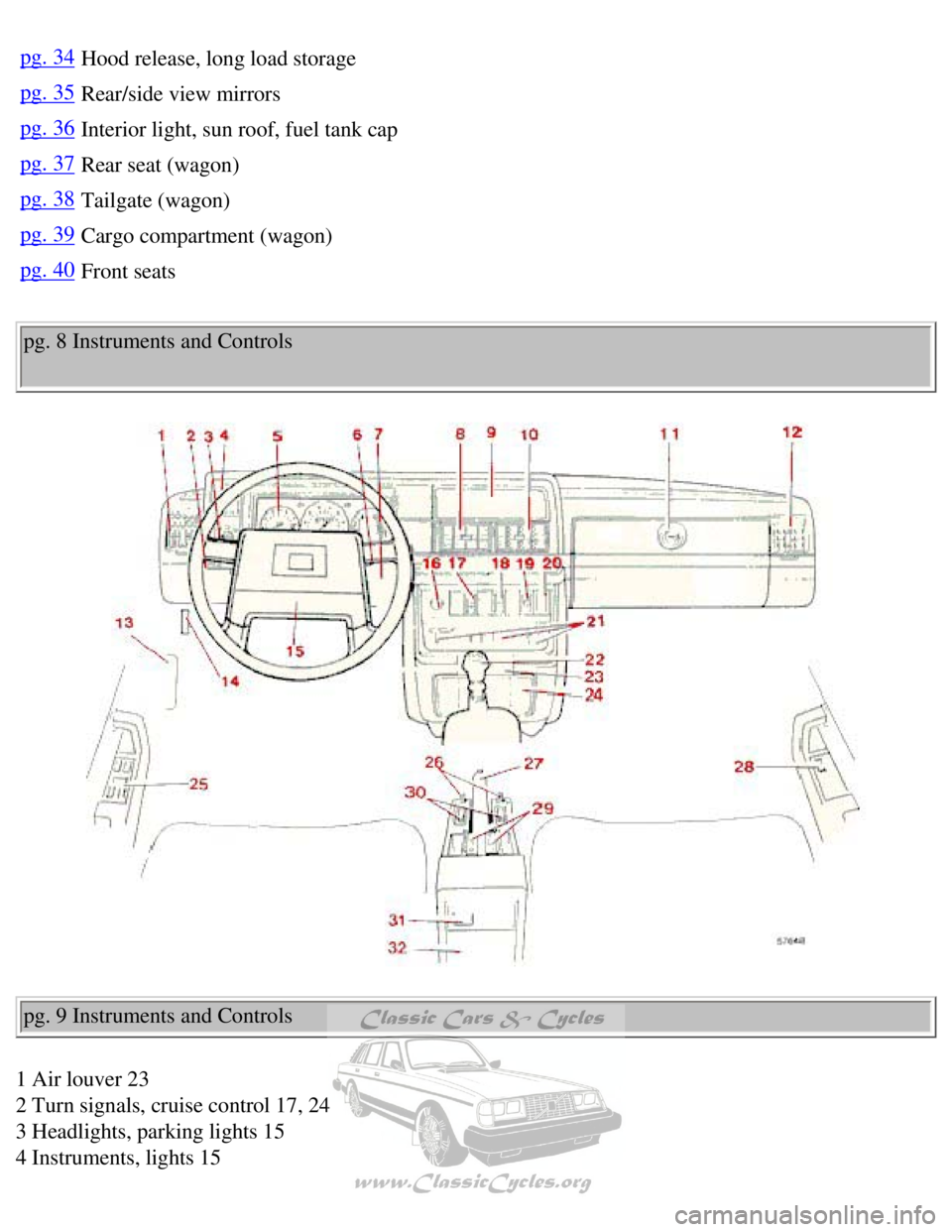
pg. 8 Instruments and Controls
pg. 9 Instruments and Controls
1 Air louver 23
2 Turn signals, cruise control 17, 24
3 Headlights, parking lights 15
4 Instruments, lights 15
file:///K|/ownersdocs/1990/1990_240/90240_01.htm (2 of 5)12/30/2006 8:\
25:01 AM
Page 8 of 143
Volvo 1990 240 Model
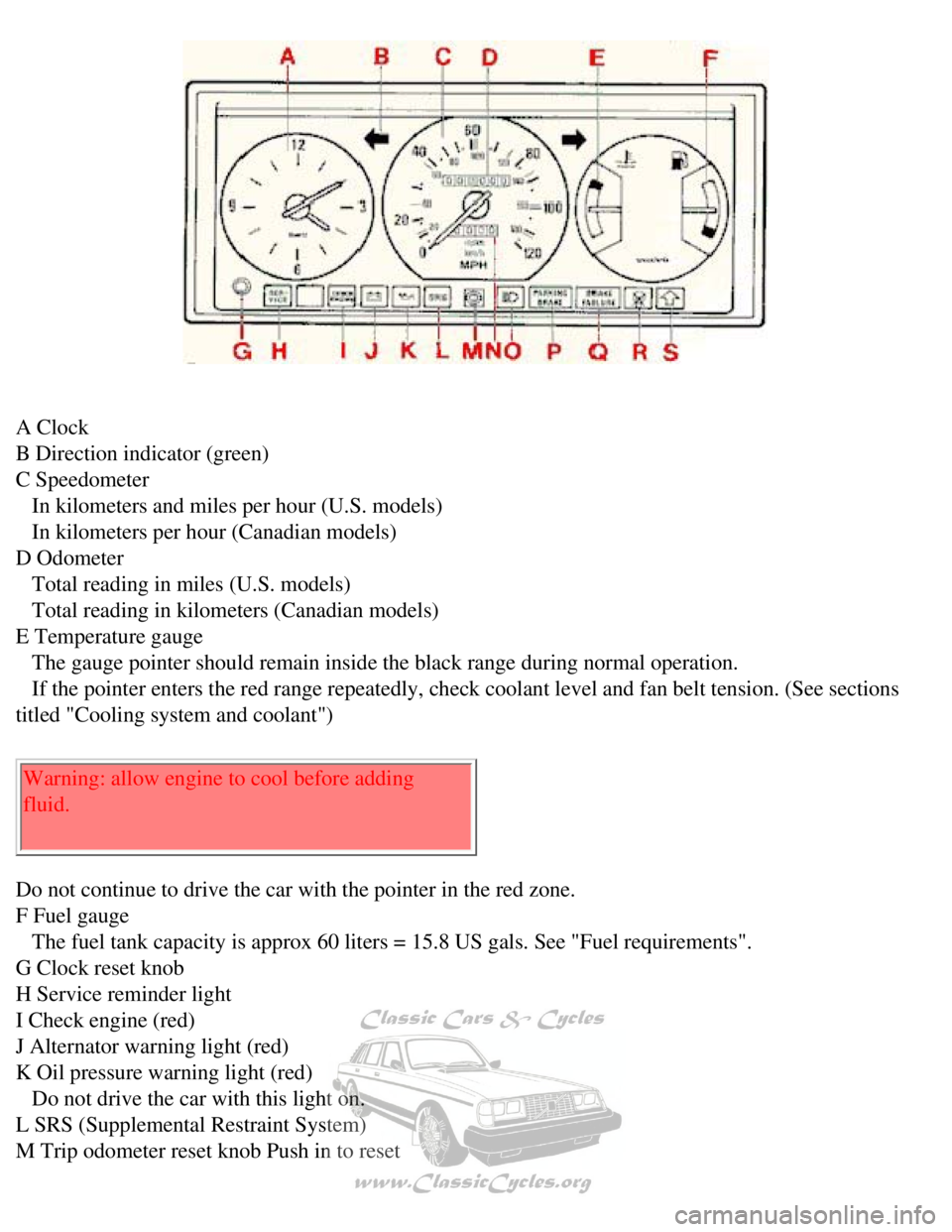
A Clock
B Direction indicator (green)
C Speedometer
In kilometers and miles per hour (U.S. models)
In kilometers per hour (Canadian models)
D Odometer
Total reading in miles (U.S. models)
Total reading in kilometers (Canadian models)
E Temperature gauge
The gauge pointer should remain inside the black range during normal \
operation.
If the pointer enters the red range repeatedly, check coolant level a\
nd fan belt tension. (See sections
titled "Cooling system and coolant") Warning: allow engine to cool before adding
fluid.
Do not continue to drive the car with the pointer in the red zone.
F Fuel gauge
The fuel tank capacity is approx 60 liters = 15.8 US gals. See "Fuel \
requirements".
G Clock reset knob
H Service reminder light
I Check engine (red)
J Alternator warning light (red)
K Oil pressure warning light (red)
Do not drive the car with this light on.
L SRS (Supplemental Restraint System)
M Trip odometer reset knob Push in to reset
file:///K|/ownersdocs/1990/1990_240/90240_01.htm (4 of 5)12/30/2006 8:\
25:01 AM
Page 48 of 143

Volvo 1990 240 Model
Power mirrors
A Adjustment up/down
B Adjustment sideways
Avoid using ice scrapers made of metal as they can easily scratch the mi\
rror surface.
WARNING!
The mirrors should always be adjusted before driving. Objects seen in th\
e wide angle right side view
mirror are closer than they appear to be.
pg. 36 Interior light, Sunroof, Refueling
Interior light
file:///K|/ownersdocs/1990/1990_240/90240_08.htm (2 of 4)12/30/2006 8:\
25:04 AM
Page 50 of 143
12/30/2006 8:\
25:04 AM")
Volvo 1990 240 Model
Refueling
The
file:///K|/ownersdocs/1990/1990_240/90240_08.htm (4 of 4)12/30/2006 8:\
25:04 AM
Page 53 of 143
, transmission in neutral, applyin\
g the parking brake")
Volvo 1990 240 Model
To obtain best parking brake performance, the brake linings should be br\
oken in.
Stop 5-7 times from 30 mph (50 km/h), transmission in neutral, applyin\
g the parking brake with the
release button pressed in during the stop. The force must not lock the r\
ear wheels. If this happens,
release the brake enough to let the wheels rotate. Drive a mile between \
each stop to cool the brakes.
Check for proper parking brake operation.
Note: The brake lights are not illuminated when applying the parking bra\
ke. To warn traffic from
behind it is therefore advisable to depress the brake pedal slightly to \
illuminate the brake lights.
600 - 1,200 mile maintenance service
To ensure proper operation the car should be taken to a Volvo dealer bet\
ween the first 600 - 1,200 miles
(1,000 - 2,000 km) for a maintenance service. The oil in the engine, m\
anual transmission and rear axle
will then be changed. This is very important since the oil rapidly colle\
cts impurities during the break-in
period.
pg. 43 Driving economy, Shift indicator light
Economical driving does not necessarily mean driving slowly
Better driving economy may be obtained by thinking ahead, avoiding rapid\
starts and stops and
adjusting the speed of your vehicle to immediate traffic conditions. Obs\
erve the following rules:
l Bring the engine to normal operating temperature as soon as possible by \
driving with a light foot on
the accelerator pedal instead of allowing the engine to idle for a prolo\
nged period. A cold engine uses
more fuel and is subject to increased wear.
l When possible avoid using the car for driving short distances. This does\
not allow the engine to reach
normal operating temperature.
l Drive carefully and avoid rapid acceleration and hard braking.
l Do not exceed speed limit.
l Avoid carrying unnecessary items (extra load) in the car.
l Check tire pressures regularly (cold tires).
l Remove snow tires when threat of snow or ice has ended.
l Note that roof racks, ski racks, etc., increase air resistance and there\
by fuel consumption.
file:///K|/ownersdocs/1990/1990_240/90240_09.htm (3 of 6)12/30/2006 8:\
25:05 AM
Page 54 of 143

Volvo 1990 240 Model
l Avoid using automatic transmission kick-down feature unless necessary.
Other factors which decrease gas mileage are:
l Worn or dirty spark plugs
l Incorrect spark plug gap
l Dirty air filter
l Incorrect valve clearance
l Incorrect idle speed
l Dirty engine oil and clogged oil filter
l Dragging brakes
l Incorrect front end alignment
l Low tire pressure
Shift indicator light
(manual transmission models only)
The Volvo shift indicator light (S.I.L.) is a device designed to help \
you get even better gas mileage from
your Volvo car. Studies have shown that the best fuel economy is obtaine\
d by shifting gears at low
engine rpm and high relative engine load. The Volvo S.I.L. is calibrated\
to show you when to shift for
improved mileage without sacrificing smooth acceleration .
Use of the S.I.L. is simple. Shift to next higher gear as soon as the li\
ght comes on. You may find after
using the S.I.L. for some time that your natural shifting rhythm will ad\
apt to the S.I.L.'s suggestion.
Some drivers may even shift before the light comes on.
Obviously, there will be times when you need to shift later than the lig\
ht would indicate (for example,
when climbing hills or trailer towing). Using the light regularly, howe\
ver, should result in a mileage
improvement of six percent or more, depending on how you normally drive.\
Programming instructions for shift indicator
If the current supply to the control unit is cut (battery disconnected)\
, the control unit will have to be re-
programmed as the control unit memory will be erased.
Drive the car in each gear (first gear not necessary) for approximatel\
y 8 seconds.
The gear change indicator light will flicker once (0.5 seconds), as ea\
ch gear is programmed.
file:///K|/ownersdocs/1990/1990_240/90240_09.htm (4 of 6)12/30/2006 8:\
25:05 AM
Page 55 of 143

Volvo 1990 240 Model
Note: Remove foot completely from the clutch pedal after each gear chang\
e when programming the
control unit.
pg. 44 Starting the engine
To start the engine;
1 Enter the car and check that the seat is adjusted properly. Make sure \
that the brake (and clutch) pedal
can be depressed completely. Move the seat closer if necessary.
2 Fasten the seat belt.
3 Apply the parking brake if not already set. Depress the brake pedal wi\
th your right foot.
4 Place the gear selector lever in neutral (position N or P, automatic \
transmission).
5 Depress the clutch pedal (manual transmission).
6 Without touching the accelerator pedal turn the ignition key to starti\
ng position. Release the key as
soon as the engine starts.
Avoid repeated short attempts to start (fuel is injected every time the\
starter is engaged when engine is
cold).
Allow the starter to operate for a longer time (but not more than 15-20\
seconds).
Do not race a cold engine immediately starting.
Engine warm-up-initial driving procedure
Experience shows that engines in vehicles driven short distances are sub\
ject to abnormally rapid wear
because the engine never reaches normal operating temperature.
It is therefore beneficial to reach normal operating temperature as soon\
as possible by driving with a
light foot on the accelerator pedal.
Warning: Always open the garage doors fully before starting the engine i\
nside the garage to ensure
adequate ventilation. The exhaust gases contain carbon monoxide, which i\
s invisible and odorless but
very poisonous.
file:///K|/ownersdocs/1990/1990_240/90240_09.htm (5 of 6)12/30/2006 8:\
25:05 AM
Page 68 of 143

Volvo 1990 240 Model
pg. 52 Catalytic Converter
Catalytic Converter Cautions
l Keep your engine properly tuned. Certain engine malfunctions, particular\
ly involving the electrical,
fuel or ignition systems, may cause unusually high converter temperature\
s. Do not continue to operate
your vehicle it you detect engine misfire, noticeable loss of power or o\
ther unusual operating conditions,
such as engine overheating or backfiring. A properly-tuned engine will h\
elp in avoiding malfunctions
that could damage the Catalytic Converter.
l Remember that tampering with or unauthorized modifications to the engine\
or the vehicle may be
illegal and can cause catalyst or exhaust system overheating. This inclu\
des:
-- Altering fuel injection settings or components.
-- Adjusting ignition timing beyond specified limits.
-- Altering emission system components or location or removing component\
s.
-- Use of leaded fuel.
WARNING: Do not park your car over combustible materials, such as grass \
or leaves, which can
come into contact with the hot exhaust system and cause such materials t\
o ignite under certain wind
and weather conditions.
l Excessive starter cranking (in excess of one continuous minute) with a\
n intermittently firing or
flooded engine, can cause catalyst or exhaust system overheating. This a\
lso applies to lengthy pushing or
towing of vehicle to start (manual transmissions only). Do not attempt\
to start a car with automatic
file:///K|/ownersdocs/1990/1990_240/90240_11.htm (5 of 6)12/30/2006 8:\
25:06 AM
Page 69 of 143

Volvo 1990 240 Model
transmission by pushing or towing .
CAUTION: Unleaded fuel is required for cars with catalytic converter. A \
label on the instrument panel
and rear fender, near the filler inlet, will remind owners and filling s\
tation attendants of this
requirement.
Important! It is unlawful to dispense leaded fuel into any vehicle label\
ed "unleaded gasoline only".
Contents | Top of Page
file:///K|/ownersdocs/1990/1990_240/90240_11.htm (6 of 6)12/30/2006 8:\
25:06 AM
Page 70 of 143
Volvo 1990 240 Model
pg. 53 Service and maintenance
55Maintenance services
56Service requirements
59Engine B230F
60Fuel requirements
61Engine fluids
62Engine oil, Oil/oil filter change interval
63Cooling system
65Servicing
70Transmission oil
72Rear axle, power steering, brake fluid
73Lubrication
74Coolant
75Alternator, jump starting
76Replacing bulbs
81Fuses
82Wheels and tires
84Wheel changing
86Replacing wiper blades
87Washing, cleaning
87Cleaning, anti-rust treatment
88Paint touch-up
90What causes rust
91Long distance trips, cold weather
92Service diagnosis
96Label information
file:///K|/ownersdocs/1990/1990_240/90240_12.htm (1 of 7)12/30/2006 8:\
25:07 AM