air condition VOLVO 240 1990 User Guide
[x] Cancel search | Manufacturer: VOLVO, Model Year: 1990, Model line: 240, Model: VOLVO 240 1990Pages: 143, PDF Size: 2.32 MB
Page 100 of 143

Volvo 1990 240 Model
Cooling system
The risk of overheating is greatest, especially in hot weather, when:
- towing a trailer up steep inclines for prolonged periods at full throt\
tle, and at low engine rpm.
- idling for prolonged periods while the air conditioning system is in o\
peration.
- stopping the engine suddenly after high speed driving, so called after\
-boiling.
To avoid overheating. the following rules should be followed.
l Reduce speed and downshift when towing a trailer up long steep inclines.\
The risk of over heating can
be reduced by switching off the air conditioning system for a short whil\
e.
l Do not let the engine idle unnecessarily.
l Do not stop the engine immediately after high-speed driving, but allow t\
he engine to idle for 1/2 - 1
minute before switching off.
When the risk of overheating is imminent, or in the event of overheating\
, (the temperature gauge goes
repeatedly into, or stays continually in, the red section) the followin\
g precautions should be taken:
l Switch off the air conditioning system and switch the heater to full (m\
aximum) position.
l Stop the car and put the gear lever into neutral position-position N. Do\
not stop the engine!
l Increase the engine speed to approx. 2000 rpm (twice idling speed).
l Check the level of coolant in the expansion tank. Top-up, if necessary
pg. 75 Alternator, Jump starting
Electrical System cautions
When changing the battery or when carrying out work involving the electr\
ical system, the following
should be observed:
1 A battery connection to the wrong terminal will damage the diodes. Bef\
ore connections are made,
check the polarity of the battery with a voltmeter.
2 If booster batteries are used for starting, they must be properly conn\
ected to prevent the diodes from
being damaged. For correct connection, see "Jump starting".
3 The battery leads should be disconnected any time the battery is being\
charged.
file:///K|/ownersdocs/1990/1990_240/90240_15.htm (8 of 10)12/30/2006 8\
:25:09 AM
Page 112 of 143
 switch OFF before replacing fuses. E\
xcessive heat may be created by
a short circuit. Care must be exercised while replacing blown fuses.")
Volvo 1990 240 Model
Warning: Turn starting (ignition) switch OFF before replacing fuses. E\
xcessive heat may be created by
a short circuit. Care must be exercised while replacing blown fuses.
Some of the equipment listed below is optional
Refer to the fuse location chart at fuse box for fuses specific to your \
car.
1 Cigarette lighter, Power mirrors, Radio, Tailgate wiper/washer 8A
2 Windshield wiper/washer, Horn 16A
3 Heater blower 25A
4 Fuel feed (in-tank) pump, Lambda-sond heating element 8A
5 Turn signals, Back-up lights 16A
6 Main fuel pump relay 16A
7 Brake lights 8A
8 Central locking, Interior and glove compartment lights, Trunk and engi\
ne
compartment lights, Radio, Power antenna, Clock, Daytime running lights \
(Canada)* 8A
9 Hazard warning Flashers 8A
10 Power windows 16A
11 Heated rear window, 4th gear (automatic transmission) 16A
12 Air conditioning (with blower control), Power windows (relay),
Heated rear window (relay), Seat belt reminder, Cruise control 8A
13 Heated front seats, Daytime running lights - relay (Canada)* 16A
14 Rear fog lights 8A
15 Parking lights (left side), License plate light 8A
16 Parking lights (right side), Instruments and control panel lights, \
Shift indicator light 8A
Blade type fuse, serving LH-Jetronic fuel injection system. Located on t\
he left
wheel housing by the ignition coil 25A
* Note: Early production Canadian vehicles are not equipped with Daytime\
Running Lights.
Contents | Top of Page
file:///K|/ownersdocs/1990/1990_240/90240_16.htm (10 of 10)12/30/2006 \
8:25:10 AM
Page 118 of 143

Volvo 1990 240 Model
The floor mats should be vacuumed or brushed clean regularly, especially\
during the winter when they
should be taken out for drying.
Spots on textile mats can be removed with a mild detergent.
Anti-rust treatment
Your Volvo has been rust protected at the factory. On external surfaces \
a heavy coat of wear resistant
material has been used, while on the internal surfaces a lighter rust in\
hibitor is used.
The rust protection should be inspected regularly by your authorized Vol\
vo dealer. Consult the Volvo
Protection Limited Warranty found in your Warranty Information Booklet f\
or additional terms and
conditions.
For further information, see section titled "What causes rust" or see yo\
ur Volvo dealer. pg. 88 Paint touch-up
Paint touch-up
Paint damage requires immediate attention to avoid rusting. Make it a ha\
bit to check the finish regularly,
for instance when washing the car. Touch-up if necessary.
Paint repairs require special equipment and skill. Contact your Volvo de\
aler for any extensive damages.
Minor scratches can be repaired by using Volvo touch-up paint.
Note: When ordering touch-up paint from your Volvo dealer, use the paint\
code indicated on the
service label. The label is located on the wheel housing in the engine c\
ompartment.
Minor stone chips and scratches
Material:
Primer-can
Paint-can or touch-up bottle
file:///K|/ownersdocs/1990/1990_240/90240_18.htm (4 of 8)12/30/2006 8:\
25:11 AM
Page 123 of 143

Volvo 1990 240 Model
pg. 91 Long distance trips, Cold weather
Prior to a long distance trip
Have your car checked at a Volvo dealer. Preventive maintenance will hel\
p to ensure a trouble free trip.
Remember to take along a Volvo dealer directory.
The main items to check are listed below:
1. Brakes, front wheel alignment and steering gear.
2. Engine running condition.
3. Fuel system operation.
4. Oil leaks: engine, transmission, rear axle.
5. Cooling system for leaks or worn hoses.
6. Examine tires carefully, replace worn tires.
7. Battery and terminals.
8. Tool equipment.
9. Lighting.
10. Drive belts, for tightness and wear.
11. All fluid levels.
Cold weather/Engine fuel system
During the winter, large variations in temperature cause condensation to\
form in the fuel tank and can
impair the running of the engine. This can be reduced by adding dry gas \
to the fuel. There is less risk of
condensation forming in the fuel tank if it is kept full or nearly full.\
Engine cooling system
Volvo type C (blue-green) coolant should be used all year round. The c\
ooling system should always
contain water plus anti-freeze and rust inhibitor, even during the summe\
r. Experience has also shown
that extremely weak anti-freeze solutions (10-25 percent) are ineffect\
ive for rust protection. For this
reason, the quantity of antifreeze/summer coolant should be about 50 per\
cent of the solution. This
lowers the freezing point to - 30 ° F (-35 ° C).
Engine lubricating system
file:///K|/ownersdocs/1990/1990_240/90240_19.htm (1 of 7)12/30/2006 8:\
25:13 AM
Page 124 of 143
 improves cold-we")
Volvo 1990 240 Model
During the winter, multigrade oil 10W-30 should be used in the engine. \
The viscosity of the engine oil is important. Oil with low viscosity (t\
hinner oil) improves cold-weather
starting as well as decreasing fuel consumption while the engine is warm\
ing up. To avoid difficult cold
start conditions (during extreme winter weather), use of 5W-30 oil, pa\
rticularly the synthetic type, is
recommended.
Be sure to use good quality oil but do not use this cold-weather oil for\
hard driving or in warm weather.
See section "Engine oil" for more information.
Electrical system
The electrical system is subject to greater stresses during the winter. \
Lighting and starter motor are used
more often. The battery capacity is reduced at low air temperature. The \
state of charge must be checked
more frequently, and if necessary the battery should be recharged. The b\
attery can freeze if the state of
charge is too low.
Windshield washers
Anti-freeze washer fluid should also be added to the washer fluid contai\
ner for the windshield and rear
window (tailgate, wagon model) washer.
This is particularly important during the winter because the windshield \
frequently becomes dirty and is
often splashed with water which freezes rapidly. This may necessitate th\
e frequent use of the windshield
washer and wipers. Your Volvo dealer can supply you with suitable anti-f\
reeze for this purpose. Suitable
mixtures of anti-freeze and water are:
Down to +14 ° F (-10 ° C) 1 part anti-freeze 4 parts water.
Down to + 7 ° F (-14 ° C) 1 part anti-freeze 3 parts water.
Down to 0 ° F (-18 ° C) 1 part anti-freeze 2 parts water.
Down to -18 ° F (-28 ° C) 1 part anti-freeze 1 part water.
Use Volvo Teflon lock spray or grease in the locks. They can be purchase\
d from your Volvo dealer
Note: Avoid the use of de-icing sprays as they can cause damage to the
locks.
pg. 92 Service diagnosis
The diagnoses outlined below are intended to serve only as a guide to lo\
cate and temporarily correct
minor faults. Causes of unsatisfactory performance should be investigate\
d and corrected by your Volvo
file:///K|/ownersdocs/1990/1990_240/90240_19.htm (2 of 7)12/30/2006 8:\
25:13 AM
Page 126 of 143
Volvo 1990 240 Model
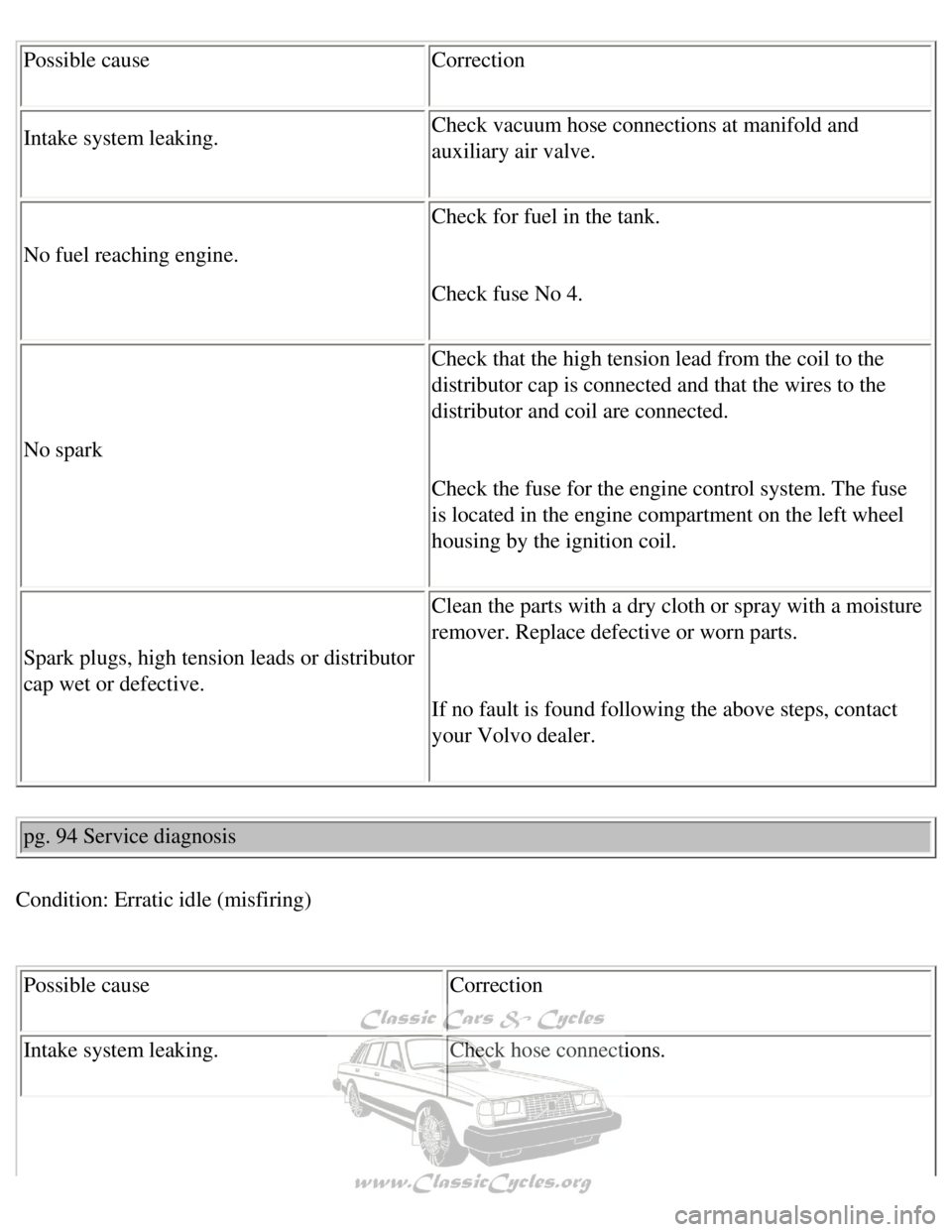
Possible cause Correction
Intake system leaking. Check vacuum hose connections at manifold and
auxiliary air valve.
No fuel reaching engine. Check for fuel in the tank.
Check fuse No 4.
No spark Check that the high tension lead from the coil to the
distributor cap is connected and that the wires to the
distributor and coil are connected.
Check the fuse for the engine control system. The fuse
is located in the engine compartment on the left wheel
housing by the ignition coil.
Spark plugs, high tension leads or distributor
cap wet or defective. Clean the parts with a dry cloth or spray with a moisture
remover. Replace defective or worn parts.
If no fault is found following the above steps, contact
your Volvo dealer.
pg. 94 Service diagnosis
Condition: Erratic idle (misfiring)
Possible cause Correction
Intake system leaking. Check hose connections.
file:///K|/ownersdocs/1990/1990_240/90240_19.htm (4 of 7)12/30/2006 8:\
25:13 AM
Page 127 of 143
Volvo 1990 240 Model
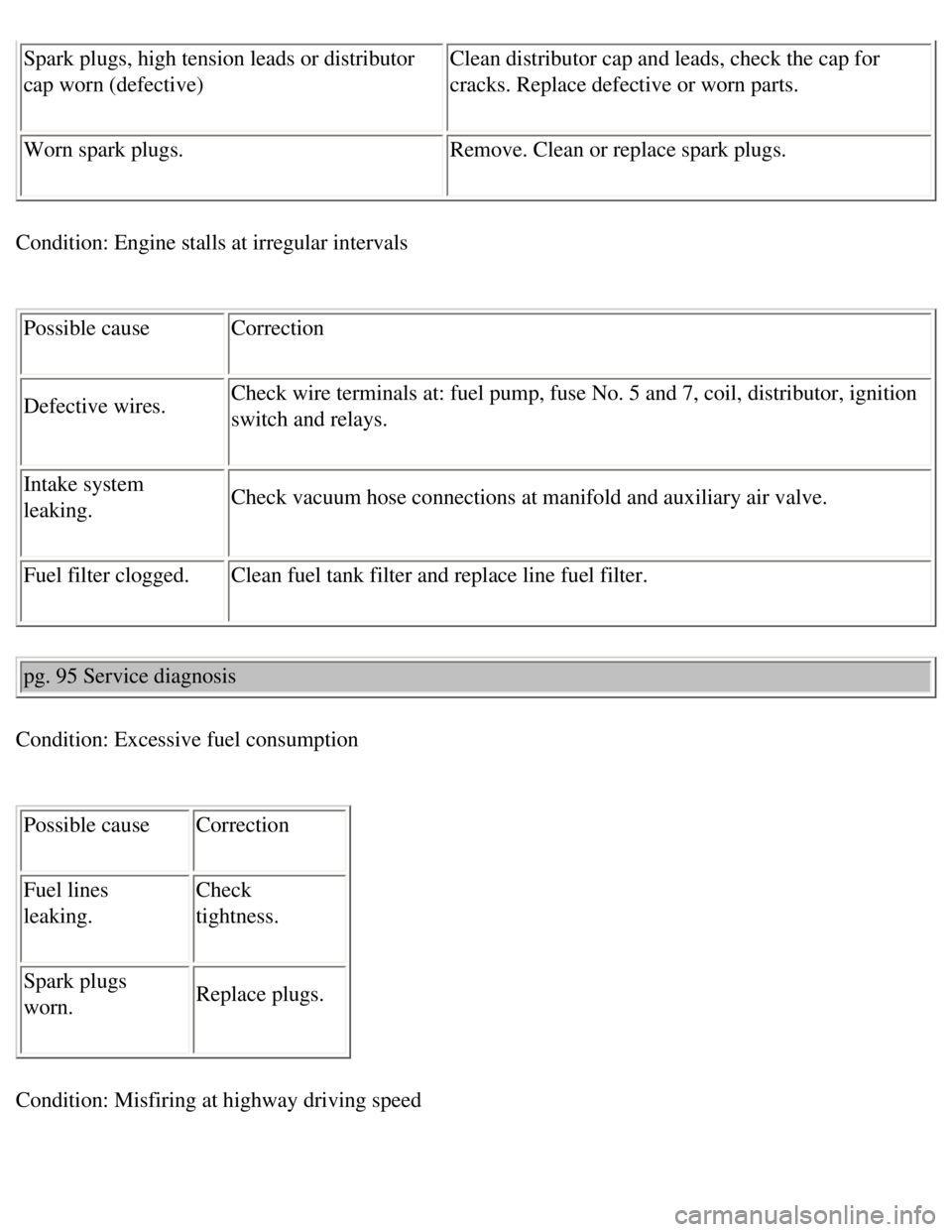
Spark plugs, high tension leads or distributor
cap worn (defective) Clean distributor cap and leads, check the cap for
cracks. Replace defective or worn parts.
Worn spark plugs. Remove. Clean or replace spark plugs.
Condition: Engine stalls at irregular intervals
Possible cause Correction
Defective wires. Check wire terminals at: fuel pump, fuse No. 5 and 7, coil, distributor,\
ignition
switch and relays.
Intake system
leaking. Check vacuum hose connections at manifold and auxiliary air valve.
Fuel filter clogged. Clean fuel tank filter and replace line fuel filter.
pg. 95 Service diagnosis
Condition: Excessive fuel consumption
Possible cause Correction
Fuel lines
leaking. Check
tightness.
Spark plugs
worn. Replace plugs.
Condition: Misfiring at highway driving speed
file:///K|/ownersdocs/1990/1990_240/90240_19.htm (5 of 7)12/30/2006 8:\
25:13 AM