light VOLVO 240 1990 User Guide
[x] Cancel search | Manufacturer: VOLVO, Model Year: 1990, Model line: 240, Model: VOLVO 240 1990Pages: 143, PDF Size: 2.32 MB
Page 16 of 143

Volvo 1990 240 Model
Rear fog lights
The rear fog lights are considerably brighter than the normal tail light\
s and should be used only when
atmospheric conditions, such as fog, rain, snow, smoke or dust reduce th\
e daytime or nighttime visibility
of other vehicles to less than 500 ft. (152 meters). (The headlights \
must be switched on.)
Note: Local regulations governing the use of these lights may
vary.
Headlights and position lights
0 All lights off*
Parking lights on*
Headlights and parking lights on
Switch from upper to lower beams, and vice versa, by moving the turn sig\
nal switch lever on the left
side of the steering column towards the steering wheel. The parking ligh\
ts can be used without switching
on the starting (ignition) key.
* Canadian models equipped with daytime running lights: Headlights and p\
arking lights on when
file:///K|/ownersdocs/1990/1990_240/90240_03.htm (3 of 7)12/30/2006 8:\
25:02 AM
Page 17 of 143
 switch is switched on.
A chime will sound if the starting (ignition) key is in the switch loc\
k when the door is open. The chime
goes off when the driv")
Volvo 1990 240 Model
starting (ignition) switch is switched on.
A chime will sound if the starting (ignition) key is in the switch loc\
k when the door is open. The chime
goes off when the driver's door is closed. If the headlight switch is in\
position
, all lights will go out
when starting (ignition) switch is switched off.
Instrument panel lamps rheostat
Clockwise - brighter
Counterclockwise - dimmer
pg. 16 Windshield wipers, Tailgate window wiper, Washer nozzles
Wiper/washer
1 Intermittent wiper
file:///K|/ownersdocs/1990/1990_240/90240_03.htm (4 of 7)12/30/2006 8:\
25:02 AM
Page 20 of 143
Volvo 1990 240 Model
NOTE: the cruise control cannot be engaged at speeds below 22 mph (35
km).
3. Depress SET SPEED switch (2).
Operating brake pedal or clutch pedal (where applicable)
This will automatically disengage the cruise control. Previously selecte\
d cruise speed is retained in the
memory and by momentarily setting the switch to RESUME position that spe\
ed will be re-engaged.
If the cruise control is already engaged, the cruising speed can be incr\
eased by depressing the SET
SPEED button (2). The vehicle will then maintain the current speed.
WARNING!
The cruise control should not be used in heavy traffic or when driving o\
n wet or slippery roads.
If the gear shift is moved to Neutral while the cruise control is engage\
d, then depress the brake pedal
momentarily, or set the cruise control switch (1) to OFF. This will di\
sengage the cruise control and
prevent overreving the engine.
NOTE: When driving on a grade, actual vehicle speed may vary slightly fr\
om the set cruise control
speed.
Acceleration
Momentary acceleration, such as for passing, does not interrupt cruise c\
ontrol operation. The previously
selected speed will be maintained without having to set switch to RESUME\
.
To disengage the cruise control system:
Set switch (1) to position OFF, or depress brake pedal, or depress clu\
tch pedal (where applicable).
Switching off the starting (ignition) switch will automatically diseng\
age the cruise control system.
Contents | Top of Page
file:///K|/ownersdocs/1990/1990_240/90240_03.htm (7 of 7)12/30/2006 8:\
25:02 AM
Page 22 of 143

Volvo 1990 240 Model
cleaner, otherwise damage to the printed circuit will occur.
Hazard warning flasher
The four-way flasher should be used to indicate that the vehicle has bec\
ome a traffic hazard.
Note: Regulations regarding the use of the hazard warning flasher may va\
ry from state to
state.
pg. 19 Parking brake
Parking brake (hand brake)
The lever is situated between the front seats. The brake is applied to t\
he rear wheels.
The PARKING BRAKE reminder light on the instrument panel comes on whenev\
er the parking brake
lever is not fully released and the ignition is on.
Always use the parking brake (hand brake) when parked.
In order to obtain the best possible performance of the parking brake, t\
he brake linings should be broken
in. (See section titled "Break-in period".)
file:///K|/ownersdocs/1990/1990_240/90240_04.htm (2 of 5)12/30/2006 8:\
25:02 AM
Page 23 of 143

Volvo 1990 240 Model
Seat heaters
The front seats are equipped with electrically-heated backrests and seat\
cushions. The switches engage
the heating which then is thermostatically controlled. It switches on au\
tomatically when the temperature
drops below 60°F (15°C) and switches off at approx. 95°F (35\
°C). pg. 20 Cigarette lighter, Ash trays
Cigarette lighter
To operate, depress the knob fully. When the knob automatically releases\
, the cigarette lighter is ready
for use.
The starting (ignition) switch must be ON for the cigarette lighter to\
function.
file:///K|/ownersdocs/1990/1990_240/90240_04.htm (3 of 5)12/30/2006 8:\
25:02 AM
Page 30 of 143

Volvo 1990 240 Model
Operating instructions are contained in the manuals associated with each\
model.
These manuals are placed in the cars when the equipment is installed.
Your Volvo Dealer will be able to assist you with any questions regardin\
g the operation of this
equipment.
Radio antenna mast
Note: Always lower the antenna mast when entering automatic car wash. Re\
tractable antennas should
be cleaned and lubricated every 5,000 miles (8,000 km). On fixed (rem\
ovable) mast antennas, be sure
to unscrew and remove the antenna before entering an automatic car wash \
or a garage with low
overhang.
The following information may help to explain differences between car ra\
dio reception and radio
reception in the home.
Signal sending
FM waves do not follow the earth's surface and do not bounce against the\
atmosphere as AM waves do.
Cross modulation
When receiving a weak signal in the vicinity of another, stronger signal\
, both stations may be received
simultaneously.
Weak reception (fading)
Because of the limited range of FM senders and the way FM waves spread, \
this problem usually occurs
with FM reception.
Mountains or similar obstacles can sometimes cause disturbances.
Multipath Distortion
FM Signals are typically "line-of-sight", and very reflective. Their ref\
lectivity to objects such as
buildings, mountains, even other passing vehicles, causes the condition \
known as multipath distortion.
This distortion is the result of the reflected signal, and the direct si\
gnal reaching your antenna at slightly
different times causing a cancellation of all signals. This condition wi\
ll sound like hissing, or static.
Very little can be done to eliminate this problem, however, lowering the\
treble on your radio could help
mask these disturbances thereby allowing you to achieve optimum pleasure\
from your audio system.
file:///K|/ownersdocs/1990/1990_240/90240_05.htm (5 of 6)12/30/2006 8:\
25:03 AM
Page 35 of 143
 key is turned to driving
position. One light is located in the instrument cluster and one in the \")
Volvo 1990 240 Model
Two lights will be illuminated for 4-8 seconds after the starting (igni\
tion) key is turned to driving
position. One light is located in the instrument cluster and one in the \
console between the front seats.
A chime will sound at the same time if the driver has not fastened his s\
eat belt. The front and rear
outboard seats are provided with self-retracting inertia-reel belts.
To buckle:
Pull the belt out from the retractor far enough to insert the latch plat\
e into the buckle until a distinct
snapping sound is heard. The belt should not be twisted or turned.
Note: The lap belt should sit low and tight under
abdomen.
To unfasten, depress red push-button in buckle and let the belts rewind \
into their retractors.
Before exiting the car, check that the seat belt retracts fully after be\
ing unbuckled. If necessary, guide
the belt back into its retractor slot.
The seat belt retractors are normally "unlocked",. The retractors will l\
ock up as follows:
l if belt is pulled out rapidly
l during braking and acceleration
l if the vehicle is leaning excessively
l when driving in turns
Check seat belt mechanism function as follows:
1. Attach the seat belt. Pull rapidly on the strap.
2. WARNING! Check other traffic before performing this
check.
Brake firmly from approximately 30 mph (50 km/h) or turn in a tight ci\
rcle while pulling on the belt.
In all the above checks you should not be able to pull the belt out.
file:///K|/ownersdocs/1990/1990_240/90240_06.htm (4 of 9)12/30/2006 8:\
25:04 AM
Page 39 of 143

Volvo 1990 240 Model
A self-diagnostic system incorporated in the sensor monitors the SRS. If\
a fault is detected, the "SRS"
warning light will illuminate. the light is included in the warning/indi\
cator light cluster in the instrument
panel. Normally, the SRS warning light will be illuminated along with th\
e other warning/indicator lights
when the ignition key is turned to the ON position (position II), and \
go out a short time after the engine
has been started. Check that this light is functioning properly every ti\
me the car is started.
The following items are monitored by the diagnostic system:
l Sensor unit electronics integrity.
l Reserve energy supply.
l Diagnostic output circuit.
l System voltage.
l Integrity of system connectors.
l Mercury switch closure.
l Gas generator ignitor
WARNING! If the SRS warning light stays on after the engine has started \
or if it comes on while you
are driving, drive the car to the nearest authorized Volvo Dealer for in\
spection as soon as possible.
ATTENTION! SRS VEHICLE!
THIS CAR IS EQUIPPED WITH A SUPPLEMENTAL RESTRAINT SYSTEM. TO PROVIDE
CONTINUED RELIABILITY, CERTAIN ELEMENTS OF THE SUPPLEMENTAL RESTRAINT
SYSTEM SHALL BE SERVICED OR REPLACED BY 1999. SEE OWNERS MANUAL FOR
FURTHER INFORMATION.
VOLVO
There is no maintenance to perform on the SRS yourself. The only periodi\
c maintenance recommended
on the SRS is that the air bag module and the sensor unit should be repl\
aced every ten years and that the
other components in the system (wiring, connectors, etc.) should also \
be inspected at this time. This
service must be performed by an authorized Volvo dealer.
file:///K|/ownersdocs/1990/1990_240/90240_06.htm (8 of 9)12/30/2006 8:\
25:04 AM
Page 42 of 143
 position during dr\
iving. In case of an accident, this
may hin")
Volvo 1990 240 Model
NOTE: The driver's door can only be locked using the
key.
The lock buttons should not be In the down (locked) position during dr\
iving. In case of an accident, this
may hinder rapid access to the occupants of the vehicle.
Child safety locks
The buttons are located on the rear door jambs.
A The lock functions normally.
B The door cannot be opened from the inside.
WARNING: In the event of an accident, the rear seat passengers cannot op\
en the doors from the inside
with the buttons in position B.
Wagon model contains child safety lock on tailgate. The lock differs fro\
m that shown above. See section
titled "Wagon, tailgate".
pg. 33 Trunk lid/light
file:///K|/ownersdocs/1990/1990_240/90240_07.htm (2 of 6)12/30/2006 8:\
25:04 AM
Page 44 of 143
Volvo 1990 240 Model
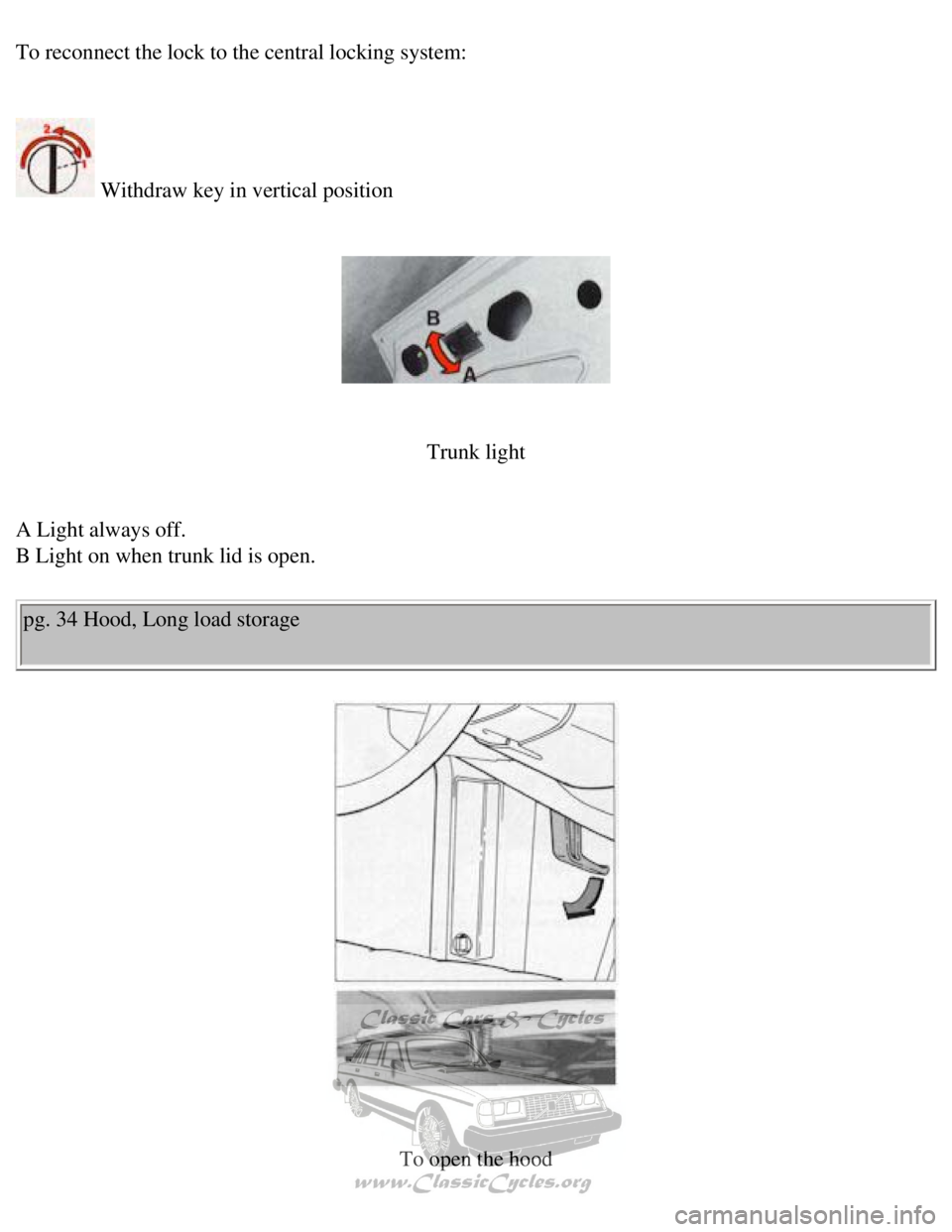
To reconnect the lock to the central locking system:
Withdraw key in vertical position
Trunk light
A Light always off.
B Light on when trunk lid is open.
pg. 34 Hood, Long load storage
To open the hood
file:///K|/ownersdocs/1990/1990_240/90240_07.htm (4 of 6)12/30/2006 8:\
25:04 AM