light VOLVO 240 1990 Owner's Guide
[x] Cancel search | Manufacturer: VOLVO, Model Year: 1990, Model line: 240, Model: VOLVO 240 1990Pages: 143, PDF Size: 2.32 MB
Page 60 of 143

Volvo 1990 240 Model
Button on gear selector knob and indicator light
symbol.
Disengaging 4th gear
The transmission will engage 4th gear automatically after upshifting thr\
ough first, second and third gears
unless the disengagement button on the side of the gear knob is pushed. \
When the button is pushed to disengage 4th gear, the transmission operat\
es as a 3-speed unit. If the
button is pushed while 4th gear is engaged, then a downshift to 3rd gear\
will occur. The transmission,
then, cannot upshift to 4th gear until the button is pushed again. As a \
reminder, when 4th gear is
disengaged, the indicator light (
) in the instrument panel is illuminated.
Be aware that, if 4th gear is disengaged (reminder light illuminated) \
when the engine is switched off, the
transmission will revert automatically to 4-speed operation (reminder l\
ight not illuminated) when the
engine is restarted.
Disengage 4th gear (reminder light illuminated) when:
* towing a trailer
* driving on hilly roads where precise speed control is desired.
Kick-down
Automatic down-shift to a lower gear is achieved by depressing the throt\
tle pedal fully and briskly.
An up-shift will be achieved when approaching the top speed for a partic\
ular gear or by releasing the
throttle pedal slightly.
Kick-down can be used for maximum acceleration or when passing at highwa\
y speeds.
Starting and stopping a car equipped with automatic transmission
file:///K|/ownersdocs/1990/1990_240/90240_10.htm (4 of 7)12/30/2006 8:\
25:05 AM
Page 61 of 143

Volvo 1990 240 Model
1. Enter the car and check that the seat is adjusted properly. Make sure\
that the brake pedal can be
depressed completely. Move the seat closer if necessary.
2. Fasten the seat belt.
3. Apply the parking brake if not already set. Depress the brake pedal w\
ith your right foot.
4. Place the gear selector in Park (or neutral).
5. Without touching the accelerator pedal, turn the ignition key to the \
starting position. Release the key
as soon as the engine starts.
6. Select the desired gear. There is a slight delay before the gear enga\
ges which is most notable when
selecting Reverse. Do not accelerate until you have felt the gear engage\
!
Note: Too-rapid acceleration immediately after selecting a gear will cau\
se harsh engagement and
premature transmission wear.
7. Release parking brake, then foot brake, and accelerate. To stop the c\
ar release the accelerator and
apply the brakes with your right foot.
It is not necessary to move the gear selector as the transmission will d\
ownshift automatically.
When idling for extended periods of time, select position N to prevent u\
nnecessary heating of the
transmission.
WARNING! Always place gear selector in Park and apply parking brake befo\
re leaving vehicle. Never
leave car unattended with engine running.
pg. 48 Emergency towing (pulling)
Front eyelet Rear eyelet
file:///K|/ownersdocs/1990/1990_240/90240_10.htm (5 of 7)12/30/2006 8:\
25:05 AM
Page 62 of 143

Volvo 1990 240 Model
Precautionary steps to observe when towing
Please check with state and local authorities before attempting this typ\
e of towing as vehicles being
towed are subject to regulations regarding maximum towing speed, length \
and type of towing device,
lighting, etc.
l Steering must be unlocked.
l Remember that power brake and power steering assists will not be availab\
le when engine is
inoperative. Pedal pressure required is 3 - 4 times above normal and gre\
ater steering effort must be
employed.
l Towing cars equipped with automatic transmission:
-- Gear selector in position N. Check transmission oil level (see secti\
on titled "Transmission oil").
-- Maximum speed: 20 mph (30 km/h).
-- Maximum distance with rear wheels on ground: 20 miles (30 km).
CAUTION!
Do not attempt to start the car by pushing or pulling as damage to catal\
ytic converter can
result.
Jump starting, see section titled "alternator, jump starting".
NOTE:
Refer lo the section regarding "On-
Call"
pg. 49 Tow-truck information
Only use wheel lift or flat bed equipment.
CAUTION:
Sling-type equipment applied at the font will damage radiator and air co\
nditioning lines. It is equally
important not to use sling-type equipment at the rear or apply lifting e\
quipment inside the rear wheels;
serious damage to the rear axle may result.
file:///K|/ownersdocs/1990/1990_240/90240_10.htm (6 of 7)12/30/2006 8:\
25:05 AM
Page 64 of 143

Volvo 1990 240 Model
pg. 50 Trailer hauling
When preparing for trailer hauling, observe the following:
l Use a trailer hitch which meets Federal Safety Standards for rear end co\
llisions (FMVSS 301 -75).
For trailer weights exceeding 2,000 lbs (908 kgs) use only a trailer h\
itch offered as a Genuine Volvo
Accessory.
l Maximum trailer weight recommended by Volvo is 3,300 lbs (1,500 kg). \
However, for cars with automatic transmission, an optional Volvo automat\
ic transmission oil cooler
must be installed when trailer weight exceeds 2,000 lbs (908 kgs). Wit\
h manual transmission, 5th gear
should not be used while towing. Observe legal requirements of the state\
in which the vehicles are
registered.
All Volvo models are equipped with energy absorbing shock mounted bumper\
s. Trailer hitch installation
should not interfere with the proper operation of the bumper system.
WARNING! Bumper-attached trailer hitches must not be used on Volvo's, no\
r should safety chains be
attached to the bumper.
Trailer hitches attaching to the vehicle rear axle must not be used.
WARNING! Never connect a trailer's hydraulic-brake system directly to th\
e vehicle brake system, nor
a trailer's lighting system directly to the vehicle lighting system. Con\
sult your nearest authorized
Volvo dealer for correct installation.
Trailer hauling does not normally present any particular problems, but t\
ake into consideration:
l Recommended hitch tongue load is 110 lbs (50 kgs) for trailer weights \
below 2,650 lbs (1,200 kgs)
and 143-154 lbs (65-70 kgs) for trailer weights above 2,650 lbs (1,20\
0 kgs). However, it must not
exceed 200 lbs (90 kgs).
l For trailer weights between 2,650-3,300 lbs (1,200-1,500 kgs) a top sp\
eed of 50 mph (80 km/h)
should never be exceeded.
l Engine and transmission are subject to increased loads. Therefore, engin\
e coolant temperature should
be closely watched when driving in hot climate or hilly terrain. Use low\
er gear and turn off air
conditioner if temperature gauge pointer enters the red range.
l Avoid overload and other abusive operation.
l Hauling a trailer affects handling, durability and economy.
file:///K|/ownersdocs/1990/1990_240/90240_11.htm (1 of 6)12/30/2006 8:\
25:06 AM
Page 67 of 143

Volvo 1990 240 Model
The power assist to the brakes functions only when the engine is running\
. When the car is moving
without the engine running the brake pedal pressure required to stop the\
car is increased 3- 4 times.
The brake pedal feels stiff and hard.
Disc brake noise: A slight-to-moderate amount of disc brake "squeal" is \
considered normal.
Air dam (front spoiler)
A non-factory air dam can negatively influence the normal flow of coolin\
g air to the front wheel brakes.
(See section titled "Wheels and Tires").
If one of the brake circuits should malfunction the red warning light wi\
ll come on
(See section titled "Warning Lights".)
The pedal stroke increases slightly and the pedal feels softer but the p\
edal pressure required does not
increase noticeably.
If the light comes on while driving and the brake pedal can be depressed\
further than normal, it is an
indication that one of the brake circuits is not functioning. Stop immed\
iately, open engine hood and
check brake fluid level.
Reservoir empty: do NOT drive. Tow car to shop for check/repair of brake\
system. Reservoir not empty:
proceed immediately and with caution to a Volvo dealer for an inspection\
of the brake system.
Severe strain on the brake system
The brakes will be subject to severe strain when driving in mountains or\
hilly areas. The speed is usually
low which means that the cooling of the brake is less efficient than whe\
n driving on level roads.
To reduce the strain on the brakes it is advisable not to use the brakes\
excessively.
Instead, shift into a lower gear and let the engine help with the brakin\
g. A good rule is to use the same
gear downhill as would be used ascending the same grade. For vehicles wi\
th automatic transmission use
position 2, or in some cases, 1.
file:///K|/ownersdocs/1990/1990_240/90240_11.htm (4 of 6)12/30/2006 8:\
25:06 AM
Page 77 of 143
Volvo 1990 240 Model
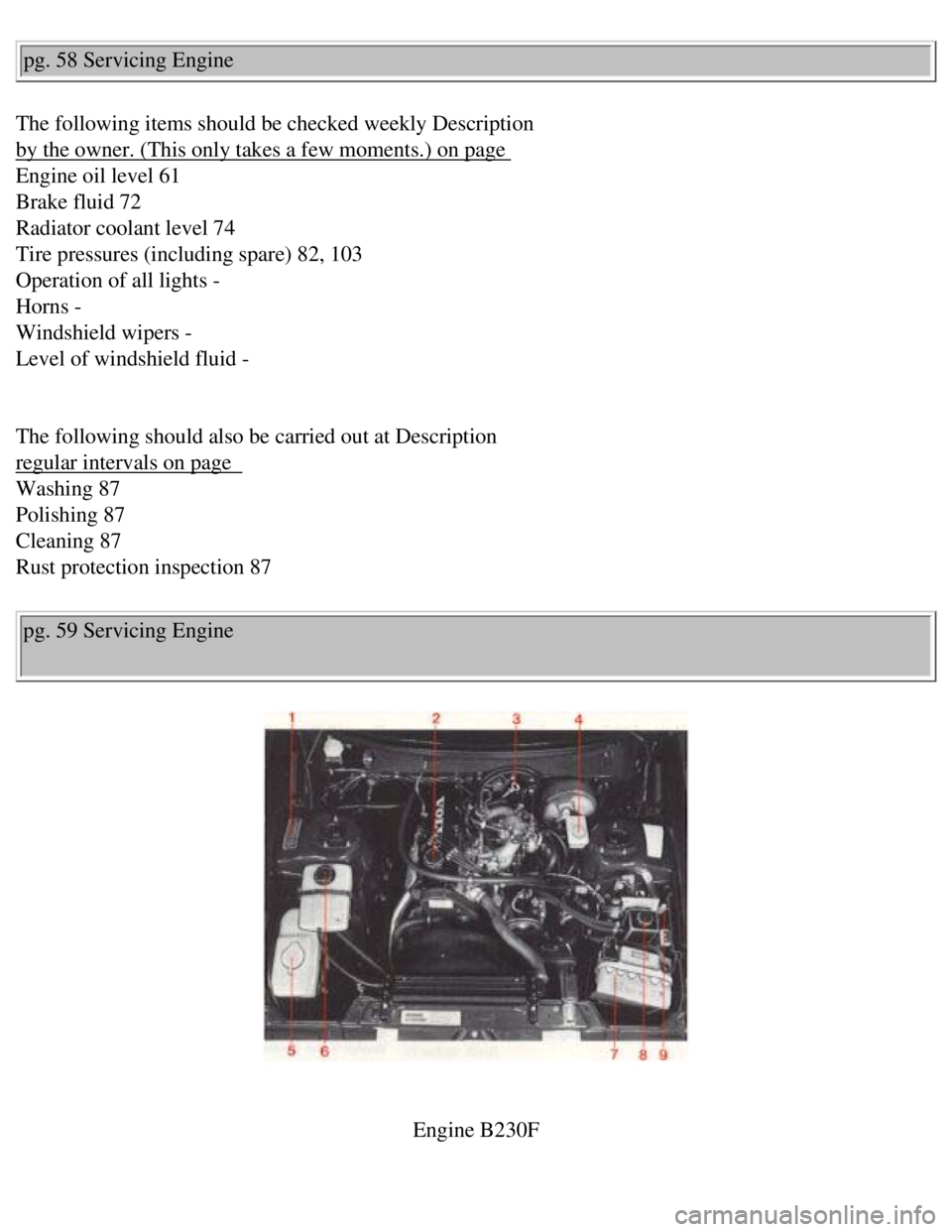
pg. 58 Servicing Engine
The following items should be checked weekly Description
by the owner. (This only takes a few moments.) on page
Engine oil level 61
Brake fluid 72
Radiator coolant level 74
Tire pressures (including spare) 82, 103
Operation of all lights -
Horns -
Windshield wipers -
Level of windshield fluid -
The following should also be carried out at Description
regular intervals on page
Washing 87
Polishing 87
Cleaning 87
Rust protection inspection 87 pg. 59 Servicing Engine
Engine B230F
file:///K|/ownersdocs/1990/1990_240/90240_13.htm (1 of 9)12/30/2006 8:\
25:08 AM
Page 84 of 143
 the cooling system should \
be drained, flushed and refilled.
Remove the expansion tank cap. Open the drain coc")
Volvo 1990 240 Model
Changing coolant
Every two years or 30,000 miles (48,000 km) the cooling system should \
be drained, flushed and refilled.
Remove the expansion tank cap. Open the drain cock on right side of the \
engine block and disconnect
the lower radiator hose.
Fill coolant through the expansion tank.
The heater controls should be fully open when draining and filling.
Add coolant until the level is up to the MAX mark or slightly above.
Start engine and run until hot. Check the cooling system connections for\
tightness. Also re-check the
coolant level. Capacity: 9.9 US qts. = 9.4 liters (manual transmission \
models); 9.7 US qts = 9.2 liters
(automatic transmission models)
Cooling system, hoses and connections
file:///K|/ownersdocs/1990/1990_240/90240_13.htm (8 of 9)12/30/2006 8:\
25:08 AM
Page 92 of 143

Volvo 1990 240 Model
WARNING!
The ignition system operates at very high voltages. Special safety preca\
utions must be followed to
prevent injury:
Always turn the ignition off when:
l connecting engine test and diagnostic equipment to the vehicle (timing \
light, tach-dwell tester,
ignition oscilloscope, etc.).
l Replacing ignition components e.g. plugs, coil, distributor, high-tensio\
n leads, etc.
Contents | Top of Page
file:///K|/ownersdocs/1990/1990_240/90240_14.htm (7 of 7)12/30/2006 8:\
25:08 AM
Page 103 of 143

Volvo 1990 240 Model
pg. 76 Replacing bulbs
Replacing bulbs
The replacement of bulbs in the various lighting units is shown on the f\
ollowing pages. Make sure when
installing bulbs, that the guide pin on the socket fits into its corresp\
onding recess.
When installing bulbs, do not touch the glass with your fingers. The rea\
son for this is that grease, oil or
any other impurities can be carbonized onto the bulb and damage the refl\
ector.
Use bulbs of correct type and voltage. Failure to do so could activate t\
he bulb failure warning light.
Replacing headlight bulbs
Working inside the engine compartment, separate the socket contact from \
the bulb holder (1). Unscrew
and remove the bulb holder retaining ring (2) Pull out the bulb holder\
assembly, and replace it as a unit
(3).
Installation is the reverse of removal.
Check headlight alignment.
Bulb Power Trade No.
Headlamp 45/65W 9004
file:///K|/ownersdocs/1990/1990_240/90240_16.htm (1 of 10)12/30/2006 8\
:25:10 AM
Page 104 of 143

Volvo 1990 240 Model
Front light bulbs
Loosen the Phillips screws and remove the lens. The bulbs can now be rem\
oved by pressing them
inwards and turning them slightly counterclockwise.
When re-installing lens, check that the gasket is in position.
Bulbs Power Socket
CP(W)
1 Front position 24/2.2(21/5) BaY15d
Side marker lights
2 Front turn signal 24/2.2(21/5) BaY15d 1) US Bulb No. 1157NA
pg. 77 Replacing bulbs
Tail lamp bulbs, sedan model
file:///K|/ownersdocs/1990/1990_240/90240_16.htm (2 of 10)12/30/2006 8\
:25:10 AM