air condition VOLVO 850 1996 User Guide
[x] Cancel search | Manufacturer: VOLVO, Model Year: 1996, Model line: 850, Model: VOLVO 850 1996Pages: 265, PDF Size: 4.57 MB
Page 183 of 265

1996 Volvo 850
pg. 4:17 Trailer towing
When preparing for trailer towing, observe the following:
l Volvo recommends the use of Volvo trailer hitches which are specially de\
signed for the car. For
trailer weights exceeding 2000 lbs. (908 kg), use only a trailer hitch\
offered as a Genuine Volvo
accessory.
NOTE: Models with automatic transmission are equipped with a transmissio\
n oil cooler as standard
equipment. This cooler helps prevent overheating of the transmission dur\
ing times of increased load, as
when towing a trailer.
l Maximum trailer weight recommended by Volvo is:
Trailers without brakes : 1100 lbs (500kg)
Trailers with brakes: 2" (50 mm) ball - 3300 lbs (1500 kg), 1 7/8" (\
47 mm) ball - 2000 lbs (908 kg).
Observe the legal requirements of the state/province in which the vehicl\
es are registered. All Volvo
models are equipped with energy-absorbing shock-mounted bumpers. Trailer\
hitch installation should
not interfere with the proper operation of this bumper system.
Trailer towing does not normally present any particular problems, but ta\
ke into consideration:
l Increase tire pressure to recommended full. See section "Wheels and tire\
s".
l Recommended hitch tongue load is 110 (50 kgs) for trailer weights belo\
w 2,650 lbs (1,200 kgs) and
165 lbs (75 kgs) for trailer weights above 2,650 lbs (1,200 kgs). Fo\
r trailer weights between 2,650-3,300
lbs (1,200-1,500 kgs) a top speed of 50 mph (80 km/h) should never b\
e exceeded.
l Engine and transmission are subject to increased loads. Therefore, engin\
e coolant temperature should
be closely watched when driving in hot climates or hilly terrain. Use lo\
wer gear and turn off air
conditioner if temperature gauge pointer enters the red range.
l Avoid overload and other abusive operation.
l Hauling a trailer affects handling, durability, and economy.
l It is necessary to balance trailer brakes with the towing vehicle brakes\
to provide a safe stop (check
and observe State/Local regulations).
l Do not connect the trailer's brake system directly to the vehicle's brak\
e system.
l More frequent vehicle maintenance is required.
l Remove the ball and drawbar assembly when the hitch is not being used.
l Volvo recommends the use of synthetic engine oil when towing a trailer o\
ver long distances or in
file:///K|/ownersdocs/1996/1996_850/96850_412.htm (7 of 10)12/30/2006 \
9:59:35 AMClassic Cars & Cycles www.ClassicCycles.org
Page 227 of 265
 *
The VIN plate is located on the top left surface of the dashboard. The V\
IN is also stamped on the right
hand door")
1996 Volvo 850
above right headlight.
5 Vehicle Identification Number (VIN) *
The VIN plate is located on the top left surface of the dashboard. The V\
IN is also stamped on the right
hand door pillar.
6 Federal Motor Vehicle Safety Standards (FMVSS) specifications (USA)\
and Ministry of Transport
(CMVSS) Standards (Canada)
Your Volvo is designed to meet all applicable safety standards, as evide\
nced by the certification label on
the facing side of the driver's door. For further information regarding \
these regulations, please consult
your Volvo retailer.
7 Child safety latch label
* The Vehicle Identification Number (VIN) should always be quoted in a\
ll correspondence concerning
your vehicle with the retailer and when ordering parts.
** These decals are located on the underside of the hood.
All specifications are subject to change without notice. pg. 8:3 Maintenance service, Warranty
Maintenance service
Volvo advises you to follow the service program which is outlined in the\
"Maintenance Records
Manual". This maintenance program contains inspections and services nece\
ssary for the proper function
of your car. The maintenance services contain several checks which requi\
re special instruments and
tools and therefore must be performed by a qualified technician. To keep\
your Volvo in top condition,
specify time tested and proven Genuine Volvo Parts and Accessories.
The Federal Clean Air Act - U.S.
The Clean Air Act requires vehicle manufacturers to furnish written inst\
ructions to the ultimate
purchaser to assure the proper functioning of those components that cont\
rol emissions. The maintenance
instructions listed in the "Servicing" section of this Manual represent \
the minimum maintenance
required. These services are not covered by the warranty. You will be re\
quired to pay for labor and
material used. Refer to your Warranty booklet for further details.
file:///K|/ownersdocs/1996/1996_850/96850_801.htm (2 of 6)12/30/2006 9\
:59:50 AMClassic Cars & Cycles www.ClassicCycles.org
Page 229 of 265
1996 Volvo 850
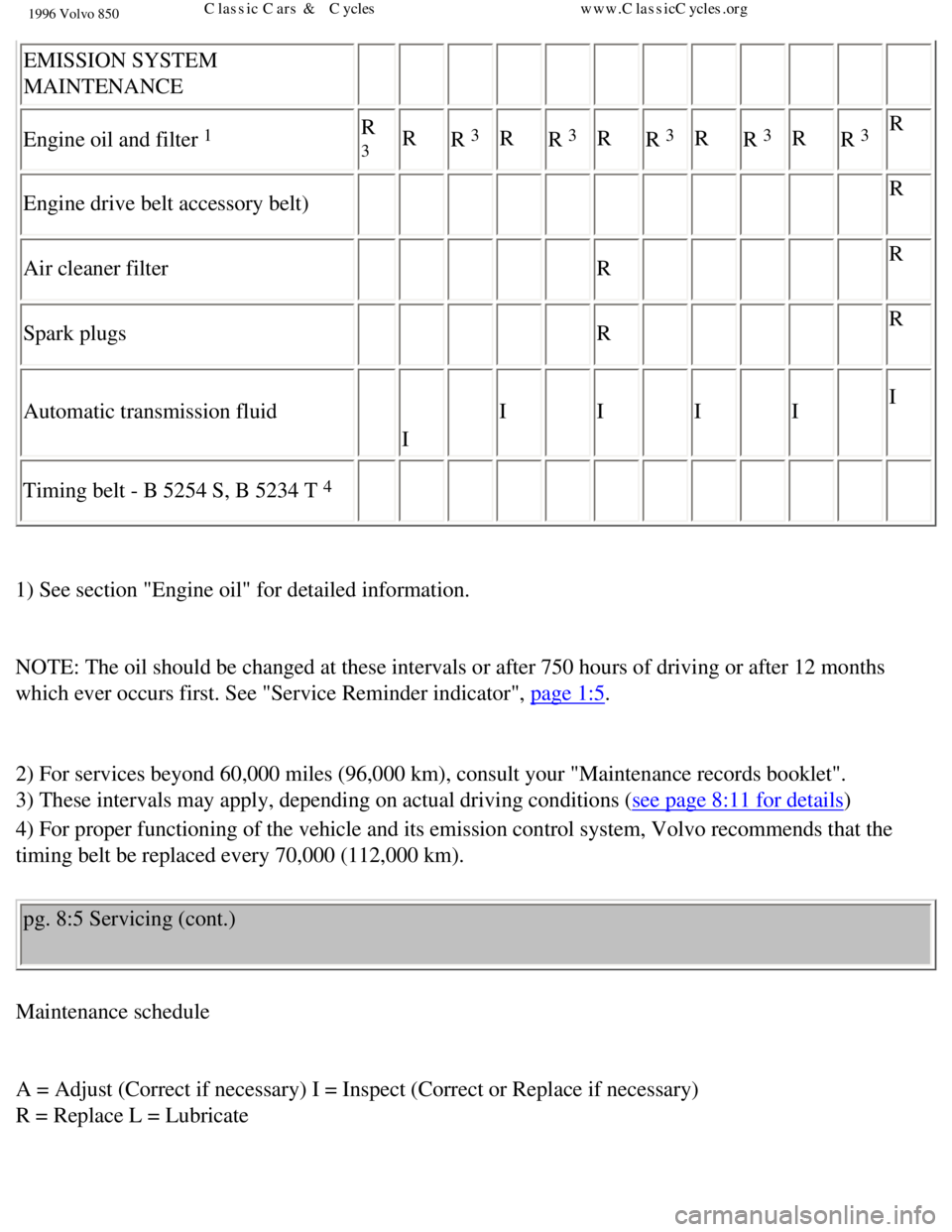
EMISSION SYSTEM
MAINTENANCE
Engine oil and filter
1 R
3 R R 3 R R 3 R R 3 R R 3 R R 3 R
Engine drive belt accessory belt) R
Air cleaner filter R R
Spark plugs R R
Automatic transmission fluid
I
I I I I I
Timing belt - B 5254 S, B 5234 T
4
1) See section "Engine oil" for detailed information.
NOTE: The oil should be changed at these intervals or after 750 hours of\
driving or after 12 months
which ever occurs first. See "Service Reminder indicator",
page 1:5.
2) For services beyond 60,000 miles (96,000 km), consult your "Mainte\
nance records booklet".
3) These intervals may apply, depending on actual driving conditions (\
see page 8:11 for details)
4) For proper functioning of the vehicle and its emission control syste\
m, Volvo recommends that the
timing belt be replaced every 70,000 (112,000 km).
pg. 8:5 Servicing (cont.)
Maintenance schedule
A = Adjust (Correct if necessary) I = Inspect (Correct or Replace if \
necessary)
R = Replace L = Lubricate
file:///K|/ownersdocs/1996/1996_850/96850_801.htm (4 of 6)12/30/2006 9\
:59:50 AMClassic Cars & Cycles www.ClassicCycles.org
Page 232 of 265

The following precautions must be observed when carrying out repairs to \
the vehicle
WARNING! The distributor ignition system operates at very high volta")
1996 Volvo 850
pg. 8:6 Servicing (cont.)
The following precautions must be observed when carrying out repairs to \
the vehicle
WARNING! The distributor ignition system operates at very high voltages.\
Special safety precautions
must be followed to prevent injury. Always turn the ignition off when:
l Connecting engine test and diagnostic equipment to the vehicle (timing \
light, tach-dwell tester,
ignition oscilloscope, etc.).
l Replacing distributor ignition components e.g. plugs, coil, etc.
l Do not touch any part of the distributor ignition system while the engin\
e is running. This may result
in unintended movements and body injury.
Battery
l Check that the battery cables are correctly connected and properly tight\
ened.
l Never disconnect the battery when the engine is running, for example whe\
n changing the battery.
l The battery should be disconnected when a boost charger is used.
l Switch off the radio before disconnecting the battery. If your radio has\
an anti-theft code and the
battery is disconnected, the radio code has to be re-entered in order fo\
r the radio to function.
Replacing spark plugs
The spark plugs should be changed every 30,000 miles (48,000 km). Howe\
ver, city driving or fast
highway driving may necessitate changing after 15,000 miles (24,000 km)\
of driving. When installing
new plugs, be sure to fit the right type and use correct torque, see "Sp\
ecifications". When changing the
plugs, check that the suppressor connectors are in good condition. Crack\
ed or damaged connectors
should be replaced. When changing the spark plugs, clean the terminals a\
nd the rubber seals.
Hoisting the car
If a garage jack is used to lift the car, the two jack attachments point\
s should be used. They are specially
reinforced to bear the weight of the car. A garage jack can also be plac\
ed under the front of the engine
file:///K|/ownersdocs/1996/1996_850/96850_806.htm (1 of 11)12/30/2006 \
9:59:52 AMClassic Cars & Cycles www.ClassicCycles.org
Page 233 of 265

1996 Volvo 850
support frame and under the reinforced plate in the spare wheel well. Ta\
ke care not to damage the splash
guard under the engine. Ensure that the jack is positioned so that the c\
ar cannot slide off it. Always use
axle stands or similar structures.
If a two-post hoist is used to lift the car, the front and rear lift arm\
pads should be centered under the
reinforced lift plates on the inboard edge of the sill rail. The positio\
n of these plates is marked with
arrows molded into the bottom of the sill rail.
CAUTION: 850 R turbo models have reduced ground clearance due to the des\
ign of the front spoiler.
Please observe caution when driving the car onto a garage hoist.
pg. 8:7 Servicing (cont.)
Torque exhaust and intake manifold nuts
A loose manifold could alter air/fuel ratio and cause an increase in emi\
ssion and/or poor driveability.
Air cleaner
Replace the air cleaner cartridge with a new one every 30,000 miles (48\
,000 km). The cartridge should
be replaced more often when driving under dirty and dusty conditions. Th\
e filter cannot be cleaned and
therefore should always be replaced with a new one.
Vacuum fittings, hoses and connections
file:///K|/ownersdocs/1996/1996_850/96850_806.htm (2 of 11)12/30/2006 \
9:59:52 AMClassic Cars & Cycles www.ClassicCycles.org
Page 235 of 265

Fuel System
The fuel system is all-electronic and is microprocessor-controlled. It c\
an continually compensate for
variation in engine load, speed and t")
1996 Volvo 850
pg. 8:8 Servicing (cont.)
Fuel System
The fuel system is all-electronic and is microprocessor-controlled. It c\
an continually compensate for
variation in engine load, speed and temperature to give the best economy\
and power. A mass air flow
sensor measures the inducted air. In this way the system can make instan\
taneous adjustments for
changes in air temperature or density, thus always assuring the best eco\
nomy with the lowest possible
exhaust emissions.
Heated oxygen sensor
This is an emission control system designed to reduce emissions and impr\
ove fuel economy. The heated
oxygen sensor monitors the composition of the exhaust gases leaving the \
engine. The exhaust gas
analysis is fed into an electronic module. This adjusts the air-fuel rat\
io to provide optimum conditions
for combustion and efficient reduction of the three major pollutants (h\
ydrocarbons, carbon monoxide
and oxides of nitrogen (NOx) by a three-way catalytic converter.
Secondary Air Injection (certain models)
This system adds air to the hot exhaust gases as they are expelled from \
the engine. This causes a
secondary combustion of residual hydrocarbons and carbon monoxide, resul\
ting in lower emissions
levels in the exhaust gases.
file:///K|/ownersdocs/1996/1996_850/96850_806.htm (4 of 11)12/30/2006 \
9:59:52 AMClassic Cars & Cycles www.ClassicCycles.org
Page 244 of 265
1996 Volvo 850
WARNING! Oil spilled on a hot exhaust pipe constitutes a fire
risk.
pg. 8:14 Drive belt, Air pump system
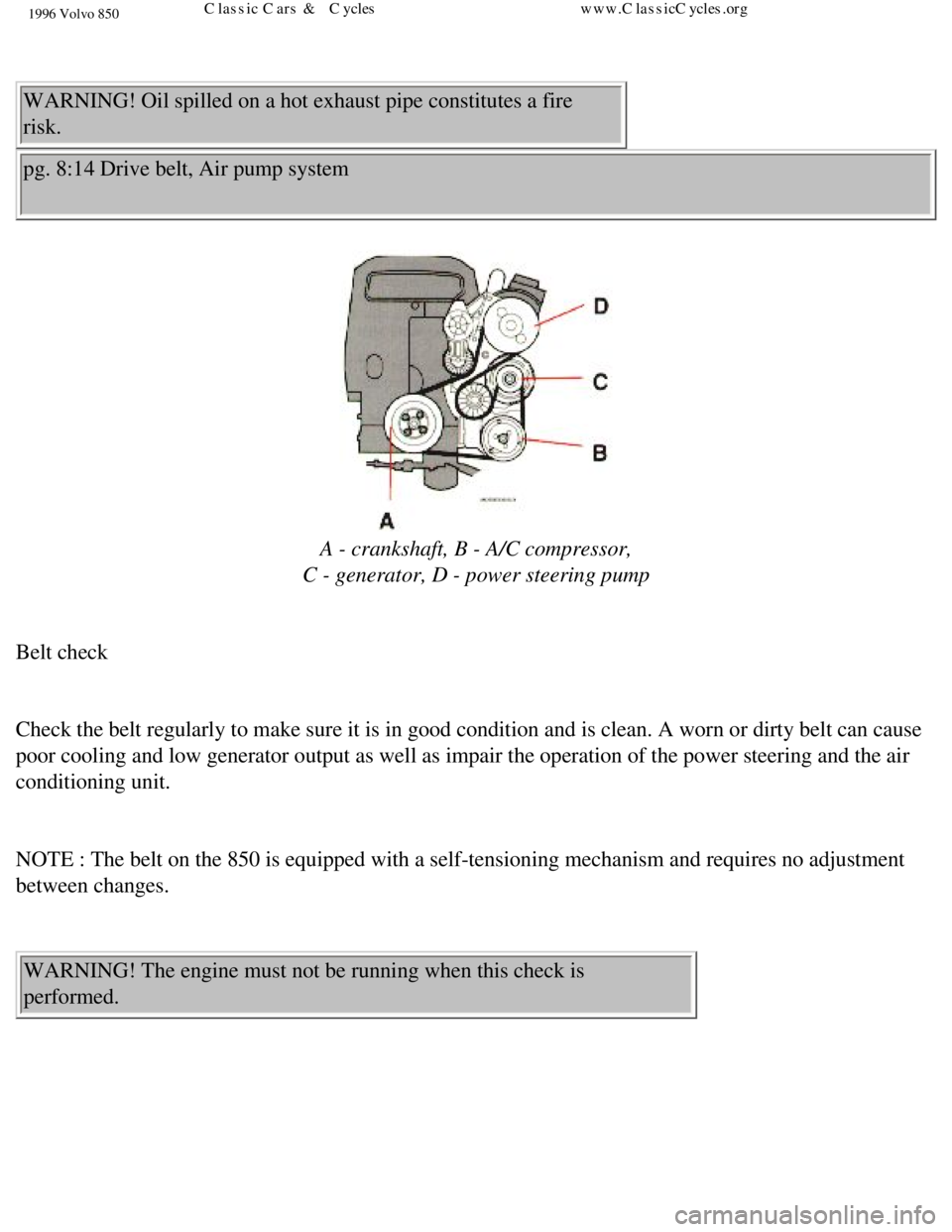
A - crankshaft, B - A/C compressor,
C - generator, D - power steering pump
Belt check
Check the belt regularly to make sure it is in good condition and is cle\
an. A worn or dirty belt can cause
poor cooling and low generator output as well as impair the operation of\
the power steering and the air
conditioning unit.
NOTE : The belt on the 850 is equipped with a self-tensioning mechanism \
and requires no adjustment
between changes.
WARNING! The engine must not be running when this check is
performed.
file:///K|/ownersdocs/1996/1996_850/96850_813.htm (2 of 7)12/30/2006 9\
:59:53 AMClassic Cars & Cycles www.ClassicCycles.org