trailer VOLVO 850 1996 Owners Manual
[x] Cancel search | Manufacturer: VOLVO, Model Year: 1996, Model line: 850, Model: VOLVO 850 1996Pages: 265, PDF Size: 4.57 MB
Page 159 of 265

1996 Volvo 850
Starting and driving
pg. 4:1 Starting and driving
Starting and driving
This section on starting and driving contains items such as starting the\
engine, operating gear selector,
towing, trailers.
4:2 Break-in period
4:3Fuel requirements, Octane rating
4:4Driving economy
4:5Starting the engine
4:6Manual transmission
4:7Automatic Transmission
4:10Points to remember
4:12Emergency towing
4:13Vehicle Towing Information
4:14Starting with an auxiliary battery (jump starting)
4:15Three-way catalytic converter
4:16Brake system, ABS
4:17Trailer towing
4:18Winter driving
4:19Long distance trips, City driving
pg. 4:2 Break-in period, Fuel requirements
A new car should be broken-in!
Refrain from utilizing your car's full driving potential during the firs\
t 1,200 miles (2,000 km) including
the "kick-down" function (automatic transmission).
file:///K|/ownersdocs/1996/1996_850/96850_401.htm (1 of 8)12/30/2006 9\
:59:32 AMClassic Cars & Cycles www.ClassicCycles.org
Page 170 of 265

Automatically shifts up and down between 1st, 2nd, and 3rd gears when in\
driving modes E or")
1996 Volvo 850
governed by accelerator pedal position and vehicle speed.
3 (Intermediate position)
Automatically shifts up and down between 1st, 2nd, and 3rd gears when in\
driving modes E or S. There
is no upshift from 3rd gear. Position 3 can be used for driving in hilly\
terrain, for towing trailers or for
increased engine braking power.
L (low position)
No upshift can occur when L is engaged. Select position L for driving in\
first and second gears. Use this
position to select low gear with no upshift, e.g. when ascending and des\
cending steep grades. The
transmission will noticeably shift down from second to first if road spe\
ed drops to below 40 km/h (25
mph) when driving in E mode and below 10 km/h (6 mph in S mode.
Kick-down
Automatic shift to a lower gear (kick-down) is achieved by depressing \
the accelerator pedal fully and
briskly. An upshift will be achieved when approaching the top speed for \
a particular gear or by releasing
the accelerator pedal slightly. Kick-down can be used for maximum accele\
ration or when passing at
highway speeds.
"Lock-up"
The transmission has a "lock-up" function which reduces engine speed and\
saves fuel. "Lock-up" can
sometimes be felt as an additional gear change. pg. 4:8 Automatic transmission
file:///K|/ownersdocs/1996/1996_850/96850_406.htm (4 of 10)12/30/2006 \
9:59:34 AMClassic Cars & Cycles www.ClassicCycles.org
Page 173 of 265

1996 Volvo 850
pg. 4:9 Automatic transmission
Special Tips - automatic transmission
l For driving down steep hills and when driving for prolonged periods at l\
ow speeds, position L should
be selected. Avoid, however, repeated changes since this can cause overh\
eating of the transmission oil.
For driving on long continuous uphill gradients, select position 3.
l See caution on page 4:7.
l Do not hold the car stationary on an incline by using the accelerator pe\
dal. Instead, apply the hand
brake (parking brake). This prevents the transmission oil from becomin\
g overheated.
l When towing a trailer, select shift position 3.
l The (E)conomy mode should be selected when the cruise control is engag\
ed.
l While towing a trailer in hilly terrain, do not drive continuously at en\
gine speeds above 4500 rpm to
help avoid high engine oil temperatures.
pg. 4:10 Points to remember
Cooling system
The risk for engine overheating is greatest, especially in hot weather, \
when:
l towing a trailer up steep inclines for prolonged periods at wide open th\
rottle and low engine rpm.
l stopping the engine suddenly after high speed driving (so-called "after\
-boiling" can occur).
l To avoid overheating, the following rules should be followed:
l Do not drive for prolonged periods at engine speeds above 4500 rpm if yo\
u are towing a trailer in
hilly terrain.
l Reduce speed and downshift when towing a trailer up long, steep inclines\
. The risk of overheating can
be reduced by switching off the air conditioning system for a short time\
.
l Do not let the engine idle unnecessarily for prolonged periods.
l Do not mount auxiliary lamps in front of the grill.
When the risk of overheating is imminent, or in the event of overheating\
, (the temperature gauge goes
repeatedly into, or stays continually in, the red section) the followin\
g precautions should be taken:
l Switch off the air conditioning system.
l Stop the car and put the gear lever into neutral. Do not stop the engine\
!
l Switch the heater to full (maximum) position. Increase the engine spee\
d to approx. 2000 rpm (twice
idling speed) until the temperature begins to drop.
file:///K|/ownersdocs/1996/1996_850/96850_406.htm (7 of 10)12/30/2006 \
9:59:34 AMClassic Cars & Cycles www.ClassicCycles.org
Page 182 of 265

1996 Volvo 850
Brake circuit malfunction
If one of the brake circuits should malfunction, the red warning light w\
ill come on, the pedal stroke
increases slightly, the pedal feels softer and extra pressure is require\
d for normal braking. If the light
comes on while driving or braking, stop immediately and check the brake \
fluid level in the reservoir.
WARNING! If the fluid level is below the MIN mark in either section of t\
he reservoir: DO NOT
DRIVE. Tow the car to a Volvo retailer and have the brake system checked\
and repaired.
Moisture on brake discs and brake pads affects braking.
Driving in rain and slush or passing through an automatic car wash can c\
ause water to collect on the
brake discs and pads. This will cause a delay in braking effect when the\
pedal is depressed. To avoid
such a delay when the brakes are needed, depress the pedal occasionally \
when driving through rain,
slush etc. This will remove the water from the brakes. Check that brake \
application feels normal! This
should also be done after washing or starting in very damp weather.
Severe strain on the brake system
The brakes will be subject to severe strain when driving in mountains or\
hilly areas or towing. The speed
is usually low which means that the cooling of the brakes is less effici\
ent than when driving on level
roads. To reduce the strain on the brakes it is advisable not to use the\
brakes excessively. Instead, shift
into a lower gear, position 3 or in some cases, L(automatic transmissio\
n) and let the engine help with the
braking. Do not forget that, if you are towing a trailer, the brakes wil\
l be subjected to greater load than is
normal.
If the brake power-assist does function
The power assist to the brakes functions only when the engine is running\
. When the car is moving
without the engine running, the brake pedal pressure required to stop th\
e car is increased by 3-4 times
and the brake pedal feels stiff.
file:///K|/ownersdocs/1996/1996_850/96850_412.htm (6 of 10)12/30/2006 \
9:59:35 AMClassic Cars & Cycles www.ClassicCycles.org
Page 183 of 265

1996 Volvo 850
pg. 4:17 Trailer towing
When preparing for trailer towing, observe the following:
l Volvo recommends the use of Volvo trailer hitches which are specially de\
signed for the car. For
trailer weights exceeding 2000 lbs. (908 kg), use only a trailer hitch\
offered as a Genuine Volvo
accessory.
NOTE: Models with automatic transmission are equipped with a transmissio\
n oil cooler as standard
equipment. This cooler helps prevent overheating of the transmission dur\
ing times of increased load, as
when towing a trailer.
l Maximum trailer weight recommended by Volvo is:
Trailers without brakes : 1100 lbs (500kg)
Trailers with brakes: 2" (50 mm) ball - 3300 lbs (1500 kg), 1 7/8" (\
47 mm) ball - 2000 lbs (908 kg).
Observe the legal requirements of the state/province in which the vehicl\
es are registered. All Volvo
models are equipped with energy-absorbing shock-mounted bumpers. Trailer\
hitch installation should
not interfere with the proper operation of this bumper system.
Trailer towing does not normally present any particular problems, but ta\
ke into consideration:
l Increase tire pressure to recommended full. See section "Wheels and tire\
s".
l Recommended hitch tongue load is 110 (50 kgs) for trailer weights belo\
w 2,650 lbs (1,200 kgs) and
165 lbs (75 kgs) for trailer weights above 2,650 lbs (1,200 kgs). Fo\
r trailer weights between 2,650-3,300
lbs (1,200-1,500 kgs) a top speed of 50 mph (80 km/h) should never b\
e exceeded.
l Engine and transmission are subject to increased loads. Therefore, engin\
e coolant temperature should
be closely watched when driving in hot climates or hilly terrain. Use lo\
wer gear and turn off air
conditioner if temperature gauge pointer enters the red range.
l Avoid overload and other abusive operation.
l Hauling a trailer affects handling, durability, and economy.
l It is necessary to balance trailer brakes with the towing vehicle brakes\
to provide a safe stop (check
and observe State/Local regulations).
l Do not connect the trailer's brake system directly to the vehicle's brak\
e system.
l More frequent vehicle maintenance is required.
l Remove the ball and drawbar assembly when the hitch is not being used.
l Volvo recommends the use of synthetic engine oil when towing a trailer o\
ver long distances or in
file:///K|/ownersdocs/1996/1996_850/96850_412.htm (7 of 10)12/30/2006 \
9:59:35 AMClassic Cars & Cycles www.ClassicCycles.org
Page 184 of 265

1996 Volvo 850
mountainous areas.
NOTE: Refer to section "Automatic transmission" for additional trailer h\
auling tips.
WARNING!
l Bumper-attached trailer hitches must not be used on Volvos, nor should s\
afety chains be attached to
the bumper.
l Trailer hitches attaching to the vehicle rear axle must not be used.
l Never connect a trailer's hydraulic brake system directly to the vehicle\
brake system, nor a trailer's
lighting system directly to the vehicle lighting system. Consult your ne\
arest authorized Volvo retailer
for correct installation.
pg. 4:18 Winter driving
Cold weather precautions
l If you wish to check your car before the approach of cold weather, the f\
ollowing advice is worth
noting:
l Make sure that the engine coolant contains at least 50 percent antifreez\
e: that is, 3.7 qts. (3.5 liters)
Volvo Genuine Coolant/Antifreeze. This gives protection against freezing\
down to -31°F (-35°C). See
section "Coolant". The use of "recycled" antifreeze is not approved by V\
olvo. Different types of
antifreeze may not be mixed.
l Try to keep the fuel tank well filled - this prevents the formation of c\
ondensation in the tank. In
addition in extremely cold weather conditions it is worthwhile to add fu\
el line de-icer before refueling.
l The viscosity of the engine oil is important. Oil with low viscosity (t\
hinner oil) improves cold-
weather starting as well as decreasing fuel consumption while the engine\
is warming up. For winter use,
5W-30 oil, particularly the synthetic type, is recommended. Be sure to u\
se good quality oil but do not
use this cold-weather oil for hard driving or in warm weather. See secti\
on "Engine oil" for more
information.
l The load placed on the battery is greater during the winter since the he\
ater, windshield wipers,
lighting etc. are used more often. Moreover, the capacity of the battery\
decreases as the temperature
drops. In very cold weather, a poorly charged battery can freeze and be \
damaged. It is therefore
advisable to check the state of charge more frequently and spray an anti\
-rust oil on the battery posts.
l Volvo recommends the use of snow tires on all four wheels for winter dri\
ving - see section "Wheels
and tires".
l To prevent the washer reservoir from freezing, add washer solvents conta\
ining antifreeze (see page
file:///K|/ownersdocs/1996/1996_850/96850_412.htm (8 of 10)12/30/2006 \
9:59:35 AMClassic Cars & Cycles www.ClassicCycles.org
Page 185 of 265
. This is important sin\
ce the dirt is often splashed on
the windshield during winter driving, thus requiring frequent use of the\")
1996 Volvo 850
8:15 for the location of the washer fluid reservoir). This is important sin\
ce the dirt is often splashed on
the windshield during winter driving, thus requiring frequent use of the\
washers and wipers. The Volvo
Washer Solvent should be diluted as follows:
Down to 14°F (-10°C): 1 part anti-freeze and 4 parts water
Down to 5°F (-15°C): 1 part anti-freeze and 3 parts water
Down to 0°F (-18°C): 1 part anti-freeze and 2 parts water
Down to -18°F (-28°): 1 part anti-freeze and 1 part water
l When driving in temperatures below 15 F (-10 C), we recommend the use \
of Volvo's radiator guard to
help the engine reach normal operating temperature as quickly as possibl\
e. This guard should not be
used when towing a trailer.
l Use Volvo Teflon Lock Spray in the locks.
NOTE: Avoid the use of de-icing spray as they can cause damage to the lo\
cks.
Winter/Wet mode
Enhanced Vehicle Traction
This mode may be selected for starting/moving off on slippery roads. In \
this mode:
* In position D, the gearbox starts in 3rd gear and changes up to 4th ge\
ar.
* In position 3, 2nd gear is locked and there is no change up to 3rd gea\
r.
In position L, first gear is locked.
* These positions always offer the kick-down feature.
pg. 4:19 Long distance trips, City driving
Before a long distance trip
It is always worthwhile to have your car checked at a Volvo retailer bef\
ore driving long distances. Your
retailer will also be able to supply you with bulbs, fuses, spark plugs \
and wiper blades for your use in the
event that problems occur.
If you prefer to check the car yourself, please note the following:
l Check that the engine runs smoothly and that fuel consumption is normal.\
l Check engine oil, coolant levels, and for possible fuel leakage.
l Check transmission oil level.
file:///K|/ownersdocs/1996/1996_850/96850_412.htm (9 of 10)12/30/2006 \
9:59:35 AMClassic Cars & Cycles www.ClassicCycles.org
Page 198 of 265
1996 Volvo 850
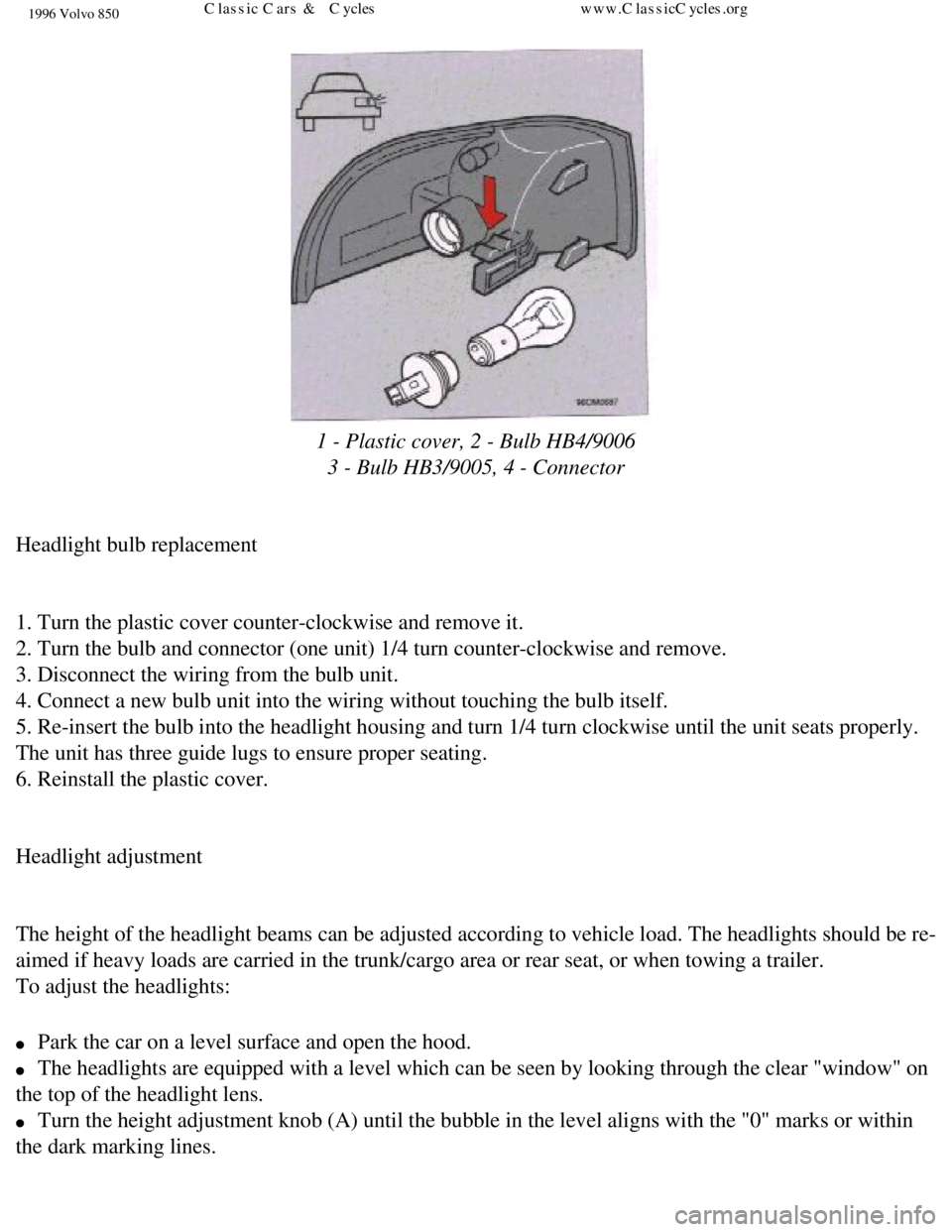
1 - Plastic cover, 2 - Bulb HB4/9006
3 - Bulb HB3/9005, 4 - Connector
Headlight bulb replacement
1. Turn the plastic cover counter-clockwise and remove it.
2. Turn the bulb and connector (one unit) 1/4 turn counter-clockwise a\
nd remove.
3. Disconnect the wiring from the bulb unit.
4. Connect a new bulb unit into the wiring without touching the bulb its\
elf.
5. Re-insert the bulb into the headlight housing and turn 1/4 turn clock\
wise until the unit seats properly.
The unit has three guide lugs to ensure proper seating.
6. Reinstall the plastic cover.
Headlight adjustment
The height of the headlight beams can be adjusted according to vehicle l\
oad. The headlights should be re-
aimed if heavy loads are carried in the trunk/cargo area or rear seat, o\
r when towing a trailer.
To adjust the headlights:
l Park the car on a level surface and open the hood.
l The headlights are equipped with a level which can be seen by looking th\
rough the clear "window" on
the top of the headlight lens.
l Turn the height adjustment knob (A) until the bubble in the level alig\
ns with the "0" marks or within
the dark marking lines.
file:///K|/ownersdocs/1996/1996_850/96850_605.htm (2 of 13)12/30/2006 \
9:59:43 AMClassic Cars & Cycles www.ClassicCycles.org
Page 211 of 265
. Spare fuses are stored in a compartmen\
t in the")
1996 Volvo 850
examine the curved metal wire to see if it is broken. If so, put in a ne\
w fuse of the same color and
amperage (written on the fuse). Spare fuses are stored in a compartmen\
t in the fuse box.
If fuses burn out repeatedly, have the electrical system tested at a Vol\
vo retailer.
If you find it difficult to remove a fuse, you will find a special fuse \
tool clipped in the fuse box. pg. 6:14 Fuses
Location * Amperage
1 Fuel injection, distributor ignition system, automatic gearbox 15A
2 Fuel pump 15A
3 Interior courtesy lights 10A
4 –
5 ECC blower (speed 4) 30A
6 Central locking system 25A
7 Audio system 15A
8 –
9 ABS 30A
10 Electrically heated rear seat 15A
11 Electrically heated rear window and side-door mirrors 30A
12 Brake lights 10A
13 Hazard warning flashers, headlight flashers 15A
14 ABS 30A
15 OBD socket, courtesy lights, open door warning lights,
remote operated central locking system 10A
16 Power antenna, electrical connector for trailer, accessories 30A
17 Key reminder, seat belt reminder 10A
18 Front fog lights 15A
19 Left high beam 15A
20 Right high beam, high beam indicator light 15A
21 Left low beam 15A
22 Right low beam 15A
23 Left parking lights, license plate lights 10A
24 Right parking lights 10A
25 Rear fog light, rear fog light indicator light 10A
26 Heated front/rear seats, power side-view mirrors 25A
27 Backup lights, direction indicators 15A
file:///K|/ownersdocs/1996/1996_850/96850_613.htm (2 of 8)12/30/2006 9\
:59:46 AMClassic Cars & Cycles www.ClassicCycles.org
Page 240 of 265

1996 Volvo 850
Do not use oils with other viscosity ratings. The use of incorrect visco\
sity oil can shorten engine life.
Volvo recommends the use of energy-conserving oils. Look for the API lab\
el. Synthetic oils complying
with oil quality requirements are recommended for: Driving in areas of s\
ustained temperature extremes
(hot or cold), when towing a trailer over long distances or for a prol\
onged driving in mountainous areas.
Extra oil additives must not be used unless advised by an authorized Vol\
vo retailer.
SAE 15W/40 is recommended for use in driving conditions that raise oil t\
emperature and increase oil
consumption (i.e., mountain driving, trailer towing).
NOTE: SAE 15W-40 must not be used at low ambient temperatures; see visco\
sity chart.
Changing oil and oil filter
Oil and oil filter changes should be made as specified in the following \
table:
If driving conditions include: Then the correct oil/oil filter change interval
is:
l Extended periods of idling and/or low-speed
operation
l Frequent short trips less than 7 miles 11 km
l Extended periods of driving in dusty and/or sandy
areas
l Trailer towing
l Driving in mountainous areas EVERY
5,000 miles= 8,000 km
OR EVERY 6 MONTHS,
WHICHEVER COMES FIRST
l Primarily highway driving
l Frequent trips of longer than 7 miles = 11 km
EVERY
10,000 miles = 16,000 km
5,000 miles= 8,000 km *
OR EVERY 12 MONTHS,
WHICH EVER COMES FIRST
* Turbo models
file:///K|/ownersdocs/1996/1996_850/96850_806.htm (9 of 11)12/30/2006 \
9:59:52 AMClassic Cars & Cycles www.ClassicCycles.org