brake VOLVO 850 1996 User Guide
[x] Cancel search | Manufacturer: VOLVO, Model Year: 1996, Model line: 850, Model: VOLVO 850 1996Pages: 265, PDF Size: 4.57 MB
Page 112 of 265

1996 Volvo 850
Electrically operated side-view mirrors
The control switches are located in the central console, beside the park\
ing brake.
A Lateral adjustment
B Vertical adjustment
WARNING! The mirrors should always be adjusted prior to driving. Objects\
seen in the wide-angle
right side-view mirror are closer than they appear to be.
pg. 2:8 Interior lights, Vanity mirror
Front courtesy lights
The front courtesy lighting consists of two reading lights for the front\
seat occupants.
Front and rear reading lights always on
Front and rear reading lights always off
Front and rear reading lights come on when a door is opened
Left or right reading light illuminates if the center switch is in posi\
tion .
file:///K|/ownersdocs/1996/1996_850/96850_206.htm (5 of 11)12/30/2006 \
9:59:22 AMClassic Cars & Cycles www.ClassicCycles.org
Page 137 of 265

1996 Volvo 850
l Move the seat as far forward as possible
WARNING! Cover sharp edges on load to help prevent injury to occupants. \
Secure load to help
prevent shifting during sudden stops.
Long load storage (sedans)
There is a flap located in the panel behind the rear seat which makes it\
possible to carry long loads such
as skis, etc. To open, pull the strap forward.
Protective covers (for skis) should be used to avoid soiling or tearin\
g the upholstery. Please note that the
flap in the rear seat is only intended for light loads such as skis, car\
pets, etc.
Max length: 6 1/2 ft (2 meters) Max weight: 55 lbs (25 kg)
WARNING! Always turn engine off and apply parking brake when loading/unl\
oading the vehicle.
Place transmission selector in P (PARK) position to help prevent inadv\
ertent movement of selector.
Contents | Top of Page
file:///K|/ownersdocs/1996/1996_850/96850_218.htm (7 of 7)12/30/2006 9\
:59:25 AMClassic Cars & Cycles www.ClassicCycles.org
Page 157 of 265

1996 Volvo 850
cleaning. Check seat belt mechanism function as follows:
Attach the seat belt and pull rapidly on the strap.
WARNING! Check other traffic before performing the following
check.
Brake firmly from approximately 30 mph (50 km/h) or turn in a tight ci\
rcle while pulling on the belt. In the above checks you should
not be able to pull the belt out.
Volvo Concern for Safety
Safety is the cornerstone for Volvo. Our concern dates back to 1927 when\
the first Volvo rolled off the production line. Three-point
seat belts, safety cages, and energy-absorbing impact zones were designe\
d into Volvo cars long before it was fashionable or required
by government regulation. We will not compromise our commitment to safet\
y. We continue to seek out new safety features and to
refine those already in our cars. You can help. We would appreciate hear\
ing your suggestions about improving automobile safety.
We also want to know if you ever have a safety concern with your car. Ca\
ll us in the U.S. at:
800-458-1552 or in Canada at: 800-663-8255.
Occupant safety
How safely you drive doesn't depend on how old you are but rather on:
l how well you see
l your ability to concentrate
l how quickly you make decisions under stress to avoid an accident.
The tips listed below are suggestions to help you cope with the ever cha\
nging traffic environment.
l Never drink and drive.
l If you are taking any medication, consult your physician about its poten\
tial effects on your driving abilities.
l Take a driver-retraining course
l Have your eyes checked regularly
l Keep your windshield and headlamps clean.
l Replace wiper blades when they start to leave streaks.
l Take into account the traffic, road, and water conditions, particularly \
with regard to stopping distance.
Reporting Safety Defects in the U.S.
If you believe that your vehicle has a defect which could cause a crash \
or could cause injury or death, you should immediately
inform the National Highway Traffic Safety Administration (NHTSA) in a\
ddition to notifying Volvo Cars of North America. If
NHTSA receives similar complaints, it may open an investigation, and if \
it finds that a safety defect exists in a group of vehicles, it
may order a recall and remedy campaign. However, NHTSA cannot become inv\
olved in individual problems between you, your
retailer, or Volvo Cars of North America. To contact NHTSA, you may eith\
er call the Auto Safety Hotline toll-free at 1-800-424-
9393 (or 366-0123 in Washington, D.C. area) or write to: NHSTA, U.S. D\
epartment of Transportation, Washington D.C. 20590.
You can also obtain other information about motor vehicle safety from th\
e Hotline.
file:///K|/ownersdocs/1996/1996_850/96850_309.htm (6 of 7)12/30/2006 9\
:59:30 AMClassic Cars & Cycles www.ClassicCycles.org
Page 159 of 265

1996 Volvo 850
Starting and driving
pg. 4:1 Starting and driving
Starting and driving
This section on starting and driving contains items such as starting the\
engine, operating gear selector,
towing, trailers.
4:2 Break-in period
4:3Fuel requirements, Octane rating
4:4Driving economy
4:5Starting the engine
4:6Manual transmission
4:7Automatic Transmission
4:10Points to remember
4:12Emergency towing
4:13Vehicle Towing Information
4:14Starting with an auxiliary battery (jump starting)
4:15Three-way catalytic converter
4:16Brake system, ABS
4:17Trailer towing
4:18Winter driving
4:19Long distance trips, City driving
pg. 4:2 Break-in period, Fuel requirements
A new car should be broken-in!
Refrain from utilizing your car's full driving potential during the firs\
t 1,200 miles (2,000 km) including
the "kick-down" function (automatic transmission).
file:///K|/ownersdocs/1996/1996_850/96850_401.htm (1 of 8)12/30/2006 9\
:59:32 AMClassic Cars & Cycles www.ClassicCycles.org
Page 163 of 265

1996 Volvo 850
CAUTION: Take care not to spill gasoline during refueling. Gasolines con\
taining alcohol can cause
damage to painted surfaces, which may not be covered under the New Vehic\
le Limited Warranty.
Do not use gasoline containing methanol (methyl alcohol, wood alcohol)\
. This practice can result in
vehicle performance deterioration and can damage critical parts in the f\
uel system. Such damage may
not be covered under the New Vehicle Limited Warranty.
pg. 4:4 Driving economy
Economical driving does not necessarily mean driving slowly
Better driving economy may be obtained by thinking ahead, avoiding rapid\
starts and stops and
adjusting the speed of your vehicle to immediate traffic conditions. Obs\
erve the following rules:
l Bring the engine to normal operating temperature as soon as possible by \
driving with a light foot on
the accelerator pedal for the first minutes of operation. A cold engine \
uses more fuel and is subject to
increased wear.
l Whenever possible, avoid using the car for driving short distances. This\
does not allow the engine to
reach normal operating temperature.
l Drive carefully and avoid rapid acceleration and hard braking.
l Do not exceed speed limit.
l Avoid carrying unnecessary items (extra load) in the car.
l Check tire pressure regularly (check when tires are cold).
l Remove snow tires when threat of snow or ice has ended.
l Note that roof racks, ski racks, etc., increase air resistance and there\
by fuel consumption.
l Avoid using automatic transmission kick-down feature unless necessary.
l Avoid using the air conditioning when it is not required. When engaged, \
the air conditioner's
compressor places places an additional load on the engine.
l If your car is equipped with the optional Trip Computer, utilizing the f\
uel consumption modes can
help you "learn" how to drive more economically.
Other factors which decrease gas mileage are:
l Low tire pressure
l Worn or dirty spark plugs
l Incorrect spark plug gap
l Dirty air cleaner
l Dirty engine oil and clogged oil filter
l Dragging brakes
l Incorrect front end alignment
file:///K|/ownersdocs/1996/1996_850/96850_401.htm (5 of 8)12/30/2006 9\
:59:32 AMClassic Cars & Cycles www.ClassicCycles.org
Page 164 of 265
rive or 5th gear (manual transmissions) should be used as\
o")
1996 Volvo 850
Some of the above mentioned items and others are checked at the standard\
Maintenance Service
intervals.
NOTE: ( D )rive or 5th gear (manual transmissions) should be used as\
often as possible to help improve
fuel economy. pg. 4:5 Starting the engine
Starting and stopping
1. Fasten the seat belt.
WARNING! Before starting, check that the seat and steering wheel are adj\
usted properly. Make sure
the brake pedal can be depressed completely. Move the seat closer if nec\
essary. Refer to section "front
seats".
2. Apply the parking brake, if not already set. The gear selector ( aut\
omatic transmission ) is locked in
the ( P )ark position ( SHIFT LOCK ).
3. Without touching the accelerator pedal , turn the ignition key to the\
starting position. Allow the starter
to operate for 5-10 seconds (turbo: 10 seconds). Release the key as so\
on as the engine starts. If the
engine fails to start, repeat step 3.
For cold starts at altitudes above 6000 ft (1800 m), depress the accel\
erator pedal halfway and turn the
key to the starting position. Release the accelerator pedal slowly when \
the engine starts.
4. To release the gear selector from the (P)ark position (automatic t\
ransmission), the ignition key must
be in position II and the brake pedal must be depressed.
See page 6:18 for instructions on manually
overriding the SHIFTLOCK system.
Do not race a cold engine immediately after starting. Oil flow may not r\
each some lubricating points fast
enough to prevent engine damage.
NOTE: (Automatic transmission only)
file:///K|/ownersdocs/1996/1996_850/96850_401.htm (6 of 8)12/30/2006 9\
:59:32 AMClassic Cars & Cycles www.ClassicCycles.org
Page 165 of 265
ark position before the starting key can be removed fro\
m the ign")
1996 Volvo 850
Your car is equipped with a KEYLOCK system. When the engine is switched \
off, the gear selector must
be in the ( P )ark position before the starting key can be removed fro\
m the ignition switch.
5. Select desired gear. The gear engages after a slight delay (automati\
c transmission) which is especially
noticeable when selecting R.
CAUTION: (Automatic transmission only) The engine should be idling; ne\
ver accelerate until after
you feel the gear engage! Too rapid acceleration immediately after selec\
ting a gear will cause harsh
engagement and premature transmission wear.
NOTE: Selecting P or N (automatic transmission) when idling at a stand\
still for prolonged periods of
time will help prevent overheating of transmission oil.
WARNING! Always place the gear selector (automatic transmission) in Pa\
rk and apply the parking
brake before leaving the vehicle. Never leave the car unattended with th\
e engine running.
Always open the garage doors fully before starting the engine inside a g\
arage to ensure adequate
ventilation. The exhaust gases contain carbon monoxide, which is invisib\
le and odorless but very
poisonous.
TURBO CAUTION:
Never race the engine immediately after starting. Oil flow may not reach\
some lubricating points fast
enough to prevent engine damage.
Do not race the engine just prior to switching off!
Hydraulic valve lifters
This engine features hydraulic valve lifters which means that valve clea\
rance is adjusted automatically.
It is possible that the valve lifters will produce a ticking sound for t\
he first few seconds after the engine
is started, while the oil pressure is increasing.
If the car has not been used for a long period of time, this ticking sou\
nd may last for up to 15 minutes.
This is entirely normal.
Do not exceed 300 rpm until the ticking sound disappears.
file:///K|/ownersdocs/1996/1996_850/96850_401.htm (7 of 8)12/30/2006 9\
:59:32 AMClassic Cars & Cycles www.ClassicCycles.org
Page 169 of 265
1996 Volvo 850
P (Park)
Use this position when starting the engine or parking the car.
Never use P while car is in motion.
The parking brake should also be used when parking on grades.
The gear selector is mechanically locked in the P position (Shift lock)\
. To release the selector, start the
engine and depress the brake pedal. If it is necessary to manually relea\
se the gear selector,
see page 6:18
for instructions.
CAUTION:
l Never select P or R while the car is in motion.
l When initially selecting positions D, 3, L or R, your right foot should \
press firmly on the brake
pedal to ensure that the car is standing still with the engine idling.
l The gear selector should not be downshifted to L at speeds above 75 mph \
(125 km/h).*
* Always observe posted speed limits.
WARNING! Never leave the car when the engine is running. If, by mistake,\
the gear selector is moved
from P the car may start moving.
R (Reverse)
Never engage R while is moving forward.
N (Neutral)
Neutral = no gear is engaged. Use the parking brake. The engine can be s\
tarted with the gear selector in
this position.
D (Drive)
D is the normal driving position and should be used as often as possible\
to help improve fuel economy.
When modes E or S are selected, upshift and downshift of the forward gea\
rs occur automatically and are
file:///K|/ownersdocs/1996/1996_850/96850_406.htm (3 of 10)12/30/2006 \
9:59:34 AMClassic Cars & Cycles www.ClassicCycles.org
Page 173 of 265

1996 Volvo 850
pg. 4:9 Automatic transmission
Special Tips - automatic transmission
l For driving down steep hills and when driving for prolonged periods at l\
ow speeds, position L should
be selected. Avoid, however, repeated changes since this can cause overh\
eating of the transmission oil.
For driving on long continuous uphill gradients, select position 3.
l See caution on page 4:7.
l Do not hold the car stationary on an incline by using the accelerator pe\
dal. Instead, apply the hand
brake (parking brake). This prevents the transmission oil from becomin\
g overheated.
l When towing a trailer, select shift position 3.
l The (E)conomy mode should be selected when the cruise control is engag\
ed.
l While towing a trailer in hilly terrain, do not drive continuously at en\
gine speeds above 4500 rpm to
help avoid high engine oil temperatures.
pg. 4:10 Points to remember
Cooling system
The risk for engine overheating is greatest, especially in hot weather, \
when:
l towing a trailer up steep inclines for prolonged periods at wide open th\
rottle and low engine rpm.
l stopping the engine suddenly after high speed driving (so-called "after\
-boiling" can occur).
l To avoid overheating, the following rules should be followed:
l Do not drive for prolonged periods at engine speeds above 4500 rpm if yo\
u are towing a trailer in
hilly terrain.
l Reduce speed and downshift when towing a trailer up long, steep inclines\
. The risk of overheating can
be reduced by switching off the air conditioning system for a short time\
.
l Do not let the engine idle unnecessarily for prolonged periods.
l Do not mount auxiliary lamps in front of the grill.
When the risk of overheating is imminent, or in the event of overheating\
, (the temperature gauge goes
repeatedly into, or stays continually in, the red section) the followin\
g precautions should be taken:
l Switch off the air conditioning system.
l Stop the car and put the gear lever into neutral. Do not stop the engine\
!
l Switch the heater to full (maximum) position. Increase the engine spee\
d to approx. 2000 rpm (twice
idling speed) until the temperature begins to drop.
file:///K|/ownersdocs/1996/1996_850/96850_406.htm (7 of 10)12/30/2006 \
9:59:34 AMClassic Cars & Cycles www.ClassicCycles.org
Page 177 of 265
1996 Volvo 850
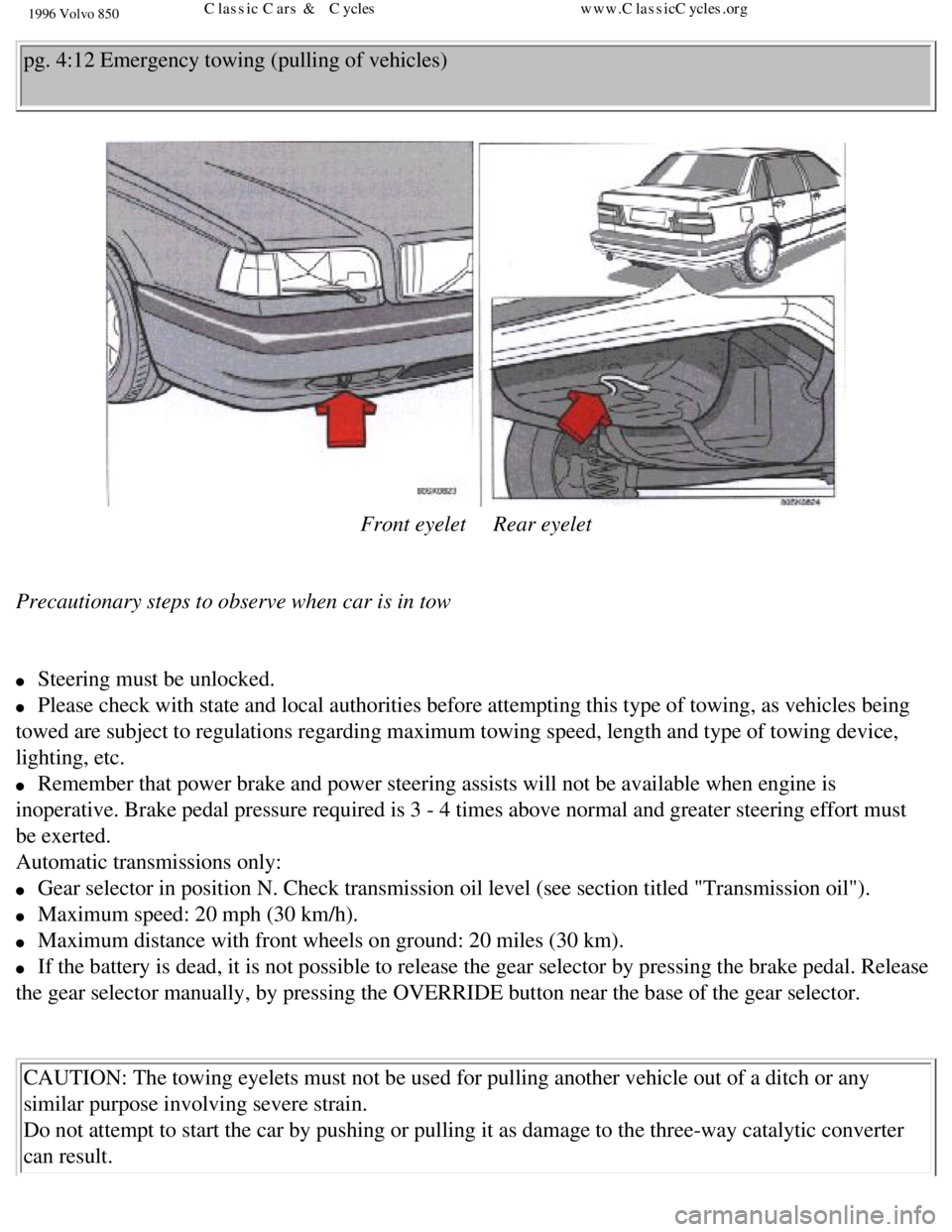
pg. 4:12 Emergency towing (pulling of vehicles)
Front eyelet Rear eyelet
Precautionary steps to observe when car is in tow
l Steering must be unlocked.
l Please check with state and local authorities before attempting this typ\
e of towing, as vehicles being
towed are subject to regulations regarding maximum towing speed, length \
and type of towing device,
lighting, etc.
l Remember that power brake and power steering assists will not be availab\
le when engine is
inoperative. Brake pedal pressure required is 3 - 4 times above normal a\
nd greater steering effort must
be exerted.
Automatic transmissions only:
l Gear selector in position N. Check transmission oil level (see section \
titled "Transmission oil").
l Maximum speed: 20 mph (30 km/h).
l Maximum distance with front wheels on ground: 20 miles (30 km).
l If the battery is dead, it is not possible to release the gear selector \
by pressing the brake pedal. Release
the gear selector manually, by pressing the OVERRIDE button near the bas\
e of the gear selector.
CAUTION: The towing eyelets must not be used for pulling another vehicle\
out of a ditch or any
similar purpose involving severe strain.
Do not attempt to start the car by pushing or pulling it as damage to th\
e three-way catalytic converter
can result.
file:///K|/ownersdocs/1996/1996_850/96850_412.htm (1 of 10)12/30/2006 \
9:59:35 AMClassic Cars & Cycles www.ClassicCycles.org