tow VOLVO 850 1996 User Guide
[x] Cancel search | Manufacturer: VOLVO, Model Year: 1996, Model line: 850, Model: VOLVO 850 1996Pages: 265, PDF Size: 4.57 MB
Page 131 of 265

WARNING! The red lock indicator is VISIBLE (A) when the backrest in NO\
T locked in position and
not visible (B) when the")
1996 Volvo 850
pg. 2:18 Folding rear seat, Removing seat cushions (wagon)
WARNING! The red lock indicator is VISIBLE (A) when the backrest in NO\
T locked in position and
not visible (B) when the backrest is correctly locked in place. When t\
he backrest is in the upright
position, it must always be correctly locked in place.
Removing seat cushions
The seat cushion can be easily removed to provide a slightly larger carg\
o storage area.
l Fold the seat cushion toward the back of the front seats
l Release the red catches
l Disconnect the connector for the rear seat heating (certain models)
file:///K|/ownersdocs/1996/1996_850/96850_218.htm (1 of 7)12/30/2006 9\
:59:25 AMClassic Cars & Cycles www.ClassicCycles.org
Page 134 of 265

1996 Volvo 850
The luggage net helps prevent cargo and animals from being thrown forwar\
d should the vehicle stop
suddenly or be involved in an accident. The luggage net unreels from the\
rear upped edge of the rear seat
backrest.
The luggage net must be accessed from the cargo storage area.
1 Open the cover on the passenger side seat back and pull the luggage ne\
t toward you.
2 Hook the rod onto the bracket on the right side ceiling.
3 Pull out the left side of the rod and attach it to the bracket on the \
driver's side ceiling.
4 Unreel the driver's side luggage net.
5 Hook it to the rod.
6 Make sure the nets are securely attached to the hooks under the covers\
and pulled taut.
Use the reverse procedure procedure to retract the net.
The luggage net can also be used when the rear seat is folded down. Howe\
ver, extra brackets (optional)
must be installed on the upper front door hand grips. pg. 2:21 Securing cargo
Eyelets in trunk (sedans)
Securing cargo
file:///K|/ownersdocs/1996/1996_850/96850_218.htm (4 of 7)12/30/2006 9\
:59:25 AMClassic Cars & Cycles www.ClassicCycles.org
Page 147 of 265

1996 Volvo 850
WARNING! Do not use child safety seats or child boosters cushions/backre\
sts in the front passenger's
seat. We also recommend that children who have outgrown these devices si\
t in the rear seat with the
seat belt properly fastened.
NOTE: Deployment of SRS components occurs only one time during an accide\
nt. In a collision where
deployment occurs, the air bags and seat belt tensioners activate. Some \
noise occurs and a small amount
of powder is released. The release of the powder may appear as smoke-lik\
e matter. This is a normal
characteristic and does not indicate fire.
WARNING!
l Occupants in the front passenger's seat must never sit on the edge of th\
e seat, sit leaning toward the
instrument panel or otherwise sit out of position. The occupant's back m\
ust be as upright as comfort
allows and be against the seat back with the seat properly fastened.
l Feet must be on the floor, e.g. not on the dash, seat or out of the wind\
ow.
l Children must never be allowed to stand in front of the passenger seat. \
l No objects or accessory equipment, e.g. dash covers, may be placed on, a\
ttached to or installed near
the SRS hatch (the area above the glove compartment) or the area affec\
ted by air bag deployment (see
illustration).
l There should be no loose articles, e.g. coffee cups, on the floor, seat \
or dash area.
l Never try to open the SRS cover on the steering wheel or the passenger s\
ide SRS hatch. This should
only be done by an authorized Volvo service technician.
l Failure to follow these instructions can result in injury to the vehicle\
occupants in an accident.
file:///K|/ownersdocs/1996/1996_850/96850_304.htm (6 of 10)12/30/2006 \
9:59:29 AMClassic Cars & Cycles www.ClassicCycles.org
Page 148 of 265

1996 Volvo 850
pg. 3:7 Volvo SRS
NOTE: The information on this page does not pertain to the Side Impact p\
rotection System airbags.
When are the airbags deployed?
The SRS system is designed to deploy during certain frontal or front-ang\
ular collisions, impacts, or
decelerations, depending in the crash severity, angle, speed, and object\
impacted. The SRS sensor is
designed to react to both the impact of the collision and the inertial f\
orces generated by it and to
determine if the intensity of the collision is sufficient for the airbag\
s to be deployed.
NOTE: The SRS system activates only once in a collision.
If the airbags have been deployed, we recommend the following:
Have the car towed to an authorized Volvo retailer. Even if it can be dr\
iven after an accident we do not
recommend driving the car with deployed airbags.
Have an authorized Volvo retailer replace the SRS system components.
Use only new, Genuine Volvo Parts when replacing SRS components (airbag\
s, seat belts, tensioners,
etc.)
When are the airbags NOT deployed?
Not all frontal collisions activate the SRS system. If the collision inv\
olves a non-rigid object (e.g., a
snow drift or bush), or a rigid, fixed object at a low speed, the SRS s\
ystem will not necessarily deploy.
Airbags do not normally deploy in a side impact collision, in a collisio\
n from the rear or in a rollover
situation. The amount of damage to the bodywork does not reliably indica\
te if the airbags should have
deployed or not.
Can the airbags deploy accidentally?
The SRS system is designed to deploy during certain frontal or front-ang\
ular collisions, impacts, or
decelerations, depending on the crash severity, angle, speed and object \
impacted. The SRS system has
its own diagnostic unit which continuously monitors and inspects the sys\
tem. Make a habit of checking
file:///K|/ownersdocs/1996/1996_850/96850_304.htm (7 of 10)12/30/2006 \
9:59:29 AMClassic Cars & Cycles www.ClassicCycles.org
Page 149 of 265

1996 Volvo 850
the SRS system warning light when starting and driving the car. Normally\
, this light will come on when
the ignition is switched on and should go out after approximately 10 sec\
onds or when the engine is
started. If this light should stay on or come on while you are driving, \
drive the car to an authorized
Volvo retailer for inspection as soon as possible.
Seat belts - the heart of the Volvo safety system
The heart of the Volvo safety system is the three-point seat belt! In or\
der for the SRS system to provide
the protection intended, seat belts must be worn at all times by everyon\
e in the car. The SRS system is a
supplement to the seat belts.
WARNING! If your car has been subjected to flood conditions (e.g. soake\
d carpeting/standing water
on the floor of the vehicle) or if your car has become flood-damaged in\
any way, do not attempt to
start the vehicle or put the key in the ignition before disconnecting th\
e battery (see below). This may
cause airbag deployment which could result in personal injury. Have the \
car towed to an authorized
Volvo retailer for repairs.
Automatic transmission only:
Before attempting to tow the car, use the following procedure to overrid\
e the shiftlock system to move
the gear selector to the neutral position.
l Disconnect the battery
l Wait at least one minute
l Insert the key in the ignition and turn it to position 1
l Press firmly on the shiftlock override button (located near the base of\
the gear selector).
l While holding the override button down, move the gear selector from the \
park position.
pg. 3:8 Volvo Side Impact Protection System (SIPS) airbag
file:///K|/ownersdocs/1996/1996_850/96850_304.htm (8 of 10)12/30/2006 \
9:59:29 AMClassic Cars & Cycles www.ClassicCycles.org
Page 159 of 265

1996 Volvo 850
Starting and driving
pg. 4:1 Starting and driving
Starting and driving
This section on starting and driving contains items such as starting the\
engine, operating gear selector,
towing, trailers.
4:2 Break-in period
4:3Fuel requirements, Octane rating
4:4Driving economy
4:5Starting the engine
4:6Manual transmission
4:7Automatic Transmission
4:10Points to remember
4:12Emergency towing
4:13Vehicle Towing Information
4:14Starting with an auxiliary battery (jump starting)
4:15Three-way catalytic converter
4:16Brake system, ABS
4:17Trailer towing
4:18Winter driving
4:19Long distance trips, City driving
pg. 4:2 Break-in period, Fuel requirements
A new car should be broken-in!
Refrain from utilizing your car's full driving potential during the firs\
t 1,200 miles (2,000 km) including
the "kick-down" function (automatic transmission).
file:///K|/ownersdocs/1996/1996_850/96850_401.htm (1 of 8)12/30/2006 9\
:59:32 AMClassic Cars & Cycles www.ClassicCycles.org
Page 170 of 265

Automatically shifts up and down between 1st, 2nd, and 3rd gears when in\
driving modes E or")
1996 Volvo 850
governed by accelerator pedal position and vehicle speed.
3 (Intermediate position)
Automatically shifts up and down between 1st, 2nd, and 3rd gears when in\
driving modes E or S. There
is no upshift from 3rd gear. Position 3 can be used for driving in hilly\
terrain, for towing trailers or for
increased engine braking power.
L (low position)
No upshift can occur when L is engaged. Select position L for driving in\
first and second gears. Use this
position to select low gear with no upshift, e.g. when ascending and des\
cending steep grades. The
transmission will noticeably shift down from second to first if road spe\
ed drops to below 40 km/h (25
mph) when driving in E mode and below 10 km/h (6 mph in S mode.
Kick-down
Automatic shift to a lower gear (kick-down) is achieved by depressing \
the accelerator pedal fully and
briskly. An upshift will be achieved when approaching the top speed for \
a particular gear or by releasing
the accelerator pedal slightly. Kick-down can be used for maximum accele\
ration or when passing at
highway speeds.
"Lock-up"
The transmission has a "lock-up" function which reduces engine speed and\
saves fuel. "Lock-up" can
sometimes be felt as an additional gear change. pg. 4:8 Automatic transmission
file:///K|/ownersdocs/1996/1996_850/96850_406.htm (4 of 10)12/30/2006 \
9:59:34 AMClassic Cars & Cycles www.ClassicCycles.org
Page 173 of 265

1996 Volvo 850
pg. 4:9 Automatic transmission
Special Tips - automatic transmission
l For driving down steep hills and when driving for prolonged periods at l\
ow speeds, position L should
be selected. Avoid, however, repeated changes since this can cause overh\
eating of the transmission oil.
For driving on long continuous uphill gradients, select position 3.
l See caution on page 4:7.
l Do not hold the car stationary on an incline by using the accelerator pe\
dal. Instead, apply the hand
brake (parking brake). This prevents the transmission oil from becomin\
g overheated.
l When towing a trailer, select shift position 3.
l The (E)conomy mode should be selected when the cruise control is engag\
ed.
l While towing a trailer in hilly terrain, do not drive continuously at en\
gine speeds above 4500 rpm to
help avoid high engine oil temperatures.
pg. 4:10 Points to remember
Cooling system
The risk for engine overheating is greatest, especially in hot weather, \
when:
l towing a trailer up steep inclines for prolonged periods at wide open th\
rottle and low engine rpm.
l stopping the engine suddenly after high speed driving (so-called "after\
-boiling" can occur).
l To avoid overheating, the following rules should be followed:
l Do not drive for prolonged periods at engine speeds above 4500 rpm if yo\
u are towing a trailer in
hilly terrain.
l Reduce speed and downshift when towing a trailer up long, steep inclines\
. The risk of overheating can
be reduced by switching off the air conditioning system for a short time\
.
l Do not let the engine idle unnecessarily for prolonged periods.
l Do not mount auxiliary lamps in front of the grill.
When the risk of overheating is imminent, or in the event of overheating\
, (the temperature gauge goes
repeatedly into, or stays continually in, the red section) the followin\
g precautions should be taken:
l Switch off the air conditioning system.
l Stop the car and put the gear lever into neutral. Do not stop the engine\
!
l Switch the heater to full (maximum) position. Increase the engine spee\
d to approx. 2000 rpm (twice
idling speed) until the temperature begins to drop.
file:///K|/ownersdocs/1996/1996_850/96850_406.htm (7 of 10)12/30/2006 \
9:59:34 AMClassic Cars & Cycles www.ClassicCycles.org
Page 177 of 265
1996 Volvo 850
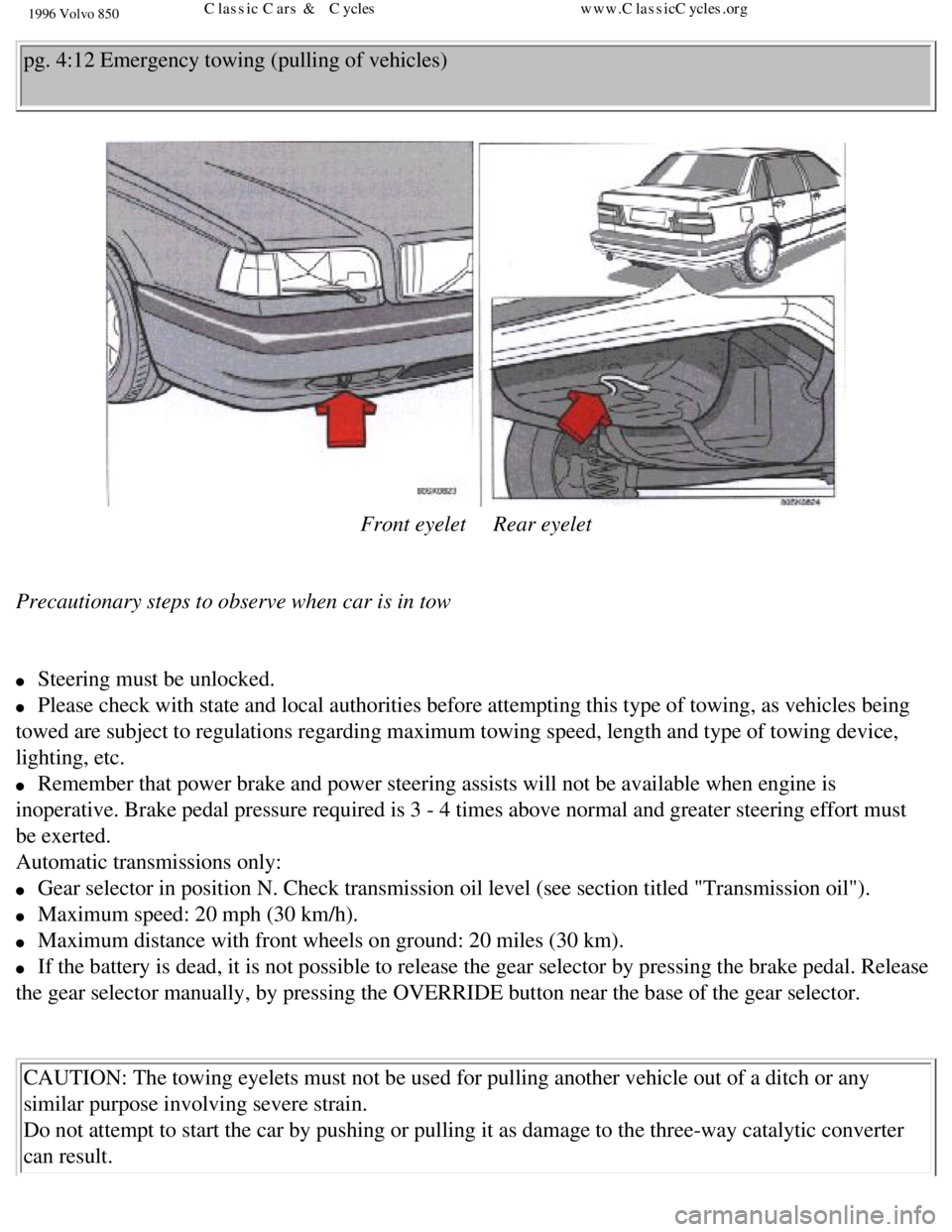
pg. 4:12 Emergency towing (pulling of vehicles)
Front eyelet Rear eyelet
Precautionary steps to observe when car is in tow
l Steering must be unlocked.
l Please check with state and local authorities before attempting this typ\
e of towing, as vehicles being
towed are subject to regulations regarding maximum towing speed, length \
and type of towing device,
lighting, etc.
l Remember that power brake and power steering assists will not be availab\
le when engine is
inoperative. Brake pedal pressure required is 3 - 4 times above normal a\
nd greater steering effort must
be exerted.
Automatic transmissions only:
l Gear selector in position N. Check transmission oil level (see section \
titled "Transmission oil").
l Maximum speed: 20 mph (30 km/h).
l Maximum distance with front wheels on ground: 20 miles (30 km).
l If the battery is dead, it is not possible to release the gear selector \
by pressing the brake pedal. Release
the gear selector manually, by pressing the OVERRIDE button near the bas\
e of the gear selector.
CAUTION: The towing eyelets must not be used for pulling another vehicle\
out of a ditch or any
similar purpose involving severe strain.
Do not attempt to start the car by pushing or pulling it as damage to th\
e three-way catalytic converter
can result.
file:///K|/ownersdocs/1996/1996_850/96850_412.htm (1 of 10)12/30/2006 \
9:59:35 AMClassic Cars & Cycles www.ClassicCycles.org
Page 178 of 265

1996 Volvo 850
pg. 4:13 Vehicle towing information
Only use flat bed equipment.
CAUTION:
l Sling-type equipment applied at the front will damage radiator and air c\
onditioning lines.
l It is equally important not to use sling-type equipment inside the rear \
wheels: serious damage to the
rear axle may result.
The car should be towed with the rear wheels on the ground, if at all po\
ssible. If it is absolutely
necessary to tow the vehicle with the front wheels on the ground, please\
refer to the towing information
on the previous page.
* If wheel lift equipment must be used, please use extreme caution to he\
lp avoid damage to the car.
WARNING!
Do not use the towing eyelets on the car to pull the car up onto a flat \
bed tow
truck.
pg. 4:14 Jump starting
file:///K|/ownersdocs/1996/1996_850/96850_412.htm (2 of 10)12/30/2006 \
9:59:35 AMClassic Cars & Cycles www.ClassicCycles.org