tow VOLVO 850 1996 Owner's Manual
[x] Cancel search | Manufacturer: VOLVO, Model Year: 1996, Model line: 850, Model: VOLVO 850 1996Pages: 265, PDF Size: 4.57 MB
Page 182 of 265

1996 Volvo 850
Brake circuit malfunction
If one of the brake circuits should malfunction, the red warning light w\
ill come on, the pedal stroke
increases slightly, the pedal feels softer and extra pressure is require\
d for normal braking. If the light
comes on while driving or braking, stop immediately and check the brake \
fluid level in the reservoir.
WARNING! If the fluid level is below the MIN mark in either section of t\
he reservoir: DO NOT
DRIVE. Tow the car to a Volvo retailer and have the brake system checked\
and repaired.
Moisture on brake discs and brake pads affects braking.
Driving in rain and slush or passing through an automatic car wash can c\
ause water to collect on the
brake discs and pads. This will cause a delay in braking effect when the\
pedal is depressed. To avoid
such a delay when the brakes are needed, depress the pedal occasionally \
when driving through rain,
slush etc. This will remove the water from the brakes. Check that brake \
application feels normal! This
should also be done after washing or starting in very damp weather.
Severe strain on the brake system
The brakes will be subject to severe strain when driving in mountains or\
hilly areas or towing. The speed
is usually low which means that the cooling of the brakes is less effici\
ent than when driving on level
roads. To reduce the strain on the brakes it is advisable not to use the\
brakes excessively. Instead, shift
into a lower gear, position 3 or in some cases, L(automatic transmissio\
n) and let the engine help with the
braking. Do not forget that, if you are towing a trailer, the brakes wil\
l be subjected to greater load than is
normal.
If the brake power-assist does function
The power assist to the brakes functions only when the engine is running\
. When the car is moving
without the engine running, the brake pedal pressure required to stop th\
e car is increased by 3-4 times
and the brake pedal feels stiff.
file:///K|/ownersdocs/1996/1996_850/96850_412.htm (6 of 10)12/30/2006 \
9:59:35 AMClassic Cars & Cycles www.ClassicCycles.org
Page 183 of 265

1996 Volvo 850
pg. 4:17 Trailer towing
When preparing for trailer towing, observe the following:
l Volvo recommends the use of Volvo trailer hitches which are specially de\
signed for the car. For
trailer weights exceeding 2000 lbs. (908 kg), use only a trailer hitch\
offered as a Genuine Volvo
accessory.
NOTE: Models with automatic transmission are equipped with a transmissio\
n oil cooler as standard
equipment. This cooler helps prevent overheating of the transmission dur\
ing times of increased load, as
when towing a trailer.
l Maximum trailer weight recommended by Volvo is:
Trailers without brakes : 1100 lbs (500kg)
Trailers with brakes: 2" (50 mm) ball - 3300 lbs (1500 kg), 1 7/8" (\
47 mm) ball - 2000 lbs (908 kg).
Observe the legal requirements of the state/province in which the vehicl\
es are registered. All Volvo
models are equipped with energy-absorbing shock-mounted bumpers. Trailer\
hitch installation should
not interfere with the proper operation of this bumper system.
Trailer towing does not normally present any particular problems, but ta\
ke into consideration:
l Increase tire pressure to recommended full. See section "Wheels and tire\
s".
l Recommended hitch tongue load is 110 (50 kgs) for trailer weights belo\
w 2,650 lbs (1,200 kgs) and
165 lbs (75 kgs) for trailer weights above 2,650 lbs (1,200 kgs). Fo\
r trailer weights between 2,650-3,300
lbs (1,200-1,500 kgs) a top speed of 50 mph (80 km/h) should never b\
e exceeded.
l Engine and transmission are subject to increased loads. Therefore, engin\
e coolant temperature should
be closely watched when driving in hot climates or hilly terrain. Use lo\
wer gear and turn off air
conditioner if temperature gauge pointer enters the red range.
l Avoid overload and other abusive operation.
l Hauling a trailer affects handling, durability, and economy.
l It is necessary to balance trailer brakes with the towing vehicle brakes\
to provide a safe stop (check
and observe State/Local regulations).
l Do not connect the trailer's brake system directly to the vehicle's brak\
e system.
l More frequent vehicle maintenance is required.
l Remove the ball and drawbar assembly when the hitch is not being used.
l Volvo recommends the use of synthetic engine oil when towing a trailer o\
ver long distances or in
file:///K|/ownersdocs/1996/1996_850/96850_412.htm (7 of 10)12/30/2006 \
9:59:35 AMClassic Cars & Cycles www.ClassicCycles.org
Page 185 of 265
. This is important sin\
ce the dirt is often splashed on
the windshield during winter driving, thus requiring frequent use of the\")
1996 Volvo 850
8:15 for the location of the washer fluid reservoir). This is important sin\
ce the dirt is often splashed on
the windshield during winter driving, thus requiring frequent use of the\
washers and wipers. The Volvo
Washer Solvent should be diluted as follows:
Down to 14°F (-10°C): 1 part anti-freeze and 4 parts water
Down to 5°F (-15°C): 1 part anti-freeze and 3 parts water
Down to 0°F (-18°C): 1 part anti-freeze and 2 parts water
Down to -18°F (-28°): 1 part anti-freeze and 1 part water
l When driving in temperatures below 15 F (-10 C), we recommend the use \
of Volvo's radiator guard to
help the engine reach normal operating temperature as quickly as possibl\
e. This guard should not be
used when towing a trailer.
l Use Volvo Teflon Lock Spray in the locks.
NOTE: Avoid the use of de-icing spray as they can cause damage to the lo\
cks.
Winter/Wet mode
Enhanced Vehicle Traction
This mode may be selected for starting/moving off on slippery roads. In \
this mode:
* In position D, the gearbox starts in 3rd gear and changes up to 4th ge\
ar.
* In position 3, 2nd gear is locked and there is no change up to 3rd gea\
r.
In position L, first gear is locked.
* These positions always offer the kick-down feature.
pg. 4:19 Long distance trips, City driving
Before a long distance trip
It is always worthwhile to have your car checked at a Volvo retailer bef\
ore driving long distances. Your
retailer will also be able to supply you with bulbs, fuses, spark plugs \
and wiper blades for your use in the
event that problems occur.
If you prefer to check the car yourself, please note the following:
l Check that the engine runs smoothly and that fuel consumption is normal.\
l Check engine oil, coolant levels, and for possible fuel leakage.
l Check transmission oil level.
file:///K|/ownersdocs/1996/1996_850/96850_412.htm (9 of 10)12/30/2006 \
9:59:35 AMClassic Cars & Cycles www.ClassicCycles.org
Page 198 of 265
1996 Volvo 850
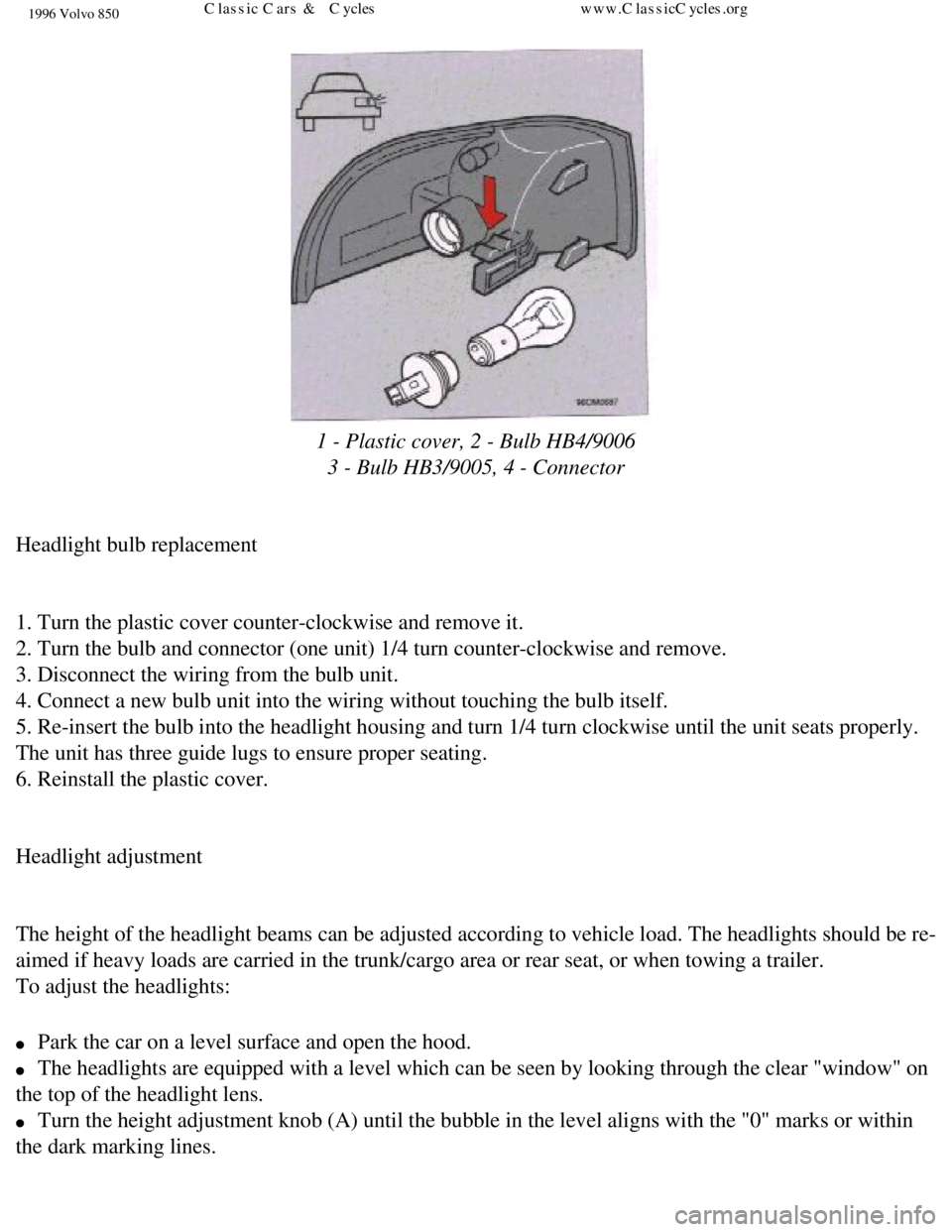
1 - Plastic cover, 2 - Bulb HB4/9006
3 - Bulb HB3/9005, 4 - Connector
Headlight bulb replacement
1. Turn the plastic cover counter-clockwise and remove it.
2. Turn the bulb and connector (one unit) 1/4 turn counter-clockwise a\
nd remove.
3. Disconnect the wiring from the bulb unit.
4. Connect a new bulb unit into the wiring without touching the bulb its\
elf.
5. Re-insert the bulb into the headlight housing and turn 1/4 turn clock\
wise until the unit seats properly.
The unit has three guide lugs to ensure proper seating.
6. Reinstall the plastic cover.
Headlight adjustment
The height of the headlight beams can be adjusted according to vehicle l\
oad. The headlights should be re-
aimed if heavy loads are carried in the trunk/cargo area or rear seat, o\
r when towing a trailer.
To adjust the headlights:
l Park the car on a level surface and open the hood.
l The headlights are equipped with a level which can be seen by looking th\
rough the clear "window" on
the top of the headlight lens.
l Turn the height adjustment knob (A) until the bubble in the level alig\
ns with the "0" marks or within
the dark marking lines.
file:///K|/ownersdocs/1996/1996_850/96850_605.htm (2 of 13)12/30/2006 \
9:59:43 AMClassic Cars & Cycles www.ClassicCycles.org
Page 203 of 265
1996 Volvo 850
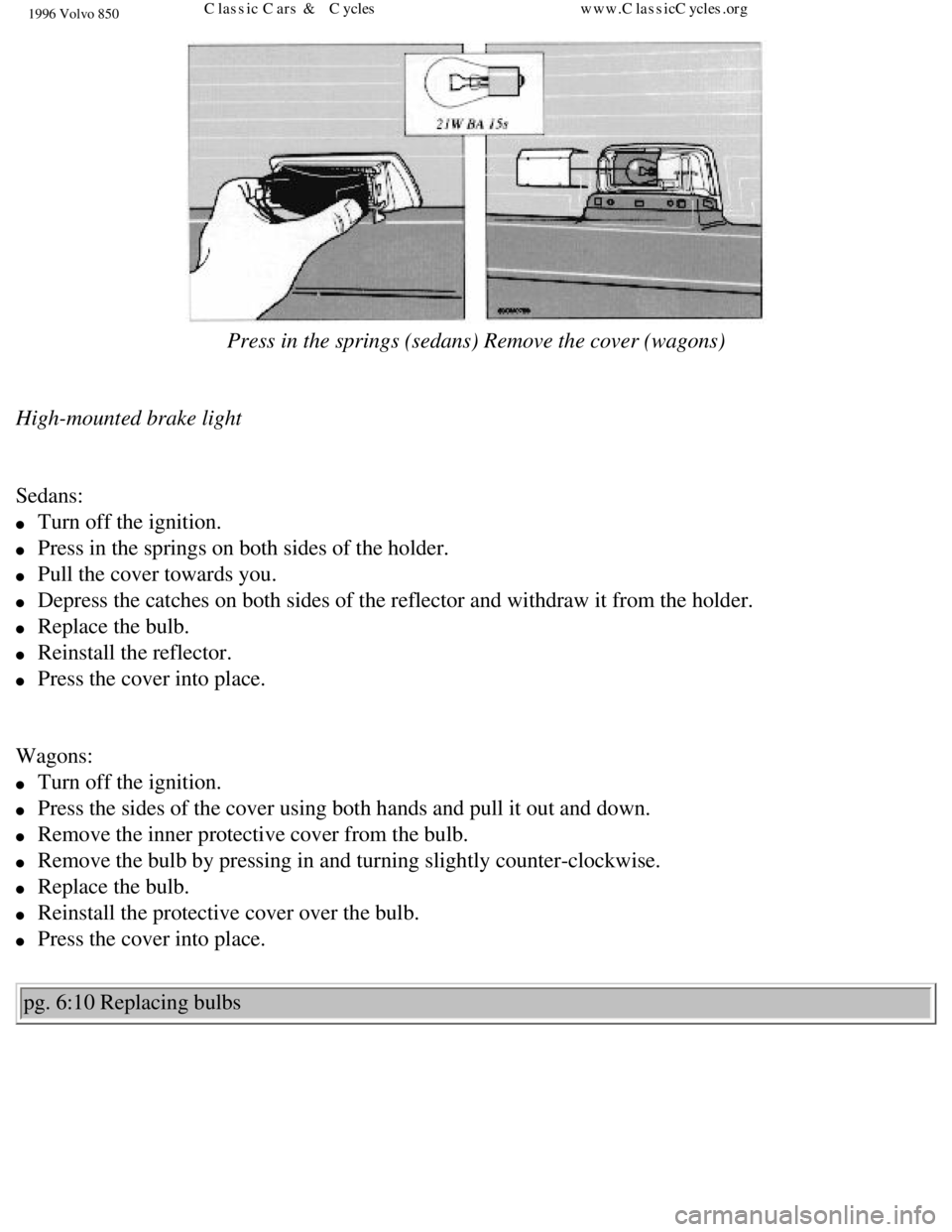
Press in the springs (sedans) Remove the cover (wagons)
High-mounted brake light
Sedans:
l Turn off the ignition.
l Press in the springs on both sides of the holder.
l Pull the cover towards you.
l Depress the catches on both sides of the reflector and withdraw it from \
the holder.
l Replace the bulb.
l Reinstall the reflector.
l Press the cover into place.
Wagons:
l Turn off the ignition.
l Press the sides of the cover using both hands and pull it out and down. \
l Remove the inner protective cover from the bulb.
l Remove the bulb by pressing in and turning slightly counter-clockwise.
l Replace the bulb.
l Reinstall the protective cover over the bulb.
l Press the cover into place.
pg. 6:10 Replacing bulbs
file:///K|/ownersdocs/1996/1996_850/96850_605.htm (7 of 13)12/30/2006 \
9:59:43 AMClassic Cars & Cycles www.ClassicCycles.org
Page 209 of 265

1996 Volvo 850
l Turn the plastic cover counter-clockwise to remove it.
l Press the spring toward the lamp unit to release it and move it to the s\
ide.
l Replace the bulb.
l Reinstall in reverse order.
Contents | Top of Page
file:///K|/ownersdocs/1996/1996_850/96850_605.htm (13 of 13)12/30/2006\
9:59:43 AMClassic Cars & Cycles www.ClassicCycles.org
Page 222 of 265
.
l In areas of high industrial fallout, more frequent washing is recommende\
d.
CAUTION: During high p")
1996 Volvo 850
l Wash off the dirt from the underside (wheel housings fenders, etc.).
l In areas of high industrial fallout, more frequent washing is recommende\
d.
CAUTION: During high pressure washing the spray mouth piece must never b\
e closer to the vehicle
than 13" (30 cm). Do not spray into the locks.
l When washing or steam cleaning the engine, avoid spraying water or steam\
directly on the electrical
components or toward the rear side of the engine.
l After cleaning the engine, the spark plug wells should be inspected for \
water and blown dry if
necessary.
Suitable detergents
Special car washing detergents or liquid dishwashing detergent can be us\
ed. A suitable mixture is about
2.5 fl. oz. (8.5 cl) of detergent to 2.6 US gal. (10 liters) of warm\
water. After washing with a detergent
the car should be well rinsed with clean water.
Bird droppings
Remove from paintwork as soon as possible. Otherwise the finish may be p\
ermanently damaged.
WARNING!
l When the car is driven immediately after being washed, apply the brake s\
everal times in order to
remove any moisture from the brake linings.
l Engine cleaning agents should not be used when the engine is warm. This \
constitutes a fire risk.
NOTE: When washing the car, remember to remove dirt from the drain holes\
in the doors and sills.
file:///K|/ownersdocs/1996/1996_850/96850_701.htm (5 of 8)12/30/2006 9\
:59:48 AMClassic Cars & Cycles www.ClassicCycles.org
Page 225 of 265

1996 Volvo 850
l Take extra care when removing stains such as ink or lipstick since the c\
oloring can spread.
l Use solvents sparingly. Too much solvent can damage the seat padding.
l Start from the outside of the stain and work toward the center.
Contents | Top of Page
file:///K|/ownersdocs/1996/1996_850/96850_701.htm (8 of 8)12/30/2006 9\
:59:48 AMClassic Cars & Cycles www.ClassicCycles.org
Page 240 of 265

1996 Volvo 850
Do not use oils with other viscosity ratings. The use of incorrect visco\
sity oil can shorten engine life.
Volvo recommends the use of energy-conserving oils. Look for the API lab\
el. Synthetic oils complying
with oil quality requirements are recommended for: Driving in areas of s\
ustained temperature extremes
(hot or cold), when towing a trailer over long distances or for a prol\
onged driving in mountainous areas.
Extra oil additives must not be used unless advised by an authorized Vol\
vo retailer.
SAE 15W/40 is recommended for use in driving conditions that raise oil t\
emperature and increase oil
consumption (i.e., mountain driving, trailer towing).
NOTE: SAE 15W-40 must not be used at low ambient temperatures; see visco\
sity chart.
Changing oil and oil filter
Oil and oil filter changes should be made as specified in the following \
table:
If driving conditions include: Then the correct oil/oil filter change interval
is:
l Extended periods of idling and/or low-speed
operation
l Frequent short trips less than 7 miles 11 km
l Extended periods of driving in dusty and/or sandy
areas
l Trailer towing
l Driving in mountainous areas EVERY
5,000 miles= 8,000 km
OR EVERY 6 MONTHS,
WHICHEVER COMES FIRST
l Primarily highway driving
l Frequent trips of longer than 7 miles = 11 km
EVERY
10,000 miles = 16,000 km
5,000 miles= 8,000 km *
OR EVERY 12 MONTHS,
WHICH EVER COMES FIRST
* Turbo models
file:///K|/ownersdocs/1996/1996_850/96850_806.htm (9 of 11)12/30/2006 \
9:59:52 AMClassic Cars & Cycles www.ClassicCycles.org
Page 250 of 265

1996 Volvo 850
Specifications
pg. 9:1 Specifications
Specifications
This chapter contains facts and figures pertaining to the technical spec\
ifications of your car.
9:2 Oil/Fluids specifications
9:3Engine specifications
9:4Cooling/fuel distributor ignition systems
9:4Front/rear suspensions
9:5Transmission, Capacities, Vehicle
loading
9:6
Electrical system/bulbs
9:7Dimensions and weights
9:8Service manuals, Road assistance
pg. 9:2 Oil/Fluids Specifications
Oil quality
Meeting API specification SG, SG/CD, SH or Energy Conserving (EC) II \
For best fuel economy and engine protection, consult with your authorize\
d Volvo retailer for
recommended oils. Oil with a different quality rating may not provide ad\
equate engine protection.
Synthetic oils complying with oil quality requirements are recommended. \
Volvo recommends the use of
fuel economy improving oils. Look for the API label.
Synthetic oils complying with oil quality requirements are recommended f\
or: Driving in areas of
sustained temperature extremes (hot or cold), when towing a trailer ov\
er long distances or for prolonged
driving in mountainous areas.
Extra oil additives must not be used unless advised by an authorized Vol\
vo retailer.
Viscosity (stable ambient temperatures):
file:///K|/ownersdocs/1996/1996_850/96850_901.htm (1 of 7)12/30/2006 9\
:59:55 AMClassic Cars & Cycles www.ClassicCycles.org