light VOLVO 850 1996 Workshop Manual
[x] Cancel search | Manufacturer: VOLVO, Model Year: 1996, Model line: 850, Model: VOLVO 850 1996Pages: 265, PDF Size: 4.57 MB
Page 149 of 265

1996 Volvo 850
the SRS system warning light when starting and driving the car. Normally\
, this light will come on when
the ignition is switched on and should go out after approximately 10 sec\
onds or when the engine is
started. If this light should stay on or come on while you are driving, \
drive the car to an authorized
Volvo retailer for inspection as soon as possible.
Seat belts - the heart of the Volvo safety system
The heart of the Volvo safety system is the three-point seat belt! In or\
der for the SRS system to provide
the protection intended, seat belts must be worn at all times by everyon\
e in the car. The SRS system is a
supplement to the seat belts.
WARNING! If your car has been subjected to flood conditions (e.g. soake\
d carpeting/standing water
on the floor of the vehicle) or if your car has become flood-damaged in\
any way, do not attempt to
start the vehicle or put the key in the ignition before disconnecting th\
e battery (see below). This may
cause airbag deployment which could result in personal injury. Have the \
car towed to an authorized
Volvo retailer for repairs.
Automatic transmission only:
Before attempting to tow the car, use the following procedure to overrid\
e the shiftlock system to move
the gear selector to the neutral position.
l Disconnect the battery
l Wait at least one minute
l Insert the key in the ignition and turn it to position 1
l Press firmly on the shiftlock override button (located near the base of\
the gear selector).
l While holding the override button down, move the gear selector from the \
park position.
pg. 3:8 Volvo Side Impact Protection System (SIPS) airbag
file:///K|/ownersdocs/1996/1996_850/96850_304.htm (8 of 10)12/30/2006 \
9:59:29 AMClassic Cars & Cycles www.ClassicCycles.org
Page 162 of 265

1996 Volvo 850
Volvo allows the use of the following "oxygenated fuels"; however, the o\
ctane ratings listed on this page
must still be met.
Alcohol -- Ethanol
Fuels containing up to 10% ethanol by volume may be used.
Ethanol may also be referred to as Ethyl alcohol, or "Gasohol".
Ethers -- MTBE
Fuels containing up to 15% MTBE may be used.
Refueling
The fuel tank filler cap is located behind the door on the left rear fen\
der. Open cap slowly during hot
weather conditions.
When filling, position the cap in the special bracket on the door.
NOTE: Turn the ignition off or to position I when refueling. If the igni\
tion is on, an incorrect reading
could occur in the fuel gauge (low fuel will be indicated).
After filling the tank, install the cap and turn until a "click" is hear\
d.
The fuel tank is designed to hold approximately 19.3 US gals (73 liters\
) with sufficient volume left over
to accommodate possible expansion of the fuel in hot weather. The "usabl\
e" tank capacity will be
somewhat less than the specified maximum. When the fuel level is low, su\
ch factors as ambient
temperature, the fuel's "vapor pressure" characteristics, and terrain ca\
n affect the fuel pumps' ability to
supply the engine with an adequate supply of fuel. Therefore, it is advi\
sable to refuel as soon as possible
when the needle nears the red zone, or when the fuel warning light comes\
on.
CAUTION: Do not refuel with the engine running. After refueling, close t\
he fuel filler cap by turning
it clockwise until it clicks into place.
NOTE: if the filler cap is not closed tightly or if the engine is runnin\
g when the car is refueled, the
Malfunction Indicator Lamp may indicate a fault. Use only Volvo original\
or approved fuel filler caps.
file:///K|/ownersdocs/1996/1996_850/96850_401.htm (4 of 8)12/30/2006 9\
:59:32 AMClassic Cars & Cycles www.ClassicCycles.org
Page 163 of 265

1996 Volvo 850
CAUTION: Take care not to spill gasoline during refueling. Gasolines con\
taining alcohol can cause
damage to painted surfaces, which may not be covered under the New Vehic\
le Limited Warranty.
Do not use gasoline containing methanol (methyl alcohol, wood alcohol)\
. This practice can result in
vehicle performance deterioration and can damage critical parts in the f\
uel system. Such damage may
not be covered under the New Vehicle Limited Warranty.
pg. 4:4 Driving economy
Economical driving does not necessarily mean driving slowly
Better driving economy may be obtained by thinking ahead, avoiding rapid\
starts and stops and
adjusting the speed of your vehicle to immediate traffic conditions. Obs\
erve the following rules:
l Bring the engine to normal operating temperature as soon as possible by \
driving with a light foot on
the accelerator pedal for the first minutes of operation. A cold engine \
uses more fuel and is subject to
increased wear.
l Whenever possible, avoid using the car for driving short distances. This\
does not allow the engine to
reach normal operating temperature.
l Drive carefully and avoid rapid acceleration and hard braking.
l Do not exceed speed limit.
l Avoid carrying unnecessary items (extra load) in the car.
l Check tire pressure regularly (check when tires are cold).
l Remove snow tires when threat of snow or ice has ended.
l Note that roof racks, ski racks, etc., increase air resistance and there\
by fuel consumption.
l Avoid using automatic transmission kick-down feature unless necessary.
l Avoid using the air conditioning when it is not required. When engaged, \
the air conditioner's
compressor places places an additional load on the engine.
l If your car is equipped with the optional Trip Computer, utilizing the f\
uel consumption modes can
help you "learn" how to drive more economically.
Other factors which decrease gas mileage are:
l Low tire pressure
l Worn or dirty spark plugs
l Incorrect spark plug gap
l Dirty air cleaner
l Dirty engine oil and clogged oil filter
l Dragging brakes
l Incorrect front end alignment
file:///K|/ownersdocs/1996/1996_850/96850_401.htm (5 of 8)12/30/2006 9\
:59:32 AMClassic Cars & Cycles www.ClassicCycles.org
Page 165 of 265
ark position before the starting key can be removed fro\
m the ign")
1996 Volvo 850
Your car is equipped with a KEYLOCK system. When the engine is switched \
off, the gear selector must
be in the ( P )ark position before the starting key can be removed fro\
m the ignition switch.
5. Select desired gear. The gear engages after a slight delay (automati\
c transmission) which is especially
noticeable when selecting R.
CAUTION: (Automatic transmission only) The engine should be idling; ne\
ver accelerate until after
you feel the gear engage! Too rapid acceleration immediately after selec\
ting a gear will cause harsh
engagement and premature transmission wear.
NOTE: Selecting P or N (automatic transmission) when idling at a stand\
still for prolonged periods of
time will help prevent overheating of transmission oil.
WARNING! Always place the gear selector (automatic transmission) in Pa\
rk and apply the parking
brake before leaving the vehicle. Never leave the car unattended with th\
e engine running.
Always open the garage doors fully before starting the engine inside a g\
arage to ensure adequate
ventilation. The exhaust gases contain carbon monoxide, which is invisib\
le and odorless but very
poisonous.
TURBO CAUTION:
Never race the engine immediately after starting. Oil flow may not reach\
some lubricating points fast
enough to prevent engine damage.
Do not race the engine just prior to switching off!
Hydraulic valve lifters
This engine features hydraulic valve lifters which means that valve clea\
rance is adjusted automatically.
It is possible that the valve lifters will produce a ticking sound for t\
he first few seconds after the engine
is started, while the oil pressure is increasing.
If the car has not been used for a long period of time, this ticking sou\
nd may last for up to 15 minutes.
This is entirely normal.
Do not exceed 300 rpm until the ticking sound disappears.
file:///K|/ownersdocs/1996/1996_850/96850_401.htm (7 of 8)12/30/2006 9\
:59:32 AMClassic Cars & Cycles www.ClassicCycles.org
Page 170 of 265

Automatically shifts up and down between 1st, 2nd, and 3rd gears when in\
driving modes E or")
1996 Volvo 850
governed by accelerator pedal position and vehicle speed.
3 (Intermediate position)
Automatically shifts up and down between 1st, 2nd, and 3rd gears when in\
driving modes E or S. There
is no upshift from 3rd gear. Position 3 can be used for driving in hilly\
terrain, for towing trailers or for
increased engine braking power.
L (low position)
No upshift can occur when L is engaged. Select position L for driving in\
first and second gears. Use this
position to select low gear with no upshift, e.g. when ascending and des\
cending steep grades. The
transmission will noticeably shift down from second to first if road spe\
ed drops to below 40 km/h (25
mph) when driving in E mode and below 10 km/h (6 mph in S mode.
Kick-down
Automatic shift to a lower gear (kick-down) is achieved by depressing \
the accelerator pedal fully and
briskly. An upshift will be achieved when approaching the top speed for \
a particular gear or by releasing
the accelerator pedal slightly. Kick-down can be used for maximum accele\
ration or when passing at
highway speeds.
"Lock-up"
The transmission has a "lock-up" function which reduces engine speed and\
saves fuel. "Lock-up" can
sometimes be felt as an additional gear change. pg. 4:8 Automatic transmission
file:///K|/ownersdocs/1996/1996_850/96850_406.htm (4 of 10)12/30/2006 \
9:59:34 AMClassic Cars & Cycles www.ClassicCycles.org
Page 171 of 265

1996 Volvo 850
Shift gate positions
The gear selector can be moved freely between N and D. Selections of oth\
er positions are obtained by
depressing the selector knob prior to moving the selector.
Slightly depressing the selector knob allows selection of positions R, N\
, D, 3 and L. Fully depressing the
selector knob allows selection of positions P. This is also necessary wh\
en initially bringing the selector
out of position P. Fully depressing the selector knob thus permits shift\
ing freely between all positions.
Mode selector
file:///K|/ownersdocs/1996/1996_850/96850_406.htm (5 of 10)12/30/2006 \
9:59:34 AMClassic Cars & Cycles www.ClassicCycles.org
Page 172 of 265

1996 Volvo 850
The push-buttons to the left of the gear lever are for selection of mode\
s E, S and W. The desired mode
can be selected at any time, including while the car is moving.
Winter/Wet mode
Enhanced Vehicle Traction
This mode may be selected for starting/moving off on slippery roads.
In this mode:
* In position D, the gearbox starts in 3rd gear and changes up to 4th ge\
ar.
* In position 3, 2nd gear is locked and there is no change up to 3rd gea\
r.
In position L, 1st gear is locked.
* These positions always offer the kick-down function.
The indicator lamp in the instrument panel
lights up when this mode is selected (the lamp will also
light up if the gear selector is in position 3 or L.). Press button WIN\
TER in order to disengage this
mode.
When mode is disengaged, the gearbox automatically reverts to the previo\
usly selected S or E mode. If
the indicator lamp
begins to flash, this is an indication of a fault in the automatic gear\
box. The
Malfunction Indicator lamp will also light up if a fault is detected. Pl\
ease contact your Volvo retailer if
this occurs.
CAUTION: Driveability and fuel economy will be adversely affected by pro\
longed driving in mode
W . Volvo recommends using this mode only when starting in extremely sli\
ppery conditions.
Economy Mode
This mode is used for normal driving. The gearbox changes gears at a low\
er engine speed to achieve the
lowest possible fuel consumption.
Sport Mode
This mode is adapted to "sporty" driving characteristics. The transmissi\
on upshifts at higher engine
speeds and less accelerator pedal pressure is required to initiate a dow\
nshift.
file:///K|/ownersdocs/1996/1996_850/96850_406.htm (6 of 10)12/30/2006 \
9:59:34 AMClassic Cars & Cycles www.ClassicCycles.org
Page 177 of 265
1996 Volvo 850
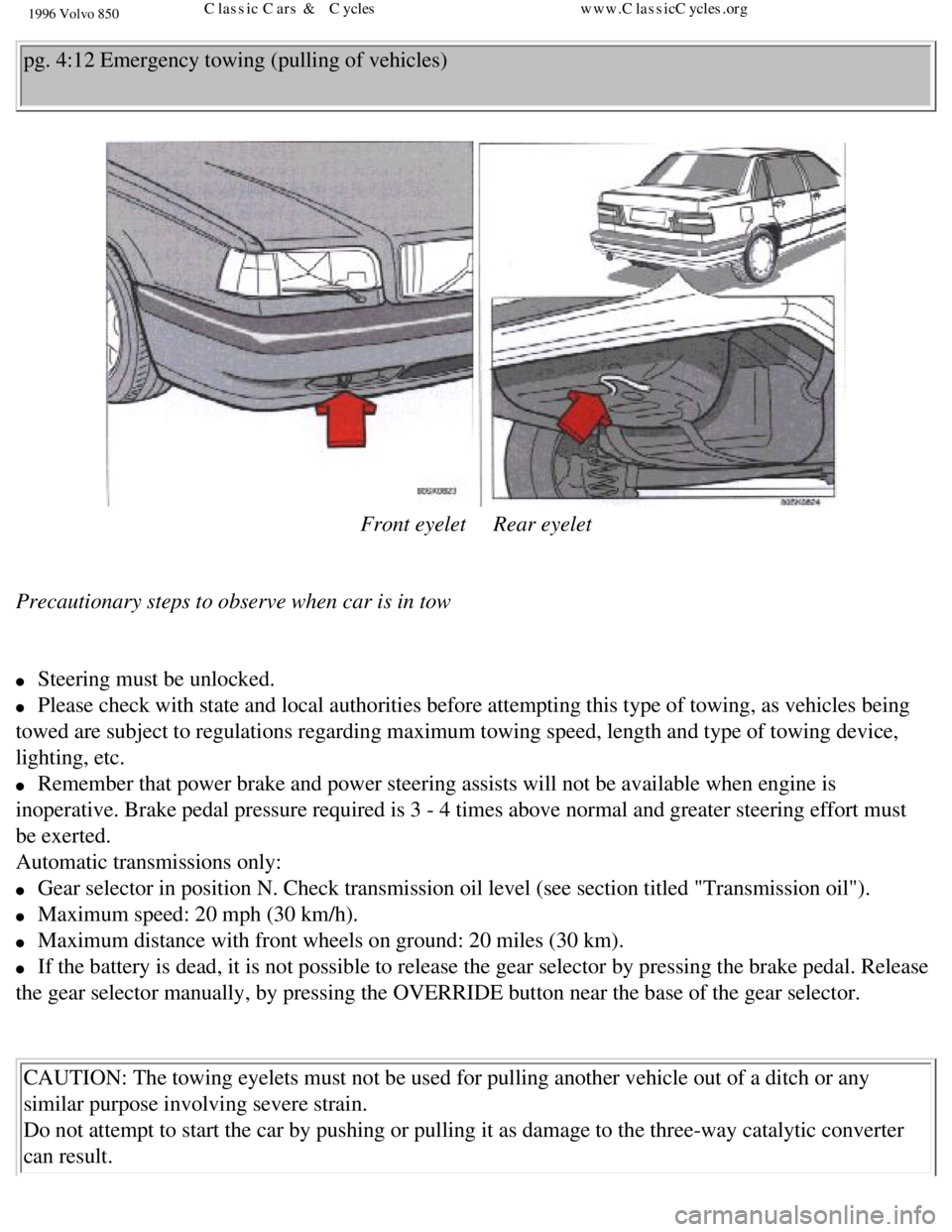
pg. 4:12 Emergency towing (pulling of vehicles)
Front eyelet Rear eyelet
Precautionary steps to observe when car is in tow
l Steering must be unlocked.
l Please check with state and local authorities before attempting this typ\
e of towing, as vehicles being
towed are subject to regulations regarding maximum towing speed, length \
and type of towing device,
lighting, etc.
l Remember that power brake and power steering assists will not be availab\
le when engine is
inoperative. Brake pedal pressure required is 3 - 4 times above normal a\
nd greater steering effort must
be exerted.
Automatic transmissions only:
l Gear selector in position N. Check transmission oil level (see section \
titled "Transmission oil").
l Maximum speed: 20 mph (30 km/h).
l Maximum distance with front wheels on ground: 20 miles (30 km).
l If the battery is dead, it is not possible to release the gear selector \
by pressing the brake pedal. Release
the gear selector manually, by pressing the OVERRIDE button near the bas\
e of the gear selector.
CAUTION: The towing eyelets must not be used for pulling another vehicle\
out of a ditch or any
similar purpose involving severe strain.
Do not attempt to start the car by pushing or pulling it as damage to th\
e three-way catalytic converter
can result.
file:///K|/ownersdocs/1996/1996_850/96850_412.htm (1 of 10)12/30/2006 \
9:59:35 AMClassic Cars & Cycles www.ClassicCycles.org
Page 181 of 265

1996 Volvo 850
can cause three-way catalytic converter or exhaust system overheating.
l Remember that tampering or unauthorized modification to the engine or th\
e vehicle may be illegal
and can cause three-way catalytic converter or exhaust system overheatin\
g. This includes:
- Altering fuel injection settings or components.
- Adjusting distributor ignition timing beyond specified limits.
- Altering emission system components or location or removing components\
- Repeated use of leaded fuel.
NOTE: Unleaded fuel is required for cars with three-way catalytic conver\
ters. A label on the instrument
panel and inside fuel tank filler door will remind owners and filling st\
ation attendants of this
requirement.
Important! It is unlawful to dispense leaded fuel into any vehicle label\
ed "unleaded gasoline only".
pg. 4:16 Brake system
Anti-lock Brake System (ABS)
If the warning lamp lights up there is a malfunction of the ABS system (\
the standard braking system will
however function) and the vehicle should be driven to a Volvo retailer \
for inspection. The Anti-lock
Braking System (ABS) helps to improve vehicle control (stopping and s\
teering) during severe braking
conditions by limiting brake lock-up. When the system "senses" impending\
lock-up, braking pressure is
automatically modulated in order to help prevent lockup, which could lea\
d to a skid.
The system performs a self-diagnostic test when the vehicle first reache\
s a speed of approximately 12
mph (20 km/h). The brake pedal will pulsate several times and a sound \
may be audible from the ABS
control module. This is normal.
To obtain optimal effect from the ABS system, constant pressure should b\
e kept on the brake pedal
while the system is modulating the brakes. Do not pump the brake pedal. \
The switching of the ABS modulator will be audible and the brake pedal w\
ill pulsate at this time. Please
be aware that ABS does not increase the absolute braking potential of th\
e vehicle. While control will be
enhanced, ABS will not shorten stopping distances on slippery surfaces. \
file:///K|/ownersdocs/1996/1996_850/96850_412.htm (5 of 10)12/30/2006 \
9:59:35 AMClassic Cars & Cycles www.ClassicCycles.org
Page 182 of 265

1996 Volvo 850
Brake circuit malfunction
If one of the brake circuits should malfunction, the red warning light w\
ill come on, the pedal stroke
increases slightly, the pedal feels softer and extra pressure is require\
d for normal braking. If the light
comes on while driving or braking, stop immediately and check the brake \
fluid level in the reservoir.
WARNING! If the fluid level is below the MIN mark in either section of t\
he reservoir: DO NOT
DRIVE. Tow the car to a Volvo retailer and have the brake system checked\
and repaired.
Moisture on brake discs and brake pads affects braking.
Driving in rain and slush or passing through an automatic car wash can c\
ause water to collect on the
brake discs and pads. This will cause a delay in braking effect when the\
pedal is depressed. To avoid
such a delay when the brakes are needed, depress the pedal occasionally \
when driving through rain,
slush etc. This will remove the water from the brakes. Check that brake \
application feels normal! This
should also be done after washing or starting in very damp weather.
Severe strain on the brake system
The brakes will be subject to severe strain when driving in mountains or\
hilly areas or towing. The speed
is usually low which means that the cooling of the brakes is less effici\
ent than when driving on level
roads. To reduce the strain on the brakes it is advisable not to use the\
brakes excessively. Instead, shift
into a lower gear, position 3 or in some cases, L(automatic transmissio\
n) and let the engine help with the
braking. Do not forget that, if you are towing a trailer, the brakes wil\
l be subjected to greater load than is
normal.
If the brake power-assist does function
The power assist to the brakes functions only when the engine is running\
. When the car is moving
without the engine running, the brake pedal pressure required to stop th\
e car is increased by 3-4 times
and the brake pedal feels stiff.
file:///K|/ownersdocs/1996/1996_850/96850_412.htm (6 of 10)12/30/2006 \
9:59:35 AMClassic Cars & Cycles www.ClassicCycles.org