warning VOLVO 850 1996 Repair Manual
[x] Cancel search | Manufacturer: VOLVO, Model Year: 1996, Model line: 850, Model: VOLVO 850 1996Pages: 265, PDF Size: 4.57 MB
Page 184 of 265

1996 Volvo 850
mountainous areas.
NOTE: Refer to section "Automatic transmission" for additional trailer h\
auling tips.
WARNING!
l Bumper-attached trailer hitches must not be used on Volvos, nor should s\
afety chains be attached to
the bumper.
l Trailer hitches attaching to the vehicle rear axle must not be used.
l Never connect a trailer's hydraulic brake system directly to the vehicle\
brake system, nor a trailer's
lighting system directly to the vehicle lighting system. Consult your ne\
arest authorized Volvo retailer
for correct installation.
pg. 4:18 Winter driving
Cold weather precautions
l If you wish to check your car before the approach of cold weather, the f\
ollowing advice is worth
noting:
l Make sure that the engine coolant contains at least 50 percent antifreez\
e: that is, 3.7 qts. (3.5 liters)
Volvo Genuine Coolant/Antifreeze. This gives protection against freezing\
down to -31°F (-35°C). See
section "Coolant". The use of "recycled" antifreeze is not approved by V\
olvo. Different types of
antifreeze may not be mixed.
l Try to keep the fuel tank well filled - this prevents the formation of c\
ondensation in the tank. In
addition in extremely cold weather conditions it is worthwhile to add fu\
el line de-icer before refueling.
l The viscosity of the engine oil is important. Oil with low viscosity (t\
hinner oil) improves cold-
weather starting as well as decreasing fuel consumption while the engine\
is warming up. For winter use,
5W-30 oil, particularly the synthetic type, is recommended. Be sure to u\
se good quality oil but do not
use this cold-weather oil for hard driving or in warm weather. See secti\
on "Engine oil" for more
information.
l The load placed on the battery is greater during the winter since the he\
ater, windshield wipers,
lighting etc. are used more often. Moreover, the capacity of the battery\
decreases as the temperature
drops. In very cold weather, a poorly charged battery can freeze and be \
damaged. It is therefore
advisable to check the state of charge more frequently and spray an anti\
-rust oil on the battery posts.
l Volvo recommends the use of snow tires on all four wheels for winter dri\
ving - see section "Wheels
and tires".
l To prevent the washer reservoir from freezing, add washer solvents conta\
ining antifreeze (see page
file:///K|/ownersdocs/1996/1996_850/96850_412.htm (8 of 10)12/30/2006 \
9:59:35 AMClassic Cars & Cycles www.ClassicCycles.org
Page 186 of 265
, and replace those th\
at are worn. Check tire pr")
1996 Volvo 850
l Check condition of drive belts.
l Check state of charge of battery.
l Examine tires carefully (the spare tire as well), and replace those th\
at are worn. Check tire pressures.
l The brakes, front wheel alignment, and steering gear should be checked b\
y your Volvo retailer only.
l Check all lights, including high beams.
l Reflective warning triangles are legal requirement in some countries.
l Have a word with your Volvo retailer concerning engine adjustments if yo\
u intend to drive in
countries where it may be difficult to obtain correct fuel.
l Consider your destination. If you will be driving through an area where \
snow or ice are likely to
occur, consider snow tires.
Contents | Top of Page
file:///K|/ownersdocs/1996/1996_850/96850_412.htm (10 of 10)12/30/2006\
9:59:35 AMClassic Cars & Cycles www.ClassicCycles.org
Page 195 of 265
. Th\
e cars weight must not rest
on the jacks attachment (B).
l Be sure the jack is on a fir")
1996 Volvo 850
WARNING!
l The jack attachment must engage the bar in the jack attachment (A). Th\
e car's weight must not rest
on the jack's attachment (B).
l Be sure the jack is on a firm, level, non-slippery surface.
l Never allow any part of your body to be extended under a car supported b\
y a jack.
l Use the jack intended for the car when replacing a wheel. For any other \
job, use stands to support
the end of the car being worked on.
l Apply the parking brake, select position P (automatic transmission) or\
Reverse gear (manual
transmission).
l Block the wheels standing on the ground. Use rigid wooden blocks or larg\
e stones.
l The jack should be kept well-greased.
Installing the wheel
Clean the contact surfaces on the wheel and hub. Lift the wheel and plac\
e it on the hub. Make sure that
you align the wheel with the guide stud on the wheel hub prior to instal\
lation. Install the wheel bolts
cross-wise (see illustration) and tighten by turning lightly clockwise\
. Lower the vehicle to the ground
and alternately tighten the bolts to 81 ft. lbs. (110 NM). Install the\
wheel cap (where applicable).
CAUTION: Correct tightening torque on wheel bolts must be observed. The \
wheel bolts should never
be greased or lubricated. The extended, chromed wheel bolts must not be \
used with steel rims, as they
make is impossible to fit the hub caps.
Correct tightening order for wheel bolts
pg. 6:4 Spare tire
file:///K|/ownersdocs/1996/1996_850/96850_601.htm (4 of 5)12/30/2006 9\
:59:39 AMClassic Cars & Cycles www.ClassicCycles.org
Page 196 of 265

1996 Volvo 850
WARNING!
Current legislation prohibits the use of the "Temporary Spare" tire othe\
r than as a temporary
replacement for a punctured tire. In other words, it must be replaced as\
soon as possible by a standard
tire. Roadholding, etc.., may be affected with the "Temporary Spare" in \
use. Do not, therefore, exceed
50 mph (80 km/h).
Temporary Spare (certain models)
The spare tire of your car is what is called a "Temporary Spare". It has\
the following designation:
T115/70 R15 or T125/90R15.
Recommended tire pressure (see decal on fuel filler flap) should be ma\
intained irrespective of which
position of the car the Temporary Spare tire is used on.
In the event of damage to this tire a new one can be purchased from your\
Volvo retailer.
Contents | Top of Page
file:///K|/ownersdocs/1996/1996_850/96850_601.htm (5 of 5)12/30/2006 9\
:59:39 AMClassic Cars & Cycles www.ClassicCycles.org
Page 197 of 265

1996 Volvo 850
pg. 6:5 Replacing bulbs
Replacing bulbs
Make sure when installing bulbs, that the guide pin on the socket fits i\
nto its corresponding recess.
When installing Halogen bulbs, do not touch the glass with your fingers \
because grease, oil or any other
impurities can be carbonized onto the bulb and damage the reflector. Use\
bulbs of correct type and
voltage. Failure to do so could cause the bulb failure warning light to \
activate.
NOTE: Turn the ignition and the light switch off before replacing any bu\
lbs.
Parking light/direction indicator
1. Loosen the spring which retains the lamp housing.
2. Withdraw the entire lamp housing; separate the bulb holder from the l\
amp unit.
3. Leave the connector with its wires in the bulb holder.
4. Remove the bulb from the holder by pressing in and turning counter-cl\
ockwise.
5. Insert a new bulb and reinstall the unit in the reverse order. pg. 6:6 Replacing bulbs
file:///K|/ownersdocs/1996/1996_850/96850_605.htm (1 of 13)12/30/2006 \
9:59:43 AMClassic Cars & Cycles www.ClassicCycles.org
Page 207 of 265
1996 Volvo 850
pg. 6:12 Replacing bulbs
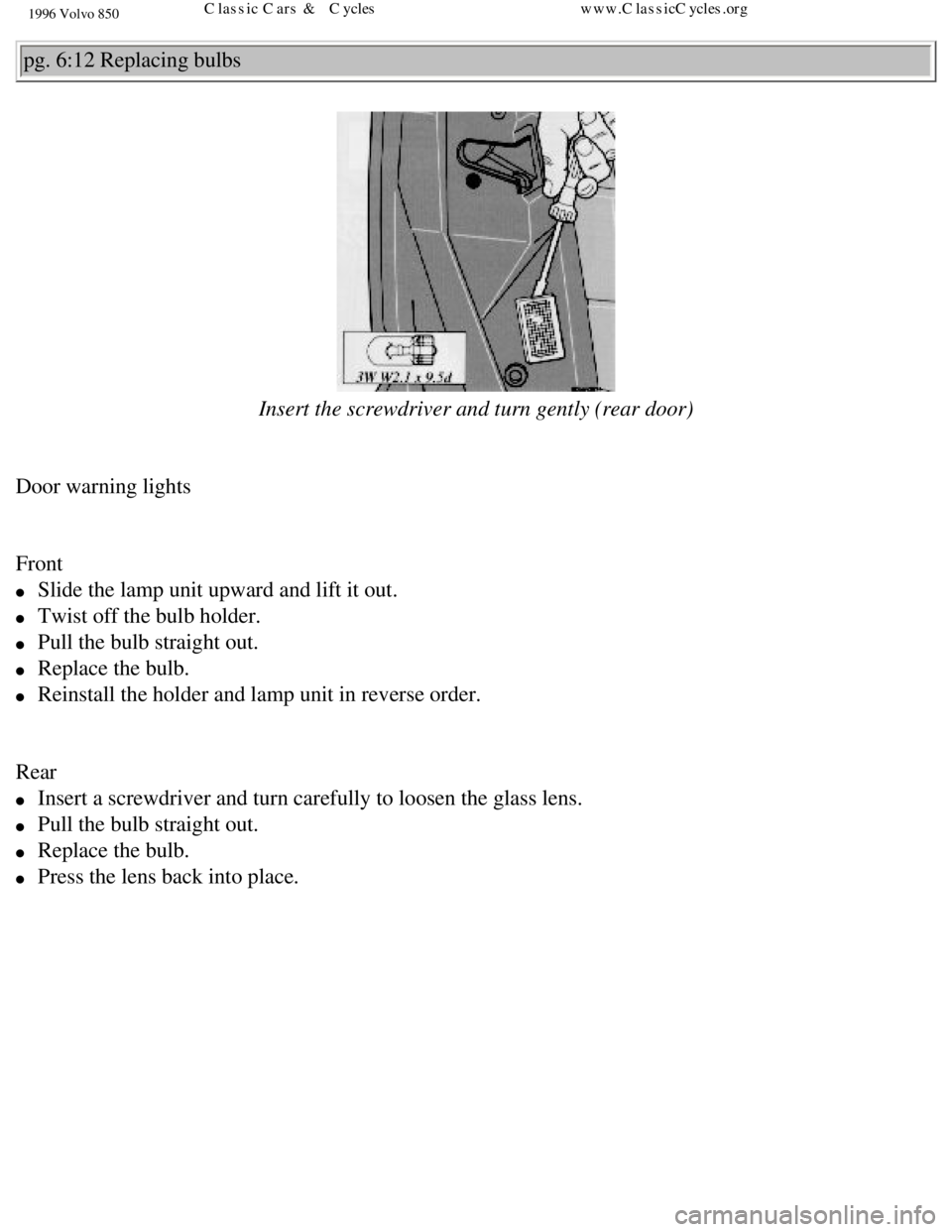
Insert the screwdriver and turn gently (rear door)
Door warning lights
Front
l Slide the lamp unit upward and lift it out.
l Twist off the bulb holder.
l Pull the bulb straight out.
l Replace the bulb.
l Reinstall the holder and lamp unit in reverse order.
Rear
l Insert a screwdriver and turn carefully to loosen the glass lens.
l Pull the bulb straight out.
l Replace the bulb.
l Press the lens back into place.
file:///K|/ownersdocs/1996/1996_850/96850_605.htm (11 of 13)12/30/2006\
9:59:43 AMClassic Cars & Cycles www.ClassicCycles.org
Page 211 of 265
. Spare fuses are stored in a compartmen\
t in the")
1996 Volvo 850
examine the curved metal wire to see if it is broken. If so, put in a ne\
w fuse of the same color and
amperage (written on the fuse). Spare fuses are stored in a compartmen\
t in the fuse box.
If fuses burn out repeatedly, have the electrical system tested at a Vol\
vo retailer.
If you find it difficult to remove a fuse, you will find a special fuse \
tool clipped in the fuse box. pg. 6:14 Fuses
Location * Amperage
1 Fuel injection, distributor ignition system, automatic gearbox 15A
2 Fuel pump 15A
3 Interior courtesy lights 10A
4 –
5 ECC blower (speed 4) 30A
6 Central locking system 25A
7 Audio system 15A
8 –
9 ABS 30A
10 Electrically heated rear seat 15A
11 Electrically heated rear window and side-door mirrors 30A
12 Brake lights 10A
13 Hazard warning flashers, headlight flashers 15A
14 ABS 30A
15 OBD socket, courtesy lights, open door warning lights,
remote operated central locking system 10A
16 Power antenna, electrical connector for trailer, accessories 30A
17 Key reminder, seat belt reminder 10A
18 Front fog lights 15A
19 Left high beam 15A
20 Right high beam, high beam indicator light 15A
21 Left low beam 15A
22 Right low beam 15A
23 Left parking lights, license plate lights 10A
24 Right parking lights 10A
25 Rear fog light, rear fog light indicator light 10A
26 Heated front/rear seats, power side-view mirrors 25A
27 Backup lights, direction indicators 15A
file:///K|/ownersdocs/1996/1996_850/96850_613.htm (2 of 8)12/30/2006 9\
:59:46 AMClassic Cars & Cycles www.ClassicCycles.org
Page 212 of 265

1996 Volvo 850
28 Cruise control, heated rear windows, seat belt reminder light,
bulb failure warning sensor, shiftlock 10A
29 ABS 15A
30 Cigarette lighter 10A
31 ECC blower (speeds 1-3), ECC, AC-compressor 25A
32 Audio system, remote controlled central locking 10A
Location * Amperage
33 Rear window wiper/washer (wagons) 15A
34 Windshield/headlight wipers/washers, horn 25A
35 Instrument panel lights, power sun roof 10A
36 –
37 Power windows, power sun roof AUT/CB **
38 –
39 Power seat (driver's side) AUT/CB **
40 Power seat (passenger's side) AUT/CB **
* Some of the equipment/systems listed may be available on certain model\
s only.
** This is an automatic circuit breaker located in the fuse box and does\
not normally need to be
replaced.
For more detailed information concerning function and location of relays\
, fuses, etc., refer to the Volvo
Service Manuals. These can be purchased directly using the Service Liter\
ature Brochure/Order Form or
through your Volvo retailer. pg. 6:15 Installation of accessories
file:///K|/ownersdocs/1996/1996_850/96850_613.htm (3 of 8)12/30/2006 9\
:59:46 AMClassic Cars & Cycles www.ClassicCycles.org
Page 222 of 265
.
l In areas of high industrial fallout, more frequent washing is recommende\
d.
CAUTION: During high p")
1996 Volvo 850
l Wash off the dirt from the underside (wheel housings fenders, etc.).
l In areas of high industrial fallout, more frequent washing is recommende\
d.
CAUTION: During high pressure washing the spray mouth piece must never b\
e closer to the vehicle
than 13" (30 cm). Do not spray into the locks.
l When washing or steam cleaning the engine, avoid spraying water or steam\
directly on the electrical
components or toward the rear side of the engine.
l After cleaning the engine, the spark plug wells should be inspected for \
water and blown dry if
necessary.
Suitable detergents
Special car washing detergents or liquid dishwashing detergent can be us\
ed. A suitable mixture is about
2.5 fl. oz. (8.5 cl) of detergent to 2.6 US gal. (10 liters) of warm\
water. After washing with a detergent
the car should be well rinsed with clean water.
Bird droppings
Remove from paintwork as soon as possible. Otherwise the finish may be p\
ermanently damaged.
WARNING!
l When the car is driven immediately after being washed, apply the brake s\
everal times in order to
remove any moisture from the brake linings.
l Engine cleaning agents should not be used when the engine is warm. This \
constitutes a fire risk.
NOTE: When washing the car, remember to remove dirt from the drain holes\
in the doors and sills.
file:///K|/ownersdocs/1996/1996_850/96850_701.htm (5 of 8)12/30/2006 9\
:59:48 AMClassic Cars & Cycles www.ClassicCycles.org
Page 232 of 265

The following precautions must be observed when carrying out repairs to \
the vehicle
WARNING! The distributor ignition system operates at very high volta")
1996 Volvo 850
pg. 8:6 Servicing (cont.)
The following precautions must be observed when carrying out repairs to \
the vehicle
WARNING! The distributor ignition system operates at very high voltages.\
Special safety precautions
must be followed to prevent injury. Always turn the ignition off when:
l Connecting engine test and diagnostic equipment to the vehicle (timing \
light, tach-dwell tester,
ignition oscilloscope, etc.).
l Replacing distributor ignition components e.g. plugs, coil, etc.
l Do not touch any part of the distributor ignition system while the engin\
e is running. This may result
in unintended movements and body injury.
Battery
l Check that the battery cables are correctly connected and properly tight\
ened.
l Never disconnect the battery when the engine is running, for example whe\
n changing the battery.
l The battery should be disconnected when a boost charger is used.
l Switch off the radio before disconnecting the battery. If your radio has\
an anti-theft code and the
battery is disconnected, the radio code has to be re-entered in order fo\
r the radio to function.
Replacing spark plugs
The spark plugs should be changed every 30,000 miles (48,000 km). Howe\
ver, city driving or fast
highway driving may necessitate changing after 15,000 miles (24,000 km)\
of driving. When installing
new plugs, be sure to fit the right type and use correct torque, see "Sp\
ecifications". When changing the
plugs, check that the suppressor connectors are in good condition. Crack\
ed or damaged connectors
should be replaced. When changing the spark plugs, clean the terminals a\
nd the rubber seals.
Hoisting the car
If a garage jack is used to lift the car, the two jack attachments point\
s should be used. They are specially
reinforced to bear the weight of the car. A garage jack can also be plac\
ed under the front of the engine
file:///K|/ownersdocs/1996/1996_850/96850_806.htm (1 of 11)12/30/2006 \
9:59:52 AMClassic Cars & Cycles www.ClassicCycles.org