ABS VOLVO 850 1996 Owners Manual
[x] Cancel search | Manufacturer: VOLVO, Model Year: 1996, Model line: 850, Model: VOLVO 850 1996Pages: 265, PDF Size: 4.57 MB
Page 3 of 265
1996 Volvo 850
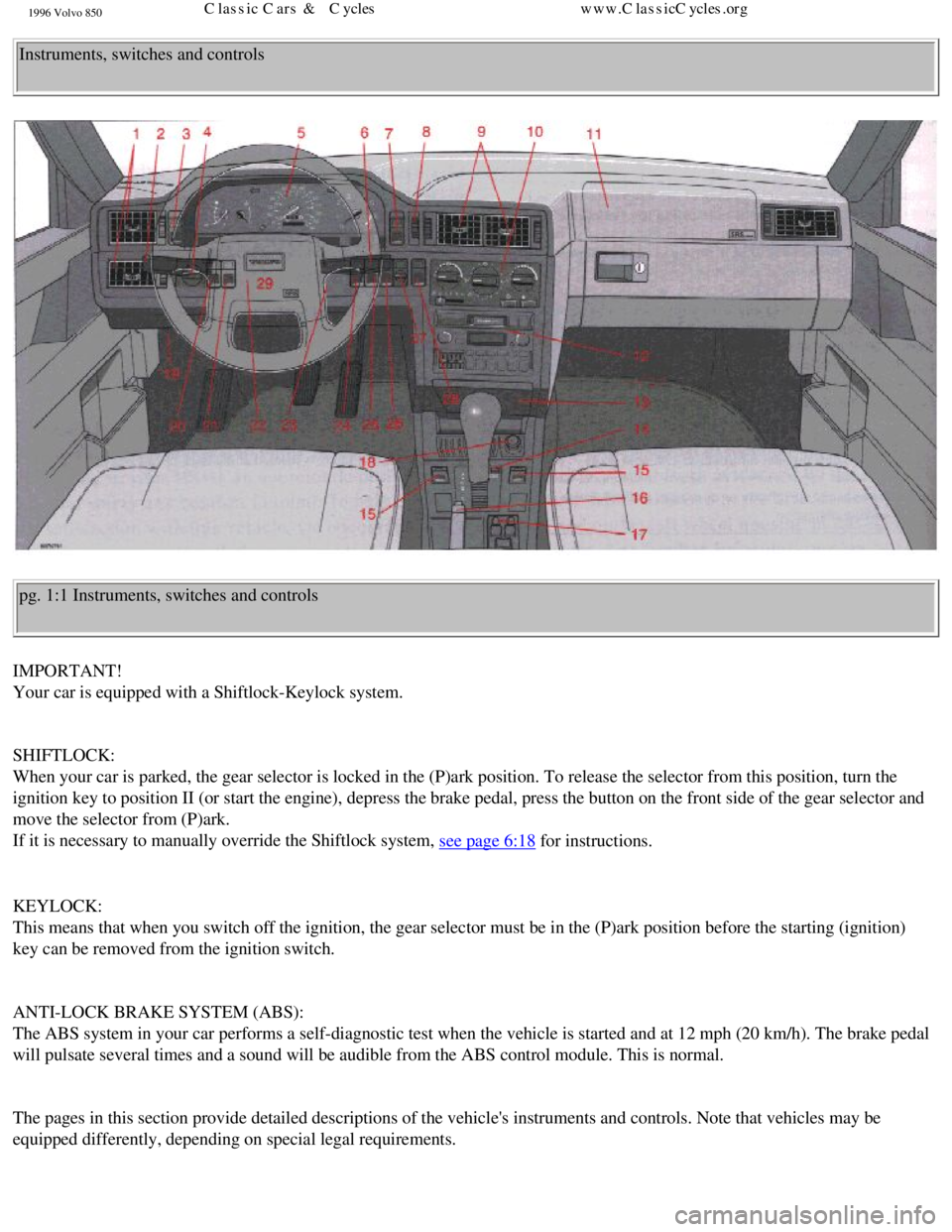
Instruments, switches and controls
pg. 1:1 Instruments, switches and controls
IMPORTANT!
Your car is equipped with a Shiftlock-Keylock system.
SHIFTLOCK:
When your car is parked, the gear selector is locked in the (P)ark pos\
ition. To release the selector from this position, turn the
ignition key to position II (or start the engine), depress the brake p\
edal, press the button on the front side of the gear selector and
move the selector from (P)ark.
If it is necessary to manually override the Shiftlock system,
see page 6:18 for instructions.
KEYLOCK:
This means that when you switch off the ignition, the gear selector must\
be in the (P)ark position before the starting (ignition)
key can be removed from the ignition switch.
ANTI-LOCK BRAKE SYSTEM (ABS):
The ABS system in your car performs a self-diagnostic test when the vehi\
cle is started and at 12 mph (20 km/h). The brake pedal
will pulsate several times and a sound will be audible from the ABS cont\
rol module. This is normal.
The pages in this section provide detailed descriptions of the vehicle's\
instruments and controls. Note that vehicles may be
equipped differently, depending on special legal requirements.
file:///K|/ownersdocs/1996/1996_850/96850_101.htm (1 of 7)12/30/2006 9\
:58:55 AMClassic Cars & Cycles www.ClassicCycles.org
Page 6 of 265

1996 Volvo 850
Used for measuring shorter distances. The last digit indicates 1/10 mile\
/kilometer. A black number on a white background =
original speedometer. A red number on a white background = replacement s\
peedometer.
9 Tachometer
Reads thousands of engine rpm. Engine should not be operated in red rang\
e. The highest permitted constant engine speed is
6,300 rpm (turbo: 6,200 rpm, B 5252 S: 6,000 rpm). pg. 1:3 Indicator and warning lights
1 Turn signal, left
2 Turn signal , right
3 (Not in use)
4 Low washer fluid level
If the lamp glows continuously when the engine is running, there is only\
about 1/2 - 1 US qt. remaining in the washer fluid
reservoir.
5 Low fuel level
When the lamp glows, only about 1.8 US gals. (8 liters) of fuel remain\
6 Rear fog light
7 High beams
8 (Not in use)
9 Bulb failure warning sensor
10 (Not in use)
11 (Not in use)
12 SRS
13 Generator not charging
14 Low engine oil pressure
15 Brake warning light
16 Parking brake applied
17 ABS-system
18 Ambient temperature warning light* (certain models)
(see pp. 1:11 or 1:14 for more information)
19 Transmission mode "W", or gear positions 3 or L engaged (automatic t\
ransmissions)
20 Low coolant level
file:///K|/ownersdocs/1996/1996_850/96850_101.htm (4 of 7)12/30/2006 9\
:58:55 AMClassic Cars & Cycles www.ClassicCycles.org
Page 8 of 265

1996 Volvo 850
Brake fluid warning light
If the light comes on while driving or braking, this indicates that the \
brake fluid level is too low.
Stop immediately, open the hood and check the brake fluid level in the r\
eservoir (see section "Engine compartment" for reservoir
position)!
Canadian models are equipped with this warning light:
WARNING! If the level is below the MIN mark in either section of the res\
ervoir: DO NOT DRIVE. Tow the car to a Volvo
retailer and have the brake system checked and any leakage repaired.
pg. 1:5 Warning lights
If the TRACS (TRaction Control System) is manually disengaged with the\
switch on the dashboard, the warning light will come
on. This will also come on to indicate a TRAC's malfunction, and when th\
e brakes overheat, although it goes out again at the
normal temperature level. If the lamp remains on, the system should be c\
hecked by an authorized Volvo retailer. This lamp
should not be confused with the ON/OFF indicator lamp above the switch. \
See page 1:9 for additional information.
Anti-lock Brake System (ABS)
If the warning lamp lights up there is a malfunction of the ABS system (\
the standard braking system will however function). The
vehicle should be driven to a Volvo retailer for inspection.
See page 4:16 for additional information.
Canadian models are equipped with this warning light:
Coolant level sensor
If the light comes on while driving, the coolant level is low. The coola\
nt level in the expansion tank should be checked
immediately and topped off if necessary. The cooling system should be in\
spected by an authorized Volvo retailer.
Mode "W" engaged
The lamp will light up when the Winter/Wet mode is engaged or if gears "\
3" or "L" are selected.
If the warning lamp begins to flash , this means that there is a fault i\
n the automatic gearbox.
Contact your Volvo retailer.
Supplemental Restraint System (SRS)
If the light comes on (or stays on after the vehicle has started), the\
SRS diagnostic system has detected a fault. Drive to an
file:///K|/ownersdocs/1996/1996_850/96850_101.htm (6 of 7)12/30/2006 9\
:58:55 AMClassic Cars & Cycles www.ClassicCycles.org
Page 16 of 265
 - option
TRACS is a system designed as an aid when starting/driving off if one of\
the drive wheels has poor
traction due to weather conditio")
1996 Volvo 850
A - TRAction Control System (TRACS) - option
TRACS is a system designed as an aid when starting/driving off if one of\
the drive wheels has poor
traction due to weather conditions or the road surface and is connected \
to the ABS control module.
TRACS engages automatically at sppeds below 25 mph (40km/h) when on of\
the drive wheels loses
traction. It disengages automatically when speed exceeds 25 mph (40 km/\
h). The sound which can be
heard when the system is operating comes from the ABS syste.
TRACS can be disengaged manually using the switch on the dashboard. The \
indicator light will come on.
B - Electrically operated sun roof - option
The sun roof can be operated in two ways; as a conventional sliding roof\
or the rear edge can be raised
to provide increased ventilation. See page 2:9 for operating instruction\
s.
NOTE: In case of a sun roof malfunction, see page 6:17.
C - Trip computer - option
Turn the dial to the desired function. For more information, see pages 1\
:12-14.
D - Hazard warning flashers
file:///K|/ownersdocs/1996/1996_850/96850_106.htm (7 of 9)12/30/2006 9\
:58:57 AMClassic Cars & Cycles www.ClassicCycles.org
Page 93 of 265

1996 Volvo 850
pg. 1:66 Audio systems, general information
CD remote changer
The CD changer, which is available separately, is loaded with a cartridg\
e containing 6 discs. Extra
cartridges are available at your Volvo retailer.
Insert the discs into the cartridge, label (A) up.
Insert the cartridge and close the cover.
Eject the cartridge by pressing the eject button (B).
Remove the discs by depressing the lock tabs (C).
Operating tips :
l Before using a new disk for the first time, remove any burrs in the cent\
er/outer edge by running the
stem of a pen or similar object around the hole/edge of the disc.
l Use high quality discs only.
l Keep the discs clean. Wipe them with a soft, clean, lint-free cloth, wor\
king from the center outwards.
If necessary, dampen the cloth with a neutral soap solution. Dry thoroug\
hly before using.
l Never use cleaning spray or anti-static liquid. Use only cleaners specif\
ically made for CD's.
l Use discs of the correct size only (3.5" discs should never be used). \
l Do not put tape or labels on the disc itself.
l Volvo does not recommend the use of plastic outer rings on the disc.
l Condensation may occur on discs/optical components of the changer in col\
d winter weather. The disc
file:///K|/ownersdocs/1996/1996_850/96850_166.htm (1 of 7)12/30/2006 9\
:59:19 AMClassic Cars & Cycles www.ClassicCycles.org
Page 157 of 265

1996 Volvo 850
cleaning. Check seat belt mechanism function as follows:
Attach the seat belt and pull rapidly on the strap.
WARNING! Check other traffic before performing the following
check.
Brake firmly from approximately 30 mph (50 km/h) or turn in a tight ci\
rcle while pulling on the belt. In the above checks you should
not be able to pull the belt out.
Volvo Concern for Safety
Safety is the cornerstone for Volvo. Our concern dates back to 1927 when\
the first Volvo rolled off the production line. Three-point
seat belts, safety cages, and energy-absorbing impact zones were designe\
d into Volvo cars long before it was fashionable or required
by government regulation. We will not compromise our commitment to safet\
y. We continue to seek out new safety features and to
refine those already in our cars. You can help. We would appreciate hear\
ing your suggestions about improving automobile safety.
We also want to know if you ever have a safety concern with your car. Ca\
ll us in the U.S. at:
800-458-1552 or in Canada at: 800-663-8255.
Occupant safety
How safely you drive doesn't depend on how old you are but rather on:
l how well you see
l your ability to concentrate
l how quickly you make decisions under stress to avoid an accident.
The tips listed below are suggestions to help you cope with the ever cha\
nging traffic environment.
l Never drink and drive.
l If you are taking any medication, consult your physician about its poten\
tial effects on your driving abilities.
l Take a driver-retraining course
l Have your eyes checked regularly
l Keep your windshield and headlamps clean.
l Replace wiper blades when they start to leave streaks.
l Take into account the traffic, road, and water conditions, particularly \
with regard to stopping distance.
Reporting Safety Defects in the U.S.
If you believe that your vehicle has a defect which could cause a crash \
or could cause injury or death, you should immediately
inform the National Highway Traffic Safety Administration (NHTSA) in a\
ddition to notifying Volvo Cars of North America. If
NHTSA receives similar complaints, it may open an investigation, and if \
it finds that a safety defect exists in a group of vehicles, it
may order a recall and remedy campaign. However, NHTSA cannot become inv\
olved in individual problems between you, your
retailer, or Volvo Cars of North America. To contact NHTSA, you may eith\
er call the Auto Safety Hotline toll-free at 1-800-424-
9393 (or 366-0123 in Washington, D.C. area) or write to: NHSTA, U.S. D\
epartment of Transportation, Washington D.C. 20590.
You can also obtain other information about motor vehicle safety from th\
e Hotline.
file:///K|/ownersdocs/1996/1996_850/96850_309.htm (6 of 7)12/30/2006 9\
:59:30 AMClassic Cars & Cycles www.ClassicCycles.org
Page 159 of 265

1996 Volvo 850
Starting and driving
pg. 4:1 Starting and driving
Starting and driving
This section on starting and driving contains items such as starting the\
engine, operating gear selector,
towing, trailers.
4:2 Break-in period
4:3Fuel requirements, Octane rating
4:4Driving economy
4:5Starting the engine
4:6Manual transmission
4:7Automatic Transmission
4:10Points to remember
4:12Emergency towing
4:13Vehicle Towing Information
4:14Starting with an auxiliary battery (jump starting)
4:15Three-way catalytic converter
4:16Brake system, ABS
4:17Trailer towing
4:18Winter driving
4:19Long distance trips, City driving
pg. 4:2 Break-in period, Fuel requirements
A new car should be broken-in!
Refrain from utilizing your car's full driving potential during the firs\
t 1,200 miles (2,000 km) including
the "kick-down" function (automatic transmission).
file:///K|/ownersdocs/1996/1996_850/96850_401.htm (1 of 8)12/30/2006 9\
:59:32 AMClassic Cars & Cycles www.ClassicCycles.org
Page 178 of 265

1996 Volvo 850
pg. 4:13 Vehicle towing information
Only use flat bed equipment.
CAUTION:
l Sling-type equipment applied at the front will damage radiator and air c\
onditioning lines.
l It is equally important not to use sling-type equipment inside the rear \
wheels: serious damage to the
rear axle may result.
The car should be towed with the rear wheels on the ground, if at all po\
ssible. If it is absolutely
necessary to tow the vehicle with the front wheels on the ground, please\
refer to the towing information
on the previous page.
* If wheel lift equipment must be used, please use extreme caution to he\
lp avoid damage to the car.
WARNING!
Do not use the towing eyelets on the car to pull the car up onto a flat \
bed tow
truck.
pg. 4:14 Jump starting
file:///K|/ownersdocs/1996/1996_850/96850_412.htm (2 of 10)12/30/2006 \
9:59:35 AMClassic Cars & Cycles www.ClassicCycles.org
Page 181 of 265

1996 Volvo 850
can cause three-way catalytic converter or exhaust system overheating.
l Remember that tampering or unauthorized modification to the engine or th\
e vehicle may be illegal
and can cause three-way catalytic converter or exhaust system overheatin\
g. This includes:
- Altering fuel injection settings or components.
- Adjusting distributor ignition timing beyond specified limits.
- Altering emission system components or location or removing components\
- Repeated use of leaded fuel.
NOTE: Unleaded fuel is required for cars with three-way catalytic conver\
ters. A label on the instrument
panel and inside fuel tank filler door will remind owners and filling st\
ation attendants of this
requirement.
Important! It is unlawful to dispense leaded fuel into any vehicle label\
ed "unleaded gasoline only".
pg. 4:16 Brake system
Anti-lock Brake System (ABS)
If the warning lamp lights up there is a malfunction of the ABS system (\
the standard braking system will
however function) and the vehicle should be driven to a Volvo retailer \
for inspection. The Anti-lock
Braking System (ABS) helps to improve vehicle control (stopping and s\
teering) during severe braking
conditions by limiting brake lock-up. When the system "senses" impending\
lock-up, braking pressure is
automatically modulated in order to help prevent lockup, which could lea\
d to a skid.
The system performs a self-diagnostic test when the vehicle first reache\
s a speed of approximately 12
mph (20 km/h). The brake pedal will pulsate several times and a sound \
may be audible from the ABS
control module. This is normal.
To obtain optimal effect from the ABS system, constant pressure should b\
e kept on the brake pedal
while the system is modulating the brakes. Do not pump the brake pedal. \
The switching of the ABS modulator will be audible and the brake pedal w\
ill pulsate at this time. Please
be aware that ABS does not increase the absolute braking potential of th\
e vehicle. While control will be
enhanced, ABS will not shorten stopping distances on slippery surfaces. \
file:///K|/ownersdocs/1996/1996_850/96850_412.htm (5 of 10)12/30/2006 \
9:59:35 AMClassic Cars & Cycles www.ClassicCycles.org
Page 183 of 265

1996 Volvo 850
pg. 4:17 Trailer towing
When preparing for trailer towing, observe the following:
l Volvo recommends the use of Volvo trailer hitches which are specially de\
signed for the car. For
trailer weights exceeding 2000 lbs. (908 kg), use only a trailer hitch\
offered as a Genuine Volvo
accessory.
NOTE: Models with automatic transmission are equipped with a transmissio\
n oil cooler as standard
equipment. This cooler helps prevent overheating of the transmission dur\
ing times of increased load, as
when towing a trailer.
l Maximum trailer weight recommended by Volvo is:
Trailers without brakes : 1100 lbs (500kg)
Trailers with brakes: 2" (50 mm) ball - 3300 lbs (1500 kg), 1 7/8" (\
47 mm) ball - 2000 lbs (908 kg).
Observe the legal requirements of the state/province in which the vehicl\
es are registered. All Volvo
models are equipped with energy-absorbing shock-mounted bumpers. Trailer\
hitch installation should
not interfere with the proper operation of this bumper system.
Trailer towing does not normally present any particular problems, but ta\
ke into consideration:
l Increase tire pressure to recommended full. See section "Wheels and tire\
s".
l Recommended hitch tongue load is 110 (50 kgs) for trailer weights belo\
w 2,650 lbs (1,200 kgs) and
165 lbs (75 kgs) for trailer weights above 2,650 lbs (1,200 kgs). Fo\
r trailer weights between 2,650-3,300
lbs (1,200-1,500 kgs) a top speed of 50 mph (80 km/h) should never b\
e exceeded.
l Engine and transmission are subject to increased loads. Therefore, engin\
e coolant temperature should
be closely watched when driving in hot climates or hilly terrain. Use lo\
wer gear and turn off air
conditioner if temperature gauge pointer enters the red range.
l Avoid overload and other abusive operation.
l Hauling a trailer affects handling, durability, and economy.
l It is necessary to balance trailer brakes with the towing vehicle brakes\
to provide a safe stop (check
and observe State/Local regulations).
l Do not connect the trailer's brake system directly to the vehicle's brak\
e system.
l More frequent vehicle maintenance is required.
l Remove the ball and drawbar assembly when the hitch is not being used.
l Volvo recommends the use of synthetic engine oil when towing a trailer o\
ver long distances or in
file:///K|/ownersdocs/1996/1996_850/96850_412.htm (7 of 10)12/30/2006 \
9:59:35 AMClassic Cars & Cycles www.ClassicCycles.org