AUX VOLVO 850 1996 Owners Manual
[x] Cancel search | Manufacturer: VOLVO, Model Year: 1996, Model line: 850, Model: VOLVO 850 1996Pages: 265, PDF Size: 4.57 MB
Page 135 of 265
 to which straps can be
attached to secure luggage.
Eyelets inside car (sedans/wagons)
WARNI")
1996 Volvo 850
As a safety precaution, your car is equipped with four eyelets (six on \
wagons) to which straps can be
attached to secure luggage.
Eyelets inside car (sedans/wagons)
WARNING! The eyelets are not to be used as passenger restraints or as an\
chorages for child restraints.
See page 3:9.
Station wagons only:
Unless the station wagon is equipped with Volvo's auxiliary seat for chi\
ldren (option) passengers
should not ride in the rear cargo area.
Station wagons only:
If the optional auxiliary seat for children is in use, fold this seat do\
wn before folding down the rear seat
backrest.
file:///K|/ownersdocs/1996/1996_850/96850_218.htm (5 of 7)12/30/2006 9\
:59:25 AMClassic Cars & Cycles www.ClassicCycles.org
Page 154 of 265
1996 Volvo 850
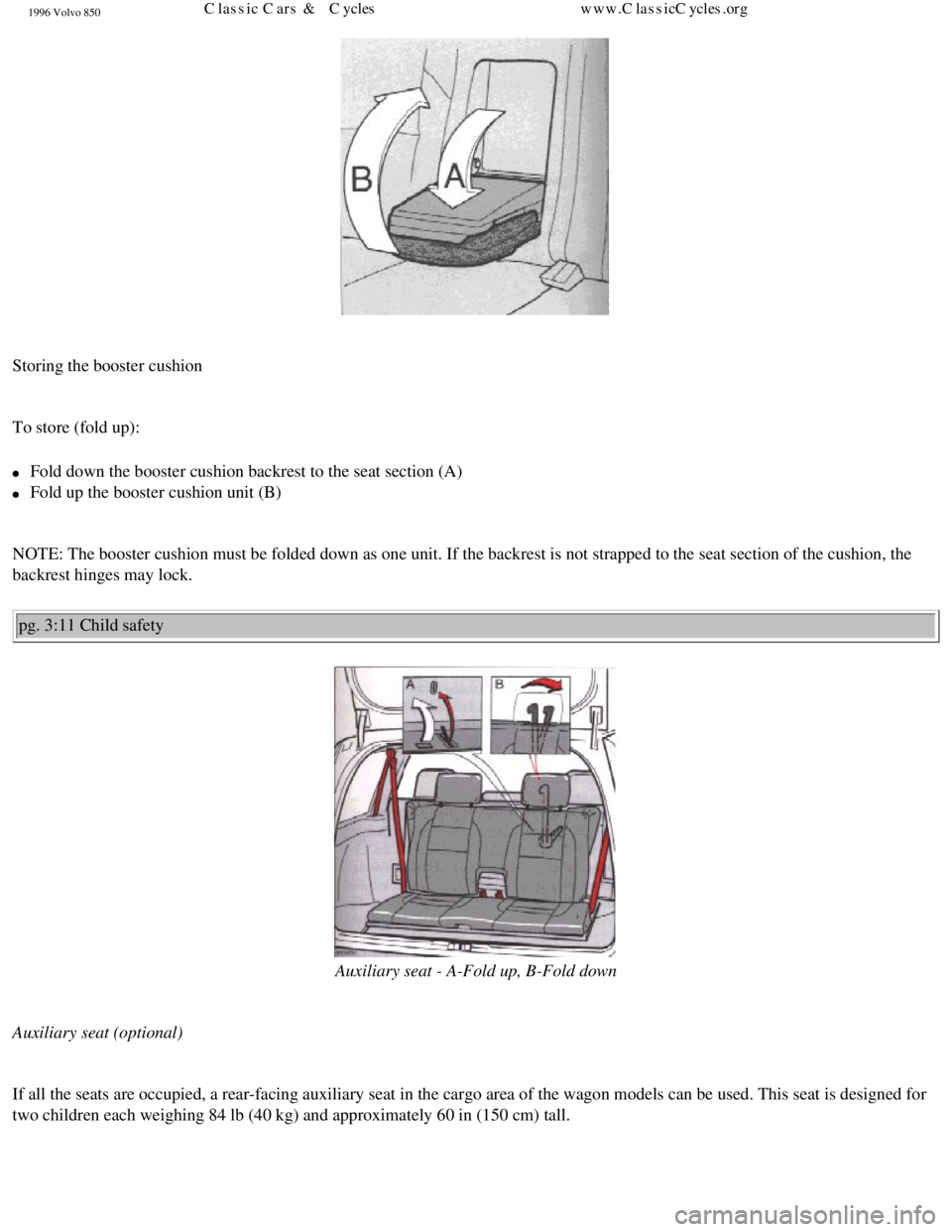
Storing the booster cushion
To store (fold up):
l Fold down the booster cushion backrest to the seat section (A)
l Fold up the booster cushion unit (B)
NOTE: The booster cushion must be folded down as one unit. If the backre\
st is not strapped to the seat section of the cushion, the
backrest hinges may lock.
pg. 3:11 Child safety
Auxiliary seat - A-Fold up, B-Fold down
Auxiliary seat (optional)
If all the seats are occupied, a rear-facing auxiliary seat in the cargo\
area of the wagon models can be used. This seat is designed for
two children each weighing 84 lb (40 kg) and approximately 60 in (150\
cm) tall.
file:///K|/ownersdocs/1996/1996_850/96850_309.htm (3 of 7)12/30/2006 9\
:59:30 AMClassic Cars & Cycles www.ClassicCycles.org
Page 155 of 265

1996 Volvo 850
WARNING! Both rear seat backrests must be up when the auxiliary seat is \
being
used.
Do not use a booster cushion or child seat in conjunction with the auxil\
iary seat.
Spool-out
To make child seat installation easier, each seat buckle (except for th\
e driver's belt) is equipped with a locking mechanism to help
keep the lap section of the seat belt taut.
When attaching the seat belt to a child seat:
l Make sure the red lock button is moved to the right (see illustration A\
). A coin, etc. can be used to move the button.
l Attach the seat belt to the child seat according the child seat manufact\
urer's instructions.
l Pull the lap section of the seat belt taut.
The lap section of the seat belt cannot be loosened as long as the red l\
ock button is in the right position.
The lap section of the seat belt can be adjusted when the lock button is\
in the left position (see illustration B).
NOTE: Before exiting the car, check that the seat belt retracts fully af\
ter being unbuckled. If necessary, guide the belt back into the
retractor slot. When not in use, the child restraint should be secured w\
ith the seat belt to help prevent movement during a sudden
stop.
WARNING! Do not use child safety seats or child booster cushions/backres\
ts in the front passenger's seat. We also recommend
that children who have outgrown these devices sit in the rear seat with \
the seat belt properly fastened.
pg. 3:12 Child safety
Child safety
Volvo recommends the proper use of restraint systems for all occupants i\
ncluding children. Remember that, regardless of age and
file:///K|/ownersdocs/1996/1996_850/96850_309.htm (4 of 7)12/30/2006 9\
:59:30 AMClassic Cars & Cycles www.ClassicCycles.org
Page 156 of 265

1996 Volvo 850
size, a child should always be properly restrained in a car.
Restraint systems for children are designed to be secured in the vehicle\
by lap belts or the lap portion of a lap-shoulder belt. Such
child restraint systems can help protect children in cars in the event o\
f an accident only if they are used properly. However, children
could be endangered in a crash if the child restraints are not properly \
secured in the vehicle. Failure to follow the installation
instructions for your child restraint can result in your child striking \
the vehicle's interior in a sudden stop.
Holding a child in your arms is NOT a suitable substitute for a child re\
straint system. In an accident, a child held in a person's arms
can be crushed between the vehicle's interior and an unrestrained person\
. The child could also be injured by striking the interior, or
by being ejected from the vehicle during a sudden maneuver or impact. Th\
e same can also happen if the infant or child rides
unrestrained on the seat. Other occupants should also be properly restra\
ined to help reduce the chance of injuries or increasing the
injury of a child.
All states and provinces have legislation governing how and where childr\
en should be carried in car. Find out the regulations
existing in your state or province. Recent accident statistics have show\
n that children are safer in rear seating positions than front
seating positions when properly restrained. A child restraint system can\
help protect a child in a vehicle. Here's what to look for
when selecting a child restraint system:
l It should have a label certifying that it meets applicable Federal Motor\
Vehicle Safety Standards (FMVSS 213-80) - or in Canada,
CMVSS 213.
l Make sure the child restraint system is approved for the child's height,\
weight and development - the label required by the
standard or regulation, or instructions for infant restraints, typically\
provide this information.
l In using any child restraint system, we urge you to look carefully over \
the instructions that are provided with the restraint. Be sure
you understand them and can use the device properly and safely in this v\
ehicle. A misused child restraint system can result in
increased injuries for both the infant or child and other occupants in t\
he vehicle.
l If your child restraint requires a top tether strap, consult your author\
ized Volvo retailer for top tether anchorage and installation
information.
When a child has outgrown the child safety seat, you should use the rear\
seat with the standard seat belt fastened. The best way to
help protect the child here is to place the child on a cushion (not ava\
ilable in Canada) so that the seat belt is properly located on the
hips (
see page 3:10).
A specially designed and tested booster cushion for children between 22.\
7 - 36 kg (50 - 80 lbs) and 117 - 137 cm (46 - 54") can be
obtained from your Volvo retailer.
If necessary, an auxiliary seat for children is available for use in the\
luggage compartment of station wagon models. This seat is
designed for two children, each weighing between 23 - 40 kg (50 - 88 lb\
s.) and up to 150 cm (59 inches) in height.
WARNING!
l When using the auxiliary seat for children, both sections of the rear se\
at backrest must be secured in the upright
position
l Do not use a booster cushion or child seat in conjunction with the auxil\
iary seat.
pg. 3:13 Occupant safety
Seat belt maintenance
Check periodically that the anchor bolts are secure and that the belts a\
re in good condition. Use water and a mild detergent for
file:///K|/ownersdocs/1996/1996_850/96850_309.htm (5 of 7)12/30/2006 9\
:59:30 AMClassic Cars & Cycles www.ClassicCycles.org
Page 159 of 265

1996 Volvo 850
Starting and driving
pg. 4:1 Starting and driving
Starting and driving
This section on starting and driving contains items such as starting the\
engine, operating gear selector,
towing, trailers.
4:2 Break-in period
4:3Fuel requirements, Octane rating
4:4Driving economy
4:5Starting the engine
4:6Manual transmission
4:7Automatic Transmission
4:10Points to remember
4:12Emergency towing
4:13Vehicle Towing Information
4:14Starting with an auxiliary battery (jump starting)
4:15Three-way catalytic converter
4:16Brake system, ABS
4:17Trailer towing
4:18Winter driving
4:19Long distance trips, City driving
pg. 4:2 Break-in period, Fuel requirements
A new car should be broken-in!
Refrain from utilizing your car's full driving potential during the firs\
t 1,200 miles (2,000 km) including
the "kick-down" function (automatic transmission).
file:///K|/ownersdocs/1996/1996_850/96850_401.htm (1 of 8)12/30/2006 9\
:59:32 AMClassic Cars & Cycles www.ClassicCycles.org
Page 173 of 265

1996 Volvo 850
pg. 4:9 Automatic transmission
Special Tips - automatic transmission
l For driving down steep hills and when driving for prolonged periods at l\
ow speeds, position L should
be selected. Avoid, however, repeated changes since this can cause overh\
eating of the transmission oil.
For driving on long continuous uphill gradients, select position 3.
l See caution on page 4:7.
l Do not hold the car stationary on an incline by using the accelerator pe\
dal. Instead, apply the hand
brake (parking brake). This prevents the transmission oil from becomin\
g overheated.
l When towing a trailer, select shift position 3.
l The (E)conomy mode should be selected when the cruise control is engag\
ed.
l While towing a trailer in hilly terrain, do not drive continuously at en\
gine speeds above 4500 rpm to
help avoid high engine oil temperatures.
pg. 4:10 Points to remember
Cooling system
The risk for engine overheating is greatest, especially in hot weather, \
when:
l towing a trailer up steep inclines for prolonged periods at wide open th\
rottle and low engine rpm.
l stopping the engine suddenly after high speed driving (so-called "after\
-boiling" can occur).
l To avoid overheating, the following rules should be followed:
l Do not drive for prolonged periods at engine speeds above 4500 rpm if yo\
u are towing a trailer in
hilly terrain.
l Reduce speed and downshift when towing a trailer up long, steep inclines\
. The risk of overheating can
be reduced by switching off the air conditioning system for a short time\
.
l Do not let the engine idle unnecessarily for prolonged periods.
l Do not mount auxiliary lamps in front of the grill.
When the risk of overheating is imminent, or in the event of overheating\
, (the temperature gauge goes
repeatedly into, or stays continually in, the red section) the followin\
g precautions should be taken:
l Switch off the air conditioning system.
l Stop the car and put the gear lever into neutral. Do not stop the engine\
!
l Switch the heater to full (maximum) position. Increase the engine spee\
d to approx. 2000 rpm (twice
idling speed) until the temperature begins to drop.
file:///K|/ownersdocs/1996/1996_850/96850_406.htm (7 of 10)12/30/2006 \
9:59:34 AMClassic Cars & Cycles www.ClassicCycles.org
Page 223 of 265

1996 Volvo 850
Bumpers: Wash the bumpers with the same cleaning agent used on the rest \
of the car. Never clean the
bumpers with gasoline or paint thinner. Difficult spots can be removed w\
ith denatured alcohol. To avoid
scratches, do not dry the bumpers with paper. pg. 7:5 Automatic car washing, Polishing and waxing
Automatic washing - simple and quick
An automatic wash is a simple and quick way to clean your car, but it is\
worth remembering that it may
not be as thorough as when you yourself go over the car with sponge and \
water. Keeping the underbody
clean is most important, especially in the winter. Some automatic washer\
s do not have facilities for
washing the underbody.
Before driving into an automatic wash, make sure that the side view mirr\
ors, auxiliary lamps, etc., are
secure, otherwise there is risk of the machine dislodging them. You shou\
ld also lower the antenna
(sedans).
We do NOT recommend washing your car in an automatic wash during the fir\
st six months (because the
paint will not have hardened sufficiently).
Polishing and waxing
Normally, polishing is not required during the first year after delivery\
, however, waxing may be
beneficial.
Before applying polish or wax the car must be washed and dried. Tar spot\
s can be removed with
kerosene or tar remover. Difficult spots may require a fine rubbing comp\
ound.
After polishing use liquid or paste wax.
Several commercially available products contain both polish and wax.
file:///K|/ownersdocs/1996/1996_850/96850_701.htm (6 of 8)12/30/2006 9\
:59:48 AMClassic Cars & Cycles www.ClassicCycles.org